Logarithmic negativity typically equals exact entanglement cost
Pith reviewed 2026-07-03 20:40 UTC · model grok-4.3
The pith
For large random induced mixed states, logarithmic negativity equals the exact entanglement cost under PPT-preserving operations.
A machine-rendered reading of the paper's core claim, the machinery that carries it, and where it could break.
Core claim
For large random induced mixed states the logarithmic negativity, an efficiently computable entanglement measure, generically coincides with the exact entanglement cost under positive-partial-transpose-preserving operations, thereby acquiring a precise operational interpretation. Our results establish logarithmic negativity as an exact characterization of entanglement in generic many-body states and provide a tractable route for quantifying entanglement in complex quantum systems.
What carries the argument
The generic equality between logarithmic negativity and the exact entanglement cost under PPT-preserving operations, for the ensemble of large random induced mixed states.
If this is right
- Logarithmic negativity acquires a precise operational interpretation as the exact entanglement cost.
- It serves as an exact characterization of entanglement in generic many-body states.
- It offers a tractable computational method to quantify entanglement in complex quantum systems.
Where Pith is reading between the lines
- The result suggests that for typical states arising in physical many-body systems, an efficiently computable measure can replace harder operational costs.
- It may be possible to verify the equality numerically on finite but large systems drawn from the induced ensemble to check the asymptotic claim.
- Extensions could examine whether the same generic coincidence appears in other ensembles used to model realistic quantum states.
Load-bearing premise
The states belong to the ensemble of large random induced mixed states and the equality holds generically for that ensemble.
What would settle it
Constructing or identifying even one large random induced mixed state where the numerical value of the logarithmic negativity differs from the exact entanglement cost under PPT operations would falsify the generic equality.
Figures
read the original abstract
Quantum entanglement plays a leading role in modern understanding of physical systems, from quantum phases of matter to quantum gravity. In quantum information theory, one seeks operationally meaningful quantifiers of entanglement, which for large quantum systems are notoriously difficult to evaluate due to the lack of computationally efficient algorithms. In this Letter, we show that for large random induced mixed states the logarithmic negativity, an efficiently computable entanglement measure, generically coincides with the exact entanglement cost under positive-partial-transpose-preserving operations, thereby acquiring a precise operational interpretation. Our results establish logarithmic negativity as an exact characterization of entanglement in generic many-body states and provide a tractable route for quantifying entanglement in complex quantum systems.
Editorial analysis
A structured set of objections, weighed in public.
Referee Report
Summary. The paper claims that for large random induced mixed states, the logarithmic negativity (an efficiently computable entanglement measure) generically coincides with the exact entanglement cost under positive-partial-transpose-preserving operations, thereby acquiring a precise operational interpretation and establishing logarithmic negativity as an exact characterization of entanglement in generic many-body states.
Significance. If the result holds, it would provide a tractable route for quantifying entanglement in complex quantum systems where direct computation of entanglement cost is difficult, and give an operational meaning to logarithmic negativity for the ensemble of large random induced mixed states.
minor comments (1)
- The abstract refers to 'large random induced mixed states' and states that the equality holds 'generically,' but does not specify the precise ensemble definition or the measure of genericity used in the result.
Simulated Author's Rebuttal
We thank the referee for their summary of the manuscript and for recognizing its potential significance. The recommendation is listed as uncertain, but the report contains no specific major comments or points of criticism to address. We stand by the results as presented and would welcome any detailed questions or concerns the referee may have.
Circularity Check
No significant circularity detected
full rationale
The provided abstract and context present a theorem establishing generic equality between logarithmic negativity and PPT entanglement cost on the ensemble of large random induced mixed states. No equations, self-definitions, fitted parameters renamed as predictions, or load-bearing self-citations are exhibited that reduce the claimed result to its inputs by construction. The derivation is described as independent of the target quantity, consistent with a standard mathematical result on random states rather than a tautology or ansatz smuggling. This is the expected non-finding for a paper whose central claim is an external equality on a defined ensemble.
Axiom & Free-Parameter Ledger
Reference graph
Works this paper leans on
-
[1]
Theorem 1.Letρ AB be a random induced mixed state drawn from a Haar random pure state onH A ⊗ H B ⊗ HC with dimensiond AdBdC
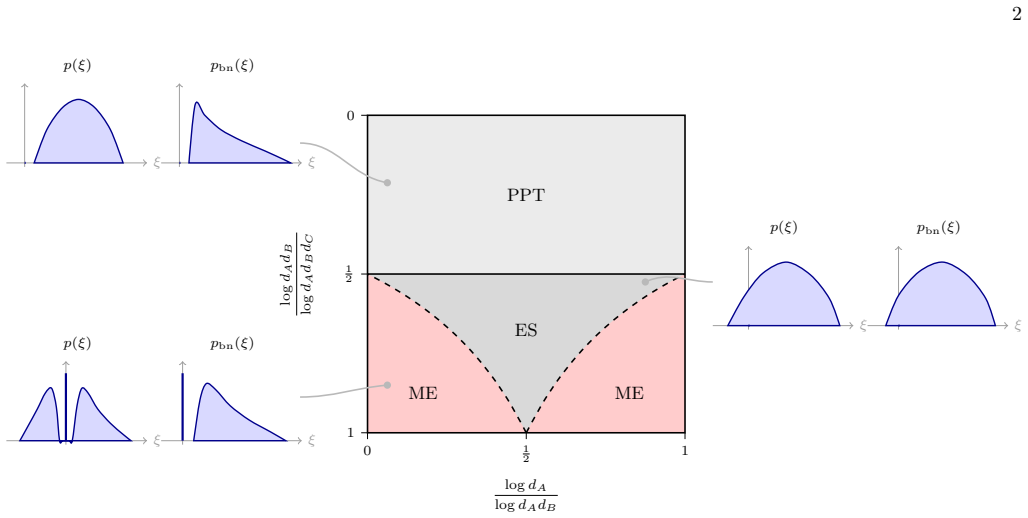
This is implied by (B) via the concentration of ξmin (SM), and is all that the operational equality requires. Theorem 1.Letρ AB be a random induced mixed state drawn from a Haar random pure state onH A ⊗ H B ⊗ HC with dimensiond AdBdC. Asd A, dB, dC → ∞, with probability tending to one, (i) (PPT phase,d C >4d AdB)ρ TB AB ⪰0, the binegativ- ity equalsρ AB,...
-
[2]
The bath (HC) is sufficiently large, such that there is no quantum entanglement present
Positive Partial Transpose phase (d C >4d AdB). The bath (HC) is sufficiently large, such that there is no quantum entanglement present. The spec- trum ofρ TB AB is a semicircle p(ξ) = dAdBdC 2π s 4 dAdBdC − ξ− 1 dAdB 2 .(6)
-
[3]
One party dominates the others
Maximally Entangled phase (d A > d BdC ord B > dAdC). One party dominates the others. Taking dA > d BdC (the caseA↔Bis similar), the neg- ativity saturates to its maximal value logd B. The 2 To be a valid state, we normalize by Tr(XX †) which induces the Hilbert-Schmidt measure on density matrices [19]. The nor- malization is a global positive rescaling t...
-
[4]
The spectrum is the same semicircle of (6), though there now exist negative eigenvalues, so the negativity is nontrivial
Entanglement Saturation phase (otherwise). The spectrum is the same semicircle of (6), though there now exist negative eigenvalues, so the negativity is nontrivial. Deep in the phase (d AdB ≫d C), ⟨E(ρ AB)⟩= 1 2 log dAdB dC + log 8 3π .(8) The phase diagram is summarized in figure 1. Binegativity Spectrum.— We now turn to the evalua- tion of the spectrum ...
2048
- [5]
- [6]
-
[7]
P. M. Hayden, M. Horodecki, and B. M. Terhal, J. Phys. A: Math. Gen.34, 6891 (2001), arXiv:quant-ph/0008134
work page internal anchor Pith review Pith/arXiv arXiv 2001
- [8]
-
[9]
Separability of Mixed States: Necessary and Sufficient Conditions
M. Horodecki, P. Horodecki, and R. Horodecki, Phys. Lett. A223, 1 (1996), arXiv:quant-ph/9605038
work page internal anchor Pith review Pith/arXiv arXiv 1996
-
[10]
K. ˙Zyczkowski, P. Horodecki, A. Sanpera, and M. Lewen- stein, Phys. Rev. A58, 883 (1998), arXiv:quant- ph/9804024
-
[11]
A computable measure of entanglement
G. Vidal and R. F. Werner, Phys. Rev. A65, 032314 (2002), arXiv:quant-ph/0102117
work page internal anchor Pith review Pith/arXiv arXiv 2002
-
[12]
M. B. Plenio, Phys. Rev. Lett.95, 090503 (2005), arXiv:quant-ph/0505071
work page internal anchor Pith review Pith/arXiv arXiv 2005
-
[13]
X. Wang and M. M. Wilde, Phys. Rev. Lett.125, 040502 (2020), arXiv:2007.14270
- [14]
-
[15]
X. Wang and M. M. Wilde, Phys. Rev. A107, 012429 (2023), arXiv:1809.09592
- [16]
-
[17]
The entanglement cost under operations preserving the positivity of partial transpose
K. Audenaert, M. B. Plenio, and J. Eisert, Phys. Rev. Lett.90, 027901 (2003), arXiv:quant-ph/0207146
work page internal anchor Pith review Pith/arXiv arXiv 2003
-
[18]
Binegativity and geometry of entangled states in two qubits
S. Ishizaka, Phys. Rev. A69, 020301(R) (2004), arXiv:quant-ph/0308056
work page internal anchor Pith review Pith/arXiv arXiv 2004
-
[19]
Sun, Science China Mathematics57, 1375 (2014)
Z.-W. Sun, Science China Mathematics57, 1375 (2014). 6
2014
-
[20]
Partial transposition of random states and non-centered semicircular distributions
G. Aubrun, Random Matrices: Theory Appl.1, 1250001 (2012), arXiv:1011.0275
work page internal anchor Pith review Pith/arXiv arXiv 2012
-
[21]
Block-modified Wishart matrices and free Poisson laws
T. Banica and I. Nechita, Houston J. Math.41, 113 (2015), arXiv:1201.4792
work page internal anchor Pith review Pith/arXiv arXiv 2015
-
[22]
H. Shapourian, S. Liu, J. Kudler-Flam, and A. Vishwanath, PRX Quantum2, 030347 (2021), arXiv:2011.01277
-
[23]
Induced measures in the space of mixed quantum states
K. ˙Zyczkowski and H.-J. Sommers, J. Phys. A: Math. Gen.34, 7111 (2001), arXiv:quant-ph/0012101
work page internal anchor Pith review Pith/arXiv arXiv 2001
-
[24]
Banica and I
T. Banica and I. Nechita, Journal of Theoretical Proba- bility26, 855 (2013)
2013
-
[25]
Wang and Z.-H
Y. Wang and Z.-H. Zhang, Journal of Integer Sequences 18, Article 15.2.4 (2015)
2015
-
[26]
C. A. Tracy and H. Widom, Commun. Math. Phys.159, 151 (1994), arXiv:hep-th/9211141
work page internal anchor Pith review Pith/arXiv arXiv 1994
-
[27]
T. Liu, S. Liu, H. Li, H. Li, K. Huang, Z. Xiang, X. Song, K. Xu, D. Zheng, and H. Fan, Nat. Commun.14, 1971 (2023)
1971
-
[28]
J. Carrasco, M. Votto, V. Vitale, C. Kokail, A. Neven, P. Zoller, B. Vermersch, and B. Kraus, Phys. Rev. A109, 012422 (2024), arXiv:2212.10181
- [29]
-
[30]
Holographic duality from random tensor networks
P. Hayden, S. Nezami, X.-L. Qi, N. Thomas, M. Wal- ter, and Z. Yang, J. High Energy Phys.2016(11), 009, arXiv:1601.01694
work page internal anchor Pith review Pith/arXiv arXiv 2016
-
[31]
X. Dong, X.-L. Qi, and M. Walter, J. High Energy Phys. 2021(6), 024, arXiv:2101.11029
-
[32]
J. Kudler-Flam, V. Narovlansky, and S. Ryu, J. High Energy Phys.2022(2), 076, arXiv:2109.02649
-
[33]
Holographic Renyi Entropy from Quantum Error Correction
C. Akers and P. Rath, J. High Energy Phys.2019(5), 052, arXiv:1811.05171
work page internal anchor Pith review Pith/arXiv arXiv 2019
- [34]
-
[35]
S. Sang, Y. Li, T. Zhou, X. Chen, T. H. Hsieh, and M. P. A. Fisher, PRX Quantum2, 030313 (2021)
2021
-
[36]
Z. Weinstein, Y. Bao, and E. Altman, Phys. Rev. Lett. 129, 080501 (2022), arXiv:2202.12905
- [37]
- [38]
-
[39]
S. Vardhan, J. Kudler-Flam, H. Shapourian, and H. Liu, Phys. Rev. Lett.129, 061602 (2022), arXiv:2110.02959
-
[40]
S. Vardhan, J. Kudler-Flam, H. Shapourian, and H. Liu, J. High Energy Phys.2023(1), 064, arXiv:2112.00020
-
[41]
R. Vershynin,High-Dimensional Probability: An In- troduction with Applications in Data Science, Cam- bridge Series in Statistical and Probabilistic Mathematics (Cambridge University Press, 2018)
2018
-
[42]
M. Fukuda and P. ´Sniady, J. Math. Phys.54, 042202 (2013), arXiv:1207.6740
work page internal anchor Pith review Pith/arXiv arXiv 2013
-
[43]
Biane, J
P. Biane, J. Combin. Theory Ser. A76, 197 (1996)
1996
-
[44]
Biane, Discrete Math.175, 41 (1997)
P. Biane, Discrete Math.175, 41 (1997)
1997
-
[45]
Nica and R
A. Nica and R. Speicher,Lectures on the Combinatorics of Free Probability, London Mathematical Society Lec- ture Note Series, Vol. 335 (Cambridge University Press, 2006)
2006
-
[46]
R. P. Stanley,Enumerative Combinatorics, Vol. 2, Cam- bridge Studies in Advanced Mathematics, Vol. 62 (Cam- bridge University Press, 1999). 7 Supplemental Material This Supplemental Material provides technical details supporting the main text. We mark each result asrigorous, conditional(on hypotheses (A), (B), (B ′)), ornumerical. Sections S1–S6 are rigor...
1999
discussion (0)
Sign in with ORCID, Apple, or X to comment. Anyone can read and Pith papers without signing in.