Laser stabilized to a room temperature cavity with AlGaAs coatings reaching 4.2 times 10⁻¹⁷ fractional frequency instability
Pith reviewed 2026-07-03 18:38 UTC · model grok-4.3
The pith
A room-temperature cavity with crystalline AlGaAs coatings stabilizes a laser to 4.2 × 10^{-17} fractional frequency instability.
A machine-rendered reading of the paper's core claim, the machinery that carries it, and where it could break.
Core claim
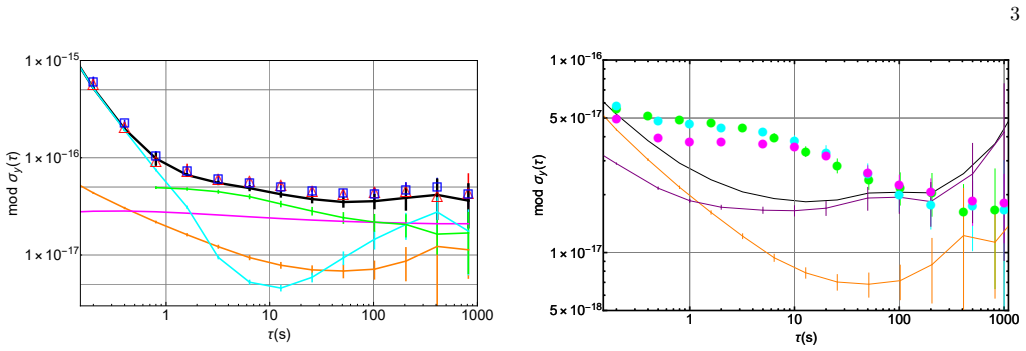
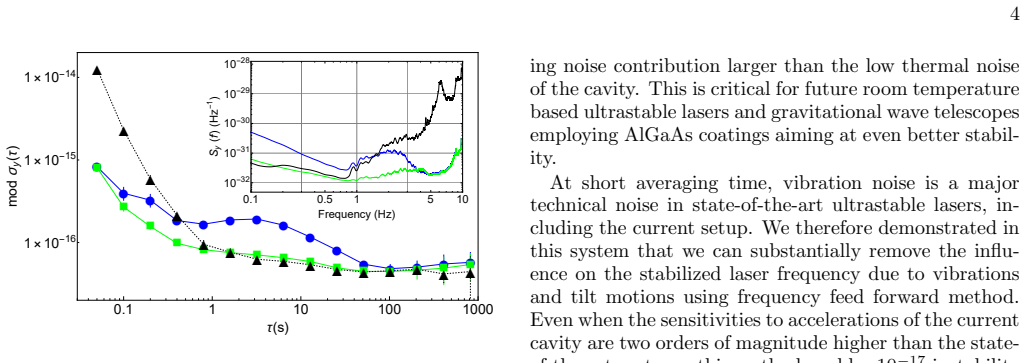
A laser referenced to a room-temperature ultrastable cavity that uses crystalline AlGaAs coatings reaches a fractional frequency instability of 4.2 × 10^{-17}, one of the lowest values reported for any room-temperature system and below the Brownian-noise limit set by dielectric coatings. Spontaneous fluctuations of coating birefringence are identified for the first time as a leading instability source in a room-temperature cavity. At optimized conditions the cavity eigenfrequency becomes highly immune to power fluctuations, and a feed-forward technique reduces the contribution of acceleration noise by a factor of four.
What carries the argument
Crystalline AlGaAs mirror coatings that lower Brownian thermal noise relative to dielectrics while introducing measurable birefringence fluctuations as the new limiting mechanism.
If this is right
- Room-temperature systems can now reach instabilities previously accessible only with cryogenic cavities.
- Birefringence fluctuations become the dominant noise term once Brownian noise is suppressed by the AlGaAs coatings.
- Power-fluctuation sensitivity can be minimized by deliberate choice of operating point.
- A simple feed-forward correction reduces vibration-induced frequency excursions by a factor of four.
Where Pith is reading between the lines
- Portable or field-deployable optical frequency standards could become practical without the infrastructure required for cryogenics.
- Further gains will require either active birefringence stabilization or a coating material with still lower thermal noise and birefringence drift.
- The same coating approach may be transferable to other high-finesse optical resonators used in precision metrology.
Load-bearing premise
The reported instability is set by the cavity itself rather than by uncharacterized technical noise or by the particular choice of data segments used to compute the Allan deviation.
What would settle it
An independent comparison against a second reference cavity or a longer continuous data set that yields an Allan deviation above 4.2 × 10^{-17} at the same averaging times would show the claimed performance is not achieved.
Figures
read the original abstract
We present a laser system referenced to a room-temperature ultrastable cavity employing crystalline AlGaAs coatings. We demonstrate a fractional frequency instability of $4.2 \times 10^{-17}$, which is one of the lowest for room temperature systems and surpasses the limit imposed by Brownian noise if dielectric coatings were employed. For the first time in a room temperature system we identified the spontaneous fluctuations of the coating birefringence as a leading contribution to frequency instability. At optimized conditions we achieve an ultrastable cavity with an eigenfrequency that is highly immune to power fluctuations. As acceleration noise is the main noise contribution, we demonstrated that a feed-forward method can reduce the influence of accelerations on the cavity-stabilized laser frequency by a factor of four.
Editorial analysis
A structured set of objections, weighed in public.
Referee Report
Summary. The manuscript presents a laser system referenced to a room-temperature ultrastable cavity employing crystalline AlGaAs coatings. It claims a fractional frequency instability of 4.2 × 10^{-17}, identifies spontaneous fluctuations of the coating birefringence as a leading contribution to frequency instability for the first time in a room-temperature system, demonstrates that the cavity eigenfrequency is highly immune to power fluctuations at optimized conditions, and shows that a feed-forward method reduces the influence of accelerations on the stabilized laser frequency by a factor of four.
Significance. If the central result holds, the work would be significant for the field of ultrastable optical references: it reports one of the lowest instabilities achieved at room temperature, exceeds the Brownian thermal noise floor expected for dielectric coatings, and provides the first explicit identification of birefringence fluctuations as a dominant noise mechanism in such systems. The feed-forward acceleration compensation is a practical technique that could be adopted more broadly.
major comments (2)
- [Results and discussion] The central claim that the observed 4.2 × 10^{-17} instability is limited by the AlGaAs-coated cavity (specifically birefringence fluctuations) rather than uncharacterized technical noise is load-bearing but unsupported by any error budget, quantitative comparison to a birefringence model, or description of the reference laser and measurement chain.
- [Experimental methods] No information is supplied on the exact averaging intervals, data-segment selection criteria, outlier rejection, or cross-checks against an independent reference used to compute the Allan deviation; without these the quoted floor cannot be confirmed as reproducible or cavity-limited.
minor comments (1)
- Figure captions and the main text should explicitly state the total measurement duration and number of independent runs contributing to the reported instability.
Simulated Author's Rebuttal
We thank the referee for their careful reading of the manuscript and for the constructive comments. We address each major comment below and indicate the revisions that will be incorporated.
read point-by-point responses
-
Referee: [Results and discussion] The central claim that the observed 4.2 × 10^{-17} instability is limited by the AlGaAs-coated cavity (specifically birefringence fluctuations) rather than uncharacterized technical noise is load-bearing but unsupported by any error budget, quantitative comparison to a birefringence model, or description of the reference laser and measurement chain.
Authors: We agree that an explicit error budget and additional quantitative support would strengthen the presentation. In the revised manuscript we will add a detailed error budget table that compares the observed instability against estimated contributions from birefringence fluctuations, residual technical noise, and other known sources. We will also include a quantitative comparison of the measured noise to a simple birefringence-fluctuation model and expand the description of the reference laser and the complete measurement chain used to obtain the Allan deviation. revision: yes
-
Referee: [Experimental methods] No information is supplied on the exact averaging intervals, data-segment selection criteria, outlier rejection, or cross-checks against an independent reference used to compute the Allan deviation; without these the quoted floor cannot be confirmed as reproducible or cavity-limited.
Authors: We acknowledge that these procedural details are necessary for reproducibility. The revised manuscript will specify the exact averaging intervals, the criteria used for data-segment selection, any outlier-rejection procedures applied, and the cross-checks performed against an independent reference to confirm that the reported floor is cavity-limited. revision: yes
Circularity Check
No circularity: experimental measurement with no derivation chain
full rationale
This is an experimental paper reporting a measured fractional frequency instability of 4.2 × 10^{-17} achieved with a room-temperature cavity using AlGaAs coatings. The abstract and available text contain no mathematical derivations, predictions, or first-principles results that reduce to fitted parameters, self-citations, or inputs by construction. The identification of birefringence fluctuations is presented as an experimental observation rather than a self-definitional or fitted quantity. No load-bearing steps match any of the enumerated circularity patterns; the result is a direct measurement and therefore self-contained against external benchmarks.
Axiom & Free-Parameter Ledger
axioms (2)
- domain assumption Brownian thermal noise in mirror coatings sets a fundamental frequency instability floor that depends on coating material and temperature.
- standard math Frequency instability can be extracted from Allan deviation of the beat note between the cavity-stabilized laser and an independent reference.
Reference graph
Works this paper leans on
-
[1]
A. D. Ludlow, M. M. Boyd, J. Ye, E. Peik, and P. O. Schmidt, Optical atomic clocks, Rev. Mod. Phys.87, 637 (2015)
2015
-
[2]
T. M. Fortier, A. N. Luiten, and H. S. Margolis, Optical atomic clocks: defining the future of time and frequency metrology, Optica13, 143 (2026)
2026
-
[3]
Wiens, A
E. Wiens, A. Y. Nevsky, and S. Schiller, Resonator with ultrahigh length stability as a probe for equivalence- principle-violating physics, Phys. Rev. Lett.117, 271102 (2016)
2016
-
[4]
C. J. Kennedy, E. Oelker, J. M. Robinson, T. Bothwell, D. Kedar, W. R. Milner, G. E. Marti, A. Derevianko, and J. Ye, Precision metrology meets cosmology: Improved constraints on ultralight dark matter from atom-cavity frequency comparisons, Phys. Rev. Lett.125, 201302 (2020)
2020
-
[5]
X. Xie, R. Bouchand, D. Nicolodi, M. Giunta, W. H¨ ansel, M. Lezius, A. Joshi, S. Datta, C. Alexandre, M. Lours, P.-A. Tremblin, G. Santarelli, R. Holzwarth, and Y. Le Coq, Photonic microwave signals with zeptosec- ond level absolute timing noise, Nature Photonics11, 44 (2017)
2017
-
[6]
Attar, H
A. Attar, H. Timmers, B. Sodergren, C. Smith, E. Barnes, N. Phillips, K. Vogel, and K. Knabe, Ultra-low phase noise microwave generation using photonics for en- hanced radar applications, Proc. SPIE13048, 130480O1 (2024)
2024
-
[7]
Meiser, J
D. Meiser, J. Ye, D. R. Carlson, and M. J. Holland, Prospects for a millihertz-linewidth laser, Phys. Rev. Lett.102, 163601 (2009)
2009
-
[8]
Olson, R
J. Olson, R. W. Fox, T. M. Fortier, T. F. Sheerin, R. C. Brown, H. Leopardi, R. E. Stoner, C. W. Oates, and A. D. Ludlow, Ramsey-Bord´ e matter-wave interferome- try for laser frequency stabilization at 10−16 frequency in- stability and below, Phys. Rev. Lett.123, 073202 (2019). 5
2019
-
[9]
X. Lin, M. T. Hartman, B. Pointard, R. Le Targat, P. Goldner, S. Seidelin, B. Fang, and Y. Le Coq, Anoma- lous subkelvin thermal frequency shifts of ultranarrow linewidth solid state emitters, Phys. Rev. Lett.133, 183803 (2024)
2024
-
[10]
Numata, A
K. Numata, A. Kemery, and J. Camp, Thermal-noise limit in the frequency stabilization of lasers with rigid cavities, Phys. Rev. Lett.93, 250602 (2004)
2004
-
[11]
G. M. Harry, H. Armandula, E. Black, D. R. M. Crooks, G. Cagnoli, J. Hough, P. Murray, S. Reid, S. Rowan, P. Sneddon, M. M. Fejer, R. Route, and S. D. Penn, Thermal noise from optical coatings in gravitational wave detectors, Appl. Opt.45, 1569 (2006)
2006
-
[12]
G. D. Cole, W. Zhang, M. J. Martin, J. Ye, and M. As- pelmeyer, Tenfold reduction of Brownian noise in optical interferometry, Nature Photonics7, 644 (2013)
2013
-
[13]
J. Yu, S. H¨ afner, T. Legero, S. Herbers, D. Nicolodi, C. Y. Ma, F. Riehle, U. Sterr, D. Kedar, J. M. Robinson, E. Oelker, and J. Ye, Excess noise and photoinduced ef- fects in highly reflective crystalline mirror coatings, Phys. Rev. X13, 041002 (2023)
2023
-
[14]
D. Lee, Z. Z. Hu, B. Lewis, A. Aeppli, K. Kim, Z. Yao, T. Legero, D. Nicolodi, F. Riehle, U. Sterr, and J. Ye, Frequency stability of 2.5×10 −17 from a Si cavity with AlGaAs crystalline mirrors, Phys. Rev. Lett.136, 033801 (2026)
2026
-
[15]
H¨ afner, S
S. H¨ afner, S. Falke, C. Grebing, S. Vogt, T. Legero, M. Merimaa, C. Lisdat, and U. Sterr, 8×10 −17 fractional laser frequency instability with a long room-temperature cavity, Opt. Lett.40, 2112 (2015)
2015
-
[16]
Schioppo, J
M. Schioppo, J. Kronj¨ ager, A. Silva, R. Ilieva, J. W. Pa- terson, C. F. A. Baynham, W. Bowden, I. R. Hill, R. Hob- son, A. Vianello, M. Dovale- ´Alvarez, R. A. Williams, G. Marra, H. S. Margolis, A. Amy-Klein, O. Lopez, E. Cantin, H. ´Alvarez-Mart´ ınez, R. Le Targat, P. E. Pottie, N. Quintin, T. Legero, S. H¨ afner, U. Sterr, R. Schwarz, S. D¨ orscher,...
2022
-
[17]
C. Y. Ma, J. Yu, T. Legero, S. Herbers, D. Nicolodi, M. Kempkes, F. Riehle, D. Kedar, J. M. Robinson, J. Ye, and U. Sterr, Ultrastable lasers: investigations of crys- talline mirrors and closed cycle cooling at 124 K, J. Phys.: Conf. Ser.2889, 012055 (2024)
2024
-
[18]
A. L. Parke, E. Clulow, W. Huang, N. Kaur, R. Karem- bera, J.-O. Gaudron, X. Zhang, M. Risaro, J. Tunesi, H. Bourne, and M. Schioppo, Laser fractional frequency instability at 4×10 −17 with a room temperature optical reference cavity, Optica13, 1190 (2026)
2026
-
[19]
Kedar, J
D. Kedar, J. Yu, E. Oelker, A. Staron, W. R. Milner, J. M. Robinson, T. Legero, F. Riehle, U. Sterr, and J. Ye, Frequency stability of cryogenic silicon cavities with semiconductor crystalline coatings, Optica10, 464 (2023)
2023
-
[20]
Winkler, L
G. Winkler, L. W. Perner, G.-W. Truong, G. Zhao, D. Bachmann, A. S. Mayer, J. Fellinger, D. Follman, P. Heu, C. Deutsch, D. M. Bailey, H. Peelaers, S. Pucheg- ger, A. J. Fleisher, G. D. Cole, and O. H. Heckl, Mid- infrared interference coatings with excess optical loss be- low 10 ppm, Optica8, 686 (2021), also see erratum [36]
2021
-
[21]
Legero, T
T. Legero, T. Kessler, and U. Sterr, Tuning the thermal expansion properties of optical reference cavities with fused silica mirrors, J. Opt. Soc. Am. B27, 914 (2010)
2010
-
[22]
AVI 200-M
The Table Stable Ltd. AVI 200-M
-
[23]
E. D. Black, An introduction to Pound-Drever-Hall laser frequency stabilization, Am. J. Phys.69, 79 (2001)
2001
-
[24]
D. G. Matei, T. Legero, S. H¨ afner, C. Grebing, R. Weyrich, W. Zhang, L. Sonderhouse, J. M. Robinson, J. Ye, F. Riehle, and U. Sterr, 1.5µm lasers with sub-10 mHz linewidth, Phys. Rev. Lett.118, 263202 (2017)
2017
-
[25]
Zhu, X.-Y
X.-Q. Zhu, X.-Y. Cui, D.-Q. Kong, H.-W. Yu, X.-M. Zhai, M.-Y. Zheng, X.-P. Xie, Q. Zhang, X. Jiang, X.-B. Zhang, P. Xu, H.-N. Dai, Y.-A. Chen, and J.-W. Pan, An ultrastable 1397-nm laser stabilized by a crystalline- coated room-temperature cavity, Rev. Sci. Instrum.95, 083002 (2024)
2024
-
[26]
Kraus, S
B. Kraus, S. Herbers, C. Nauk, U. Sterr, C. Lisdat, and P. O. Schmidt, Ultra-stable transportable ultraviolet clock laser using cancellation between photo-thermal and photo-birefringence noise, Opt. Lett.50, 658 (2025)
2025
- [27]
-
[28]
C. Y. Ma, J. Yu, T. Legero, S. Herbers, D. Nicolodi, M. Kempkes, F. Riehle, and U. Sterr, Photo-birefringent effects in crystalline AlGaAs mirror coatings, Opt. Ex- press34, 25456 (2026)
2026
-
[29]
Evans, S
M. Evans, S. Ballmer, M. Fejer, P. Fritschel, G. Harry, and G. Ogin, Thermo-optic noise in coated mirrors for high-precision optical measurements, Phys. Rev. D78, 102003 (2008)
2008
-
[30]
Chalermsongsak, E
T. Chalermsongsak, E. D. Hall, G. D. Cole, D. Follman, F. Seifert, K. Arai, E. K. Gustafson, J. R. Smith, M. As- pelmeyer, and R. X. Adhikari, Coherent cancellation of photothermal noise in GaAs/Al 0.92Ga0.08As Bragg mir- rors, Metrologia53, 860 (2016)
2016
-
[31]
Cerdonio, L
M. Cerdonio, L. Conti, A. Heidmann, and M. Pinard, Thermoelastic effects at low temperatures and quantum limits in displacement measurements, Phys. Rev. D63, 082003 (2001)
2001
-
[32]
Zhang, M
W. Zhang, M. J. Martin, C. Benko, J. L. Hall, J. Ye, C. Hagemann, T. Legero, U. Sterr, F. Riehle, G. D. Cole, and M. Aspelmeyer, Reduction of residual ampli- tude modulation to 1×10 −6 for frequency-modulation and laser stabilization, Opt. Lett.39, 1980 (2014)
1980
-
[33]
Yu, Cryogenic silicon Fabry-Perot resonator with Al0.92Ga0.08As/GaAs mirror coatings., Ph.D
J. Yu, Cryogenic silicon Fabry-Perot resonator with Al0.92Ga0.08As/GaAs mirror coatings., Ph.D. thesis, QUEST-Leibniz-Forschungsschule der Gottfried Wilhelm Leibniz Universit¨ at Hannover (2023)
2023
-
[34]
J. Barbarat, E. Benkler, M. Bober, C. Clivati, J. Dick- mann, B. Fang, C. Fluhr, T. Fordell, J. Gillot, V. Gior- dano, D. Gustavsson, K. Hanhij¨ arvi, M. Hartman, S. Herbers, A. Jaros, J. Kawohl, Y. Kersal´ e, S. Kro- ker, C. J. Kwong, C. Lacroˆ ute, R. L. Targat, T. Leg- ero, M. Lind´ en, T. Lindvall, J. Lodewyck, C. Y. Ma, R. Meyer, P. Morzy´ nski, J. M...
-
[35]
Freier, M
C. Freier, M. Hauth, V. Schkolnik, B. Leykauf, M. Schilling, H. Wziontek, H.-G. Scherneck, J. M¨ uller, and A. Peters, Mobile quantum gravity sensor with un- precedented stability, J. Phys.: Conf. Ser.723, 012050 (2016)
2016
-
[36]
L. W. Perner, G. Winkler, G.-W. Truong, G. Zhao, D. Bachmann, A. S. Mayer, J. Fellinger, D. Follman, P. Heu, C. Deutsch, D. M. Bailey, H. Peelaers, S. Pucheg- ger, A. J. Fleisher, G. D. Cole, and O. H. Heckl, Mid- infrared interference coatings with excess optical loss be- low 10 ppm: erratum, Optica11, 619 (2024)
2024
discussion (0)
Sign in with ORCID, Apple, or X to comment. Anyone can read and Pith papers without signing in.