SLFS: a Flexible, Low-Cost Distributed File System Using Serverless Designs
Pith reviewed 2026-07-03 18:16 UTC · model grok-4.3
The pith
SLFS builds a distributed file system using serverless functions for both data and metadata operations.
A machine-rendered reading of the paper's core claim, the machinery that carries it, and where it could break.
Core claim
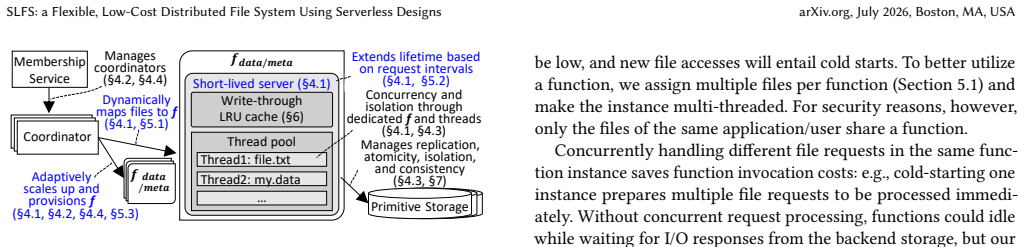
SLFS implements file services on top of key-value stores, keeping function operations simple and short, and introduces a novel multi-threaded, short-lived server design that overcomes the cold-start problem while maintaining low cost. A policy-enforcing coordinator efficiently maps files to function instances, scales the system elastically, and controls function lifetimes to balance performance and cost. SLFS can flexibly run on diverse storage backends -- from cloud-native services like S3 to user-managed key-value stores -- enabling configurable cost-performance trade-offs.
What carries the argument
Multi-threaded short-lived server design that overcomes cold starts at low cost, together with a policy-enforcing coordinator that maps files, scales instances, and controls lifetimes.
If this is right
- File-system scaling can occur at millisecond granularity instead of minutes or hours.
- Cost can be reduced by up to 68 percent relative to EFS while preserving or improving performance.
- Cold starts can be lowered by a factor of 580 compared with a plain serverless implementation.
- The same code base can be deployed against S3 or against a local key-value store to obtain different cost-performance points.
Where Pith is reading between the lines
- The coordinator's mapping and lifetime policies could be reused as a general pattern for other stateful serverless services that need fine-grained elasticity.
- Because the design decouples the file-system logic from any single storage backend, it may simplify hybrid deployments that span public cloud and on-premise stores.
- Extending the short-lived server pattern to metadata-heavy workloads beyond files could reduce cold-start penalties in other distributed systems.
Load-bearing premise
The multi-threaded short-lived server design can eliminate cold starts without raising overall operating cost.
What would settle it
Measure cold-start frequency and total cost when running SLFS on a fluctuating real-world workload and compare those numbers directly to an otherwise identical serverless implementation that lacks the multi-threaded short-lived design.
Figures





read the original abstract
Large-scale distributed file systems must provision resources for peak demand, yet file access patterns fluctuate significantly, leaving substantial capacity idle during off-peak periods. Existing scaling mechanisms operate at the granularity of entire servers and take minutes to hours, making them unable to track the rapid, fine-grained load variations that file systems commonly experience. Serverless computing, with its millisecond-granularity elasticity and pay-per-use pricing, offers a compelling alternative. We present SLFS, the first distributed file system built with serverless functions for both data and metadata operations. SLFS implements file services on top of key-value stores, keeping function operations simple and short, and introduces a novel multi-threaded, short-lived server design that overcomes the cold-start problem while maintaining low cost. A policy-enforcing coordinator efficiently maps files to function instances, scales the system elastically, and controls function lifetimes to balance performance and cost. SLFS can flexibly run on diverse storage backends -- from cloud-native services like S3 to user-managed key-value stores -- enabling configurable cost-performance trade-offs. Our evaluation shows that SLFS mitigates cold starts by 580$\times$ compared to the base serverless design and outperforms $\lambda$FS, EFS, and Ceph at up to 63%, 68%, and 63% lower cost, respectively.
Editorial analysis
A structured set of objections, weighed in public.
Referee Report
Summary. The paper presents SLFS as the first distributed file system using serverless functions for both data and metadata operations. It builds file services atop key-value stores with short, simple operations, introduces a multi-threaded short-lived server design plus a policy-enforcing coordinator to map files, scale elastically, and control lifetimes, and supports configurable backends from S3 to user-managed KV stores. Evaluation claims include 580× cold-start mitigation versus base serverless and up to 63%, 68%, and 63% lower cost than λFS, EFS, and Ceph respectively.
Significance. If the reported performance and cost results hold under scrutiny, the work would demonstrate a practical path to millisecond-granularity elasticity for distributed file systems, directly addressing the mismatch between peak-provisioned servers and variable file-access patterns. The KV-backend abstraction and coordinator lifetime policy are concrete strengths that could influence future serverless storage designs.
major comments (1)
- [Evaluation] Evaluation section: the central claims of 580× cold-start reduction and the specific cost savings (63–68% lower than the three baselines) are stated without visible experimental setup, workload definitions, trial counts, or error bars. These details are load-bearing for the primary contribution and must be supplied to allow verification.
Simulated Author's Rebuttal
We thank the referee for their review and constructive comment on the evaluation. We address the concern below and will revise the manuscript accordingly.
read point-by-point responses
-
Referee: [Evaluation] Evaluation section: the central claims of 580× cold-start reduction and the specific cost savings (63–68% lower than the three baselines) are stated without visible experimental setup, workload definitions, trial counts, or error bars. These details are load-bearing for the primary contribution and must be supplied to allow verification.
Authors: We agree that the current evaluation section lacks sufficient methodological detail to allow independent verification of the reported 580× cold-start mitigation and cost savings. In the revised manuscript we will expand the Evaluation section to explicitly describe: (1) the experimental setup and hardware/cloud configuration, (2) the workloads and access patterns used (including file sizes, operation mixes, and concurrency levels), (3) the number of trials/repetitions performed for each measurement, and (4) error bars or variance statistics for all reported figures. These additions will directly support the primary claims without altering the experimental results themselves. revision: yes
Circularity Check
No significant circularity identified
full rationale
The paper describes an implemented distributed file system (SLFS) using serverless functions for data and metadata, a multi-threaded short-lived server design, and a coordinator for mapping and scaling. All central claims rest on empirical measurements from the running system (e.g., 580× cold-start mitigation and cost comparisons) rather than any equations, fitted parameters renamed as predictions, or self-referential definitions. No derivation chain exists that reduces to its own inputs by construction, and the evaluation is externally falsifiable via the reported implementation and benchmarks.
Axiom & Free-Parameter Ledger
axioms (1)
- domain assumption Serverless functions can be used for file system operations with appropriate design to mitigate cold starts.
Reference graph
Works this paper leans on
-
[1]
Amazon DynamoDB Transactions
2018. Amazon DynamoDB Transactions. https://aws.amazon.com/blogs/aws/ new-amazon-dynamodb-transactions/. SLFS: a Flexible, Low-Cost Distributed File System Using Serverless Designs arXiv.org, July 2026, Boston, MA, USA
2018
-
[2]
Reducing Java Cold Starts on AWS Lambda Functions with SnapStart | AWS Compute Blog
2022. Reducing Java Cold Starts on AWS Lambda Functions with SnapStart | AWS Compute Blog. https://aws.amazon.com/blogs/compute/reducing-java- cold-starts-on-aws-lambda-functions-with-snapstart/
2022
-
[3]
Apache OpenWhisk Is a Serverless, Open Source Cloud Platform
2023. Apache OpenWhisk Is a Serverless, Open Source Cloud Platform. https://openwhisk.apache.org/
2023
-
[4]
Apache ZooKeeper
2023. Apache ZooKeeper. https://zookeeper.apache.org/
2023
-
[5]
AWS Fargate Enables Faster Container Startup using Seekable OCI
2023. AWS Fargate Enables Faster Container Startup using Seekable OCI. https://aws.amazon.com/blogs/aws/aws-fargate-enables-faster-container- startup-using-seekable-oci/
2023
-
[6]
AWS Lambda Pricing
2023. AWS Lambda Pricing. https://aws.amazon.com/lambda/pricing/
2023
-
[7]
HDFS Architecture Guide
2023. HDFS Architecture Guide. https://hadoop.apache.org/docs/r1.2.1/hdfso_ design.html
2023
-
[8]
Why is my EFS file system performance slow? https://repost.aws/ knowledge-center/efs-troubleshoot-slow-performance
2024. Why is my EFS file system performance slow? https://repost.aws/ knowledge-center/efs-troubleshoot-slow-performance
2024
-
[9]
Amazon EFS
2025. Amazon EFS. https://aws.amazon.com/efs/
2025
-
[10]
Amazon S3 | Strong Consistency | Amazon Web Services
2025. Amazon S3 | Strong Consistency | Amazon Web Services. https://aws. amazon.com/s3/consistency/
2025
-
[11]
AWS Batch on AWS Fargate
2025. AWS Batch on AWS Fargate. https://docs.aws.amazon.com/batch/latest/ userguide/fargate.html
2025
-
[12]
AWS EC2 Instance lifecycle
2025. AWS EC2 Instance lifecycle. https://docs.aws.amazon.com/AWSEC2/latest/ UserGuide/ec2-instance-lifecycle.html
2025
-
[13]
AWS Price Calculator
2025. AWS Price Calculator. https://calculator.aws
2025
-
[14]
Azure Blob Storage | Microsoft Azure
2025. Azure Blob Storage | Microsoft Azure. https://azure.microsoft.com/en- us/services/storage/blobs/
2025
-
[15]
Azure Disk Storage – Block Storage | Microsoft Azure
2025. Azure Disk Storage – Block Storage | Microsoft Azure. https://azure. microsoft.com/en-us/services/storage/disks/
2025
-
[16]
Azure Durable Functions
2025. Azure Durable Functions. https://learn.microsoft.com/en-us/azure/azure- functions/durable/
2025
-
[17]
Azure Files - Managed File Shares and Storage | Microsoft Azure
2025. Azure Files - Managed File Shares and Storage | Microsoft Azure. https: //azure.microsoft.com/en-us/services/storage/files/
2025
-
[18]
Cloud Object Storage – Amazon S3 – Amazon Web Services
2025. Cloud Object Storage – Amazon S3 – Amazon Web Services. https: //aws.amazon.com/s3/
2025
-
[19]
Docker: Accelerated, Containerized Application Development
2025. Docker: Accelerated, Containerized Application Development. https: //www.docker.com/
2025
-
[20]
Filestore: Fully Managed Cloud File Storage | Google Cloud
2025. Filestore: Fully Managed Cloud File Storage | Google Cloud. https://cloud. google.com/filestore
2025
-
[21]
2025. GCSFS. https://gcsfs.readthedocs.io/en/latest/
2025
-
[22]
Google Cloud Storage
2025. Google Cloud Storage. https://cloud.google.com/storage
2025
-
[23]
High-Performance Block Storage – Amazon EBS – Amazon Web Services
2025. High-Performance Block Storage – Amazon EBS – Amazon Web Services. https://aws.amazon.com/ebs/
2025
-
[24]
IOzone Filesystem Benchmark
2025. IOzone Filesystem Benchmark. https://www.iozone.org/
2025
-
[25]
LambdaFS
2025. LambdaFS. https://github.com/ds2-lab/LambdaFS
2025
-
[26]
LambdaFS-Benchmarking
2025. LambdaFS-Benchmarking. https://github.com/ds2-lab/LambdaFS- Benchmarking
2025
-
[27]
2025. LevelDB. https://github.com/google/leveldb
2025
-
[28]
Microsoft Azure Traces
2025. Microsoft Azure Traces. https://github.com/Azure/AzurePublicDataset
2025
-
[29]
MySQL NDB Cluster Carrier Grade Edition
2025. MySQL NDB Cluster Carrier Grade Edition. https://www.mysql.com/ products/cluster/
2025
-
[30]
Persistent Disk: durable block storage | Google Cloud
2025. Persistent Disk: durable block storage | Google Cloud. https://cloud.google. com/persistent-disk
2025
-
[31]
2025. S3Fs. https://s3fs.readthedocs.io/en/latest/
2025
-
[32]
Bolosky, Miguel Castro, Gerald Cermak, Ronnie Chaiken, John R
Atul Adya, William J. Bolosky, Miguel Castro, Gerald Cermak, Ronnie Chaiken, John R. Douceur, Jon Howell, Jacob R. Lorch, Marvin Theimer, and Roger P. Wattenhofer. 2002. {FARSITE}: Federated, Available, and Reliable Storage for an Incompletely Trusted Environment. In5th Symposium on Operating Systems Design and Implementation (OSDI 02)
2002
-
[33]
Alexandru Agache, Marc Brooker, Alexandra Iordache, Anthony Liguori, Rolf Neugebauer, Phil Piwonka, and Diana-Maria Popa. 2020. Firecracker: Light- weight Virtualization for Serverless Applications. In17th USENIX Symposium on Networked Systems Design and Implementation (NSDI 20). 419–434. https: //www.usenix.org/conference/nsdi20/presentation/agache
2020
-
[34]
Aguilera, Arif Merchant, Mehul Shah, Alistair Veitch, and Christos Karamanolis
Marcos K. Aguilera, Arif Merchant, Mehul Shah, Alistair Veitch, and Christos Karamanolis. 2007. Sinfonia: a new paradigm for building scalable distributed systems. InProceedings of Twenty-First ACM SIGOPS Symposium on Operating Systems Principles(Stevenson, Washington, USA)(SOSP ’07). Association for Com- puting Machinery, New York, NY, USA, 159–174. doi:...
-
[35]
Arpaci-Dusseau, Andrea C
Remzi H. Arpaci-Dusseau, Andrea C. Arpaci-Dusseau, and Venkateshwaran Venkataramani. 2018. Cloud-Native File Systems. In10th USENIX Workshop on Hot Topics in Cloud Computing (HotCloud ’18). USENIX Association, Boston, MA. https://www.usenix.org/conference/hotcloud18/presentation/arpaci-dusseau
2018
-
[36]
Mahesh Balakrishnan, Dahlia Malkhi, Vijayan Prabhakaran, Ted Wobber, Michael Wei, and John D. Davis. 2012. CORFU: A Shared Log Design for Flash Clusters. InProceedings of the 9th USENIX Conference on Networked Systems Design and Implementation (NSDI’12). USENIX Association, 1
2012
-
[37]
Bernstein, Vassos Hadzilacos, and Nathan Goodman
Philip A. Bernstein, Vassos Hadzilacos, and Nathan Goodman. 1987.Concurrency Control and Recovery in Database Systems. Addison-Wesley
1987
-
[38]
James Cadden, Thomas Unger, Yara Awad, Han Dong, Orran Krieger, and Jonathan Appavoo. 2020. SEUSS: skip redundant paths to make serverless fast. InProceedings of the Fifteenth European Conference on Computer Systems (Eu- roSys ’20). Association for Computing Machinery, New York, NY, USA, 1–15. doi:10.1145/3342195.3392698
-
[40]
Benjamin Carver, Runzhou Han, Jingyuan Zhang, Mai Zheng, and Yue Cheng
-
[41]
𝜆FS: A Scalable and Elastic Distributed File System Metadata Service using Serverless Functions. InProceedings of the 28th ACM International Conference on Architectural Support for Programming Languages and Operating Systems, Volume 4(Vancouver, BC, Canada)(ASPLOS ’23). Association for Computing Machinery, New York, NY, USA, 394–411. doi:10.1145/3623278.3624765
-
[42]
Benjamin Carver, Jingyuan Zhang, Ao Wang, Ali Anwar, Panruo Wu, and Yue Cheng. 2020. Wukong: a scalable and locality-enhanced framework for serverless parallel computing. InProceedings of the 11th ACM Symposium on Cloud Comput- ing (SoCC ’20). Association for Computing Machinery, New York, NY, USA, 1–15. doi:10.1145/3419111.3421286
-
[43]
Paul Castro, Vatche Ishakian, Vinod Muthusamy, and Aleksander Slominski
-
[44]
The rise of serverless computing.Commun. ACM62, 12 (Nov. 2019), 44–54. doi:10.1145/3368454
-
[45]
Cooper, Adam Silberstein, Erwin Tam, Raghu Ramakrishnan, and Russell Sears
Brian F. Cooper, Adam Silberstein, Erwin Tam, Raghu Ramakrishnan, and Russell Sears. 2010. Benchmarking Cloud Serving Systems with YCSB. InProceedings of the 1st ACM Symposium on Cloud Computing (SoCC ’10). Association for Computing Machinery, 143–154. doi:10.1145/1807128.1807152
-
[46]
Dong Du, Tianyi Yu, Yubin Xia, Binyu Zang, Guanglu Yan, Chenggang Qin, Qix- uan Wu, and Haibo Chen. 2020. Catalyzer: Sub-millisecond Startup for Serverless Computing with Initialization-less Booting. InProceedings of the Twenty-Fifth International Conference on Architectural Support for Programming Languages and Operating Systems (ASPLOS ’20). Association...
-
[47]
Bryan Ford, Pyda Srisuresh, and Dan Kegel. 2005. Peer-to-Peer Communication Across Network Address Translators. In2005 USENIX Annual Technical Conference (USENIX ATC 05). https://www.usenix.org/conference/2005-usenix-annual- technical-conference/peer-peer-communication-across-network-address
2005
-
[48]
Wahby, Brennan Shacklett, Karthikeyan Vasuki Bal- asubramaniam, William Zeng, Rahul Bhalerao, Anirudh Sivaraman, George Porter, and Keith Winstein
Sadjad Fouladi, Riad S. Wahby, Brennan Shacklett, Karthikeyan Vasuki Bal- asubramaniam, William Zeng, Rahul Bhalerao, Anirudh Sivaraman, George Porter, and Keith Winstein. 2017. Encoding, Fast and Slow: Low-Latency Video Processing Using Thousands of Tiny Threads. In14th USENIX Sympo- sium on Networked Systems Design and Implementation (NSDI 17). 363–376....
2017
-
[49]
Alexander Fuerst and Prateek Sharma. 2021. FaasCache: keeping serverless computing alive with greedy-dual caching. InProceedings of the 26th ACM In- ternational Conference on Architectural Support for Programming Languages and Operating Systems (ASPLOS 2021). Association for Computing Machinery, New York, NY, USA, 386–400. doi:10.1145/3445814.3446757
-
[50]
Ganger and Yale N
Gregory R. Ganger and Yale N. Patt. 1994. Metadata update performance in file systems. InProceedings of the 1st USENIX Conference on Operating Systems Design and Implementation(Monterey, California)(OSDI ’94). USENIX Association, USA, 5–es
1994
-
[51]
Sanjay Ghemawat, Howard Gobioff, and Shun-Tak Leung. 2003. The Google File System.ACM SIGOPS Operating Systems Review37, 5 (Oct. 2003), 29–43. doi:10.1145/1165389.945450
-
[52]
Kuszmaul, and Donald E
William Jannen, Jun Yuan, Yang Zhan, Amogh Akshintala, John Esmet, Yizheng Jiao, Ankur Mittal, Prashant Pandey, Phaneendra Reddy, Leif Walsh, Michael Bender, Martin Farach-Colton, Rob Johnson, Bradley C. Kuszmaul, and Donald E. Porter. 2015. BetrFS: A Right-Optimized Write-Optimized File System. InPro- ceedings of the 13th USENIX Conference on File and St...
2015
-
[53]
Zhipeng Jia and Emmett Witchel. 2021. Boki: Stateful Serverless Computing with Shared Logs. InProceedings of the ACM SIGOPS 28th Symposium on Operating Systems Principles (SOSP ’21). Association for Computing Machinery, New York, NY, USA, 691–707. doi:10.1145/3477132.3483541
-
[54]
Jiawei Jiang, Shaoduo Gan, Yue Liu, Fanlin Wang, Gustavo Alonso, Ana Klimovic, Ankit Singla, Wentao Wu, and Ce Zhang. 2021. Towards Demystifying Serverless Machine Learning Training. InProceedings of the 2021 International Conference on Management of Data (SIGMOD ’21). Association for Computing Machinery, New York, NY, USA, 857–871. doi:10.1145/3448016.3459240
-
[55]
David Karger, Eric Lehman, Tom Leighton, Rina Panigrahy, Matthew Levine, and Daniel Lewin. 1997. Consistent Hashing and Random Trees: Distributed Caching Protocols for Relieving Hot Spots on the World Wide Web. InProceedings of the Twenty-Ninth Annual ACM Symposium on Theory of Computing (STOC ’97). Association for Computing Machinery, 654–663. doi:10.114...
-
[56]
Anurag Khandelwal, Arun Kejariwal, and Karthikeyan Ramasamy. 2020. Le Taureau: Deconstructing the Serverless Landscape & A Look Forward. InPro- ceedings of the 2020 ACM SIGMOD International Conference on Management of Data (SIGMOD ’20). Association for Computing Machinery, New York, NY, USA, arXiv.org, July 2026, Boston, MA, USA Cheng Hao (Ryan) Yang, Pao...
-
[57]
Ana Klimovic, Yawen Wang, Patrick Stuedi, Animesh Trivedi, Jonas Pfefferle, and Christos Kozyrakis. 2018. Pocket: Elastic Ephemeral Storage for Server- less Analytics. In13th USENIX Symposium on Operating Systems Design and Implementation (OSDI 18). 427–444. https://www.usenix.org/conference/osdi18/ presentation/klimovic
2018
-
[58]
Jinhyung Koo, Junsu Im, Jooyoung Song, Juhyung Park, Eunji Lee, Bryan S Kim, and Sungjin Lee. 2021. Modernizing file system through in-storage indexing. In15th {USENIX} Symposium on Operating Systems Design and Implementation ({OSDI}21). 75–92
2021
-
[59]
John Kubiatowicz, David Bindel, Yan Chen, Steven Czerwinski, Patrick Eaton, Dennis Geels, Ramakrishan Gummadi, Sean Rhea, Hakim Weatherspoon, Westley Weimer, Chris Wells, and Ben Zhao. 2000. OceanStore: An Architecture for Global- Scale Persistent Storage.ACM SIGPLAN Notices35, 11 (Nov. 2000), 190–201. doi:10.1145/356989.357007
-
[60]
Avinash Lakshman and Prashant Malik. 2010. Cassandra: A Decentralized Struc- tured Storage System.ACM SIGOPS Operating Systems Review44, 2 (April 2010), 35–40. doi:10.1145/1773912.1773922
-
[61]
Leslie Lamport. 2001. Paxos Made Simple.ACM SIGACT News (Distributed Computing Column) 32, 4 (Whole Number 121, December 2001)(Dec. 2001), 51–58. https://www.microsoft.com/en-us/research/publication/paxos-made-simple/
2001
-
[62]
Kunal Lillaney, Vasily Tarasov, David Pease, and Randal Burns. 2019. Agni: An Efficient Dual-Access File System over Object Storage. InProceedings of the ACM Symposium on Cloud Computing(Santa Cruz, CA, USA)(SoCC ’19). Association for Computing Machinery, New York, NY, USA, 390–402. doi:10.1145/3357223. 3362703
-
[63]
Kai Mast, Andrea C. Arpaci-Dusseau, and Remzi H. Arpaci-Dusseau. 2022. Lamb- daObjects: Re-aggregating storage and execution for cloud computing. InProceed- ings of the 14th ACM Workshop on Hot Topics in Storage and File Systems(Virtual Event)(HotStorage ’22). Association for Computing Machinery, New York, NY, USA, 15–22. doi:10.1145/3538643.3539751
-
[64]
Marshall Kirk McKusick and Gregory R. Ganger. 1999. Soft updates: a technique for eliminating most synchronous writes in the fast filesystem. InProceedings of the Annual Conference on USENIX Annual Technical Conference(Monterey, California)(ATEC ’99). USENIX Association, USA, 24
1999
-
[65]
Salman Niazi, Mahmoud Ismail, Seif Haridi, Jim Dowling, Steffen Grohsschmiedt, and Mikael Ronström. 2017. HopsFS: scaling hierarchical file system metadata using newSQL databases. InProceedings of the 15th Usenix Conference on File and Storage Technologies(Santa clara, CA, USA)(FAST’17). USENIX Association, USA, 89–103
2017
-
[66]
Kai Ren and Garth Gibson. 2013. TABLEFS: Enhancing Metadata Efficiency in the Local File System. InProceedings of the 2013 USENIX Conference on Annual Technical Conference (USENIX ATC’13). USENIX Association, 145–156
2013
-
[67]
Sean Rhea, Patrick Eaton, Dennis Geels, Hakim Weatherspoon, Ben Zhao, and John Kubiatowicz. 2003. Pond: The {OceanStore} Prototype. In2nd USENIX Conference on File and Storage Technologies (FAST 03)
2003
-
[68]
Yadwadkar, Rodrigo Fonseca, Christos Kozyrakis, and Ricardo Bianchini
Francisco Romero, Gohar Irfan Chaudhry, Íñigo Goiri, Pragna Gopa, Paul Ba- tum, Neeraja J. Yadwadkar, Rodrigo Fonseca, Christos Kozyrakis, and Ricardo Bianchini. 2021. Faa$T: A Transparent Auto-Scaling Cache for Serverless Ap- plications. InProceedings of the ACM Symposium on Cloud Computing (SoCC ’21). Association for Computing Machinery, New York, NY, U...
-
[69]
Yadwadkar, and Christos Kozyrakis
Francisco Romero, Mark Zhao, Neeraja J. Yadwadkar, and Christos Kozyrakis
-
[70]
Yadwadkar, Rodrigo Fonseca, Christos Kozyrakis, and Ricardo Bianchini
Llama: A Heterogeneous & Serverless Framework for Auto-Tuning Video Analytics Pipelines. InProceedings of the ACM Symposium on Cloud Computing (SoCC ’21). Association for Computing Machinery, New York, NY, USA, 1–17. doi:10.1145/3472883.3486972
-
[71]
Rohan Basu Roy, Tirthak Patel, and Devesh Tiwari. 2022. IceBreaker: warming serverless functions better with heterogeneity. InProceedings of the 27th ACM International Conference on Architectural Support for Programming Languages and Operating Systems (ASPLOS 2022). Association for Computing Machinery, New York, NY, USA, 753–767. doi:10.1145/3503222.3507750
-
[72]
Johann Schleier-Smith, Leonhard Holz, Nathan Pemberton, and Joseph M. Hellerstein. 2020. A FaaS File System for Serverless Computing. arXiv:2009.09845 [cs.DC]
-
[73]
Yadwadkar, Raluca Ada Popa, Joseph E
Johann Schleier-Smith, Vikram Sreekanti, Anurag Khandelwal, Joao Carreira, Neeraja J. Yadwadkar, Raluca Ada Popa, Joseph E. Gonzalez, Ion Stoica, and David A. Patterson. 2021. What serverless computing is and should become: the next phase of cloud computing.Commun. ACM64, 5 (April 2021), 76–84. doi:10.1145/3406011
-
[74]
Mohammad Shahrad, Rodrigo Fonseca, Íñigo Goiri, Gohar Chaudhry, Paul Batum, Jason Cooke, Eduardo Laureano, Colby Tresness, Mark Russinovich, and Ricardo Bianchini. 2020. Serverless in the Wild: Characterizing and Optimizing the Serverless Workload at a Large Cloud Provider. In2020 USENIX Annual Technical Conference (USENIX ATC 20). 205–218. https://www.us...
2020
-
[75]
Pradeep Shetty, Richard Spillane, Ravikant Malpani, Binesh Andrews, Justin Seyster, and Erez Zadok. 2013. Building Workload-Independent Storage with VT- trees. InProceedings of the 11th USENIX Conference on File and Storage Technologies (FAST’13). USENIX Association, 17–30
2013
-
[76]
Vikram Sreekanti, Chenggang Wu, Saurav Chhatrapati, Joseph E. Gonzalez, Joseph M. Hellerstein, and Jose M. Faleiro. 2020. A fault-tolerance shim for serverless computing. InProceedings of the Fifteenth European Conference on Computer Systems (EuroSys ’20). Association for Computing Machinery, New York, NY, USA, 1–15. doi:10.1145/3342195.3387535
-
[77]
Vikram Sreekanti, Chenggang Wu, Xiayue Charles Lin, Johann Schleier-Smith, Joseph E. Gonzalez, Joseph M. Hellerstein, and Alexey Tumanov. 2020. Cloudburst: stateful functions-as-a-service.Proceedings of the VLDB Endowment13, 12 (July 2020), 2438–2452. doi:10.14778/3407790.3407836
-
[78]
Frans Kaashoek, and Hari Balakr- ishnan
Ion Stoica, Robert Morris, David Karger, M. Frans Kaashoek, and Hari Balakr- ishnan. 2001. Chord: A Scalable Peer-to-Peer Lookup Service for Internet Ap- plications.ACM SIGCOMM Computer Communication Review31, 4 (Aug. 2001), 149–160. doi:10.1145/964723.383071
-
[79]
Terry, A.J
D.B. Terry, A.J. Demers, K. Petersen, M.J. Spreitzer, M.M. Theimer, and B.B. Welch
-
[80]
InProceedings of 3rd International Conference on Parallel and Distributed Information Systems
Session guarantees for weakly consistent replicated data. InProceedings of 3rd International Conference on Parallel and Distributed Information Systems. 140–149. doi:10.1109/PDIS.1994.331722
-
[81]
Terry, Vijayan Prabhakaran, Ramakrishna Kotla, Mahesh Balakrish- nan, Marcos K
Douglas B. Terry, Vijayan Prabhakaran, Ramakrishna Kotla, Mahesh Balakrish- nan, Marcos K. Aguilera, and Hussam Abu-Libdeh. 2013. Consistency-Based Service Level Agreements for Cloud Storage. InProceedings of the Twenty-Fourth ACM Symposium on Operating Systems Principles (SOSP ’13). Association for Computing Machinery, 309–324. doi:10.1145/2517349.2522731
discussion (0)
Sign in with ORCID, Apple, or X to comment. Anyone can read and Pith papers without signing in.