Boosting Ultrasound Image Classification via Attribute-Guided Dual-Branch Framework
Pith reviewed 2026-07-03 16:48 UTC · model grok-4.3
The pith
An attribute-guided dual-branch framework improves ultrasound classification by injecting domain-agnostic medical priors for better accuracy and interpretability.
A machine-rendered reading of the paper's core claim, the machinery that carries it, and where it could break.
Core claim
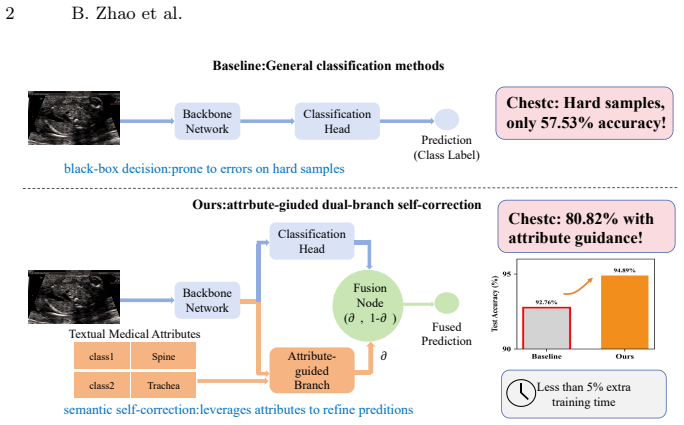
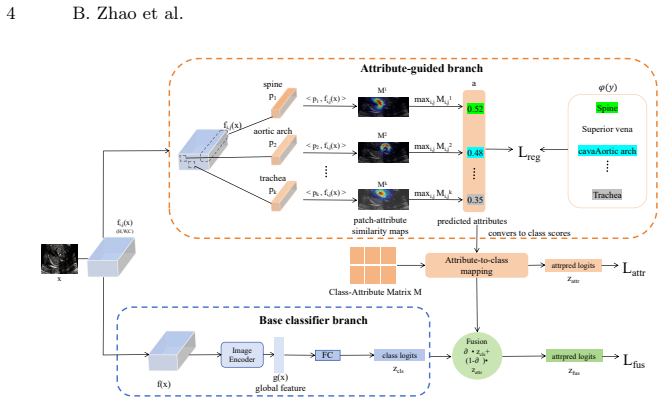
The attribute-guided dual-branch framework consists of a baseline branch that follows conventional architectures to predict image categories via a fully connected classifier, an attribute-guided branch that injects domain-agnostic attributes as priors and produces human-interpretable decision cues, and an adaptive decision module that fuses the two branches in a data-dependent manner; experiments show this construction can be integrated into multiple backbones and state-of-the-art methods with low overhead while consistently raising accuracy and interpretability across diverse ultrasound classification tasks.
What carries the argument
Attribute-guided dual-branch framework, in which the attribute-guided branch injects domain-agnostic medical attribute priors to generate interpretable cues that are then fused adaptively with a conventional baseline branch.
If this is right
- The same module can be added to multiple existing classification backbones with only low computational overhead.
- Accuracy rises on a range of ultrasound tasks when the attribute branch is included.
- Decision cues produced by the attribute branch supply human-interpretable evidence alongside the final label.
- The adaptive fusion step lets the model rely more or less on the priors depending on the input image.
Where Pith is reading between the lines
- If the priors prove portable, the same branch design could be tested on other imaging modalities such as X-ray or histopathology slides.
- The interpretability gain could be measured by asking clinicians to rate explanation quality before and after adding the attribute branch.
- Failure to improve on a new scanner type would indicate that the priors need to be made scanner-aware rather than fully domain-agnostic.
Load-bearing premise
Domain-agnostic medical attribute priors exist that can be defined once and injected into the network so that they reliably improve generalization on new tasks without task-specific tuning or new failure modes.
What would settle it
Running the method on a held-out ultrasound dataset from a different clinical site or scanner and finding no accuracy gain or no gain in human-rated interpretability compared with the unmodified baseline backbone.
Figures
read the original abstract
Ultrasound image classification is essential for computer-aided diagnosis. However, current methods often neglect clinical priors, leading to poor generalization in challenging scenarios and a lack of interpretability that limits clinical adoption. To address these issues, we aim to develop a medical-prior module that can be seamlessly integrated into existing pipelines to enhance both diagnostic performance and interpretability. In this paper, we propose an attribute-guided dual-branch framework for ultrasound classification that introduces domain-agnostic medical attribute priors, improving generalization while offering interpretable evidence. Specifically, a baseline branch follows conventional architectures and predicts image categories via a fully connected classifier. An attribute-guided branch injects domain-agnostic attributes as priors and produces human-interpretable decision cues. Finally, an adaptive decision module fuses the two branches in a data-dependent manner to yield the final prediction. Experiments across diverse ultrasound classification tasks demonstrate that our approach can be integrated into multiple backbones and state-of-the-art methods with low overhead, consistently improving accuracy and interpretability. Code is available at: https://github.com/zhaobo253-crypto/AttrGuide.
Editorial analysis
A structured set of objections, weighed in public.
Referee Report
Summary. The manuscript proposes an attribute-guided dual-branch framework for ultrasound image classification. A baseline branch uses conventional architectures and a fully connected classifier; an attribute-guided branch injects domain-agnostic medical attribute priors to produce human-interpretable cues; an adaptive decision module fuses the branches data-dependently. The central claim is that the framework integrates into multiple backbones and SOTA methods with low overhead, yielding consistent gains in accuracy and interpretability across diverse tasks. Code is released at the provided GitHub link.
Significance. If the empirical gains hold and the priors prove reliably domain-agnostic, the work could improve generalization and clinical interpretability in ultrasound CAD with minimal added cost. The explicit code release is a clear strength supporting reproducibility.
major comments (2)
- [Method] Method section: the attribute-guided branch is specified only architecturally (attribute injection, human-interpretable cues, adaptive fusion); no concrete attribute inventory, encoding procedure, or cross-task invariance test appears. This directly underpins the headline claim that the priors are domain-agnostic and beneficial without per-task engineering.
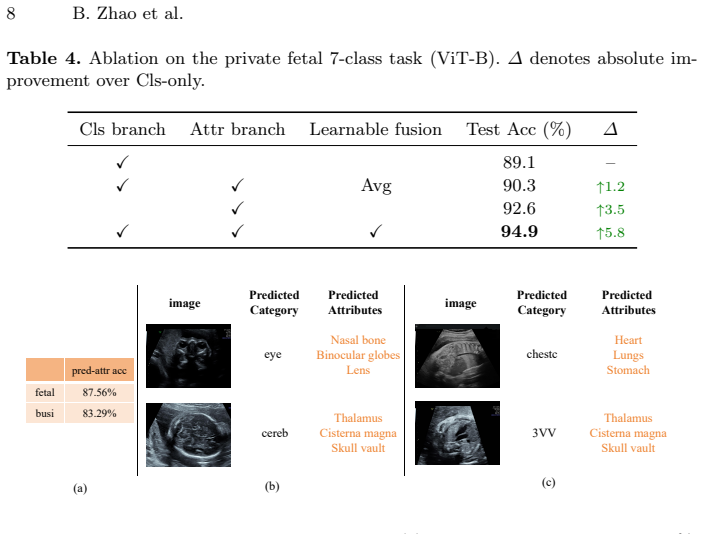
- [Experiments] Experiments section: while the abstract asserts consistent improvements across tasks and backbones, the manuscript description supplies neither quantitative tables, ablation results on the attribute branch, nor details on attribute acquisition/validation, leaving the central empirical claim only moderately supported.
minor comments (1)
- Abstract would be strengthened by including at least one key quantitative result (e.g., accuracy delta on a representative task) to ground the claim of consistent improvement.
Simulated Author's Rebuttal
We thank the referee for the constructive feedback. We address each major comment below and will revise the manuscript to strengthen the supporting details.
read point-by-point responses
-
Referee: [Method] Method section: the attribute-guided branch is specified only architecturally (attribute injection, human-interpretable cues, adaptive fusion); no concrete attribute inventory, encoding procedure, or cross-task invariance test appears. This directly underpins the headline claim that the priors are domain-agnostic and beneficial without per-task engineering.
Authors: We agree that the current method description is primarily architectural and lacks the requested specifics. In the revised manuscript we will add a subsection providing the concrete attribute inventory (standard ultrasound features such as echogenicity and margin descriptors drawn from clinical literature), the encoding procedure (fixed-length binary/continuous vectors), and cross-task invariance results demonstrating consistent performance gains without task-specific re-engineering. revision: yes
-
Referee: [Experiments] Experiments section: while the abstract asserts consistent improvements across tasks and backbones, the manuscript description supplies neither quantitative tables, ablation results on the attribute branch, nor details on attribute acquisition/validation, leaving the central empirical claim only moderately supported.
Authors: We acknowledge that the experiments section as presented requires expansion to fully support the claims. The revised version will include quantitative tables reporting accuracy gains across backbones and tasks, dedicated ablations isolating the attribute branch, and explicit information on attribute acquisition (from domain literature) and validation (consistency checks). revision: yes
Circularity Check
No derivation chain present; framework proposal is architectural, not deductive.
full rationale
The paper describes an attribute-guided dual-branch architecture (baseline branch + attribute-guided branch + adaptive fusion) and reports experimental gains when integrated into existing backbones. No equations, first-principles derivations, predictions of derived quantities, or self-citations appear in the abstract or method sketch. The claimed improvements are empirical outcomes of the proposed module rather than quantities shown to equal their inputs by construction. No load-bearing self-referential steps exist, so the central claim is independent of any circular reduction.
Axiom & Free-Parameter Ledger
axioms (1)
- domain assumption Domain-agnostic medical attributes exist that can be injected as priors without task-specific engineering
Reference graph
Works this paper leans on
-
[1]
Burgos-Artizzu, X.P., Coronado-Gutiérrez, D., Valenzuela-Alcaraz, B., et al.: Eval- uation of deep convolutional neural networks for automatic classification of com- mon maternal fetal ultrasound planes.Scientific Reports10, 10200 (2020)
2020
-
[2]
Al-Dhabyani, W., et al.: Dataset of breast ultrasound images.Data in Brief28, 104863 (2020)
2020
-
[3]
Chen, Y., Zhao, S., Chen, B., Gustaf, M.: Clinically guided adaptive contrast ad- justment for fetal plane classification: a modular plug-and-play solution.Frontiers in Physiology16, 1689936 (2025)
2025
-
[4]
Litjens, G., et al.: A survey on deep learning in medical image analysis.Medical Image Analysis42, 60–88 (2017)
2017
-
[5]
Tajbakhsh, N., et al.: Convolutional Neural Networks for Medical Image Analysis: Full Training or Fine Tuning?IEEE Transactions on Medical Imaging35(5), 1299– 1312 (2016)
2016
-
[6]
In:Proceedings of ICCV, pp
Azizi, S., et al.: Big self-supervised models advance medical image classification. In:Proceedings of ICCV, pp. 3478–3488 (2021)
2021
-
[7]
In: Proceedings of MICCAI(2024)
Shakeri, F., et al.: Few-shot Adaptation of Medical Vision-Language Models. In: Proceedings of MICCAI(2024)
2024
-
[8]
In:Proceedings of MICCAI(2024)
Huang, Y., Cheng, P., Tam, R., Tang, X.: Fine-grained Prompt Tuning: A Param- eter and Memory Efficient Transfer Learning Method for High-resolution Medical Image Classification. In:Proceedings of MICCAI(2024)
2024
-
[9]
In: Proceedings of MICCAI(2024)
Hussein, N., Shamshad, F., Naseer, M., Nandakumar, K.: PromptSmooth: Cer- tifying Robustness of Medical Vision-Language Models via Prompt Learning. In: Proceedings of MICCAI(2024)
2024
-
[10]
Zech, J.R., et al.: Variable generalization performance of a deep learning model to detect pneumonia in chest radiographs: a cross-sectional study.PLoS Medicine 15(11), e1002683 (2018)
2018
-
[11]
In:Proceedings of ICML, pp
Chen, T., et al.: A simple framework for contrastive learning of visual representa- tions. In:Proceedings of ICML, pp. 1597–1607 (2020)
2020
-
[12]
In:Proceedings of CVPR, pp
He, K., et al.: Momentum contrast for unsupervised visual representation learning. In:Proceedings of CVPR, pp. 9729–9738 (2020)
2020
-
[13]
In:Medical Image Computing and Computer Assisted Intervention – MICCAI 2022, pp
You,K.,Lee,S.,Jo,K.,Park,E.,Kooi,T.,Nam,H.:Intra-classcontrastivelearning improves computer aided diagnosis of breast cancer in mammography. In:Medical Image Computing and Computer Assisted Intervention – MICCAI 2022, pp. 331– 340 (2022)
2022
-
[14]
Zheng, X., et al.: XFMamba: Cross-Fusion Mamba for Multi-View Medical Image Classification. arXiv:2503.02619 (2025)
-
[15]
Feng, Z., Fu, J., Zou, X., Ye, H., Wu, H., Zhou, J., Wang, Y.: Hybrid-View Atten- tionNetworkforClinicallySignificantProstateCancerClassificationinTransrectal Ultrasound. arXiv:2507.03421 (2025)
-
[16]
Pattern Anal
Lampert, C.H., Nickisch, H., Harmeling, S.: Attribute-based classification for zero- shot visual object categorization.IEEE Trans. Pattern Anal. Mach. Intell.36(3), 453–465 (2014)
2014
-
[17]
In:Medical Image Computing and Com- puter Assisted Intervention – MICCAI 2023, pp
Lei, Y., Li, Z., Shen, Y., Zhang, J., Shan, H.: CLIP-Lung: Textual knowledge- guided lung nodule malignancy prediction. In:Medical Image Computing and Com- puter Assisted Intervention – MICCAI 2023, pp. 403–412 (2023)
2023
-
[18]
In:Proceedings of MICCAI(2024); arXiv:2405.12255
Ghosh, S., Poynton, C.B., Visweswaran, S., Batmanghelich, K.: Mammo-CLIP: A Vision Language Foundation Model to Enhance Data Efficiency and Robustness in Mammography. In:Proceedings of MICCAI(2024); arXiv:2405.12255. 10 B. Zhao et al
-
[19]
Learning Transferable Visual Models From Natural Language Supervision
Radford, A., et al.: Learning transferable visual models from natural language supervision. arXiv:2103.00020 (2021)
work page internal anchor Pith review Pith/arXiv arXiv 2021
- [20]
-
[21]
Fang, X., Lin, Y., Zhang, D., Cheng, K.-T., Chen, H.: Aligning Medical Images with General Knowledge from Large Language Models. arXiv:2409.00341 (2024)
-
[22]
Koh, P.W., Nguyen, T., Tang, Y.S., Mussmann, S., Pierson, E., Kim, B., Liang, P.: Concept Bottleneck Models. arXiv:2007.04612 (2020)
-
[23]
Label-free concept bottleneck models
Oikarinen, T., Das, S., Nguyen, L.M., Weng, T.-W.: Label-Free Concept Bottleneck Models. arXiv:2304.06129 (2023)
-
[24]
Post-hoc concept bottleneck models.arXiv preprint arXiv:2205.15480, 2022
Yuksekgonul, M., Wang, M., Zou, J.: Post-hoc Concept Bottleneck Models. arXiv:2205.15480 (2023)
-
[25]
Pattern Anal
Kittler, J., Hatef, M., Duin, R.P.W., Matas, J.: On combining classifiers.IEEE Trans. Pattern Anal. Mach. Intell.20(3), 226–239 (1998)
1998
-
[26]
Guo, S., Wang, L., Chen, Q., Wang, L., Zhang, J., Zhu, Y.: Multimodal MRI image decision fusion-based network for glioma classification.Frontiers in Oncology12, 819673 (2022)
2022
-
[27]
Nasiri-Sarvi, A., Hosseini, M.S., Rivaz, H.: Vision Mamba for Classification of Breast Ultrasound Images. arXiv:2407.03552 (2024). (MICCAI 2024 Deep-Breath Workshop)
-
[28]
Lin, Z., et al.: UniUSNet: A Promptable Framework for Universal Ultrasound Dis- ease Prediction and Tissue Segmentation. arXiv:2406.01154 (2024)
-
[29]
Chen, S., Wang, W., Xia, B., et al.: TransZero: Attribute-Guided Transformer for Zero-Shot Learning. arXiv:2112.01683 (2021)
-
[30]
Aumente-Maestro, C., Díez, J., Remeseiro, B.: A multi-task framework for breast cancer segmentation and classification in ultrasound imaging.Computer Methods and Programs in Biomedicine260, 108540 (2025)
2025
discussion (0)
Sign in with ORCID, Apple, or X to comment. Anyone can read and Pith papers without signing in.