ProSAC-CT: Progressive Spectral-Anatomical Co-Guided Multi-Stage Diffusion Model for Low-Dose CT Denoising
Pith reviewed 2026-07-03 16:29 UTC · model grok-4.3
The pith
ProSAC-CT denoises low-dose CT images by progressively guiding a diffusion model with anatomical priors and frequency decoupling across stages.
A machine-rendered reading of the paper's core claim, the machinery that carries it, and where it could break.
Core claim
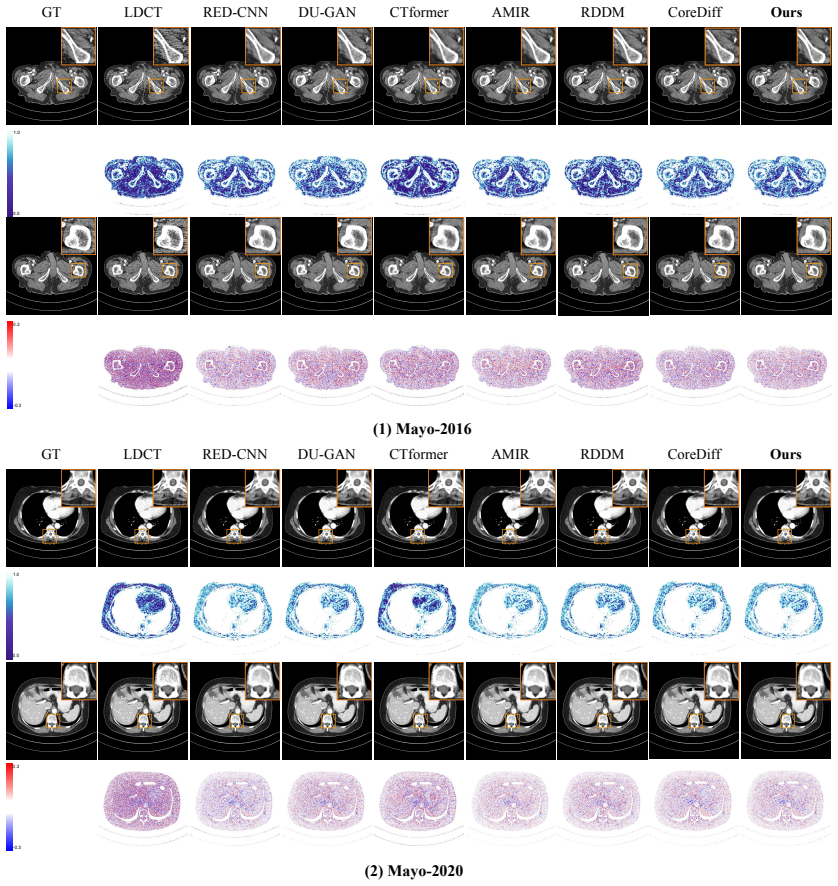
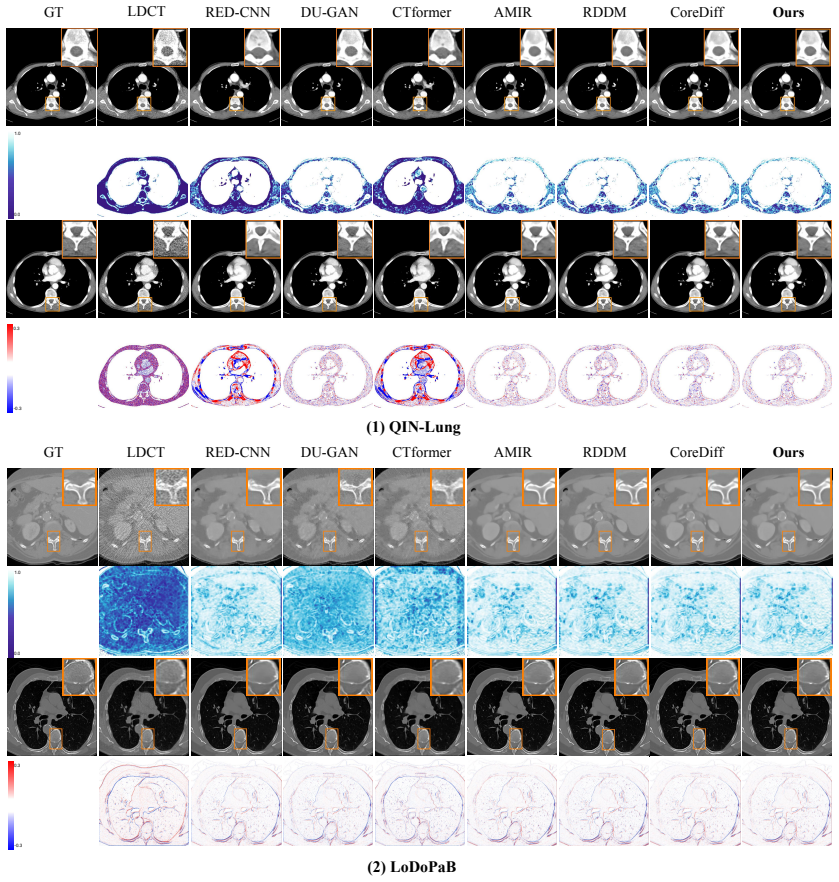
ProSAC-CT integrates APGC to extract LDCT-derived structural guidance, RFDDS to enhance frequency-aware representations, and TD3 to assign them to different reverse-diffusion stages for anatomical stabilization, boundary refinement, and fine-detail recovery, yielding measurable gains in image fidelity, structural similarity, perceptual quality, and information preservation on four LDCT benchmarks while better retaining boundary-sensitive anatomical details.
What carries the argument
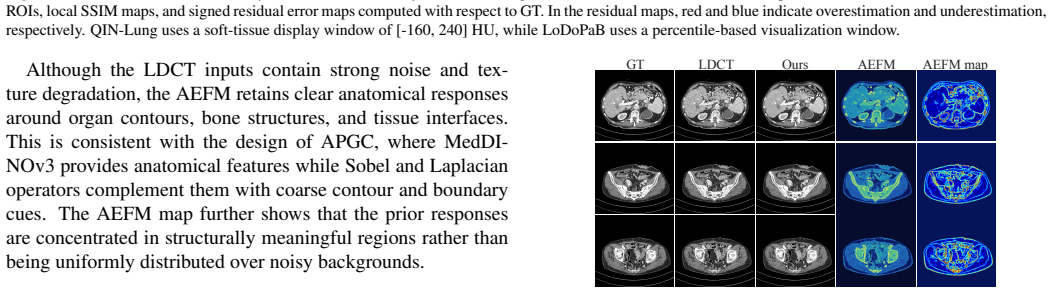
The ProSAC-CT model whose three modules (APGC for anatomical conditioning, RFDDS for frequency decoupling, TD3 for stage-specific decoding) progressively co-guide the diffusion reverse process.
If this is right
- LDCT images exhibit higher fidelity and structural similarity than those from prior diffusion denoisers on the tested benchmarks.
- Boundary-sensitive anatomical details remain more intact after denoising.
- Perceptual quality and information preservation improve relative to representative methods.
- Downstream anatomical-region classification on Mayo-2020 data retains more task-relevant information.
Where Pith is reading between the lines
- If the staged guidance pattern holds, similar frequency-and-anatomy decoupling could be tested on other inverse problems such as MRI reconstruction from undersampled data.
- The reported retention of classification performance suggests the method may support reduced-dose protocols in screening workflows where diagnostic accuracy must stay constant.
- Extending the time-step decoupling idea to non-uniform noise distributions across body regions could address streak artifacts that vary by anatomy.
Load-bearing premise
The three proposed modules actually deliver anatomical stabilization, frequency-aware recovery, and stage-specific refinement as claimed.
What would settle it
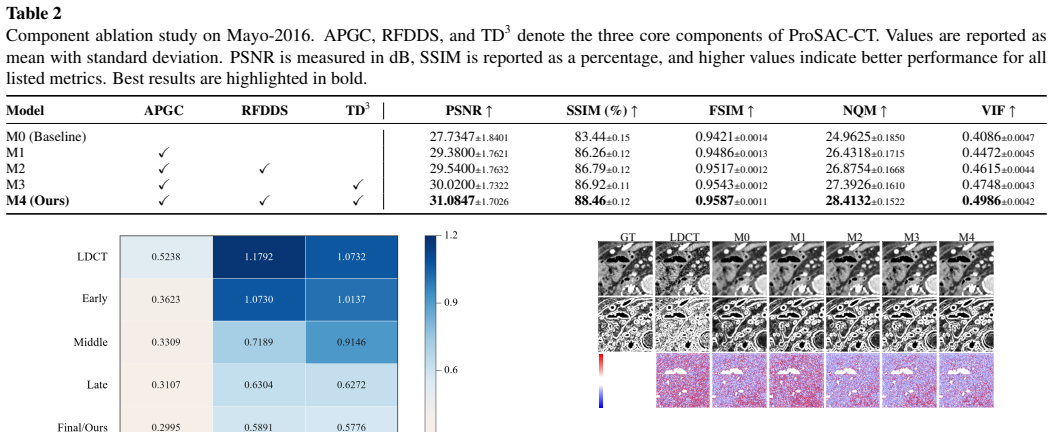
An ablation experiment on the Mayo or similar benchmark in which removing any one module produces no measurable drop in PSNR, SSIM, or boundary preservation metrics would falsify the claim that the co-guidance mechanism is responsible for the reported gains.
Figures



read the original abstract
Low-dose computed tomography (LDCT) reduces radiation exposure but introduces stronger quantum noise, streak artifacts, and local texture degradation, which can obscure anatomical boundaries and weaken low-contrast structures. Diffusion models are promising for LDCT denoising by progressively recovering normal-dose CT (NDCT) images from degraded LDCT inputs, but existing methods often suffer from insufficient anatomical guidance, uncertain frequency-dependent recovery, and uniform reverse-process modeling. We propose ProSAC-CT, a progressive spectral-anatomical co-guided multi-stage diffusion model for image-domain LDCT denoising. ProSAC-CT integrates an anatomical-prior-guided conditioning (APGC) module, a residual frequency-domain decoupling stage (RFDDS), and a time-step-decoupling denoising decoder (TD3). APGC extracts LDCT-derived structural guidance, RFDDS enhances frequency-aware representations, and TD3 assigns them to different reverse-diffusion stages for anatomical stabilization, boundary refinement, and fine-detail recovery. Experiments on four LDCT degradation benchmarks show that ProSAC-CT improves image fidelity, structural similarity, perceptual quality, and information preservation over representative methods while better preserving boundary-sensitive anatomical details. Downstream anatomical-region classification on Mayo-2020 further indicates that ProSAC-CT retains task-relevant anatomical information, supporting its practical use for low-dose CT denoising.
Editorial analysis
A structured set of objections, weighed in public.
Referee Report
Summary. The manuscript introduces ProSAC-CT, a progressive spectral-anatomical co-guided multi-stage diffusion model for low-dose CT (LDCT) denoising. It integrates three modules—an anatomical-prior-guided conditioning (APGC) module, a residual frequency-domain decoupling stage (RFDDS), and a time-step-decoupling denoising decoder (TD3)—to supply structural guidance from LDCT, enhance frequency-aware representations, and assign refinements to specific reverse-diffusion stages. Experiments on four LDCT degradation benchmarks demonstrate gains in image fidelity, structural similarity, perceptual quality, and information preservation over representative methods, with improved boundary-sensitive anatomical detail retention; a downstream anatomical-region classification task on Mayo-2020 further supports retention of task-relevant information.
Significance. If the reported gains hold under full verification, the work provides a targeted extension of diffusion models to LDCT by coupling anatomical priors with frequency decoupling across stages. This addresses documented weaknesses in uniform reverse processes and could support lower radiation doses while preserving diagnostic features. The inclusion of a downstream classification evaluation strengthens the claim of practical utility beyond pixel-level metrics.
minor comments (2)
- [Abstract] The abstract states results on 'four LDCT degradation benchmarks' without naming the datasets; adding the specific benchmark names (e.g., Mayo, AAPM, etc.) would improve immediate readability.
- [§3.3] Section 3.3 (TD3 description) introduces stage-specific assignment but does not explicitly state how the time-step decoupling interacts with the frequency bands from RFDDS; a short clarifying sentence or diagram annotation would reduce ambiguity.
Simulated Author's Rebuttal
We thank the referee for the supportive review, the accurate summary of our contributions, and the recommendation for minor revision. We appreciate the recognition of the practical utility demonstrated via the downstream classification task.
Circularity Check
No significant circularity; derivation is self-contained
full rationale
The paper introduces ProSAC-CT as a new multi-stage diffusion architecture with three modules (APGC, RFDDS, TD3) whose roles are defined descriptively in the abstract and methods. No equations, parameter-fitting loops, or predictions that reduce by construction to fitted inputs are present. No self-citation chains or uniqueness theorems are invoked as load-bearing premises. Experimental claims rest on external benchmarks (four LDCT datasets, Mayo-2020 classification) rather than internal redefinitions. The central claim of improved fidelity and anatomical preservation is therefore not equivalent to its inputs by definition and receives a score of 0.
Axiom & Free-Parameter Ledger
Reference graph
Works this paper leans on
-
[1]
IEEE transactions on medical imaging , volume=
Low-dose CT with a residual encoder-decoder convolutional neural network , author=. IEEE transactions on medical imaging , volume=. 2017 , publisher=
work page 2017
-
[2]
EURASIP Journal on Advances in Signal Processing , volume=
Disentangled generative adversarial network for low-dose CT , author=. EURASIP Journal on Advances in Signal Processing , volume=. 2021 , publisher=
work page 2021
-
[3]
IEEE Transactions on Medical Imaging , volume=
Low-Dose CT Image Denoising Using a Generative Adversarial Network With Wasserstein Distance and Perceptual Loss , author=. IEEE Transactions on Medical Imaging , volume=. 2018 , publisher=
work page 2018
-
[4]
UNAD: Universal anatomy-initialized noise distribution learning framework towards low-dose CT denoising , author=. ICASSP 2024-2024 IEEE International Conference on Acoustics, Speech and Signal Processing (ICASSP) , pages=. 2024 , organization=
work page 2024
-
[5]
Physics in Medicine & Biology , volume=
CTformer: convolution-free Token2Token dilated vision transformer for low-dose CT denoising , author=. Physics in Medicine & Biology , volume=. 2023 , publisher=
work page 2023
-
[6]
International conference on medical image computing and computer-assisted intervention , pages=
All-in-one medical image restoration via task-adaptive routing , author=. International conference on medical image computing and computer-assisted intervention , pages=. 2024 , organization=
work page 2024
-
[7]
Liu, Guan-Horng and Vahdat, Arash and Huang, De-An and Theodorou, Evangelos A and Nie, Weili and Anandkumar, Anima , journal=
-
[8]
Proceedings of the IEEE/CVF Conference on Computer Vision and Pattern Recognition , pages=
Residual denoising diffusion models , author=. Proceedings of the IEEE/CVF Conference on Computer Vision and Pattern Recognition , pages=
-
[9]
Advances in Neural Information Processing Systems , volume=
Resshift: Efficient diffusion model for image super-resolution by residual shifting , author=. Advances in Neural Information Processing Systems , volume=
-
[10]
IEEE Transactions on Medical Imaging , volume=
CoreDiff: Contextual error-modulated generalized diffusion model for low-dose CT denoising and generalization , author=. IEEE Transactions on Medical Imaging , volume=. 2023 , publisher=
work page 2023
-
[11]
Medical Imaging 2016: Physics of Medical Imaging , volume=
An open library of CT patient projection data , author=. Medical Imaging 2016: Physics of Medical Imaging , volume=. 2016 , organization=
work page 2016
-
[12]
Low-dose CT image and projection dataset , author=. Medical physics , volume=. 2021 , publisher=
work page 2021
-
[13]
LoDoPaB-CT, a benchmark dataset for low-dose computed tomography reconstruction , author=. Scientific Data , volume=. 2021 , publisher=
work page 2021
- [14]
-
[15]
IEEE transactions on Image Processing , volume=
FSIM: A feature similarity index for image quality assessment , author=. IEEE transactions on Image Processing , volume=. 2011 , publisher=
work page 2011
-
[16]
IEEE Transactions on image processing , volume=
Image information and visual quality , author=. IEEE Transactions on image processing , volume=. 2006 , publisher=
work page 2006
-
[17]
IEEE transactions on image processing , volume=
Image quality assessment based on a degradation model , author=. IEEE transactions on image processing , volume=. 2000 , publisher=
work page 2000
-
[18]
Journal of nuclear medicine technology , volume=
Principles of CT: radiation dose and image quality , author=. Journal of nuclear medicine technology , volume=. 2007 , publisher=
work page 2007
-
[19]
Archives of internal medicine , volume=
Radiation dose associated with common computed tomography examinations and the associated lifetime attributable risk of cancer , author=. Archives of internal medicine , volume=. 2009 , publisher=
work page 2009
-
[20]
Recurrent CT, cumulative radiation exposure, and associated radiation-induced cancer risks from CT of adults , author=. Radiology , volume=. 2009 , publisher=
work page 2009
-
[21]
International conference on machine learning , pages=
Deep unsupervised learning using nonequilibrium thermodynamics , author=. International conference on machine learning , pages=. 2015 , organization=
work page 2015
-
[22]
Advances in neural information processing systems , volume=
Denoising diffusion probabilistic models , author=. Advances in neural information processing systems , volume=
-
[23]
Denoising Diffusion Implicit Models
Denoising diffusion implicit models , author=. arXiv preprint arXiv:2010.02502 , year=
work page internal anchor Pith review Pith/arXiv arXiv 2010
-
[24]
International conference on machine learning , pages=
Improved denoising diffusion probabilistic models , author=. International conference on machine learning , pages=. 2021 , organization=
work page 2021
-
[25]
Proceedings of the IEEE/CVF conference on computer vision and pattern recognition , pages=
Solving 3d inverse problems using pre-trained 2d diffusion models , author=. Proceedings of the IEEE/CVF conference on computer vision and pattern recognition , pages=
-
[26]
Proceedings of the IEEE/CVF conference on computer vision and pattern recognition , pages=
High-resolution image synthesis with latent diffusion models , author=. Proceedings of the IEEE/CVF conference on computer vision and pattern recognition , pages=
-
[27]
Proceedings of the IEEE/CVF international conference on computer vision , pages=
Diffir: Efficient diffusion model for image restoration , author=. Proceedings of the IEEE/CVF international conference on computer vision , pages=
-
[28]
Nature Machine Intelligence , volume=
Competitive performance of a modularized deep neural network compared to commercial algorithms for low-dose CT image reconstruction , author=. Nature Machine Intelligence , volume=. 2019 , publisher=
work page 2019
-
[29]
Nature machine intelligence , volume=
Deep learning for tomographic image reconstruction , author=. Nature machine intelligence , volume=. 2020 , publisher=
work page 2020
-
[30]
Advances in Neural Information Processing Systems , volume=
Cold diffusion: Inverting arbitrary image transforms without noise , author=. Advances in Neural Information Processing Systems , volume=
-
[31]
A performance comparison of convolutional neural network-based image denoising methods: the effect of loss functions on low-dose CT images , author=. Medical physics , volume=. 2019 , publisher=
work page 2019
-
[32]
A bias-reducing loss function for CT image denoising , author=. ICASSP 2021-2021 IEEE International Conference on Acoustics, Speech and Signal Processing (ICASSP) , pages=. 2021 , organization=
work page 2021
-
[33]
Neural Processing Letters , volume=
A complete review on image denoising techniques for medical images , author=. Neural Processing Letters , volume=. 2023 , publisher=
work page 2023
-
[34]
Research status and prospect for low-dose CT imaging , author=. J. Data Acquisition Process. , volume=
-
[35]
CT-guided microcoil pulmonary nodule localization prior to video-assisted thoracoscopic surgery: diagnostic utility and recurrence-free survival , author=. Radiology , volume=. 2019 , publisher=
work page 2019
-
[36]
Radiotherapy and Oncology , volume=
CT-based radiomic analysis of stereotactic body radiation therapy patients with lung cancer , author=. Radiotherapy and Oncology , volume=. 2016 , publisher=
work page 2016
-
[37]
Cycle-consistent adversarial denoising network for multiphase coronary CT angiography , author=. Medical physics , volume=. 2019 , publisher=
work page 2019
-
[38]
IEEE transactions on medical imaging , volume=
Ray contribution masks for structure adaptive sinogram filtering , author=. IEEE transactions on medical imaging , volume=. 2012 , publisher=
work page 2012
-
[39]
Projection space denoising with bilateral filtering and CT noise modeling for dose reduction in CT , author=. Medical physics , volume=. 2009 , publisher=
work page 2009
-
[40]
AirNet: fused analytical and iterative reconstruction with deep neural network regularization for sparse-data CT , author=. Medical physics , volume=. 2020 , publisher=
work page 2020
-
[41]
Physics in medicine and biology , volume=
Sparse-view x-ray CT reconstruction via total generalized variation regularization , author=. Physics in medicine and biology , volume=. 2014 , publisher=
work page 2014
-
[42]
IEEE Transactions on Computational Imaging , volume=
Image denoising for low-dose CT via convolutional dictionary learning and neural network , author=. IEEE Transactions on Computational Imaging , volume=. 2023 , publisher=
work page 2023
-
[43]
Signal, Image and Video Processing , volume=
LDCT image quality improvement algorithm based on optimal wavelet basis and MCA , author=. Signal, Image and Video Processing , volume=. 2022 , publisher=
work page 2022
-
[44]
IEEE transactions on medical imaging , volume=
Low-dose X-ray CT reconstruction via dictionary learning , author=. IEEE transactions on medical imaging , volume=. 2012 , publisher=
work page 2012
-
[45]
IEEE transactions on medical imaging , volume=
PWLS-ULTRA: An efficient clustering and learning-based approach for low-dose 3D CT image reconstruction , author=. IEEE transactions on medical imaging , volume=. 2018 , publisher=
work page 2018
-
[46]
Physics in medicine and biology , volume=
Adaptive-weighted total variation minimization for sparse data toward low-dose x-ray computed tomography image reconstruction , author=. Physics in medicine and biology , volume=. 2012 , publisher=
work page 2012
-
[47]
Deep Residual Learning for Image Recognition , author=. 2015 , eprint=
work page 2015
-
[48]
Swin Transformer: Hierarchical Vision Transformer using Shifted Windows , author=. 2021 , eprint=
work page 2021
-
[49]
MambaOut: Do We Really Need Mamba for Vision? , author=. 2024 , eprint=
work page 2024
-
[50]
Li, Bo and Xue, Kaitao and Liu, Bin and Lai, Yu-Kun , booktitle=
-
[51]
Pan, Shaoyan and Wang, Tonghe and Qiu, Richard L J and Axente, Marian and Chang, Chih-Wei and Peng, Junbo and Patel, Ashish B and Shelton, Joseph and Patel, Sagar A and Roper, Justin and Yang, Xiaofeng , journal=. 2023 , publisher=
work page 2023
-
[52]
Biguri, Ander and Dosanjh, Manjit and Hancock, Steven and Soleimani, Manuchehr , journal=. 2016 , publisher=
work page 2016
-
[53]
Ordered-subset simultaneous algebraic reconstruction techniques (
Wang, Ge and Jiang, Ming , journal=. Ordered-subset simultaneous algebraic reconstruction techniques (. 2004 , publisher=
work page 2004
-
[54]
arXiv preprint arXiv:2509.02379 , year=
MedDINOv3: How to adapt vision foundation models for medical image segmentation? , author=. arXiv preprint arXiv:2509.02379 , year=
discussion (0)
Sign in with ORCID, Apple, or X to comment. Anyone can read and Pith papers without signing in.