Colour evolution in the radio afterglow of GRB 241025A
Pith reviewed 2026-07-03 07:55 UTC · model grok-4.3
The pith
Radio color evolution in GRB 241025A afterglow requires a 500-fold boost to optical depth in a structured jet forward shock.
A machine-rendered reading of the paper's core claim, the machinery that carries it, and where it could break.
Core claim
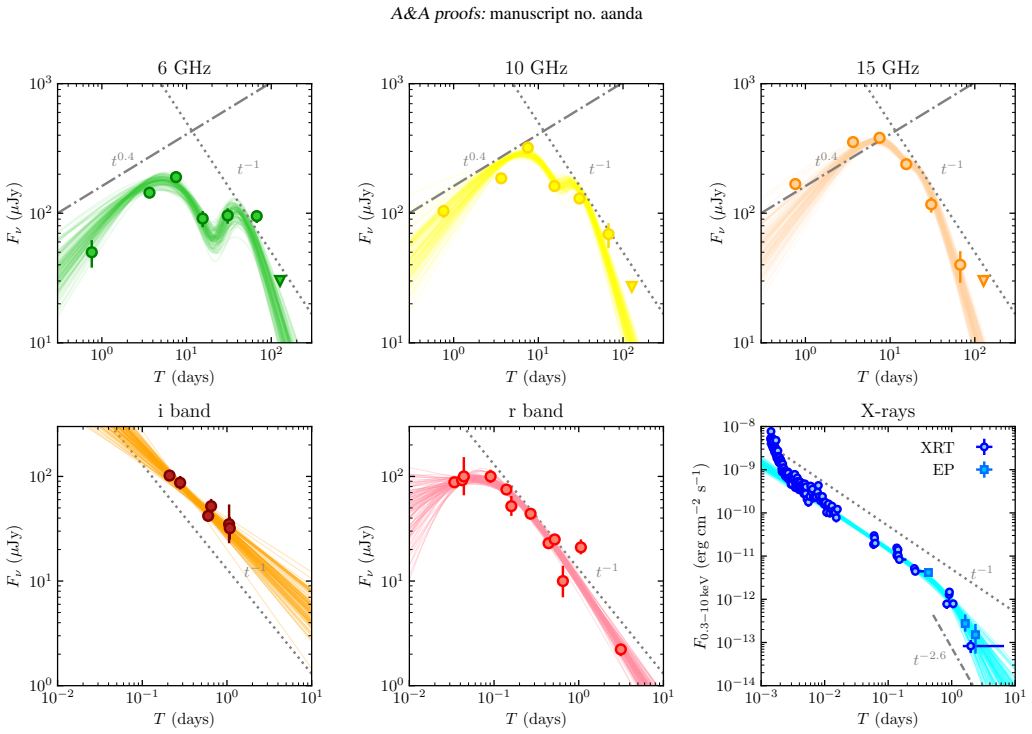
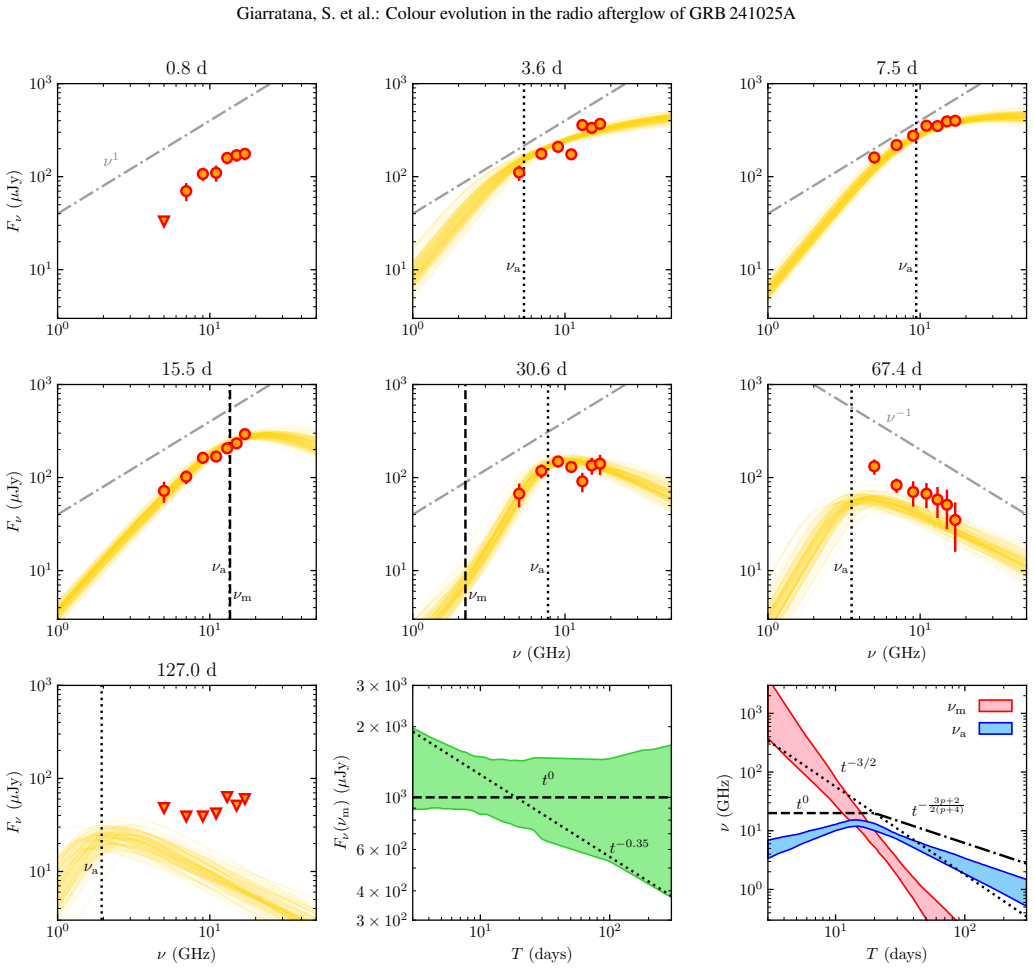
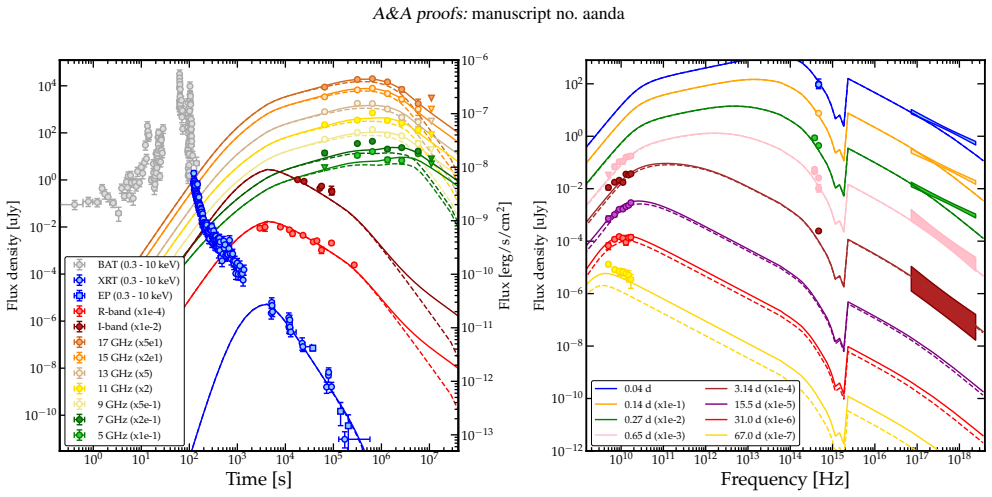
The radio colour evolution together with the near-infrared, optical and X-ray emission can be described reasonably well by a forward shock from a structured jet, provided that the optical depth in the shocked material is enhanced by a factor τ_enh=500.
What carries the argument
Multiplicative factor τ_enh applied to the optical depth in the semi-analytical afterglow model, which raises the synchrotron self-absorption frequency to reproduce the observed radio spectral evolution over time.
If this is right
- The unmodified standard afterglow model in the slow-cooling regime is inconsistent with the observed radio colour evolution.
- A structured jet is required once the optical depth is adjusted to fit the combined radio through X-ray data.
- The enhancement can be produced by cold electrons in the downstream region that were not accelerated by the shock.
- Dense, multi-epoch radio observations are necessary to reveal such deviations from basic afterglow theory.
Where Pith is reading between the lines
- If cold electrons are routinely present, many existing GRB afterglow fits that ignore them may systematically mis-estimate jet energy or structure.
- Similar radio colour changes in other bursts would indicate how common this optical-depth boost is across the GRB population.
- Radio data at frequencies below the self-absorption turnover could directly test whether the required enhancement occurs.
Load-bearing premise
A population of cold electrons can increase the optical depth by a factor of 500 without violating other constraints from the same observations or from the electron energy distribution.
What would settle it
An independent measurement of the electron energy distribution that limits the number of cold electrons to far below the level needed for a 500-fold optical-depth increase.
Figures
read the original abstract
We present the observing campaign of the afterglow of GRB241025A, a gamma-ray burst (GRB) whose prompt emission has been simultaneously detected by Swift, Einstein Probe, Fermi/GBM, SVOM, Konus-Wind and VZLUSAT-2 3U CubeSat. Our multi-wavelength campaign comprises radio, near-infrared, Optical and X-ray observations. The afterglow was clearly detected in all bands. We performed a semi-empirical fit of the data, showing that the afterglow behaviour can be reasonably reproduced by a single component, i.e. an ultra-relativistic shock. However, the results from the semi-empirical fit are inconsistent with the predicted evolution from the standard afterglow model in the slow cooling regime. Specifically, we found that at early times the synchrotron self-absorption frequency $\nu_a$ should be at higher frequencies with respect to the ones sampled by our campaign, in order to explain the observed colour evolution in radio, namely the spectral evolution in time. To reconcile the prediction from the standard model with the observed data set, we fit the observations with a semi-analytical model, including a multiplicative factor $\tau_{enh}$ to the optical depth which, in turn, artificially increases $\nu_a$. We found that the radio colour evolution, together with the near-infrared, optical and X-ray emission, can be described reasonably well by a forward shock from a structured jet, provided that the optical depth in the shocked material is enhanced by a factor $\tau_{enh}=500$. We suggest that such enhancement in the optical depth can result from a population of cold electrons in the downstream material, i.e. electrons that were not accelerated by Fermi I process at the shock front, in agreement with the theoretical expectations previously reported in the literature. Overall, our work underscores the importance of systematic, multi-frequency, multi-epoch radio follow-ups of these extreme events.
Editorial analysis
A structured set of objections, weighed in public.
Referee Report
Summary. The manuscript presents multi-wavelength (radio through X-ray) observations of the afterglow of GRB 241025A and shows via semi-empirical and semi-analytical modeling that the radio spectral (color) evolution together with the NIR/optical/X-ray data can be reproduced by a forward shock in a structured jet, provided the optical depth in the shocked material is multiplied by a factor τ_enh = 500. The authors attribute this enhancement to a population of cold (unaccelerated) electrons downstream and note that such populations are expected theoretically.
Significance. If the physical mapping from cold electrons to τ_enh = 500 can be made quantitative and shown to be consistent with the rest of the data, the result would provide a concrete example of how non-Fermi-I electrons affect radio afterglow observables and would strengthen the case for systematic, multi-epoch radio campaigns on GRBs. The work already demonstrates the diagnostic value of radio color evolution when combined with higher-frequency coverage.
major comments (2)
- [Abstract] Abstract: the value τ_enh = 500 is introduced specifically so that the model reproduces the observed radio color evolution; the manuscript supplies no quantitative relation between a cold-electron fraction and the resulting optical-depth multiplier, nor an explicit check that the implied cold population leaves the slow-cooling synchrotron spectrum (and therefore the fitted NIR/optical/X-ray fluxes and indices) unchanged.
- [Semi-analytical model description] Semi-analytical model description: because the same dataset is used both to constrain the accelerated-electron parameters and to motivate the extra optical depth, it remains unclear whether the cold-electron population required by τ_enh = 500 is already excluded by the observed spectral indices or light-curve shapes in the slow-cooling regime.
Simulated Author's Rebuttal
We thank the referee for their thoughtful comments and for recognizing the potential significance of this work. We provide point-by-point responses below and will make revisions to address the concerns raised.
read point-by-point responses
-
Referee: [Abstract] Abstract: the value τ_enh = 500 is introduced specifically so that the model reproduces the observed radio color evolution; the manuscript supplies no quantitative relation between a cold-electron fraction and the resulting optical-depth multiplier, nor an explicit check that the implied cold population leaves the slow-cooling synchrotron spectrum (and therefore the fitted NIR/optical/X-ray fluxes and indices) unchanged.
Authors: We agree that the manuscript would benefit from a more quantitative discussion of how a cold-electron population could produce τ_enh = 500. In the revised version, we will add a brief calculation or reference to theoretical work showing that a modest fraction of cold electrons can significantly increase the effective optical depth at radio frequencies due to their contribution to the plasma frequency or absorption. For the check on the slow-cooling spectrum, the semi-analytical model was constructed to fit all available data simultaneously, including the NIR, optical, and X-ray bands. The best-fit parameters reproduce the observed fluxes and spectral indices in those bands, demonstrating that the enhancement primarily impacts the self-absorption frequency in the radio without altering the higher-frequency emission. We will include an explicit statement and possibly an additional figure panel illustrating the spectrum with and without the τ_enh factor to make this clear. revision: yes
-
Referee: [Semi-analytical model description] Semi-analytical model description: because the same dataset is used both to constrain the accelerated-electron parameters and to motivate the extra optical depth, it remains unclear whether the cold-electron population required by τ_enh = 500 is already excluded by the observed spectral indices or light-curve shapes in the slow-cooling regime.
Authors: The parameters for the accelerated electron population are determined from the light curves and spectra in the NIR/optical/X-ray regime, where the emission is in the slow-cooling synchrotron regime above the self-absorption frequency. The radio data are used to constrain the self-absorption frequency, which is affected by the enhanced optical depth. The cold electrons are postulated to contribute only to the absorption at low frequencies and not to the radiating population responsible for the higher-frequency emission. Since the model successfully fits the observed spectral indices (e.g., the optical to X-ray slope) and light-curve shapes in the slow-cooling regime, the required cold population is not excluded by those data. We will revise the model description section to explicitly separate these components and discuss why the cold electrons do not impact the observed higher-frequency observables. revision: yes
Axiom & Free-Parameter Ledger
free parameters (1)
- τ_enh =
500
axioms (1)
- domain assumption The afterglow is produced by a single ultra-relativistic forward shock in the slow-cooling regime.
invented entities (1)
-
population of cold electrons in the downstream material
no independent evidence
Reference graph
Works this paper leans on
-
[1]
D., Laskar , T., Berger , E., et al
Alexander , K. D., Laskar , T., Berger , E., et al. 2019, , 870, 67
2019
-
[2]
2024, GCN, 37859, 1
Ambrosi , E., D'Ai , A., D'Elia , V., et al. 2024, GCN, 37859, 1
2024
-
[3]
2020, , 497, 5518
Antier , S., Agayeva , S., Almualla , M., et al. 2020, , 497, 5518
2020
-
[4]
R., & Frail , D
Berger , E., Kulkarni , S. R., & Frail , D. A. 2004, , 612, 966
2004
-
[5]
F., Bartel , N., Argo , M., et al
Bietenholz , M. F., Bartel , N., Argo , M., et al. 2021, , 908, 75
2021
-
[6]
Blandford , R. D. & McKee , C. F. 1976, PhFl, 19, 1130
1976
-
[7]
C., Magnier, E
Chambers, K. C., Magnier, E. A., Metcalfe, N., et al. 2019, The Pan-STARRS1 Surveys
2019
-
[8]
B., Frail , D
Chandra , P., Cenko , S. B., Frail , D. A., et al. 2008, , 683, 924
2008
-
[9]
& Frail , D
Chandra , P. & Frail , D. A. 2012, , 746, 156
2012
-
[10]
W., Bloom , J
Coughlin , M. W., Bloom , J. S., Nir , G., et al. 2023, , 267, 31
2023
-
[11]
2024, GCN, 38162, 1
Dafcikova , M., Ripa , J., Pal , A., et al. 2024, GCN, 38162, 1
2024
-
[12]
& Waxman , E
Eichler , D. & Waxman , E. 2005, , 627, 861
2005
-
[13]
A., Beardmore , A
Evans , P. A., Beardmore , A. P., Page , K. L., et al. 2009, , 397, 1177
2009
-
[14]
A., Beardmore , A
Evans , P. A., Beardmore , A. P., Page , K. L., et al. 2007, , 469, 379
2007
-
[15]
2024, GCN, 37860, 1
Fermi GBM Team . 2024, GCN, 37860, 1
2024
-
[16]
W., Lang , D., & Goodman , J
Foreman-Mackey , D., Hogg , D. W., Lang , D., & Goodman , J. 2013, , 125, 306
2013
-
[17]
A., Metzger , B
Frail , D. A., Metzger , B. D., Berger , E., Kulkarni , S. R., & Yost , S. A. 2004, , 600, 828
2004
-
[18]
A., Soderberg , A
Frail , D. A., Soderberg , A. M., Kulkarni , S. R., et al. 2005, , 619, 994
2005
-
[19]
& M \'e sz \'a ros , P
Gao , H. & M \'e sz \'a ros , P. 2015, AdAst, 2015, 192383
2015
-
[20]
2024, GCN, 38130, 1
Giarratana , S., Giroletti , M., Ghirlanda , G., et al. 2024, GCN, 38130, 1
2024
-
[21]
& Granot , J
Gill , R. & Granot , J. 2023, , 524, L78
2023
-
[22]
R., Osborne , J
Goad , M. R., Osborne , J. P., Beardmore , A. P., Evans , P. A., & Swift-XRT Team. 2024, GCN, 37868, 1
2024
-
[23]
1997, NewA, 2, 449
Goodman , J. 1997, NewA, 2, 449
1997
-
[24]
2024, JOSS, 9, 7023
Gordon , K. 2024, JOSS, 9, 7023
2024
-
[25]
& Sari , R
Granot , J. & Sari , R. 2002, , 568, 820
2002
-
[26]
K., Lata , S., et al
Gupta , A., Ror , A. K., Lata , S., et al. 2024, GCN, 37893, 1
2024
-
[27]
2013, , 208, 19
Hinshaw , G., Larson , D., Komatsu , E., et al. 2013, , 208, 19
2013
-
[28]
Q., Tinyanont , S., Anutarawiramkul , R., et al
Jiang , S. Q., Tinyanont , S., Anutarawiramkul , R., et al. 2024, GCN, 37862, 1
2024
-
[29]
Kalberla , P. M. W., Burton , W. B., Hartmann , D., et al. 2005, , 440, 775
2005
-
[30]
2025, AcPol, 65, 50–64
Karpov, S. 2025, AcPol, 65, 50–64
2025
-
[31]
J., Ambrosi , E., & Swift/UVOT Team
Klingler , N. J., Ambrosi , E., & Swift/UVOT Team . 2024, GCN, 37919, 1
2024
-
[32]
& Sari , R
Kobayashi , S. & Sari , R. 2000, , 542, 819
2000
-
[33]
D., Berger , E., et al
Laskar , T., Alexander , K. D., Berger , E., et al. 2016, , 833, 88
2016
-
[34]
D., Berger , E., et al
Laskar , T., Alexander , K. D., Berger , E., et al. 2018 a , , 862, 94
2018
-
[35]
2018 b , , 858, 65
Laskar , T., Berger , E., Chornock , R., et al. 2018 b , , 858, 65
2018
-
[36]
2018 c , , 859, 134
Laskar , T., Berger , E., Margutti , R., et al. 2018 c , , 859, 134
2018
-
[37]
A., et al
Laskar , T., Berger , E., Zauderer , B. A., et al. 2013, , 776, 119
2013
-
[38]
2019, , 884, 121
Laskar , T., van Eerten , H., Schady , P., et al. 2019, , 884, 121
2019
-
[39]
K., Anderson , G
Leung , J. K., Anderson , G. E., van der Horst , A. J., et al. 2026, , 997, L1
2026
-
[40]
Y., Liu , Z
Li , D. Y., Liu , Z. Y., Huang , M. Q., et al. 2024 a , GCN, 37872, 1
2024
-
[41]
Y., Liu , Z
Li , D. Y., Liu , Z. Y., Huang , M. Q., et al. 2024 b , GCN, 37864, 1
2024
-
[42]
P., Waters , B., Schiebel , D., Young , W., & Golap , K
McMullin , J. P., Waters , B., Schiebel , D., Young , W., & Golap , K. 2007, in Astronomical Society of the Pacific Conference Series, Vol. 376, Astronomical Data Analysis Software and Systems XVI, ed. R. A. Shaw , F. Hill , & D. J. Bell , 127
2007
-
[43]
2002, , 40, 137
M \'e sz \'a ros , P. 2002, , 40, 137
2002
-
[44]
& Rees , M
M \'e sz \'a ros , P. & Rees , M. J. 1993, , 405, 278
1993
-
[45]
& Rees , M
M \'e sz \'a ros , P. & Rees , M. J. 1997, , 476, 232
1997
-
[46]
2024, GCN, 37890, 1
Mohan , T., Swain , V., Kumar , R., et al. 2024, GCN, 37890, 1
2024
-
[47]
S., Spiridonova , O
Moskvitin , A. S., Spiridonova , O. I., & GRB follow-up Team . 2024 a , GCN, 37923, 1
2024
-
[48]
S., Spiridonova , O
Moskvitin , A. S., Spiridonova , O. I., & GRB follow-up Team . 2024 b , GCN, 37914, 1
2024
-
[49]
2023, SciA, 9, eadi1405
O'Connor , B., Troja , E., Ryan , G., et al. 2023, SciA, 9, eadi1405
2023
-
[50]
S., et al
Oganesyan , G., Karpov , S., Salafia , O. S., et al. 2023, NatAs, 7, 843
2023
-
[51]
& Rhoads , J
Paczynski , B. & Rhoads , J. E. 1993, , 418, L5
1993
-
[52]
L., Sbarrato , T., D'Avanzo , P., et al
Page , K. L., Sbarrato , T., D'Avanzo , P., et al. 2024, GCN, 37888, 1
2024
-
[53]
& Kumar , P
Panaitescu , A. & Kumar , P. 2000, , 543, 66
2000
-
[54]
2024, GCN, 37912, 1
Pankov , N., Klunko , E., Pozanenko , A., Belkin , S., & IKI FuN , G. 2024, GCN, 37912, 1
2024
-
[55]
M., Butler , N., et al
Pereyra , M., Watson , A. M., Butler , N., et al. 2024, GCN, 37865, 1
2024
-
[56]
A., Cenko , S
Perley , D. A., Cenko , S. B., Corsi , A., et al. 2014, , 781, 37
2014
-
[57]
A., Ho , A
Perley , D. A., Ho , A. Y. Q., Fausnaugh , M., et al. 2025, , 537, 2362
2025
-
[58]
Rees , M. J. & Meszaros , P. 1992, , 258, 41
1992
-
[59]
& Zhang , B
Resmi , L. & Zhang , B. 2016, , 825, 48
2016
-
[60]
Ressler , S. M. & Laskar , T. 2017, , 845, 150
2017
-
[61]
J., Bright , J
Rhodes , L., van der Horst , A. J., Bright , J. S., et al. 2024, , 533, 4435
2024
-
[62]
J., Fender , R., et al
Rhodes , L., van der Horst , A. J., Fender , R., et al. 2020, , 496, 3326
2020
-
[63]
Rickett , B. J. 1990, , 28, 561
1990
-
[64]
B., et al
Rossi , A., Maiorano , E., Malesani , D. B., et al. 2024, GCN, 38114, 1
2024
-
[65]
S., Ravasio , M
Salafia , O. S., Ravasio , M. E., Yang , J., et al. 2022, , 931, L19
2022
-
[66]
& Esin , A
Sari , R. & Esin , A. A. 2001, , 548, 787
2001
-
[67]
& Piran , T
Sari , R. & Piran , T. 1999, , 520, 641
1999
-
[68]
1998, , 497, L17
Sari , R., Piran , T., & Narayan , R. 1998, , 497, L17
1998
-
[69]
J., Finkbeiner , D
Schlegel , D. J., Finkbeiner , D. P., & Davis , M. 1998, , 500, 525
1998
-
[70]
Speagle , J. S. 2020, , 493, 3132
2020
-
[71]
2024, GCN, 37927, 1
Svinkin , D., Frederiks , D., Lysenko , A., et al. 2024, GCN, 37927, 1
2024
-
[72]
2024, GCN, 37863, 1
SVOM/GRM Team , Wang , C.-W., Zheng , S.-J., et al. 2024, GCN, 37863, 1
2024
-
[73]
L., Li , H
SVOM/VT commissioning Team , Qiu , Y. L., Li , H. L., et al. 2024, GCN, 37871, 1
2024
-
[74]
A., Chang , P., & Quataert , E
Thompson , T. A., Chang , P., & Quataert , E. 2004, , 611, 380
2004
-
[75]
Vallenari, A., Brown, A. G. A., Prusti, T., et al. 2023, , 674, A1
2023
-
[76]
van Eerten , H. J. & MacFadyen , A. I. 2012, , 751, 155
2012
-
[77]
2024, GCN, 37891, 1
Vinko , J., Sarneczky , K., Bora , Z., et al. 2024, GCN, 37891, 1
2024
-
[78]
Walker , M. A. 1998, , 294, 307
1998
-
[79]
C., Barkov , M
Warren , D. C., Barkov , M. V., Ito , H., Nagataki , S., & Laskar , T. 2018, , 480, 4060
2018
-
[80]
C., Dainotti , M., Barkov , M
Warren , D. C., Dainotti , M., Barkov , M. V., et al. 2022, , 924, 40
2022
discussion (0)
Sign in with ORCID, Apple, or X to comment. Anyone can read and Pith papers without signing in.