Personalized 4D Whole-Heart Mesh Reconstruction from Cine MRI via Multi-Scale Temporal Modeling and Differentiable Contour Rendering
Pith reviewed 2026-07-03 15:46 UTC · model grok-4.3
The pith
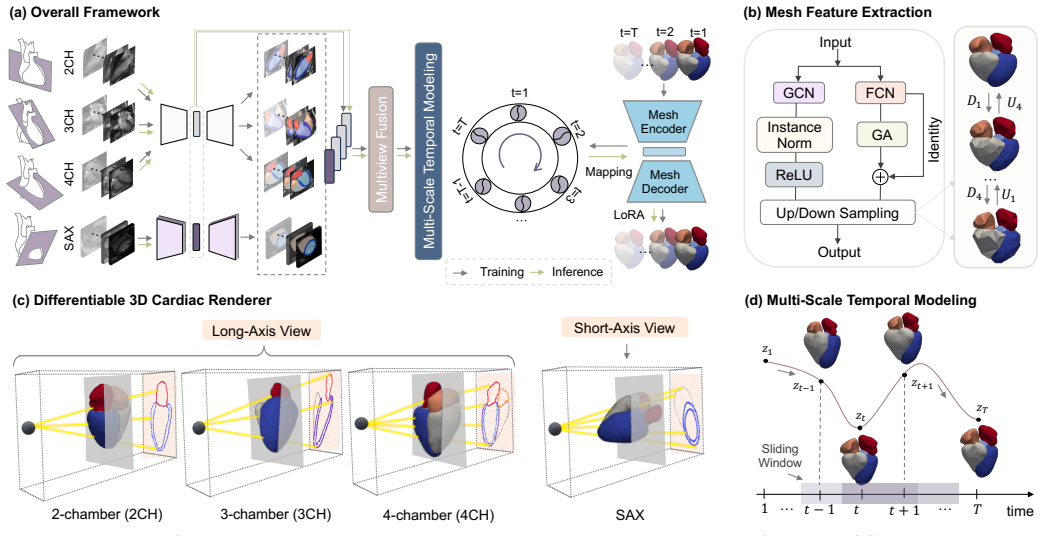
An end-to-end method reconstructs personalized 4D whole-heart meshes from multi-view cine MRI with 1.68 mm error and reduced motion jitter.
A machine-rendered reading of the paper's core claim, the machinery that carries it, and where it could break.
Core claim
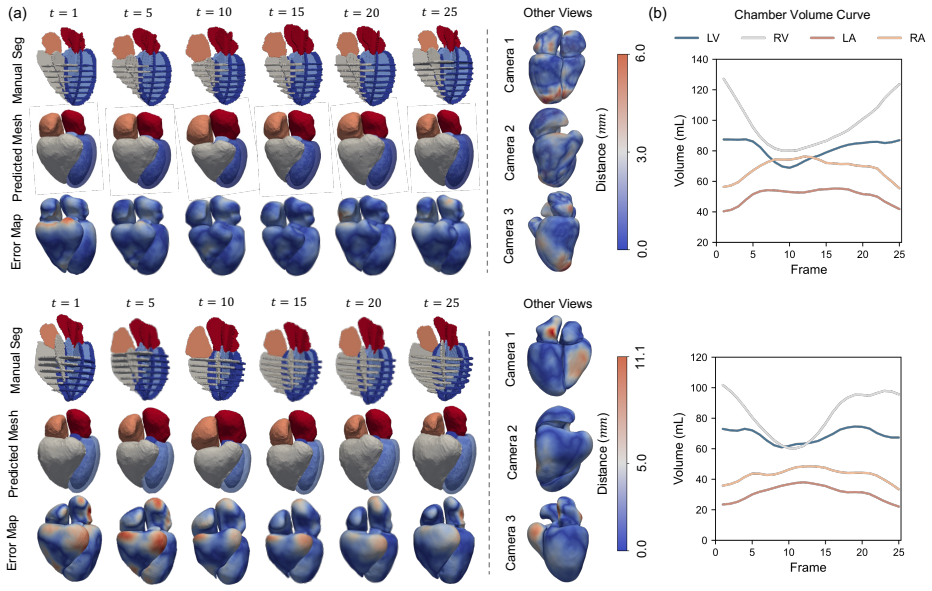
The framework produces 4D whole-heart meshes with a mean absolute error of 1.68 ± 0.31 mm and motion jitter of 0.77 ± 0.17 mm/frame³ while improving 2D contour alignment across cine views and enabling proof-of-concept electrophysiological simulation; it does so by combining the differentiable renderer for supervision of mesh deformation with multi-scale temporal modeling for smooth trajectories across the cardiac cycle.
What carries the argument
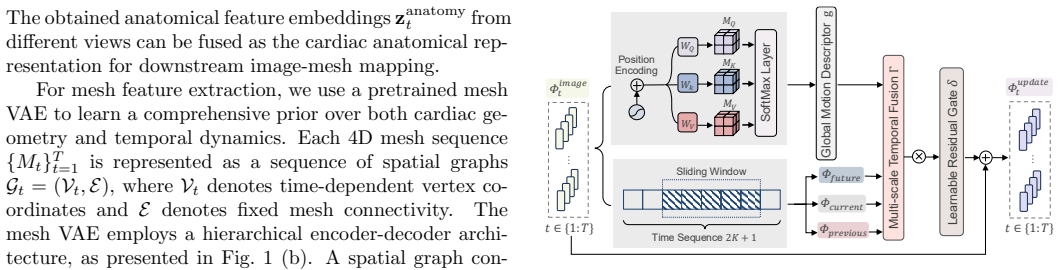
The differentiable contour renderer (inspired by the Beer-Lambert attenuation principle) that supplies anatomy-aware supervision to 3D+t mesh deformation via contour-based projection losses, paired with the multi-scale temporal modeling module that fuses global cycle dynamics and local inter-frame coherence.
If this is right
- Full-chamber 4D dynamics are captured without limiting reconstruction to static, single-phase, or partial geometries.
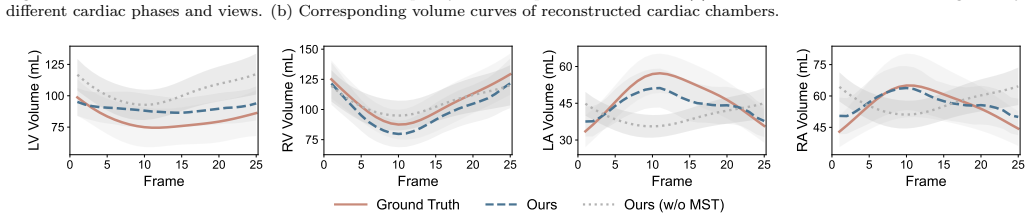
- Motion trajectories become smoother and more physiologically plausible across the cardiac cycle.
- 2D contour alignment improves across multiple cine MRI views simultaneously.
- The resulting meshes directly support downstream electrophysiological simulations.
Where Pith is reading between the lines
- The same projection-loss mechanism could be adapted to other sparse 2D-to-3D reconstruction tasks such as lung or liver motion tracking.
- If the temporal module generalizes, it might reduce the number of MRI phases needed for acceptable smoothness in future protocols.
- Personalized meshes at this accuracy level could feed into patient-specific arrhythmia risk models without additional imaging.
Load-bearing premise
The differentiable contour renderer supplies sufficiently accurate anatomy-aware supervision for the 3D+t mesh deformation without introducing systematic projection errors that propagate into the final mesh geometry.
What would settle it
A side-by-side comparison of the output meshes against registered high-resolution 3D+t CT ground truth on held-out patients, checking whether the reported 1.68 mm error holds or rises due to projection artifacts.
Figures
read the original abstract
Accurate 4D whole-heart mesh reconstruction from sparse cine MRI is critical for creating cardiac digital twins, but remains challenging due to limited 2D slice coverage and the complex coupling between cardiac shape and motion. Existing methods often rely on intermediate contour fitting and typically reconstruct static, single-phase, or partial cardiac geometries, limiting their ability to capture full-chamber dynamics. We propose a novel end-to-end framework for reconstructing temporally resolved whole-heart meshes from multi-view 2D cine MRI sequences by learning an image-to-mesh mapping. The framework incorporates a differentiable contour renderer inspired by the Beer-Lambert attenuation principle, enabling anatomy-aware supervision of 3D+t mesh deformation through contour-based projection losses. To improve temporal consistency across the cardiac cycle, we further introduce a multi-scale temporal modeling module that integrates global cycle-level dynamics with local inter-frame coherence to generate smooth and physiologically plausible mesh trajectories. The proposed method achieved a whole-heart mean absolute error of 1.68 $\pm$ 0.31 mm and a motion jitter of 0.77 $\pm$ 0.17 $\mathrm{mm}/\mathrm{frame}^{3}$, outperforming existing methods with lower reconstruction error and substantially improved motion smoothness. It also improved 2D contour alignment across multiple cine MRI views and supported downstream proof-of-concept electrophysiological simulation. The code will be released publicly upon acceptance of the manuscript for publication.
Editorial analysis
A structured set of objections, weighed in public.
Referee Report
Summary. The paper proposes an end-to-end supervised framework for 4D whole-heart mesh reconstruction from multi-view 2D cine MRI. It learns an image-to-mesh mapping with a differentiable contour renderer (Beer-Lambert attenuation inspired) that supplies anatomy-aware projection losses, plus a multi-scale temporal module that combines cycle-level and inter-frame modeling for smooth trajectories. Reported results include whole-heart MAE of 1.68 ± 0.31 mm and motion jitter of 0.77 ± 0.17 mm/frame³, outperforming prior methods on reconstruction error and smoothness, plus improved 2D contour alignment and a proof-of-concept electrophysiological simulation.
Significance. If the central claims hold after addressing validation gaps, the work would advance cardiac digital-twin construction by enabling temporally consistent, personalized 4D meshes directly from routine sparse cine MRI without intermediate contour fitting. The planned public code release would support reproducibility and downstream use in simulations.
major comments (2)
- [Abstract] Abstract: the headline MAE (1.68 ± 0.31 mm) and jitter (0.77 ± 0.17 mm/frame³) claims rest on the differentiable renderer supplying faithful anatomy-aware gradients. No independent validation, ablation, or quantitative comparison of the Beer-Lambert-inspired projection against actual MRI physics (partial voluming, slice thickness, intensity inhomogeneity) is described, leaving open the possibility that systematic projection biases are minimized into the mesh while still reducing the training loss.
- [Abstract] Abstract: the multi-scale temporal modeling module is asserted to produce 'physiologically plausible' trajectories by integrating global cycle-level dynamics with local inter-frame coherence, yet the abstract supplies neither the architecture equations, loss terms, nor ablation results that would demonstrate this coupling is load-bearing for the reported jitter reduction versus single-scale baselines.
minor comments (2)
- [Abstract] Abstract: the jitter unit 'mm/frame³' is ambiguous and should be clarified (e.g., whether it denotes a per-frame cubed quantity or a notational shorthand).
- [Abstract] Abstract: the statement that the method 'supported downstream proof-of-concept electrophysiological simulation' would benefit from a brief quantitative metric (e.g., activation-time error) rather than a qualitative claim.
Simulated Author's Rebuttal
We thank the referee for the constructive comments regarding the abstract. We address each point below and will revise the manuscript to improve clarity where appropriate.
read point-by-point responses
-
Referee: [Abstract] Abstract: the headline MAE (1.68 ± 0.31 mm) and jitter (0.77 ± 0.17 mm/frame³) claims rest on the differentiable renderer supplying faithful anatomy-aware gradients. No independent validation, ablation, or quantitative comparison of the Beer-Lambert-inspired projection against actual MRI physics (partial voluming, slice thickness, intensity inhomogeneity) is described, leaving open the possibility that systematic projection biases are minimized into the mesh while still reducing the training loss.
Authors: We acknowledge that the abstract does not present an independent quantitative comparison of the Beer-Lambert-inspired renderer against full MRI physics simulations. The renderer is introduced as a differentiable approximation to enable anatomy-aware projection losses without requiring explicit contour extraction. Its utility is demonstrated through end-to-end improvements in 2D contour alignment across views and superior whole-heart reconstruction accuracy relative to baselines that lack this component. We will revise the abstract to briefly note the approximation nature of the projection model and add a short clarifying paragraph in the methods section on its scope and limitations relative to full physics. revision: partial
-
Referee: [Abstract] Abstract: the multi-scale temporal modeling module is asserted to produce 'physiologically plausible' trajectories by integrating global cycle-level dynamics with local inter-frame coherence, yet the abstract supplies neither the architecture equations, loss terms, nor ablation results that would demonstrate this coupling is load-bearing for the reported jitter reduction versus single-scale baselines.
Authors: The abstract is necessarily concise. The multi-scale temporal module architecture, including the equations for cycle-level and inter-frame components and the associated loss terms, is fully specified in Section 3.2. Ablation experiments quantifying the jitter reduction attributable to the multi-scale coupling versus single-scale variants are reported in Table 4 and the associated figures in the experiments section. We will revise the abstract to include a short clause referencing the integration of global and local dynamics and directing readers to Section 3.2 and the ablations for details. revision: yes
Circularity Check
No circularity: supervised pipeline reports external empirical metrics
full rationale
The paper describes a supervised image-to-mesh learning framework whose central outputs (whole-heart MAE of 1.68 mm and motion jitter of 0.77 mm/frame³) are measured against external ground-truth meshes and compared to prior methods. The differentiable contour renderer supplies a training loss but does not redefine or substitute for the reported test metrics. No self-definitional equations, fitted inputs renamed as predictions, or load-bearing self-citations appear in the abstract or described pipeline. The derivation chain remains self-contained against external benchmarks.
Axiom & Free-Parameter Ledger
Reference graph
Works this paper leans on
-
[1]
International Conference on Medical Image Computing and Computer-Assisted Intervention , pages=
Mesh4D: A Motion-Aware Multi-view Variational Autoencoder for 3D+ t Mesh Reconstruction , author=. International Conference on Medical Image Computing and Computer-Assisted Intervention , pages=. 2025 , organization=
2025
-
[2]
Personalized 3D Myocardial Infarct Geometry Reconstruction from Cine MRI for Cardiac Digital Twins
Personalized 3D Myocardial Infarct Geometry Reconstruction from Cine MRI for Cardiac Digital Twins , author=. arXiv preprint arXiv:2606.01808 , year=
work page internal anchor Pith review Pith/arXiv arXiv
-
[3]
RePCM: Region-Specific and Phenotype-Adaptive Bi-Ventricular Cardiac Motion Synthesis
RePCM: Region-Specific and Phenotype-Adaptive Bi-Ventricular Cardiac Motion Synthesis , author=. arXiv preprint arXiv:2605.21237 , year=
work page internal anchor Pith review Pith/arXiv arXiv
-
[4]
IEEE transactions on medical imaging , volume=
Anatomically constrained neural networks (ACNNs): application to cardiac image enhancement and segmentation , author=. IEEE transactions on medical imaging , volume=. 2017 , publisher=
2017
-
[5]
IEEE Transactions on Medical Imaging , volume=
Slice2mesh: 3d surface reconstruction from sparse slices of images for the left ventricle , author=. IEEE Transactions on Medical Imaging , volume=. 2024 , publisher=
2024
-
[6]
CineMesh4D: Personalized 4D Whole Heart Reconstruction from Sparse Cine MRI
CineMesh4D: Personalized 4D Whole Heart Reconstruction from Sparse Cine MRI , author=. arXiv preprint arXiv:2605.13994 , year=
work page internal anchor Pith review Pith/arXiv arXiv
-
[7]
Cardiac Mesh Flow: One-Step Generation of 3D+t Cardiac Four-Chamber Meshes via Flow Matching
Cardiac Mesh Flow: One-Step Generation of 3D+ t Cardiac Four-Chamber Meshes via Flow Matching , author=. arXiv preprint arXiv:2605.01884 , year=
work page internal anchor Pith review Pith/arXiv arXiv
-
[8]
Medical image analysis , volume=
A gradient-based optical-flow cardiac motion estimation method for cine and tagged MR images , author=. Medical image analysis , volume=. 2019 , publisher=
2019
-
[9]
Medical image analysis , volume=
Explainable cardiac pathology classification on cine MRI with motion characterization by semi-supervised learning of apparent flow , author=. Medical image analysis , volume=. 2019 , publisher=
2019
-
[10]
Medical image analysis , volume=
Myocardial deformation recovery from cine MRI using a nearly incompressible biventricular model , author=. Medical image analysis , volume=. 2008 , publisher=
2008
-
[11]
Medical Physics , volume=
Temporally coherent cardiac motion tracking from cine MRI: Traditional registration method and modern CNN method , author=. Medical Physics , volume=. 2020 , publisher=
2020
-
[12]
International conference on medical image computing and computer-assisted intervention , pages=
Mesh-based 3d motion tracking in cardiac mri using deep learning , author=. International conference on medical image computing and computer-assisted intervention , pages=. 2022 , organization=
2022
-
[13]
Computers & Graphics , volume=
Representation learning of 3D meshes using an Autoencoder in the spectral domain , author=. Computers & Graphics , volume=. 2022 , publisher=
2022
-
[14]
Nature biomedical engineering , volume=
Computationally guided personalized targeted ablation of persistent atrial fibrillation , author=. Nature biomedical engineering , volume=. 2019 , publisher=
2019
-
[15]
Medical Image Analysis , volume=
Personalized topology-informed localization of standard 12-lead ECG electrode placement from incomplete cardiac MRIs for efficient cardiac digital twins , author=. Medical Image Analysis , volume=. 2025 , publisher=
2025
-
[16]
Medical image analysis , pages=
An efficient end-to-end computational framework for the generation of ECG calibrated volumetric models of human atrial electrophysiology , author=. Medical image analysis , pages=. 2025 , publisher=
2025
-
[17]
Computer Methods in Applied Mechanics and Engineering , volume=
A comprehensive and biophysically detailed computational model of the whole human heart electromechanics , author=. Computer Methods in Applied Mechanics and Engineering , volume=. 2023 , publisher=
2023
-
[18]
NPJ Digital Medicine , volume=
Whole-heart electromechanical simulations using latent neural ordinary differential equations , author=. NPJ Digital Medicine , volume=. 2024 , publisher=
2024
-
[19]
Frontiers in Physiology , volume=
A personalized real-time virtual model of whole heart electrophysiology , author=. Frontiers in Physiology , volume=. 2022 , publisher=
2022
-
[20]
Nature , volume=
Blinded, randomized trial of sonographer versus AI cardiac function assessment , author=. Nature , volume=. 2023 , publisher=
2023
-
[21]
Medical image analysis , volume=
Deformable models with sparsity constraints for cardiac motion analysis , author=. Medical image analysis , volume=. 2014 , publisher=
2014
-
[22]
International Workshop on Digital Twin for Healthcare , pages=
Personalized 4D Whole Heart Geometry Reconstruction from Cine MRI for Cardiac Digital Twins , author=. International Workshop on Digital Twin for Healthcare , pages=. 2025 , organization=
2025
-
[23]
International Workshop on Digital Twin for Healthcare , pages=
Personalized 3D Myocardial Infarct Geometry Reconstruction from Cine MRI with Explicit Cardiac Motion Modeling , author=. International Workshop on Digital Twin for Healthcare , pages=. 2025 , organization=
2025
-
[24]
IEEE Journal of Biomedical and Health Informatics , volume=
Modeling 3D cardiac contraction and relaxation with point cloud deformation networks , author=. IEEE Journal of Biomedical and Health Informatics , volume=. 2024 , publisher=
2024
-
[25]
Medical Image Analysis , volume=
WarpPINN: Cine-MR image registration with physics-informed neural networks , author=. Medical Image Analysis , volume=. 2023 , publisher=
2023
-
[26]
Circulation , volume=
Investigating cardiac function using motion and deformation analysis in the setting of coronary artery disease , author=. Circulation , volume=. 2007 , publisher=
2007
-
[27]
IEEE transactions on medical imaging , volume=
Cardiac motion and deformation recovery from MRI: a review , author=. IEEE transactions on medical imaging , volume=. 2011 , publisher=
2011
-
[28]
Radiology: Artificial Intelligence , volume=
Implementation and validation of a three-dimensional cardiac motion estimation network , author=. Radiology: Artificial Intelligence , volume=. 2019 , publisher=
2019
-
[29]
IEEE Reviews in Biomedical Engineering , volume=
Ultrasound-image-based cardiovascular tissue motion estimation , author=. IEEE Reviews in Biomedical Engineering , volume=. 2016 , publisher=
2016
-
[30]
Medical image analysis , volume=
Tagged magnetic resonance imaging of the heart: a survey , author=. Medical image analysis , volume=. 2005 , publisher=
2005
-
[31]
IEEE transactions on medical imaging , volume=
Motion estimation by deep learning in 2D echocardiography: Synthetic dataset and validation , author=. IEEE transactions on medical imaging , volume=. 2022 , publisher=
2022
-
[32]
Radiology: Cardiothoracic Imaging , volume=
StrainNet: improved myocardial strain analysis of cine MRI by deep learning from DENSE , author=. Radiology: Cardiothoracic Imaging , volume=. 2023 , publisher=
2023
-
[33]
Nature , volume=
Video-based AI for beat-to-beat assessment of cardiac function , author=. Nature , volume=. 2020 , publisher=
2020
-
[34]
Radiology , volume=
Myocardial tissue phase mapping with cine phase-contrast MR imaging: regional wall motion analysis in healthy volunteers , author=. Radiology , volume=. 2006 , publisher=
2006
-
[35]
Medical image analysis , volume=
Segmentation and quantification of infarction without contrast agents via spatiotemporal generative adversarial learning , author=. Medical image analysis , volume=. 2020 , publisher=
2020
-
[36]
Medical image analysis , volume=
Contrast agent-free synthesis and segmentation of ischemic heart disease images using progressive sequential causal GANs , author=. Medical image analysis , volume=. 2020 , publisher=
2020
-
[37]
IEEE transactions on medical imaging , volume=
Cine cardiac MRI motion artifact reduction using a recurrent neural network , author=. IEEE transactions on medical imaging , volume=. 2021 , publisher=
2021
-
[38]
IEEE Transactions on image processing , volume=
Myocardial motion analysis from B-mode echocardiograms , author=. IEEE Transactions on image processing , volume=. 2005 , publisher=
2005
-
[39]
Nature machine intelligence , volume=
Deep-learning cardiac motion analysis for human survival prediction , author=. Nature machine intelligence , volume=. 2019 , publisher=
2019
-
[40]
Visual computing for industry, biomedicine, and art , volume=
Survey of methods and principles in three-dimensional reconstruction from two-dimensional medical images , author=. Visual computing for industry, biomedicine, and art , volume=. 2023 , publisher=
2023
-
[41]
International Conference on Medical Image Computing and Computer-Assisted Intervention , pages=
UltraTwin: towards cardiac anatomical twin generation from multi-view 2D ultrasound , author=. International Conference on Medical Image Computing and Computer-Assisted Intervention , pages=. 2025 , organization=
2025
-
[42]
Computers in Biology and Medicine , volume=
Reconstruction and completion of high-resolution 3D cardiac shapes using anisotropic CMRI segmentations and continuous implicit neural representations , author=. Computers in Biology and Medicine , volume=. 2023 , publisher=
2023
-
[43]
Geometric Deep Learning in Medical Image Analysis , pages=
Reconstructing 3D cardiac anatomies from misaligned multi-view magnetic resonance images with mesh deformation U-Nets , author=. Geometric Deep Learning in Medical Image Analysis , pages=. 2022 , organization=
2022
-
[44]
2022 44th Annual International Conference of the IEEE Engineering in Medicine & Biology Society (EMBC) , pages=
Automated 3D whole-heart mesh reconstruction from 2D cine MR slices using statistical shape model , author=. 2022 44th Annual International Conference of the IEEE Engineering in Medicine & Biology Society (EMBC) , pages=. 2022 , organization=
2022
-
[45]
International Conference on Functional Imaging and Modeling of the Heart , pages=
Whole heart 3D shape reconstruction from sparse views: leveraging cardiac computed tomography for cardiovascular magnetic resonance , author=. International Conference on Functional Imaging and Modeling of the Heart , pages=. 2023 , organization=
2023
-
[46]
Medical Image Analysis , volume=
2D echocardiography video to 3D heart shape reconstruction for clinical application , author=. Medical Image Analysis , volume=. 2025 , publisher=
2025
-
[47]
2023 IEEE 20th International Symposium on Biomedical Imaging (ISBI) , pages=
3D coronary vessel reconstruction from bi-plane angiography using graph convolutional networks , author=. 2023 IEEE 20th International Symposium on Biomedical Imaging (ISBI) , pages=. 2023 , organization=
2023
-
[48]
Nature Machine Intelligence , volume=
A personalized time-resolved 3D mesh generative model for unveiling normal heart dynamics , author=. Nature Machine Intelligence , volume=. 2025 , publisher=
2025
-
[49]
IEEE transactions on visualization and computer graphics , volume=
The ball-pivoting algorithm for surface reconstruction , author=. IEEE transactions on visualization and computer graphics , volume=. 1999 , publisher=
1999
-
[50]
Seminal graphics: pioneering efforts that shaped the field , pages=
Marching cubes: A high resolution 3D surface construction algorithm , author=. Seminal graphics: pioneering efforts that shaped the field , pages=
-
[51]
Advances in neural information processing systems , volume=
Pointnet++: Deep hierarchical feature learning on point sets in a metric space , author=. Advances in neural information processing systems , volume=
-
[52]
Proceedings of the IEEE conference on computer vision and pattern recognition , pages=
Pu-net: Point cloud upsampling network , author=. Proceedings of the IEEE conference on computer vision and pattern recognition , pages=
-
[53]
IEEE transactions on pattern analysis and machine intelligence , volume=
Point set registration: Coherent point drift , author=. IEEE transactions on pattern analysis and machine intelligence , volume=. 2010 , publisher=
2010
-
[54]
IEEE transactions on pattern analysis and machine intelligence , volume=
Robust point set registration using gaussian mixture models , author=. IEEE transactions on pattern analysis and machine intelligence , volume=. 2010 , publisher=
2010
-
[55]
Proceedings of the European conference on computer vision (ECCV) , pages=
Pixel2mesh: Generating 3d mesh models from single rgb images , author=. Proceedings of the European conference on computer vision (ECCV) , pages=
-
[56]
International Journal of Bifurcation and Chaos , volume=
The dynamics of Runge--Kutta methods , author=. International Journal of Bifurcation and Chaos , volume=. 1992 , publisher=
1992
-
[57]
, author=
Lora: Low-rank adaptation of large language models. , author=. ICLR , volume=
-
[58]
Advances in neural information processing systems , volume=
Attention is all you need , author=. Advances in neural information processing systems , volume=
-
[59]
Proceedings of the European conference on computer vision (ECCV) , pages=
Generating 3D faces using convolutional mesh autoencoders , author=. Proceedings of the European conference on computer vision (ECCV) , pages=
-
[60]
International Conference on Machine Learning , pages=
Exphormer: Sparse transformers for graphs , author=. International Conference on Machine Learning , pages=. 2023 , organization=
2023
-
[61]
International Conference on Medical image computing and computer-assisted intervention , pages=
U-net: Convolutional networks for biomedical image segmentation , author=. International Conference on Medical image computing and computer-assisted intervention , pages=. 2015 , organization=
2015
-
[62]
International Workshop on Statistical Atlases and Computational Models of the Heart , pages=
Improved 3D whole heart geometry from sparse CMR slices , author=. International Workshop on Statistical Atlases and Computational Models of the Heart , pages=. 2024 , organization=
2024
-
[63]
Sensors , volume=
Digital Cardiovascular Twins, AI Agents, and Sensor Data: A Narrative Review from System Architecture to Proactive Heart Health , author=. Sensors , volume=. 2025 , publisher=
2025
-
[64]
European journal of preventive cardiology , volume=
Global burden of cardiovascular diseases: projections from 2025 to 2050 , author=. European journal of preventive cardiology , volume=. 2025 , publisher=
2025
-
[65]
IEEE transactions on medical imaging , volume=
DeepMesh: Mesh-based cardiac motion tracking using deep learning , author=. IEEE transactions on medical imaging , volume=. 2023 , publisher=
2023
-
[66]
Proceedings of the IEEE/CVF International Conference on Computer Vision , pages=
4D myocardium reconstruction with decoupled motion and shape model , author=. Proceedings of the IEEE/CVF International Conference on Computer Vision , pages=
-
[67]
Medical image analysis , volume=
Rapid inference of personalised left-ventricular meshes by deformation-based differentiable mesh voxelization , author=. Medical image analysis , volume=. 2022 , publisher=
2022
-
[68]
2021 IEEE 18th International Symposium on Biomedical Imaging (ISBI) , pages=
Biventricular surface reconstruction from cine MRI contours using point completion networks , author=. 2021 IEEE 18th International Symposium on Biomedical Imaging (ISBI) , pages=. 2021 , organization=
2021
-
[69]
Proceedings of the IEEE/CVF International Conference on Computer Vision , pages=
Neural deformable models for 3d bi-ventricular heart shape reconstruction and modeling from 2d sparse cardiac magnetic resonance imaging , author=. Proceedings of the IEEE/CVF International Conference on Computer Vision , pages=
-
[70]
IEEE transactions on medical imaging , volume=
Automatic 3D bi-ventricular segmentation of cardiac images by a shape-refined multi-task deep learning approach , author=. IEEE transactions on medical imaging , volume=. 2019 , publisher=
2019
-
[71]
Medical image analysis , volume=
Shape registration with learned deformations for 3D shape reconstruction from sparse and incomplete point clouds , author=. Medical image analysis , volume=. 2021 , publisher=
2021
-
[72]
Medical image analysis , volume=
Multi-class point cloud completion networks for 3D cardiac anatomy reconstruction from cine magnetic resonance images , author=. Medical image analysis , volume=. 2023 , publisher=
2023
-
[73]
International Conference on Medical Image Computing and Computer-Assisted Intervention , pages=
CardiacFlow: 3D+ t Four-Chamber Cardiac Shape Completion and Generation via Flow Matching , author=. International Conference on Medical Image Computing and Computer-Assisted Intervention , pages=. 2025 , organization=
2025
-
[74]
Medical image analysis , volume=
Weakly supervised inference of personalized heart meshes based on echocardiography videos , author=. Medical image analysis , volume=. 2023 , publisher=
2023
-
[75]
ChemPhysChem , volume=
The Bouguer-Beer-Lambert law: Shining light on the obscure , author=. ChemPhysChem , volume=. 2020 , publisher=
2020
-
[76]
Proceedings of the IEEE/CVF conference on computer vision and pattern recognition , pages=
Darnet: Deep active ray network for building segmentation , author=. Proceedings of the IEEE/CVF conference on computer vision and pattern recognition , pages=
-
[77]
arXiv preprint arXiv:1912.00367 , year=
End to end trainable active contours via differentiable rendering , author=. arXiv preprint arXiv:1912.00367 , year=
-
[78]
Proceedings of the IEEE/CVF conference on computer vision and pattern recognition , pages=
Physical inertial poser (pip): Physics-aware real-time human motion tracking from sparse inertial sensors , author=. Proceedings of the IEEE/CVF conference on computer vision and pattern recognition , pages=
-
[79]
Wham: Reconstructing world-grounded humans with accurate
Shin, Soyong and Kim, Juyong and Halilaj, Eni and Black, Michael J , booktitle=. Wham: Reconstructing world-grounded humans with accurate
-
[80]
International conference on medical imaging with deep learning , pages=
Boundary loss for highly unbalanced segmentation , author=. International conference on medical imaging with deep learning , pages=. 2019 , organization=
2019
discussion (0)
Sign in with ORCID, Apple, or X to comment. Anyone can read and Pith papers without signing in.