Traceable Fault Diagnosis for Battery Energy Storage Systems via Retrieval-Augmented Multi-Agent O&M Assistant
Pith reviewed 2026-07-03 13:43 UTC · model grok-4.3
The pith
A retrieval-augmented multi-agent system delivers traceable fault diagnosis for battery energy storage by linking operational data, domain knowledge, visual evidence, and report generation.
A machine-rendered reading of the paper's core claim, the machinery that carries it, and where it could break.
Core claim
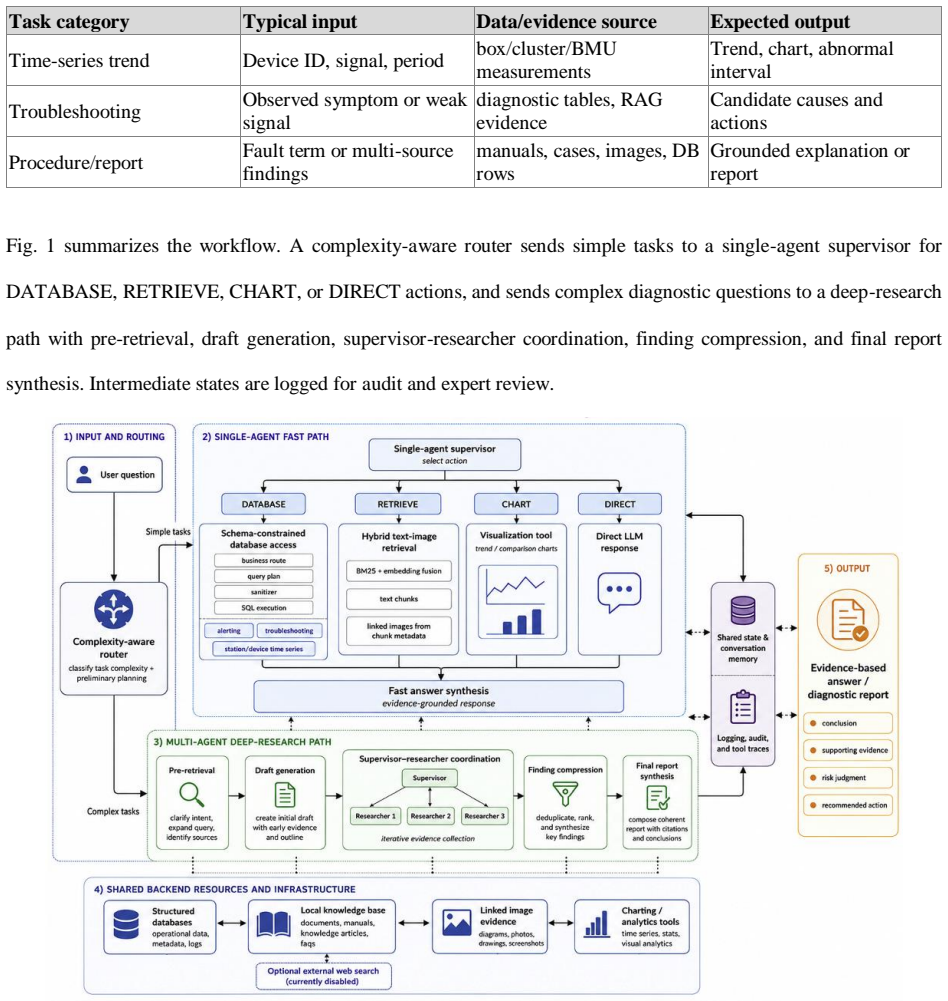
The paper claims that a traceable BESS fault-diagnosis assistant using retrieval-augmented multi-agent reasoning connects operational data, domain knowledge, visual evidence, and report generation, with reliability improved through BESS-specific task routing, schema-constrained natural-language database access, hybrid text-image retrieval, and evidence-based answer synthesis.
What carries the argument
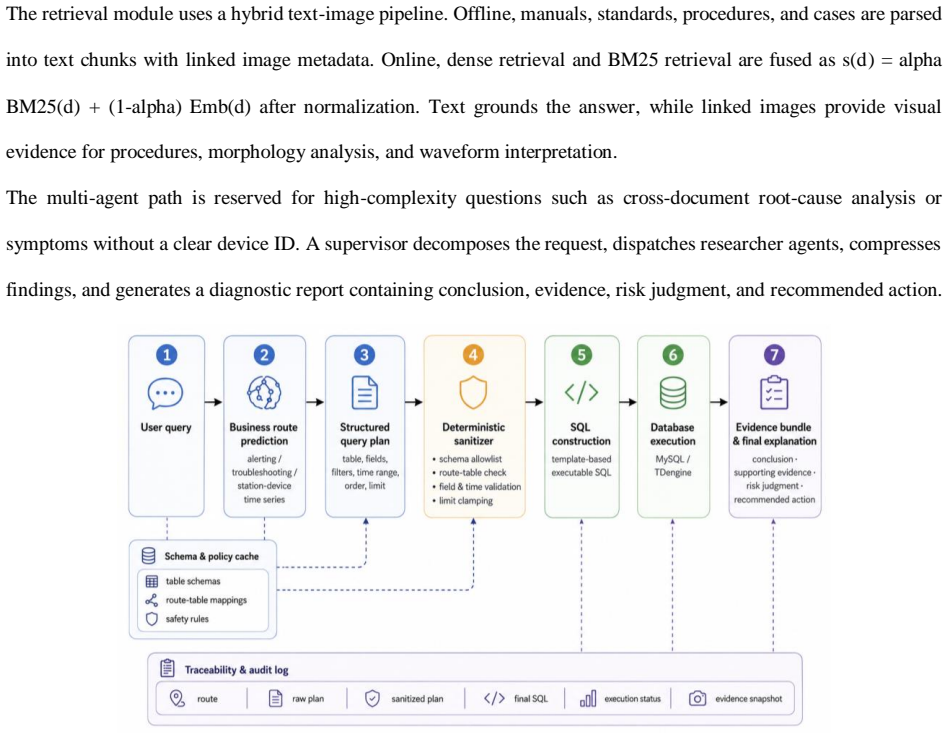
Retrieval-augmented multi-agent reasoning framework that performs BESS-specific task routing, schema-constrained natural-language database access, hybrid text-image retrieval, and evidence-based answer synthesis.
If this is right
- Monitoring platforms can explain specific risks such as voltage inconsistency or thermal abnormality rather than only reporting threshold violations.
- Diagnostic outputs incorporate both textual documents and visual evidence through hybrid retrieval.
- Schema-constrained natural-language queries reduce errors when accessing cell-level measurements and topology data.
- Evidence-based synthesis produces reports that remain traceable to the original data sources and documents.
- BESS-specific task routing improves the relevance of retrieved knowledge for operation and maintenance decisions.
Where Pith is reading between the lines
- The approach could be tested by measuring reduction in unnecessary maintenance calls when the assistant is deployed alongside existing platforms.
- Integration with live sensor streams beyond the described database access might extend the system's real-time capability.
- Comparison against single-agent or non-retrieval baselines would clarify whether the multi-agent routing step adds measurable value.
- Application to other energy systems with similar data heterogeneity, such as wind or solar farms, would test the generality of the routing and retrieval components.
Load-bearing premise
The described combination of task routing, schema-constrained database access, hybrid retrieval, and evidence synthesis will produce accurate and traceable diagnoses, an assumption resting on unshown details of the preliminary internal evaluation.
What would settle it
An external test set of BESS cases in which the assistant outputs incorrect diagnoses or non-traceable reasoning steps when compared against expert review.
Figures
read the original abstract
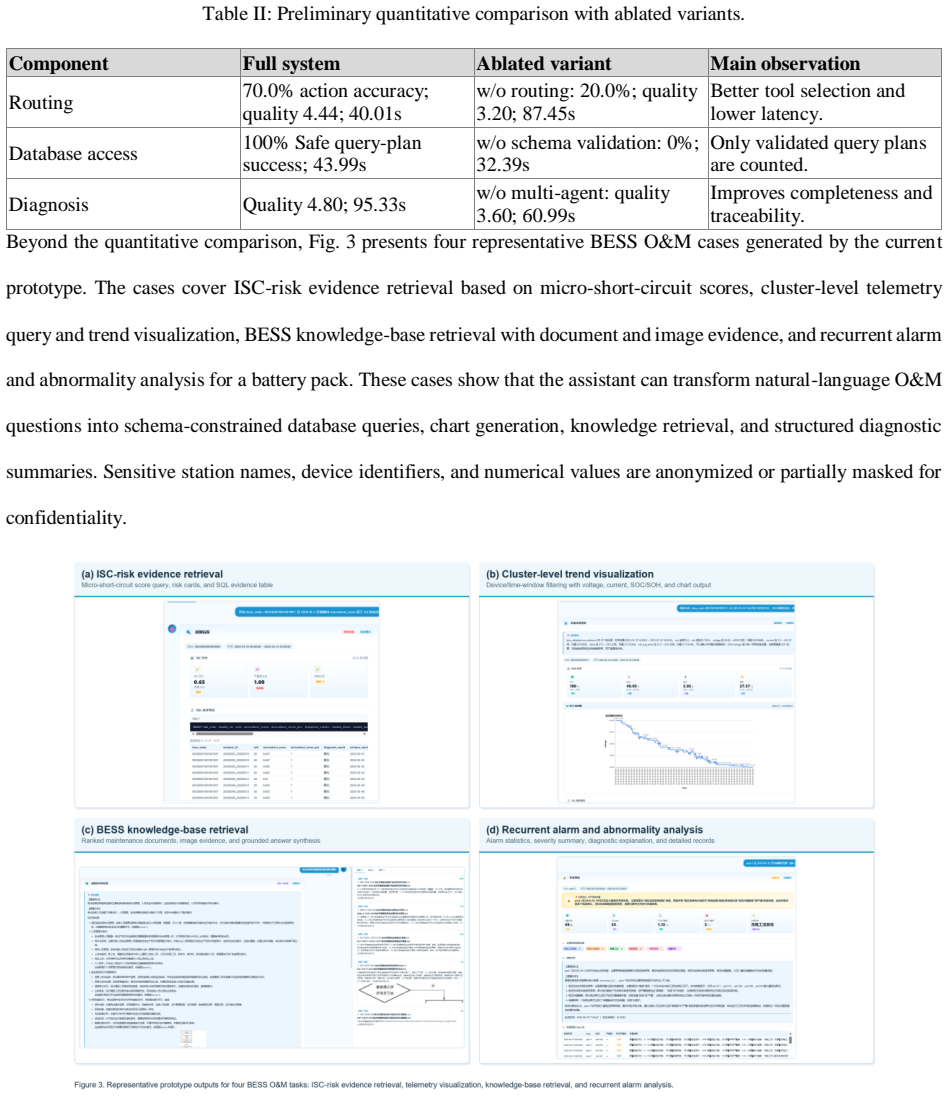
Large-scale battery energy storage systems (BESSs) require O&M decisions that combine alarms, cell-level measurements, device topology, diagnostic tables, historical cases, and maintenance documents. Monitoring platforms can flag threshold violations, but they often cannot explain whether voltage inconsistency, resistance drift, short-circuit risk, capacity divergence, or thermal abnormality needs intervention. This digest presents a traceable BESS fault-diagnosis assistant that uses retrieval-augmented multi-agent reasoning to connect operational data, domain knowledge, visual evidence, and report generation. Reliability is improved through BESS-specific task routing, schema-constrained natural-language database access, hybrid text-image retrieval, and evidence-based answer synthesis. Preliminary internal evaluation is reported for routing, database access, and diagnostic reasoning.
Editorial analysis
A structured set of objections, weighed in public.
Referee Report
Summary. The manuscript presents a retrieval-augmented multi-agent system for traceable fault diagnosis and O&M assistance in large-scale battery energy storage systems (BESS). It integrates operational data, domain knowledge, visual evidence, and report generation via BESS-specific task routing, schema-constrained natural-language database access, hybrid text-image retrieval, and evidence-based answer synthesis. The central claim is that these components improve diagnostic reliability and traceability, with the assertion supported by a preliminary internal evaluation of routing, database access, and diagnostic reasoning.
Significance. If the internal evaluation were to demonstrate measurable gains in accuracy, traceability, and robustness over simpler retrieval or single-agent baselines on representative BESS fault cases, the work could offer practical value for operations and maintenance platforms that currently lack explanatory diagnostics beyond threshold alarms. The system description itself is coherent, but the lack of any quantitative results prevents assessment of whether the claimed reliability improvements are realized.
major comments (1)
- [evaluation section (and abstract)] The abstract and introduction state that 'preliminary internal evaluation is reported for routing, database access, and diagnostic reasoning,' yet the manuscript supplies no quantitative metrics, baselines, test cases, datasets, error rates, or comparison conditions. Because the central claim that the multi-agent RAG pipeline improves reliability rests entirely on this unevidenced assertion, the evaluation section must be expanded with concrete results before the improvement claim can be evaluated.
Simulated Author's Rebuttal
We thank the referee for the constructive feedback. We agree that the evaluation section must be expanded with quantitative details to allow proper assessment of the claimed improvements.
read point-by-point responses
-
Referee: [evaluation section (and abstract)] The abstract and introduction state that 'preliminary internal evaluation is reported for routing, database access, and diagnostic reasoning,' yet the manuscript supplies no quantitative metrics, baselines, test cases, datasets, error rates, or comparison conditions. Because the central claim that the multi-agent RAG pipeline improves reliability rests entirely on this unevidenced assertion, the evaluation section must be expanded with concrete results before the improvement claim can be evaluated.
Authors: We accept the point. Although the manuscript references a preliminary internal evaluation, the provided text does not include the requested quantitative metrics, baselines, test cases, datasets, error rates, or explicit comparisons. We will revise the evaluation section to report concrete results for routing accuracy, database query success rates under schema constraints, and diagnostic reasoning performance on representative BESS fault cases, including descriptions of the internal test conditions and any baseline comparisons performed. revision: yes
Circularity Check
No circularity: system description without derivations or self-referential reductions
full rationale
The paper is a system description of a retrieval-augmented multi-agent assistant for BESS fault diagnosis. It asserts reliability improvements via task routing, schema-constrained access, hybrid retrieval, and evidence synthesis, with mention of preliminary internal evaluation, but contains no equations, fitted parameters, predictions, uniqueness theorems, or self-citation chains. No load-bearing step reduces by construction to its inputs, satisfying the default expectation of no circularity for non-theoretical work.
Axiom & Free-Parameter Ledger
Reference graph
Works this paper leans on
-
[1]
Detection and Isolation of Small Faults in Lithium- Ion Batteries via the Asymptotic Local Approach,
L. D. Couto, J. M. Reniers, D. A. Howey, and M. Kinnaert, "Detection and Isolation of Small Faults in Lithium- Ion Batteries via the Asymptotic Local Approach," arXiv:2103.09936, 2021
-
[2]
Li-ion Battery Fault Detection in Large Packs Using Force and Gas Sensors,
T. Cai, P. Mohtat, A. G. Stefanopoulou, and J. B. Siegel, "Li-ion Battery Fault Detection in Large Packs Using Force and Gas Sensors," arXiv:2010.13519, 2020
-
[3]
J. Schaeffer et al., "Gaussian Process-based Online Health Monitoring and Fault Analysis of Lithium-Ion Battery Systems from Field Data," arXiv:2406.19015, 2024
-
[4]
J. Qu, Y. Wang, Y. Fu, P. Zhang, W. Li, and M. Li, "From Inconsistency to Decision: Explainable Operation and Maintenance of Battery Energy Storage Systems," arXiv:2601.03007, 2026
work page internal anchor Pith review Pith/arXiv arXiv 2026
-
[5]
Retrieval-Augmented Generation for Knowledge-Intensive NLP Tasks,
P. Lewis et al., "Retrieval-Augmented Generation for Knowledge-Intensive NLP Tasks," in Proc. Advances in Neural Information Processing Systems (NeurIPS), 2020
2020
-
[6]
Dense Passage Retrieval for Open-Domain Question Answering,
V. Karpukhin et al., "Dense Passage Retrieval for Open-Domain Question Answering," in Proc. EMNLP, 2020
2020
-
[7]
The Probabilistic Relevance Framework: BM25 and Beyond,
S. Robertson and H. Zaragoza, "The Probabilistic Relevance Framework: BM25 and Beyond," Foundations and Trends in Information Retrieval, vol. 3, no. 4, pp. 333-389, 2009
2009
-
[8]
MuRAG: Multimodal Retrieval-Augmented Generator for Open Question Answering over Images and Text,
W. Chen, H. Hu, X. Chen, P. Verga, and W. W. Cohen, "MuRAG: Multimodal Retrieval-Augmented Generator for Open Question Answering over Images and Text," arXiv:2210.02928, 2022
-
[9]
ReAct: Synergizing Reasoning and Acting in Language Models
S. Yao et al., "ReAct: Synergizing Reasoning and Acting in Language Models," arXiv:2210.03629, 2022
work page internal anchor Pith review Pith/arXiv arXiv 2022
-
[10]
Toolformer: Language Models Can Teach Themselves to Use Tools
T. Schick et al., "Toolformer: Language Models Can Teach Themselves to Use Tools," arXiv:2302.04761, 2023
work page internal anchor Pith review Pith/arXiv arXiv 2023
-
[11]
Tree of Thoughts: Deliberate Problem Solving with Large Language Models
S. Yao et al., "Tree of Thoughts: Deliberate Problem Solving with Large Language Models," arXiv:2305.10601, 2023
work page internal anchor Pith review Pith/arXiv arXiv 2023
-
[12]
DIN-SQL: Decomposed In-Context Learning of Text-to-SQL with Self- Correction,
M. Pourreza and D. Rafiei, "DIN-SQL: Decomposed In-Context Learning of Text-to-SQL with Self- Correction," arXiv:2304.11015, 2023
-
[13]
RESDSQL: Decoupling Schema Linking and Skeleton Parsing for Text- to-SQL,
H. Li, J. Zhang, C. Li, and H. Chen, "RESDSQL: Decoupling Schema Linking and Skeleton Parsing for Text- to-SQL," arXiv:2302.05965, 2023
-
[14]
S. Zhou, R. Liu, B. Su, J. Wang, Y. Wang, and B. Jiang, "BatteryAgent: Synergizing Physics-Informed Interpretation with LLM Reasoning for Intelligent Battery Fault Diagnosis," arXiv:2512.24686, 2025
-
[15]
Accuracy and Robust Early Detection of Short-Circuit Faults in Single- Cell Lithium Battery,
C. Zhang, H. Zhao, and W. Zhang, "Accuracy and Robust Early Detection of Short-Circuit Faults in Single- Cell Lithium Battery," arXiv:2412.17234, 2024
-
[16]
Health feature extraction from battery energy storage system field fault data
C. Wong et al., "Health Feature Extraction from Battery Energy Storage System Field Fault Data," arXiv:2606.26347, 2026
work page internal anchor Pith review Pith/arXiv arXiv 2026
discussion (0)
Sign in with ORCID, Apple, or X to comment. Anyone can read and Pith papers without signing in.