Numerical analysis of the Biot equations coupled to frictional contact mechanics
Pith reviewed 2026-07-03 07:58 UTC · model grok-4.3
The pith
A fully discrete finite-element and implicit-Euler scheme for the Biot system with normal-compliance and Coulomb-friction contact is shown to possess a unique solution and to satisfy stability and a priori error estimates.
A machine-rendered reading of the paper's core claim, the machinery that carries it, and where it could break.
Core claim
Existence and uniqueness of the discrete solution is established for the fully discrete variational problem obtained by applying conforming finite elements to the Biot system and implicit Euler to the time derivative while treating the normal-compliance and Coulomb-friction conditions as a variational inequality; stability of the scheme is proved and a priori error estimates are derived under the standing assumption that the continuous problem is well-posed with sufficient regularity.
What carries the argument
The fully discrete variational formulation that couples a linear Biot weak form to a nonlinear contact inequality, discretized by conformal finite elements in space and backward Euler in time.
If this is right
- The discrete problem has a unique solution at each time step.
- The scheme remains stable in the natural energy norms independent of the mesh size and time step.
- The error between the discrete and continuous solutions is bounded by constants times the mesh size to the appropriate power plus the time step size.
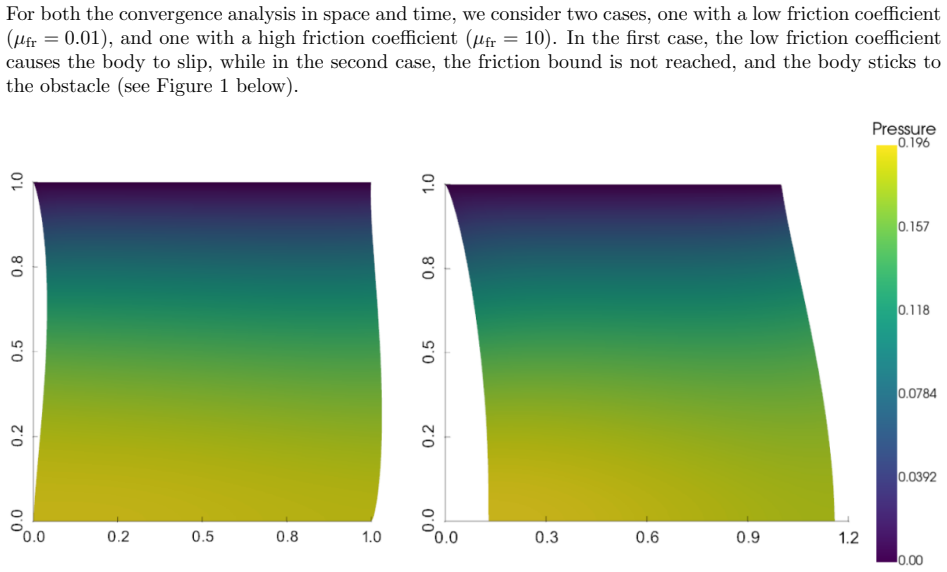
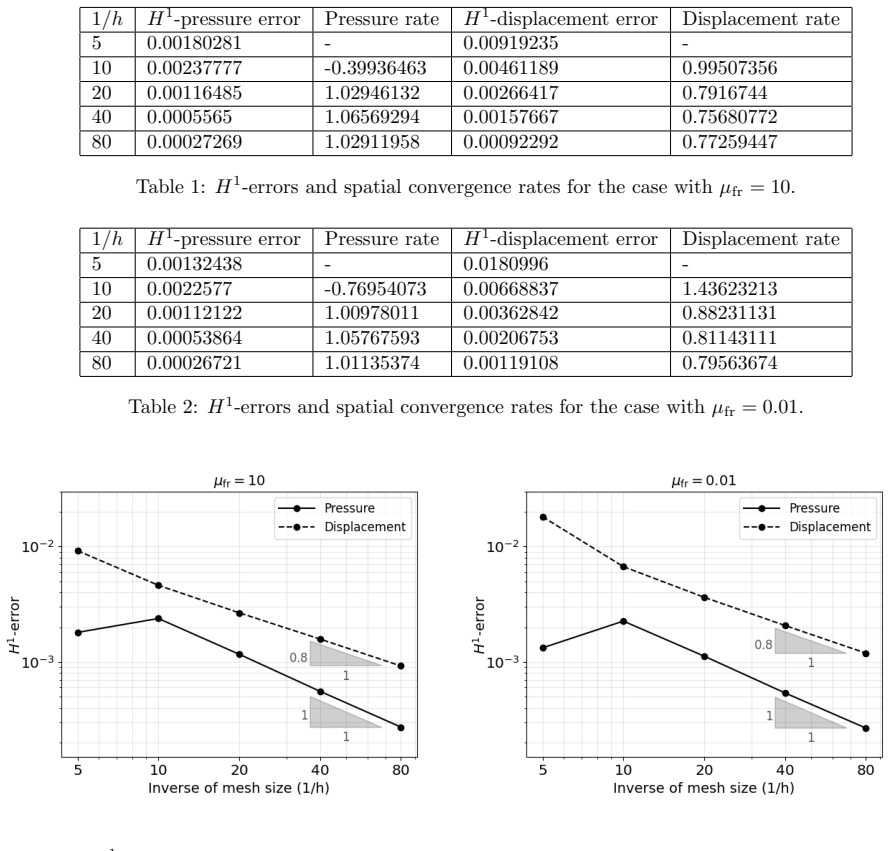
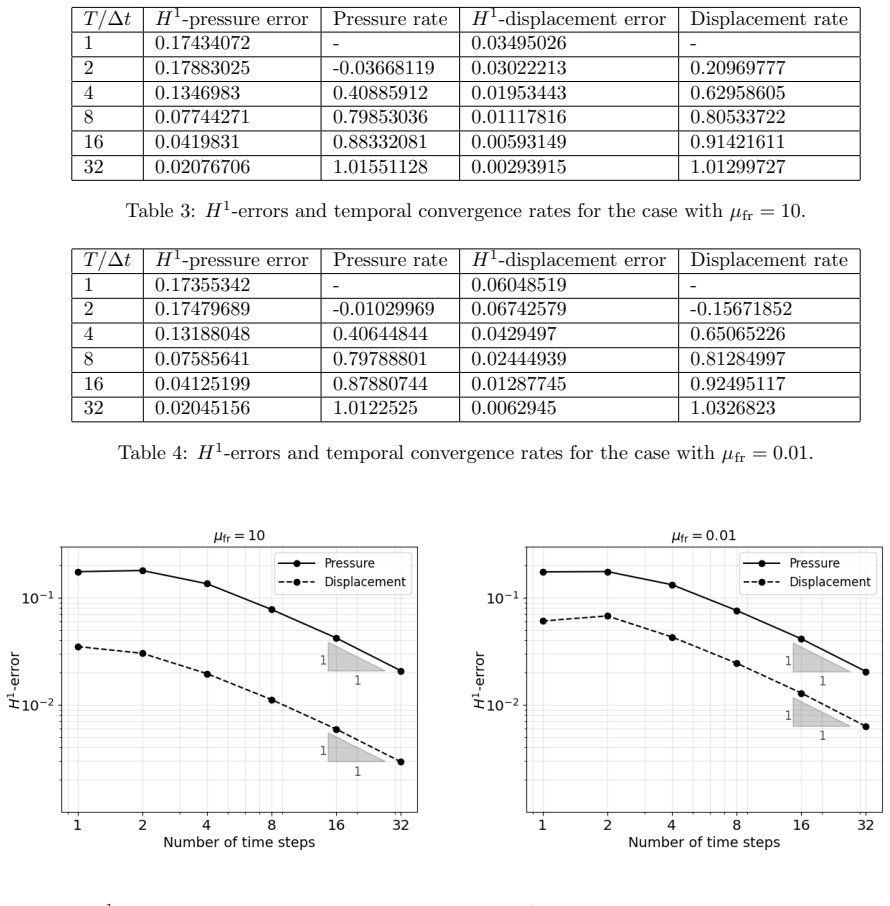
- Observed convergence rates in a numerical experiment match the orders predicted by the a priori analysis.
Where Pith is reading between the lines
- If independent well-posedness results for the continuous contact-Biot problem become available, the present discrete theory applies immediately.
- The same discretization strategy could be combined with other frictional laws provided the corresponding continuous problem remains well-posed.
- Implementation inside existing poroelastic finite-element codes would require only the addition of a contact module that handles the variational inequality at each time step.
Load-bearing premise
The continuous variational problem formed by the Biot equations together with normal compliance and Coulomb friction is well-posed and possesses enough regularity for the discrete comparison arguments to hold.
What would settle it
A sequence of successively refined space-time meshes on which the computed solution fails to converge at the predicted rates, or on which the nonlinear solver ceases to return a unique discrete solution for admissible data, would contradict the existence, uniqueness, or error claims.
Figures
read the original abstract
We consider a mathematical model of a poro-visco-elastic medium subject to frictional contact with a rigid obstacle, and study its numerical approximation. This model couples the Biot equations and contact conditions in the form of normal compliance and Coulomb friction. The resulting variational problem consists of a linear partial differential equation coupled to a nonlinear variational inequality. We propose and analyze a fully discrete numerical scheme for this problem, using conformal finite elements in space and the implicit Euler method in time. Existence and uniqueness of the discrete solution is established, and stability and a priori error estimates are derived. A numerical experiment is performed in which numerical error estimates are computed and compared to the theoretical results.
Editorial analysis
A structured set of objections, weighed in public.
Referee Report
Summary. The manuscript considers a poro-visco-elastic medium modeled by the Biot equations subject to frictional contact with a rigid obstacle via normal compliance and Coulomb friction. The resulting variational problem is a linear PDE coupled to a nonlinear variational inequality. The authors propose a fully discrete scheme using conforming finite elements in space and implicit Euler in time, establish existence and uniqueness of the discrete solution, derive stability and a priori error estimates, and present a numerical experiment comparing observed errors to the theoretical rates.
Significance. If the central claims hold, the work supplies a rigorous numerical analysis (existence, stability, and error bounds) for a coupled Biot-contact system of practical interest in geomechanics and biomechanics. The derivation of a priori estimates and the numerical validation are strengths that would support convergence of the scheme under the stated assumptions.
major comments (2)
- [Section 2] Section 2 (continuous problem formulation): well-posedness and sufficient regularity of the continuous variational inequality (Biot system plus normal compliance and Coulomb friction) are invoked without a self-contained proof or citation to existing results. This premise is load-bearing for the transfer of properties used to prove discrete existence/uniqueness (Section 4), stability, and a priori error estimates (Section 5).
- [Section 5] Section 5 (error analysis): the a priori estimates rely on regularity assumptions transferred from the continuous problem; without explicit justification or bounds for that regularity, the constants and rates in the estimates cannot be verified as independent of the discretization parameters.
minor comments (2)
- [Abstract] Abstract: 'conformal finite elements' is a typographical error and should read 'conforming finite elements'.
- Notation for the contact conditions (normal compliance and friction) could be introduced with a brief reminder of the physical meaning to improve readability for a numerical-analysis audience.
Simulated Author's Rebuttal
We thank the referee for the thorough review and the constructive major comments. We address each point below and outline the revisions we will make to strengthen the manuscript.
read point-by-point responses
-
Referee: [Section 2] Section 2 (continuous problem formulation): well-posedness and sufficient regularity of the continuous variational inequality (Biot system plus normal compliance and Coulomb friction) are invoked without a self-contained proof or citation to existing results. This premise is load-bearing for the transfer of properties used to prove discrete existence/uniqueness (Section 4), stability, and a priori error estimates (Section 5).
Authors: We agree that an explicit reference to the well-posedness of the continuous problem is required. In the revised version we will insert a citation to established results on the existence, uniqueness, and regularity for the Biot system with normal-compliance contact and Coulomb friction (e.g., works treating quasistatic poro-viscoelastic contact via variational inequalities). This reference will justify the assumptions transferred to the discrete analysis in Sections 4 and 5. revision: yes
-
Referee: [Section 5] Section 5 (error analysis): the a priori estimates rely on regularity assumptions transferred from the continuous problem; without explicit justification or bounds for that regularity, the constants and rates in the estimates cannot be verified as independent of the discretization parameters.
Authors: The error analysis is performed under the standard assumption that the continuous solution possesses the regularity needed for the interpolation and consistency terms to be well-defined. The constants appearing in the a priori bounds depend on this regularity but are independent of the mesh size h and time step Δt; this is the usual setting for a priori estimates of nonlinear variational inequalities. We will add a clarifying remark in Section 5 stating the precise regularity hypothesis, the dependence of the constants, and the fact that the derived rates are optimal under the stated assumptions. revision: yes
Circularity Check
No circularity: discrete analysis rests on standard assumption of continuous well-posedness without self-referential reduction.
full rationale
The paper derives existence, uniqueness, stability, and a priori error estimates for the fully discrete scheme (conformal FEM + implicit Euler) by transferring properties from the continuous Biot-contact variational problem. This is a conventional structure in numerical analysis and does not reduce any claimed result to a fitted parameter, self-definition, or self-citation chain by construction. No equations or steps in the provided abstract exhibit the enumerated circularity patterns; the continuous well-posedness premise is an external modeling assumption rather than an internal loop.
Axiom & Free-Parameter Ledger
axioms (2)
- domain assumption The continuous Biot-contact variational problem admits a unique solution with sufficient regularity for the discrete error analysis to hold.
- standard math Standard properties of conformal finite element spaces and the implicit Euler scheme apply to the coupled linear-nonlinear system.
Reference graph
Works this paper leans on
-
[1]
T Almani, K Kumar, and MF Wheeler. “Convergence and error analysis of fully discrete iterative coupling schemes for coupling flow with geomechanics”. In:Computational Geosciences21.5 (2017), pp. 1157–1172.doi:10.1007/s10596-017-9691-7
-
[2]
T Almani et al. “Convergence analysis of multirate fixed-stress split iterative schemes for coupling flow with geomechanics”. In:Computer Methods in Applied Mechanics and Engineering311 (2016), pp. 180–207.doi:10.1016/j.cma.2016.07.036
-
[3]
Fixed Stress Splitting Approach for Contact Problems in a Porous Medium
Tameem Almani and Kundan Kumar. “Fixed Stress Splitting Approach for Contact Problems in a Porous Medium”. In:Numerical Mathematics and Advanced Applications ENUMATH 2023, Volume 2. Ed. by Ad´ elia Sequeira et al. Cham: Springer Nature Switzerland, 2025, pp. 94–103.doi:10.1007/978-3- 031-86169-7_10
-
[4]
Martin S Alnæs et al. “Unified form language: A domain-specific language for weak formulations of partial differential equations”. In:ACM Transactions on Mathematical Software (TOMS)40.2 (2014), pp. 1–37.doi:10.1145/2566630
-
[5]
Contact problems in porous media
Lothar Banz and Fleurianne Bertrand. “Contact problems in porous media”. In:Computational Meth- ods in Applied Mathematics25.3 (2025), pp. 529–545.doi:10.1515/cmam-2025-0012
-
[6]
Baratta et al.DOLFINx: The next generation FEniCS problem solving environment
Igor A. Baratta et al.DOLFINx: The next generation FEniCS problem solving environment. Dec. 2023. doi:10.5281/zenodo.10447666
-
[7]
General theory of three-dimensional consolidation
Maurice A Biot. “General theory of three-dimensional consolidation”. In:Journal of applied physics 12.2 (1941), pp. 155–164.doi:10.1063/1.1712886
-
[8]
Francesco Bonaldi, J´ erˆ ome Droniou, and Roland Masson. “Numerical analysis of a mixed-dimensional poromechanical model with frictionless contact at matrix–fracture interfaces”. In:Mathematics of Com- putation93.349 (2024), pp. 2103–2134.doi:10.1090/mcom/3949
-
[9]
Francesco Bonaldi et al. “Energy-stable discretization of two-phase flows in deformable porous media with frictional contact at matrix–fracture interfaces”. In:Journal of Computational Physics455 (2022), p. 110984.doi:10.1016/j.jcp.2022.110984. 24
-
[10]
Springer, 2023.doi:10.1007/978-3-031-31423-0
Franz Chouly, Patrick Hild, and Yves Renard.Finite element approximation of contact and friction in elasticity. Springer, 2023.doi:10.1007/978-3-031-31423-0
-
[11]
Ciarlet.The Finite Element Method for Elliptic Problems
Philippe G. Ciarlet.The Finite Element Method for Elliptic Problems. Society for Industrial and Applied Mathematics, 2002.doi:10.1137/1.9780898719208
-
[12]
Coupling of flow, contact mechanics and friction, generating waves in a fractured porous medium
Maarten V. de Hoop and Kundan Kumar. “Coupling of flow, contact mechanics and friction, generating waves in a fractured porous medium”. In:Journal of Mathematical Analysis and Applications560.1 (2026), p. 130416.doi:https://doi.org/10.1016/j.jmaa.2026.130416
-
[13]
Berlin: Springer Science & Business Media, 2012.doi:10.1007/978-3-642-66165-5
Georges Duvant and Jacques Louis Lions.Inequalities in mechanics and physics. Berlin: Springer Science & Business Media, 2012.doi:10.1007/978-3-642-66165-5
-
[14]
A lubrication fracture model in a poro-elastic medium
Vivette Girault et al. “A lubrication fracture model in a poro-elastic medium”. In:Mathematical Models and Methods in Applied Sciences25.04 (2015), pp. 587–645.doi:10.1142/S0218202515500141
-
[15]
Mixed Formulation of a Linearized Lubrication Fracture Model in a Poro- elastic Medium
Vivette Girault et al. “Mixed Formulation of a Linearized Lubrication Fracture Model in a Poro- elastic Medium”. In:Contributions to Partial Differential Equations and Applications. Cham: Springer International Publishing, 2019, pp. 171–219.isbn: 978-3-319-78325-3.doi:10 . 1007 / 978 - 3 - 319 - 78325-3_12
2019
-
[16]
Analysis and numerical approximation of an elastic frictional contact problem with normal compliance
Weimin Han and Mircea Sofonea. “Analysis and numerical approximation of an elastic frictional contact problem with normal compliance”. In:Applicationes Mathematicae26.4 (1999), pp. 415–435
1999
-
[17]
Numerical analysis of hemivariational inequalities in contact me- chanics
Weimin Han and Mircea Sofonea. “Numerical analysis of hemivariational inequalities in contact me- chanics”. In:Acta Numerica(2019), pp. 175–286.doi:10.1017/S0962492919000023
-
[18]
American Mathematical Soc., 2002
Weimin Han and Mircea Sofonea.Quasistatic contact problems in viscoelasticity and viscoplasticity. American Mathematical Soc., 2002
2002
-
[19]
Philadelphia: SIAM Studies in Applied and Numerical Math- ematics, 1988.doi:10.1137/1.9781611970845
Noboru Kikuchi and John Tinsley Oden.Contact Problems in Elasticity: A Study of Variational In- equalities and Finite Element Methods. Philadelphia: SIAM Studies in Applied and Numerical Math- ematics, 1988.doi:10.1137/1.9781611970845
-
[20]
Stability, accuracy, and efficiency of sequential methods for coupled flow and geomechanics
Jihoon Kim, Hamdi A Tchelepi, and Ruben Juanes. “Stability, accuracy, and efficiency of sequential methods for coupled flow and geomechanics”. In:SPE Journal16.02 (2011), pp. 249–262.doi:10. 2118/119084-PA
2011
-
[21]
Dordrecht: Springer, 2007.doi:10.1007/978-1-4020-6377-0
Alexander S Kravchuk and Pekka J Neittaanm¨ aki.Variational and quasi-variational inequalities in mechanics. Dordrecht: Springer, 2007.doi:10.1007/978-1-4020-6377-0
-
[22]
J.A.C. Martins and J.T. Oden. “Existence and uniqueness results for dynamic contact problems with nonlinear normal and friction interface laws”. In:Nonlinear Analysis: Theory, Methods & Applications 11.3 (1987), pp. 407–428.issn: 0362-546X.doi:https://doi.org/10.1016/0362-546X(87)90055-1
-
[23]
Convergence of iterative coupling for coupled flow and geome- chanics
Andro Mikeli´ c and Mary F Wheeler. “Convergence of iterative coupling for coupled flow and geome- chanics”. In:Computational Geosciences17.3 (2013), pp. 455–461.doi:10.1007/s10596-012-9318-y
-
[24]
On stability and convergence of finite element approxima- tions of Biot’s consolidation problem
M´ arcio A Murad and Abimael FD Loula. “On stability and convergence of finite element approxima- tions of Biot’s consolidation problem”. In:International Journal for Numerical Methods in Engineering 37.4 (1994), pp. 645–667.doi:10.1002/nme.1620370407DigitalObjectIdentifier(DOI)
work page doi:10.1002/nme.1620370407digitalobjectidentifier(doi 1994
-
[25]
Marius Nevland et al.Source code: Numerical analysis of the Biot equations coupled to frictional contact mechanics.doi:10.5281/zenodo.20816611
-
[26]
Phillip Joseph Phillips and Mary F Wheeler. “A coupling of mixed and continuous Galerkin finite element methods for poroelasticity II: the discrete-in-time case”. In:Computational Geosciences11.2 (2007), pp. 145–158.doi:10.1007/s10596-007-9044-z
-
[27]
Basix: a runtime finite element basis evaluation library
Matthew W Scroggs et al. “Basix: a runtime finite element basis evaluation library”. In:Journal of Open Source Software7.73 (2022), p. 3982.doi:10.21105/joss.03982
-
[28]
Matthew W Scroggs et al. “Construction of arbitrary order finite element degree-of-freedom maps on polygonal and polyhedral cell meshes”. In:ACM Transactions on Mathematical Software (TOMS)48.2 (2022), pp. 1–23.doi:10.1145/3524456. 25
-
[29]
Diffusion in poro-elastic media
Ralph E Showalter. “Diffusion in poro-elastic media”. In:Journal of mathematical analysis and appli- cations251.1 (2000), pp. 310–340.doi:10.1006/jmaa.2000.7048
-
[30]
An augmented lagrangian treatment of contact problems involving friction
J.C. Simo and T.A. Laursen. “An augmented lagrangian treatment of contact problems involving friction”. In:Computers & Structures42.1 (1992), pp. 97–116.issn: 0045-7949.doi:10.1016/0045- 7949(92)90540-G
-
[31]
Modelling of contact problems
Mircea Sofonea and Andaluzia Matei. “Modelling of contact problems”. In:Mathematical Models in Contact Mechanics. London Mathematical Society Lecture Note Series. Cambridge University Press, 2012, pp. 83–122
2012
-
[32]
Optimal L 2 A Priori Error Estimates for the Biot System
Mary F Wheeler, Vivette Girault, and Xueying Lu. “Optimal L 2 A Priori Error Estimates for the Biot System”. In:La Matematica1.1 (2022), pp. 317–341.doi:10.1007/s44007-022-00020-3. 26
discussion (0)
Sign in with ORCID, Apple, or X to comment. Anyone can read and Pith papers without signing in.