Disorder-induced superconductivity in graphene
Pith reviewed 2026-07-03 03:49 UTC · model grok-4.3
The pith
Disorder from vacancies or hydrogenation induces superconductivity in graphene for arbitrarily weak attractive interactions.
A machine-rendered reading of the paper's core claim, the machinery that carries it, and where it could break.
Core claim
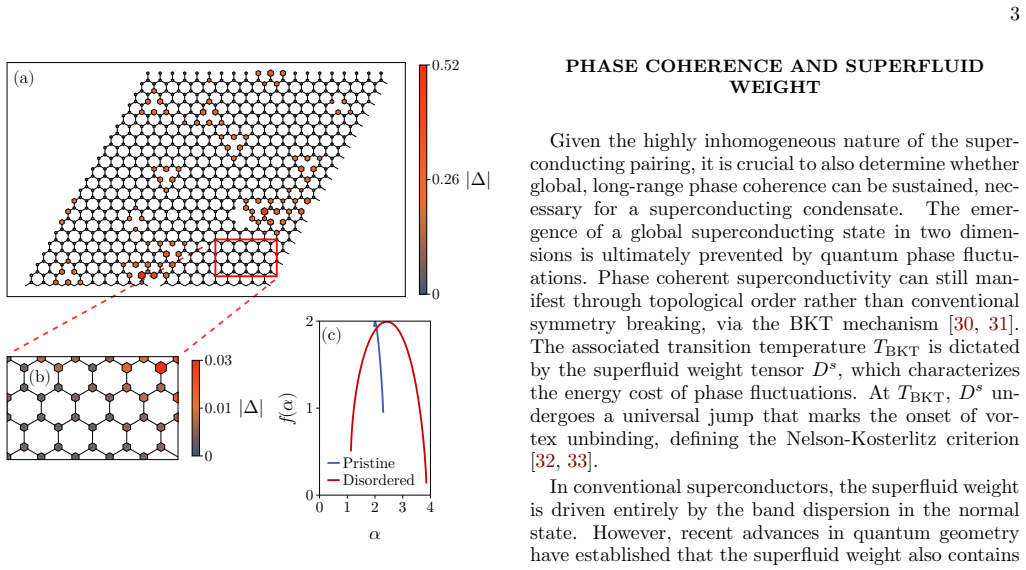
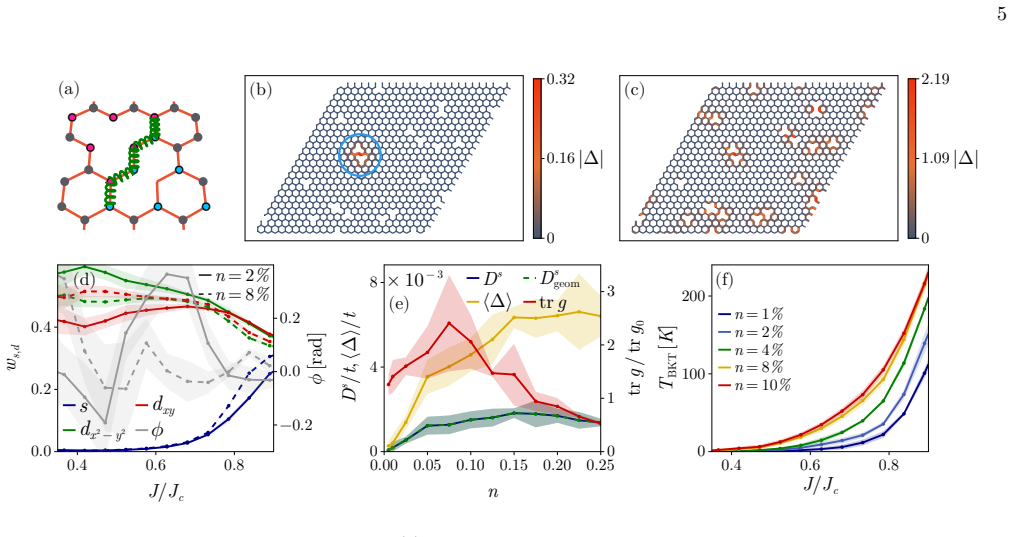
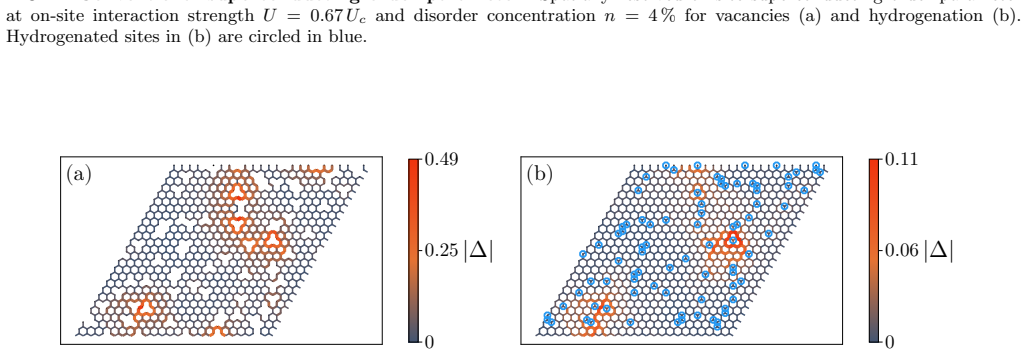
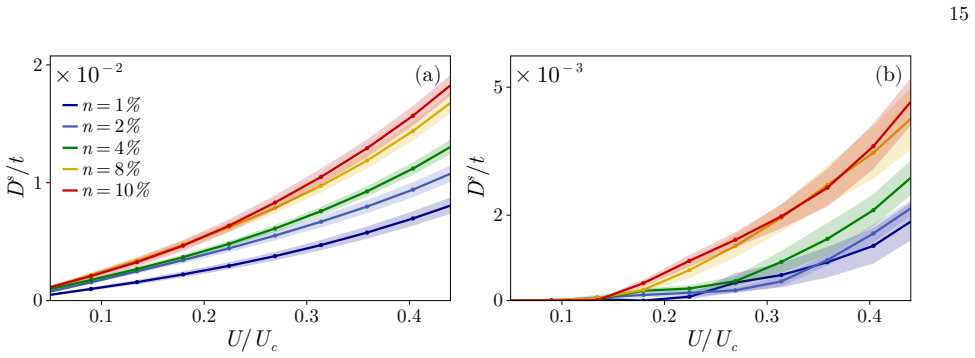
For conventional s-wave pairing, disorder induces a finite superconducting order parameter for arbitrarily weak attractive interactions. Rather than forming isolated superconducting puddles, global phase coherence is established through a finite superfluid weight of purely geometrical origin. Away from the chiral limit of vacancies, hydrogenation similarly yields a finite transition temperature and nonzero superfluid weight for weak interactions. For unconventional nearest-neighbor pairing, superconductivity exhibits quantum-critical-like behavior, yet phase coherence persists at low interaction strengths, with mixed d-wave symmetries.
What carries the argument
Disorder-generated low-energy density of states that enables mean-field pairing together with a purely geometrical contribution to the superfluid weight.
If this is right
- Superconductivity emerges from disorder alone without requiring strong clean-limit interactions.
- Global phase coherence is achieved through a geometrical superfluid weight rather than isolated puddles.
- The effect holds for both vacancies in the chiral limit and for hydrogenation.
- Unconventional pairing still supports phase coherence at low interaction strengths despite quantum-critical-like signatures.
Where Pith is reading between the lines
- The same disorder route may apply to other two-dimensional semimetals that lack superconductivity in the clean limit.
- Varying vacancy or adatom density could provide experimental control over the transition temperature.
- The geometrical origin of the superfluid weight may confer robustness to additional forms of disorder.
Load-bearing premise
Low concentrations of vacancies or hydrogenation produce a sufficiently large density of low-energy states that can be treated within the chosen theoretical framework to yield finite order parameter and geometrical superfluid weight for weak interactions.
What would settle it
An experiment finding zero superconducting transition temperature and zero superfluid weight in graphene with controlled low-concentration vacancies or hydrogenation at weak interaction strengths would falsify the claim.
Figures



read the original abstract
Correlated phases of matter are typically investigated in crystalline systems, where disorder is considered to be detrimental. However, intriguing exceptions exist, such as superconductivity being enhanced in amorphous realizations of Al and Bi. Here, we demonstrate that superconductivity can even emerge entirely from disorder, using monolayer graphene as an example. In the clean limit, the semi-metallic nature of graphene requires prohibitively strong electronic interactions to achieve superconductivity. Despite the inherently random nature of disorder, we show that introducing low concentrations of vacancies or hydrogenation in graphene provides a large density of low-energy states that easily induce superconductivity. For conventional $s$-wave pairing, disorder induces a finite superconducting order parameter for arbitrarily weak attractive interactions. Rather than forming isolated superconducting puddles, global phase coherence is established through a finite superfluid weight of purely geometrical origin. Away from the chiral limit of vacancies, hydrogenation similarly yields a finite transition temperature and nonzero superfluid weight for weak interactions. For unconventional nearest-neighbor pairing, typically more disrupted by disorder, superconductivity exhibits quantum-critical-like behavior, yet phase coherence persists at low interaction strengths, with mixed $d$-wave symmetries. Our work demonstrates the robust emergence of macroscopic superconducting phase coherence engineered entirely from microscopic disorder.
Editorial analysis
A structured set of objections, weighed in public.
Referee Report
Summary. The manuscript claims that introducing low concentrations of vacancies or hydrogenation into monolayer graphene induces superconductivity for arbitrarily weak attractive interactions by generating a large density of low-energy states. For conventional s-wave pairing, disorder produces a finite superconducting order parameter, with global phase coherence arising from a finite superfluid weight of purely geometrical origin rather than isolated puddles. Hydrogenation yields a finite transition temperature and nonzero superfluid weight away from the chiral limit. For unconventional nearest-neighbor pairing, the system exhibits quantum-critical-like behavior yet maintains phase coherence at low interaction strengths with mixed d-wave symmetries.
Significance. If the central claims are supported by the derivations and numerics, the result would be significant for demonstrating that disorder can induce rather than suppress superconductivity in a clean-limit semi-metal, with the geometrical superfluid weight providing a mechanism for phase coherence. This offers a theoretical route to disorder-engineered macroscopic coherence in 2D materials and highlights how low-energy DOS from vacancies can enable mean-field pairing at weak V.
minor comments (1)
- [Abstract] The abstract packs multiple distinct results (s-wave vs. unconventional, vacancies vs. hydrogenation) into long sentences; splitting the final two sentences would improve readability without altering content.
Simulated Author's Rebuttal
We thank the referee for their positive assessment of our work on disorder-induced superconductivity in graphene and for recommending minor revision. The report raises no specific major comments requiring point-by-point responses.
Circularity Check
No circularity; derivation self-contained
full rationale
The provided abstract and mechanism description rely on standard BCS-like mean-field response to disorder-induced finite DOS at low energies, yielding finite order parameter for weak attraction, plus a geometrical contribution to superfluid stiffness. No equations, self-citations, or fitted parameters are quoted that reduce a claimed prediction or uniqueness result back to the input by construction. The central claims remain independent of the paper's own fitted values or prior self-citations in a load-bearing way, consistent with externally verifiable lattice models of disordered graphene superconductivity.
Axiom & Free-Parameter Ledger
Reference graph
Works this paper leans on
-
[1]
R. Nandkishore, L. S. Levitov, and A. V. Chubukov, Chiral superconductivity from repulsive interactions in doped graphene, Nat. Phys.8, 158 (2012)
work page 2012
-
[2]
A. M. Black-Schaffer and C. Honerkamp, Chiral d-wave superconductivity in doped graphene, J. Phys. Condens. Matter26, 423201 (2014)
work page 2014
-
[3]
Y. Cao, V. Fatemi, S. Fang, K. Watanabe, T. Taniguchi, E. Kaxiras, and P. Jarillo-Herrero, Unconventional super- conductivity in magic-angle graphene superlattices, Na- ture556, 43 (2018)
work page 2018
-
[4]
M. Yankowitz, S. Chen, H. Polshyn, Y. Zhang, K. Watan- abe, T. Taniguchi, D. Graf, A. F. Young, and C. R. Dean, Tuning superconductivity in twisted bilayer graphene, Science363, 1059 (2019). 7
work page 2019
-
[5]
P. T¨ orm¨ a, S. Peotta, and B. A. Bernevig, Superconduc- tivity, superfluidity and quantum geometry in twisted multilayer systems, Nature Reviews Physics4, 528 (2022)
work page 2022
-
[6]
R. Bistritzer and A. H. MacDonald, Moir´ e bands in twisted double-layer graphene, Proc. Natl. Acad. Sci. U.S.A108, 12233 (2011)
work page 2011
-
[7]
S. Lisi, X. Lu, T. Benschop, T. A. de Jong, P. Stepanov, J. R. Duran, F. Margot, I. Cucchi, E. Cappelli, A. Hunter,et al., Observation of flat bands in twisted bilayer graphene, Nat. Phys.17, 189 (2021)
work page 2021
-
[8]
H. Zhou, T. Xie, T. Taniguchi, K. Watanabe, and A. F. Young, Superconductivity in rhombohedral trilayer graphene, Nature598, 434 (2021)
work page 2021
-
[9]
T. Han, Z. Lu, Z. Hadjri, L. Shi, Z. Wu, W. Xu, Y. Yao, A. A. Cotten, O. Sharifi Sedeh, H. Weldeyesus,et al., Signatures of chiral superconductivity in rhombohedral graphene, Nature643, 654 (2025)
work page 2025
-
[10]
Gade, Anderson localization for sublattice models, Nucl
R. Gade, Anderson localization for sublattice models, Nucl. Phys. B398, 499 (1993)
work page 1993
-
[11]
V. M. Pereira, F. Guinea, J. M. B. Lopes dos Santos, N. M. R. Peres, and A. H. Castro Neto, Disorder induced localized states in graphene, Phys. Rev. Lett.96, 036801 (2006)
work page 2006
-
[12]
P. M. Ostrovsky, I. V. Gornyi, and A. D. Mirlin, Elec- tron transport in disordered graphene, Phys. Rev. B74, 235443 (2006)
work page 2006
-
[13]
T. Stauber, N. M. R. Peres, and F. Guinea, Electronic transport in graphene: A semiclassical approach includ- ing midgap states, Phys. Rev. B76, 205423 (2007)
work page 2007
-
[14]
T. O. Wehling, S. Yuan, A. I. Lichtenstein, A. K. Geim, and M. I. Katsnelson, Resonant scattering by realistic impurities in graphene, Phys. Rev. Lett.105, 056802 (2010)
work page 2010
-
[15]
M. M. Ugeda, I. Brihuega, F. Guinea, and J. M. G´ omez- Rodr´ ıguez, Missing atom as a source of carbon mag- netism, Phys. Rev. Lett.104, 096804 (2010)
work page 2010
-
[16]
P. M. Ostrovsky, I. V. Protopopov, E. J. K¨ onig, I. V. Gornyi, A. D. Mirlin, and M. A. Skvortsov, Density of states in a two-dimensional chiral metal with vacancies, Phys. Rev. Lett.113, 186803 (2014)
work page 2014
-
[17]
N. B. Kopnin, Surface superconductivity in multilayered rhombohedral graphene: Supercurrent, JETP Lett.94, 81 (2011)
work page 2011
-
[18]
S. Peotta and P. T¨ orm¨ a, Superfluidity in topologically nontrivial flat bands, Nat. Commun.6, 8944 (2015)
work page 2015
- [19]
-
[20]
S. Peotta, K.-E. Huhtinen, and P. T¨ orm¨ a, Quantum ge- ometry in superfluidity and superconductivity, inQuan- tum Mixtures with Ultra-cold Atoms(IOS Press, 2025) pp. 373–404
work page 2025
-
[21]
J. Yu, B. A. Bernevig, R. Queiroz, E. Rossi, P. T¨ orm¨ a, and B.-J. Yang, Quantum geometry in quantum materi- als, npj Quantum Mater.10, 101 (2025)
work page 2025
-
[22]
Q. Marsal and A. M. Black-Schaffer, Enhanced quantum metric due to vacancies in graphene, Phys. Rev. Lett. 133, 026002 (2024)
work page 2024
-
[23]
H. Gonz´ alez-Herrero, J. M. G´ omez-Rodr´ ıguez, P. Mallet, M. Moaied, J. J. Palacios, C. Salgado, M. M. Ugeda, J.- Y. Veuillen, F. Yndurain, and I. Brihuega, Atomic-scale control of graphene magnetism by using hydrogen atoms, Science352, 437 (2016)
work page 2016
-
[24]
G. Usaj, P. S. Cornaglia, and C. A. Balseiro, Partial preservation of chiral symmetry and colossal magnetore- sistance in adatom-doped graphene, Phys. Rev. B89, 085405 (2014)
work page 2014
-
[25]
A. M. Black-Schaffer and S. Doniach, Effect of near- est neighbor spin-singlet correlations in conventional graphene sns josephson junctions, Phys. Rev. B79, 064502 (2009)
work page 2009
-
[26]
N. B. Kopnin, T. T. Heikkil¨ a, and G. E. Volovik, High-temperature surface superconductivity in topologi- cal flat-band systems, Phys. Rev. B83, 220503 (2011)
work page 2011
-
[27]
F. Evers and A. D. Mirlin, Anderson transitions, Rev. Mod. Phys.80, 1355 (2008)
work page 2008
-
[28]
A. Chhabra and R. V. Jensen, Direct determination of the f (α) singularity spectrum, Phys. Rev. Lett.62, 1327 (1989)
work page 1989
-
[29]
R. Lopes and N. Betrouni, Fractal and multifractal anal- ysis: A review, Med. Image Anal.13, 634 (2009)
work page 2009
-
[30]
V. L. Berezinskii, Destruction of long-range order in one- dimensional and two-dimensional systems having a con- tinuous symmetry group i. classical systems, Sov. Phys. JETP32, 493 (1971)
work page 1971
-
[31]
J. M. Kosterlitz and D. J. Thouless, Ordering, metasta- bility and phase transitions in two-dimensional systems, J. Phys. C: Solid State Phys.6, 1181 (1973)
work page 1973
-
[32]
J. M. Kosterlitz, The critical properties of the two- dimensional xy model, J. Phys. Condens. Matter7, 1046 (1974)
work page 1974
-
[33]
D. R. Nelson and J. M. Kosterlitz, Universal jump in the superfluid density of two-dimensional superfluids, Phys. Rev. Lett.39, 1201 (1977)
work page 1977
- [34]
-
[35]
K.-E. Huhtinen, J. Herzog-Arbeitman, A. Chew, B. A. Bernevig, and P. T¨ orm¨ a, Revisiting flat band supercon- ductivity: Dependence on minimal quantum metric and band touchings, Phys. Rev. B106, 014518 (2022)
work page 2022
-
[36]
A. Lau, S. Peotta, D. Pikulin, E. Rossi, and T. Hyart, Universal suppression of superfluid weight by non- magnetic disorder ins-wave superconductors indepen- dent of quantum geometry and band dispersion, SciPost Phys.13, 086 (2022)
work page 2022
-
[37]
E. O. Lamponen, S. K. P¨ ontys, and P. T¨ orm¨ a, Supercon- ductivity and pair density waves from nearest-neighbor interactions in frustrated lattice geometries, Phys. Rev. B112, 144514 (2025)
work page 2025
-
[38]
N. B. Kopnin and E. B. Sonin, Bcs superconductivity of dirac electrons in graphene layers, Phys. Rev. Lett.100, 246808 (2008)
work page 2008
-
[39]
N. B. Kopnin and E. B. Sonin, Supercurrent in super- conducting graphene, Phys. Rev. B82, 014516 (2010)
work page 2010
-
[40]
A. M. Black-Schaffer and S. Doniach, Resonating va- lence bonds and mean-field d-wave superconductivity in graphite, Phys. Rev. B75, 134512 (2007)
work page 2007
-
[41]
M. L. Kiesel, C. Platt, W. Hanke, D. A. Abanin, and R. Thomale, Competing many-body instabilities and un- conventional superconductivity in graphene, Phys. Rev. B86, 020507(R) (2012)
work page 2012
-
[42]
A. M. Black-Schaffer, W. Wu, and K. Le Hur, Chirald- wave superconductivity on the honeycomb lattice close to the mott state, Phys. Rev. B90, 054521 (2014)
work page 2014
-
[43]
E. Pangburn, L. Haurie, A. Cr´ epieux, O. A. Awoga, 8 A. M. Black-Schaffer, C. P´ epin, and C. Bena, Supercon- ductivity in monolayer and few-layer graphene. i. review of possible pairing symmetries and basic electronic prop- erties, Phys. Rev. B108, 134514 (2023)
work page 2023
-
[44]
O. A. Awoga, T. L¨ othman, and A. M. Black-Schaffer, Superconductivity and magnetism in the surface states of abc-stacked multilayer graphene, Phys. Rev. B108, 144504 (2023)
work page 2023
-
[45]
A. H. Castro Neto, F. Guinea, N. M. R. Peres, K. S. Novoselov, and A. K. Geim, The electronic properties of graphene, Rev. Mod. Phys.81, 109 (2009)
work page 2009
-
[46]
M. S. M. de Sousa, F. Liu, F. Qu, and W. Chen, Vacancy-engineered flat-band superconductivity in holey graphene, Phys. Rev. B105, 014511 (2022)
work page 2022
-
[47]
J. J. Palacios, J. Fern´ andez-Rossier, and L. Brey, Vacancy-induced magnetism in graphene and graphene ribbons, Phys. Rev. B77, 195428 (2008)
work page 2008
-
[48]
G.-D. Lee, C. Z. Wang, E. Yoon, N.-M. Hwang, D.-Y. Kim, and K. M. Ho, Diffusion, coalescence, and recon- struction of vacancy defects in graphene layers, Phys. Rev. Lett.95, 205501 (2005)
work page 2005
-
[49]
V. O. ¨Oz¸ celik, H. H. Gurel, and S. Ciraci, Self-healing of vacancy defects in single-layer graphene and silicene, Phys. Rev. B88, 045440 (2013)
work page 2013
-
[50]
R. R. Nair, I.-L. Tsai, M. Sepioni, O. Lehtinen, J. Keinonen, A. V. Krasheninnikov, A. H. Castro Neto, M. I. Katsnelson, A. K. Geim, and I. V. Grigorieva, Dual origin of defect magnetism in graphene and its reversible switching by molecular doping, Nat. Commun.4, 2010 (2013)
work page 2010
-
[51]
T. L¨ othman and A. M. Black-Schaffer, Universal phase diagrams with superconducting domes for electronic flat bands, Phys. Rev. B96, 064505 (2017)
work page 2017
-
[52]
E. H. Lieb, M. Loss, and R. J. McCann, Uniform density theorem for the hubbard model, J. Math. Phys.34, 891 (1993)
work page 1993
-
[53]
J. E. Moussa, Minimax rational approximation of the fermi-dirac distribution, J. Climate Meteor.145(2016)
work page 2016
-
[54]
T. L¨ othman, J. Schmidt, F. Parhizgar, and A. M. Black-Schaffer, Nematic superconductivity in magic- angle twisted bilayer graphene from atomistic modeling, Commun. Phys.5, 92 (2022)
work page 2022
-
[55]
R. P. Brent, Some efficient algorithms for solving systems of nonlinear equations, SIAM J. Numer. Anal.10, 327 (1973)
work page 1973
-
[56]
Zhu,Bogoliubov-de Gennes method and its applica- tions, Vol
J.-X. Zhu,Bogoliubov-de Gennes method and its applica- tions, Vol. 924 (Springer, 2016)
work page 2016
-
[57]
A. Braun and P. Schmitteckert, Numerical evaluation of green’s functions based on the chebyshev expansion, Phys. Rev. B90, 165112 (2014)
work page 2014
-
[58]
Extended Hubbard model on fractals: d-Wave superconductivity and competing pairing channels
R. Canyellas, M. I. Katsnelson, and A. Bagrov, Ex- tended hubbard model on fractals: d-wave superconduc- tivity and competing pairing channels, arXiv preprint arXiv:2603.17362 (2026)
work page internal anchor Pith review Pith/arXiv arXiv 2026
-
[59]
H. J. Monkhorst and J. D. Pack, Special points for brillouin-zone integrations, Phys. Rev. B13, 5188 (1976)
work page 1976
- [60]
-
[61]
J. Bezanson, A. Edelman, S. Karpinski, and V. B. Shah, Julia: A fresh approach to numerical computing, SIAM Rev.59, 65 (2017)
work page 2017
-
[62]
Disorder-induced superconductivity in graphene
J. van Poppelen, T. L¨ othman, and A. M. Black-Schaffer, Data for “Disorder-induced superconductivity in graphene” (2026), https://doi.org/10.5281/zenodo.21133299. 9 METHODS Normal state We consider a graphene latticeGwithNsites, with nearest-neighbor hoppingt. Vacancies are introduced by removing a set of sitesV, corresponding to a vacancy con- centratio...
discussion (0)
Sign in with ORCID, Apple, or X to comment. Anyone can read and Pith papers without signing in.