Neural-Network Inverse Design of SRF Cavities and Transmons for Bosonic Quantum Computation
Pith reviewed 2026-07-03 12:02 UTC · model grok-4.3
The pith
Deep neural networks recover SRF cavity and transmon geometries that match target electromagnetic parameters within a few percent.
A machine-rendered reading of the paper's core claim, the machinery that carries it, and where it could break.
Core claim
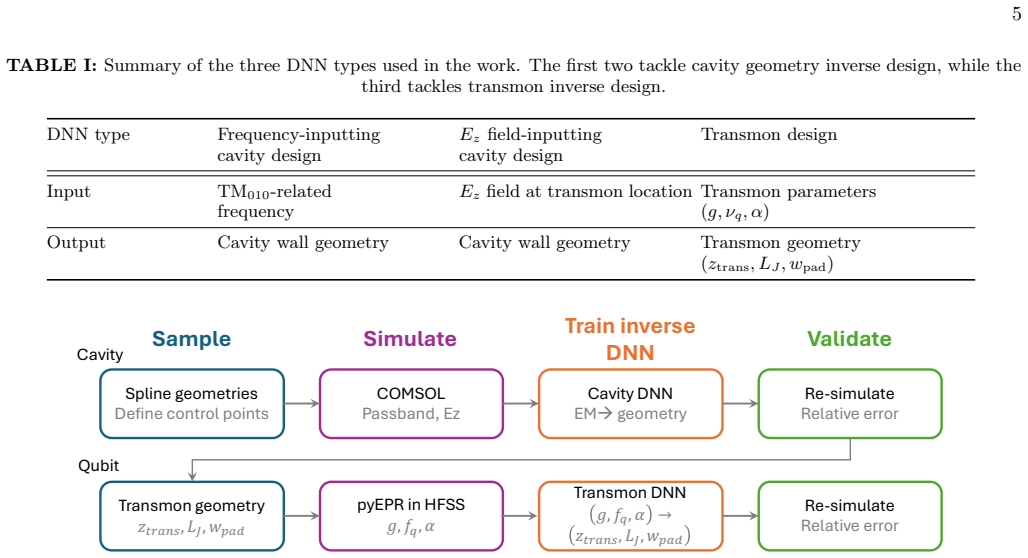
Two deep neural network approaches address the inverse-design problem at complementary levels: the first proposes SRF cavity geometries that produce target cavity observables, while the second proposes transmon qubit designs that produce target qubit-cavity parameters (g, ν_q, α). The recovered candidate designs match the targets to within ∼5% (cavity) and ∼2% (transmon), confirmed by end-to-end re-simulation. Both approaches map desired device behavior directly to candidate designs, providing a fast alternative to the iterative simulation studies usually required.
What carries the argument
Deep neural networks trained on electromagnetic simulation data to learn the inverse mapping from target observables to device geometries.
If this is right
- Cavity geometries can be generated directly from desired observables without repeated forward simulations.
- Transmon geometry and position can be adjusted to hit specified coupling, frequency, and anharmonicity simultaneously.
- The two networks can be used sequentially to design coupled cavity-transmon systems from high-level targets.
- Design iteration time drops from many simulation cycles to a single network evaluation plus verification.
Where Pith is reading between the lines
- If the same training strategy works for other superconducting components, full-stack hardware could be designed from performance specifications alone.
- Hybrid approaches that embed Maxwell-equation constraints inside the network loss might reduce the required training data volume.
- Accuracy on out-of-distribution targets could be tested by deliberately holding out regions of the geometry space during training.
Load-bearing premise
The electromagnetic simulation data used to train the networks sufficiently samples the relevant geometry and parameter space so that the learned inverse mapping generalizes accurately to unseen target values.
What would settle it
Re-simulating a network-proposed geometry for a target value outside the training distribution and finding deviations much larger than 5% or 2% from the requested observables.
Figures





read the original abstract
Three-dimensional superconducting radio-frequency (SRF) cavities provide exceptionally long-lived electromagnetic modes and, when coupled to nonlinear elements such as transmon qubits, become promising architectures for bosonic quantum information processing. The inverse design of such systems, i.e., recovering device geometries that produce specified electromagnetic and coupling targets, is generally a one-to-many problem. The qubit-cavity coupling strength depends sensitively on both the transmon geometry and its position within the cavity's electromagnetic field. As these systems scale up and their design parameter spaces grow, the cost of conventional iterative simulation becomes prohibitive. We present two deep neural network (DNN) approaches that address this inverse-design problem at complementary levels of the design stack. The first proposes SRF cavity geometries that produce target cavity observables. The second proposes transmon qubit designs that produce target qubit-cavity parameters -- the coupling rate, qubit frequency, and anharmonicity $(g, \nu_q, \alpha)$. The recovered candidate designs match the targets to within $\sim$5\% (cavity) and $\sim$2\% (transmon), confirmed by end-to-end re-simulation. Both approaches map desired device behavior directly to candidate designs, a fast alternative to the iterative simulation studies usually required.
Editorial analysis
A structured set of objections, weighed in public.
Referee Report
Summary. The paper presents two deep neural network approaches for inverse design of SRF cavities and transmon qubits. The first maps target cavity observables to device geometries; the second maps target parameters (g, ν_q, α) to transmon designs. Recovered designs are reported to match targets within ~5% (cavity) and ~2% (transmon) when validated by independent electromagnetic re-simulation, offering a fast alternative to iterative optimization for bosonic quantum devices.
Significance. If the results hold, the work provides a practical demonstration of machine learning for accelerating design of long-lived bosonic quantum systems, with the re-simulation validation serving as a direct empirical check that avoids circularity. This could reduce the computational cost of scaling such architectures, though the significance hinges on whether the approach generalizes reliably beyond the specific cases shown.
major comments (1)
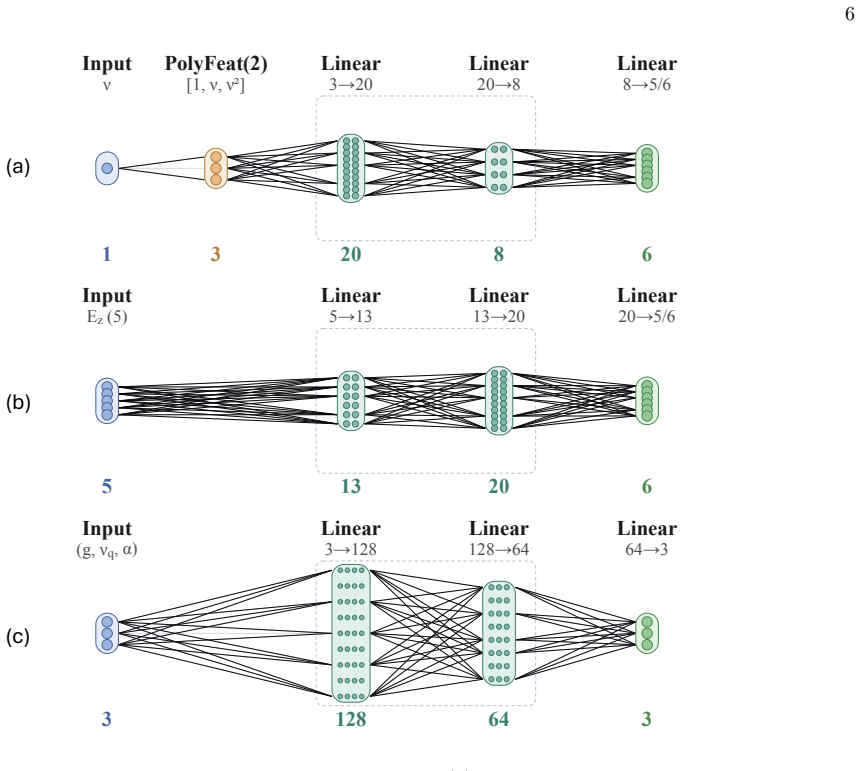
- [DNN training and dataset generation] The description of the DNN training procedure provides no information on training set size, sampling density of the geometry/parameter space, network depth or width, regularization, or cross-validation. This is load-bearing for the central claim because the inverse problem is one-to-many and the reported ~5%/~2% accuracies (verified by re-simulation) only confirm consistency if the test targets lie within a densely sampled region of the training manifold; sparse coverage would imply extrapolation rather than true inverse-design capability.
minor comments (1)
- [Abstract and introduction] The abstract and main text introduce parameters g, ν_q, and α without an explicit early definition or table summarizing their physical meanings and target ranges.
Simulated Author's Rebuttal
We thank the referee for their thoughtful review and for highlighting the importance of training details in assessing the inverse-design claims. We address the single major comment below and will incorporate the requested information in a revised manuscript.
read point-by-point responses
-
Referee: [DNN training and dataset generation] The description of the DNN training procedure provides no information on training set size, sampling density of the geometry/parameter space, network depth or width, regularization, or cross-validation. This is load-bearing for the central claim because the inverse problem is one-to-many and the reported ~5%/~2% accuracies (verified by re-simulation) only confirm consistency if the test targets lie within a densely sampled region of the training manifold; sparse coverage would imply extrapolation rather than true inverse-design capability.
Authors: We agree that these details are necessary to substantiate that the reported accuracies reflect interpolation within a well-sampled manifold rather than extrapolation. In the revised manuscript we will add an explicit subsection (or appendix) specifying: (i) the total number of training/validation/test geometries and parameter sets generated, (ii) the sampling strategy and density used to cover the geometry/parameter space, (iii) network depth, width, and activation choices, (iv) regularization methods (e.g., dropout, weight decay), and (v) the cross-validation protocol. These additions will allow readers to evaluate coverage and will be placed immediately before the results on re-simulation accuracy. revision: yes
Circularity Check
No circularity; empirical ML inverse mapping validated by independent re-simulation
full rationale
The paper trains DNNs on electromagnetic simulation data to map target observables to candidate geometries for cavities and transmons. The load-bearing claim is that recovered designs match targets to ~5% (cavity) and ~2% (transmon) when the network outputs are fed into fresh end-to-end re-simulation. This check is external to the training set and does not reduce any prediction to a fitted input by construction, nor does any equation or self-citation chain appear in the provided text. The approach is a standard supervised learning pipeline whose generalization depends on data coverage, not on definitional equivalence or imported uniqueness theorems. No steps match the enumerated circularity patterns.
Axiom & Free-Parameter Ledger
free parameters (1)
- neural network weights and biases
axioms (1)
- domain assumption Electromagnetic simulations used for training data accurately capture the relevant physics of SRF cavities and transmon-cavity coupling.
Reference graph
Works this paper leans on
-
[1]
INTRODUCTION Designing electromagnetic devices to meet target per- formance specifications is a recurring challenge across mi- crowave engineering, photonics, and accelerator physics. The forward problem, i.e., predicting device performance from a given geometry, is routinely tackled with finite- element software packages for electromagnetic and mul- tiph...
work page internal anchor Pith review Pith/arXiv arXiv 2026
-
[2]
BACKGROUND In cavity QED [21, 22], resonant modes of the cav- ity provide a controllable environment in which quan- tum states can be prepared, manipulated, and read out with high fidelity through the use of an ancillary trans- mon. SRF cavities are particularly well suited for this role, with a demonstrated record high photon lifetime, exceeding 2 second...
-
[3]
METHODS The one-to-many inverse mapping from EM param- eters to viable geometric features is well-suited for a data-driven approach. Many perturbations around an initial geometry are randomly sampled, then Maxwell’s equations are solved for each one. The EM analysis is made via commercial software packages, such as COM- SOL Multiphysics. This way, a label...
work page 2000
-
[4]
verify that training and testing losses decrease and converge
-
[5]
compare geometries from the testing set with pre- dicted DNN output geometries
-
[6]
These checks were applied to all DNN configurations de- scribed above
run predicted geometries back through COMSOL to compare the resulting EM parameters against the original DNN inputs corresponding to data points from the testing set. These checks were applied to all DNN configurations de- scribed above. 3.3. EPR characterization of DNN-generated cavity geometries This subsection details a workflow to characterize the cou...
-
[7]
RESULTS The results that follow are split into three distinct problems that together span the full cavity-qubit design 5 Both are dimensionless coefficients in the Adam update rule: the learning rate scales each gradient step in the standardized parameter space, and the weight decay is the L2-regularization multiplier. 10 stack. Section 4.1 reports the ca...
-
[8]
CONCLUSIONS We have presented a deep-learning approach to the inverse design of 3D cQED hardware that operates at two levels of the design stack: (i) SRF cavity geome- 14 try and (ii) transmon qubit position and properties. On the cavity side, the DNN architectures generated ge- ometries matching the target passband widths within ∼5%, diverging from the h...
- [9]
-
[10]
A. Radovic, M. Williams, D. Rousseau, M. Kagan, D. Bonacorsi, A. Himmel, A. Aurisano, K. Terao, and T. Wongjirad, Nature560, 41 (2018)
work page 2018
-
[11]
J. Peurifoy, Y. Shen, L. Jing, Y. Yang, F. Cano-Fano, J. D. Joannopoulos, M. Tegmark, and M. Soljačić, Sci- ence Advances4, eaar4206 (2018)
work page 2018
- [12]
-
[13]
H. Paik, D. I. Schuster, L. S. Bishop, G. Kirchmair, G. Catelani, A. P. Sears, B. R. Johnson, M. J. Reagor, L. Frunzio, L. I. Glazman, S. M. Girvin, M. H. De- voret, and R. J. Schoelkopf, Physical Review Letters107, 240501 (2011)
work page 2011
-
[14]
A. Romanenko, R. Pilipenko, S. Zorzetti, D. Frolov, M. Awida, S. Belomestnykh, S. Posen, and A. Gras- sellino, Physical Review Applied13, 034032 (2020)
work page 2020
- [15]
-
[16]
J. Koch, T. M. Yu, J. Gambetta, A. A. Houck, D. I. Schuster, J. Majer, A. Blais, M. H. Devoret, S. M. Girvin, and R. J. Schoelkopf, Physical Review A76, 042319 (2007)
work page 2007
- [17]
-
[18]
A. Reineri, T. Roy, X. You,et al., arXiv preprint (2023), arXiv:2308.11740
- [19]
-
[20]
R. W. Heeres, B. Vlastakis, E. Holland, S. Krastanov, V. V. Albert, L. Frunzio, L. Jiang, and R. J. Schoelkopf, Physical Review Letters115, 137002 (2015)
work page 2015
-
[21]
B. Vlastakis, G. Kirchmair, Z. Leghtas, S. E. Nigg, L. Frunzio, S. M. Girvin, M. Mirrahimi, M. H. Devoret, and R. J. Schoelkopf, Science342, 607 (2013)
work page 2013
-
[22]
P. Campagne-Ibarcq, A. Eickbusch, S. Touzard, E. Zalys- Geller, N. E. Frattini, V. V. Sivak, P. Reinhold, S. Puri, S. Shankar, R. J. Schoelkopf, L. Frunzio, M. Mirrahimi, and M. H. Devoret, Nature584, 368 (2020)
work page 2020
-
[23]
A. Blais, R.-S. Huang, A. Wallraff, S. M. Girvin, and R. J. Schoelkopf, Physical Review A69, 062320 (2004)
work page 2004
-
[24]
Z. K. Minev, Z. Leghtas, S. O. Mundhada, L. Christakis, I. M. Pop, and M. H. Devoret, npj Quantum Information 7, 131 (2021)
work page 2021
- [25]
-
[26]
V. Akçelik, K. Ko, L.-Q. Lee, Z. Li, C.-K. Ng, and L. Xiao, Journal of Computational Physics227, 1722 (2008)
work page 2008
-
[27]
M. Kranjčević, A. Adelmann, P. Arbenz, A. Citterio, and L. Stingelin, Nuclear Instruments and Methods in Physics Research A920, 106 (2019)
work page 2019
-
[28]
X. You, Y. Lu, T. Kim, D. M. Kürkçüoğlu, S. Zhu, D. Van Zanten, T. Roy, Y. Lu, S. Chakram, A. Gras- sellino,et al., Physical Review Applied22, 044072 (2024)
work page 2024
-
[29]
H. Walther, B. T. Varcoe, B.-G. Englert, and T. Becker, Reports on Progress in Physics69, 1325 (2006)
work page 2006
- [30]
-
[31]
D. M. Pozar,Microwave Engineering, 4th ed. (John Wi- ley & Sons, Hoboken, NJ, 2011)
work page 2011
-
[32]
H. Padamsee,Superconducting radiofrequency technology for accelerators: state of the art and emerging trends (Wiley-VCH, USA, 2023)
work page 2023
-
[33]
B. Aune, R. Bandelmann, D. Bloess, B. Bonin, A. Bosotti, M. Champion, C. Crawford, G. Deppe, B. Dwersteg, D. Edwards,et al., Physical Review spe- cial topics-accelerators and beams3, 092001 (2000)
work page 2000
-
[34]
A. Reineri, S. Zorzetti, T. Roy, and X. You, 2023 IEEE International Conference on Quantum Computing and Engineering (QCE) , 1342 (2023)
work page 2023
-
[35]
H. Padamsee,RF Superconductivity: Science, Technol- ogy, and Applications(Wiley-VCH, USA, 2009) 978-3- 527-40572-5
work page 2009
-
[36]
B. Aune, R. Bandelmann, D. Bloess, B. Bonin, A. Bosotti, M. Champion, C. Crawford, G. Deppe, B.Dwersteg, D.A.Edwards, H.T.Edwards, M.Ferrario, M. Fouaidy, P.-D. Gall, A. Gamp, A. Gössel, J. Graber, D. Hubert, M. Hüning, M. Juillard, T. Junquera, H. Kaiser, G. Kreps, M. Kuchnir, R. Lange, M. Lee- nen, M. Liepe, L. Lilje, A. Matheisen, W.-D. Möller, A. Mosn...
work page 2000
-
[37]
B. Riemann, T. Weis, and A. Neumann, 11th Interna- tional Computational Accelerator Physics Conference , WEP14 (2012)
work page 2012
- [38]
- [39]
-
[40]
D. P. Kingma and J. Ba, International Conference on Learning Representations (ICLR) (2015)
work page 2015
discussion (0)
Sign in with ORCID, Apple, or X to comment. Anyone can read and Pith papers without signing in.