Physical surfaces make touch interactions in virtual reality precise, efficient, and bimanual
Pith reviewed 2026-07-03 05:46 UTC · model grok-4.3
The pith
Portable physical surfaces improve selection precision, tracing efficiency, and sketch quality in VR touch tasks compared to visual or vibrotactile feedback alone.
A machine-rendered reading of the paper's core claim, the machinery that carries it, and where it could break.
Core claim
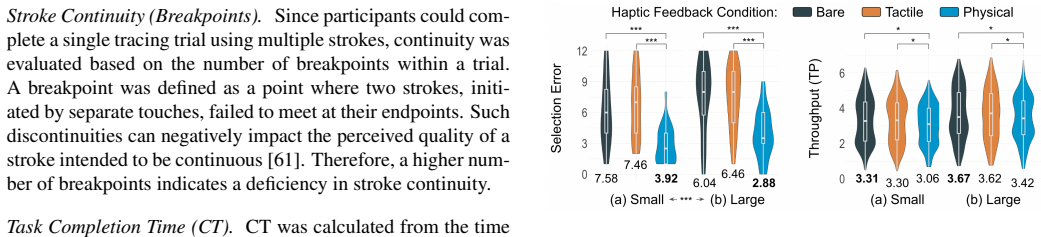
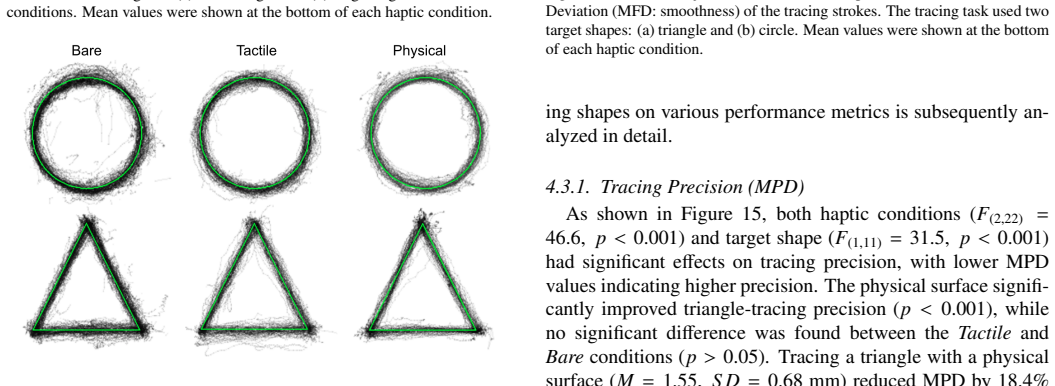
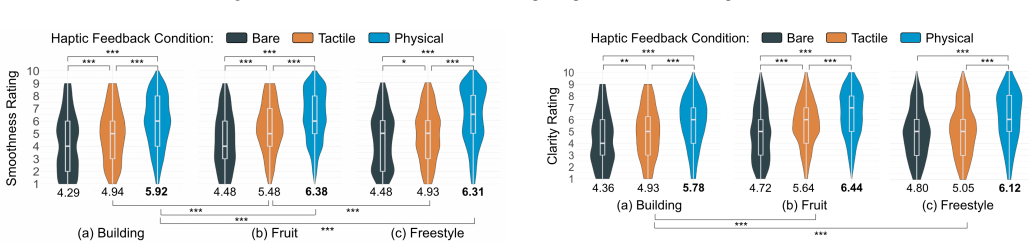
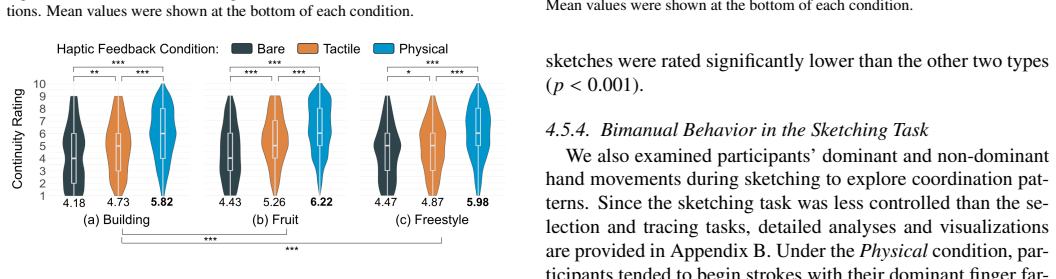
Portable physical surfaces enabled the best selection precision, tracing efficiency, and sketch quality while increasing bimanual hand utilization, with participants attributing their preference to a stronger sense of confidence and control over the interaction.
What carries the argument
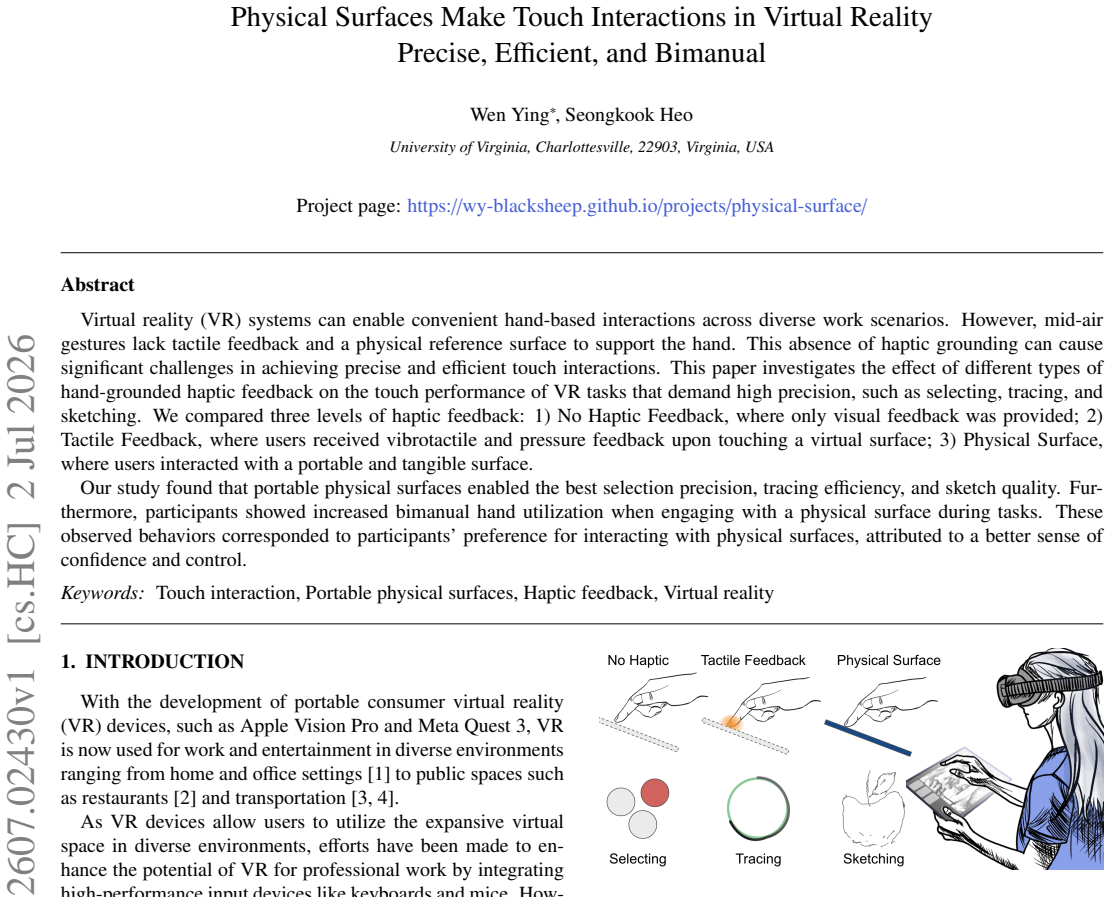
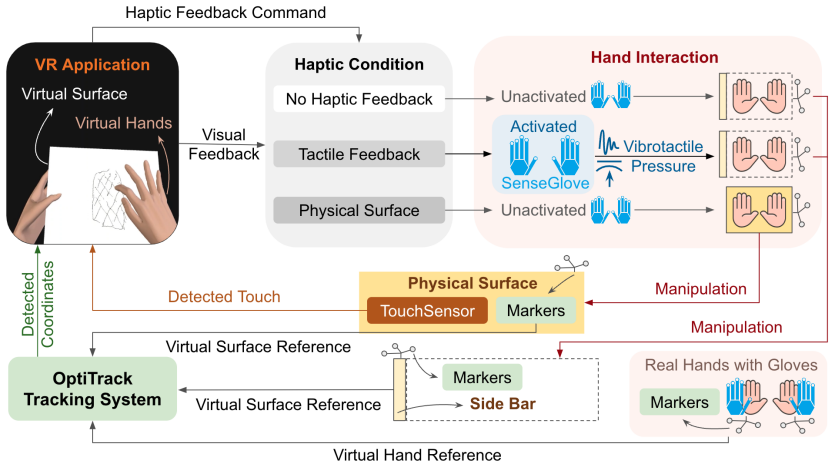
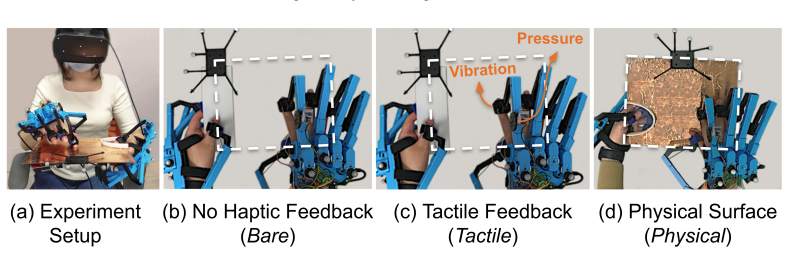
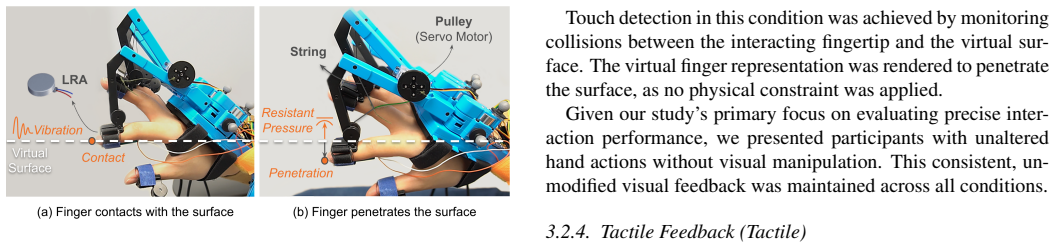
Comparison of three haptic feedback levels (no feedback, vibrotactile plus pressure feedback, and portable tangible surface) during high-precision VR tasks, with the physical surface providing grounded tactile reference.
If this is right
- Physical surfaces support finer motor control in selection tasks than either visual cues or vibrotactile cues alone.
- Tracing tasks complete faster when a tangible reference surface is present.
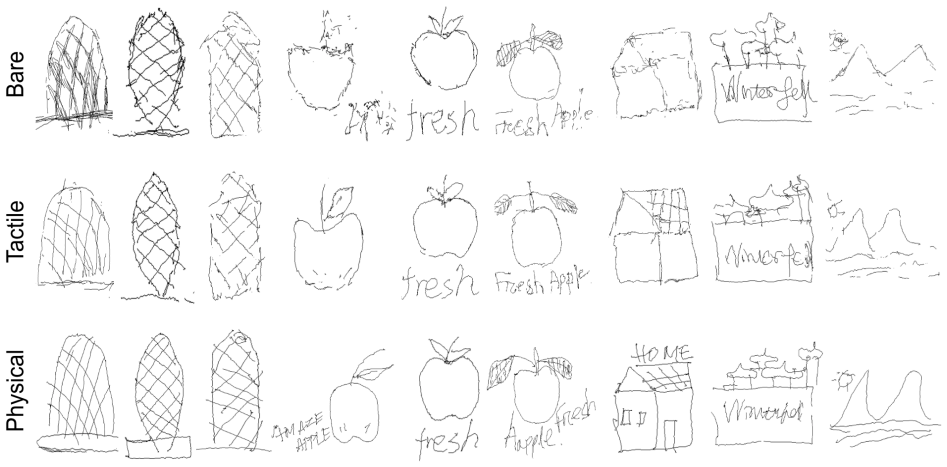
- Sketch output quality rises when users can rest their hand on a physical surface.
- Bimanual coordination increases when one hand can anchor to a tangible surface.
- Users report higher confidence and control with physical surfaces than with purely virtual feedback.
Where Pith is reading between the lines
- VR interfaces for precision work such as design or annotation may gain from always-available portable props rather than relying solely on mid-air gestures.
- Increased bimanual use suggests physical surfaces could reduce fatigue in prolonged sessions by distributing workload across both hands.
- The preference for physical grounding may extend to other VR tasks that require stable hand positioning, such as menu navigation or object manipulation.
Load-bearing premise
The portable physical surface can be tracked and aligned with the virtual environment accurately enough that any performance gains are not caused by tracking errors or alignment problems.
What would settle it
A controlled replication in which the physical surface condition shows no measurable advantage over the tactile feedback condition on selection error rates, tracing completion times, or sketch quality scores.
Figures





read the original abstract
Virtual reality (VR) systems can enable convenient hand-based interactions across diverse work scenarios. However, mid-air gestures lack tactile feedback and a physical reference surface to support the hand. This absence of haptic grounding can cause significant challenges in achieving precise and efficient touch interactions. This paper investigates the effect of different types of hand-grounded haptic feedback on the touch performance of VR tasks that demand high precision, such as selecting, tracing, and sketching. We compared three levels of haptic feedback: 1) No Haptic Feedback, where only visual feedback was provided; 2) Tactile Feedback, where users received vibrotactile and pressure feedback upon touching a virtual surface; 3) Physical Surface, where users interacted with a portable and tangible surface. Our study found that portable physical surfaces enabled the best selection precision, tracing efficiency, and sketch quality. Furthermore, participants showed increased bimanual hand utilization when engaging with a physical surface during tasks. These observed behaviors corresponded to participants' preference for interacting with physical surfaces, attributed to a better sense of confidence and control.
Editorial analysis
A structured set of objections, weighed in public.
Referee Report
Summary. The paper reports an empirical comparison of three haptic feedback conditions (no haptic, tactile vibrotactile/pressure, and portable physical surface) for VR tasks requiring high precision: selection, tracing, and sketching. It claims that the physical-surface condition produced the highest selection precision, tracing efficiency, and sketch quality, increased bimanual hand utilization, and was preferred by participants for providing greater confidence and control.
Significance. If the empirical results are robust, the work supplies concrete evidence that portable physical props can improve precision and bimanual coordination in VR touch interactions relative to purely virtual or tactile-only feedback. This has direct implications for the design of hybrid physical-virtual interfaces in productivity and creative VR applications.
major comments (2)
- [Methods] Methods: The manuscript does not report the calibration procedure for aligning the portable physical surface with the virtual environment, nor any measured positional or rotational tracking error (e.g., via external ground-truth system) or drift during bimanual use. Without these data, observed differences in selection precision and tracing efficiency cannot be unambiguously attributed to the haptic surface rather than tracking artifacts.
- [Results] Results: Neither the abstract nor the reported results section supplies participant count, statistical tests performed, effect sizes, error bars, task details, or exclusion criteria. This absence prevents evaluation of whether the claimed performance advantages are statistically supported.
minor comments (1)
- [Abstract] The abstract should include a brief statement of sample size and key statistical outcomes to allow readers to assess the strength of the claims without reading the full methods.
Simulated Author's Rebuttal
We thank the referee for the constructive comments, which highlight important aspects of methodological transparency. We address each major comment below and will revise the manuscript to incorporate the requested details.
read point-by-point responses
-
Referee: [Methods] Methods: The manuscript does not report the calibration procedure for aligning the portable physical surface with the virtual environment, nor any measured positional or rotational tracking error (e.g., via external ground-truth system) or drift during bimanual use. Without these data, observed differences in selection precision and tracing efficiency cannot be unambiguously attributed to the haptic surface rather than tracking artifacts.
Authors: We agree that explicit reporting of the calibration procedure and tracking accuracy metrics is necessary to rule out confounds from tracking artifacts. In the revised manuscript we will add a dedicated paragraph in the Methods section describing the alignment calibration between the physical surface and virtual coordinate system, the tracking hardware employed, and any available measurements of positional/rotational error or observed drift during bimanual tasks. revision: yes
-
Referee: [Results] Results: Neither the abstract nor the reported results section supplies participant count, statistical tests performed, effect sizes, error bars, task details, or exclusion criteria. This absence prevents evaluation of whether the claimed performance advantages are statistically supported.
Authors: We acknowledge the omission of these quantitative details from the abstract and the summarized results presentation. The revised manuscript will update the abstract to state the participant count and will expand the Results section to explicitly report the statistical tests used, effect sizes, error bars or confidence intervals, full task specifications, and any exclusion criteria applied, thereby enabling readers to assess the statistical support for the performance differences. revision: yes
Circularity Check
No circularity: empirical user study with no derivations or fitted predictions
full rationale
This is a controlled user study comparing three haptic conditions (no haptic, tactile, physical surface) on selection, tracing, and sketching tasks in VR. Results are reported from participant performance metrics and preferences; no equations, models, first-principles derivations, parameter fitting, or predictions appear in the abstract or described methods. Claims rest on direct experimental comparison rather than any self-referential construction. The skeptic concern about tracking accuracy is a validity issue, not a circularity issue.
Axiom & Free-Parameter Ledger
Reference graph
Works this paper leans on
-
[2]
P. Eghbali, K. Väänänen, T. Jokela, Social acceptability of virtual reality in public spaces: experiential factors and design recommendations, in: Proceedings of the 18th In- ternational Conference on Mobile and Ubiquitous Multi- media, MUM ’19, Association for Computing Machinery, New York, NY , USA, 2019. URL:https://doi.org/ 10.1145/3365610.3365647. do...
-
[3]
M. McGill, S. Brewster, Virtual reality passenger experi- ences, in: Proceedings of the 11th International Confer- ence on Automotive User Interfaces and Interactive Vehic- ular Applications: Adjunct Proceedings, AutomotiveUI ’19, Association for Computing Machinery, New York, NY , USA, 2019, p. 434–441. URL:https://doi.org/ 10.1145/3349263.3351330. doi:d...
- [4]
-
[5]
Grubert, E
J. Grubert, E. Ofek, M. Pahud, P. O. Kristensson, The office of the future: Virtual, portable, and global, IEEE computer graphics and applications 38 (2018) 125–133
2018
- [6]
-
[8]
K.-D. Le, T. Q. Tran, K. Chlasta, K. Krejtz, M. Fjeld, A. Kunz, Vxslate: Exploring combination of head move- ments and mobile touch for large virtual display inter- action, in: Proceedings of the 2021 ACM Design- ing Interactive Systems Conference, DIS ’21, Associa- tion for Computing Machinery, New York, NY , USA, 2021, p. 283–297. URL:https://doi.org/10...
-
[9]
R. Xiao, J. Schwarz, N. Throm, A. D. Wilson, H. Benko, Mrtouch: Adding touch input to head-mounted mixed re- ality, IEEE Transactions on Visualization and Computer Graphics 24 (2018) 1653–1660. doi:doi:10.1109/TVCG. 2018.2794222
-
[10]
J. Dudley, H. Benko, D. Wigdor, P. O. Kristensson, Perfor- mance envelopes of virtual keyboard text input strategies in virtual reality, in: 2019 IEEE International Sympo- sium on Mixed and Augmented Reality (ISMAR), 2019, pp. 289–300. doi:doi:10.1109/ISMAR.2019.00027
-
[11]
H. Benko, C. Holz, M. Sinclair, E. Ofek, Normaltouch and texturetouch: High-fidelity 3d haptic shape render- ing on handheld virtual reality controllers, in: Pro- ceedings of the 29th Annual Symposium on User In- terface Software and Technology, UIST ’16, Associa- tion for Computing Machinery, New York, NY , USA, 2016, p. 717–728. URL:https://doi.org/10.1...
-
[12]
R. Arora, R. H. Kazi, F. Anderson, T. Grossman, K. Singh, G. Fitzmaurice, Experimental evaluation of sketching on surfaces in vr, in: Proceedings of the 2017 CHI Confer- ence on Human Factors in Computing Systems, CHI ’17, Association for Computing Machinery, New York, NY , USA, 2017, p. 5643–5654. URL:https://doi.org/ 10.1145/3025453.3025474. doi:doi:10....
-
[13]
Gallotti, A
P. Gallotti, A. Raposo, L. Soares, v-glove: A 3d virtual touch interface, in: 2011 XIII Symposium on Virtual Re- ality, 2011, pp. 242–251
2011
-
[14]
Horvath, J
S. Horvath, J. Galeotti, B. Wu, R. Klatzky, M. Siegel, G. Stetten, Fingersight: Fingertip haptic sensing of the visual environment, IEEE Journal of Translational Engi- neering in Health and Medicine 2 (2014) 1–9
2014
-
[15]
C.-H. Wang, C.-Y . Hsieh, N.-H. Yu, A. Bianchi, L. Chan, Hapticsphere: Physical support to enable precision touch interaction in mobile mixed-reality, in: 2019 IEEE Con- ference on Virtual Reality and 3D User Interfaces (VR), 2019, pp. 331–339. doi:doi:10.1109/VR.2019.8798255
-
[16]
V . Yem, R. Okazaki, H. Kajimoto, Fingar: Com- bination of electrical and mechanical stimulation for high-fidelity tactile presentation, in: ACM SIG- GRAPH 2016 Emerging Technologies, SIGGRAPH ’16, Association for Computing Machinery, New York, NY , USA, 2016. URL:https://doi.org/10.1145/ 2929464.2929474. doi:doi:10.1145/2929464.2929474
-
[17]
Z. Ma, P. Ben-Tzvi, Design and optimization of a five- finger haptic glove mechanism, Journal of Mechanisms and Robotics 7 (2015) 041008. URL:https://api. semanticscholar.org/CorpusID:109198703. 19
2015
-
[19]
H. Kim, M. Kim, W. Lee, Hapthimble: A wear- able haptic device towards usable virtual touch screen, in: Proceedings of the 2016 CHI Conference on Hu- man Factors in Computing Systems, CHI ’16, As- sociation for Computing Machinery, New York, NY , USA, 2016, p. 3694–3705. URL:https://doi.org/ 10.1145/2858036.2858196. doi:doi:10.1145/2858036. 2858196
-
[20]
Y . Wang, C. L. MacKenzie, The role of contextual hap- tic and visual constraints on object manipulation in virtual environments, in: Proceedings of the SIGCHI Conference on Human Factors in Computing Systems, CHI ’00, Asso- ciation for Computing Machinery, New York, NY , USA, 2000, p. 532–539. URL:https://doi.org/10.1145/ 332040.332494. doi:doi:10.1145/3...
-
[21]
Israel, E
J. Israel, E. Wiese, M. Mateescu, C. Zöllner, R. Stark, Investigating three-dimensional sketching for early con- ceptual design—results from expert discussions and user studies, Computers & Graphics 33 (2009) 462–473
2009
-
[22]
T. Drey, J. Gugenheimer, J. Karlbauer, M. Milo, E. Rukzio, Vrsketchin: Exploring the design space of pen and tablet interaction for 3d sketching in virtual re- ality, in: Proceedings of the 2020 CHI Conference on Hu- man Factors in Computing Systems, CHI ’20, Association for Computing Machinery, New York, NY , USA, 2020, p. 1–14. URL:https://doi.org/10.11...
-
[23]
R. Arora, R. Habib Kazi, T. Grossman, G. Fitzmau- rice, K. Singh, Symbiosissketch: Combining 2d & 3d sketching for designing detailed 3d objects in situ, in: Proceedings of the 2018 CHI Conference on Hu- man Factors in Computing Systems, CHI ’18, Association for Computing Machinery, New York, NY , USA, 2018, p. 1–15. URL:https://doi.org/10.1145/3173574. 3...
-
[24]
H. B. Surale, A. Gupta, M. Hancock, D. V ogel, Tabletinvr: Exploring the design space for using a multi-touch tablet in virtual reality, in: Proceedings of the 2019 CHI Con- ference on Human Factors in Computing Systems, CHI ’19, Association for Computing Machinery, New York, NY , USA, 2019, p. 1–13. URL:https://doi.org/ 10.1145/3290605.3300243. doi:doi:1...
-
[25]
L. Jones, S. Lederman, Human Hand Func- tion, volume 32, 2006. doi:doi:10.1093/acprof: oso/9780195173154.001.0001
-
[26]
can i touch this?
E. Bouzbib, G. Bailly, S. Haliyo, P. Frey, “can i touch this?”: Survey of virtual reality interactions via haptic solutions: Revue de littérature des interactions en réalité virtuelle par le biais de solutions haptiques, in: 32e Con- férence Francophone sur l’Interaction Homme-Machine, 2021, pp. 1–16
2021
-
[27]
life-sized and operable
S. Tano, S. Yamamoto, J. Ichino, T. Hashiyama, M. Iwata, Truly useful 3d drawing system for professional designer by “life-sized and operable” feature and new interaction, in: P. Kotzé, G. Marsden, G. Lindgaard, J. Wesson, M. Winckler (Eds.), Human-Computer Interaction – IN- TERACT 2013, Springer Berlin Heidelberg, Berlin, Hei- delberg, 2013, pp. 37–55
2013
-
[28]
J. Rekimoto, Traxion: A tactile interaction de- vice with virtual force sensation, in: ACM SIG- GRAPH 2014 Emerging Technologies, SIGGRAPH ’14, Association for Computing Machinery, New York, NY , USA, 2014. URL:https://doi.org/10.1145/ 2614066.2614079. doi:doi:10.1145/2614066.2614079
-
[29]
T. Carter, S. A. Seah, B. Long, B. Drinkwater, S. Sub- ramanian, Ultrahaptics: Multi-point mid-air hap- tic feedback for touch surfaces, in: Proceedings of the 26th Annual ACM Symposium on User In- terface Software and Technology, UIST ’13, Associa- tion for Computing Machinery, New York, NY , USA, 2013, p. 505–514. URL:https://doi.org/10.1145/ 2501988.25...
-
[30]
A. Sand, I. Rakkolainen, P. Isokoski, J. Kangas, R. Raisamo, K. Palovuori, Head-mounted display with mid-air tactile feedback, in: Proceedings of the 21st ACM Symposium on Virtual Reality Soft- ware and Technology, VRST ’15, Association for Com- puting Machinery, New York, NY , USA, 2015, p. 51–58. URL:https://doi.org/10.1145/2821592. 2821593. doi:doi:10....
-
[31]
B. Long, S. A. Seah, T. Carter, S. Subramanian, Render- ing volumetric haptic shapes in mid-air using ultrasound, ACM Transactions on Graphics (TOG) 33 (2014) 1–10
2014
-
[32]
C. Fang, Y . Zhang, M. Dworman, C. Harrison, Wireality: Enabling Complex Tangible Geometries in Virtual Reality with Worn Multi-String Haptics, Association for Comput- ing Machinery, New York, NY , USA, 2020, p. 1–10. URL: https://doi.org/10.1145/3313831.3376470
-
[33]
Strasnick, C
E. Strasnick, C. Holz, E. Ofek, M. Sinclair, H. Benko, Haptic links: Bimanual haptics for virtual reality using variable stiffness actuation, in: Proceedings of the 2018 CHI Conference on Human Factors in Computing Sys- tems, 2018, pp. 1–12. 20
2018
-
[34]
S.-Y . Teng, K. Wu, J. Chen, P. Lopes, Prolonging vr haptic experiences by harvesting kinetic energy from the user, in: Proceedings of the 35th Annual ACM Symposium on User Interface Software and Technology, 2022, pp. 1–18
2022
-
[35]
I. Choi, E. W. Hawkes, D. L. Christensen, C. J. Ploch, S. Follmer, Wolverine: A wearable haptic interface for grasping in virtual reality, in: 2016 IEEE/RSJ Inter- national Conference on Intelligent Robots and Systems (IROS), IEEE, 2016, pp. 986–993
2016
-
[36]
R. Hinchet, V . Vechev, H. Shea, O. Hilliges, Dex- tres: Wearable haptic feedback for grasping in vr via a thin form-factor electrostatic brake, in: Proceed- ings of the 31st Annual ACM Symposium on User In- terface Software and Technology, UIST ’18, Associa- tion for Computing Machinery, New York, NY , USA, 2018, p. 901–912. URL:https://doi.org/10.1145/ ...
-
[37]
SenseGlove, Senseglove|feel the virtual like it’s real, https://www.senseglove.com/, n.d
-
[38]
Wacharamanotham, K
C. Wacharamanotham, K. Todi, M. Pye, J. Borchers, Un- derstanding finger input above desktop devices, in: Pro- ceedings of the SIGCHI Conference on Human Factors in Computing Systems, 2014, pp. 1083–1092
2014
-
[39]
R. J. Teather, W. Stuerzlinger, Pointing at 3d targets in a stereo head-tracked virtual environment, in: 2011 IEEE Symposium on 3D User Interfaces (3DUI), 2011, pp. 87–
2011
-
[40]
doi:doi:10.1109/3DUI.2011.5759222
-
[41]
F. Wang, X. Ren, Empirical evaluation for finger input properties in multi-touch interaction, in: Proceedings of the SIGCHI Conference on Human Factors in Computing Systems, 2009, pp. 1063–1072
2009
-
[42]
J. S. Roo, M. Hachet, One reality: Augmenting how the physical world is experienced by combin- ing multiple mixed reality modalities, in: Proceed- ings of the 30th Annual ACM Symposium on User In- terface Software and Technology, UIST ’17, Associa- tion for Computing Machinery, New York, NY , USA, 2017, p. 787–795. URL:https://doi.org/10.1145/ 3126594.312...
-
[43]
M. Sinclair, M. Pahud, H. Benko, Touchmover: Ac- tuated 3d touchscreen with haptic feedback, in: Pro- ceedings of the 2013 ACM International Conference on Interactive Tabletops and Surfaces, ITS ’13, Associa- tion for Computing Machinery, New York, NY , USA, 2013, p. 287–296. URL:https://doi.org/10.1145/ 2512349.2512805. doi:doi:10.1145/2512349.2512805
-
[44]
A. Horie, M. Y . Saraiji, Z. Kashino, M. Inami, Encoun- teredlimbs: A room-scale encountered-type haptic presen- tation using wearable robotic arms, in: 2021 IEEE Virtual Reality and 3D User Interfaces (VR), 2021, pp. 260–269. doi:doi:10.1109/VR50410.2021.00048
-
[45]
S. Mortezapoor, K. Vasylevska, E. V onach, H. Kaufmann, Cobodeck: A large-scale haptic vr system using a collab- orative mobile robot, in: 2023 IEEE Conference Virtual Reality and 3D User Interfaces (VR), 2023, pp. 297–307. doi:doi:10.1109/VR55154.2023.00045
-
[46]
R. Gomi, K. Takashima, Y . Onishi, K. Fujita, Y . Kita- mura, Ubisurface: A robotic touch surface for supporting mid-air planar interactions in room-scale vr, Proc. ACM Hum.-Comput. Interact. 7 (2023). URL:https://doi. org/10.1145/3626479. doi:doi:10.1145/3626479
-
[47]
Weng, P.-H
Y .-H. Weng, P.-H. Han, K.-N. Chang, C.-Y . Lin, C.-H. Lin, H. Y . Ng, C.-H. Chou, W.-H. Chiu, Hit around: Sub- stitutional moving robot for immersive and exertion inter- action with encountered-type haptic, IEEE Transactions on Visualization and Computer Graphics 31 (2025) 3569–
2025
-
[48]
doi:doi:10.1109/TVCG.2025.3549556
-
[49]
M. R. Mine, F. P. Brooks, C. H. Sequin, Moving objects in space: exploiting proprioception in virtual-environment interaction, in: Proceedings of the 24th Annual Confer- ence on Computer Graphics and Interactive Techniques, SIGGRAPH ’97, ACM Press/Addison-Wesley Publishing Co., USA, 1997, p. 19–26. URL:https://doi.org/10. 1145/258734.258747. doi:doi:10.11...
-
[50]
R. W. Lindeman, J. L. Sibert, J. K. Hahn, Hand-held win- dows: towards effective 2d interaction in immersive vir- tual environments, in: Proceedings IEEE Virtual Reality (Cat. No. 99CB36316), IEEE, 1999, pp. 205–212
1999
- [51]
-
[52]
H. Tu, X. Ren, S. Zhai, Differences and similarities between finger and pen stroke gestures on stationary and mobile devices, ACM Trans. Comput.-Hum. In- teract. 22 (2015). URL:https://doi.org/10.1145/ 2797138. doi:doi:10.1145/2797138
-
[53]
M. Cutkosky, On grasp choice, grasp models, and the de- sign of hands for manufacturing tasks, IEEE Transactions on Robotics and Automation 5 (1989) 269–279. doi:doi: 10.1109/70.34763
-
[54]
Guiard, Asymmetric division of labor in human skilled bimanual action: The kinematic chain as a model, Journal of motor behavior 19 (1987) 486–517
Y . Guiard, Asymmetric division of labor in human skilled bimanual action: The kinematic chain as a model, Journal of motor behavior 19 (1987) 486–517
1987
-
[55]
R. Balakrishnan, K. Hinckley, The role of kinesthetic ref- erence frames in two-handed input performance, in: Pro- ceedings of the 12th Annual ACM Symposium on User In- terface Software and Technology, UIST ’99, Association for Computing Machinery, New York, NY , USA, 1999, p. 171–178. URL:https://doi.org/10.1145/320719. 322599. doi:doi:10.1145/320719.322599. 21
-
[56]
Hinckley, R
K. Hinckley, R. Pausch, D. Proffitt, N. F. Kassell, Two- handed virtual manipulation, ACM Transactions on Computer-Human Interaction (TOCHI) 5 (1998) 260– 302
1998
-
[57]
K. Hinckley, R. Pausch, D. Proffitt, J. Patten, N. Kas- sell, Cooperative bimanual action, in: Proceedings of the ACM SIGCHI Conference on Human Factors in Com- puting Systems, CHI ’97, Association for Computing Ma- chinery, New York, NY , USA, 1997, p. 27–34. URL: https://doi.org/10.1145/258549.258571. doi:doi: 10.1145/258549.258571
-
[58]
K. Hinckley, R. Pausch, J. C. Goble, N. F. Kassell, Pas- sive real-world interface props for neurosurgical visual- ization, in: Proceedings of the SIGCHI Conference on Human Factors in Computing Systems, CHI ’94, Asso- ciation for Computing Machinery, New York, NY , USA, 1994, p. 452–458. URL:https://doi.org/10.1145/ 191666.191821. doi:doi:10.1145/191666.191821
-
[59]
P. Kabbash, W. Buxton, A. Sellen, Two-handed input in a compound task, in: Proceedings of the SIGCHI Confer- ence on Human Factors in Computing Systems, CHI ’94, Association for Computing Machinery, New York, NY , USA, 1994, p. 417–423. URL:https://doi.org/10. 1145/191666.191808. doi:doi:10.1145/191666.191808
-
[60]
K. Hinckley, R. Pausch, D. Proffitt, Attention and vi- sual feedback: the bimanual frame of reference, in: Proceedings of the 1997 Symposium on Interactive 3D Graphics, I3D ’97, Association for Computing Ma- chinery, New York, NY , USA, 1997, p. 121–ff. URL: https://doi.org/10.1145/253284.253318. doi:doi: 10.1145/253284.253318
-
[61]
Bouzbib, M
E. Bouzbib, M. Teyssier, T. Howard, C. Pacchierotti, A. Lécuyer, Palmex: Adding palmar force-feedback for 3d manipulation with haptic exoskeleton gloves, IEEE Transactions on Visualization and Computer Graphics (2023)
2023
-
[62]
J. T. Hansberger, C. Peng, S. L. Mathis, V . Areyur Shan- thakumar, S. C. Meacham, L. Cao, V . R. Blakely, Dis- pelling the gorilla arm syndrome: The viability of pro- longed gesture interactions, in: S. Lackey, J. Chen (Eds.), Virtual, Augmented and Mixed Reality, Springer Interna- tional Publishing, Cham, 2017, pp. 505–520
2017
-
[63]
Wiese, J
E. Wiese, J. H. Israel, A. Meyer, S. Bongartz, Investi- gating the learnability of immersive free-hand sketching, in: Proceedings of the seventh sketch-based interfaces and modeling symposium, 2010, pp. 135–142
2010
-
[64]
H. Xia, R. Jota, B. McCanny, Z. Yu, C. Forlines, K. Singh, D. Wigdor, Zero-latency tapping: Using hover informa- tion to predict touch locations and eliminate touchdown latency, in: Proceedings of the 27th Annual ACM Sym- posium on User Interface Software and Technology, UIST ’14, Association for Computing Machinery, New York, NY , USA, 2014, p. 205–214. ...
-
[65]
Colligan, H
L. Colligan, H. W. W. Potts, C. T. Finn, R. A. Sinkin, Cog- nitive workload changes for nurses transitioning from a legacy system with paper documentation to a commercial electronic health record, International journal of medi- cal informatics 84 7 (2015) 469–76. URL:https://api. semanticscholar.org/CorpusID:205287049
2015
-
[66]
J. O. Wobbrock, L. Findlater, D. Gergle, J. J. Higgins, The aligned rank transform for nonparametric factorial analy- ses using only anova procedures, in: Proceedings of the SIGCHI conference on human factors in computing sys- tems, 2011, pp. 143–146
2011
-
[67]
L. A. Elkin, M. Kay, J. J. Higgins, J. O. Wobbrock, An aligned rank transform procedure for multifactor contrast tests, in: The 34th Annual ACM Symposium on User Interface Software and Technology, UIST ’21, Associ- ation for Computing Machinery, New York, NY , USA, 2021, p. 754–768. URL:https://doi.org/10.1145/ 3472749.3474784. doi:doi:10.1145/3472749.3474784
-
[68]
X. Bi, Y . Li, S. Zhai, Ffitts law: modeling finger touch with fitts’ law, in: Proceedings of the SIGCHI Confer- ence on Human Factors in Computing Systems, CHI ’13, Association for Computing Machinery, New York, NY , USA, 2013, p. 1363–1372. URL:https://doi.org/ 10.1145/2470654.2466180. doi:doi:10.1145/2470654. 2466180
-
[69]
Wagner, S
J. Wagner, S. Huot, W. Mackay, Bitouch and bipad: de- signing bimanual interaction for hand-held tablets, in: Proceedings of the SIGCHI Conference on Human Fac- tors in Computing Systems, 2012, pp. 2317–2326
2012
-
[70]
Pfeuffer, K
K. Pfeuffer, K. Hinckley, M. Pahud, B. Buxton, Thumb+pen interaction on tablets., in: CHI, 2017, pp. 3254–3266
2017
-
[71]
Sharma, M
A. Sharma, M. A. Hedderich, D. Bhardwaj, B. Fruchard, J. McIntosh, A. S. Nittala, D. Klakow, D. Ashbrook, J. Steimle, Solofinger: Robust microgestures while grasp- ing everyday objects, in: Proceedings of the 2021 CHI conference on human factors in computing systems, 2021, pp. 1–15
2021
-
[72]
S. Brewster, J. Lumsden, M. Bell, M. Hall, S. Tasker, Multimodal ’eyes-free’ interaction techniques for wear- able devices, in: Proceedings of the SIGCHI Conference on Human Factors in Computing Systems, CHI ’03, Asso- ciation for Computing Machinery, New York, NY , USA, 2003, p. 473–480. URL:https://doi.org/10.1145/ 642611.642694. doi:doi:10.1145/642611.642694
-
[73]
B. Yi, X. Cao, M. Fjeld, S. Zhao, Exploring user motivations for eyes-free interaction on mobile devices, 22 in: Proceedings of the SIGCHI Conference on Hu- man Factors in Computing Systems, CHI ’12, As- sociation for Computing Machinery, New York, NY , USA, 2012, p. 2789–2792. URL:https://doi.org/ 10.1145/2207676.2208678. doi:doi:10.1145/2207676. 2208678
-
[74]
S. Zhu, J. Zheng, S. Zhai, X. Bi, i’sfree: Eyes-free gesture typing via a touch-enabled remote control, in: Proceedings of the 2019 CHI Conference on Human Factors in Computing Systems, CHI ’19, Association for Computing Machinery, New York, NY , USA, 2019, p. 1–12. URL:https://doi.org/10.1145/3290605. 3300678. doi:doi:10.1145/3290605.3300678
-
[75]
K. Hinckley, K. Yatani, M. Pahud, N. Coddington, J. Ro- denhouse, A. Wilson, H. Benko, B. Buxton, Pen+touch= new tools, in: Proceedings of the 23nd Annual ACM Sym- posium on User Interface Software and Technology, UIST ’10, Association for Computing Machinery, New York, NY , USA, 2010, p. 27–36. URL:https://doi.org/ 10.1145/1866029.1866036. doi:doi:10.114...
discussion (0)
Sign in with ORCID, Apple, or X to comment. Anyone can read and Pith papers without signing in.