Transverse-spin dependent energy-energy correlators in proton-proton collisions within the dihadron fragmentation framework
Pith reviewed 2026-07-03 09:30 UTC · model grok-4.3
The pith
Energy-energy correlators of hadron pairs in jets match STAR data in transversely polarized proton collisions when modeled with dihadron fragmentation functions.
A machine-rendered reading of the paper's core claim, the machinery that carries it, and where it could break.
Core claim
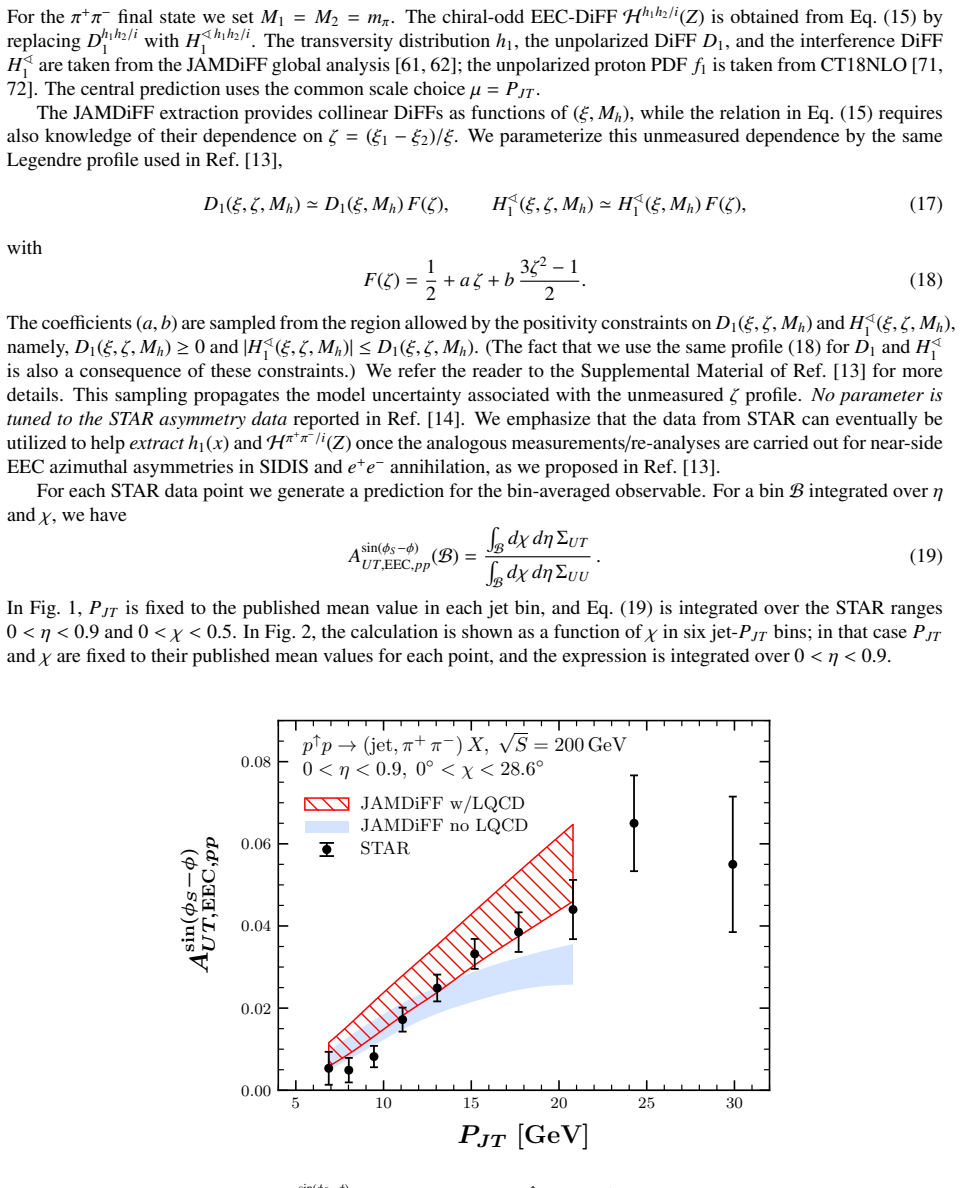
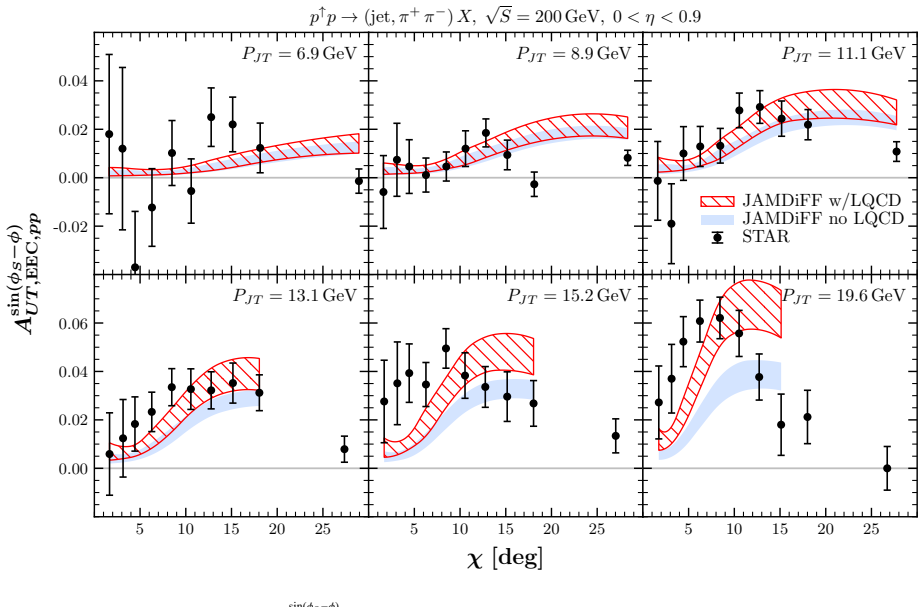
We calculate energy-energy correlations for two hadrons produced inside a jet in transversely polarized proton-proton collisions. Numerical predictions based on a simple model that utilizes a previous global QCD analysis of dihadron fragmentation and transversity parton distribution functions show remarkable agreement with a very recent STAR measurement. The data at large jet transverse momentum have a slight preference for extractions of transversity that are consistent with lattice QCD computations of the nucleon tensor charges.
What carries the argument
Transverse-spin dependent energy-energy correlators modeled within the dihadron fragmentation framework.
If this is right
- These observables furnish further evidence for the non-perturbative mechanism of near-side energy-energy correlators.
- The observables can be used to probe transverse-spin effects inside the nucleon.
- High transverse-momentum data can help discriminate among different extractions of transversity.
- The framework supplies a practical route to incorporate jet-based measurements into global analyses of spin-dependent distributions.
Where Pith is reading between the lines
- The same modeling approach could be tested in electron-proton collisions where initial-state effects are simpler.
- Inclusion of these observables in future global fits might tighten constraints on both fragmentation functions and transversity.
- Analogous calculations for other polarization observables or multi-hadron systems could reveal additional spin-dependent structures.
Load-bearing premise
A simple model that utilizes a previous global QCD analysis of dihadron fragmentation and transversity parton distribution functions is adequate for making accurate numerical predictions for these observables in transversely polarized pp collisions.
What would settle it
A new high-precision measurement of the correlator at large jet transverse momentum that shows no preference for lattice-consistent transversity or deviates from the model predictions would falsify the reported agreement and preference.
Figures
read the original abstract
We calculate energy-energy correlations for two hadrons produced inside a jet in transversely polarized proton-proton collisions. We make numerical predictions based on a simple model that utilizes a previous global QCD analysis of dihadron fragmentation and transversity parton distribution functions. The results show remarkable agreement with a very recent STAR measurement. We also find the data at large jet transverse momentum have a slight preference for extractions of transversity that are consistent with lattice QCD computations of the nucleon tensor charges. Overall, this work provides further evidence for the underlying non-perturbative mechanism of near-side energy-energy correlators as well as highlights the potential for these observables to probe transverse-spin effects inside the nucleon.
Editorial analysis
A structured set of objections, weighed in public.
Referee Report
Summary. The paper calculates transverse-spin dependent energy-energy correlators (EECs) for two hadrons inside a jet in transversely polarized pp collisions within the dihadron fragmentation framework. It generates numerical predictions via a simple model that imports transversity PDFs and dihadron fragmentation functions from a prior global QCD analysis, reports remarkable agreement with recent STAR data, and finds that data at large jet pT slightly prefer transversity extractions consistent with lattice QCD nucleon tensor charges.
Significance. If the central results hold after addressing model robustness, the work would provide supporting evidence that near-side EECs can probe transverse-spin effects and would strengthen the link between phenomenological fits and lattice computations of tensor charges. The use of an existing global analysis allows direct comparison to data but limits the independence of the test.
major comments (2)
- [§4] §4 (Numerical results): The predictions import central values of transversity and dihadron FF parameters from a previous global fit without propagating fit uncertainties or performing independent variations; this renders the reported 'remarkable agreement' with STAR data and the 'slight preference' for lattice-consistent transversity non-diagnostic, as both outcomes are inherited from the input parametrization rather than tested anew.
- [§2] §2 (Theoretical framework): The factorization is presented as adequate for the kinematics, yet no quantitative assessment or comparison is given against alternative treatments such as TMD evolution, higher-twist corrections, or different dihadron FF models; without such checks the claim that the data prefer lattice-consistent transversity remains model-dependent.
minor comments (2)
- [Abstract] Abstract: the phrase 'remarkable agreement' is used without a quantitative measure (e.g., χ² per degree of freedom or residual plots), which should be clarified for precision.
- [Figures] Figure captions and text: axis labels and kinematic cuts (jet pT range, z_h cuts) should be stated explicitly to allow direct reproduction of the plotted curves.
Simulated Author's Rebuttal
We thank the referee for the careful reading of the manuscript and the constructive comments. Below we address each major comment in turn.
read point-by-point responses
-
Referee: [§4] §4 (Numerical results): The predictions import central values of transversity and dihadron FF parameters from a previous global fit without propagating fit uncertainties or performing independent variations; this renders the reported 'remarkable agreement' with STAR data and the 'slight preference' for lattice-consistent transversity non-diagnostic, as both outcomes are inherited from the input parametrization rather than tested anew.
Authors: We agree that propagating the full fit uncertainties from the prior global analysis would allow a more quantitative assessment of the agreement. The present work uses the central values of that analysis as the best available parametrization to generate predictions for a new observable (EEC) that was not included in the original fit. We will revise the text in §4 to explicitly note this limitation and to qualify the statements on agreement and preference accordingly. revision: partial
-
Referee: [§2] §2 (Theoretical framework): The factorization is presented as adequate for the kinematics, yet no quantitative assessment or comparison is given against alternative treatments such as TMD evolution, higher-twist corrections, or different dihadron FF models; without such checks the claim that the data prefer lattice-consistent transversity remains model-dependent.
Authors: The collinear dihadron framework adopted here follows the standard factorization for this class of observables at the relevant scales. A systematic comparison against TMD evolution, higher-twist contributions, or alternate FF models would require separate calculations that lie outside the scope of the present study. We will add a short paragraph in §2 that states the assumptions of the framework and notes the model dependence of the extracted preference. revision: partial
Circularity Check
Numerical predictions and STAR agreement rest on imported fitted dihadron FFs and transversity PDFs from prior global analysis
specific steps
-
fitted input called prediction
[Abstract]
"We make numerical predictions based on a simple model that utilizes a previous global QCD analysis of dihadron fragmentation and transversity parton distribution functions. The results show remarkable agreement with a very recent STAR measurement. We also find the data at large jet transverse momentum have a slight preference for extractions of transversity that are consistent with lattice QCD computations of the nucleon tensor charges."
The quoted 'numerical predictions' and the reported agreement/preference are generated by inserting the dihadron fragmentation functions and transversity PDFs that were already determined by the previous global fit; the STAR comparison therefore tests the adequacy of those imported fitted functions rather than constituting an independent prediction from the present formalism.
full rationale
The paper's headline results (remarkable agreement with STAR and preference for lattice-consistent transversity) are obtained by direct numerical evaluation of a simple model that imports the relevant nonperturbative functions from an earlier global QCD fit. No independent derivation, variation of functional forms, or propagation of fit uncertainties is performed within this work; the outputs are therefore determined by the prior fitted inputs rather than emerging from the present calculation.
Axiom & Free-Parameter Ledger
free parameters (1)
- transversity and dihadron fragmentation parameters
axioms (1)
- domain assumption QCD factorization theorem applies to energy-energy correlators in this kinematic regime
Reference graph
Works this paper leans on
-
[1]
R. D. Klem et al., Phys. Rev. Lett.36, 929 (1976)
1976
-
[2]
Bunce et al., Phys
G. Bunce et al., Phys. Rev. Lett.36, 1113 (1976)
1976
-
[3]
C. L. Basham, L. S. Brown, S. D. Ellis, and S. T. Love, Phys. Rev. Lett.41, 1585 (1978)
1978
-
[4]
C. L. Basham, L. S. Brown, S. D. Ellis, and S. T. Love, Phys. Rev. D19, 2018 (1979)
2018
- [5]
- [6]
- [7]
- [8]
- [9]
-
[10]
Accessing nucleon transversity with one-point energy correlators
M.-S. Gao, Z.-B. Kang, W. Li, and D. Y . Shao, Phys. Rev. Lett.136, 151902 (2026),2509.15809. 6
work page internal anchor Pith review Pith/arXiv arXiv 2026
- [11]
-
[12]
S. Bhattacharya, Z.-B. Kang, D. Padilla, and J. Penttala (2025),2504.10475
-
[13]
Z.-B. Kang, A. Metz, D. Pitonyak, and C. Zhang (2026),2604.28131
work page internal anchor Pith review Pith/arXiv arXiv 2026
-
[14]
STAR (STAR) (2026),2604.15543
work page internal anchor Pith review Pith/arXiv arXiv 2026
-
[15]
J. P. Ralston and D. E. Soper, Nucl. Phys.B152, 109 (1979)
1979
-
[16]
Herczeg, Prog
P. Herczeg, Prog. Part. Nucl. Phys.46, 413 (2001)
2001
-
[17]
Low Energy Tests of the Weak Interaction
J. Erler and M. J. Ramsey-Musolf, Prog. Part. Nucl. Phys.54, 351 (2005),hep-ph/0404291
work page internal anchor Pith review Pith/arXiv arXiv 2005
-
[18]
Electric dipole moments as probes of new physics
M. Pospelov and A. Ritz, Annals Phys.318, 119 (2005),hep-ph/0504231
work page internal anchor Pith review Pith/arXiv arXiv 2005
-
[19]
Tests of the standard electroweak model in beta decay
N. Severijns, M. Beck, and O. Naviliat-Cuncic, Rev. Mod. Phys.78, 991 (2006),nucl-ex/0605029
work page internal anchor Pith review Pith/arXiv arXiv 2006
-
[20]
Beta Decays and Non-Standard Interactions in the LHC Era
V . Cirigliano, S. Gardner, and B. Holstein, Prog. Part. Nucl. Phys.71, 93 (2013),1303.6953
work page internal anchor Pith review Pith/arXiv arXiv 2013
-
[21]
Beyond-Standard-Model Tensor Interaction and Hadron Phenomenology
A. Courtoy, S. Baeßler, M. González-Alonso, and S. Liuti, Phys. Rev. Lett.115, 162001 (2015),1503.06814
work page internal anchor Pith review Pith/arXiv arXiv 2015
-
[22]
N. Yamanaka, B. K. Sahoo, N. Yoshinaga, T. Sato, K. Asahi, and B. P. Das, Eur. Phys. J. A53, 54 (2017), 1703.01570
work page internal anchor Pith review Pith/arXiv arXiv 2017
-
[23]
T. Liu, Z. Zhao, and H. Gao, Phys. Rev. D97, 074018 (2018),1704.00113
work page internal anchor Pith review Pith/arXiv arXiv 2018
-
[24]
González-Alonso, O
M. González-Alonso, O. Naviliat-Cuncic, and N. Severijns, Prog. Part. Nucl. Phys.104, 165 (2019),1803. 08732
2019
-
[25]
Isovector Charges of the Nucleon from 2+1+1-flavor Lattice QCD
R. Gupta, Y .-C. Jang, B. Yoon, H.-W. Lin, V . Cirigliano, and T. Bhattacharya, Phys. Rev.D98, 034503 (2018), 1806.09006
work page internal anchor Pith review Pith/arXiv arXiv 2018
-
[26]
Flavor diagonal tensor charges of the nucleon from 2+1+1 flavor lattice QCD
R. Gupta, B. Yoon, T. Bhattacharya, V . Cirigliano, Y .-C. Jang, and H.-W. Lin, Phys. Rev. D98, 091501 (2018), 1808.07597
work page internal anchor Pith review Pith/arXiv arXiv 2018
-
[27]
Nucleon charges with dynamical overlap fermions
N. Yamanaka, S. Hashimoto, T. Kaneko, and H. Ohki (JLQCD), Phys. Rev. D98, 054516 (2018),1805.10507
work page internal anchor Pith review Pith/arXiv arXiv 2018
-
[28]
Nucleon axial, scalar, and tensor charges using lattice QCD at the physical pion mass
N. Hasan, J. Green, S. Meinel, M. Engelhardt, S. Krieg, J. Negele, A. Pochinsky, and S. Syritsyn, Phys. Rev. D99, 114505 (2019),1903.06487
work page internal anchor Pith review Pith/arXiv arXiv 2019
-
[29]
C. Alexandrou, S. Bacchio, M. Constantinou, J. Finkenrath, K. Hadjiyiannakou, K. Jansen, G. Koutsou, and A. Vaquero Aviles-Casco, Phys. Rev. D102, 054517 (2020),1909.00485
- [30]
- [31]
-
[32]
C. Alexandrou, M. Constantinou, K. Hadjiyiannakou, K. Jansen, and F. Manigrasso, Phys. Rev. D104, 054503 (2021),2106.16065
- [33]
- [34]
- [35]
- [36]
- [37]
-
[38]
D. Djukanovic, G. von Hippel, H. B. Meyer, K. Ottnad, and H. Wittig, Phys. Rev. D109, 074507 (2024), 2402.03024
-
[39]
C. Alexandrou, S. Bacchio, J. Finkenrath, C. Iona, G. Koutsou, Y . Li, and G. Spanoudes, Phys. Rev. D111, 054505 (2025),2412.01535
-
[40]
J.-H. Wang, Z.-C. Hu, X. Ji, X. Jiang, Y . Su, P. Sun, and Y .-B. Yang (CLQCD) (2025),2511.02326
-
[41]
H.-x. He and X.-D. Ji, Phys. Rev. D52, 2960 (1995),hep-ph/9412235
work page internal anchor Pith review Pith/arXiv arXiv 1995
-
[42]
A confinement model calculation of h_1(x)
V . Barone, T. Calarco, and A. Drago, Phys. Lett. B390, 287 (1997),hep-ph/9605434
work page internal anchor Pith review Pith/arXiv arXiv 1997
-
[43]
Transversity distributions in the nucleon in the large-N_c limit
P. Schweitzer, D. Urbano, M. V . Polyakov, C. Weiss, P. V . Pobylitsa, and K. Goeke, Phys. Rev. D64, 034013 (2001),hep-ph/0101300
work page internal anchor Pith review Pith/arXiv arXiv 2001
-
[44]
L. P. Gamberg and G. R. Goldstein, Phys. Rev. Lett.87, 242001 (2001),hep-ph/0107176
work page internal anchor Pith review Pith/arXiv arXiv 2001
-
[45]
Chiral-odd generalized parton distributions in constituent quark models
B. Pasquini, M. Pincetti, and S. Boffi, Phys. Rev.D72, 094029 (2005),hep-ph/0510376
work page internal anchor Pith review Pith/arXiv arXiv 2005
-
[46]
M. Wakamatsu, Phys. Lett. B653, 398 (2007),0705.2917
work page internal anchor Pith review Pith/arXiv arXiv 2007
-
[47]
Tensor charges of light baryons in the Infinite Momentum Frame
C. Lorce, Phys. Rev. D79, 074027 (2009),0708.4168
work page internal anchor Pith review Pith/arXiv arXiv 2009
-
[48]
Quark tensor charge and electric dipole moment within the Schwinger-Dyson formalism
N. Yamanaka, T. M. Doi, S. Imai, and H. Suganuma, Phys. Rev. D88, 074036 (2013),1307.4208
work page internal anchor Pith review Pith/arXiv arXiv 2013
-
[49]
Nucleon tensor charges and electric dipole moments
M. Pitschmann, C.-Y . Seng, C. D. Roberts, and S. M. Schmidt, Phys. Rev.D91, 074004 (2015),1411.2052
work page internal anchor Pith review Pith/arXiv arXiv 2015
-
[50]
S.-S. Xu, C. Chen, I. C. Cloet, C. D. Roberts, J. Segovia, and H.-S. Zong, Phys. Rev. D92, 114034 (2015), 1509.03311
work page internal anchor Pith review Pith/arXiv arXiv 2015
-
[51]
Proton tensor charges from a Poincar\'e-covariant Faddeev equation
Q.-W. Wang, S.-X. Qin, C. D. Roberts, and S. M. Schmidt, Phys. Rev. D98, 054019 (2018),1806.01287
work page internal anchor Pith review Pith/arXiv arXiv 2018
-
[52]
L. Liu, L. Chang, and Y .-X. Liu, Phys. Rev. D99, 074013 (2019),1902.10917
work page internal anchor Pith review Pith/arXiv arXiv 2019
-
[53]
N.-Y . Ghim, H.-Y . Won, J.-Y . Kim, and H.-C. Kim, Phys. Rev. D111, 074024 (2025),2501.12241
-
[54]
J. C. Collins, S. F. Heppelmann, and G. A. Ladinsky, Nucl. Phys.B420, 565 (1994),hep-ph/9305309
work page internal anchor Pith review Pith/arXiv arXiv 1994
-
[55]
R. L. Jaffe, X.-m. Jin, and J. Tang, Phys. Rev. Lett.80, 1166 (1998),hep-ph/9709322
work page internal anchor Pith review Pith/arXiv arXiv 1998
-
[56]
Two-hadron interference fragmentation functions. Part I: general framework
A. Bianconi, S. Boffi, R. Jakob, and M. Radici, Phys. Rev.D62, 034008 (2000),hep-ph/9907475
work page internal anchor Pith review Pith/arXiv arXiv 2000
-
[57]
Accessing transversity with interference fragmentation functions
M. Radici, R. Jakob, and A. Bianconi, Phys. Rev.D65, 074031 (2002),hep-ph/0110252
work page internal anchor Pith review Pith/arXiv arXiv 2002
-
[58]
D. Pitonyak, C. Cocuzza, A. Metz, A. Prokudin, and N. Sato, Phys. Rev. Lett.132, 011902 (2024),2305.11995
- [59]
-
[60]
D. Pitonyak, C. Cocuzza, A. Metz, A. Prokudin, and N. Sato, Phys. Rev. D113, 038901 (2026),2502.15817
-
[61]
C. Cocuzza, A. Metz, D. Pitonyak, A. Prokudin, N. Sato, and R. Seidl (JAM), Phys. Rev. Lett.132, 091901 (2024),2306.12998
-
[62]
C. Cocuzza, A. Metz, D. Pitonyak, A. Prokudin, N. Sato, and R. Seidl (Jefferson Lab Angular Momentum (JAM)), Phys. Rev. D109, 034024 (2024),2308.14857
- [63]
-
[64]
Z.-B. Kang, A. Prokudin, F. Ringer, and F. Yuan, Phys. Lett.B774, 635 (2017),1707.00913. 8
work page internal anchor Pith review Pith/arXiv arXiv 2017
-
[65]
J. F. Owens, Rev. Mod. Phys.59, 465 (1987)
1987
-
[66]
Azimuthal Asymmetric Distribution of Hadrons Inside a Jet at Hadron Collider
F. Yuan, Phys. Rev. Lett.100, 032003 (2008),arXiv:0709.3272[hep-ph]
work page internal anchor Pith review Pith/arXiv arXiv 2008
-
[67]
Z.-B. Kang, F. Yuan, and J. Zhou, Phys. Lett.B691, 243 (2010),1002.0399
work page internal anchor Pith review Pith/arXiv arXiv 2010
-
[68]
A. Hayrapetyan et al. (CMS), Phys. Rev. Lett.133, 071903 (2024),2402.13864
- [69]
- [70]
- [71]
-
[72]
Reconstruction of Monte Carlo replicas from Hessian parton distributions
T.-J. Hou et al., JHEP03, 099 (2017),1607.06066. 9
work page internal anchor Pith review Pith/arXiv arXiv 2017
discussion (0)
Sign in with ORCID, Apple, or X to comment. Anyone can read and Pith papers without signing in.