Endogenous shareholding auctions
Pith reviewed 2026-07-03 01:45 UTC · model grok-4.3
The pith
Endogenous shareholding auctions distribute a monopolist's profits to consumers according to ownership shares determined during the auction itself.
A machine-rendered reading of the paper's core claim, the machinery that carries it, and where it could break.
Core claim
In production economies, endogenous shareholding auctions have the defining property that auction profits are distributed across the monopolist and consumers in line with ownership shares that are set over the course of the auction, and this class can be characterized by standard axioms.
What carries the argument
Endogenous shareholding auctions, in which ownership shares are determined during the auction to allocate the resulting profit.
If this is right
- The class of endogenous shareholding auctions is fully characterized by standard axioms.
- A larger class of auctions can also be characterized similarly.
- Optimal auctions exist according to prior-free domination.
- Optimal auctions exist according to subjective expected welfare.
Where Pith is reading between the lines
- If these auctions work as described, they could reduce the need for separate regulatory mechanisms to handle monopolist-consumer profit sharing.
- Similar endogenous mechanisms might apply to settings where demand information must be elicited from multiple parties with conflicting interests.
- The approach opens the possibility of auctions that self-regulate ownership in other economic contexts like resource allocation.
Load-bearing premise
The standard axioms used for characterization apply appropriately to the monopolist's demand-elicitation problem in the production economy.
What would settle it
Finding an auction that satisfies the standard axioms but fails to distribute profits exactly according to the ownership shares determined within the auction would falsify the characterization.
Figures
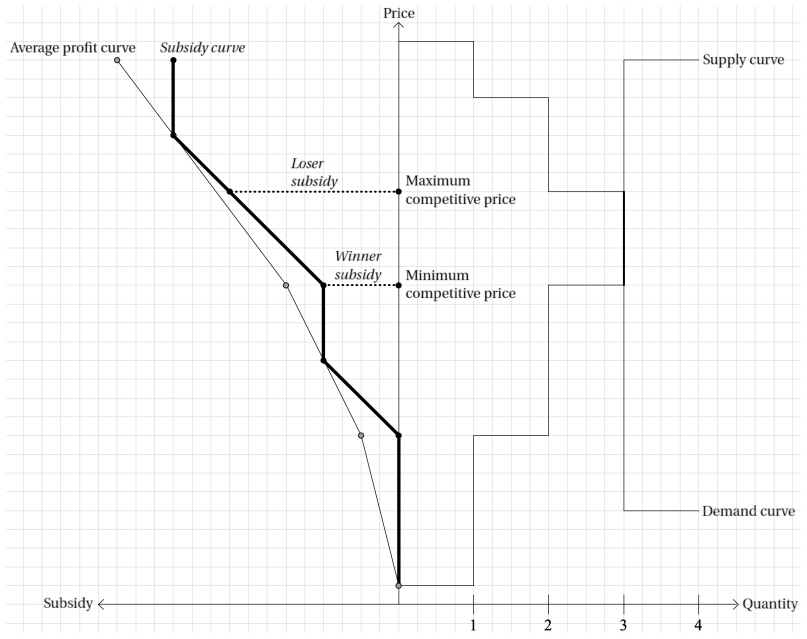

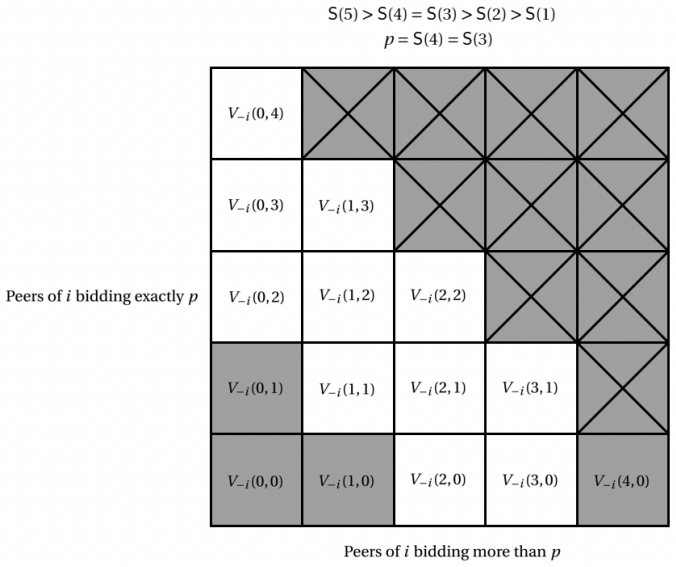
read the original abstract
We introduce endogenous shareholding auctions for production economies where a monopolist must elicit consumer demand in order to determine price and quantity. Each of these auctions has the property that the auction's profit is distributed across the monopolist and the consumers in accordance with ownership shares that are determined over the course of the auction. We characterize this class, and a larger class, on the basis of standard axioms. Finally, we investigate optimal auctions according to both prior-free domination and subjective expected welfare.
Editorial analysis
A structured set of objections, weighed in public.
Referee Report
Summary. The paper introduces endogenous shareholding auctions for production economies where a monopolist must elicit consumer demand to determine price and quantity. These auctions distribute the auction's profit across the monopolist and consumers according to ownership shares determined during the auction. The manuscript claims to characterize this class (and a larger class) on the basis of standard axioms and investigates optimal auctions according to prior-free domination and subjective expected welfare.
Significance. If the claimed axiomatic characterization holds and the axioms appropriately encode the incentive and feasibility constraints of the monopolist's demand-elicitation problem, the work could offer a new mechanism-design framework that endogenously links allocation, pricing, and ownership in production economies. The prior-free and subjective-welfare optimality analysis would then provide concrete guidance on mechanism selection.
major comments (1)
- [Abstract] Abstract: the central claim is a characterization of endogenous shareholding auctions (and a larger class) on the basis of 'standard axioms,' yet the abstract supplies neither the list of axioms nor any derivation showing that they capture incentive-compatibility, individual rationality, or feasibility constraints specific to a monopolist's demand-elicitation problem in a production economy. This omission is load-bearing because the applicability of unmodified standard axioms to the setting is unverified and directly determines whether the profit-distribution property is fully characterized.
Simulated Author's Rebuttal
We thank the referee for their comments on our manuscript. We address the single major comment below.
read point-by-point responses
-
Referee: [Abstract] Abstract: the central claim is a characterization of endogenous shareholding auctions (and a larger class) on the basis of 'standard axioms,' yet the abstract supplies neither the list of axioms nor any derivation showing that they capture incentive-compatibility, individual rationality, or feasibility constraints specific to a monopolist's demand-elicitation problem in a production economy. This omission is load-bearing because the applicability of unmodified standard axioms to the setting is unverified and directly determines whether the profit-distribution property is fully characterized.
Authors: The abstract is written as a concise overview of the paper's contributions, consistent with standard practice in axiomatic mechanism design. The full list of axioms, the characterization theorems, and the verification that these axioms encode the incentive-compatibility, individual-rationality, and feasibility constraints of the monopolist's demand-elicitation problem appear in Sections 3 and 4 of the manuscript (with the profit-distribution property derived directly from the axioms). We maintain that the abstract need not replicate these details, as the body of the paper supplies the required derivations and applicability checks. revision: no
Circularity Check
No circularity; characterization relies on external standard axioms
full rationale
The paper introduces endogenous shareholding auctions and states that the class (and a larger class) is characterized on the basis of standard axioms. No equations, definitions, or steps in the provided text reduce a claimed result to a fitted parameter, self-referential definition, or self-citation chain. The axioms are presented as external (standard in the field), making the derivation self-contained against independent benchmarks rather than circular by construction. This is the expected non-finding for papers whose core claims rest on cited external properties.
Axiom & Free-Parameter Ledger
axioms (1)
- domain assumption Standard axioms suffice to characterize the class of endogenous shareholding auctions
invented entities (1)
-
Endogenous shareholding auctions
no independent evidence
Reference graph
Works this paper leans on
-
[1]
``Optimal regulation with unknown demand and cost functions." Journal of Economic Theory 84, 196-215
Armstrong, Mark (1999). ``Optimal regulation with unknown demand and cost functions." Journal of Economic Theory 84, 196-215
work page 1999
-
[2]
Athanasiou, Efthymios and Giacomo Valletta (2021). ``Binary public decisions and undominated mechanisms." Journal of Economic Theory 198, Article 105355
work page 2021
-
[3]
``The demand revealing process: to distribute the surplus." Public Choice 91, 107-126
Bailey, Martin (1997). ``The demand revealing process: to distribute the surplus." Public Choice 91, 107-126
work page 1997
-
[4]
``Strategy-proof social choice." Handbook of Social Choice and Welfare, Volume II , 731-831
Barber\` a , Salvador (2011). ``Strategy-proof social choice." Handbook of Social Choice and Welfare, Volume II , 731-831
work page 2011
-
[5]
``Regulating a monopolist with unknown costs." Econometrica 50, 911-930
Baron, David and Roger Myerson (1982). ``Regulating a monopolist with unknown costs." Econometrica 50, 911-930
work page 1982
-
[6]
B\" o hm-Bawerk, Eugen (1888). Kapital und kapitalzins. Zweite abteilung: Positive theorie des kapitales [in German]. Innsbruck, Austria: Verlag der Wagner'schen Universit\" a ts-Bucchandlung. Translation: B\" o hm-Bawerk, Eugen (1891). The positive theory of capital . Translator: Smart, William. London, England: Macmillan and Co
-
[7]
o rgers, Tilman, Jiangtao Li, and Kexin Wang (2025). ``Undominated mechanisms
B\" o rgers, Tilman, Jiangtao Li, and Kexin Wang (2025). ``Undominated mechanisms." Working paper
work page 2025
-
[8]
Budish, Eric (2011). ``The combinatorial assignment problem: Approximate competitive equilibrium from equal incomes." Journal of Political Economy 119, 1061-1103
work page 2011
-
[9]
``Robustness and linear contracts." American Economic Review 105, 536-563
Carroll, Gabriel (2015). ``Robustness and linear contracts." American Economic Review 105, 536-563
work page 2015
-
[10]
Cavallo, Ruggiero (2006). ``Optimal decision-making with minimal waste: strategyproof redistribution of VCG payments." In : Proceedings of the fifth international joint conference on Autonomous agents and multiagent systems (AAMAS `06) , 882-889
work page 2006
-
[11]
``Multipart pricing of public goods." Public Choice 8, 19-33
Clarke, Edward (1971). ``Multipart pricing of public goods." Public Choice 8, 19-33
work page 1971
-
[12]
``Strategyproofness in the assignment market game." Mimeo
Demange, Gabrielle (1982). ``Strategyproofness in the assignment market game." Mimeo. Laboratoire d'Econometrie de l'Ecole Polytechnique, Paris, France
work page 1982
-
[13]
``When Walras meets Vickrey." Theoretical Economics 17, 1803-1845
Delacr\' e taz, David, Simon Loertscher, and Claudio Mezzetti (2022). ``When Walras meets Vickrey." Theoretical Economics 17, 1803-1845
work page 2022
-
[14]
``Resource allocation and the public sector." Yale Economic Essays 7, 45-98
Foley, Duncan (1967). ``Resource allocation and the public sector." Yale Economic Essays 7, 45-98
work page 1967
-
[15]
``Manipulation of voting schemes: a general result." Econometrica 41, 587-601
Gibbard, Allan (1973). ``Manipulation of voting schemes: a general result." Econometrica 41, 587-601
work page 1973
-
[16]
``Incentives in teams." Econometrica 41, 617-631
Groves, Theodore (1973). ``Incentives in teams." Econometrica 41, 617-631
work page 1973
-
[17]
Guo, Mingyu and Vincent Conitzer (2009). ``Worst-case optimal redistribution of VCG payments in multi-unit auctions." Games and Economic Behavior 67, 69-98
work page 2009
-
[18]
``Undominated Groves mechanisms." Journal of Artificial Intelligence Research 46, 129-163
Guo, Mingyu, Evangelos Markakis, Krzysztof Apt, and Vincent Conitzer (2013). ``Undominated Groves mechanisms." Journal of Artificial Intelligence Research 46, 129-163
work page 2013
-
[19]
``Robust monopoly regulation." American Economic Review 115, 599-634
Guo, Yingi and Eran Shmaya (2023). ``Robust monopoly regulation." American Economic Review 115, 599-634
work page 2023
-
[20]
``No envy: Jan Tinbergen on fairness." Erasmus Journal for Philosophy and Economics 14, 222-245
Heilmann, Conrad and Stefan Wintein (2021). ``No envy: Jan Tinbergen on fairness." Erasmus Journal for Philosophy and Economics 14, 222-245
work page 2021
-
[21]
o m, Bengt (1979). ``Groves' scheme on restricted domains
Holmstr\" o m, Bengt (1979). ``Groves' scheme on restricted domains." Econometrica 47, 1137-1144
work page 1979
-
[22]
Kazumura, Tomoya, Debasis Mishra, and Shigehiro Serizawa (2020). ``Strategy-proof multi-object mechanism design: Ex-post revenue maximization with non-quasilinear preferences." Journal of Economic Theory 188, Article 105036
work page 2020
-
[23]
Kolm, Serge-Christophe (1971). Justice et equit\' e . Paris, France: Centre d'Etudes Prospectives et d'Economie Math\' e matique Appliqu\' e es \` a la Planification (CEPREMAP)
work page 1971
-
[24]
``Assignment problems and the location of economic activities." Econometrica 25, 53-76
Koopmans, Tjalling and Martin Beckmann (1957). ``Assignment problems and the location of economic activities." Econometrica 25, 53-76
work page 1957
-
[25]
``Efficient mechanism design." Working paper
Krishna, Vijay and Motty Perry (2000). ``Efficient mechanism design." Working paper
work page 2000
-
[26]
Leonard, Herman (1983). ``Elicitation of honest preferences for the assignment of individuals to positions." The Journal of Political Economy 91, 461-479
work page 1983
-
[27]
``The English Common Law concerning Monopolies." University of Chicago Law Review 21, 355-385
Letwin, William (1954). ``The English Common Law concerning Monopolies." University of Chicago Law Review 21, 355-385
work page 1954
-
[28]
``Regulating a Monopolist with Unknown Demand." The American Economic Review 78, 986-998
Lewis, Tracy and David Sappington (1988a). ``Regulating a Monopolist with Unknown Demand." The American Economic Review 78, 986-998
-
[29]
Lewis, Tracy and David Sappington (1988b). ``Regulating a Monopolist with Unknown Demand and Cost Functions." The RAND Journal of Economics 19, 438-457
-
[30]
``On Groves mechanisms for costly inclusion." Theoretical Economics 18, 1181-1223
Mackenzie, Andrew and Christian Trudeau (2023). ``On Groves mechanisms for costly inclusion." Theoretical Economics 18, 1181-1223
work page 2023
-
[31]
Mas-Colell, Andreu, Michael Whinston, and Jerry Green (1995). Microeconomic Theory . New York, New York: Oxford University Press
work page 1995
-
[32]
``Undominated monopoly regulation." Journal of Economic Theory 228, Article 106049
Mishra, Debasis and Sanket Patil (2025). ``Undominated monopoly regulation." Journal of Economic Theory 228, Article 106049
work page 2025
-
[33]
Mishra, Debasis and Dolf Talman (2010). ``Characterization of the Walrasian equilibria of the assignment model." Journal of Mathematical Economics 46, 6-20
work page 2010
-
[34]
Moulin, Herv\' e (2009). ``Almost budget-balanced VCG mechanisms to assign multiple objects." Journal of Economic Theory 144, 96-119
work page 2009
-
[35]
Munkres, James R. (2000). Topology (Second Edition). Upper Saddle River, NJ: Prentice Hall
work page 2000
-
[36]
``Optimal auction design." Mathematics of Operation Research 6, 58-73
Myerson, Roger (1981). ``Optimal auction design." Mathematics of Operation Research 6, 58-73
work page 1981
-
[37]
Ohseto, Shinji (2006). ``Characterizations of strategy-proof and fair mechanisms for allocating indivisible goods." Economic Theory 29, 111-121
work page 2006
-
[38]
P\' a pai, Szilvia (2003). ``Groves sealed bid auctions of heterogeneous objects with fair prices." Social Choice and Welfare 20, 371-385
work page 2003
-
[39]
Pathak, Parag and Tayfun S\" o nmez (2008). ``Leveling the playing field: sincere and sophisticated players in the Boston mechanism." The American Economic Review 98, 1636-1652
work page 2008
-
[40]
Rawls, John (1971). A theory of justice. Cambridge, Massachusetts: Belknap Press
work page 1971
-
[41]
Royden, Halsey L. and Patrick M. Fitzpatrick (2010). Real Analysis (Fourth Edition). Boston, MA: Prentice Hall
work page 2010
-
[42]
Sakai, Ryosuke and Shigehiro Serizawa (2023). ``Strategy-proof mechanism design with non-quasi-linear preferences: ex-post revenue maximization for an arbitrary number of objects." Social Choice and Welfare 60, 103-120
work page 2023
-
[43]
Savage, Leonard (1954). The Foundations of Statistics. Wiley, NY: Dover Publications
work page 1954
-
[44]
``Fair net trades." Econometrica 40, 637-642
Schmeidler, David and Karl Vind (1972). ``Fair net trades." Econometrica 40, 637-642
work page 1972
-
[45]
``The assignment game I: The core." International Journal of Game Theory 1, 111-130
Shapley, Lloyd and Martin Shubik (1972). ``The assignment game I: The core." International Journal of Game Theory 1, 111-130
work page 1972
-
[46]
Sprumont, Yves (1995). ``Strategyproof collective choice in economic and political environments." Canadian Journal of Economics / Revue canadienne d'Economique 28, 68-107
work page 1995
-
[47]
Mens en Maatschappij 6, 342-352. Translation: Tinbergen, Jan (2021). ``Mathematical Psychology
Tinbergen, Jan (1930). ``Mathematiese psychologie [ Mathematical psychology , in Dutch]." Mens en Maatschappij 6, 342-352. Translation: Tinbergen, Jan (2021). ``Mathematical Psychology." Translators: Heilmann, Conrad, Stefan Wintein, Ruth Hinz, and Erwin Dekker. Erasmus Journal for Philosophy and Economics 14, 210-221
work page 1930
-
[48]
Redelijke inkomensverdeling [ Reasonable income , in Dutch]
Tinbergen, Jan (1946). Redelijke inkomensverdeling [ Reasonable income , in Dutch]. Haarlem, the Netherlands: De Gulden Pers
work page 1946
-
[49]
``Equity, envy and efficiency." Journal of Economic Theory 29, 217-244
Varian, Hal (1974). ``Equity, envy and efficiency." Journal of Economic Theory 29, 217-244
work page 1974
-
[50]
``Counterspeculation, auctions, and competitive sealed tenders." The Journal of Finance 16, 8-37
Vickrey, William (1961). ``Counterspeculation, auctions, and competitive sealed tenders." The Journal of Finance 16, 8-37
work page 1961
-
[51]
Wakker, Peter (1993b). ``Unbounded utility for Savage's `Foundations of Statistics,' and other models." Mathematics of Operations Research 18, 446-485
-
[52]
``Optimal rewards for economic regulation." The American Economic Review 68, 683-691
Weitzman, Martin (1978). ``Optimal rewards for economic regulation." The American Economic Review 68, 683-691
work page 1978
-
[53]
Yengin, Duygu (2012). ``Characterizing Welfare-egalitarian mechanisms with solidarity when valuations are private information." The B.E. Journal of Theoretical Economics 12
work page 2012
-
[54]
Yengin, Duygu (2017). ``No-envy and egalitarian-equivalence under multi-object-demand for heterogeneous objects." Social Choice and Welfare 48, 81-108
work page 2017
discussion (0)
Sign in with ORCID, Apple, or X to comment. Anyone can read and Pith papers without signing in.