REVIEW 3 major objections 6 minor 34 references
From Region Arrival to Instance-Level Grounding in Vision-and-Language Navigation
T0 review · 3 major / 6 minor · reviewed 2026-07-11 · grok-4.5
Pith's one-line read Stopping near a room is not the same as seeing the object; a short-horizon refinement module can close that gap.
desk verdict Solid problem formalization and multi-backbone gains on a real VLN evaluation gap; the hand-off basin assumption is real but does not sink the contribution. read the letter →
The pith
A machine-rendered reading of the paper's core claim, the machinery that carries it, and where it could break.
The reading
What carries the argument
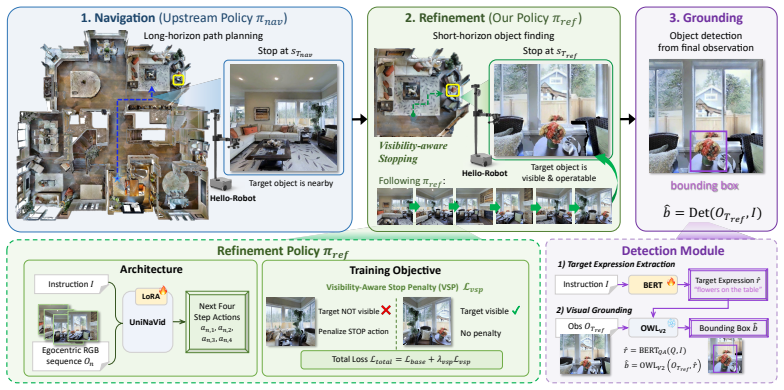
REALM: a decoupled short-horizon refinement policy (LoRA-adapted UniNaVid) whose visibility-aware stop penalty (VSP) suppresses premature termination until the referred object becomes visible, after which open-vocabulary detection grounds the final view.
What would settle it
Run the same four upstream backbones on the REVERIE-AIM val-unseen split with and without REALM; if ONS@0.1 m, GS, and OracleGS do not rise under the full VSP loss, or if the gains disappear when the upstream stop is artificially displaced beyond a few meters, the central claim fails.
Extended reading notes
Core claim
The paper claims that the conventional 3-meter success rate systematically overstates object-level readiness, and that a plug-and-play, architecture-agnostic refinement stage (REALM) that is trained only on short-horizon approaching and that penalizes stops when the target is invisible can consistently improve proximity precision, target visibility, and final-view grounding without altering the upstream navigator.
Load-bearing premise
The upstream navigator must already stop close enough that a short-horizon visibility-aware policy can recover a usable viewpoint; if it stops many meters away or in the wrong room, the refinement module has no recovery path.
Editorial analysis
A structured set of objections, weighed in public.
Referee Report
Summary. The paper argues that standard VLN-CE success (stop within 3 m of a region endpoint) does not guarantee instance-level object grounding, formalizing this as the Last-3-Meter Grounding Gap. It introduces three metrics (ONS for geodesic proximity to the instance, GS for final-view detection IoU, OracleGS for target visibility/area), the REVERIE-AIM dataset with object-centric endpoints and ~180K short-horizon clips, and REALM: a plug-and-play refinement stage that takes over after any upstream navigator stops, LoRA-adapts UniNaVid with a visibility-aware stop penalty (VSP), then extracts a target phrase and runs OWLv2. Table 2 reports consistent gains on ONS/GS/OracleGS across four diverse backbones (ETPNav-ZS/FT, UniNaVid-ZS, Smartway); a small real-robot study on Stretch shows parallel direction of improvement.
Significance. If the results hold, the work usefully separates long-horizon VLN from short-horizon viewpoint alignment and supplies evaluation tools that better match downstream interaction needs. Strengths include: architecture-agnostic hand-off design; multi-backbone ablations (including VSP ablation) that move in the claimed direction; an explicit short-horizon training set rather than only end-to-end fine-tuning; and preliminary physical deployment. These are concrete engineering contributions for continuous object-referring navigation, even if absolute numbers remain far below the reported human upper bound.
major comments (3)
- [§4, §5.4, Table 2] §4 (three-stage pipeline) and §5.4 (short-horizon sampling from second-to-last node with σ=1.5 m perturbation): the plug-and-play claim assumes that π_nav’s stop already lies inside REALM’s recovery basin. The manuscript never reports the distribution of geodesic distances (or room-level correctness) of the raw upstream stop poses that are handed to REALM. Without that breakdown—especially for zero-shot/training-free backbones whose SR is low—the Table 2 gains could be driven mainly by already-near episodes rather than general recovery. Please add distance/room histograms of hand-off poses and, if possible, a stratified analysis (e.g., gains conditioned on d_hand-off ≤ 3 m vs. farther).
- [§6.3, Table 3] §6.3 / Table 3: real-world evaluation uses only 12 episodes and reports point estimates with no error bars, confidence intervals, or statistical tests. The jump from 8.33% to 33.33% ONS@0.5m is directionally consistent with simulation but is too thin to support the claim of “preliminary evidence of real-world applicability” at the strength stated in the abstract and conclusion. Expand the episode set or qualify the claim more carefully and report variability.
- [Table 2, §6.2] Table 2 “Human Eval” row (ONS@0.1m 50.40%, ONS@0.5m 74.71%, GS 38.24%, OracleGS 80.38%): no protocol is given (number of subjects, interface, time budget, whether they used the same continuous action space and camera FOV). These numbers are used as an upper bound that frames the remaining gap; without a clear protocol they are hard to interpret and should be documented or removed from the primary comparison.
minor comments (6)
- [Figure 1] Figure 1 caption and body: “Grounding-based Evalua;on” and similar OCR-style typos; clean for camera-ready.
- [§4.1] Eq. (2)–(3): λ_vsp is free but no sensitivity sweep is shown; a short ablation over a few λ values would strengthen the VSP claim.
- [§3.3] §3.3 OracleGS uses Area(b*)/Area(OT) ≥ 0.01; justify the 1% threshold or show robustness to nearby values (e.g., 0.5%, 2%).
- [§2] Related work: GroundingMate is discussed for discrete REVERIE; a sentence clarifying how REALM’s open-world OWLv2 detection differs from candidate-box classification would help readers.
- [Table 1, §5.3] Table 1 feature matrix is useful; ensure “Object Proximity Endpoint” is defined consistently with the 0.34 m average min geodesic distance stated in §5.3.
- [Abstract, §4] Abstract and intro claim “architecture-agnostic” while the refinement policy is always UniNaVid+LoRA; clarify that agnosticism refers to the upstream hand-off interface, not the refinement backbone itself.
Circularity Check
No significant circularity: empirical VLN engineering paper with independently defined metrics, external simulator supervision, and non-tautological multi-backbone gains.
full rationale
The paper’s load-bearing claims are empirical performance lifts (Table 2: ONS/GS/OracleGS across four backbones) and a three-stage pipeline (navigation → refinement → grounding). None of these reduce by construction to their inputs. ONS, GS, and OracleGS are defined from geodesic proximity, IoU, and frame-area visibility against simulator ground truth, independent of REALM’s parameters or losses. REVERIE-AIM endpoints come from Habitat ObjectNav instance sampling, not from the learned policy’s own stops. The VSP term (Eq. 2) multiplies a stop-margin by an external binary visibility label vb from the simulator; it is a training regularizer, not a fitted constant renamed as a prediction. LoRA fine-tuning of UniNaVid on 180K short-horizon clips is ordinary supervised adaptation. Self-citations (UniNaVid base architecture; SmartWay as one of four baselines) are ordinary prior-work reuse and do not force the multi-backbone gains. There is no uniqueness theorem, no ansatz smuggled via self-citation, and no equation that equates a claimed prediction to a fitted input. The basin/hand-off assumption noted by the skeptic is a validity/scope concern, not circularity. Score 0 is the honest finding.
Assumptions & free parameters
free parameters (5)
- lambda_vsp
- ONS distance thresholds (0.1 m / 0.5 m)
- OracleGS area fraction 0.01
- GS IoU threshold 0.5
- Spatial perturbation sigma=1.5 m, truncation [-5,5] m
assumptions (4)
- domain assumption Habitat continuous simulator trajectories and ObjectNav navigable-point sampling faithfully represent real indoor geometry and visibility for the purpose of training and metric computation.
- domain assumption A short-horizon policy that receives only egocentric RGB and the original language instruction can recover a usable final pose once any upstream navigator has stopped.
- domain assumption Simulator-provided binary visibility labels are a valid supervisory signal for the VSP loss.
- standard math Standard token-level cross-entropy imitation learning plus LoRA on a frozen vision encoder is a sufficient adaptation regime for the refinement task.
invented entities (4)
-
Last-3-Meter Grounding Gap
-
ONS / GS / OracleGS metrics
-
REVERIE-AIM dataset
-
REALM refinement module + Visibility-Aware Stop Penalty
Cite this review
Pith. "Pith review of From Region Arrival to Instance-Level Grounding in Vision-and-Language Navigation." pith.science (2026). https://pith.science/paper/VYO2PWDF
@misc{pith2026260703792,
  author       = {Pith},
  title        = {Pith review of: From Region Arrival to Instance-Level Grounding in Vision-and-Language Navigation},
  year         = {2026},
  howpublished = {\url{https://pith.science/paper/VYO2PWDF}},
  note         = {Machine review of arXiv:2607.03792}
}
read the original abstract
Vision-and-Language Navigation (VLN) agents may satisfy conventional success criteria while still failing to establish reliable object-level grounding, because current evaluation protocols mainly reward stopping within a 3-meter radius and largely ignore the agent's final orientation and target visibility. We formalize this limitation as the Last-3-Meter Grounding Gap and introduce three instance-centric metrics to quantify proximity precision, target visibility, and final-view grounding. To mitigate this gap, we propose REALM (Region-to-Entity Alignment for Last-3-Meter Navigation), a plug-and-play, architecture-agnostic refinement module that decouples fine-grained target approaching from long-horizon navigation. REALM uses a visibility-aware stopping strategy to reduce premature termination and improve final viewpoint alignment. We further construct REVERIE-AIM, which provides object-instance-level goals and 180K short-horizon training samples for final-stage target approaching. Extensive evaluations across four diverse VLN backbones show that REALM consistently improves proximity precision and visual grounding success, demonstrating its broad applicability.
Figures

Reference graph
Works this paper leans on
-
[1]
Y . Qi, Q. Wu, P. Anderson, X. Wang, W. Y . Wang, C. Shen, and A. v. d. Hengel. Reverie: Remote embodied visual referring expression in real indoor environments. InCVPR, pages 9982–9991, 2020
2020
-
[2]
X. Li, D. Guo, H. Liu, and F. Sun. Reve-ce: Remote embodied visual referring expression in continuous environment.RAL, 7(2):1494–1501, 2022
2022
-
[3]
Z. Wang, S. Lee, and G. H. Lee. Dynam3d: Dynamic layered 3d tokens empower vlm for vision-and-language navigation. InNeurIPS, 2025. 10
2025
-
[4]
Z. Wang, S. Lee, G. Dai, and G. H. Lee. D3d-vlp: Dynamic 3d vision-language-planning model for embodied grounding and navigation.arXiv preprint arXiv:2512.12622, 2025
arXiv 2025
-
[5]
Wasserman, K
J. Wasserman, K. Yadav, G. Chowdhary, A. Gupta, and U. Jain. Last-mile embodied visual navigation. InCoRL, pages 666–678. PMLR, 2023
2023
- [6]
-
[7]
Y . Deng, S. Yuan, and Y . Fang. Anyimagenav: Any-view geometry for precise last-meter image-goal navigation.arXiv preprint arXiv:2604.05351, 2026
arXiv 2026
-
[8]
D. An, H. Wang, W. Wang, Z. Wang, Y . Huang, K. He, and L. Wang. Etpnav: Evolving topo- logical planning for vision-language navigation in continuous environments.TPAMI, 2024
2024
Show all 34 references
-
[9]
Zhang, K
J. Zhang, K. Wang, S. Wang, M. Li, H. Liu, S. Wei, Z. Wang, Z. Zhang, and H. Wang. Uni- navid: A video-based vision-language-action model for unifying embodied navigation tasks. arXiv preprint arXiv:2412.06224, 2024
2024 arXiv
-
[10]
Anderson, Q
P. Anderson, Q. Wu, D. Teney, J. Bruce, M. Johnson, N. S ¨underhauf, I. Reid, S. Gould, and A. Van Den Hengel. Vision-and-language navigation: Interpreting visually-grounded naviga- tion instructions in real environments. InCVPR, pages 3674–3683, 2018
2018
-
[11]
Zhang, Z
Y . Zhang, Z. Ma, J. Li, Y . Qiao, Z. Wang, J. Chai, Q. Wu, M. Bansal, and P. Kordjamshidi. Vision-and-language navigation today and tomorrow: A survey in the era of foundation mod- els.arXiv preprint arXiv:2407.07035, 2024
2024 arXiv
-
[12]
X. Su, R. Chen, B. Liu, J. Ma, Z. Di, R. Krishna, and J. Froehlich. Capnav: Bench- marking vision language models on capability-conditioned indoor navigation.arXiv preprint arXiv:2602.18424, 2026
2026
-
[13]
S. Wang, Y . Wang, G. Lian, Y . Wang, M. Chen, K. Wang, B. Zhang, Z. Su, Y . Zhou, W. Li, et al. Progress-think: Semantic progress reasoning for vision-language navigation. InCVPR, 2026
2026
-
[14]
Q. Jin, Y . Song, and Q. Wu. Does peer observation help? vision-sharing collaboration for vision-language navigation.arXiv preprint arXiv:2603.20804, 2026
2026
-
[15]
A. Ku, P. Anderson, R. Patel, E. Ie, and J. Baldridge. Room-across-room: Multilingual vision- and-language navigation with dense spatiotemporal grounding. InEMNLP, pages 4392–4412, 2020
2020
-
[16]
Thomason, M
J. Thomason, M. Murray, M. Cakmak, and L. Zettlemoyer. Vision-and-dialog navigation. In CoRL, pages 394–406, 2020
2020
-
[17]
Y . Qiao, Y . Qi, Y . Hong, Z. Yu, P. Wang, and Q. Wu. Hop: History-and-order aware pre-training for vision-and-language navigation. InCVPR, pages 15418–15427, 2022
2022
-
[18]
Zhang, J
J. Zhang, J. Fan, J. Peng, et al. Curriculum learning for vision-and-language navigation. NeurIPS, 34:13328–13339, 2021
2021
-
[19]
Krantz, E
J. Krantz, E. Wijmans, A. Majumdar, D. Batra, and S. Lee. Beyond the nav-graph: Vision-and- language navigation in continuous environments. InECCV, pages 104–120. Springer, 2020
2020
-
[20]
Zhang, Y
S. Zhang, Y . Qiao, Q. Wang, Z. Yan, Q. Wu, Z. Wei, and J. Liu. Cosmo: Combination of selective memorization for low-cost vision-and-language navigation. InICCV, pages 5511– 5522, 2025. 11
2025
-
[21]
Y . Long, W. Cai, H. Wang, G. Zhan, and H. Dong. Instructnav: Zero-shot system for generic instruction navigation in unexplored environment. InCoRL, pages 2049–2060. PMLR, 2024
-
[22]
X. Shi, Z. Li, W. Lyu, J. Xia, F. Dayoub, Y . Qiao, and Q. Wu. Smartway: Enhanced waypoint prediction and backtracking for zero-shot vision-and-language navigation. InIROS, 2025
2025
-
[23]
K. Chen, D. An, Y . Huang, R. Xu, Y . Su, Y . Ling, I. Reid, and L. Wang. Constraint-aware zero-shot vision-language navigation in continuous environments.TPAMI, 2025
2025
-
[24]
Q. Liu, S. Zhang, Y . Qiao, J. Zhu, X. Li, L. Guo, Q. Wang, X. He, Q. Wu, and J. Liu. Ground- ingmate: Aiding object grounding for goal-oriented vision-and-language navigation. InWACV, pages 1775–1784. IEEE, 2025
2025
-
[25]
L. Qin, M. Wang, P. Li, W. Zhou, and H. Li. Active perception meets rule-guided rl: A two-phase approach for precise object navigation in complex environments. InICCV, pages 7603–7612, 2025
2025
-
[26]
Khanna, Y
M. Khanna, Y . Mao, H. Jiang, S. Haresh, B. Shacklett, D. Batra, A. Clegg, E. Undersander, A. X. Chang, and M. Savva. Habitat synthetic scenes dataset (hssd-200): An analysis of 3d scene scale and realism tradeoffs for objectgoal navigation. InCVPR, pages 16384–16393, 2024
2024
-
[27]
E. J. Hu, Y . Shen, P. Wallis, Z. Allen-Zhu, Y . Li, S. Wang, L. Wang, and W. Chen. Lora: Low-rank adaptation of large language models. InICLR. OpenReview.net, 2022
2022
-
[28]
Devlin, M.-W
J. Devlin, M.-W. Chang, K. Lee, and K. Toutanova. Bert: Pre-training of deep bidirectional transformers for language understanding. InProceedings of the 2019 conference of the North American chapter of the association for computational linguistics: human language technolo- gie...
2019
-
[29]
Minderer, A
M. Minderer, A. Gritsenko, and N. Houlsby. Scaling open-vocabulary object detection. NeurIPS, 36:72983–73007, 2023
2023
-
[30]
Batra, A
D. Batra, A. Gokaslan, A. Kembhavi, O. Maksymets, R. Mottaghi, M. Savva, A. Toshev, and E. Wijmans. Objectnav revisited: On evaluation of embodied agents navigating to objects. arXiv preprint arXiv:2006.13171, 2020
2006 arXiv
-
[31]
Yadav, S
K. Yadav, S. K. Ramakrishnan, J. Turner, A. Gokaslan, O. Maksymets, R. Jain, R. Ramrakhya, A. X. Chang, A. Clegg, M. Savva, E. Undersander, D. S. Chaplot, and D. Batra. Habitat challenge 2022.https://aihabitat.org/challenge/2022/, 2022
2022
-
[32]
Yadav, R
K. Yadav, R. Ramrakhya, S. K. Ramakrishnan, T. Gervet, J. Turner, A. Gokaslan, N. Maestre, A. X. Chang, D. Batra, M. Savva, et al. Habitat-matterport 3d semantics dataset. InPro- ceedings of the IEEE/CVF Conference on Computer Vision and Pattern Recognition, pages 4927–4936, 2023
2023
-
[33]
S. Chen, T. Chabal, I. Laptev, and C. Schmid. Object goal navigation with recursive implicit maps. InIROS, pages 7089–7096. IEEE, 2023
2023
-
[34]
Y . Hong, Z. Wang, Q. Wu, and S. Gould. Bridging the gap between learning in discrete and continuous environments for vision-and-language navigation. InCVPR, pages 15439–15449, 2022. 12
2022
Reviewed July 11, 2026 · model on record in the stance chip above.
Discussion (0). Sign in to comment.