REVIEW 3 major objections 5 minor 53 references
A multi-agent LLM system with a tripartite harness can co-pilot full-cycle mathematical research and has solved eleven open problems.
Reviewed by Pith at T0; open to challenge. T0 means a machine referee read the full paper against a public rubric. the ladder, T0–T4 →
T0 review · grok-4.5
2026-07-11 19:28 UTC pith:AYAUAYJA
load-bearing objection Solid multi-agent harness with real Lean case studies and open-problem traces; the '11 solved' headline cannot be scored independently of same-team human work. the 3 major comments →
MechMath Agent Team: LLM Driven Agents for Mathematical Research
The pith
A machine-rendered reading of the paper's core claim, the machinery that carries it, and where it could break.
Core claim
The authors claim that a decoupled Harness Architecture—Control, Execution, and Augmentation planes—lets specialized LLM agents (Knowledge Base Manager, Natural Language Prover, Formal Language Prover) operate in a closed loop and produce formally certified mathematical proofs, thereby serving as a co-pilot across the full research cycle; they report solving eleven open problems over a two-month deployment as empirical support.
What carries the argument
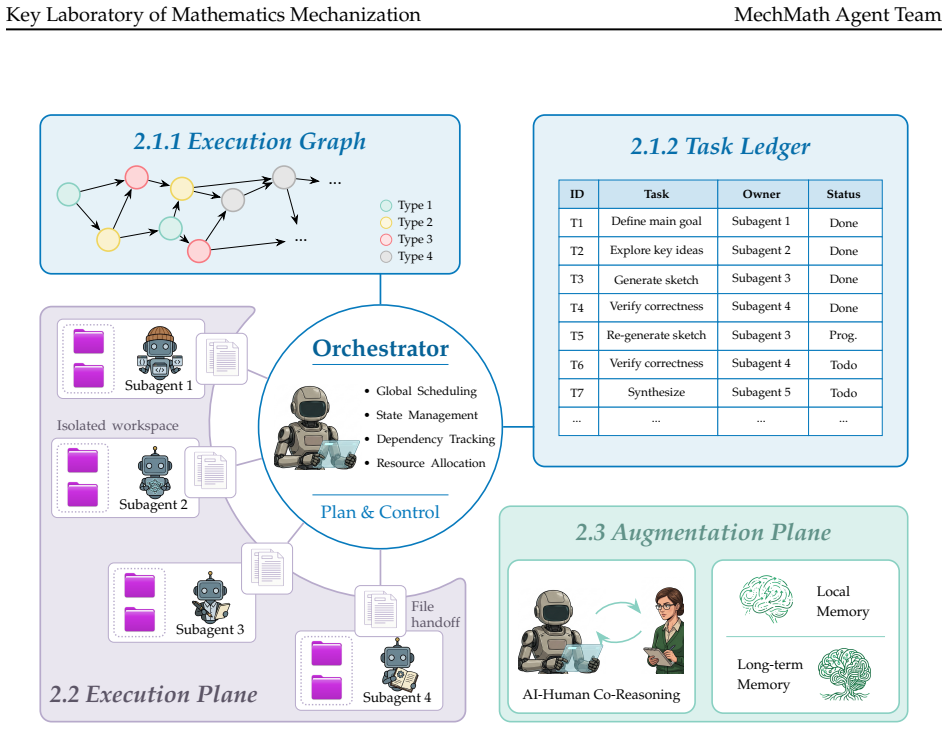
The Harness Architecture: a tripartite scaffold that places global scheduling in a Control Plane (orchestrator, execution DAG, task ledger), isolates agents in an Execution Plane (sandboxed workspaces and file-based handoffs), and extends cognition in an Augmentation Plane (human–AI breakpoints and stratified continual memory of negative constraints). This separation is what lets open-ended exploration coexist with deterministic state and Lean-4 certification.
Load-bearing premise
That the eleven solved problems, many appearing in companion papers co-authored by the same team with mixed human involvement, count as independent evidence of the agent architecture rather than joint human–AI work whose automation share is not measured.
What would settle it
An independent re-run of the same open problems with the released agent stack that fails to recover the reported natural-language or Lean proofs without large additional human rewriting, or an audit showing that critical Lean developments rest on unreduced axioms beyond those the paper discloses.
If this is right
- Multi-agent systems can audit existing proof chains, isolate logical flaws, and produce counterexamples at extreme scales.
- Natural-language discovery can be closed into Lean-4 certificates through iterative formalize–feedback loops.
- Object-oriented knowledge cards (partial proofs, obstructions, Lean artifacts) can accumulate reusable research memory across sessions.
- A single problem can be steered into a multi-problem project (e.g., sparse-polynomial multiplication, divisibility, GCD, factorization).
- Human mathematicians can inject strategic corrections at structured breakpoints without restarting the entire search.
Where Pith is reading between the lines
- The same isolation-and-handoff pattern could transfer to other high-stakes domains that need exploratory error contained (formal software verification, protocol design).
- Publishing quantified human-vs-agent contribution ratios would let outsiders test how much of the co-pilot claim is automation versus collaboration.
- Shared libraries of distilled negative constraints might reduce repeated failure modes across independent research groups.
- Closed-loop NL-to-Lean formalization could lower the barrier for mathematicians who do not write interactive theorem-prover code by hand.
Editorial analysis
A structured set of objections, weighed in public.
Referee Report
Summary. The paper introduces MechMath Agent Team (MMAT), an LLM-driven multi-agent system intended as a co-pilot for the full cycle of mathematical research. It proposes a tripartite Harness Architecture that separates Control (orchestrator with execution graph and task ledger), Execution (isolated workspaces and file-based handoffs), and Augmentation (human–AI co-reasoning and stratified memory) planes. This is instantiated as three agents—KB-Manager, NL-Prover, and FL-Prover (Lean 4)—operating in a closed Inform–Formalize–Feedback–Archive loop. Empirical claims rest on a two-month deployment that purportedly solved 11 open problems across number theory, algebraic complexity, differential algebra, operator algebra, and inequalities (Table 4), illustrated by three case studies: a full natural-to-formal pipeline for OEIS A287616 (§4.1), orchestrated certification of 40 320 cones for Vasc’s n=9 inequality (§4.2), and a sparse-polynomial project that includes proof-chain auditing, a large-scale counterexample, and human–AI reconstruction (§4.3).
Significance. If the architecture and co-pilot claims hold, the work is significant for AI-assisted mathematical research: it moves beyond static benchmarks to open problems, couples natural-language exploration with Lean 4 mechanical verification, and documents concrete agent traces (e.g., 137 subagents and ~3500 lines of Lean for A287616; parallel branches and exception handling for the 40 320-cone certification; counterexample construction at N=10^20). The Harness design (deterministic state structures, sandbox isolation, file handoffs, negative-constraint memory) is a concrete engineering contribution that could be reused. Machine-checked fragments and reproducible computational certificates are genuine strengths. The significance is tempered by the fact that nearly all empirical successes are reported only via same-team companion arXiv preprints, so the incremental value of the multi-agent harness versus skilled human mathematicians using ordinary LLM tools remains hard to isolate from this manuscript alone.
major comments (3)
- [Abstract; Table 4; §4] The central empirical claim (Abstract; Table 4; §4) that MMAT “solved 11 problems” and thereby demonstrated co-pilot capacity throughout the research cycle rests almost exclusively on companion arXiv preprints co-authored by the same team (refs. [6–8,14,15,19,20,36,51] etc.). Table 4’s Human column marks human participation for most entries, yet the manuscript supplies no counts of intervention breakpoints (§2.3.1), fraction of novel lemmas/routes supplied by humans versus agents, or task-ledger excerpts that would let a reader separate MMAT-driven discovery from human-led research assisted by LLM tools. Without such quantification or public execution logs, the load-bearing co-pilot claim cannot be independently assessed from this paper.
- [§4.3; Figure 7] §4.3.1–4.3.2 present the sparse-polynomial audit and reconstruction as evidence of autonomous proof-chain auditing and bidirectional co-reasoning, including a counterexample at N=10^20 that falsifies a prior probabilistic claim. These are valuable case studies, but the manuscript does not isolate the necessity of the Harness Architecture (execution graph, task ledger, isolated workspaces) via ablation or comparison against a simpler single-agent or non-harness baseline. Consequently it remains unclear whether the reported successes require the tripartite design or would arise from ordinary LLM + Lean + human interaction.
- [Table 4; §4.1; Figure 3] The paper asserts a closed-loop, formally certified pipeline (Figure 3; §3), yet Table 4 shows that only a minority of the 11 results are fully formalized (✓); several are partial (◆, axioms retained) or unformalized (✗). For the flagship A287616 case (§4.1) the FL-Prover still leaves the computational cover certificate and a classical genus theorem as axioms. The claim that the system “produce[s] formally certified mathematical proofs” therefore overstates the degree of end-to-end mechanical certification actually achieved for the suite of open problems.
minor comments (5)
- [Abstract; §5] Abstract and §1 state that 11 problems were solved; the Conclusion (§5) says “ten problems.” Align the count with Table 4.
- [Figure 2; §2.3] Figure 1 and Figure 2 captions and body text refer to “orange regions” for the Augmentation Plane while the surrounding prose describes it as green; colour consistency would aid readability.
- [References] Several companion results are cited as 2026 arXiv preprints without DOIs or stable identifiers beyond arXiv numbers; adding version pins or permanent links would improve reproducibility.
- [§3; §4] The manuscript never names the concrete base LLMs (or coding agents such as Claude Code / Codex) used inside the Orchestrator and subagents, nor the compute budget of the two-month deployment; a short implementation appendix would help replication.
- [Table 1a; §4.1–4.3] Table 1a lists twelve specialist roles; a brief mapping of which roles were actually invoked in each of the three case studies would make the agent traces easier to follow.
Circularity Check
The '11 problems solved' co-pilot claim is load-bearing on same-team companion arXiv papers whose human vs. MMAT contribution share is unquantified, so evaluation reduces to self-citation of joint outputs.
specific steps
-
self citation load bearing
[Abstract; §1; Table 4; §4 intro; refs. [6–8,14,15,19,20,36,51]]
"Across a two-month deployment, 11 problems have been solved, demonstrating its capacity to act as a co-pilot throughout the entire research cycle. ... Over a two-month internal experience period by authors and collaborators, MMAT solved 11 mathematical problems (Table 4 and Figure 8) ... Among these advancements, MMAT either provides a rigorous proof of the key theorem or fully automates the derivation of the complete result. ... The “Human” column indicates whether the work involved human participation ... To date, we have uploaded nine completed works to arXiv."
The load-bearing empirical premise (MMAT solved 11 open problems as co-pilot) is justified only by companion arXiv papers whose author lists overlap with the present paper. Table 4 marks Human ✓ for most entries and Formal only for a subset, yet the manuscript never quantifies human strategic inputs, breakpoints (§2.3.1), or lemma/route ownership versus agents. The evaluation therefore cites the joint human–AI outputs being evaluated; no external benchmark or independent replication breaks the loop. Lean formalization (where present) checks the math, not MMAT’s causal contribution.
-
self citation load bearing
[§4.3; Figure 8; refs. [8,19,20,36]]
"Sparse polynomial computation serves as a running case study in this section. ... Settle the problem over integers [20]. ... Sparse polynomial divisibility test over finite fields CoNP-hard [8]. ... Output-sensitive GCD over finite field is NP-hard [36]. ... Multi-variate case of the conjecture ... [19]."
Project-level success (six sparse-polynomial problems resolved) is again evidenced by same-team companion papers. The audit of Giorgi et al. and the subsequent reconstruction are presented as MMAT-driven, but the published resolutions are co-authored by the MMAT team and the Human column remains ✓; the manuscript does not isolate which steps were agent-only versus human-directed, so the project-level co-pilot claim again rests on self-citation of the outputs under evaluation.
full rationale
This is a systems/architecture paper, not a first-principles derivation paper; the Harness design, agent roles, and case-study pipelines are self-contained engineering descriptions and are not circular by construction. The circularity is confined to the central empirical claim that MMAT solved 11 open problems as co-pilot across the full research cycle. That claim is evidenced almost exclusively by companion arXiv preprints co-authored by the same team (Table 4; refs. [6–8,14,15,19,20,36,51] etc.), with the Human column marking participation for most entries but supplying no counts of intervention breakpoints, strategic inputs, or fraction of novel lemmas/routes from humans versus agents. Formal Lean checks (where present) certify mathematical correctness of the companion results, not that MMAT autonomously produced them or that the Harness was necessary. There is no external benchmark suite, third-party replication, or ablation that separates system contribution from human-led research assisted by LLM tools. This is partial (evaluation-loop) circularity via self-citation, not definitional circularity in the math itself; architecture content remains independent. Score 6 reflects that the headline empirical claim reduces to the self-citation chain, while the rest of the paper does not.
Axiom & Free-Parameter Ledger
axioms (4)
- standard math Lean 4 kernel correctly decides mathematical validity of the formalized statements
- domain assumption Isolated workspaces plus file-based hand-offs contain reasoning errors and prevent context bloat
- domain assumption The 11 problems listed in Table 4 were open prior to the two-month MMAT deployment
- ad hoc to paper Human-in-the-loop breakpoints do not reduce the system to a pure human-driven workflow
invented entities (2)
-
Harness Architecture (Control / Execution / Augmentation planes)
no independent evidence
-
MMAT closed-loop agents (KB-Manager, NL-Prover, FL-Prover)
no independent evidence
read the original abstract
AI reasoning has become a central focus in contemporary artificial intelligence, largely driven by the success of large language models. However, mathematical research, which is characterized by non-linear derivation paths, rigorous logical requirements, and protracted exploration cycles, poses severe challenges for existing reasoning systems. To overcome these limitations, we present the MechMath Agent Team (MMAT), which is a large language model driven agent designed to serve as a co-pilot throughout the full cycle of mathematical research. We design a tripartite Harness Architecture that decouples system responsibilities into Control, Execution, and Augmentation planes, thereby reconciling rigorous logical control with the agility demanded by open-ended research. Building upon this framework, we instantiate three specialized agents: a Knowledge Base Manager, a Natural Language Prover, and a Formal Language Prover, all operating in a closed loop to produce formally certified mathematical proofs. We evaluate MMAT on open problems in Number Theory, Algebraic Complexity Theory, Differential Algebra, Operator Algebra, and Inequalities. Across a two-month deployment, 11 problems have been solved, demonstrating its capacity to act as a co-pilot throughout the entire research cycle. The contributions are threefold: a general decoupled Harness Architecture for multi-agent mathematical reasoning, its concrete instantiation in the MMAT system, and empirical validation on a diverse suite of open problems.
Figures



Reference graph
Works this paper leans on
-
[1]
QED: An open-source multi-agent sys- tem for generating mathematical proofs on open problems
Chenyang An, Qihao Ye, Minghao Pan, and Jiayun Zhang. QED: An open-source multi-agent sys- tem for generating mathematical proofs on open problems. In3rd AI for Math Workshop: Toward Self- Evolving Scientific Agents, 2026
2026
-
[2]
Leanexplore: A search engine for lean 4 declarations, 2025
Justin Asher. Leanexplore: A search engine for lean 4 declarations, 2025. URLhttps://arxiv.org/ abs/2506.11085
Pith/arXiv arXiv 2025
-
[3]
Traceability and accountability in role-specialized multi-agent llm pipelines
Amine Barrak. Traceability and accountability in role-specialized multi-agent llm pipelines. In2025 40th IEEE/ACM International Conference on Automated Software Engineering Workshops (ASEW), pp. 315– 322, 2025
2025
-
[4]
Deterministic factorization of sparse polyno- mials with bounded individual degree.Journal of the ACM, 67(2):Article 8, 2020
Vishwas Bhargava, Shubhangi Saraf, and Ilya Volkovich. Deterministic factorization of sparse polyno- mials with bounded individual degree.Journal of the ACM, 67(2):Article 8, 2020
2020
-
[5]
Maurice Rojas
Jingguo Bi, Qi Cheng, and J. Maurice Rojas. Sublinear root detection and new hardness results for sparse polynomials over finite fields.SIAM Journal on Computing, 45(4):1433–1447, 2016
2016
-
[6]
The equivalence problem for generalized airy operators, 2026
Yichuan Cao, Ruyong Feng, Yunfei Li, and Ruichen Qiu. The equivalence problem for generalized airy operators, 2026. URLhttps://arxiv.org/abs/2607.00359
Pith/arXiv arXiv 2026
-
[7]
Every nonnegative integer is a sum of a triangular, a pentagonal, and a heptagonal number, 2026
Yichuan Cao, Dakai Guo, Ruichen Qiu, Ruyong Feng, and Xiao-Shan Gao. Every nonnegative integer is a sum of a triangular, a pentagonal, and a heptagonal number, 2026. URLhttps://arxiv.org/abs/ 2606.26035
Pith/arXiv arXiv 2026
-
[8]
Sparse polynomial divisibility test over finite field is conp-hard, 2026
Yichuan Cao, Ruichen Qiu, Qiao-Long Huang, Ruyong Feng, and Xiao-Shan Gao. Sparse polynomial divisibility test over finite field is conp-hard, 2026. 21 Key Laboratory of Mathematics Mechanization MechMath Agent Team
2026
-
[9]
Cohesive conversations: Enhancing authenticity in multi-agent simulated dialogues
KuanChao Chu, Yi-Pei Chen, and Hideki Nakayama. Cohesive conversations: Enhancing authenticity in multi-agent simulated dialogues. InFirst Conference on Language Modeling, 2024
2024
-
[10]
The sparsity challenges
James Harold Davenport and Jacques Carette. The sparsity challenges. InProc. 11th International Symposium on Symbolic and Numeric Algorithms for Scientific Computing, SYNASC’09, pp. 3–7, 2009
2009
-
[11]
P . Erdös. On the number of terms of the square of a polynomial.Nieuw Arch. Wiskd., 23(2):63–65, 1949
1949
-
[12]
Leansearch v2: Global premise retrieval for lean 4 theorem proving, 2026
Guoxiong Gao, Zeming Sun, Jiedong Jiang, Yutong Wang, Jingda Xu, Peihao Wu, Bryan Dai, and Bin Dong. Leansearch v2: Global premise retrieval for lean 4 theorem proving, 2026. URLhttps: //arxiv.org/abs/2605.13137
Pith/arXiv arXiv 2026
-
[13]
Essentially optimal sparse polynomial mul- tiplication
Pascal Giorgi, Bruno Grenet, and Armelle Perret du Cray. Essentially optimal sparse polynomial mul- tiplication. InProceedings of the 45th International Symposium on Symbolic and Algebraic Computation, ISSAC ’20, pp. 202–209, New York, NY, USA, 2020. Association for Computing Machinery
2020
-
[14]
A finite certificate for the positiven=9 vasc inequality, 2026
Dakai Guo, Ruichen Qiu, Yichuan Cao, and Ruyong Feng. A finite certificate for the positiven=9 vasc inequality, 2026. URLhttps://arxiv.org/abs/2606.06136
Pith/arXiv arXiv 2026
-
[15]
A greatest common divisor criterion of certain binomial coefficients, 2026
Dakai Guo, Ruichen Qiu, Yichuan Cao, Ruyong Feng, and Xiao-Shan Gao. A greatest common divisor criterion of certain binomial coefficients, 2026. URLhttps://arxiv.org/abs/2606.22997
Pith/arXiv arXiv 2026
-
[16]
Metagpt: Meta programming for a multi-agent collaborative framework
Sirui Hong, Mingchen Zhuge, Jonathan Chen, Xiawu Zheng, Yuheng Cheng, Jinlin Wang, Ceyao Zhang, zili wang, Steven Yau, Zijuan Lin, Liyang Zhou, Chenyu Ran, Lingfeng Xiao, Chenglin Wu, and Jürgen Schmidhuber. Metagpt: Meta programming for a multi-agent collaborative framework. In B. Kim, Y. Yue, S. Chaudhuri, K. Fragkiadaki, M. Khan, and Y. Sun (eds.),Inte...
2024
-
[17]
Large language models cannot self-correct reasoning yet
Jie Huang, Xinyun Chen, Swaroop Mishra, Huaixiu Steven Zheng, Adams Yu, Xinying Song, and Denny Zhou. Large language models cannot self-correct reasoning yet. In B. Kim, Y. Yue, S. Chaudhuri, K. Fragkiadaki, M. Khan, and Y. Sun (eds.),International Conference on Learning Representations, volume 2024, pp. 32808–32824, 2024
2024
-
[18]
Sparse polynomial interpolation over fields with large or zero characteristic
Qiao-Long Huang. Sparse polynomial interpolation over fields with large or zero characteristic. In Proceedings of the 2019 International Symposium on Symbolic and Algebraic Computation, ISSAC ’19, pp. 219–226, New York, NY, USA, 2019. Association for Computing Machinery
2019
-
[19]
Qiao-Long Huang, Yichuan Cao, Ruichen Qiu, and Xiao-Shan Gao. Deterministic polynomial-time exact-root computation for sparse polynomials with bounded total degree, 2026. URLhttps://arxiv. org/abs/2607.02364
Pith/arXiv arXiv 2026
-
[20]
Quasi-linear time multiplication of sparse polynomials with integer coefficients, 2026
Qiao-Long Huang, Yichuan Cao, Ruichen Qiu, and Xiao-Shan Gao. Quasi-linear time multiplication of sparse polynomials with integer coefficients, 2026. URLhttps://arxiv.org/abs/2606.12100
Pith/arXiv arXiv 2026
-
[21]
Understanding the planning of llm agents: A survey, 2024
Xu Huang, Weiwen Liu, Xiaolong Chen, Xingmei Wang, Hao Wang, Defu Lian, Yasheng Wang, Ruim- ing Tang, and Enhong Chen. Understanding the planning of llm agents: A survey, 2024. URL https://arxiv.org/abs/2402.02716
Pith/arXiv arXiv 2024
-
[22]
Yichen Huang and Lin F. Yang. Winning gold at imo 2025 with a model-agnostic verification-and- refinement pipeline, 2025. URLhttps://arxiv.org/abs/2507.15855
arXiv 2025
-
[23]
Survey of hallucination in natural language generation.ACM Comput
Ziwei Ji, Nayeon Lee, Rita Frieske, Tiezheng Yu, Dan Su, Yan Xu, Etsuko Ishii, Ye Jin Bang, Andrea Madotto, and Pascale Fung. Survey of hallucination in natural language generation.ACM Comput. Surv., 55(12), March 2023. ISSN 0360-0300
2023
-
[24]
Draft, sketch, and prove: Guiding formal theorem provers with informal proofs
Albert Qiaochu Jiang, Sean Welleck, Jin Peng Zhou, Timothee Lacroix, Jiacheng Liu, Wenda Li, Mateja Jamnik, Guillaume Lample, and Yuhuai Wu. Draft, sketch, and prove: Guiding formal theorem provers with informal proofs. InThe Eleventh International Conference on Learning Representations, 2023
2023
-
[25]
Matlas: A semantic search engine for mathematics, 2026
Haocheng Ju, Leheng Chen, Peihao Wu, Bryan Dai, and Bin Dong. Matlas: A semantic search engine for mathematics, 2026. URLhttps://arxiv.org/abs/2604.17484
Pith/arXiv arXiv 2026
-
[26]
LLM Wiki
Andrej Karpathy. LLM Wiki. Technical report, 2026. URLhttps://gist.github.com/karpathy/ 442a6bf555914893e9891c11519de94f. 22 Key Laboratory of Mathematics Mechanization MechMath Agent Team
2026
-
[27]
On the calculation of some differential galois groups.Inventiones mathematicae, 87(1): 13–61, 1987
Nicholas M Katz. On the calculation of some differential galois groups.Inventiones mathematicae, 87(1): 13–61, 1987
1987
-
[28]
Numina-lean-agent: An open and general agentic reasoning system for formal mathematics, 2026
Junqi Liu, Zihao Zhou, Zekai Zhu, Marco Dos Santos, Weikun He, Jiawei Liu, Ran Wang, Yunzhou Xie, Junqiao Zhao, Qiufeng Wang, Lihong Zhi, Jia Li, and Wenda Li. Numina-lean-agent: An open and general agentic reasoning system for formal mathematics, 2026. URLhttps://arxiv.org/abs/ 2601.14027
arXiv 2026
-
[29]
Liu, Kevin Lin, John Hewitt, Ashwin Paranjape, Michele Bevilacqua, Fabio Petroni, and Percy Liang
Nelson F. Liu, Kevin Lin, John Hewitt, Ashwin Paranjape, Michele Bevilacqua, Fabio Petroni, and Percy Liang. Lost in the middle: How language models use long contexts.Transactions of the Association for Computational Linguistics, 12:157–173, 2024
2024
-
[30]
Lean finder: Semantic search for mathlib that understands user intents, 2026
Jialin Lu, Kye Emond, Kaiyu Yang, Swarat Chaudhuri, Weiran Sun, and Wuyang Chen. Lean finder: Semantic search for mathlib that understands user intents, 2026. URLhttps://arxiv.org/abs/2510. 15940
2026
-
[31]
A proposal for the dartmouth summer research project on artificial intelligence, august 31, 1955.AI magazine, 27(4):12–12, 2006
John McCarthy, Marvin L Minsky, Nathaniel Rochester, and Claude E Shannon. A proposal for the dartmouth summer research project on artificial intelligence, august 31, 1955.AI magazine, 27(4):12–12, 2006
1955
-
[32]
Patil, Ion Stoica, and Joseph E
Charles Packer, Sarah Wooders, Kevin Lin, Vivian Fang, Shishir G. Patil, Ion Stoica, and Joseph E. Gonzalez. Memgpt: Towards llms as operating systems, 2024. URLhttps://arxiv.org/abs/2310. 08560
2024
-
[33]
Knowledge graph refinement: A survey of approaches and evaluation methods
Heiko Paulheim. Knowledge graph refinement: A survey of approaches and evaluation methods. Semantic web, 8(3):489–508, 2016
2016
-
[34]
New np-hard and np-complete polynomial and integer divisibility problems
David Alan Plaisted. New np-hard and np-complete polynomial and integer divisibility problems. Theoretical Computer Science, 31(1):125–138, 1984
1984
-
[35]
Shihao Qi, Jie Ma, Rui Xing, Wei Guo, Xiao Huang, Zhitao Gao, Jianhao Deng, Jun Liu, Lingling Zhang, Bifan Wei, Boqian Yang, Pinghui Wang, Jianwen Sun, Jing Tao, Yaqiang Wu, Hui Liu, Yu Yao, and Tongliang Liu. Beyond individual intelligence: Surveying collaboration, failure attribution, and self-evolution in llm-based multi-agent systems, 2026. URLhttps:/...
Pith/arXiv arXiv 2026
-
[36]
Output-sensitive sparse polynomial gcd over finite fields is np-hard, 2026
Ruichen Qiu, Yichuan Cao, Qiao-Long Huang, Ruyong Feng, and Xiao-Shan Gao. Output-sensitive sparse polynomial gcd over finite fields is np-hard, 2026. URLhttps://arxiv.org/abs/2606.12144
Pith/arXiv arXiv 2026
-
[37]
Code generation with alphacodium: From prompt engineering to flow engineering, 2024
Tal Ridnik, Dedy Kredo, and Itamar Friedman. Code generation with alphacodium: From prompt engineering to flow engineering, 2024. URLhttps://arxiv.org/abs/2401.08500
Pith/arXiv arXiv 2024
-
[38]
Daniel S. Roche. What can (and can’t) we do with sparse polynomials? InProc. ISSAC, ISSAC’18, pp. 16–19, 2018
2018
-
[39]
Daniel S. Roche. What can (and can’t) we do with sparse polynomials? InProceedings of the 2018 ACM International Symposium on Symbolic and Algebraic Computation, ISSAC ’18, pp. 25–30, New York, NY, USA, 2018. Association for Computing Machinery
2018
-
[40]
Aaai 2025 presidential panel on the future of ai research.Association for the Advancement of Artificial Intelli- gence, Washington, DC, 2025
Francesca Rossi, Christian Bessiere, Joydeep Biswas, R Brooks, V Conitzer, TG Dietterich, et al. Aaai 2025 presidential panel on the future of ai research.Association for the Advancement of Artificial Intelli- gence, Washington, DC, 2025
2025
-
[41]
Schinzel
A. Schinzel. On the number of terms of a power of a polynomial.Acta Arithmetica, XLIX:55–70, 1997
1997
-
[42]
Sil. Answer to “prove a cyclic inequality” (xia–yang references). Mathematics Stack Exchange, 2023. URLhttps://math.stackexchange.com/a/4693459
arXiv 2023
-
[43]
Brown, Adam Santoro, and et al
Aarohi Srivastava, Abhinav Rastogi, Abhishek Rao, Abu Awal Md Shoeb, Abubakar Abid, Adam Fisch, Adam R. Brown, Adam Santoro, and et al. Beyond the imitation game: Quantifying and ex- trapolating the capabilities of language models.Transactions on Machine Learning Research, 2023. ISSN 2835-8856. Featured Certification. 23 Key Laboratory of Mathematics Mech...
2023
-
[44]
Mistake notebook learning: Batch-clustered failures for training-free agent adaptation
Xuanbo Su, Yingfang Zhang, Hao Luo, Xiaoteng Liu, and Leo Huang. Mistake notebook learning: Batch-clustered failures for training-free agent adaptation. In Maria Liakata, Viviane P . Moreira, Jiajun Zhang, and David Jurgens (eds.),Findings of the Association for Computational Linguistics: ACL 2026, pp. 14629–14645, San Diego, California, United States, Ju...
2026
-
[45]
Atharva Tekawade and Suman Banerjee. A makespan and energy-aware scheduling algorithm for workflows under reliability constraint on a multiprocessor platform, 2022. URLhttps://arxiv.org/ abs/2212.09274
Pith/arXiv arXiv 2022
-
[46]
Factoring sparse multivariate polynomials.Journal of Computer and System Sciences, 31(2):265–287, 1985
Joachim von zur Gathen and Erich Kaltofen. Factoring sparse multivariate polynomials.Journal of Computer and System Sciences, 31(2):265–287, 1985
1985
-
[47]
A survey on large language model based autonomous agents.Frontiers of Computer Science, 18(6):186345, 2024
Lei Wang, Chen Ma, Xueyang Feng, Zeyu Zhang, Hao Yang, Jingsen Zhang, Zhiyuan Chen, Jiakai Tang, Xu Chen, Yankai Lin, Wayne Xin Zhao, Zhewei Wei, and Jirong Wen. A survey on large language model based autonomous agents.Frontiers of Computer Science, 18(6):186345, 2024. ISSN 2095-2236
2024
-
[48]
Chain-of-thought prompting elicits reasoning in large language models
Jason Wei, Xuezhi Wang, Dale Schuurmans, Maarten Bosma, brian ichter, Fei Xia, Ed Chi, Quoc V Le, and Denny Zhou. Chain-of-thought prompting elicits reasoning in large language models. In S. Koyejo, S. Mohamed, A. Agarwal, D. Belgrave, K. Cho, and A. Oh (eds.),Advances in Neural Infor- mation Processing Systems, volume 35, pp. 24824–24837. Curran Associat...
2022
-
[49]
World Scientific, 2016
Bican Xia and Lu Yang.Automated Inequality Proving and Discovering. World Scientific, 2016
2016
-
[50]
Yizhe Xie, Congcong Zhu, Xinyue Zhang, Tianqing Zhu, Dayong Ye, Minfeng Qi, Huajie Chen, and Wanlei Zhou. From spark to fire: Modeling and mitigating error cascades in llm-based multi-agent collaboration, 2026. URLhttps://arxiv.org/abs/2603.04474
Pith/arXiv arXiv 2026
-
[51]
Complexity of low-degree skew polynomial multiplication over finite fields, 2026
Ke Ye, Yichuan Cao, and Ruichen Qiu. Complexity of low-degree skew polynomial multiplication over finite fields, 2026. URLhttps://arxiv.org/abs/2607.00476
Pith/arXiv arXiv 2026
-
[52]
J. Yu, Y. Ding, and H. Sato. Dyntaskmas: A dynamic task graph-driven framework for asynchronous and parallel llm-based multi-agent systems.Proceedings of the International Conference on Automated Planning and Scheduling, 35(1):288–296, 2025
2025
-
[53]
On composite lacunary polynomials and the proof of a conjecture of Schinzel.In- ventiones Mathematicae, 174:127–138, 2008
Umberto Zannier. On composite lacunary polynomials and the proof of a conjecture of Schinzel.In- ventiones Mathematicae, 174:127–138, 2008. 24
2008
discussion (0)
Sign in with ORCID, Apple, or X to comment. Anyone can read and Pith papers without signing in.