REVIEW 5 major objections 6 minor 37 references
The paper argues that audio-visual forgery cues live below 0.15 normalized frequency, and that a Mamba model which scans every other frame—not every frame—localizes tampered segments more accurately, robustly, and about six times faster tha
Reviewed by Pith at T0; open to challenge. T0 means a machine referee read the full paper against a public rubric. the ladder, T0–T4 →
T0 review · deepseek-v4-flash
2026-08-02 08:35 UTC pith:LH33VZU3
load-bearing objection Strong empirical AV-TFL results on a genuinely new architecture, but the frequency theory is a post-hoc story with a circular band choice and a missing derivation. the 5 major comments →
UniSkip-Mamba: A Frequency-Aware State Space Model for Audio-Visual Temporal Forgery Localization
The pith
A machine-rendered reading of the paper's core claim, the machinery that carries it, and where it could break.
Core claim
On its own terms, the paper's central claim is that temporal forgery localization should be treated as a frequency-selective problem. Spectral band-removal ablations show that dropping low (0–0.05) or mid (0.05–0.15) bands collapses performance by 56–93%, whereas dropping the high band (>0.15) changes performance by −0.7% to +1.4%. The proposed UniSkip-Mamba operationalizes this: it serializes audio and visual features into one temporal sequence with modality embeddings, then feeds that sequence to a bidirectional Mamba backbone whose scanning stride p is configurable. With stride 2, the model preserves the discriminative band while attenuating high-frequency noise, and the paper reports sta
What carries the argument
Group-Scan-Merge (skip-scanning) is the load-bearing mechanism. Given a sequence, it reshapes tokens into p interleaved groups, runs the bidirectional Mamba scan on each shortened group in parallel, then interleaves the outputs back to the original order without dropping any token. The paper treats this as approximate decimation: the effective Nyquist frequency becomes f_eff ≈ 1/(2p), so stride 2 corresponds to a normalized cutoff near 0.25, above the empirically determined discriminative band (0–0.15). The accompanying Unified Sequence Representation—concatenating aligned audio and visual features along time rather than channel-wise—converts cross-modal synchronization into a long-range dep
Load-bearing premise
The paper's frequency-principled story assumes Group-Scan-Merge behaves like decimation with effective Nyquist frequency 1/(2p), yet the spectral-equivalence derivation is deferred to a supplementary that is not present; if that approximation fails, the 'optimal stride-2' rationale is unsupported even if the empirical numbers hold.
What would settle it
Compute the actual frequency response of a Group-Scan-Merge S-Mamba block: feed a known sinusoidal sequence, measure the output amplitude across frequencies, and compare the effective low-pass curve to the predicted cutoff 1/(2p). If a stride-4 block still passes significant energy above 0.125 normalized frequency (or stride-2 passes energy above 0.25), the Nyquist-based explanation fails. A second check: train on a dataset whose forgeries are single-frame glitches; if stride-2 cannot localize them, the claim that the discriminative band is entirely below 0.15 is over-general.
If this is right
- If correct, forgery localization can be done at linear time with better boundary precision, eliminating the quadratic bottleneck of transformer-based detectors on long videos.
- The stride choice is no longer arbitrary: one can set it from the measured discriminative frequency band, and the same recipe transfers to other temporal detection tasks with different feature rates.
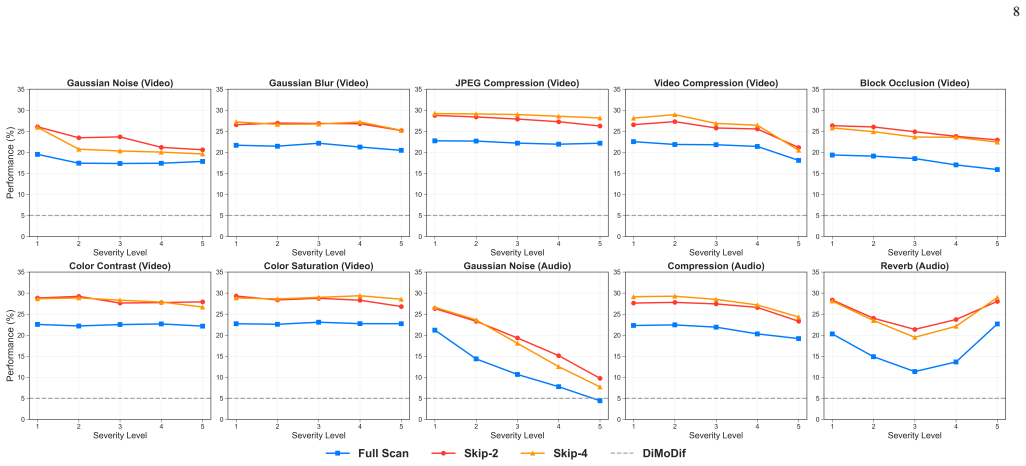
- Skip-scanning doubles as a cheap robustness regularizer, so degraded inputs (compression, noise, blur) are handled without extra augmentation or denoising.
- Unified sequence fusion and frame-skipping are synergistic: applying them separately (transformer backbone or channel concatenation) hurts, so the benefits depend on the Mamba backbone's position-agnostic state propagation.
- The +1.4% gain from removing high frequencies suggests explicit high-frequency filtering could be a simple add-on to existing dense-scan models.
Where Pith is reading between the lines
- Because Group-Scan-Merge retains all tokens, the claimed Nyquist cutoff is a behavioral approximation rather than a true sampling operation; the paper defers the spectral-equivalence proof to a missing supplementary, so the frequency story rests on empirical alignment until that proof appears.
- The same band-selection logic could be tested on other forgery types (e.g., single-frame glitches), which the authors acknowledge stride may attenuate; an adaptive stride or multi-scale mixture could recover those cases.
- The frequency analysis uses features extracted at 6.25 Hz; at other frame rates the 0–0.15 band corresponds to different physical timescales, so the optimal stride would need rescaling rather than literal transfer.
- A testable extension: train a dense-scan model with a learned high-frequency-suppression head and compare to skip-scanning; this would isolate the regularization effect from the efficiency gain.
Editorial analysis
A structured set of objections, weighed in public.
Referee Report
Summary. The paper proposes UniSkip-Mamba, a Mamba-based framework for audio-visual temporal forgery localization (AV-TFL). The method combines (1) a unified multimodal sequence constructed by temporally concatenating audio and visual features with learnable modality embeddings, and (2) a skip-scanning Mamba block that de-interleaves the sequence into p groups, scans each group in parallel with a bidirectional state-space model, and merges the results back. The authors report state-of-the-art results on LAV-DF (63.4% AP@0.95, +9.8% over UniCaCLF) and AV-Deepfake1M (63.58% mAP, +14.32% over DiMoDif), plus robustness gains under perturbations and inference speedups. The central mechanistic claim is that stride-2 skip-scanning acts as frequency-aware regularization: it preserves an empirically identified discriminative band (normalized frequency 0–0.15) while attenuating high-frequency noise, with the stride choice justified by an approximate effective Nyquist frequency f_N(p) ≈ 1/(2p).
Significance. If the results and mechanism are correct, this would be a meaningful advance for AV-TFL: the method is linear-complexity, achieves large gains at high IoU thresholds, and offers a plausible frequency-domain rationale for architectural regularization. The paper includes extensive experiments on two large benchmarks, a useful efficiency comparison, and a clearly described architecture with Algorithm 1. The unified-sequence ablation, including the negative result with a Transformer backbone, is informative. However, the theoretical justification for the central frequency-principled claim is currently not established: the effective-Nyquist derivation is deferred to a missing Supplementary, the matrix-norm equality used in the state-space argument is mathematically incorrect as stated, and the discriminative band is determined from the same ablation experiments used to validate the stride choice, creating circularity. The SOTA empirical numbers are promising but rest on single-run evaluations without error bars.
major comments (5)
- [§III-E3] The state-space argument relies on ∥Ā^p∥ = ∥Ā∥^p. For a general matrix this equality is false; only the submultiplicative inequality ∥Ā^p∥ ≤ ∥Ā∥^p holds without further assumptions such as normality. Moreover, Mamba's input-dependent Ā is not guaranteed to be contractive in norm. The quantitative decay claims (e.g., 0.64 vs 0.41) and the derived exponential down-weighting of high-frequency dynamics are therefore unsupported. This is load-bearing for the claimed theoretical grounding of skip-scanning as a low-pass regularizer.
- [§III-E3 and Algorithm 1] The identification of Group-Scan-Merge with an effective Nyquist frequency f_N(p) ≈ 1/(2p) is asserted without proof. The operation de-interleaves tokens, scans shorter subsequences, and re-interleaves; no tokens are dropped and no anti-aliasing filter is applied. Reducing the recurrence depth within each group changes the model's temporal memory but does not, by itself, create a low-pass cutoff. Classical sampling theory would predict aliasing of high-frequency content into low frequencies when samples are processed in decimated subsequences, not attenuation. Since the full derivation is deferred to a missing Supplementary, the central claim that stride-2 'naturally attenuates high-frequency noise' while preserving the 0–0.15 band is not established.
- [§III-E3 and §IV-G] The discriminative band 0–0.15 is empirically determined from the same band-removal ablations (Table IV, on 1,000 AV-Deepfake1M samples) that are then used to 'derive' the optimality of stride-2 through Nyquist reasoning. This is circular: the threshold f_d is not predicted a priori, and the table's three broad bands (0–0.05, 0.05–0.15, >0.15) are too coarse to establish the precise 0.15 boundary or to validate the f_N(4)=0.125 cutoff. The 'theoretical justification' should be reframed as a post-hoc interpretation, or validated with a genuinely independent prediction (e.g., a new dataset or a predicted sensitivity pattern over finer frequency bands).
- [Tables I–II and Figure 4] All reported results are single-run with no error bars, standard deviations, or significance tests. This is particularly problematic for the LAV-DF comparison between stride=1 (63.0 AP@0.95) and stride=2 (63.4), a 0.4-point difference that is presented as evidence that stride-2 is optimal. The robustness claims (5–8% absolute gains in Figure 4) also lack repeated-run variability. Reporting multiple seeds or confidence intervals is necessary to support both the SOTA and the stride-selection conclusions.
- [§IV-G and §IV-D] The paper repeatedly refers to a Supplementary for the frequency-domain methodology, robustness parameter settings, and 'complete frequency spectrum analysis'. None of this material is present in the submitted manuscript. Since the frequency-removal protocol and the robustness degradation settings are essential for reproducing and verifying the main claims, the paper is incomplete as submitted. The authors should either include these details in the main text or append the supplementary file.
minor comments (6)
- [Abstract / §IV-E] The abstract claims '6× faster inference', but §IV-E reports this speedup for the stride=1 model at T=9216 relative to UMMAFormer. The main model is stride=2; the speedup for that configuration should be stated explicitly to avoid overstatement.
- [Table I] UniSkip-Mamba's AR@20 and AR@10 values are lower than UniCaCLF's (e.g., 91.7 vs 93.8 at AR@10), which is not discussed. Given the paper emphasizes precision at high IoUs, this trade-off should be acknowledged and explained.
- [§IV-G] The text says 'band-pass filters to isolate three frequency ranges' but the experiments remove bands rather than isolate them. Clarify that a notch/removal operation was applied, and specify how the filtered features were reconstructed.
- [Figure 4] The robustness figure is referenced as 'Figure 4' but no actual figure or quantitative per-perturbation values are included in the text. Without the figure or a table, the 5–8% robustness claims cannot be evaluated.
- [§I and §III-E3] The introduction states skip-scanning gives 'accuracy, speed (2×)' while the abstract emphasizes '6× faster inference'. These refer to different baselines/conditions; make the distinction clear to avoid confusion.
- [§III-B] The unified sequence is called a 'phase preserver', but concatenating V-then-A changes the temporal index of one modality rather than preserving a shared phase coordinate. The terminology is misleading; consider describing it as 'phase-sensitive serialization' or similar.
Circularity Check
Frequency-selective predictions are post-hoc confirmations of the empirically chosen discriminative band; effective-Nyquist derivation is deferred and unsupported.
specific steps
-
fitted input called prediction
[§IV-G (Design Implications); cf. §III-E3 Prediction (Frequency Selectivity)]
"The optimal stride (p=2) is not an arbitrary hyperparameter but a principled decision derived from the Nyquist-Shannon sampling theorem applied to the empirically-determined discriminative frequency band. This explains why stride=2 simultaneously improves accuracy, robustness, and efficiency—a frequency-aware design validated by both theory and experiments."
The 'empirically-determined discriminative frequency band' (0–0.15) is established by the same band-removal ablations (Table IV) that are then presented as validation of the stride-ordering predictions. In §III-E3, Prediction 3 ('Stride-4 should exhibit increased sensitivity to mid-frequency removal compared to stride-2, as f_eff_N(4)<f_d') is a direct consequence of fixing f_eff_N(4)=0.125 and f_d=0.15; both numbers are set by the band binning and the assumed 1/(2p) formula, not by the data. Table IV's mid-removal ordering (-79.7% vs -72.4%) therefore confirms a relation already built into the chosen band/stride definition; only the magnitudes are free. The 'theoretical ranking' is a post-hoc rationalization of the empirical band rather than an independent prediction.
full rationale
The paper's headline SOTA numbers (63.4% AP@0.95 on LAV-DF, 63.58% mAP on AV-Deepfake1M) are empirical results against external benchmarks and are not themselves circular. No load-bearing self-citation chain is present: the DBM block is cited from Video Mamba Suite [13], which is not the authors' own work, and the Group-Scan-Merge mechanism is not justified by a self-citation. The circularity is confined to the theoretical 'frequency-principled' narrative. The discriminative band 0–0.15 is empirically determined by band-removal experiments, and the same experiments are used to validate the prediction that stride-2 is optimal and stride-4 is more sensitive to mid-frequency removal. Since Prediction 3 follows from the chosen inequality 0.125<0.15, the validation is a consistency check on the binning rather than a test of an independent theory. Separately, the paper's asserted effective Nyquist formula f_eff_N(p)≈1/(2p) is not derived from Algorithm 1—which de-interleaves but does not drop tokens or apply an anti-aliasing filter—and the derivation is deferred to a missing Supplementary. That is a correctness/evidence gap, not itself a circular step, but it removes independent support from the theory. Overall, the central empirical contributions stand, but the theoretical justification for stride-2 optimality is partially circular, warranting a score of 6.
Axiom & Free-Parameter Ledger
free parameters (2)
- discriminative band upper bound =
0.15 (normalized frequency)
- skip-scanning stride p =
p=2
axioms (5)
- ad hoc to paper Group-Scan-Merge with stride p can be treated as temporal decimation with effective Nyquist frequency f_eff_N(p) ≈ 1/(2p).
- ad hoc to paper The Mamba state transition matrix A̅ is contractive and satisfies ∥A̅^p∥ = ∥A̅∥^p.
- domain assumption Forgery-discriminative patterns occur at 50–200ms human-perception timescales, mapping to normalized frequencies 0.05–0.2 at a 6.25 Hz feature rate.
- domain assumption Band-pass filtering of input features removes only the intended frequency band without artifacts.
- domain assumption Pre-extracted features and evaluation protocol match those of prior baselines.
read the original abstract
With the proliferation of AI-generated content, sophisticated multimedia manipulation has raised critical concerns about malicious applications such as opinion manipulation and evidence fabrication, making Audio-Visual Temporal Forgery Localization (AV-TFL) an urgent research frontier. Existing TFL methods have progressed along two main paradigms: Transformer-based temporal modeling and channel-wise multimodal fusion. While these approaches capture temporal dependencies and cross-modal correlations, they process all frequency components indiscriminately, leading to overfitting on high-frequency noise and limited robustness under real-world data degradation. Through systematic frequency domain analysis, we find that forgery-discriminative patterns concentrate in the low/mid-frequency range (normalized frequency 0-0.15), while high-frequency components primarily introduce noise, removing them even improves detection performance by +1.4%. Based on this phenomenon, we propose UniSkip-Mamba, a frequency-aware State Space Model framework that incorporates Unified Multimodal Sequence Fusion to preserve cross-modal phase relationships, and Skip-Scanning Mamba Blocks that implement frequency-aware regularization through a novel Group-Scan-Merge mechanism, naturally biasing learning toward discriminative low/mid-frequency patterns (0-0.15) while maintaining representational completeness. We achieve state-of-the-art (SOTA) performance: 63.4% AP@0.95 on LAV-DF (+9.8% improvement) and 63.58% mAP on AV-Deepfake1M (+14.32% improvement), with 6x faster inference. Our frequency-domain analysis provides theoretical justification from a signal processing perspective for why skip-scanning inherently improves both accuracy and robustness.
Figures



Reference graph
Works this paper leans on
-
[1]
Video generative adversarial networks: a review,
N. Aldausari, A. Sowmya, N. Marcus, and G. Mohammadi, “Video generative adversarial networks: a review,”ACM Computing Surveys (CSUR), vol. 55, no. 2, pp. 1–25, 2022
2022
-
[2]
Devit: Deformed vision transformers in video inpainting,
J. Cai, C. Li, X. Tao, C. Yuan, and Y .-W. Tai, “Devit: Deformed vision transformers in video inpainting,” inProceedings of the 30th ACM international conference on multimedia, 2022, pp. 779–789
2022
-
[3]
Fastlts: Non-autoregressive end-to-end un- constrained lip-to-speech synthesis,
Y . Wang and Z. Zhao, “Fastlts: Non-autoregressive end-to-end un- constrained lip-to-speech synthesis,” inProceedings of the 30th ACM International Conference on Multimedia, 2022, pp. 5678–5687
2022
-
[4]
Detection of synthetic speech based on spectrum defects,
J. Deng, T. Mao, D. Yan, L. Dong, and M. Dong, “Detection of synthetic speech based on spectrum defects,” inProceedings of the 1st International Workshop on Deepfake Detection for Audio Multimedia, 2022, pp. 3–8
2022
-
[5]
Low-quality fake audio detection through frequency feature masking,
I.-Y . Kwak, S. Choi, J. Yang, Y . Lee, S. Han, and S. Oh, “Low-quality fake audio detection through frequency feature masking,” inProceedings of the 1st International Workshop on Deepfake Detection for Audio Multimedia, 2022, pp. 9–17
2022
-
[6]
Deepfake video detection with spatiotemporal dropout transformer,
D. Zhang, F. Lin, Y . Hua, P. Wang, D. Zeng, and S. Ge, “Deepfake video detection with spatiotemporal dropout transformer,” inProceedings of the 30th ACM international conference on multimedia, 2022, pp. 5833– 5841
2022
-
[7]
Multi- attentional deepfake detection,
H. Zhao, W. Zhou, D. Chen, T. Wei, W. Zhang, and N. Yu, “Multi- attentional deepfake detection,” inProceedings of the IEEE/CVF confer- ence on computer vision and pattern recognition, 2021, pp. 2185–2194
2021
-
[8]
Joint audio-visual deepfake detection,
Y . Zhou and S.-N. Lim, “Joint audio-visual deepfake detection,” in Proceedings of the IEEE/CVF international conference on computer vision, 2021, pp. 14 800–14 809
2021
-
[9]
Um- maformer: A universal multimodal-adaptive transformer framework for temporal forgery localization,
R. Zhang, H. Wang, M. Du, H. Liu, Y . Zhou, and Q. Zeng, “Um- maformer: A universal multimodal-adaptive transformer framework for temporal forgery localization,” inProceedings of the 31st ACM Inter- national Conference on Multimedia, 2023, pp. 8749–8759
2023
-
[10]
Q. Yin, W. Lu, X. Luo, and X. Cao, “Context-aware tfl: A universal context-aware contrastive learning framework for temporal forgery lo- calization,”arXiv preprint arXiv:2506.08493, 2025
Pith/arXiv arXiv 2025
-
[11]
Actionformer: Localizing moments of actions with transformers,
C.-L. Zhang, J. Wu, and Y . Li, “Actionformer: Localizing moments of actions with transformers,” inEuropean Conference on Computer Vision. Springer, 2022, pp. 492–510
2022
-
[12]
Vision mamba: Efficient visual representation learning with bidirectional state space model,
L. Zhu, B. Liao, Q. Zhang, X. Wang, W. Liu, and X. Wang, “Vision mamba: Efficient visual representation learning with bidirectional state space model,”arXiv preprint arXiv:2401.09417, 2024
Pith/arXiv arXiv 2024
-
[13]
Video mamba suite: State space model as a versatile alternative for video understanding,
G. Chen, Y . Huang, J. Xu, B. Pei, Z. Chen, Z. Li, J. Wang, K. Li, T. Lu, and L. Wang, “Video mamba suite: State space model as a versatile alternative for video understanding,”CoRR, 2024
2024
-
[14]
Tridet: Temporal action detection with relative boundary modeling,
D. Shi, Y . Zhong, Q. Cao, L. Ma, J. Li, and D. Tao, “Tridet: Temporal action detection with relative boundary modeling,” inProceedings of the IEEE/CVF conference on computer vision and pattern recognition, 2023, pp. 18 857–18 866
2023
-
[15]
C. Koutlis and S. Papadopoulos, “Dimodif: Discourse modality- information differentiation for audio-visual deepfake detection and lo- calization,”arXiv preprint arXiv:2411.10193, 2024
Pith/arXiv arXiv 2024
-
[16]
Efficiently modeling long sequences with structured state spaces,
A. Gu, K. Goel, and C. R ´e, “Efficiently modeling long sequences with structured state spaces,”arXiv preprint arXiv:2111.00396, 2021
Pith/arXiv arXiv 2021
-
[17]
Hungry hungry hippos: Towards language modeling with state space models,
D. Y . Fu, T. Dao, K. K. Saab, A. W. Thomas, A. Rudra, and C. R ´e, “Hungry hungry hippos: Towards language modeling with state space models,”arXiv preprint arXiv:2212.14052, 2022
Pith/arXiv arXiv 2022
-
[18]
Long range language modeling via gated state spaces,
H. Mehta, A. Gupta, A. Cutkosky, and B. Neyshabur, “Long range language modeling via gated state spaces,”arXiv preprint arXiv:2206.13947, 2022
Pith/arXiv arXiv 2022
-
[19]
Mamba: Linear-time sequence modeling with selective state spaces,
A. Gu and T. Dao, “Mamba: Linear-time sequence modeling with selective state spaces,”arXiv preprint arXiv:2312.00752, 2023
Pith/arXiv arXiv 2023
-
[20]
T. Dao and A. Gu, “Transformers are ssms: Generalized models and ef- ficient algorithms through structured state space duality,”arXiv preprint arXiv:2405.21060, 2024
Pith/arXiv arXiv 2024
-
[21]
Vmamba: Visual state space model,
Y . Liu, Y . Tian, Y . Zhao, H. Yu, L. Xie, Y . Wang, Q. Ye, J. Jiao, and Y . Liu, “Vmamba: Visual state space model,”Advances in neural information processing systems, vol. 37, pp. 103 031–103 063, 2024
2024
-
[22]
Mambatad: When state-space models meet long-range temporal action detection,
H. Lu, Y . Yu, S. Lu, D. Rajan, B. P. Ng, A. C. Kot, and X. Jiang, “Mambatad: When state-space models meet long-range temporal action detection,”arXiv preprint arXiv:2511.17929, 2025
arXiv 2025
-
[23]
Avs-mamba: Exploring temporal and multi-modal mamba for audio- visual segmentation,
S. Gong, Y . Zhuge, L. Zhang, Y . Wang, P. Zhang, L. Wang, and H. Lu, “Avs-mamba: Exploring temporal and multi-modal mamba for audio- visual segmentation,”IEEE Transactions on Multimedia, 2025
2025
-
[24]
Mug: Pseudo labeling augmented audio-visual mamba network for audio- visual video parsing,
L. Wang, B. Zhu, Y . Chen, Y . Zhang, M. Tang, and J. Wang, “Mug: Pseudo labeling augmented audio-visual mamba network for audio- visual video parsing,”arXiv preprint arXiv:2507.01384, 2025
Pith/arXiv arXiv 2025
-
[25]
Lc-mamba: Local and continuous mamba with shifted windows for frame interpolation,
M. W. Jeong and C. E. Rhee, “Lc-mamba: Local and continuous mamba with shifted windows for frame interpolation,” inProceedings of the Computer Vision and Pattern Recognition Conference, 2025, pp. 17 671– 17 681
2025
-
[26]
Hear me out: Fusional approaches for audio augmented temporal action localization,
A. Bagchi, J. Mahmood, D. Fernandes, and R. K. Sarvadevabhatla, “Hear me out: Fusional approaches for audio augmented temporal action localization,”arXiv preprint arXiv:2106.14118, 2021
Pith/arXiv arXiv 2021
-
[27]
Not made for each other-audio-visual dissonance-based deepfake detection and local- ization,
K. Chugh, P. Gupta, A. Dhall, and R. Subramanian, “Not made for each other-audio-visual dissonance-based deepfake detection and local- ization,” inProceedings of the 28th ACM international conference on multimedia, 2020, pp. 439–447
2020
-
[28]
Do you really mean that? content driven audio-visual deepfake dataset and multimodal method for temporal forgery localization,
Z. Cai, K. Stefanov, A. Dhall, and M. Hayat, “Do you really mean that? content driven audio-visual deepfake dataset and multimodal method for temporal forgery localization,” in2022 International Conference on Digital Image Computing: Techniques and Applications (DICTA). IEEE, 2022, pp. 1–10
2022
-
[29]
Glitch in the matrix: A large scale benchmark for content driven audio– visual forgery detection and localization,
Z. Cai, S. Ghosh, A. Dhall, T. Gedeon, K. Stefanov, and M. Hayat, “Glitch in the matrix: A large scale benchmark for content driven audio– visual forgery detection and localization,”Computer Vision and Image Understanding, vol. 236, p. 103818, 2023
2023
-
[30]
Av-deepfake1m: A large-scale llm-driven audio- visual deepfake dataset,
Z. Cai, S. Ghosh, A. P. Adatia, M. Hayat, A. Dhall, T. Gedeon, and K. Stefanov, “Av-deepfake1m: A large-scale llm-driven audio- visual deepfake dataset,” inProceedings of the 32nd ACM International Conference on Multimedia, 2024, pp. 7414–7423
2024
-
[31]
Activitynet: A large-scale video benchmark for human activity under- standing,
F. Caba Heilbron, V . Escorcia, B. Ghanem, and J. Carlos Niebles, “Activitynet: A large-scale video benchmark for human activity under- standing,” inProceedings of the ieee conference on computer vision and pattern recognition, 2015, pp. 961–970
2015
-
[32]
Byol for audio: Self-supervised learning for general-purpose audio represen- tation,
D. Niizumi, D. Takeuchi, Y . Ohishi, N. Harada, and K. Kashino, “Byol for audio: Self-supervised learning for general-purpose audio represen- tation,” in2021 International Joint Conference on Neural Networks (IJCNN). IEEE, 2021, pp. 1–8
2021
-
[33]
Audio set: An ontology and human- labeled dataset for audio events,
J. F. Gemmeke, D. P. Ellis, D. Freedman, A. Jansen, W. Lawrence, R. C. Moore, M. Plakal, and M. Ritter, “Audio set: An ontology and human- labeled dataset for audio events,” in2017 IEEE international conference on acoustics, speech and signal processing (ICASSP). IEEE, 2017, pp. 776–780
2017
-
[34]
Videomae v2: Scaling video masked autoencoders with dual masking,
L. Wang, B. Huang, Z. Zhao, Z. Tong, Y . He, Y . Wang, Y . Wang, and Y . Qiao, “Videomae v2: Scaling video masked autoencoders with dual masking,” inProceedings of the IEEE/CVF conference on computer vision and pattern recognition, 2023, pp. 14 549–14 560
2023
-
[35]
wav2vec 2.0: A framework for self-supervised learning of speech representations,
A. Baevski, Y . Zhou, A. Mohamed, and M. Auli, “wav2vec 2.0: A framework for self-supervised learning of speech representations,” Advances in neural information processing systems, vol. 33, pp. 12 449– 12 460, 2020
2020
-
[36]
Actionmamba: Action spatial–temporal aggregation network based on mamba and gcn for skeleton-based action recognition,
J. Wen, D. Liu, and B. Zheng, “Actionmamba: Action spatial–temporal aggregation network based on mamba and gcn for skeleton-based action recognition,”Electronics, vol. 14, no. 18, p. 3610, 2025
2025
-
[37]
Mesonet: a compact facial video forgery detection network,
D. Afchar, V . Nozick, J. Yamagishi, and I. Echizen, “Mesonet: a compact facial video forgery detection network,” in2018 IEEE international workshop on information forensics and security (WIFS). IEEE, 2018, pp. 1–7
2018
discussion (0)
Sign in with ORCID, Apple, or X to comment. Anyone can read and Pith papers without signing in.