REVIEW 2 major objections 15 references
Language Models Represent and Transform Concepts with Shared Geometry
T0 review · 2 major / 0 minor · reviewed 2026-07-11 · grok-4.5
Pith's one-line read Language models share a common geometry not only of where concepts sit, but of how context moves them—displacements that are semantically organized and transferable across models.
desk verdict Solid multi-model evidence that contextual displacements are non-uniform, semantically organized, and relationally transferable across models—under fixed templates; that operationalization is the real limit, not a collapse of the claim. read the letter →
The pith
A machine-rendered reading of the paper's core claim, the machinery that carries it, and where it could break.
The reading
What carries the argument
Concepts as point-cloud manifolds (sets of contextualized embeddings of the same word) and contextual transformations as vector fields Φ of displacements from a neutral reference context; the load-bearing empirical tool is relational transport, which reweights one model’s held-out displacements using cosine similarities from another model’s displacement field.
What would settle it
Run the same relational-transport test on the same vocabulary: if weights derived from one model’s displacement field no longer predict held-out magnitudes and residual directions in another model above a random-permutation baseline, or if scrambling the semantic content of the templates leaves transport performance unchanged, the claim of shared, semantically organized transformation geometry fails.
Extended reading notes
Core claim
Models share a common geometry not only of concept representations but, more importantly, of contextual transformations. Context moves each concept differently; the variance in those displacements is semantically organized, correlating with concreteness and lexical density; and displacement structure transported from one model predicts held-out displacements in others significantly above chance.
Load-bearing premise
The argument treats a handful of fixed prompt templates—categorization, perception, situation, affection, knowledge, plus a neutral template—as a valid stand-in for the contexts that transform concepts; if those templates do not induce the relevant transformations, the shared vector-field geometry does not generalize.
Editorial extensions
If this is right
- Single-vector steering is only an approximation that discards a structured, semantically meaningful residual in how context moves concepts.
- Alignment of transformation fields tracks model capability (e.g., MMLU) more tightly than parameter count, so shared transformation geometry is a signature of learned semantic organization.
- Concepts can be both stable (consistent relational structure across models) and flexible (context-specific, graded displacements).
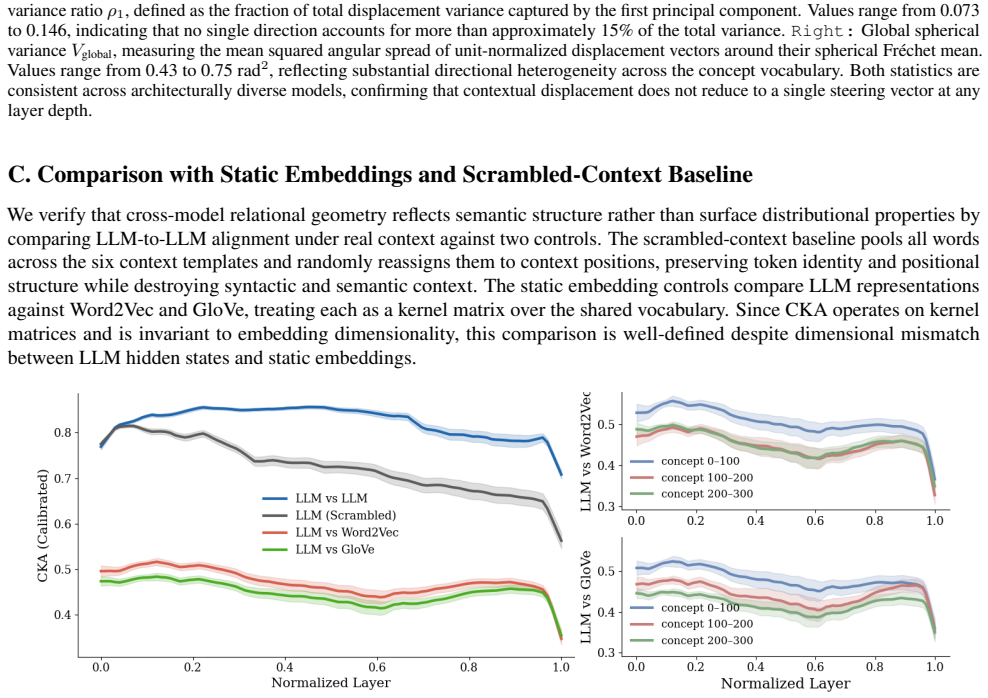
- Cross-model concept alignment cannot be reduced to surface co-occurrence; scrambling context collapses it.
- Representation engineering and alignment methods that assume stationary concept vectors need to account for the geometry of contextual transformations themselves.
Reading between the lines
- If displacement structure is shared, multi-model steering or transfer of concept interventions may succeed more reliably when matching relational geometry than when matching absolute directions.
- The same vector-field formalization can be tested in vision or multimodal models to check whether contextual transformation geometry is modality-general.
- Negative correlation of lexical density with displacement magnitude suggests dense neighborhoods act as geometric anchors, which could predict which concepts are easiest or hardest to steer.
- Free-form or corpus-derived contexts, rather than fixed templates, could reveal additional structure or break the transport result and thereby bound how general the shared geometry is.
Editorial analysis
A structured set of objections, weighed in public.
Referee Report
Summary. The paper formalizes concept representations in LLMs as point-cloud manifolds and contextual transformations as vector fields Φ_τ (Eqs. 1–6). Across 23 base models from six families, it reports that (i) displacements are heterogeneous (low leading variance ratio ρ1, high spherical variance), (ii) this variance is semantically organized by lexical concreteness and density (Table 1; Fig. 2), (iii) both concept-space geometry (within- and between-concept CKA) and transformation-field geometry (CKA and Grassmann) are shared across models and track capability more than size (Fig. 3), and (iv) relational transport of displacement structure from a source model predicts held-out displacements in target models above permutation and Gaussian baselines (Eq. 12; Fig. 4). Scrambled-context and static-embedding controls (Appendix C) are used to argue that the shared geometry is not reducible to surface co-occurrence.
Significance. If the operationalization of context is accepted, the work supplies a concrete geometric account of how concepts can be simultaneously stable (shared relational structure) and flexible (semantically organized displacements). The multi-family, multi-scale measurement suite, permutation-calibrated CKA/Grassmann, and relational-transport test that beats explicit ablations are genuine strengths and go beyond static linear-representation or Platonic-representation claims. The results would matter for representation engineering (single-vector steering as an approximation that discards structured residual) and for cognitive science accounts of conceptual flexibility. The main limitation is that the strongest claim is currently secured only under a fixed set of theory-inspired prompt templates rather than free naturalistic context.
major comments (2)
- §4.1 and Eqs. 4–6: The central claim that models share the geometry of how context transforms concepts rests on five fixed, theory-inspired templates plus a single neutral τ0. All models therefore see identical short prompts. Relational transport (Eq. 12; Fig. 4) can succeed from residual patterns induced by those shared templates (or residual co-occurrence that survives mean subtraction) without establishing a shared geometry of naturalistic contextual transformation. The scrambled-context control (Appendix C) only reassigns words within the same template set; it does not test free sentences that differ across words. A load-bearing robustness check—repeating transport and semantic correlations on naturalistic Wikipedia contexts (already collected for the within-concept analysis)—is needed before the stronger claim is secure.
- §5.1 / Table 1 and Fig. 3: Semantic organization and capability–alignment correlations are reported primarily for a subset of mid-size models (Qwen2.5-7B, Llama3.1-8B, Ministral3-8B, Gemma2-9B) and for Qwen2.5-32B as reference. Given that 23 models spanning 0.5B–32B are introduced, the manuscript should state whether the concreteness/density correlations and the MMLU-vs-alignment dissociation hold for the full set (including Pythia and the smaller Qwen checkpoints) or only for the illustrated subset; otherwise the generality of “shared geometry across six families” is overstated.
Circularity Check
No load-bearing circularity: transport predictions and semantic correlations are empirical tests against external baselines and norms, not reductions by construction; only minor non-load-bearing self-cites.
full rationale
The paper's derivation chain is measurement-first and self-contained against its own definitions. Concepts are operationalized as point clouds X_w (Eq. 1) and contextual transformations as displacements ϕ(w,τ)=r(w,τ)-r(w,τ0) forming vector fields Φ_τ (Eqs. 4-5), with geometry compared via unbiased CKA (Eqs. 7-8) and Grassmann distance (Eqs. 9-10) after permutation calibration (Eq. 11). These are standard non-parametric comparisons; none equal their inputs by definition. The central transport claim (Eq. 12) constructs a cosine-weighted average of target-model training displacements using source-model similarities, then evaluates magnitude rank correlation and residual cosine on held-out words against random-permutation and Gaussian baselines (Fig. 4); outperformance is an empirical result, not forced by construction or by any fitted global parameter. Semantic organization (Table 1, Fig. 2) correlates displacement magnitude/deviation with external Brysbaert concreteness ratings and Word2Vec lexical density (decorrelated, r=-0.018), not with quantities derived from the same CKA/Grassmann scores. Within/between-concept CKA heatmaps (Fig. 5) and scrambled-context/static-embedding controls (Appendix C) further test against surface statistics. Self-citations (Hu et al. 2024; Hu et al. 2026) appear only in related work and as partial justification for prompt templates eliciting conceptual structure; they are not uniqueness theorems, not the sole support for the shared-geometry claim, and do not make the multi-model transport or correlation results tautological. The fixed-template operationalization of context is a validity/generalization assumption, not a circular step. Score 1 only for the presence of non-load-bearing self-cites; central claims remain independent empirical content.
Assumptions & free parameters
free parameters (5)
- Subspace dimension p for Grassmann analysis
- Analysis layer depths (25%, 50%, 75%)
- Vocabulary sizes and sampling (≈40 / ≈300 / ≈1000 words)
- Train/test split and transport weighting (80/20; cosine-similarity weights)
- Permutation count K=200 and calibration quantile
assumptions (6)
- domain assumption Concept representations in LLMs can be treated as empirical point-cloud samples from an underlying distribution, characterized non-parametrically by kernels (Section 2.1).
- domain assumption Centered Kernel Alignment (unbiased HSIC) and Grassmann distance on principal subspaces measure the shared geometry that matters for the claims (Section 3).
- ad hoc to paper Fixed theory-inspired prompt templates elicit human-like conceptual structure and valid contextual transformations (Section 4.1, citing Rosch, Barsalou, Osgood, Murphy; Hu/Xu prior work).
- ad hoc to paper Displacement ϕ(w,τ)=r(w,τ)−r(w,τ0) with neutral template τ0 defines the contextual transformation field (Eqs. 4–6).
- domain assumption Multi-token words may be represented by the mean of subword token states (Section 2.1).
- standard math Linear algebra, SVD, spherical Fréchet means, and Spearman correlation behave as standardly assumed.
invented entities (2)
-
Contextual transformation field Φ_τ
independent evidence
-
Concept point-cloud manifold X_w in LLM activation space
Cite this review
Pith. "Pith review of Language Models Represent and Transform Concepts with Shared Geometry." pith.science (2026). https://pith.science/paper/PQBGEVQY
@misc{pith2026260704525,
  author       = {Pith},
  title        = {Pith review of: Language Models Represent and Transform Concepts with Shared Geometry},
  year         = {2026},
  howpublished = {\url{https://pith.science/paper/PQBGEVQY}},
  note         = {Machine review of arXiv:2607.04525}
}
read the original abstract
How concepts are represented in neural networks is a fundamental question in machine learning. The dominant view treats concept representations as stationary geometric objects. Yet concepts appear in context, and context transforms them. Drawing from neural population geometry, we formalize concept representations as point-cloud manifolds and contextual transformations as vector fields, and instantiate this framework in large language models. Across six model families of varying scales, we find that context moves each concept differently. The variance in these displacements is semantically organized, correlating with lexical concreteness and density. Importantly, both the concepts being transformed and this variance structure are shared across models: displacement structure transported from one model predicts held-out displacements in others significantly above chance. Together, these findings show that models share a common geometry not only in how concepts are represented, but more importantly in how context transforms them, a structure with richer organization than prior work has recognized.
Figures


Figures from the paper (4 more)


Reference graph
Works this paper leans on
-
[1]
Deepseek llm: Scaling open-source language models with longtermism
Bi, X., Chen, D., Chen, G., Chen, S., Dai, D., Deng, C., Ding, H., Dong, K., Du, Q., Fu, Z., et al. Deepseek llm: Scaling open-source language models with longtermism. arXiv preprint arXiv:2401.02954,
-
[2]
Datasheet for the pile.arXiv preprint arXiv:2201.07311,
Biderman, S., Bicheno, K., and Gao, L. Datasheet for the pile.arXiv preprint arXiv:2201.07311,
-
[3]
The pile: An 800gb dataset of diverse text for language modeling.arXiv preprint arXiv:2101.00027,
Gao, L., Biderman, S., Black, S., Golding, L., Hoppe, T., Foster, C., Phang, J., He, H., Thite, A., Nabeshima, N., et al. The pile: An 800gb dataset of diverse text for language modeling.arXiv preprint arXiv:2101.00027,
-
[4]
The llama 3 herd of models.arXiv preprint arXiv:2407.21783,
Grattafiori, A., Dubey, A., Jauhri, A., Pandey, A., Kadian, A., Al-Dahle, A., Letman, A., Mathur, A., Schelten, A., Vaughan, A., et al. The llama 3 herd of models.arXiv preprint arXiv:2407.21783,
-
[5]
Gr¨oger, F., Wen, S., and Brbi´c, M. Revisiting the platonic representation hypothesis: An aristotelian view.arXiv preprint arXiv:2602.14486,
-
[6]
The representational geome- try of number.arXiv preprint arXiv:2602.06843,
Hu, Z., Niu, L., and Varma, S. The representational geome- try of number.arXiv preprint arXiv:2602.06843,
-
[7]
9 Language Models Represent and Transform Concepts with Shared Geometry Liu, A. H., Khandelwal, K., Subramanian, S., Jouault, V ., Rastogi, A., Sad ´e, A., Jeffares, A., Jiang, A., Cahill, A., Gavaudan, A., et al. Ministral 3.arXiv preprint arXiv:2601.08584,
-
[8]
Efficient estimation of word representations in vector space.arXiv preprint arXiv:1301.3781,
Mikolov, T., Chen, K., Corrado, G., and Dean, J. Efficient estimation of word representations in vector space.arXiv preprint arXiv:1301.3781,
Show all 15 references
-
[9]
G., Hardin, C., Bhupatiraju, S., Hussenot, L., Mesnard, T., Shahri- ari, B., Ram ´e, A., et al
Team, G., Riviere, M., Pathak, S., Sessa, P. G., Hardin, C., Bhupatiraju, S., Hussenot, L., Mesnard, T., Shahri- ari, B., Ram ´e, A., et al. Gemma 2: Improving open language models at a practical size.arXiv preprint arXiv:2408.00118,
-
[10]
Llama 2: Open foundation and fine- tuned chat models.arXiv preprint arXiv:2307.09288,
Touvron, H., Martin, L., Stone, K., Albert, P., Almahairi, A., Babaei, Y ., Bashlykov, N., Batra, S., Bhargava, P., Bhosale, S., et al. Llama 2: Open foundation and fine- tuned chat models.arXiv preprint arXiv:2307.09288,
-
[11]
Qwen2.5 technical report.arXiv preprint arXiv:2412.15115,
Yang, A., Yang, B., Zhang, B., Hui, B., Zheng, B., Yu, B., Li, C., Liu, D., Huang, F., Wei, H., et al. Qwen2.5 technical report.arXiv preprint arXiv:2412.15115,
-
[12]
Model Details This appendix provides a comprehensive overview of the 23 pre-trained language models evaluated in this work, spanning six model families released between 2023 and
10 Language Models Represent and Transform Concepts with Shared Geometry A. Model Details This appendix provides a comprehensive overview of the 23 pre-trained language models evaluated in this work, spanning six model families released between 2023 and
2023
-
[13]
was designed specifically to facilitate research on learning dynamics and interpretability across model scales. All six models we evaluate (0.4B–12B) share a decoder-only Transformer architecture based on GPT-3, with three key modifications: rotary positional embeddings (RoPE)...
2020
-
[14]
Note that artificial and natural concepts are inherently concrete concepts
and define concreteness using Brysbaert’s rating (Brysbaert et al., 2014). Note that artificial and natural concepts are inherently concrete concepts. We denote concept above the mid point of rating as concrete concepts (some of them are also artificial and natural concepts) a...
2014
-
[15]
Word Category Conc
Table 3.Concept vocabulary used in the internal geometry analysis, sorted by concreteness rating. Word Category Conc. Word Category Conc. belief Abstract 1.19 curriculum Concrete 3.23 hope Abstract 1.25 overlay Artifact 3.30 goodness Abstract 1.38 instruction Concrete 3.37 abs...
2010
Reviewed July 11, 2026 · model on record in the stance chip above.
Discussion (0). Continue with ORCID to comment.