REVIEW 3 major objections 5 minor 93 references
G2VD claims that counterfactual intervention and causal disentanglement—not more data or bigger models—let AI-generated video detectors generalize to unseen generators, reaching 91.9% overall accuracy on GenVidBench.
Reviewed by Pith at T0; open to challenge. T0 means a machine referee read the full paper against a public rubric. the ladder, T0–T4 →
T0 review · deepseek-v4-flash
2026-08-02 08:34 UTC pith:WBUTOFQF
load-bearing objection G2VD is a strong empirical video forensics paper with impressive cross-generator gains, but the causal story is a well-motivated proxy rather than an established counterfactual, and the language should be toned down. the 3 major comments →
G2VD: Generalizable AI-Generated Video Detection via Counterfactual Intervention and Causal Disentanglement
The pith
A machine-rendered reading of the paper's core claim, the machinery that carries it, and where it could break.
Core claim
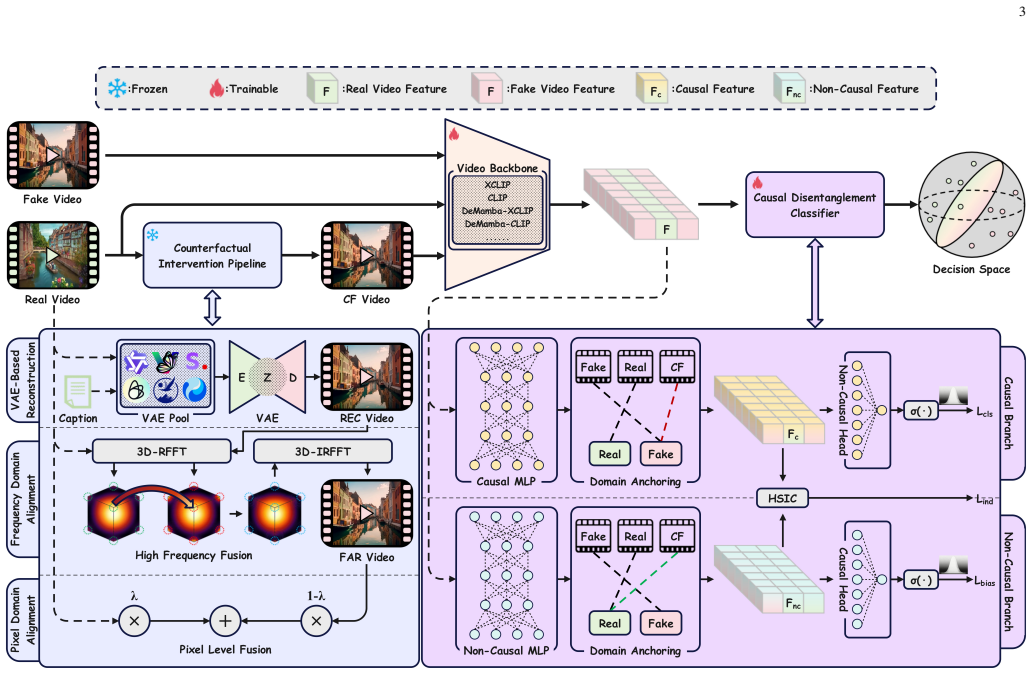
The central claim is that shortcut learning—reliance on domain-specific bias such as generator fingerprints, compression patterns, and style—rather than lack of data or capacity, is the main obstacle to cross-domain generalization in AI-generated video detection. G2VD intervenes by constructing counterfactual videos: a real video is passed through a VAE, its spectrum is fused so the original supplies high-frequency amplitudes while the reconstruction supplies the rest, and the result is blended back into the original. This produces an approximate version of the ideal counterfactual f(S_f, U_r)—fake forensic cues with real-video domain characteristics. A causal branch is trained to label real
What carries the argument
CFIPipeline: a counterfactual construction using VAE-based reconstruction of a real video, frequency-domain alignment (high-pass amplitude from the original, low-frequency amplitude from the reconstruction, recombined with the reconstructed phase), and pixel-domain interpolation to yield X_cf. Causal disentanglement classifier: two MLP branches with opposing label assignments (causal branch: real=0, fake and counterfactual=1; non-causal branch: counterfactual relabeled real), plus a Hilbert-Schmidt Independence Criterion penalty that minimizes dependence between the two representations. The work these do: the counterfactual weakens the correlation between domain bias and authenticity label,
Load-bearing premise
The method assumes that the traces left by VAE-reconstructing a real video are a faithful stand-in for the intrinsic forensic cues that fake generators imprint—the paper itself says the proxy is 'not strictly equivalent' to the ideal causal factor, and if this assumption fails the causal branch would be learning a reconstruction artifact rather than a generalizable fake signal.
What would settle it
Train the same architecture with counterfactuals built by swapping the latent codes of matched real–fake video pairs (so the counterfactual carries the fake video's actual content, not a VAE reconstruction). If accuracy on unseen generators stays near 91.9%, the intervention mechanism is confirmed; if it collapses toward the ~66% baseline, the VAE reconstruction shortcut was the real driver.
If this is right
- Detectors trained on a small slice of one benchmark can identify videos from generators never seen in training, at accuracy above 90%.
- The gain is concentrated on the hardest cross-domain pairs (image-to-video generators such as MuseV and SVD), which are exactly where baseline accuracy collapses.
- Counterfactual intervention alone provides the bulk of the improvement (+21.7 pp on GenVidBench), with disentanglement adding a further +5.4 pp; both components transfer across four backbone architectures.
- The causal branch retains roughly 90% cross-domain accuracy while the non-causal branch falls to about 60%, showing the two branches separate transferable from non-transferable signals.
Where Pith is reading between the lines
- If the VAE proxy really approximates intrinsic forensic cues, the same recipe could be applied to other generative families (e.g., audio or images) by swapping the reconstruction target; the paper does not test this.
- The frequency-alignment step suggests a direct robustness test: detectors built this way should be less brittle to codec compression, but the paper reports JPEG robustness still drops sharply at Q=60, so a natural extension is training with compression-aware augmentation.
- The data-efficiency result implies that new generators could be covered by regenerating counterfactuals from existing real video rather than collecting labeled fake video from each new generator—a claim the paper implies but does not state explicitly.
Editorial analysis
A structured set of objections, weighed in public.
Referee Report
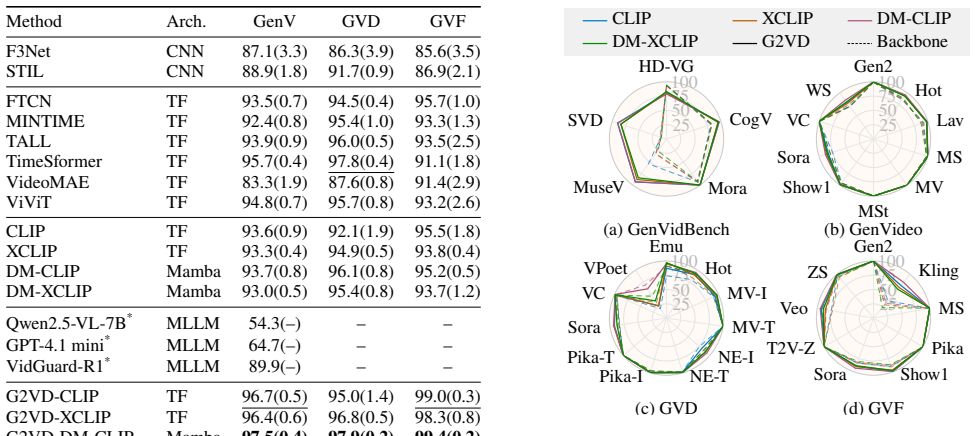
Summary. The paper proposes G2VD, a framework for cross-domain AI-generated video detection. It introduces a 'counterfactual intervention pipeline' that builds a synthetic sample from a real video by VAE reconstruction, frequency-domain alignment, and pixel-domain blending, and assigns it the fake label; a 'causal disentanglement classifier' with two branches (causal and non-causal) and an HSIC-based independence penalty is trained on the resulting supervision. Experiments on GenVidBench, GenVideo, GVD, and GVF show large gains over matched baselines, especially on the challenging GenVidBench Pair2 setting, using only 10% of Pair1 for training and a compact backbone. The paper reports seed-level means and standard deviations for all main results and includes ablations. The central narrative is that the gains are caused by counterfactual intervention and causal disentanglement, rather than by data augmentation alone.
Significance. If the causal attribution is correct, the result is significant: a compact detector trained on a limited subset of one benchmark achieves above 90% overall ACC on unseen generators, with consistent gains across four backbones and four datasets, and the released code and seed-level variance reporting are strengths. However, the load-bearing assumption that X_cf approximates f(S_f, U_r) is not established. The implemented X_cf is derived entirely from a real video's VAE reconstruction; the paper itself concedes the reconstruction traces are 'not strictly equivalent to S_f.' Consequently, the reported ablation gains, while reproducible in aggregate, may arise from a well-engineered augmentation scheme rather than from the claimed causal intervention. The current manuscript is therefore promising but needs additional validation to support its central claim.
major comments (3)
- [Method: Counterfactual Intervention Pipeline, Eqs. (3)-(9)] The ideal counterfactual in Eq. (3) is X*_cf = f(S_f, U_r), pairing a fake causal factor with a real non-causal factor. The implemented X_cf in Eq. (9) is λX_r + (1-λ)X_far, where X_far is built from X_r, the VAE reconstruction X_rec = D(E(X_r,t)), and spectra derived from those real videos. No fake video contributes S_f. The paper acknowledges that reconstruction traces are 'not strictly equivalent to S_f,' but this caveat is load-bearing rather than minor. Under this construction, the causal branch in Eq. (11) can learn a shortcut based on 'looks VAE-reconstructed' rather than intrinsic forensic cues. The +21.7 pp CFI ablation gain in Table 3 is equally consistent with a data-augmentation effect. A concrete test is needed: e.g., train a control model that uses the same VAE reconstruction pool but labels reconstructed real videos as real (or as a separate class), and compare generalizat
- [Experimental Analysis: Branch Generalization Analysis, Fig. 4] The branch gap in Fig. 4 does not adjudicate between causal disentanglement and a reconstruction-artifact shortcut. F_c is trained to classify X_r as real and X_f plus X_cf as fake; since X_cf is a VAE-degraded real video, F_c can achieve this by detecting any VAE-type trace. On Pair2, such a detector would still separate unseen fakes from real videos if unseen generators leave similar autoencoding traces, while F_nc, anchored to source-domain real appearance through the relabeling in Eq. (13), would degrade. The observed pattern therefore does not establish that F_c captures S_f rather than a reconstruction-specific artifact. Please report source-identity probe accuracy on F_c and F_nc, and/or cross-generator invariance statistics for F_c, to differentiate these explanations.
- [Objective Function, HSIC constraint, Eq. (15)-(16)] Minimizing HSIC(F_c, F_nc) ensures statistical independence between the two branch representations; it does not ensure that F_c corresponds to the causal factor S or that F_nc corresponds to the non-causal factor U. The claim that the branches 'capture intrinsic forensic cues and domain-specific bias, respectively' requires a direct measurement. For example, train a linear probe for generator/source identity on F_nc and on F_c. The desired outcome is high probe accuracy on F_nc and near-chance accuracy on F_c; this would operationalize 'non-causal' vs 'causal' and is currently missing.
minor comments (5)
- [Table 3 ablation] There is no CD-only arm (CFI off, CD on). Since the paper presents CFI and CD as complementary, adding this variant would help isolate the contribution of the disentanglement classifier independent of the intervention pipeline.
- [Eq. (7) / implementation details] The high-pass mask M_high is not specified. Its definition (frequency threshold, window shape, whether it is learnable) should be given for reproducibility.
- [Abstract vs Table 1] The abstract reports an F1 improvement of 0.194 over 'comparable state-of-the-art methods.' The exact baseline should be named; Table 1 shows different gaps depending on which baseline is used.
- [Statistics] Seed-level standard deviations are reported, but no paired significance tests are given. Given the large reported gaps, a simple paired test (e.g., Wilcoxon) across seeds and backbones would increase confidence.
- [Figure 3] The caption says 'radii report mean ACC' but the text refers to 'curves.' The figure would be clearer with confidence intervals or error bars on the source-level estimates.
Circularity Check
No significant circularity: cross-domain results rest on external benchmark labels; the counterfactual proxy is an acknowledged assumption, not a definitional reduction.
full rationale
The claimed derivation chain is not circular. The SCM and ideal counterfactual in Eqs. (1)-(3) define a conceptual target, and CFIPipeline in Eqs. (4)-(9) constructs X_cf from a real video X_r via VAE reconstruction, frequency alignment, and pixel blending. The paper explicitly labels this an 'operational approximation' and states the reconstruction traces are 'not strictly equivalent to S_f' (Method, CFIPipeline), so it does not claim the constructed sample is the true counterfactual. All headline results (Tables 1-2) are measured against external benchmark labels — GenVidBench Pair2, GenVideo, GVD, and GVF — not against any value fitted from those labels. The ablation study (Table 3) and branch analysis (Fig. 4) compare component variants on the same external labels, so the causal vs non-causal gap is not a prediction that reduces to a fitted parameter or a self-assigned target. The only author-overlapping citation, DeMamba (Chen et al. 2026), is used as a baseline backbone/dataset and is not load-bearing for the central causal-disentanglement claim. The self-assigned fake label on X_cf is training-data construction, not an evaluated prediction, and the paper acknowledges the proxy limitation; this is a correctness/validation caveat, not circularity. No circular step meeting the quoted-evidence standard was found.
Axiom & Free-Parameter Ledger
free parameters (4)
- Intervention strength λ =
not reported (stated λ ∈ [0,0.5])
- Loss weights w_cls, w_bias, w_ind =
not reported
- High-pass mask M_high =
not reported
- VAE pool composition (14 VAEs) =
10 TAE variants + 4 VideoVAE+ variants
axioms (5)
- domain assumption SCM decomposition X:=f(S,U,V1), Y:=h(S,V2) with S⊥⊥U⊥⊥V1, V1⊥⊥V2
- domain assumption P(Y|S) is invariant across domains while U–Y correlations shift
- ad hoc to paper VAE reconstruction traces are a proxy for the causal forensic factor S_f
- domain assumption Compression mainly affects high-frequency magnitude; phase preserves spatiotemporal structure
- standard math HSIC is a valid independence measure for representation disentanglement
invented entities (3)
-
Causal factor S
no independent evidence
-
Non-causal factor U
no independent evidence
-
Reconstruction-induced traces
no independent evidence
read the original abstract
Rapid advances in AI video generation pose increasing security risks and call for reliable detectors with strong cross-domain generalization. Although existing methods perform well under in-domain evaluation, their performance degrades substantially on unseen generators. A key reason is shortcut learning, where detectors rely on domain-specific bias rather than intrinsic forensic cues. To address this issue, we propose G2VD, a generalizable AI-generated video detection framework based on counterfactual intervention and causal disentanglement. First, G2VD introduces a counterfactual intervention pipeline (CFIPipeline) that constructs counterfactual samples through VAE-based reconstruction and subsequent frequency-domain and pixel-domain alignment, thereby weakening spurious correlations between domain-specific bias and authenticity labels. Building on this intervention, we further design a causal disentanglement classifier that combines two domain-anchored branches with complementary objectives and a constraint based on the Hilbert-Schmidt Independence Criterion (HSIC), encouraging the causal and non-causal representations to capture intrinsic forensic cues and domain-specific bias, respectively. Experiments across four public datasets demonstrate strong cross-domain performance and consistent gains over baseline methods. In the challenging GenVidBench setting, G2VD achieves over 90\% overall ACC, with improvements of 0.194 in F1 and 0.104 in AUC over comparable state-of-the-art methods, while using only 10\% of the available training data. Code is available at https://github.com/DMOSCAR-98/G2VD.
Figures




Reference graph
Works this paper leans on
-
[1]
2024 , institution=
Video generation models as world simulators , author=. 2024 , institution=
2024
-
[3]
Proceedings of the AAAI Conference on Artificial Intelligence , volume=
Frequency-Aware Deepfake Detection: Improving Generalizability through Frequency Space Domain Learning , author=. Proceedings of the AAAI Conference on Artificial Intelligence , volume=. 2024 , doi=
2024
-
[4]
2025 , doi=
Wang, Bo and Zhang, Zhao and Zhao, Suiyi and Ye, Xianming and Zhang, Haijun and Wang, Meng , booktitle=. 2025 , doi=
2025
-
[5]
European Conference on Computer Vision (ECCV) , pages=
Thinking in Frequency: Face Forgery Detection by Mining Frequency-Aware Clues , author=. European Conference on Computer Vision (ECCV) , pages=. 2020 , publisher=
2020
-
[6]
Proceedings of the 29th ACM International Conference on Multimedia , pages=
Spatiotemporal Inconsistency Learning for DeepFake Video Detection , author=. Proceedings of the 29th ACM International Conference on Multimedia , pages=
-
[7]
Proceedings of the IEEE/CVF International Conference on Computer Vision (ICCV) , pages=
Exploring Temporal Coherence for More General Video Face Forgery Detection , author=. Proceedings of the IEEE/CVF International Conference on Computer Vision (ICCV) , pages=
-
[8]
Proceedings of the IEEE/CVF Conference on Computer Vision and Pattern Recognition (CVPR) , pages=
Generalizing Deepfake Video Detection with Plug-and-Play: Video-Level Blending and Spatiotemporal Adapter Tuning , author=. Proceedings of the IEEE/CVF Conference on Computer Vision and Pattern Recognition (CVPR) , pages=
-
[9]
GenVidBench: A 6-Million Benchmark for
Ni, Zhenliang and Yan, Qiangyu and Huang, Mouxiao and Yuan, Tianning and Tang, Yehui and Hu, Hailin and Chen, Xinghao and Wang, Yunhe , booktitle=. GenVidBench: A 6-Million Benchmark for. 2026 , doi=
2026
-
[10]
Your One-Stop Solution for
Ma, Long and Xue, Zihao and Wang, Yan and Yan, Zhiyuan and Xu, Jin and Jiang, Xiaorui and Yu, Haiyang and Liao, Yong and Bi, Zhen , booktitle=. Your One-Stop Solution for
-
[11]
Tang, Yuqi and Shi, Yang and Zhang, Zhuoran and Wang, Qixun and Bai, Xuehai and Ding, Yue and Chen, Ruizhe and Zeng, Bohan and Chen, Xinlong and Zhu, Xuanyu and Li, Bozhou and Wang, Yuran and Dai, Yifan and Tong, Chengzhuo and Liu, Xinyu and Ji, Yiyan and Wei, Yujie and Dong, Yuhao and Yan, Shilin and Wang, Fengxiang and Zhang, Yi-Fan and Wang, Haotian an...
-
[12]
DeMamba:
Chen, Haoxing and Hong, Yan and Huang, Zizheng and Xu, Zhuoer and Gu, Zhangxuan and Li, Yaohui and Lan, Jun and Zhu, Huijia and Zhang, Jianfu and Wang, Weiqiang and Li, Huaxiong , journal=. DeMamba:. 2026 , doi=
2026
-
[13]
Zheng, Chende and Suo, Ruiqi and Lin, Chenhao and Zhao, Zhengyu and Yang, Le and Liu, Shuai and Yang, Minghui and Wang, Cong and Shen, Chao , booktitle=
-
[14]
Yan, Zhiyuan and Zhang, Yong and Fan, Yanbo and Wu, Baoyuan , booktitle=
-
[15]
, booktitle=
Kundu, Rohit and Xiong, Hao and Mohanty, Vishal and Balachandran, Athula and Roy-Chowdhury, Amit K. , booktitle=. Towards a Universal Synthetic Video Detector: From Face or Background Manipulations to Fully. 2025 , doi=
2025
-
[16]
Seeing What Matters: Generalizable
Corvi, Riccardo and Cozzolino, Davide and Prashnani, Ekta and De Mello, Shalini and Nagano, Koki and Verdoliva, Luisa , journal=. Seeing What Matters: Generalizable. 2025 , doi=
2025
-
[17]
Preserving Forgery Artifacts:
Li, Zhengcen and Jiang, Chenyang and Zhao, Hang and Zhou, Shiyang and Mo, Yunyang and Gao, Feng and Yang, Fan and Shan, Qiben and Wu, Shaocong and Su, Jingyong , journal=. Preserving Forgery Artifacts:. 2026 , doi=
2026
-
[18]
2026 , doi=
Wang, Hang and Shen, Chao and Lin, Chenhao and Yang, Minghui and Zhang, Lei and Wang, Cong , journal=. 2026 , doi=
2026
-
[19]
Journal of Machine Learning Research , volume=
Domain-Adversarial Training of Neural Networks , author=. Journal of Machine Learning Research , volume=
-
[20]
Chen, Xi and Duan, Yan and Houthooft, Rein and Schulman, John and Sutskever, Ilya and Abbeel, Pieter , booktitle=
-
[21]
Nature Machine Intelligence , volume=
Shortcut Learning in Deep Neural Networks , author=. Nature Machine Intelligence , volume=
-
[23]
Proceedings of the IEEE , volume=
Toward Causal Representation Learning , author=. Proceedings of the IEEE , volume=
-
[24]
Proceedings of the IEEE/CVF Conference on Computer Vision and Pattern Recognition (CVPR) , pages=
Causality Inspired Representation Learning for Domain Generalization , author=. Proceedings of the IEEE/CVF Conference on Computer Vision and Pattern Recognition (CVPR) , pages=
-
[25]
Computer Vision and Image Understanding , volume=
Dynamic Disentanglement: A Contrastive Causal Framework for Deepfake Detection , author=. Computer Vision and Image Understanding , volume=. 2026 , doi=
2026
-
[26]
Proceedings of the AAAI Conference on Artificial Intelligence , volume=
Critical Forgetting-Based Multi-Scale Disentanglement for Deepfake Detection , author=. Proceedings of the AAAI Conference on Artificial Intelligence , volume=. 2025 , doi=
2025
-
[27]
2009 , edition=
Causality: Models, Reasoning, and Inference , author=. 2009 , edition=
2009
-
[28]
Algorithmic Learning Theory (ALT) , series=
Measuring Statistical Dependence with Hilbert-Schmidt Norms , author=. Algorithmic Learning Theory (ALT) , series=. 2005 , publisher=
2005
-
[29]
Dual Data Alignment Makes
Chen, Ruoxin and Xi, Junwei and Yan, Zhiyuan and Zhang, Ke-Yue and Wu, Shuang and Xie, Jingyi and Chen, Xu and Xu, Lei and Guan, Isabel and Yao, Taiping and Ding, Shouhong , booktitle=. Dual Data Alignment Makes
-
[30]
2026 , doi=
Liu, Bo and Qin, Qiao and He, Qinghui , booktitle=. 2026 , doi=
2026
-
[31]
2025 , publisher=
Bai, Jianfa and Lin, Man and Cao, Gang and Lou, Zijie , booktitle=. 2025 , publisher=
2025
-
[32]
Detecting
Ma, Long and Yan, Zhiyuan and Guo, Qinglang and Liao, Yong and Yu, Haiyang and Zhou, Pengyuan , booktitle=. Detecting. 2025 , doi=
2025
-
[33]
2025 , howpublished=
Boer Bohan, Ollin , title=. 2025 , howpublished=
2025
-
[34]
2024 , howpublished=
Boer Bohan, Ollin , title=. 2024 , howpublished=
2024
-
[35]
International Conference on Learning Representations (ICLR) , year=
CogVideoX: Text-to-Video Diffusion Models with An Expert Transformer , author=. International Conference on Learning Representations (ICLR) , year=
-
[39]
Xing, Yazhou and Fei, Yang and He, Yingqing and Chen, Jingye and Xie, Jiaxin and Chi, Xiaowei and Chen, Qifeng , booktitle=
-
[40]
European Conference on Computer Vision (ECCV) , pages=
Expanding Language-Image Pretrained Models for General Video Recognition , author=. European Conference on Computer Vision (ECCV) , pages=. 2022 , publisher=
2022
-
[41]
Proceedings of the 38th International Conference on Machine Learning (ICML) , pages=
Learning Transferable Visual Models From Natural Language Supervision , author=. Proceedings of the 38th International Conference on Machine Learning (ICML) , pages=. 2021 , publisher=
2021
-
[42]
Proceedings of the 38th International Conference on Machine Learning (ICML) , pages=
Is Space-Time Attention All You Need for Video Understanding? , author=. Proceedings of the 38th International Conference on Machine Learning (ICML) , pages=. 2021 , publisher=
2021
-
[43]
Tong, Zhan and Song, Yibing and Wang, Jue and Wang, Limin , booktitle=
-
[44]
Proceedings of the IEEE/CVF International Conference on Computer Vision (ICCV) , pages=
Arnab, Anurag and Dehghani, Mostafa and Heigold, Georg and Sun, Chen and Lu. Proceedings of the IEEE/CVF International Conference on Computer Vision (ICCV) , pages=
-
[45]
Coccomini, Davide Alessandro and Kordopatis-Zilos, Giorgos and Amato, Giuseppe and Caldelli, Roberto and Falchi, Fabrizio and Papadopoulos, Symeon and Gennaro, Claudio , journal=
-
[46]
Xu, Yuting and Liang, Jian and Jia, Gengyun and Yang, Ziming and Zhang, Yanhao and He, Ran , booktitle=
-
[47]
Wen, Haiquan and He, Yiwei and Huang, Zhenglin and Li, Tianxiao and Yu, Zihan and Huang, Xingru and Qi, Lu and Wu, Baoyuan and Li, Xiangtai and Cheng, Guangliang , journal=
-
[48]
Park, Kyoungjun and Yang, Yifan and Yi, Juheon and Zheng, Shicheng and Shen, Yifei and Han, Dongqi and Shan, Caihua and Muaz, Muhammad and Qiu, Lili , booktitle=
-
[49]
Journal of Computational and Applied Mathematics , volume=
Silhouettes: A Graphical Aid to the Interpretation and Validation of Cluster Analysis , author=. Journal of Computational and Applied Mathematics , volume=. 1987 , doi=
1987
-
[50]
Arjovsky, M.; Bottou, L.; Gulrajani, I.; and Lopez-Paz, D. 2019. Invariant Risk Minimization. arXiv preprint arXiv:1907.02893
Pith/arXiv arXiv 2019
-
[51]
Arnab, A.; Dehghani, M.; Heigold, G.; Sun, C.; Lu c i \'c , M.; and Schmid, C. 2021. ViViT : A Video Vision Transformer. In Proceedings of the IEEE/CVF International Conference on Computer Vision (ICCV), 6836--6846
2021
-
[52]
Bai, J.; Lin, M.; Cao, G.; and Lou, Z. 2025. AI -Generated Video Detection via Spatial-Temporal Anomaly Learning. In Pattern Recognition and Computer Vision (PRCV 2024), volume 15040 of Lecture Notes in Computer Science, 460--470. Springer
2025
-
[53]
Bertasius, G.; Wang, H.; and Torresani, L. 2021. Is Space-Time Attention All You Need for Video Understanding? In Proceedings of the 38th International Conference on Machine Learning (ICML), 813--824. PMLR
2021
-
[54]
Blattmann, A.; Dockhorn, T.; Kulal, S.; Mendelevitch, D.; Kilian, M.; Lorenz, D.; Levi, Y.; English, Z.; Voleti, V.; Letts, A.; Jampani, V.; and Rombach, R. 2023. Stable Video Diffusion: Scaling Latent Video Diffusion Models to Large Datasets. arXiv preprint arXiv:2311.15127
Pith/arXiv arXiv 2023
-
[55]
Boer Bohan, O. 2024. TAESDV : Tiny AutoEncoder for Stable Diffusion Videos. https://github.com/madebyollin/taesdv
2024
-
[56]
Boer Bohan, O. 2025. TAEHV : Tiny AutoEncoder for Hunyuan Video. https://github.com/madebyollin/taehv
2025
-
[57]
Brooks, T.; Peebles, B.; Holmes, C.; DePue, W.; Guo, Y.; Jing, L.; Schnurr, D.; Taylor, J.; Luhman, T.; Luhman, E.; Ng, C.; Wang, R.; and Ramesh, A. 2024. Video generation models as world simulators. Technical report, OpenAI
2024
-
[58]
Chen, H.; Hong, Y.; Huang, Z.; Xu, Z.; Gu, Z.; Li, Y.; Lan, J.; Zhu, H.; Zhang, J.; Wang, W.; and Li, H. 2026. DeMamba: AI -generated video detection on million-scale GenVideo benchmark. Science China Information Sciences, 69(6): 162103
2026
-
[59]
Chen, R.; Xi, J.; Yan, Z.; Zhang, K.-Y.; Wu, S.; Xie, J.; Chen, X.; Xu, L.; Guan, I.; Yao, T.; and Ding, S. 2025. Dual Data Alignment Makes AI -Generated Image Detector Easier Generalizable. In Advances in Neural Information Processing Systems
2025
-
[60]
Chen, X.; Duan, Y.; Houthooft, R.; Schulman, J.; Sutskever, I.; and Abbeel, P. 2016. InfoGAN : Interpretable Representation Learning by Information Maximizing Generative Adversarial Nets. In Advances in Neural Information Processing Systems, volume 29
2016
-
[61]
A.; Kordopatis-Zilos, G.; Amato, G.; Caldelli, R.; Falchi, F.; Papadopoulos, S.; and Gennaro, C
Coccomini, D. A.; Kordopatis-Zilos, G.; Amato, G.; Caldelli, R.; Falchi, F.; Papadopoulos, S.; and Gennaro, C. 2024. MINTIME : Multi-Identity Size-Invariant Video Deepfake Detection. IEEE Transactions on Information Forensics and Security, 19: 6084--6096
2024
-
[62]
Corvi, R.; Cozzolino, D.; Prashnani, E.; De Mello, S.; Nagano, K.; and Verdoliva, L. 2025. Seeing What Matters: Generalizable AI -Generated Video Detection with Forensic-Oriented Augmentation. arXiv preprint arXiv:2506.16802
arXiv 2025
-
[63]
Ganin, Y.; Ustinova, E.; Ajakan, H.; Germain, P.; Larochelle, H.; Laviolette, F.; Marchand, M.; and Lempitsky, V. 2016. Domain-Adversarial Training of Neural Networks. Journal of Machine Learning Research, 17(59): 1--35
2016
-
[64]
Geirhos, R.; Jacobsen, J.-H.; Michaelis, C.; Zemel, R.; Brendel, W.; Bethge, M.; and Wichmann, F. A. 2020. Shortcut Learning in Deep Neural Networks. Nature Machine Intelligence, 2(11): 665--673
2020
-
[65]
Gretton, A.; Bousquet, O.; Smola, A.; and Sch \"o lkopf, B. 2005. Measuring Statistical Dependence with Hilbert-Schmidt Norms. In Algorithmic Learning Theory (ALT), volume 3734 of Lecture Notes in Computer Science, 63--77. Springer
2005
-
[66]
Gu, Z.; Chen, Y.; Yao, T.; Ding, S.; Li, J.; Huang, F.; and Ma, L. 2021. Spatiotemporal Inconsistency Learning for DeepFake Video Detection. In Proceedings of the 29th ACM International Conference on Multimedia, 3473--3481
2021
-
[67]
HaCohen, Y.; Chiprut, N.; Brazowski, B.; Shalem, D.; Moshe, D.; Richardson, E.; Levin, E.; Shiran, G.; Zabari, N.; Gordon, O.; Panet, P.; Weissbuch, S.; Kulikov, V.; Bitterman, Y.; Melumian, Z.; and Bibi, O. 2025. LTX-Video: Realtime Video Latent Diffusion. arXiv preprint arXiv:2501.00103
Pith/arXiv arXiv 2025
-
[68]
Kong, W.; Tian, Q.; Zhang, Z.; Min, R.; Dai, Z.; Zhou, J.; Xiong, J.; Li, X.; Wu, B.; Zhang, J.; et al. 2024. HunyuanVideo: A Systematic Framework For Large Video Generative Models. arXiv preprint arXiv:2412.03603
Pith/arXiv arXiv 2024
-
[69]
Kundu, R.; Xiong, H.; Mohanty, V.; Balachandran, A.; and Roy-Chowdhury, A. K. 2025. Towards a Universal Synthetic Video Detector: From Face or Background Manipulations to Fully AI -Generated Content. In Proceedings of the IEEE/CVF Conference on Computer Vision and Pattern Recognition (CVPR), 28050--28060
2025
-
[70]
Li, K.; Ren, W.; Li, J.; Wang, W.; and Cao, X. 2025. Critical Forgetting-Based Multi-Scale Disentanglement for Deepfake Detection. In Proceedings of the AAAI Conference on Artificial Intelligence, volume 39, 424--432
2025
-
[71]
Li, Z.; Jiang, C.; Zhao, H.; Zhou, S.; Mo, Y.; Gao, F.; Yang, F.; Shan, Q.; Wu, S.; and Su, J. 2026. Preserving Forgery Artifacts: AI -Generated Video Detection at Native Scale. arXiv preprint arXiv:2604.04634
Pith/arXiv arXiv 2026
-
[72]
Liu, B.; Qin, Q.; and He, Q. 2026. CausalCLIP : Causally-Informed Feature Disentanglement and Filtering for Generalizable Detection of Generated Images. In Proceedings of the AAAI Conference on Artificial Intelligence, volume 40, 7069--7077
2026
-
[73]
H.; Wang, Z.; and Liu, D
Lv, F.; Liang, J.; Li, S.; Zang, B.; Liu, C. H.; Wang, Z.; and Liu, D. 2022. Causality Inspired Representation Learning for Domain Generalization. In Proceedings of the IEEE/CVF Conference on Computer Vision and Pattern Recognition (CVPR), 8046--8056
2022
-
[74]
Ma, L.; Xue, Z.; Wang, Y.; Yan, Z.; Xu, J.; Jiang, X.; Yu, H.; Liao, Y.; and Bi, Z. 2026. Your One-Stop Solution for AI -Generated Video Detection. In Proceedings of the IEEE/CVF Conference on Computer Vision and Pattern Recognition (CVPR), 4458--4470
2026
-
[75]
Ma, L.; Yan, Z.; Guo, Q.; Liao, Y.; Yu, H.; and Zhou, P. 2025. Detecting AI -Generated Video via Frame Consistency. In 2025 IEEE International Conference on Multimedia and Expo (ICME), 1--6
2025
-
[76]
Ni, B.; Peng, H.; Chen, M.; Zhang, S.; Meng, G.; Fu, J.; Xiang, S.; and Ling, H. 2022. Expanding Language-Image Pretrained Models for General Video Recognition. In European Conference on Computer Vision (ECCV), 1--18. Springer
2022
-
[77]
Ni, Z.; Yan, Q.; Huang, M.; Yuan, T.; Tang, Y.; Hu, H.; Chen, X.; and Wang, Y. 2026. GenVidBench: A 6-Million Benchmark for AI -Generated Video Detection. In Proceedings of the AAAI Conference on Artificial Intelligence, volume 40, 15582--15590
2026
-
[78]
Park, K.; Yang, Y.; Yi, J.; Zheng, S.; Shen, Y.; Han, D.; Shan, C.; Muaz, M.; and Qiu, L. 2026. VidGuard-R1 : AI -Generated Video Detection and Explanation via Reasoning MLLMs and RL . In The Fourteenth International Conference on Learning Representations
2026
-
[79]
Pearl, J. 2009. Causality: Models, Reasoning, and Inference. Cambridge University Press, 2nd edition
2009
-
[80]
Qian, Y.; Yin, G.; Sheng, L.; Chen, Z.; and Shao, J. 2020. Thinking in Frequency: Face Forgery Detection by Mining Frequency-Aware Clues. In European Conference on Computer Vision (ECCV), 86--103. Springer
2020
-
[81]
W.; Hallacy, C.; Ramesh, A.; Goh, G.; Agarwal, S.; Sastry, G.; Askell, A.; Mishkin, P.; Clark, J.; Krueger, G.; and Sutskever, I
Radford, A.; Kim, J. W.; Hallacy, C.; Ramesh, A.; Goh, G.; Agarwal, S.; Sastry, G.; Askell, A.; Mishkin, P.; Clark, J.; Krueger, G.; and Sutskever, I. 2021. Learning Transferable Visual Models From Natural Language Supervision. In Proceedings of the 38th International Conference on Machine Learning (ICML), 8748--8763. PMLR
2021
-
[82]
Rousseeuw, P. J. 1987. Silhouettes: A Graphical Aid to the Interpretation and Validation of Cluster Analysis. Journal of Computational and Applied Mathematics, 20: 53--65
1987
-
[83]
R.; Kalchbrenner, N.; Goyal, A.; and Bengio, Y
Sch \"o lkopf, B.; Locatello, F.; Bauer, S.; Ke, N. R.; Kalchbrenner, N.; Goyal, A.; and Bengio, Y. 2021. Toward Causal Representation Learning. Proceedings of the IEEE, 109(5): 612--634
2021
-
[84]
Shi, H.; Wang, G.; Li, F.; Liu, M.; and Meng, X. 2026. Dynamic Disentanglement: A Contrastive Causal Framework for Deepfake Detection. Computer Vision and Image Understanding, 269: 104797
2026
-
[85]
Tan, C.; Zhao, Y.; Wei, S.; Gu, G.; Liu, P.; and Wei, Y. 2024. Frequency-Aware Deepfake Detection: Improving Generalizability through Frequency Space Domain Learning. In Proceedings of the AAAI Conference on Artificial Intelligence, volume 38, 5052--5060
2024
discussion (0)
Sign in with ORCID, Apple, or X to comment. Anyone can read and Pith papers without signing in.