REVIEW 3 major objections 40 references
A frozen video model, queried once at pure noise, yields a directional interaction prior that improves low-data robot manipulation without future-frame rollout.
Reviewed by Pith at T0; open to challenge. T0 means a machine referee read the full paper against a public rubric. the ladder, T0–T4 →
T0 review · grok-4.5
2026-07-11 15:44 UTC pith:E2VDPPUU
load-bearing objection Clean, reusable idea—single-step frozen Flow Matching velocity as a policy prior—with solid gains and a real ablation, but the “directional beyond localization” claim is under-identified and the numbers are single-run sim. the 3 major comments →
KAM-WM: Kinematic Affordance Maps from Latent World Models for Robot Manipulation
The pith
A machine-rendered reading of the paper's core claim, the machinery that carries it, and where it could break.
Core claim
In the evaluated low-data settings, the single-step latent velocity of a frozen Flow Matching image-to-video backbone, read once at the noise endpoint from the first head-camera frame and language instruction, is a useful first-order visual prior for manipulation: it supplies task-conditioned interaction regions plus coarse directional structure, and when compressed into tokens that condition a diffusion policy it improves success over strong baselines without multi-step video rollout or world-model fine-tuning. Controlled comparisons with instruction-conditioned masks indicate that part of the improvement comes from directional information beyond spatial localization alone.
What carries the argument
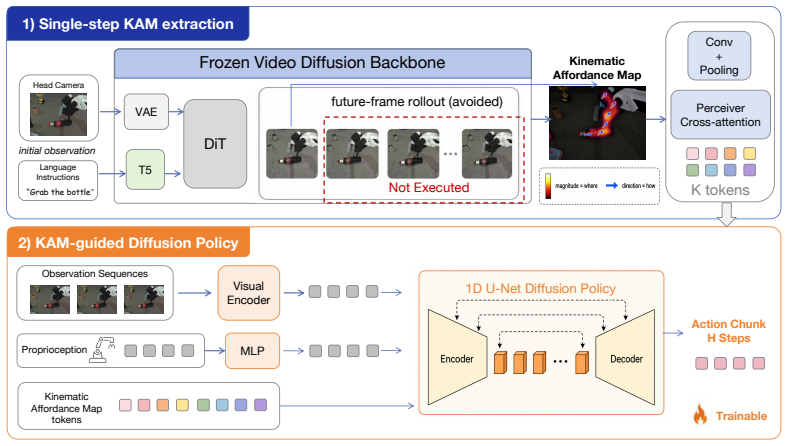
Kinematic Affordance Map (KAM): the dense single-step latent velocity field produced by one query of a frozen Flow Matching image-to-video model at the pure-noise endpoint, whose magnitude marks task-conditioned response regions and whose normalized response carries coarse orientation; a lightweight Perceiver then compresses this field into a few tokens that condition the policy.
Load-bearing premise
That a single velocity field extracted from the first head-camera frame and held fixed for the whole episode stays informative enough for closed-loop control, even when the scene changes, the horizon is long, or the contact view becomes occluded.
What would settle it
On the same 50-demo RoboTwin and LIBERO protocols, re-run the exact policy architecture with KAM refreshed at every critical contact or after major visual change, versus the default once-per-episode fixed KAM: if success does not rise on long-horizon and occlusion-heavy tasks, the claim that a single fixed first-frame prior is sufficient collapses; if a pure mask prior then matches or beats KAM on direction-sensitive tasks under multi-seed evaluation, the directional-beyond-localization claim fails.
Editorial analysis
A structured set of objections, weighed in public.
Referee Report
Summary. KAM-WM proposes reading a single-step latent velocity field from a frozen Flow Matching image-to-video model (Wan 2.2) at the noise endpoint t=1.0 and treating it as a Kinematic Affordance Map (KAM)—a task-conditioned first-order visual prior that encodes interaction regions and coarse motion structure without future-frame rollout or world-model fine-tuning. A lightweight Perceiver compresses the dense field into K=8 tokens that condition a 1D U-Net Diffusion Policy together with multi-view RGB and proprioception. On LIBERO (50 demos) the method reports 90.6% average success; on RoboTwin 2.0 (50 demos, 50 tasks) it reports 65.7% Easy and 22.4% Hard success. Controlled ablations against instruction-conditioned SAM masks under a fixed policy interface, plus a low-data diagnostic and timestep study, are used to argue that part of the gain is directional structure beyond zero-order localization.
Significance. If the result holds, the paper offers a practically attractive design point: reuse a large frozen video model as a one-query, first-order visual prior for low-data imitation learning without test-time video generation or backbone updates. That is a useful complement to mask/affordance priors and to rollout-based world-model policies. Strengths include a clear extraction interface (Eqs. 1–3), a controlled same-architecture mask ablation (Table 3 / Appendix C), efficiency accounting (one-time ~895 ms extraction amortized over the episode; ~2.1M KAM-specific trainable parameters), and large reported gains on standard low-data suites. The work is empirical rather than circular by construction, and the limitations section candidly flags staleness, simulation-only main evaluation, and single-run reporting.
major comments (3)
- Abstract, §1, §4.4, and conclusion claim that “part of the gains comes from directional information beyond spatial localization alone.” The load-bearing control is Table 3 / Appendix C Table 7 (same Perceiver + diffusion policy; only conditioning tensor swapped). That comparison shows Easy 67.8%→77.0% and Hard 24.0%→28.6% on a 9-task subset, with large Easy lifts on Hanging Mug and Place Empty Cup, but Hard is mixed or worse for KAM on precise-contact tasks (Click Bell 34→18; Place Shoe 22→10). Critically, the policy consumes the dense field V_prior (Eq. 3), not the separated magnitude A_kam vs. normalized response bV_prior (Eq. 4). Without a magnitude-only / soft-heatmap control of matched spatial support and channel capacity, sharper multi-channel localization remains a viable alternative explanation. Please add that control (or an explicit orientation-scrambled / direction-randomized
- §4.1 Evaluation protocol and Limitations §5: all main success rates (Tables 1–2, full 50-task Table 8) are single training runs with no multi-seed means or error bars. In the low-data regime the paper targets, training variance is material; several RoboTwin Hard rates are low enough that single-run differences of a few points are hard to interpret. At minimum, report multi-seed statistics for the main aggregate claims (LIBERO suite averages; RoboTwin 50-task Easy/Hard averages) and for the prior-type ablation subset, or clearly demote leaderboard-style point estimates to exploratory and restate confidence accordingly.
- §3.4 default protocol extracts KAM once from the first head-camera frame and holds it fixed for the episode. Limitations §5 correctly notes staleness under long horizons, occlusion, or major scene change—precisely the regimes where Long-suite LIBERO and Hard RoboTwin gains are most interesting. The paper does not quantify how often the fixed prior becomes mismatched, nor does it report a refresh-at-key-events or periodic re-query ablation. A small controlled study (e.g., refresh every N steps or at contact events on Long / Hard tasks) is needed to bound how much of the reported gain depends on the “once and fixed” axiom versus a still-valid prior.
Circularity Check
No significant circularity: KAM-WM is an empirical control interface whose claims are measured on external benchmarks, not forced by definition or self-citation.
full rationale
The paper does not present a first-principles derivation that forces its performance claims. KAM is defined operationally as the frozen Flow Matching single-step latent velocity V_prior = v_θ(x1, 1.0, [o1, l]) (Eqs. 1–3); success rates on LIBERO and RoboTwin 2.0 are external empirical measurements under a fixed 50-demo protocol, not quantities recovered from a fit to the same targets. The Flow Matching identity at t=1.0 (Eq. 2) is a standard property of the training objective and is used only to motivate reading a conditional latent field, not to equate that field with robot success. The controlled mask ablation (Table 3 / Appendix C) holds the Perceiver + diffusion policy fixed and swaps only the conditioning tensor; any under-identification of “direction vs. sharper localization” is an experimental-design limitation, not a by-construction reduction of the claimed gain to the input. The sole author-overlapping citation of note is SVP [38], which supplies the mask-baseline protocol (SAM-3 instruction masks through the same Perceiver), not the success metric or a uniqueness theorem that forbids alternatives. No uniqueness is imported, no ansatz is smuggled as a forced result, and no fitted free parameter is renamed as a prediction. The work is therefore self-contained against external benchmarks with no circular derivation chain.
Axiom & Free-Parameter Ledger
free parameters (4)
- KAM extraction timestep t
- Number of Perceiver tokens K
- Action horizon Ha and diffusion inference steps
- Checkpoint selection epochs {100,300,600} in low-data diagnostic
axioms (4)
- standard math Under Flow Matching / rectified flow with straight paths, the model velocity at t=1.0 approximates x1 − E[x0|c], i.e., a conditional latent displacement up to a constant offset (Eqs. 1–2).
- domain assumption A frozen general-purpose video model (Wan 2.2) encodes motion and interaction structure useful for robot manipulation when queried only at the noise endpoint.
- ad hoc to paper Extracting KAM once from the first head-camera frame and holding it fixed for the episode is sufficient for the evaluated tasks.
- domain assumption A lightweight Perceiver can compress the dense latent velocity into a few tokens without destroying the directional cue the policy needs.
invented entities (1)
-
Kinematic Affordance Map (KAM)
no independent evidence
read the original abstract
Learning manipulation from few demonstrations requires visual priors that capture not only where to interact, but also how the interaction should begin; static priors such as segmentation masks encode only the former. We present KAM-WM, a framework that extracts a coarse directional interaction cue from a frozen latent video world model without rollout or world-model fine-tuning. KAM-WM queries a Flow Matching image-to-video backbone once and interprets its single-step latent velocity as a Kinematic Affordance Map (KAM), which provides task-conditioned interaction regions and coarse motion structure. A lightweight Perceiver compresses KAM into tokens that condition a diffusion policy together with RGB observations and proprioception. Across LIBERO and RoboTwin2.0, KAM-WM reaches 90.6% average success on LIBERO and achieves 65.7% and 22.4% success rates in the Easy and Hard settings on RoboTwin2.0, respectively. Controlled comparisons against a zero-order mask prior suggest that part of the gains comes from directional information beyond spatial localization alone. These results indicate that, in the evaluated settings, a frozen video model can provide a useful first-order visual prior for control without the test-time cost of future rollout.
Figures



Reference graph
Works this paper leans on
-
[1]
Y . Lipman, R. T. Q. Chen, H. Ben-Hamu, M. Nickel, and M. Le. Flow matching for gen- erative modeling. InInternational Conference on Learning Representations (ICLR), 2023. arXiv:2210.02747
Pith/arXiv arXiv 2023
-
[2]
X. Liu, C. Gong, and Q. Liu. Flow straight and fast: Learning to generate and transfer data with rectified flow. InInternational Conference on Learning Representations (ICLR), 2023
2023
-
[3]
B. Liu, Y . Zhu, C. Gao, Y . Feng, Q. Liu, Y . Zhu, and P. Stone. LIBERO: Benchmarking knowledge transfer for lifelong robot learning.Advances in Neural Information Processing Systems (NeurIPS), 36:44776–44791, 2023
2023
-
[4]
T. Chen, Z. Chen, B. Chen, Z. Cai, Y . Liu, Z. Li, Q. Liang, X. Lin, Y . Ge, Z. Gu, et al. RoboTwin 2.0: A scalable data generator and benchmark with strong domain randomization for robust bimanual robotic manipulation.arXiv preprint arXiv:2506.18088, 2025
Pith/arXiv arXiv 2025
-
[5]
Radford, J
A. Radford, J. W. Kim, C. Hallacy, A. Ramesh, G. Goh, S. Agarwal, G. Sastry, A. Askell, P. Mishkin, J. Clark, et al. Learning transferable visual models from natural language supervision. InInternational Conference on Machine Learning (ICML), pages 8748–8763. PMLR, 2021
2021
-
[6]
K. He, X. Chen, S. Xie, Y . Li, P. Dollár, and R. Girshick. Masked autoencoders are scalable vision learners. InProceedings of the IEEE/CVF Conference on Computer Vision and Pattern Recognition (CVPR), pages 16000–16009, 2022
2022
-
[7]
M. Oquab, T. Darcet, T. Moutakanni, H. V o, M. Soyer, V . Kinnunen, H. Touvron, et al. DINOv2: Learning robust visual features without supervision.arXiv preprint arXiv:2304.07193, 2023
Pith/arXiv arXiv 2023
-
[8]
Kirillov, E
A. Kirillov, E. Mintun, N. Ravi, H. Mao, C. Rolland, L. Gustafson, T. Xiao, S. Whitehead, A. C. Berg, W.-Y . Lo, et al. Segment anything. InProceedings of the IEEE/CVF International Conference on Computer Vision (ICCV), pages 4015–4026, 2023
2023
-
[9]
S. Nair, A. Rajeswaran, V . Kumar, C. Finn, and A. Gupta. R3M: A universal visual representation for robot manipulation. InConference on Robot Learning (CoRL), pages 892–909. PMLR, 2022
2022
-
[10]
Radosavovic, T
I. Radosavovic, T. Xiao, S. James, P. Abbeel, J. Malik, and T. Darrell. Real-world robot learning with masked visual pre-training. InConference on Robot Learning (CoRL), 2022
2022
-
[11]
Majumdar, K
A. Majumdar, K. Yadav, S. Lin, S. Peralta, et al. Where are we in the search for an artificial visual cortex for embodied intelligence? InAdvances in Neural Information Processing Systems (NeurIPS), volume 36, 2023
2023
-
[12]
A. Bardes, Q. Garrido, J. Ponce, X. Chen, M. Rabbat, Y . LeCun, M. Assran, and N. Ballas. Revisiting feature prediction for learning visual representations from video.arXiv preprint arXiv:2404.08471, 2024
Pith/arXiv arXiv 2024
-
[13]
K. Mo, L. J. Guibas, M. Mukadam, A. Gupta, and S. Tulsiani. Where2Act: From pixels to actions for articulated 3d objects. InProceedings of the IEEE/CVF International Conference on Computer Vision (ICCV), pages 6813–6823, 2021
2021
-
[14]
R. Wu, Y . Zhao, K. Mo, Z. Guo, Y . Wang, T. Wu, Q. Fan, X. Chen, L. Guibas, and H. Dong. V AT-Mart: Learning visual action trajectory proposals for manipulating 3d articulated objects. InInternational Conference on Learning Representations (ICLR), 2022
2022
-
[15]
S. Bahl, R. Mendonca, L. Chen, U. Jain, and D. Pathak. Affordances from human videos as a versatile representation for robotics. InProceedings of the IEEE/CVF Conference on Computer Vision and Pattern Recognition (CVPR), pages 13778–13790, 2023. 9
2023
-
[16]
A. Zeng, P. Florence, J. Tompson, J. Welker, J. Chien, M. Attarian, T. Armstrong, I. Krasin, D. Duong, V . Sindhwani, and J. Lee. Transporter networks: Rearranging the visual world for robotic manipulation. InProceedings of the Conference on Robot Learning (CoRL), volume 155 ofProceedings of Machine Learning Research, pages 726–747. PMLR, 2021
2021
-
[17]
Shridhar, L
M. Shridhar, L. Manuelli, and D. Fox. CLIPort: What and where pathways for robotic manipulation. InProceedings of the Conference on Robot Learning (CoRL), volume 164 of Proceedings of Machine Learning Research, pages 894–906. PMLR, 2022
2022
-
[18]
X. Shao, Y . Tang, P. Xie, K. Zhou, Y . Zhuang, et al. More than a point: Capturing uncertainty with adaptive affordance heatmaps for spatial grounding in robotic tasks.arXiv preprint arXiv:2510.10912, 2025
arXiv 2025
-
[19]
Y . Du, M. Yang, P. Florence, and A. Zeng. UniPi: Learning universal policies via text-guided video generation. InAdvances in Neural Information Processing Systems (NeurIPS), 2023
2023
-
[20]
Y . Hu, Y . Guo, P. Wang, X. Chen, Y .-J. Wang, J. Zhang, K. Sreenath, C. Lu, and J. Chen. Video prediction policy: A generalist robot policy with predictive visual representations.arXiv preprint arXiv:2412.14803, 2024
Pith/arXiv arXiv 2024
-
[21]
Black, M
K. Black, M. Nakamoto, P. Atreya, H. Walke, C. Finn, A. Kumar, and S. Levine. Zero- shot robotic manipulation with pre-trained image-editing diffusion models. InInternational Conference on Learning Representations (ICLR), 2024
2024
-
[22]
X. Shao, J. Zhang, H. Wang, L. M. Brunswic, K. Zhou, J. Dong, K. Guo, Z. Chen, J. Wang, J. Hao, X. Li, and Y . Li. Generative models in decision making: A survey.arXiv preprint arXiv:2502.17100, 2025
arXiv 2025
-
[23]
A. Brohan, N. Brown, J. Carbajal, Y . Chebotar, X. Chen, K. Choromanski, T. Ding, et al. RT-2: Vision-language-action models transfer web knowledge to robotic control.arXiv preprint arXiv:2307.15818, 2023
Pith/arXiv arXiv 2023
-
[24]
Octo Model Team, D. Ghosh, H. Walke, K. Pertsch, K. Black, O. Mees, S. Dasari, et al. Octo: An open-source generalist robot policy.arXiv preprint arXiv:2405.12213, 2024
Pith/arXiv arXiv 2024
-
[25]
K. Black, N. Brown, D. Driess, A. Esmail, M. Equi, C. Finn, N. Fusai, L. Groom, K. Hausman, B. Ichter, S. Jakubczak, T. Jones, L. Ke, S. Levine, A. Li-Bell, M. Mothukuri, S. Nair, K. Pertsch, L. X. Shi, J. Tanner, Q. Vuong, A. Walling, H. Wang, and U. Zhilinsky.π0: A vision-language- action flow model for general robot control.arXiv preprint arXiv:2410.24...
Pith/arXiv arXiv 2024
-
[26]
M. J. Kim, K. Pertsch, S. Karamcheti, T. Xiao, A. Balakrishna, S. Nair, R. Rafailov, E. P. Foster, P. R. Sanketi, Q. Vuong, T. Kollar, B. Burchfiel, R. Tedrake, D. Sadigh, S. Levine, P. Liang, and C. Finn. OpenVLA: An open-source vision-language-action model. InProceedings of The 8th Conference on Robot Learning, volume 270 ofProceedings of Machine Learni...
2025
-
[27]
C. Wen, X. Lin, J. I. R. So, K. Chen, Q. Dou, Y . Gao, and P. Abbeel. Any-point trajectory modeling for policy learning. InProceedings of Robotics: Science and Systems (RSS), 2024. arXiv:2401.00025
Pith/arXiv arXiv 2024
-
[28]
H. Bharadhwaj, R. Mottaghi, A. Gupta, and S. Tulsiani. Track2act: Predicting point tracks from internet videos enables generalizable robot manipulation. InEuropean Conference on Computer Vision (ECCV), 2024. arXiv:2405.01527
Pith/arXiv arXiv 2024
-
[29]
M. Xu, Z. Xu, Y . Xu, C. Chi, G. Wetzstein, M. Veloso, and S. Song. Flow as the cross- domain manipulation interface. InProceedings of The 8th Conference on Robot Learning, volume 270 ofProceedings of Machine Learning Research, pages 2475–2499. PMLR, 2025. arXiv:2407.15208. 10
Pith/arXiv arXiv 2025
-
[30]
C. Yuan, C. Wen, T. Zhang, and Y . Gao. General flow as foundation affordance for scalable robot learning. InProceedings of The 8th Conference on Robot Learning, volume 270 ofProceedings of Machine Learning Research, pages 1541–1566. PMLR, 2025. arXiv:2401.11439
Pith/arXiv arXiv 2025
-
[31]
Wan Team, A. Wang, B. Ai, B. Wen, C. Mao, C.-W. Xie, D. Chen, F. Yu, H. Zhao, J. Yang, et al. Wan: Open and advanced large-scale video generative models.arXiv preprint arXiv:2503.20314, 2025
Pith/arXiv arXiv 2025
-
[32]
Jaegle, F
A. Jaegle, F. Gimeno, A. Brock, O. Vinyals, A. Zisserman, and J. Carreira. Perceiver: General perception with iterative attention. InInternational Conference on Machine Learning (ICML), pages 4651–4664. PMLR, 2021
2021
-
[33]
C. Chi, S. Feng, Y . Du, Z. Xu, E. Cousineau, B. Burchfiel, and S. Song. Diffusion policy: Visuomotor policy learning via action diffusion. InProceedings of Robotics: Science and Systems (RSS), 2023
2023
-
[34]
Perez, F
E. Perez, F. Strub, H. de Vries, V . Dumoulin, and A. Courville. FiLM: Visual reasoning with a general conditioning layer. InProceedings of the AAAI Conference on Artificial Intelligence (AAAI), 2018
2018
-
[35]
T. Z. Zhao, V . Kumar, S. Levine, and C. Finn. Learning fine-grained bimanual manipulation with low-cost hardware. InProceedings of Robotics: Science and Systems (RSS), 2023
2023
-
[36]
S. Liu, L. Wu, B. Li, H. Tan, H. Chen, Z. Wang, K. Xu, H. Su, and J. Zhu. RDT-1B: A diffusion foundation model for bimanual manipulation. InInternational Conference on Learning Representations (ICLR), 2025
2025
-
[37]
Y . Ze, G. Zhang, K. Zhang, C. Hu, M. Wang, and H. Xu. 3D diffusion policy: Generalizable visuomotor policy learning via simple 3D representations. InRobotics: Science and Systems (RSS), 2024
2024
-
[38]
Y . Tang, X. Shao, P. Xie, J. Li, J. Li, Y . Gao, G. Huang, T. Cao, and X. Li. Decoupling semantics and geometric grounding: Spatial visual prompts for language-conditioned imitation learning. arXiv preprint arXiv:2606.25360, 2026
Pith/arXiv arXiv 2026
-
[39]
N. Carion, L. Gustafson, Y .-T. Hu, S. Debnath, R. Hu, D. Suris Coll-Vinent, C. Ryali, K. V . Alwala, H. Khedr, A. Huang, et al. SAM 3: Segment anything with concepts. InInternational Conference on Learning Representations (ICLR), 2026. arXiv:2511.16719. 11 Appendix Overview This appendix provides implementation details, an auxiliary real-world feasibilit...
Pith/arXiv arXiv 2026
-
[40]
For RoboTwin 2.0, proprioception includes the 14-DoF dual-arm state and end-effector poses
The global condition concatenates language-modulated visual features, flattened KAM tokens (K×d k = 2,048 dimensions), and proprioceptive features. For RoboTwin 2.0, proprioception includes the 14-DoF dual-arm state and end-effector poses. For LIBERO, it uses the corresponding single-arm state. The action chunk horizon is Ha = 16 . We use a DDPM scheduler...
discussion (0)
Sign in with ORCID, Apple, or X to comment. Anyone can read and Pith papers without signing in.