REVIEW 3 major objections 7 minor 87 references
Injecting realistic bugs into otherwise correct GenAI code steers students toward editing and verification instead of only re-prompting.
Reviewed by Pith at T0; open to challenge. T0 means a machine referee read the full paper against a public rubric. the ladder, T0–T4 →
T0 review · grok-4.5
2026-07-11 09:17 UTC pith:JNXTBEIO
load-bearing objection Solid large-scale classroom evidence that injected near-miss bugs shift CS1 students from reprompting to local code repair inside authentic GenAI workflows. the 3 major comments →
When AI Is Wrong on Purpose: How Students Respond to Buggy GenAI Code
The pith
A machine-rendered reading of the paper's core claim, the machinery that carries it, and where it could break.
Core claim
Students treat natural prompt-related failures and deliberately injected near-miss bugs as different kinds of problems: natural bugs mainly drive specification refinement through re-prompting, while injected bugs mainly drive localized code edits and higher immediate success, making verification and repair an explicit part of prompt-based GenAI programming.
What carries the argument
A bug-injection pipeline that intercepts GenAI-generated code: if the code fails hidden tests it is shown as a natural bug; if it passes, a validated near-miss variant with a subtle runnable fault is shown instead, forcing students to inspect and repair rather than accept the output.
Load-bearing premise
That differences in student action and success can be attributed mainly to bug source rather than to the design fact that injected bugs are created only after the model first produced fully correct code, making them systematically closer to a working solution.
What would settle it
An A/B classroom study that randomly enables or disables injection (or matches natural and injected bugs for distance-to-correctness) and still finds the same action and success gap between bug sources would support the claim; if the gap disappears when nearness is controlled, the claim fails.
Editorial analysis
A structured set of objections, weighed in public.
Referee Report
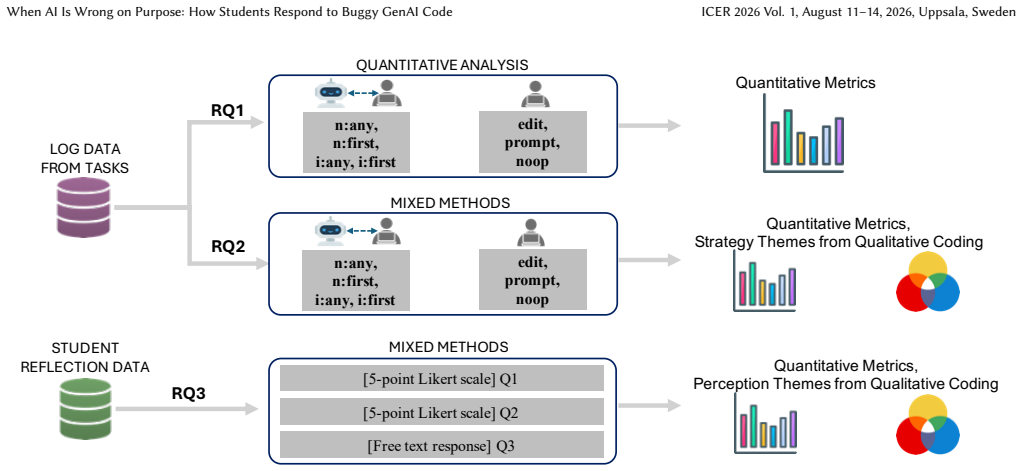
Summary. The paper studies how CS1 students respond to buggy GenAI code inside a prompt-based programming platform that mixes naturally failing model outputs with deliberately injected, validated near-miss bugs. Using 2,636 filtered sessions from 917 students (6,071 bug-fixing turns), the authors operationalize turn-level labels (n:first/i:first/n:any/i:any), first-action choices (prompt/edit/noop), and immediate success (edit-and-run success vs. counterfactual pre-injection success after a prompt). They report that injected near-misses are associated with more edit-first behavior, smaller edits, fewer edit-and-run cycles, and higher immediate success, while natural bugs are associated with more prompt-first behavior and specification-oriented strategies (signature updates, task extension, reframing). Post-lab Likert and thematically coded free-text reflections emphasize code understanding, debugging, and awareness of GenAI limits. The authors argue that combining natural failures with designed near-misses can support both specification refinement and verification/repair in the same workflow.
Significance. This is a timely, well-scoped contribution to GenAI-in-CS1 research. The core empirical result—an observational association between failure context (specification-mismatch vs. near-miss) and students’ next repair move—is directly useful for platform and activity design. Strengths include classroom scale, a clear middleware pipeline with audit logs, independence-aware testing restricted to first buggy turns, dual quantitative/qualitative analysis with strong IRR (Krippendorff α ≈ 0.87 for prompts; mean α ≈ 0.82 for reflections), and an explicit non-causal framing of natural vs. injected comparisons. The work productively bridges prompt-problems literature with controlled-failure debugging practice and offers concrete design implications (diagnose-before-action scaffolds; near-misses as verification scaffolds). Even without a randomized no-injection arm or objective learning gains, the descriptive behavioral map is a solid, citable result for the community.
major comments (3)
- [Abstract; §3.2; §3.5; §4.2 RQ1 summary] §3.2 pipeline + §3.5/RQ1 interpretation: Injected bugs exist only after a candidate already passes hidden tests, so they are near-misses by construction. The paper repeatedly states that comparisons are associations, not causal effects of “bug source” (§3.5; RQ1 summary; §5.3). That is correct and load-bearing. However, the abstract, strongest claims, and several result sentences still read as if “injected vs. natural” itself drives edits/success. Please consistently rephrase the operative contrast as near-miss / localized fault vs. specification-or-logic mismatch (of which injection is one engineered source), so the non-causal reading cannot be missed by abstract-only readers.
- [§3.5; Fig. 6b; §4.2] §3.5 immediate-success definition for prompt actions: Success after a prompt is defined counterfactually via the pre-injection audit of the next assistant output. This is methodologically careful, but it is easy to misread the high prompt-success rates after injected bugs (e.g., ~87–88% in Fig. 6b) as “students fixed the task by reprompting and received a working solution.” Under the pipeline, a subsequent correct generation is typically re-injected. The manuscript should state more prominently in §4.2 and the figure caption what “immediate success” means for prompt turns, and avoid language that implies students completed the task via prompting alone after an injected bug.
- [Table 1; Fig. 6; §4.1–4.2] Table 1 / pooled analyses: Injection rate and session success vary sharply by problem (Array II: ~51% injected, 99% success; Binary: ~7% injected, ~51% success). Pooled n:any/i:any fractions and success rates are therefore compositionally sensitive to easier, high-injection tasks. Per-problem tests are reported, which is good, but the main narrative and abstract lean on pooled contrasts. Please either (a) weight or stratify pooled summaries more carefully, or (b) lead with the consistent per-problem directional pattern and treat pooled numbers as secondary descriptive summaries.
minor comments (7)
- [Fig. 1; §3.1] Fig. 1 caption and §3.1: The walkthrough is excellent; a one-line note that the student is not told whether a failure is natural or injected would help readers who skip §3.3.
- [Table 2] Table 2: “Nb. bugs” after normalization is useful; briefly state whether frequency ranking is by occurrence count or distinct students, so readers can judge representativeness of the two examples.
- [Fig. 7e] Fig. 7e: Report sample sizes already appear in row labels; adding absolute counts in cells (or a companion table) would make rare strategies easier to interpret, especially for n:first/i:first.
- [§3.4] §3.4 filtering: 177/2813 sessions (6.3%) removed for non-alternation or missing code. A short sensitivity note (e.g., whether removed sessions were harder problems) would strengthen robustness claims.
- [§4.4; Fig. 8c] RQ3 coding: Concept learning and Bug types have lower α (0.61, 0.59). The paper already treats them cautiously; consider demoting them in the main frequency plot or merging with neighboring themes to avoid over-interpreting low-reliability labels.
- [Abstract; §1; §5] Minor prose: “2,636studentsessions” and similar missing spaces appear in the abstract/intro; fix spacing and a few long sentences in §5.1–5.2 for readability.
- [§3.3; §5.3] Ethics/credit design: Students needed only 2/5 tasks for credit and Binary had low completion. Mention possible self-selection into harder tasks when discussing generalizability in §5.3.
Circularity Check
No significant circularity: observational associations from classroom logs, not predictions forced by definition or self-citation.
full rationale
This is an empirical CS-education study. The load-bearing claims are turn-level associations (edit vs. prompt rates, immediate success, coded prompt strategies) measured from 2,636 sessions and 6,071 bug-fixing turns, plus post-task reflections. Nothing is defined in terms of the quantity it is said to predict; there is no fitted parameter re-labeled as a prediction; and no uniqueness theorem or ansatz is imported from prior author work to force the result. The design fact that injected bugs are created only after a candidate already passes hidden tests (pipeline §3.2) makes them near-misses by construction and partly explains higher immediate success—but the authors explicitly interpret natural-vs-injected comparisons as differences in response behavior rather than causal effects of bug source (§3.5, RQ1 summary, Limitations). That is a stated design confound and a limit on causal learning claims, not circular derivation. Self-citations to the Prompt Programming platform and related tools are infrastructure references, not load-bearing uniqueness arguments. The reported patterns (more edit-first and higher success after injected near-misses; more specification-oriented prompting after natural failures) are grounded in logs and qualitative coding and do not reduce to their inputs by definition.
Axiom & Free-Parameter Ledger
free parameters (1)
- number of candidate buggy variants per injection =
5
axioms (4)
- ad hoc to paper A GenAI response that fails hidden tests after a student prompt is a natural bug; a response that would have passed but is replaced by a validated near-miss is an injected bug.
- ad hoc to paper Student next-step response is the first logged action (prompt before any edit, or edit before any prompt); turns with neither are noop.
- ad hoc to paper Immediate success after a prompt is defined counterfactually by the pre-injection audit of the next model output.
- domain assumption Students in a graded CS1 lab who are warned that the model makes mistakes will treat the activity as authentic verification practice.
invented entities (1)
-
natural bug (n) vs. injected bug (i) labels, plus slip-through
no independent evidence
read the original abstract
As Generative AI (GenAI) becomes increasingly central to software development, CS education is integrating prompt-centered workflows where students describe intended program behavior in natural language to elicit code. However, professional practice requires careful review and verification of GenAI-generated code that may appear correct while containing subtle faults. This creates a challenge for CS1-level activities, where current models often solve tasks correctly and reduce students' incentive to closely inspect generated outputs. We investigate how prompt-centered programming activities can be adapted to better foster these practices. Specifically, we explore an approach where realistic, runnable bugs are injected into otherwise correct solutions, thus requiring students to read and repair generated outputs. We analyzed 2,636 sessions from 917 students, and examined behavior across instances of naturally occurring prompt-related failures and deliberately injected bugs within each session. Our findings show that students responded differently across bug sources. Deliberately injected bugs more often led to direct code edits and higher next-attempt success, suggesting localized repair of near-miss solutions. Prompt-related failures instead more often led students to refine prompts by clarifying constraints, updating function signatures, adding edge cases, or reframing the task. Student reflections reinforce the emphasis on review and repair, describing useful practice in code understanding, code review, and debugging, as well as a more careful verification mindset and greater awareness of GenAI limitations. Ultimately, prompt-related failures and injected bugs together support a pedagogically useful GenAI workflow, where students practice both specification refinement through prompts and debugging through code editing.
Figures




Reference graph
Works this paper leans on
-
[1]
Vincent Aleven, Elmar Stahl, Silke Schworm, Frank Fischer, and Raven Wallace
-
[2]
Review of Educational Research(2003)
Help Seeking and Help Design in Interactive Learning Environments. Review of Educational Research(2003)
2003
-
[3]
Leonardo Banh, Florian Holldack, and Gero Strobel. 2025. Copiloting the Future: How Generative AI Transforms Software Engineering.Information and Software Technology(2025)
2025
-
[4]
Elizabeth L Bjork and Robert A Bjork. 2011. Making Things Hard on Yourself, But in a Good Way: Creating Desirable Difficulties to Enhance Learning.Psychology and the Real World: Essays Illustrating Fundamental Contributions to Society(2011)
2011
-
[5]
Robert A. Bjork. 1994. Memory and Metamemory Considerations in the Training of Human Beings. InMetacognition: Knowing about Knowing. MIT Press
1994
-
[6]
Virginia Braun and Victoria Clarke. 2006. Using Thematic Analysis in Psychology. Qualitative Research in Psychology(2006)
2006
-
[7]
Nikitha Donekal Chandrashekar, Sehrish Basir Nizamani, Margaret Ellis, and Naren Ramakrishnan. 2026. Demystify, Use, Reflect: Preparing Students To Be Informed LLM-users. InProceedings of the Technical Symposium on Computer Science Education (SIGCSE)
2026
-
[8]
Michelene TH Chi, Nicholas De Leeuw, Mei-Hung Chiu, and Christian LaVancher
-
[9]
Eliciting Self-explanations Improves Understanding.Cognitive science (1994)
1994
-
[10]
Heeryung Choi, Tung Phung, Mengyan Wu, Adish Singla, and Christopher Brooks. 2025. Reflection-Satisfaction Tradeoff: Investigating Impact of Reflec- tion on Student Engagement with AI-Generated Programming Hints.CoRR abs/2512.04630 (2025)
arXiv 2025
-
[11]
Victoria Clarke and Virginia Braun. 2017. Thematic Analysis.The Journal of Positive Psychology(2017)
2017
-
[12]
Gergely Márk Csányi, István Üveges, Dorina Lakatos, Dóra Ripszám, Kornélia Kozák, Dániel Nagy, and János Pál Vadász. 2025. Sentence-Level Rhetorical Role Labeling in Judicial Decisions.Big Data and Cognitive Computing(2025)
2025
-
[13]
Cunningham
Mehmet Arif Demirtas, Max Fowler, Nicole Hu, and Kathryn I. Cunningham. 2024. Validating, Refining, and Identifying Programming Plans Using Learning Curve Analysis on Code Writing Data. InProceedings of the Conference on International Computing Education Research (ICER)
2024
-
[14]
Paul Denny et al . 2024. Computing Education in the Era of Generative AI. Commun. ACM(2024)
2024
-
[15]
Heffernan, Tanja Käser, Steven Moore, Anna N
Paul Denny, Sumit Gulwani, Neil T. Heffernan, Tanja Käser, Steven Moore, Anna N. Rafferty, and Adish Singla. 2024. Generative AI for Education (GAIED): Advances, Opportunities, and Challenges.CoRRabs/2402.01580 (2024)
Pith/arXiv arXiv 2024
-
[16]
Paul Denny, Juho Leinonen, James Prather, Andrew Luxton-Reilly, Thezyrie Amarouche, Brett A. Becker, and Brent N. Reeves. 2023. Promptly: Using Prompt Problems to Teach Learners How to Effectively Utilize AI Code Generators.CoRR abs/2307.16364 (2023)
Pith/arXiv arXiv 2023
-
[17]
Becker, and Brent N
Paul Denny, Juho Leinonen, James Prather, Andrew Luxton-Reilly, Thezyrie Amarouche, Brett A. Becker, and Brent N. Reeves. 2024. Prompt Problems: A New Programming Exercise for the Generative AI Era. InProceedings of the Technical Symposium on Computer Science Education (SIGCSE)
2024
-
[18]
Stephen H. Edwards. 2004. Using Software Testing to Move Students from Trial- and-Error to Reflection-in-Action. InProceedings of the Technical Symposium on Computer Science Education (SIGCSE)
2004
-
[19]
Anastasia Efklides. 2011. Interactions of Metacognition With Motivation and Affect in Self-Regulated Learning: The MASRL Model.Educational Psychologist (2011)
2011
-
[20]
Sue Fitzgerald, Gary Lewandowski, Renée McCauley, Laurie Murphy, Beth Simon, Lynda Thomas, and Carol Zander. 2008. Debugging: Finding, Fixing and Flailing, a Multi-institutional Study of Novice Debuggers.Computer Science Education18 (2008)
2008
-
[21]
Sharon Nelson-Le Gall. 1981. Help-seeking: An Understudied Problem-solving Skill in Children.Developmental Review(1981)
1981
-
[22]
John Hattie and Helen Timperley. 2007. The Power of Feedback.Review of Educational Research(2007). ICER 2026 Vol. 1, August 11–14, 2026, Uppsala, Sweden Victor-Alexandru Pădurean et al
2007
-
[23]
Xinying Hou, Ruiwei Xiao, Runlong Ye, Michael Liut, and John C. Stamper
-
[24]
InProceedings of the Technical Symposium on Computer Science Education (SIGCSE)
Exploring Student Choice and the Use of Multimodal Generative AI in Programming Learning. InProceedings of the Technical Symposium on Computer Science Education (SIGCSE)
-
[25]
Manu Kapur. 2008. Productive Failure.Cognition and Instruction(2008)
2008
-
[26]
Katz and John R
Irvin R. Katz and John R. Anderson. 1987. Debugging: An Analysis of Bug- Location Strategies.Human-Computer Interaction(1987)
1987
-
[27]
Ericson, David Weintrop, and Tovi Grossman
Majeed Kazemitabaar, Justin Chow, Carl Ka To Ma, Barbara J. Ericson, David Weintrop, and Tovi Grossman. 2023. Studying the Effect of AI Code Generators on Supporting Novice Learners in Introductory Programming. InProceedings of the Conference on Human Factors in Computing Systems (CHI)
2023
-
[28]
Henley, Barbara Jane Ericson, David Weintrop, and Tovi Grossman
Majeed Kazemitabaar, Xinying Hou, Austin Z. Henley, Barbara Jane Ericson, David Weintrop, and Tovi Grossman. 2023. How Novices Use LLM-based Code Generators to Solve CS1 Coding Tasks in a Self-Paced Learning Environment. In Proceedings of the Koli Calling International Conference on Computing Education Research (Koli Calling)
2023
-
[29]
Majeed Kazemitabaar, Runlong Ye, Xiaoning Wang, Austin Zachary Henley, Paul Denny, Michelle Craig, and Tovi Grossman. 2024. CodeAid: Evaluating a Classroom Deployment of an LLM-based Programming Assistant that Balances Student and Educator Needs. InProceedings of the Conference on Human Factors in Computing Systems (CHI)
2024
-
[30]
Nina Keith and Michael Frese. 2008. Effectiveness of Error Management Training: A Meta-analysis.Journal of Applied Psychology(2008)
2008
-
[31]
Smith, James Prather, Juho Leinonen, Andrew Luxton-Reilly, and Stephen MacNeil
Chris Kerslake, Paul Denny, David H. Smith, James Prather, Juho Leinonen, Andrew Luxton-Reilly, and Stephen MacNeil. 2024. Integrating Natural Language Prompting Tasks in Introductory Programming Courses. InProceedings of the Virtual Global Computing Education Conference (SIGCSE Virtual)
2024
-
[32]
Ko and Brad A
Amy J. Ko and Brad A. Myers. 2008. Debugging Reinvented: Asking and Answer- ing Why and Why Not Questions About Program Behavior. InProceedings of the International Conference on Software Engineering (ICSE)
2008
-
[33]
Nachiket Kotalwar, Alkis Gotovos, and Adish Singla. 2024. Hints-in-browser: Benchmarking Language Models for Programming Feedback Generation. In Annual Conference on Neural Information Processing Systems (NeurIPS)
2024
-
[34]
Klaus Krippendorff. 2011. Computing Krippendorff’s Alpha-Reliability
2011
-
[35]
2018.Content Analysis: An Introduction to Its Methodology
Klaus Krippendorff. 2018.Content Analysis: An Introduction to Its Methodology. SAGE Publications
2018
-
[36]
Reeves, Paul Denny, James Prather, and Brett A
Juho Leinonen, Arto Hellas, Sami Sarsa, Brent N. Reeves, Paul Denny, James Prather, and Brett A. Becker. 2023. Using Large Language Models to Enhance Programming Error Messages. InProceedings of the Technical Symposium on Computer Science Education (SIGCSE)
2023
-
[37]
Evanfiya Logacheva, Arto Hellas, James Prather, Sami Sarsa, and Juho Leinonen
-
[38]
InProceedings of the Conference on International Computing Education Research (ICER)
Evaluating Contextually Personalized Programming Exercises Created with Generative AI. InProceedings of the Conference on International Computing Education Research (ICER)
-
[39]
Koedinger, and Sherry Tongshuang Wu
Qianou Ma, Hua Shen, Kenneth R. Koedinger, and Sherry Tongshuang Wu. 2024. How to Teach Programming in the AI Era? Using LLMs as a Teachable Agent for Debugging. InProceedings of the Artificial Intelligence in Education (AIED)
2024
-
[40]
Becker, Michel Wermelinger, and Karen Reid
Stephen MacNeil, Juho Leinonen, Paul Denny, Natalie Kiesler, Arto Hellas, James Prather, Brett A. Becker, Michel Wermelinger, and Karen Reid. 2024. Discussing the Changing Landscape of Generative AI in Computing Education. InProceedings of the Technical Symposium on Computer Science Education (SIGCSE)
2024
-
[41]
Renée McCauley, Sue Fitzgerald, Gary Lewandowski, Laurie Murphy, Beth Simon, Lynda Thomas, and Carol Zander. 2008. Debugging: A Review of the Literature from an Educational Perspective.Computer Science Education(2008)
2008
-
[42]
Tilman Michaeli and Ralf Romeike. 2019. Improving Debugging Skills in the Class- room: The Effects of Teaching a Systematic Debugging Process. InProceedings of the Workshop in Primary and Secondary Computing Education (WiPSCE)
2019
-
[43]
Ran Mo, Dongyu Wang, Wenjing Zhan, Yingjie Jiang, Yepeng Wang, Yuqi Zhao, Zengyang Li, and Yutao Ma. 2025. Assessing and Analyzing the Correctness of GitHub Copilot’s Code Suggestions.ACM Transactions on Software Engineering and Methodology(2025)
2025
-
[44]
Laurie Murphy, Gary Lewandowski, Renée McCauley, Beth Simon, Lynda Thomas, and Carol Zander. 2008. Debugging: the Good, the Bad, and the Quirky – A Qualitative Analysis of Novices’ Strategies. InProceedings of the Technical Symposium on Computer Science Education (SIGCSE)
2008
-
[45]
Neuendorf
Kimberly A. Neuendorf. 2002.The Content Analysis Guidebook. SAGE Publica- tions
2002
-
[46]
Manh Hung Nguyen, Victor-Alexandru Padurean, Alkis Gotovos, Sebastian Tschi- atschek, and Adish Singla. 2025. Synthesizing High-Quality Programming Tasks with LLM-Based Expert and Student Agents. InProceedings of the Artificial Intel- ligence in Education (AIED)
2025
-
[47]
Julian Oertel, Jil Klünder, and Regina Hebig. 2025. Don’t Settle for the First! How Many GitHub Copilot Solutions Should You Check?Information and Software Technology(2025)
2025
-
[48]
Eng Lieh Ouh, Kar Way Tan, Siaw Ling Lo, and Benjamin Kok Siew Gan. 2025. Evaluating ChatGPT to Answer Multi-Modal Exercises in Computer Science Education. InProceedings of the Innovation and Technology in Computer Science Education Conference (ITiCSE)
2025
-
[49]
Stack Overflow. 2024. Stack Overflow Developer Survey: AI section. https: //survey.stackoverflow.co/2024/ai
2024
-
[50]
Victor-Alexandru Padurean, Paul Denny, Alkis Gotovos, and Adish Singla. 2025. Prompt Programming: A Platform for Dialogue-based Computational Problem Solving with Generative AI Models. InProceedings of the Innovation and Technol- ogy in Computer Science Education Conference (ITiCSE)
2025
-
[51]
Victor-Alexandru Padurean, Paul Denny, and Adish Singla. 2025. BugSpotter: Au- tomated Generation of Code Debugging Exercises. InProceedings of the Technical Symposium on Computer Science Education (SIGCSE)
2025
-
[52]
Passonneau
Rebecca J. Passonneau. 2006. Measuring Agreement on Set-valued Items (MASI) for Semantic and Pragmatic Annotation. InProceedings of the Conference on Language Resources and Evaluation (LREC)
2006
-
[53]
Tung Phung, José Cambronero, Sumit Gulwani, Tobias Kohn, Rupak Majumdar, Adish Singla, and Gustavo Soares. 2023. Generating High-Precision Feedback for Programming Syntax Errors using Large Language Models. InProceedings of the International Conference on Educational Data Mining (EDM)
2023
-
[54]
Tung Phung, Victor-Alexandru Padurean, Anjali Singh, Christopher Brooks, José Cambronero, Sumit Gulwani, Adish Singla, and Gustavo Soares. 2024. Automating Human Tutor-Style Programming Feedback: Leveraging GPT-4 Tutor Model for Hint Generation and GPT-3.5 Student Model for Hint Validation. InProceedings of the International Learning Analytics and Knowled...
2024
-
[55]
Chanathip Pornprasit and Chakkrit Tantithamthavorn. 2024. Fine-Tuning and Prompt Engineering for Large Language Models-Based Code Review Automation. Information and Software Technology(2024)
2024
-
[56]
James Prather et al. 2023. The Robots Are Here: Navigating the Generative AI Revolution in Computing Education. InProceedings of the Working Group Reports on Innovation and Technology in Computer Science Education (ITiCSE-WGR)
2023
-
[57]
James Prather et al. 2024. Beyond the Hype: A Comprehensive Review of Current Trends in Generative AI Research, Teaching Practices, and Tools. InProceedings of the Working Group Reports on Innovation and Technology in Computer Science Education (ITiCSE-WGR)
2024
-
[58]
It’s Weird That it Knows What I Want
James Prather, Brent N. Reeves, Paul Denny, Brett A. Becker, Juho Leinonen, Andrew Luxton-Reilly, Garrett B. Powell, James Finnie-Ansley, and Eddie Antonio Santos. 2024. "It’s Weird That it Knows What I Want": Usability and Interactions with Copilot for Novice Programmers.ACM Transactions on Computer-Human Interaction(2024)
2024
-
[59]
Reeves, Juho Leinonen, Stephen MacNeil, Arisoa S
James Prather, Brent N. Reeves, Juho Leinonen, Stephen MacNeil, Arisoa S. Ran- drianasolo, Brett A. Becker, Bailey Kimmel, Jared Wright, and Ben Briggs. 2024. The Widening Gap: The Benefits and Harms of Generative AI for Novice Pro- grammers. InProceedings of the Conference on International Computing Education Research (ICER)
2024
-
[60]
Christian Rahe and Walid Maalej. 2025. How Do Programming Students Use Generative AI?Proceedings of the ACM on Software Engineering(2025)
2025
-
[61]
Reeves, James Prather, Paul Denny, Juho Leinonen, Stephen MacNeil, Andrew Luxton-Reilly, Sebastian Mateos Nicolajsen, and Claus Brabrand
Brent N. Reeves, James Prather, Paul Denny, Juho Leinonen, Stephen MacNeil, Andrew Luxton-Reilly, Sebastian Mateos Nicolajsen, and Claus Brabrand. 2025. Prompts First, Precision Later: Reviving the Vision of Natural Language Program- ming for Computing Education. InProceedings of the Koli Calling International Conference on Computing Education Research (K...
2025
-
[62]
Brian J. Reiser. 2004. Scaffolding Complex Learning: The Mechanisms of Struc- turing and Problematizing Student Work.Journal of the Learning Sciences(2004)
2004
-
[63]
Jake Renzella, Alexandra Vassar, Lorenzo Lee Solano, and Andrew Taylor. 2025. Compiler-Integrated, Conversational AI for Debugging CS1 Programs. InPro- ceedings of the Technical Symposium on Computer Science Education (SIGCSE)
2025
-
[64]
Gordon, Carina Negreanu, Christian Poelitz, Sruti Srini- vasa Ragavan, and Ben Zorn
Advait Sarkar, Andrew D. Gordon, Carina Negreanu, Christian Poelitz, Sruti Srini- vasa Ragavan, and Ben Zorn. 2022. What is it like to program with artificial intelligence?. InProceedings of the Conference of the Psychology of Programming Interest Group (PPIG)
2022
-
[65]
Sami Sarsa, Paul Denny, Arto Hellas, and Juho Leinonen. 2022. Automatic Gen- eration of Programming Exercises and Code Explanations Using Large Language Models. InProceedings of the Conference on International Computing Education Research (ICER)
2022
-
[66]
Sauvola, Sasu Tarkoma, Mika Klemettinen, Jukka Riekki, and David S
Jaakko J. Sauvola, Sasu Tarkoma, Mika Klemettinen, Jukka Riekki, and David S. Doermann. 2024. Future of Software Development with Generative AI.Automated Software Engineering(2024)
2024
-
[67]
Andreas Scholl and Natalie Kiesler. 2025. SCRIPT - Supportive Chatbot for Resolving Introductory Programming Tasks. InProceedings of the Innovation and Technology in Computer Science Education Conference (ITiCSE)
2025
-
[68]
Valerie J Shute. 2008. Focus on Formative Feedback.Review of Educational Research(2008)
2008
-
[69]
Debra Steele-Johnson and Zachary T Kalinoski. 2014. Error Framing Effects on Performance: Cognitive, Motivational, and Affective Pathways.The Journal of Psychology(2014)
2014
-
[70]
Steve Stemler. 2000. An Overview of Content Analysis.Practical Assessment, Research, and Evaluation(2000)
2000
-
[71]
John Sweller. 1988. Cognitive Load During Problem Solving: Effects on Learning. Cognitive science(1988)
1988
-
[72]
Desmarais, and Giuliano Antoniol
Florian Tambon, Arghavan Moradi-Dakhel, Amin Nikanjam, Foutse Khomh, Michel C. Desmarais, and Giuliano Antoniol. 2025. Bugs in Large Language When AI Is Wrong on Purpose: How Students Respond to Buggy GenAI Code ICER 2026 Vol. 1, August 11–14, 2026, Uppsala, Sweden Models Generated Code: An Empirical Study.Empirical Software Engineering (2025)
2025
-
[73]
Cordeiro
Norbert Tihanyi, Tamás Bisztray, Mohamed Amine Ferrag, Ridhi Jain, and Lucas C. Cordeiro. 2025. How Secure Is AI-Generated Code? A Large-Scale Comparison of Large Language Models.Empirical Software Engineering(2025)
2025
-
[74]
Smith IV, Mounika Padala, Christine Alvarado, Jamie Gorson Benario, and Leo Porter
Annapurna Vadaparty, Daniel Zingaro, David H. Smith IV, Mounika Padala, Christine Alvarado, Jamie Gorson Benario, and Leo Porter. 2024. CS1-LLM: Integrating LLMs into CS1 Instruction. InProceedings of the Innovation and Technology in Computer Science Education Conference (ITiCSE)
2024
-
[75]
Glassman
Priyan Vaithilingam, Tianyi Zhang, and Elena L. Glassman. 2022. Expectation vs. Experience: Evaluating the Usability of Code Generation Tools Powered by Large Language Models. InProceedings of the Conference on Human Factors in Computing Systems (CHI)
2022
-
[76]
Olga Viberg, Jacqueline Wong, Yael Feldman-Maggor, Nora Dunder, and Car- rie Demmans Epp. 2025. Chatting with Code: Exploring LLMs as Learning Partners in Programming Education. InProceedings of the Artificial Intelligence in Education (AIED)
2025
-
[77]
Mitchell, and Chris Piech
Sierra Wang, John C. Mitchell, and Chris Piech. 2024. A Large Scale RCT on Effective Error Messages in CS1. InProceedings of the Technical Symposium on Computer Science Education (SIGCSE)
2024
-
[78]
Winne and Allyson F
Philip H. Winne and Allyson F. Hadwin. 1998. Studying as Self-Regulated Learn- ing. InMetacognition in Educational Theory and Practice. Lawrence Erlbaum Associates, 277–304
1998
-
[79]
Stephanie Yang, Miles Baird, Eleanor O’Rourke, Karen Brennan, and Bertrand Schneider. 2024. Decoding Debugging Instruction: A Systematic Literature Re- view of Debugging Interventions.ACM Transactions on Computing Education (2024)
2024
-
[80]
Stephanie Yang, Hanzhang Zhao, Yudian Xu, Karen Brennan, and Bertrand Schnei- der. 2024. Debugging with an AI Tutor: Investigating Novice Help-seeking Be- haviors and Perceived Learning. InProceedings of the Conference on International Computing Education Research (ICER)
2024
discussion (0)
Sign in with ORCID, Apple, or X to comment. Anyone can read and Pith papers without signing in.