REVIEW 3 major objections 6 minor 300 references
A compact high-redshift AGN sits beside a 12 kpc filament that will merge in a few hundred million years, so the compact look is temporary.
Reviewed by Pith at T0; open to challenge. T0 means a machine referee read the full paper against a public rubric. the ladder, T0–T4 →
T0 review · grok-4.5
2026-07-11 06:21 UTC pith:B6ZS5MAF
load-bearing objection Solid IFU case study of a z=5.23 compact AGN sitting next to a real 12 kpc filament; the transient-phase claim is a reasonable extrapolation, not a load-bearing proof. the 3 major comments →
BlackTHUNDER Reveals a Massive Filament around a Compact AGN at zsimeq5.23
The pith
A machine-rendered reading of the paper's core claim, the machinery that carries it, and where it could break.
Core claim
The compact broad-line appearance of GN-77652 is a transient evolutionary stage: the AGN sits only a few kiloparsecs from a multi-source filament at the same redshift, the whole complex is gravitationally bound inside a common dark-matter halo, and dynamical-friction estimates show that the sources will coalesce in 150–440 Myr, after which the merged system will more closely resemble ordinary AGN.
What carries the argument
The 12 kpc multi-source filament at z≃5.23, mapped with NIRSpec IFU [O III] kinematics and multi-band NIRCam SED fitting, supplies both the environmental context and the short merger clock that convert a single compact AGN into a temporary phase.
Load-bearing premise
The claim that the compact look is short-lived rests on the estimate that the galaxies will merge in 150–440 Myr; that number comes from a dynamical-friction formula that assumes they all sit inside one halo with typical mass ratios and a virial velocity taken from the stellar-to-halo mass relation.
What would settle it
A deeper IFU map or millimetre gas kinematics that shows the filament members are not bound to a single halo, or that their relative orbits yield a coalescence time much longer than a few hundred million years, would remove the transient-phase conclusion.
If this is right
- Compact JWST AGN at z>4 need not be a permanent new class; many may simply be caught during a brief pre-merger stage.
- The observed drop in number density of compact red AGN toward lower redshift follows if most such systems coalesce within a few hundred Myr.
- Dual or multiple AGN at few-kiloparsec separations should be relatively common inside similar high-redshift filaments.
- Once the complex merges, the black-hole-to-stellar-mass ratio is expected to move closer to local scaling relations.
Where Pith is reading between the lines
- If many Little Blue Dots and Little Red Dots sit in similarly crowded filaments, environment-driven mergers could be the dominant channel that transforms them into ordinary AGN by z~3–4.
- The possible second AGN in the massive neighbour raises the chance that black-hole mergers themselves contribute to the final mass budget once the group coalesces.
- Future medium-resolution IFU observations that resolve auroral lines across the whole filament would test whether additional low-luminosity AGN are already present and whether metallicity gradients track the converging gas flows.
Editorial analysis
A structured set of objections, weighed in public.
Referee Report
Summary. This paper presents a detailed multi-wavelength study of the compact broad-line AGN GN-77652 at z=5.229 and its immediate environment, combining BlackTHUNDER NIRSpec IFU spectroscopy with deep JADES NIRCam imaging. The authors identify a ~12 kpc filament of four additional sources at the same redshift, spanning roughly an order of magnitude in stellar mass, SFR and gas-phase metallicity. They report a smooth large-scale [OIII] velocity gradient centred on the massive, metal-rich source B; a shallow velocity gradient in GN-77652 consistent with disk rotation from DysmalPy modelling; possible AGN ionisation in B from [OIII]λ4363 auroral diagnostics and an ionising-budget argument; and a Lyman–Werner field too weak for recent direct-collapse BH formation. They estimate coalescence of the complex in 150–440 Myr and, via toy-model and TNG100 comparisons, argue that the compact BL AGN appearance of GN-77652 is a transient evolutionary phase, consistent with the apparent decline in compact JWST AGN number density toward lower redshift.
Significance. If the environmental characterisation and evolutionary interpretation hold, the paper provides one of the most complete case studies to date of a high-z compact JWST AGN in a multi-source filament, with possible dual AGN at ~2.4 kpc projected separation. The combination of resolved kinematics, SED maps, strong-line metallicities and dynamical modelling is a genuine strength and will be a useful reference for formation channels of overmassive BHs and for the fate of little blue/red dots. The SC-SAM abundance estimate and TNG100 analogue search are valuable contextual additions. The work is observationally rich even if the coalescence-driven “transient phase” narrative remains partly model-dependent.
major comments (3)
- §5.3: The 150–440 Myr coalescence time is load-bearing for the abstract/conclusion claim that the compact BL AGN appearance is a transient phase ending by z~4. It is obtained solely by inserting an average 5 kpc separation, mass ratios 0.1–1 and V_vir~170 km s⁻¹ (from the Shuntov et al. 2025 SHMR applied to B and D) into Eq. 9 of Jiang et al. (2008). The manuscript does not demonstrate that all five members are bound in a single halo, nor does it sample non-circular orbits or line-of-sight depth. Please (i) quantify how τ_merger changes under plausible unbound/hyperbolic configurations and under a factor ~2 uncertainty in shared halo mass, and (ii) either provide a binding argument from the observed velocity field (Fig. 3) or clearly demote the “transient by z~4” statement to a conditional scenario in the abstract and §6.
- §4.1–4.2 and Appendix E: The dual-AGN claim for source B rests on (a) placement in the Mazzolari et al. (2024) [OIII]λ4363/Hγ diagrams after deblending the PRISM [OIII]λ4363+Hγ blend with a fixed Case-B Hγ/Hβ and A_V,neb, and (b) an ionising-budget lower limit that assumes all of B’s Hβ is AGN-photoionised and uses the projected separation. Both steps are reasonable but optimistic. Please report the sensitivity of B’s position in Fig. 6 to the deblending assumptions (including temperature/density variations) and state explicitly that the second AGN remains candidate-level until medium/high-resolution auroral-line detections are obtained.
- §3.3: The DysmalPy fit fixes inclination at i=18° from b/a=0.95 and q_0=0.2, yielding an unrealistically small formal error on M_dyn (0.02 dex) before the authors adopt 0.2 dex by hand. Given that V_rot/σ_0 and the disk interpretation are used to support a settled host, please either free i with a prior informed by the F115W axis ratio and report the joint posterior, or present the fixed-i result only as a consistency check and quote the virial range as the primary M_dyn for A.
minor comments (6)
- Table 2 / §3.5: Gas masses assume a single t_depl=0.7 Gyr for all sources, including those with AGN signatures. A short note on how AGN feedback could bias f_gas (and thus M_bar vs M_dyn for E) would help.
- Fig. 3 and §3.2: The interpretation of the large-scale gradient as “converging flows into B” is plausible but not unique (ordered orbital motion along the filament is an alternative). Soften the wording or list both options more evenly.
- §5.2: The J_21,LW~500 calculation uses projected distances only. A brief upper-bound estimate if sources lie closer along the line of sight would strengthen the DCBH discussion.
- Appendix C.3: The discrepancy between MSA PRISM broad-Hα width and medium/high-resolution results is well noted; consider flagging the PRISM BL component as unreliable in the main text when quoting AGN properties.
- Fig. 1 / Table 1: Source E is only marginally detected in [OIII] and Hβ is undetected; ensure that global statements about “five sources” spanning the full metallicity range do not over-weight E.
- Typos/notation: abstract and main text mix “BL AGN” and “compact AGN”; keep terminology consistent. In Table 2 note (c), t_depl units are correct in the text but the appendix F.1 once writes “0.7 Myr” instead of Gyr—please correct.
Circularity Check
No circularity: observational measurements plus external calibrations and an explicit toy-model extrapolation; the transient-phase claim is not forced by construction.
full rationale
The paper measures morphologies, kinematics, line ratios, SED-based M⋆/SFR, and metallicities from new NIRSpec IFU + NIRCam data using standard external calibrations (Reines et al. 2013 for MBH, Dors 2021 / Cataldi et al. 2025 for Z, Cardelli extinction, DysmalPy dynamical modelling with fixed morphological priors). The 150–440 Myr coalescence time is obtained by plugging observed separations and an SHMR-derived Vvir into the published Jiang et al. (2008) dynamical-friction formula; the subsequent MBH–M⋆ and µgas evolution is an openly labelled toy model (constant SFR or tdepl, fixed λEdd, 10 % duty cycle) plus one TNG100 analogue. None of these steps reduces a claimed prediction to a fitted input or to a self-citation uniqueness theorem. Self-citations to prior JADES/BlackTHUNDER papers supply context or re-derived quantities, not load-bearing premises that close the argument. The transient-phase interpretation is therefore an inference from independent data and external formulae, not a tautology.
Axiom & Free-Parameter Ledger
free parameters (4)
- gas depletion timescale t_depl =
0.7 Gyr
- AGN duty cycle =
10 %
- disk inclination of GN-77652 =
18 deg
- primary-to-satellite mass ratio range for merger time =
0.1–1
axioms (5)
- domain assumption Planck 2016 cosmology (H0=67.7, Ωm=0.307, ΩΛ=0.691) and Chabrier IMF
- domain assumption Dors (2021) and Cataldi et al. (2025) strong-line metallicity calibrations
- domain assumption Reines et al. (2013) single-epoch Hα BH-mass calibration and Stern & Laor (2012) bolometric correction
- domain assumption Jiang et al. (2008) dynamical-friction merger-time formula applies at z≈5 with the adopted mass ratios and circular velocity
- domain assumption Shuntov et al. (2025) stellar-to-halo mass relation at z=5 yields Mhalo ≈ 2×10^11 M⊙ for the most massive members
read the original abstract
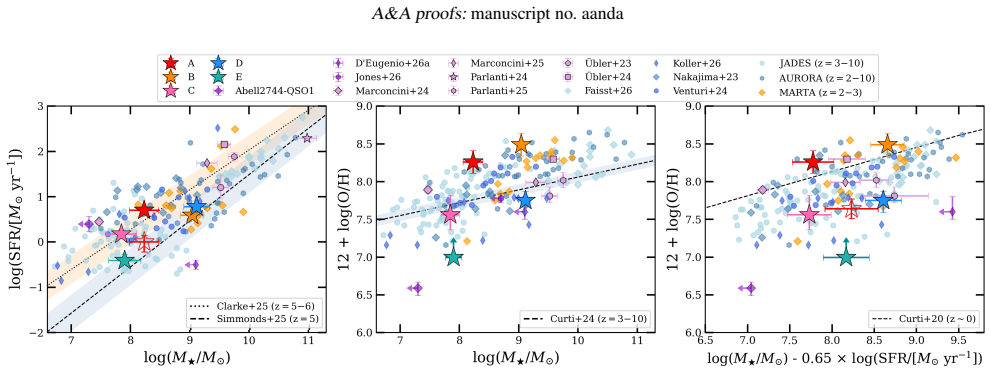
Despite the growing number of compact active galactic nuclei (AGN) at $z>4$ discovered by JWST, their formation and evolution remain poorly understood. This paper investigates the large-scale environment of GN-77652, a compact AGN at $z=5.229$ observed as part of the JWST NIRSpec IFU Large Program BlackTHUNDER and complemented by deep multi-band NIRCam imaging. GN-77652 lies in close proximity to a 12 kpc-long filament composed of multiple sources at $z\simeq5.23$, spanning a remarkable range in stellar masses ($M_{\star}=0.7-13 \times 10^8$ ${M_\odot}$), gas phase metallicities (12$+$log(O/H) $=$ 7.6-8.5) and star formation rates (SFR $=0.4-6$ ${M_\odot}$ yr$^{-1}$). The [OIII]$\lambda$5007 kinematics reveals a smooth large-scale velocity gradient centred on the central, massive ($M_{\star}\simeq1.1\times10^9$ ${M_\odot}$) and metal rich ($Z\sim0.6$ $Z_{\odot}$) system of the group. In this source, only 2.4 kpc (projected) from GN-77652, [OIII]$\lambda$4363 line diagnostics provide possible evidence for a second AGN. GN-77652 exhibits a shallow ($-30$ to $+20$ km s$^{-1}$) velocity gradient that is consistent with disk rotation according to dynamical modelling. The Lyman-Werner radiation field produced by the filament is too weak for the black hole (BH) in GN-77652 to have formed recently via direct collapse. However, the required conditions may have existed at earlier epochs, or alternative scenarios (e.g. a recoiling BH ejected from the filament) could also be plausible. The whole system is expected to coalesce in $150-440$ Myr, also motivating an exploration of its future evolution through toy-model extrapolations and numerical simulations. Our analysis suggests that the compact AGN appearance of GN-77652 represents a transient evolutionary phase, consistent with the apparent decline with redshift in number density of compact AGN identified with JWST.
Figures



Reference graph
Works this paper leans on
-
[1]
Little Red and Blue Dots: AGN-excited narrow lines, Lyman- α emission, and resemblance to standard quasars. arXiv e-prints , keywords =. doi:10.48550/arXiv.2606.21614 , archivePrefix =. 2606.21614 , primaryClass =
-
[2]
The merger rate of galaxies in the Illustris simulation: a comparison with observations and semi-empirical models. , keywords =. doi:10.1093/mnras/stv264 , archivePrefix =. 1502.01339 , primaryClass =
-
[3]
JADES Data Release 3: NIRSpec/Microshutter Assembly Spectroscopy for 4000 Galaxies in the GOODS Fields. , keywords =. doi:10.3847/1538-4365/ada148 , archivePrefix =. 2404.06531 , primaryClass =
-
[4]
Irony at z=6.68: a bright AGN with forbidden Fe emission and multi-component Balmer absorption. arXiv e-prints , keywords =. doi:10.48550/arXiv.2510.00101 , archivePrefix =. 2510.00101 , primaryClass =
-
[5]
Are we surprised to find SMBHs with JWST at z > 9?
Are we surprised to find SMBHs with JWST at z 9?. , keywords =. doi:10.1093/mnras/stad2503 , archivePrefix =. 2305.12504 , primaryClass =
work page internal anchor Pith review Pith/arXiv arXiv doi:10.1093/mnras/stad2503
-
[6]
Nature Astronomy , year = 2026, month = mar, volume =
Measurement of the gas consumption history of a massive quiescent galaxy. Nature Astronomy , year = 2026, month = mar, volume =. doi:10.1038/s41550-025-02751-z , adsurl =
-
[7]
Data reduction, analysis, and emission-line fluxes of the complete spectroscopic sample
JADES Data Release 4 ─ Paper II. Data reduction, analysis, and emission-line fluxes of the complete spectroscopic sample. , keywords =. doi:10.1093/mnras/stag939 , archivePrefix =. 2510.01034 , primaryClass =
-
[8]
Evidence for mature bulges and an inside-out quenching phase 3 billion years after the Big Bang. Science , keywords =. doi:10.1126/science.1261094 , archivePrefix =. 1504.04021 , primaryClass =
-
[9]
JWST/NIRSpec spectroscopy of z = 7-9 star-forming galaxies with CEERS: new insight into bright Ly emitters in ionized bubbles. , keywords =. doi:10.1093/mnras/stad2763 , archivePrefix =. 2301.07072 , primaryClass =
-
[10]
Broad-line AGNs at 3.5 < z < 6: The Black Hole Mass Function and a Connection with Little Red Dots. , keywords =. doi:10.3847/1538-4357/add15b , archivePrefix =. 2409.06772 , primaryClass =
-
[11]
Constraints on the Assembly and Dynamics of Galaxies. II. Properties of Kiloparsec-scale Clumps in Rest-frame Optical Emission of z -0.5ex 2 Star-forming Galaxies. , keywords =. doi:10.1088/0004-637X/739/1/45 , archivePrefix =. 1104.0248 , primaryClass =
-
[12]
PHIBSS: Unified Scaling Relations of Gas Depletion Time and Molecular Gas Fractions. , keywords =. doi:10.3847/1538-4357/aaa4b4 , archivePrefix =. 1702.01140 , primaryClass =
-
[13]
The Evolution of the Star-Forming Interstellar Medium Across Cosmic Time. , keywords =. doi:10.1146/annurev-astro-082812-141034 , archivePrefix =. 2003.06245 , primaryClass =
Pith/arXiv arXiv doi:10.1146/annurev-astro-082812-141034 2003
-
[14]
A Highly Consistent Framework for the Evolution of the Star-Forming ``Main Sequence'' from z -0.5ex 0-6. , keywords =. doi:10.1088/0067-0049/214/2/15 , archivePrefix =. 1405.2041 , primaryClass =
-
[15]
Star-Forming Galaxies at Cosmic Noon
Star-Forming Galaxies at Cosmic Noon. , keywords =. doi:10.1146/annurev-astro-032620-021910 , archivePrefix =. 2010.10171 , primaryClass =
work page internal anchor Pith review Pith/arXiv arXiv doi:10.1146/annurev-astro-032620-021910 2010
-
[16]
MARTA: Temperature-temperature relationships and strong-line metallicity calibrations from multiple auroral-line detections at cosmic noon. , keywords =. doi:10.1051/0004-6361/202554843 , archivePrefix =. 2504.03839 , primaryClass =
-
[17]
The MOSDEF Survey: The Evolution of the Mass-Metallicity Relation from z = 0 to z 3.3. , keywords =. doi:10.3847/1538-4357/abf4c1 , archivePrefix =. 2009.07292 , primaryClass =
-
[18]
Explaining the high nitrogen abundances observed in high-z galaxies via population III stars of a few thousand solar masses. , keywords =. doi:10.1051/0004-6361/202348035 , archivePrefix =. 2402.03428 , primaryClass =
work page internal anchor Pith review Pith/arXiv arXiv doi:10.1051/0004-6361/202348035
-
[19]
The Dual Nature of GHZ9: Coexisting Active Galactic Nuclei and Star Formation Activity in a Remote X-Ray Source at z = 10.145. , keywords =. doi:10.3847/1538-4357/ade706 , archivePrefix =. 2410.18763 , primaryClass =
-
[20]
Little Red Dots as Direct-collapse Black Hole Nurseries
Little Red Dots as direct-collapse black hole nurseries. , keywords =. doi:10.1093/mnras/staf1362 , archivePrefix =. 2508.14897 , primaryClass =
work page internal anchor Pith review Pith/arXiv arXiv doi:10.1093/mnras/staf1362
-
[21]
Gas inflow and metallicity drops in star-forming galaxies
Gas inflow and metallicity drops in star-forming galaxies. , keywords =. doi:10.1093/mnras/stw064 , archivePrefix =. 1509.02051 , primaryClass =
work page internal anchor Pith review Pith/arXiv arXiv doi:10.1093/mnras/stw064
-
[22]
Counting Little Red Dots at z < 4 with Ground-based Surveys and Spectroscopic Follow-up. , keywords =. doi:10.3847/1538-4357/ae4596 , archivePrefix =. 2504.08032 , primaryClass =
-
[23]
De re metallica: the cosmic chemical evolution of galaxies. , keywords =. doi:10.1007/s00159-018-0112-2 , archivePrefix =. 1811.09642 , primaryClass =
-
[24]
The JWST EXCELS survey: direct estimates of C, N, and O abundances in two relatively metal-rich galaxies at z 5. arXiv e-prints , keywords =. doi:10.48550/arXiv.2412.10557 , archivePrefix =. 2412.10557 , primaryClass =
-
[25]
The SAURON project - IV. The mass-to-light ratio, the virial mass estimator and the Fundamental Plane of elliptical and lenticular galaxies. , keywords =. doi:10.1111/j.1365-2966.2005.09981.x , archivePrefix =. astro-ph/0505042 , primaryClass =
-
[26]
MNRAS , eprint =
Full spectrum fitting with photometry in PPXF: stellar population versus dynamical masses, non-parametric star formation history and metallicity for 3200 LEGA-C galaxies at redshift z 0.8. MNRAS , eprint =
-
[27]
Chemical abundances and ionizing clusters of Hii regions in the LINER galaxy NGC 4258. , keywords =. doi:10.1046/j.1365-8711.2000.03737.x , archivePrefix =. astro-ph/0006193 , primaryClass =
-
[28]
The Sunburst Arc with JWST. III. An Abundance of Direct Chemical Abundances. , keywords =. doi:10.3847/1538-4357/ada76c , archivePrefix =. 2405.06631 , primaryClass =
-
[29]
Smooth(er) Stellar Mass Maps in CANDELS: Constraints on the Longevity of Clumps in High-redshift Star-forming Galaxies. , keywords =. doi:10.1088/0004-637X/753/2/114 , archivePrefix =. 1203.2611 , primaryClass =
-
[30]
A CANDELS-3D-HST synergy: Resolved Star Formation Patterns at 0.7 < z < 1.5. , keywords =. doi:10.1088/0004-637X/779/2/135 , archivePrefix =. 1310.5702 , primaryClass =
-
[31]
KMOS3D: Dynamical Constraints on the Mass Budget in Early Star-forming Disks. , keywords =. doi:10.3847/0004-637X/831/2/149 , archivePrefix =. 1603.03432 , primaryClass =
-
[32]
New Ionization Models and the Shocking Nitrogen Excess at z > 5. arXiv e-prints , keywords =. doi:10.48550/arXiv.2412.06763 , archivePrefix =. 2412.06763 , primaryClass =
-
[33]
A Tight Relation between N/O Ratio and Galaxy Stellar Mass Can Explain the Evolution of Strong Emission Line Ratios with Redshift. , keywords =. doi:10.3847/0004-637X/828/1/18 , archivePrefix =. 1605.04314 , primaryClass =
work page internal anchor Pith review Pith/arXiv arXiv doi:10.3847/0004-637x/828/1/18
-
[34]
Reconciling the Stellar and Nebular Spectra of High-redshift Galaxies. , keywords =. doi:10.3847/0004-637X/826/2/159 , archivePrefix =. 1605.07186 , primaryClass =
-
[35]
Type 1 AGN at low z- I. Emission properties. , keywords =. doi:10.1111/j.1365-2966.2012.20901.x , archivePrefix =. 1203.3158 , primaryClass =
-
[36]
Nebular Emission Line Ratios in z ≃ 2-3 Star-forming Galaxies with KBSS-MOSFIRE: Exploring the Impact of Ionization, Excitation, and Nitrogen-to-Oxygen Ratio. , keywords =. doi:10.3847/1538-4357/836/2/164 , archivePrefix =. 1608.02587 , primaryClass =
-
[37]
Measuring the Physical Conditions in High-redshift Star-forming Galaxies: Insights from KBSS-MOSFIRE. , keywords =. doi:10.3847/1538-4357/aae1a5 , archivePrefix =. 1711.08820 , primaryClass =
-
[38]
Nitrogen and oxygen abundances in the Local Universe. , keywords =. doi:10.1093/mnras/stw532 , archivePrefix =. 1603.00460 , primaryClass =
-
[39]
Rapid Growth of High-Redshift Black Holes. , keywords =. doi:10.1086/466521 , archivePrefix =. astro-ph/0506040 , primaryClass =
-
[40]
Nature Reviews Physics , keywords =
The origins of massive black holes. Nature Reviews Physics , keywords =. doi:10.1038/s42254-021-00364-9 , archivePrefix =. 2110.10175 , primaryClass =
-
[41]
What if young z>9 JWST galaxies hosted massive black holes?
What if young z > 9 JWST galaxies hosted massive black holes?. , keywords =. doi:10.1093/mnras/stad499 , archivePrefix =. 2212.04710 , primaryClass =
work page internal anchor Pith review Pith/arXiv arXiv doi:10.1093/mnras/stad499
-
[42]
JWST Identification of Extremely Low C/N Galaxies with [N/O] 0.5 at z 6-10 Evidencing the Early CNO-cycle Enrichment and a Connection with Globular Cluster Formation. , keywords =. doi:10.3847/1538-4357/ad09be , archivePrefix =. 2307.00710 , primaryClass =
work page internal anchor Pith review Pith/arXiv arXiv doi:10.3847/1538-4357/ad09be
-
[43]
Metal-poor star formation at z > 6 with JWST: new insight into hard radiation fields and nitrogen enrichment on 20 pc scales. , keywords =. doi:10.1093/mnras/stae682 , archivePrefix =. 2401.08764 , primaryClass =
work page internal anchor Pith review Pith/arXiv arXiv doi:10.1093/mnras/stae682
-
[44]
A weak Ly halo for an extremely bright little red dot: Indications of enshrouded supermassive black hole growth. , keywords =. doi:10.1051/0004-6361/202555596 , archivePrefix =. 2505.09542 , primaryClass =
-
[45]
SUPER. II. Spatially resolved ionised gas kinematics and scaling relations in z 2 AGN host galaxies. , keywords =. doi:10.1051/0004-6361/202038551 , archivePrefix =. 2008.01728 , primaryClass =
work page internal anchor Pith review Pith/arXiv arXiv doi:10.1051/0004-6361/202038551 2008
-
[46]
EIGER. I. A Large Sample of [O III]-emitting Galaxies at 5.3 < z < 6.9 and Direct Evidence for Local Reionization by Galaxies. , keywords =. doi:10.3847/1538-4357/acc588 , archivePrefix =. 2211.08254 , primaryClass =
work page internal anchor Pith review Pith/arXiv arXiv doi:10.3847/1538-4357/acc588
-
[47]
The Origin of Elements from Carbon to Uranium. , keywords =. doi:10.3847/1538-4357/abae65 , archivePrefix =. 2008.04660 , primaryClass =
-
[48]
Chemo-Dynamical Evolution of Galaxies
Chemo-Dynamical Evolution of Galaxies. arXiv e-prints , keywords =. doi:10.48550/arXiv.2302.07255 , archivePrefix =. 2302.07255 , primaryClass =
work page internal anchor Pith review Pith/arXiv arXiv doi:10.48550/arxiv.2302.07255
-
[49]
UNCOVER: A NIRSpec Identification of a Broad-line AGN at z = 8.50. , keywords =. doi:10.3847/2041-8213/ad037a , archivePrefix =. 2308.11610 , primaryClass =
-
[50]
Nitrogen enhancements 440 Myr after the big bang: supersolar N/O, a tidal disruption event, or a dense stellar cluster in GN-z11?. , keywords =. doi:10.1093/mnras/stad1579 , archivePrefix =. 2302.10142 , primaryClass =
-
[51]
The KLEVER survey: nitrogen abundances at z 2 and probing the existence of a fundamental nitrogen relation. , keywords =. doi:10.1093/mnras/stac584 , archivePrefix =. 2110.00033 , primaryClass =
work page internal anchor Pith review Pith/arXiv arXiv doi:10.1093/mnras/stac584
-
[52]
NGDEEP Epoch 1: Spatially Resolved H Observations of Disk and Bulge Growth in Star-forming Galaxies at z 0.6 2.2 from JWST NIRISS Slitless Spectroscopy. , keywords =. doi:10.3847/2041-8213/ad28bd , archivePrefix =. 2310.13745 , primaryClass =
work page internal anchor Pith review Pith/arXiv arXiv doi:10.3847/2041-8213/ad28bd 2041
-
[53]
The ALMA-CRISTAL Survey: Spatially Resolved Star Formation Activity and Dust Content in 4 < z < 6 Star-forming Galaxies. , keywords =. doi:10.3847/1538-4357/ad7fee , archivePrefix =. 2409.10961 , primaryClass =
work page internal anchor Pith review Pith/arXiv arXiv doi:10.3847/1538-4357/ad7fee
-
[54]
arXiv e-prints , keywords =
CECILIA: Gas-Phase Physical Conditions and Multi-Element Chemistry at Cosmic Noon. arXiv e-prints , keywords =
-
[55]
The KLEVER Survey: spatially resolved metallicity maps and gradients in a sample of 1.2 < z < 2.5 lensed galaxies. , keywords =. doi:10.1093/mnras/stz3379 , archivePrefix =. 1910.13451 , primaryClass =
work page internal anchor Pith review Pith/arXiv arXiv doi:10.1093/mnras/stz3379 1910
-
[56]
JWST PRIMER: A lack of outshining in four normal z =4-6 galaxies from the ALMA-CRISTAL Survey
JWST PRIMER: a lack of outshining in four normal z = 4 ‑ 6 galaxies from the ALMA-CRISTAL Survey. , keywords =. doi:10.1093/mnras/staf627 , archivePrefix =. 2409.10963 , primaryClass =
work page internal anchor Pith review Pith/arXiv arXiv doi:10.1093/mnras/staf627
-
[57]
Spatially unresolved SED fitting can underestimate galaxy masses: a solution to the missing mass problem. , keywords =. doi:10.1093/mnras/sty186 , archivePrefix =. 1801.07368 , primaryClass =
-
[58]
Spatially Resolved Properties of High Redshift Galaxies in the SMACS0723 JWST ERO Field
Spatially Resolved Properties of Galaxies at 5 < z < 9 in the SMACS 0723 JWST ERO Field. , keywords =. doi:10.3847/1538-4357/acc5ea , archivePrefix =. 2212.08670 , primaryClass =
work page internal anchor Pith review Pith/arXiv arXiv doi:10.3847/1538-4357/acc5ea
-
[59]
Outshining in the spatially resolved analysis of a strongly lensed galaxy at z = 6.072 with JWST NIRCam. , keywords =. doi:10.1051/0004-6361/202349135 , archivePrefix =. 2402.17875 , primaryClass =
work page internal anchor Pith review Pith/arXiv arXiv doi:10.1051/0004-6361/202349135
-
[60]
Galaxy Masses as Constraints of Formation Models , year = 2015, editor =
MaNGA: Mapping Nearby Galaxies at Apache Point Observatory. Galaxy Masses as Constraints of Formation Models , year = 2015, editor =. doi:10.1017/S1743921315003476 , adsurl =
-
[61]
JADES NIRSpec Spectroscopy of GN-z11: Lyman- emission and possible enhanced nitrogen abundance in a z = 10.60 luminous galaxy. , keywords =. doi:10.1051/0004-6361/202346159 , archivePrefix =. 2302.07256 , primaryClass =
-
[62]
What can we learn from the Nitrogen abundance of High-z galaxies?
What Can We Learn from the Nitrogen Abundance of High-z Galaxies?. , keywords =. doi:10.3847/1538-4357/adb5f3 , archivePrefix =. 2412.06517 , primaryClass =
work page internal anchor Pith review Pith/arXiv arXiv doi:10.3847/1538-4357/adb5f3
-
[63]
A Preview of JWST Metallicity Studies at Cosmic Noon: The First Detection of Auroral [O II] Emission at High Redshift. , keywords =. doi:10.3847/1538-4357/aca9cc , archivePrefix =. 2207.12430 , primaryClass =
work page internal anchor Pith review Pith/arXiv arXiv doi:10.3847/1538-4357/aca9cc
-
[64]
Carnall, A C and McLure, R J and Dunlop, J S and Cullen, F and McLeod, D J and Wild, V and Johnson, B D and Appleby, S and Davé, R and Amorin, R and Bolzonella, M and Castellano, M and Cimatti, A and Cucciati, O and Gargiulo, A and Garilli, B and Marchi, F and Pentericci, L and Pozzetti, L and Schreiber, C and Talia, M and Zamorani, G , year=. The VANDELS...
-
[65]
SINS/zC-SINF Survey of z 2 Galaxy Kinematics: Rest-frame Morphology, Structure, and Colors from Near-infrared Hubble Space Telescope Imaging. , keywords =. doi:10.1088/0004-637X/802/2/101 , archivePrefix =. 1411.7034 , primaryClass =
-
[66]
CECILIA: Direct O, N, S, and Ar Abundances in Q2343-D40, a Galaxy at $z\sim$3
CECILIA: Direct O, N, S, and Ar Abundances in Q2343-D40, a Galaxy at z 3. , keywords =. doi:10.3847/2041-8213/ad2f37 , archivePrefix =. 2312.08427 , primaryClass =
work page internal anchor Pith review Pith/arXiv arXiv doi:10.3847/2041-8213/ad2f37 2041
-
[67]
The MOSDEF Survey: [S III] as a New Probe of Evolving Interstellar Medium Conditions. , keywords =. doi:10.3847/2041-8213/ab5d40 , adsurl =
-
[68]
The Chemical Composition of the Sun. , keywords =. doi:10.1146/annurev.astro.46.060407.145222 , archivePrefix =. 0909.0948 , primaryClass =
-
[69]
Spectrophotometric observations
The metal abundance of circumnuclear star-forming regions in early-type spirals. Spectrophotometric observations. , keywords =. doi:10.1111/j.1365-2966.2007.12351.x , archivePrefix =. 0709.1236 , primaryClass =
-
[70]
On the use of Sulphur as a tracer for abundances in galaxies
On the use of sulphur as a tracer for abundances in galaxies. , keywords =. doi:10.1093/mnras/stac387 , archivePrefix =. 2202.10302 , primaryClass =
work page internal anchor Pith review Pith/arXiv arXiv doi:10.1093/mnras/stac387
-
[71]
The dawn of discs: unveiling the turbulent ionized gas kinematics of the galaxy population at z 4─6 with JWST/NIRCam grism spectroscopy. , keywords =. doi:10.1093/mnras/staf1540 , archivePrefix =. 2503.21863 , primaryClass =
-
[72]
CLEAR: Paschen- Star Formation Rates and Dust Attenuation of Low-redshift Galaxies. , keywords =. doi:10.3847/1538-4357/ac5a4c , archivePrefix =. 2009.00617 , primaryClass =
-
[73]
Ionized Gas Kinematics with FRESCO: An Extended, Massive, Rapidly Rotating Galaxy at z = 5.4. , keywords =. doi:10.3847/2041-8213/ad7b17 , archivePrefix =. 2310.06887 , primaryClass =
-
[74]
FRESCO: The Paschen- Star-forming Sequence at Cosmic Noon. , keywords =. doi:10.3847/1538-4357/ad6158 , archivePrefix =. 2404.10816 , primaryClass =
-
[75]
doi:10.5281/zenodo.8370018 , version =
grizli. doi:10.5281/zenodo.8370018 , version =
-
[76]
The JWST FRESCO survey: legacy NIRCam/grism spectroscopy and imaging in the two GOODS fields. , keywords =. doi:10.1093/mnras/stad2411 , archivePrefix =. 2304.02026 , primaryClass =
-
[77]
Primordial Star Formation under Far-Ultraviolet Radiation. , keywords =. doi:10.1086/318296 , archivePrefix =. astro-ph/0011446 , primaryClass =
-
[78]
A GLIMPSE of Intermediate Mass Black Holes in the Epoch of Reionization: Witnessing the Descendants of Direct Collapse?. , keywords =. doi:10.3847/1538-4357/ae6248 , archivePrefix =. 2509.20452 , primaryClass =
-
[79]
Nuclear activity versus star formation: emission-line diagnostics at ultraviolet and optical wavelengths. , keywords =. doi:10.1093/mnras/stv2794 , archivePrefix =. 1511.08217 , primaryClass =
-
[80]
The Near-Infrared Spectrograph (NIRSpec) on the James Webb Space Telescope. II. Multi-object spectroscopy (MOS). , keywords =. doi:10.1051/0004-6361/202142673 , archivePrefix =. 2202.03306 , primaryClass =
discussion (0)
Sign in with ORCID, Apple, or X to comment. Anyone can read and Pith papers without signing in.