The Impact of Security and Privacy Controls on Users' Emotional Engagement with Generative AI Chatbots
Reviewed by Pith T0 review T1 audit T2 compute T3 formal T4 kernel 2026-07-08 08:00 UTCglm-5.2pith:MLWZCCQNrecord.jsonopen to challenge →
The pith
Simple deletion controls beat sophisticated privacy tech for AI emotional support
A machine-rendered reading of the paper's core claim, the machinery that carries it, and where it could break.
Core claim
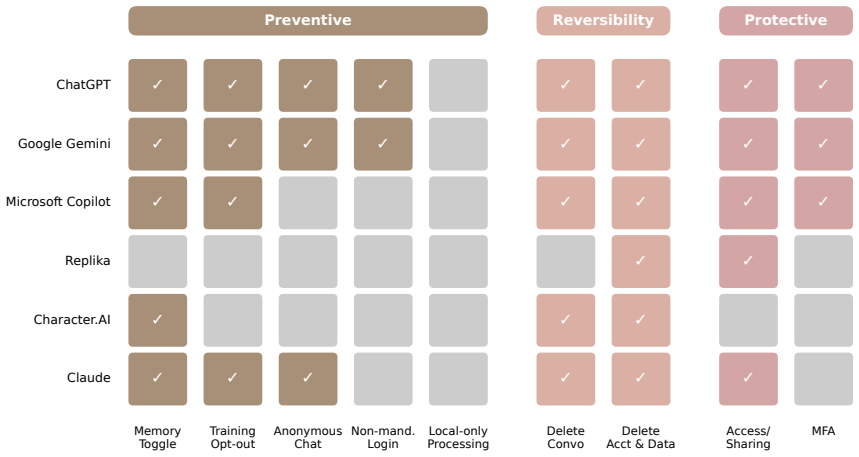
The paper's central discovery is that user-facing privacy controls in AI chatbots succeed or fail based on three distinct, identifiable gaps between what a control promises and what users can comprehend, trust, or tolerate under emotional distress. Deletion controls dominate because they are comprehensible, feel reversible, and impose no friction — even though users doubt they truly work. Sophisticated controls fail not because they are technically inferior but because users cannot understand them, cannot verify them, or cannot bear the friction they impose when seeking emotional relief. The paper classifies the nine controls into three categories — preventive (limiting data creation),revers
What carries the argument
Three structural gaps — comprehension, assurance, and affective urgency — form the explanatory framework. Preventive controls (local-only processing, model training opt-out, memory toggle, anonymous chat, non-mandatory login) suffer from the comprehension gap: users lack accurate mental models of how these mechanisms affect their data. Reversibility controls (delete conversation, delete account & data) suffer from the assurance gap: users understand the promise but cannot verify execution. Protective controls (MFA, access/sharing controls) suffer from the affective urgency gap: users recognize protection but experience authentication barriers as prohibitively burdensome during emotionaldist
If this is right
- Designers of AI chatbots used for emotional support should prioritize simple, outcome-framed deletion controls over technically sophisticated privacy mechanisms, since users understand and trust 'delete' far more than 'local-only processing' or 'training opt-out.'
- The finding that MFA is perceived as protective but reduces willingness to engage suggests that authentication design for emotional-support contexts needs context-sensitive defaults — frictionless access during acute distress with optional hardening for users who fear physically proximate adversaries.
- The assurance gap — where users understand deletion but doubt it works — implies that verifiable transparency mechanisms (showing what data exists before and after deletion) may be more important than adding new controls.
- Policy frameworks that place responsibility on users to calibrate their own privacy settings (as in the federal AI policy approach cited) may fail systematically, since users demonstrably cannot understand or verify the controls they are asked tomanage.
Where Pith is reading between the lines
- If the comprehension gap generalizes beyond the nine tested controls, then any new privacy mechanism introduced into AI chatbots will face adoption resistance proportional to how difficult it is to explain in plain language — regardless of its technical strength.
- The finding that emotional context had no effect on control preferences suggests that privacy control design for AI chatbots can be unified rather than context-specific, simplifying the design space considerably.
- The coexistence of desire and doubt (participants who wanted to disclose more but doubted controls would protect them) implies a population of users currently under-disclosing to AI chatbots — representing lost therapeutic value that better assurance mechanisms couldunlock.
- The paper's vignette methodology may systematically overstate the affective urgency gap, since calm survey respondents may not accurately simulate the urgency that reduces MFA tolerance during acute emotionaldistress.
Load-bearing premise
The study's central design premise is that vignette-based hypothetical responses — where calm participants imagine how they would behave when emotionally distressed — reliably predict real-world behavior in actual emotional crises. If participants cannot accurately simulate the urgency and reduced tolerance for friction that accompanies acute distress, then the magnitude of the affective urgency finding may be inflated.
What would settle it
If a real-world deployment study showed that users in acute emotional distress actually tolerate MFA or other friction-inducing controls at rates similar to their vignette responses, the affective urgency gap would need to be reconsidered. Conversely, if technically sophisticated controls like local-only processing were reframed in plain outcome language and subsequently performed comparably to deletion controls, the comprehension gap — not the controls themselves — would be confirmed as the primarybarrier.
Figures

read the original abstract
Chatbots powered by generative AI (e.g., OpenAI's ChatGPT and Google's Gemini) are increasingly being appropriated for emotional support and companionship. These tools offer a suite of security and privacy (S&P) controls, including model training opt-outs and memory toggles, yet how the presence of these controls influences users' attitudes toward emotionally sensitive disclosure remains understudied. We conducted a mixed-methods vignette study with 354 U.S. participants to examine how S&P controls influence users' willingness to engage with generative AI chatbots for emotional support, their perceptions of how protected they are when using these systems, and their perceptions of how effective the chatbots are for providing support. Controls enabling deletion of disclosures had the largest positive impact: these offerings outperformed technically sophisticated controls such as local-only processing and model training opt-outs, where participants expressed difficulty understanding the underlying mechanisms. Yet trust remains fragile, and participants often doubted S&P controls would function as promised. We conclude with actionable recommendations informed by our results to bridge users' comprehension gaps, build credible assurances, and properly calibrate barriers for users in distress.
Editorial analysis
A structured set of objections, weighed in public.
Referee Report
Summary. This paper investigates how nine user-facing security and privacy (S&P) controls—derived from a systematic audit of 87 generative AI chatbot applications—influence users' willingness to engage, perceived protection, and perceived efficacy when using GenAI chatbots for emotional support. Using a mixed-methods vignette study (N=354 U.S. participants), the authors fit cumulative link mixed models (CLMMs) with participant random intercepts and supplement quantitative findings with inductive thematic analysis of open-ended responses. The central finding is that deletion-based controls dominate user preferences, significantly outperforming technically sophisticated controls like local-only processing and model training opt-outs, which suffer from comprehension gaps. The authors synthesize their findings into a three-gap framework (comprehension, assurance, affective urgency) and offer design and policy recommendations.
Significance. The paper addresses a timely and important gap at the intersection of usable privacy, conversational AI, and mental health. The saturation-based audit methodology is well-executed and follows HCI norms, and the nine-control taxonomy is derived independently rather than from prior theoretical commitments, avoiding circularity. The CLMMs are appropriate for the ordinal repeated-measures design, and the authors apply both BH FDR and Bonferroni corrections. The mixed-methods integration is a strength: qualitative codes provide mechanistic explanations for quantitative patterns (e.g., MFA's dissociation between protection and willingness). The three-gap framework is actionable and falsifiable. The vignette-behavior gap is acknowledged in §3.5 and is standard for HCI vignette methodology. Open science practices are noted, with survey instruments and analysis code provided in a supplementary repository.
major comments (2)
- [§3.2, Experimental Design] The between-subjects assignment of Context of Disclosure is based on participants' highest-rated use case rather than random assignment. This self-selection mechanism means the null finding for context (Tables 3–5, Table 7: Depression and Interpersonal Tension coefficients near zero, all p > .05) could be confounded. Participants who select 'Anxiety & Stress' may differ systematically from those who select 'Interpersonal Tension' in ways that mask context effects. The paper claims context 'had no significant effect on user perceptions' (§4), but this is a secondary claim that the design cannot strongly support. The authors should explicitly acknowledge this confound when interpreting the null context effect, or soften the claim to note that context invariance is observed only among self-selected context assignments. This does not undermine the central within-subjects finding about deleti
- [§5.4, Policy Implications] The policy discussion states: 'Our findings suggest the empirical ground favors the latter orientation' (referring to California's platform-level vetting approach over the federal user-responsibility model). This claim overreaches the evidence. The study measures user perceptions of S&P controls in a hypothetical vignette context; it does not evaluate the effectiveness of regulatory frameworks or platform-level vetting. The finding that users lack comprehension of certain controls supports the general observation that user-responsibility models face challenges, but it does not constitute empirical evidence favoring one regulatory approach over another. The authors should reframe this as suggesting that their findings raise concerns about user-responsibility models, rather than claiming the empirical ground favors a specific regulatory orientation.
minor comments (6)
- [§3.2] The paper states each participant evaluated 4 of 9 S&P controls. Given the within-subjects design, it would be helpful to report how many participants were exposed to each control and whether any control was systematically under- or over-represented due to the randomization scheme.
- [§3.5] The vignette-behavior gap limitation is acknowledged but could be strengthened. The Baruh et al. meta-analysis citation is somewhat general; the authors could note that their vignettes are contextually specific (as Baruh et al. recommend), which is a design strength that partially mitigates the gap.
- [Table 7 note] The rationale for retaining only race/ethnicity as a demographic covariate is briefly mentioned ('covariate selection rationale'). A more explicit justification for why other demographics (e.g., age, gender, mental health care history) were removed would improve transparency.
- [Figure 2] The categorization of controls into preventive, reversibility, and protective is introduced in the Discussion (§5.1–§5.3) but not in the Methods or Results. A brief note in the Methods explaining that this taxonomy emerged from the qualitative analysis would help readers understand its provenance.
- [Ethical Considerations] The compensation ($2.50 for ~17 minutes) is noted as consistent with Prolific norms. This is acceptable, but the paper could note the hourly rate (~$8.82/hr) for reader expectations.
- [§4.1] The phrase 'betrayal framing' is used in the section heading but not clearly defined in the body text. A brief operational definition would improve clarity.
Simulated Author's Rebuttal
We thank the referee for a careful and constructive review. Both major comments identify legitimate issues that we will address in revision. Below we respond to each point.
read point-by-point responses
-
Referee: The between-subjects assignment of Context of Disclosure is based on participants' highest-rated use case rather than random assignment. This self-selection mechanism means the null finding for context could be confounded. The authors should explicitly acknowledge this confound or soften the claim.
Authors: The referee is correct. Context of Disclosure was assigned based on each participant's highest-rated use case in a pre-task, not by random assignment. This means participants self-selected into contexts, and systematic differences between groups (e.g., participants who rate 'Anxiety & Stress' highest may differ in clinically relevant ways from those who rate 'Interpersonal Tension' highest) could mask true context effects. Our design cannot rule out this confound. We chose self-selected context assignment to maximize ecological validity—participants evaluated vignettes in the context most relevant to them—but this design decision trades internal validity for contextual relevance, and we should have been more transparent about the tradeoff. In revision, we will (1) add an explicit acknowledgment of the self-selection confound in §3.5 (Limitations), noting that the null context effect is observed only among self-selected context assignments and cannot be interpreted as evidence of true context invariance, and (2) soften the claim in §4 from 'context had no significant effect on user perceptions' to language specifying that 'no significant differences were observed across self-selected disclosure contexts.' We will also note that a fully randomized design would be needed to draw stronger conclusions about context effects. We agree this does not undermine the central within-subjects finding about deletion controls, which is independent of the context assignment mechanism. revision: yes
-
Referee: The policy discussion states 'Our findings suggest the empirical ground favors the latter orientation' (California's platform-level vetting over the federal user-responsibility model). This overreaches the evidence, as the study measures user perceptions in a hypothetical vignette context, not the effectiveness of regulatory frameworks.
Authors: The referee is right that our study does not evaluate regulatory frameworks or platform-level vetting. Our evidence is about user comprehension of and trust in S&P controls, not about the comparative effectiveness of regulatory approaches. The sentence as written conflates 'our findings raise concerns about user-responsibility models' with 'the empirical ground favors a specific regulatory orientation,' which is a stronger claim than our data support. In revision, we will reframe this passage to state that our findings raise concerns about user-responsibility models—specifically, that such models presuppose a deliberative capacity to understand and calibrate S&P controls that our participants often lacked—without claiming that the empirical ground favors any particular regulatory framework. We will also clarify that we offer our three-gap framework as assessment criteria that regulators may find useful, not as empirical validation of any specific regulatory approach. revision: yes
Circularity Check
No significant circularity; one minor self-citation for 'intangible vulnerability' concept that is not load-bearing for the central findings.
full rationale
The paper's central empirical findings derive from an independent audit of 87 apps (producing the nine-control taxonomy), a pre-registered vignette survey (N=354), and inductively coded qualitative responses. The quantitative results (CLMM coefficients in Tables 3-5) are fitted from participant survey data, not from prior theoretical commitments. The qualitative codebook was developed inductively from 10% of responses. The three structural gaps (comprehension, assurance, affective urgency) are interpretive syntheses of the qualitative data, not definitions that presuppose the quantitative outcomes. The one self-citation is to Kwesi et al. [43] for the 'intangible vulnerability' concept in §1, which provides background framing but is not load-bearing for any of the paper's statistical results or design recommendations. The vignette-behavior gap acknowledged in §3.5 is a standard methodological limitation, not a circularity. No step in the derivation chain reduces to its inputs by construction.
Axiom & Free-Parameter Ledger
axioms (5)
- domain assumption Vignette-based hypothetical responses reliably predict real-world behavior in emotionally distressed states
- domain assumption Saturation-based sampling of 87 apps from a 344-app corpus produces a representative taxonomy of S&P controls
- domain assumption Participants' self-reported use of GenAI chatbots for emotional support at least monthly defines a population whose perceptions are relevant to the research questions
- domain assumption The three emotional contexts (anxiety, depression, interpersonal tension) are representative of the primary use cases for GenAI emotional support
- standard math Cumulative link mixed models with the specified fixed and random effects structure are the appropriate statistical framework for ordinal vignette ratings
Reference graph
Works this paper leans on
-
[1]
ABD-ALRAZAQ, A. A., ALAJLANI, M., ALALWAN, A. A., BE- WICK, B. M., GARDNER, P.,ANDHOUSEH, M. An overview of the features of chatbots in mental health: A scoping review.Interna- tional journal of medical informatics 132(2019), 103978
work page 2019
-
[2]
Pri- vacy and human behavior in the age of information.Science 347, 6221 (2015), 509–514
ACQUISTI, A., BRANDIMARTE, L.,ANDLOEWENSTEIN, G. Pri- vacy and human behavior in the age of information.Science 347, 6221 (2015), 509–514
work page 2015
-
[3]
Privacy attitudes and privacy behavior: Losses, gains, and hyperbolic discounting
ACQUISTI, A.,ANDGROSSKLAGS, J. Privacy attitudes and privacy behavior: Losses, gains, and hyperbolic discounting. InEconomics of information security. Springer, 2004, pp. 165–178
work page 2004
-
[4]
Privacy and rationality in indi- vidual decision making.IEEE security & privacy 3, 1 (2005), 26–33
ACQUISTI, A.,ANDGROSSKLAGS, J. Privacy and rationality in indi- vidual decision making.IEEE security & privacy 3, 1 (2005), 26–33
work page 2005
-
[5]
AMA urges congress to strengthen safeguards for AI chatbots
AMERICANMEDICALASSOCIATION. AMA urges congress to strengthen safeguards for AI chatbots. AMA Press Release, Apr. 2026
work page 2026
-
[6]
Protecting the wellbeing of our users
ANTHROPIC. Protecting the wellbeing of our users. Anthropic News, 2025
work page 2025
-
[7]
Estimating survey fatigue in time use study
BACKOR, K., GOLDE, S.,ANDNIE, N. Estimating survey fatigue in time use study. Ininternational association for time use research conference. Washington, DC(2007)
work page 2007
-
[8]
BARNETT-PAGE, E.,ANDTHOMAS, J. Methods for the synthesis of qualitative research: a critical review.BMC medical research method- ology 9, 1 (2009), 59
work page 2009
-
[9]
BARUH, L., SECINTI, E.,ANDCEMALCILAR, Z. Online privacy concerns and privacy management: A meta-analytical review.Journal of Communication 67, 1 (2017), 26–53
work page 2017
-
[10]
Ai chatbots upended their lives
BOND, S. Ai chatbots upended their lives. they found support from each other. NPR, Jan. 2026
work page 2026
-
[11]
BRANDIMARTE, L., ACQUISTI, A.,ANDLOEWENSTEIN, G. Mis- placed confidences: Privacy and the control paradox.Social psycho- logical and personality science 4, 3 (2013), 340–347
work page 2013
-
[12]
BURNHAM, K. P.,ANDANDERSON, D. R.Model selection and multimodel inference: a practical information-theoretic approach. Springer, 2002
work page 2002
-
[13]
BURTON, C., SZENTAGOTAITATAR, A., MCKINSTRY, B., MATH- ESON, C., MATU, S., MOLDOVAN, R., MACNAB, M., FARROW, E., DAVID, D., PAGLIARI, C.,ET AL. Pilot randomised controlled trial of help4mood, an embodied virtual agent-based system to sup- port treatment of depression.Journal of telemedicine and telecare 22, 6 (2016), 348–355
work page 2016
-
[14]
CALIFORNIASTATELEGISLATURE. SB 243: Artificial Intelli- gence: Chatbots.https://leginfo.legislature.ca.gov/faces/ billNavClient.xhtml?bill_id=202520260SB243, 2025. Enacted October 2025, effective January 1, 2026. Requires AI chatbots to pro- vide suicide prevention resources, prohibits chatbots from claiming to be human, and mandates disclosure that users...
work page 2025
-
[15]
Extracting training data from large language models
CARLINI, N., TRAMER, F., WALLACE, E., JAGIELSKI, M., HERBERT-VOSS, A., LEE, K., ROBERTS, A., BROWN, T., SONG, D., ERLINGSSON, U.,ET AL. Extracting training data from large language models. In30th USENIX security symposium (USENIX Se- curity 21)(2021), pp. 2633–2650
work page 2021
-
[16]
CHRISTENSEN, R. H. B.ordinal—Regression Models for Ordinal Data, 2025
work page 2025
-
[17]
AI mental health apps: Ratings and re- views
COMMONSENSEMEDIA. AI mental health apps: Ratings and re- views. Common Sense Media AI Ratings, 2026
work page 2026
-
[18]
M., BIYANOVA, T., ELHAI, J., SCHNURR, P
COOK, J. M., BIYANOVA, T., ELHAI, J., SCHNURR, P. P.,AND COYNE, J. C. What do psychotherapists really do in practice? an internet study of over 2,000 practitioners.Psychotherapy: Theory, Research, Practice, Training 47, 2 (2010), 260
work page 2010
-
[19]
DAS, S., WANG, B., TINGLE, Z.,ANDCAMP, L. J. Evaluating user perception of multi-factor authentication: A systematic review.arXiv preprint arXiv:1908.05901(2019)
work page internal anchor Pith review Pith/arXiv arXiv 1908
-
[20]
Benefits and Harms of Large Language Models in Digital Mental Health
DECHOUDHURY, M., PENDSE, S. R.,ANDKUMAR, N. Benefits and harms of large language models in digital mental health.arXiv preprint arXiv:2311.14693(2023)
work page internal anchor Pith review Pith/arXiv arXiv 2023
-
[21]
DRAPER, N. A.,ANDTUROW, J. The corporate cultivation of digital resignation.New media & society 21, 8 (2019), 1824–1839
work page 2019
-
[22]
DU, Y., LI, Z., LI, N.,ANDDING, B. Beyond data pri- vacy: New privacy risks for large language models.arXiv preprint arXiv:2509.14278(2025)
-
[23]
First I “like” it, then I hide it: Folk theories of social feeds
ESLAMI, M., KARAHALIOS, K., SANDVIG, C., VACCARO, K., RICKMAN, A., HAMILTON, K.,ANDKIRLIK, A. First I “like” it, then I hide it: Folk theories of social feeds. InProceedings of the 2016 CHI Conference on Human Factors in Computing Systems (CHI ’16)(2016), ACM, pp. 2371–2382
work page 2016
-
[24]
EUROPEANPARLIAMENT ANDCOUNCIL OF THEEUROPEAN UNION. Article 12: Transparent information, communication and modalities for the exercise of the rights of the data subject. General Data Protection Regulation (EU) 2016/679, 2016
work page 2016
-
[25]
Legislative recommenda- tions: A national policy framework for artificial intelligence
EXECUTIVEOFFICE OF THEPRESIDENT. Legislative recommenda- tions: A national policy framework for artificial intelligence. White House, Mar. 2026
work page 2026
-
[26]
FITZPATRICK, K. K., DARCY, A.,ANDVIERHILE, M. Delivering cognitive behavior therapy to young adults with symptoms of depres- sion and anxiety using a fully automated conversational agent (woe- bot): a randomized controlled trial.JMIR mental health 4, 2 (2017), e7785
work page 2017
-
[27]
FREED, D., PALMER, J., MINCHALA, D., LEVY, K., RISTENPART, T.,ANDDELL, N. “a stalker’s paradise” how intimate partner abusers exploit technology. InProceedings of the 2018 CHI conference on human factors in computing systems(2018), pp. 1–13
work page 2018
-
[28]
OpenAI launches ChatGPT health in a push to become a hub for personal health data
GOLDMAN, S. OpenAI launches ChatGPT health in a push to become a hub for personal health data. Fortune, Jan. 2026
work page 2026
-
[29]
GREEN, P.,ANDMACLEOD, C. J. Simr: An r package for power analysis of generalized linear mixed models by simulation.Methods in Ecology and Evolution 7, 4 (2016), 493–498
work page 2016
-
[30]
GUEST, G., NAMEY, E.,ANDCHEN, M. A simple method to assess and report thematic saturation in qualitative research.PloS one 15, 5 (2020), e0232076
work page 2020
-
[31]
H., FARRINGTON, J., KEEN, T., LI, K.,ET AL
GUO, Z., LAI, A., THYGESEN, J. H., FARRINGTON, J., KEEN, T., LI, K.,ET AL. Large language models for mental health applications: systematic review.JMIR mental health 11, 1 (2024), e57400
work page 2024
-
[32]
HARRELL, JR., F. E.Regression Modeling Strategies: With Applica- tions to Linear Models, Logistic and Ordinal Regression, and Survival Analysis, 2 ed. Springer Series in Statistics. Springer, Cham, Switzer- land, 2015
work page 2015
-
[33]
HUA, Y., SIDDALS, S., MA, Z., GALATZER-LEVY, I., XIA, W., HAU, C., NA, H., FLATHERS, M., LINARDON, J., AYUBCHA, C., ET AL. Charting the evolution of artificial intelligence mental health chatbots from rule-based systems to large language models: a system- atic review.World Psychiatry 24, 3 (2025), 383–394
work page 2025
-
[34]
HUANG, M., ZHU, X.,ANDGAO, J. Challenges in building intelli- gent open-domain dialog systems.ACM Transactions on Information Systems (TOIS) 38, 3 (2020), 1–32
work page 2020
-
[35]
ILLINOISGENERALASSEMBLY. HB 1806: Wellness and Oversight for Psychological Resources Act.https://www.billtrack50.com/ billdetail/1805267, 2025. Enacted 2025. Prohibits artificial intel- ligence from providing mental health treatment in Illinois. Violations subject to fines up to $10,000
-
[36]
INKSTER, B., SARDA, S., SUBRAMANIAN, V.,ET AL. An empathy- driven, conversational artificial intelligence agent (wysa) for digital mental well-being: real-world data evaluation mixed-methods study. JMIR mHealth and uHealth 6, 11 (2018), e12106
work page 2018
-
[37]
Rethinking Large Language Models in Mental Health Applications
JI, S., ZHANG, T., YANG, K., ANANIADOU, S.,ANDCAMBRIA, E. Rethinking large language models in mental health applications. arXiv preprint arXiv:2311.11267(2023)
work page internal anchor Pith review Pith/arXiv arXiv 2023
-
[38]
JIBINJOSEPH. Be careful with meta ai: You might accidentally make your chats public.https://www.pcmag.com/news/be- careful- with- meta- ai- you- might- accidentally- make- your- chats- public, June 2025
work page 2025
-
[39]
Demand for 988 continues to grow at third anniversary
KAISERFAMILYFOUNDATION. Demand for 988 continues to grow at third anniversary. KFF, July 2025
work page 2025
-
[40]
KANG, R., DABBISH, L., FRUCHTER, N.,ANDKIESLER, S. “My data just goes everywhere:” User mental models of the Internet and implications for privacy and security. InProceedings of the Eleventh Symposium On Usable Privacy and Security (SOUPS 2015)(Ottawa, Canada, 2015), USENIX Association, pp. 39–52
work page 2015
-
[41]
User privacy and large language models: An analysis of frontier devel- opers’ privacy policies
KING, J., KLYMAN, K., CAPSTICK, E., SAADE, T.,ANDHSIEH, V. User privacy and large language models: An analysis of frontier devel- opers’ privacy policies. InProceedings of the AAAI/ACM Conference on AI, Ethics, and Society(2025), vol. 8, pp. 1465–1477
work page 2025
-
[42]
R., VIDGEN, B., RÖTTGER, P.,ANDHALE, S
KIRK, H. R., VIDGEN, B., RÖTTGER, P.,ANDHALE, S. A. The benefits, risks and bounds of personalizing the alignment of large lan- guage models to individuals.Nature Machine Intelligence 6, 4 (2024), 383–392
work page 2024
-
[43]
KWESI, J., CAO, J., MANCHANDA, R.,ANDEMAMI-NAEINI, P. Exploring user security and privacy attitudes and concerns to- ward the use of general-purpose llm chatbots for mental health. In 34th USENIX Security Symposium (USENIX Security 25)(2025), pp. 6007–6024
work page 2025
-
[44]
LAESTADIUS, L., BISHOP, A., GONZALEZ, M., ILLEN ˇCÍK, D., ANDCAMPOS-CASTILLO, C. Too human and not human enough: A grounded theory analysis of mental health harms from emotional dependence on the social chatbot replika.New Media & Society 26, 10 (2024), 5923–5941
work page 2024
-
[45]
LEDBETTER, A. M. Measuring online communication attitude: In- strument development and validation.Communication Monographs 76, 4 (2009), 463–486
work page 2009
-
[46]
LEE, Y.-C., YAMASHITA, N., HUANG, Y.,ANDFU, W. " i hear you, i feel you": encouraging deep self-disclosure through a chatbot. InProceedings of the 2020 CHI conference on human factors in com- puting systems(2020), pp. 1–12
work page 2020
-
[47]
LI, H., ZHANG, R., LEE, Y.-C., KRAUT, R. E.,ANDMOHR, D. C. Systematic review and meta-analysis of ai-based conversational agents for promoting mental health and well-being.NPJ Digital Medicine 6, 1 (2023), 236
work page 2023
-
[48]
LUPTON, D. The diverse domains of quantified selves: self-tracking modes and dataveillance.Economy and Society 45, 1 (2016), 101– 122
work page 2016
-
[49]
Self-control in cyberspace: Applying dual systems theory to a review of digital self- control tools
LYNGS, U., LUKOFF, K., SLOVAK, P., BINNS, R., SLACK, A., IN- ZLICHT, M., VANKLEEK, M.,ANDSHADBOLT, N. Self-control in cyberspace: Applying dual systems theory to a review of digital self- control tools. Inproceedings of the 2019 CHI conference on human factors in computing systems(2019), pp. 1–18
work page 2019
-
[50]
MA, Z., MEI, Y.,ANDSU, Z. Understanding the benefits and chal- lenges of using large language model-based conversational agents for mental well-being support. InAMIA Annual Symposium Proceed- ings(2023), vol. 2023, American Medical Informatics Association, p. 1105
work page 2023
-
[51]
MCDONALD, N., SCHOENEBECK, S.,ANDFORTE, A. Reliability and inter-rater reliability in qualitative research: Norms and guide- lines for cscw and hci practice.Proceedings of the ACM on human- computer interaction 3, CSCW (2019), 1–23
work page 2019
-
[52]
MIRESHGHALLAH, N., KIM, H., ZHOU, X., TSVETKOV, Y., SAP, M., SHOKRI, R.,ANDCHOI, Y. Can llms keep a secret? testing pri- vacy implications of language models via contextual integrity theory. arXiv preprint arXiv:2310.17884(2023)
work page internal anchor Pith review Pith/arXiv arXiv 2023
-
[53]
Digi- tal identity guidelines: Authentication and authenticator management
NATIONALINSTITUTE OFSTANDARDS ANDTECHNOLOGY. Digi- tal identity guidelines: Authentication and authenticator management. NIST Special Publication 800-63B-4, U.S. Department of Commerce, Gaithersburg, MD, 2025
work page 2025
-
[54]
NEDERHOF, A. J. Methods of coping with social desirability bias: A review.European journal of social psychology 15, 3 (1985), 263–280
work page 1985
-
[55]
AB 406: Mental Health Services, 2025
NEVADALEGISLATURE. AB 406: Mental Health Services, 2025. En- acted 2025. Prohibits AI systems from independently providing men- tal health diagnosis or treatment in Nevada. Requires human oversight for any AI-assisted mental health services
work page 2025
-
[56]
NGONG, I. C., KADHE, S. R., WANG, H., MURUGESAN, K., WEISZ, J. D., DHURANDHAR, A.,ANDRAMAMURTHY, K. N. Pro- tecting users from themselves: Safeguarding contextual privacy in in- teractions with conversational agents. InFindings of the Association for Computational Linguistics: ACL 2025(2025), pp. 26196–26220
work page 2025
-
[57]
Privacy as contextual integrity.Washington Law Review 79, 1 (2004), 119–158
NISSENBAUM, H. Privacy as contextual integrity.Washington Law Review 79, 1 (2004), 119–158
work page 2004
-
[58]
NORBERG, P. A., HORNE, D. R.,ANDHORNE, D. A. The privacy paradox: Personal information disclosure intentions versus behaviors. Journal of consumer affairs 41, 1 (2007), 100–126
work page 2007
-
[59]
Executive order N-5-26: Trusted AI procurement
OFFICE OFGOVERNORGAVINNEWSOM. Executive order N-5-26: Trusted AI procurement. State of California, Office of the Governor, Mar. 2026. Signed March 30, 2026
work page 2026
-
[60]
Introducing ChatGPT health.https://openai.com/ index/introducing-chatgpt-health/, Jan
OPENAI. Introducing ChatGPT health.https://openai.com/ index/introducing-chatgpt-health/, Jan. 2026
work page 2026
-
[61]
ORNE, M. T. Demand characteristics and the concept of quasi- controls.Artifacts in behavioral research: Robert Rosenthal and Ralph L. Rosnow’s classic books 110(2009), 110–137
work page 2009
-
[62]
ORTLOFF, A.-M., FASSL, M., PONTICELLO, A., MARTIUS, F., MERTENS, A., KROMBHOLZ, K.,ANDSMITH, M. Different re- searchers, different results? analyzing the influence of researcher ex- perience and data type during qualitative analysis of an interview and survey study on security advice. InProceedings of the 2023 CHI Con- ference on Human Factors in Computin...
work page 2023
- [63]
-
[64]
Exploring relationship development with social chatbots: A mixed-method study of replika
PENTINA, I., HANCOCK, T.,ANDXIE, T. Exploring relationship development with social chatbots: A mixed-method study of replika. Computers in Human Behavior 140(2023), 107600
work page 2023
-
[65]
PÉREZ-ROJAS, A. E., LOCKARD, A. J., BARTHOLOMEW, T. T., JANIS, R. A., CARNEY, D. M., XIAO, H., YOUN, S. J., SCOFIELD, B. E., LOCKE, B. D., CASTONGUAY, L. G.,ET AL. Presenting con- cerns in counseling centers: The view from clinicians on the ground. Psychological Services 14, 4 (2017), 416
work page 2017
-
[66]
REZAEIKHONAKDAR, D. Ai chatbots and challenges of hipaa com- pliance for ai developers and vendors.Journal of Law, Medicine & Ethics 51, 4 (2023), 988–995
work page 2023
-
[67]
ROUSMANIERE, T., ZHANG, Y., LI, X.,ANDSHAH, S. Large lan- guage models as mental health resources: Patterns of use in the united states.Practice Innovations(2025)
work page 2025
-
[68]
SAGE Publications, London, 2021
SALDAÑA, J.The Coding Manual for Qualitative Researchers, 4th ed. SAGE Publications, London, 2021
work page 2021
-
[69]
SoK: The privacy paradox of large language models: Advancements, privacy risks, and mitigation
SHANMUGARASA, Y., DING, M., CHAMIKARA, M.,ANDRAKO- TOARIVELO, T. SoK: The privacy paradox of large language models: Advancements, privacy risks, and mitigation. InProceedings of the 20th ACM Asia Conference on Computer and Communications Secu- rity (ASIA CCS ’25)(Hanoi, Vietnam, 2025), ACM
work page 2025
-
[70]
Cognitive Reframing of Negative Thoughts through Human-Language Model Interaction
SHARMA, A., RUSHTON, K., LIN, I. W., WADDEN, D., LUCAS, K. G., MINER, A. S., NGUYEN, T.,ANDALTHOFF, T. Cognitive reframing of negative thoughts through human-language model inter- action.arXiv preprint arXiv:2305.02466(2023)
work page internal anchor Pith review Pith/arXiv arXiv 2023
-
[71]
L., HAMILTON-PAGE, M., JADAD, A
SHEN, N., LEVITAN, M.-J., JOHNSON, A., BENDER, J. L., HAMILTON-PAGE, M., JADAD, A. A. R.,ANDWILJER, D. Finding a depression app: a review and content analysis of the depression app marketplace.JMIR mHealth and uHealth 3, 1 (2015), e3713
work page 2015
-
[72]
SKJUVE, M., FØLSTAD, A., FOSTERVOLD, K. I.,AND BRANDTZAEG, P. B. My chatbot companion-a study of human- chatbot relationships.International Journal of Human-Computer Studies 149(2021), 102601
work page 2021
-
[73]
SOLOVE, D. J. The myth of the privacy paradox.Geo. Wash. L. Rev. 89(2021), 1
work page 2021
-
[74]
The Typing Cure: Experiences with Large Language Model Chatbots for Mental Health Support
SONG, I., PENDSE, S. R., KUMAR, N.,ANDDECHOUDHURY, M. The typing cure: Experiences with large language model chatbots for mental health support.arXiv preprint arXiv:2401.14362(2024)
work page internal anchor Pith review Pith/arXiv arXiv 2024
-
[75]
SPRINGER, A.,ANDWHITTAKER, S. Progressive disclosure: When, why, and how do users want algorithmic transparency information? ACM Transactions on Interactive Intelligent Systems (TiiS) 10, 4 (2020), 1–32
work page 2020
-
[76]
Be- yond memorization: Violating privacy via inference with large lan- guage models
STAAB, R., VERO, M., BALUNOVIC, M.,ANDVECHEV, M. Be- yond memorization: Violating privacy via inference with large lan- guage models. InThe Twelfth International Conference on Learning Representations(2024)
work page 2024
-
[77]
STAWARZ, K., COX, A. L.,ANDBLANDFORD, A. Beyond self- tracking and reminders: designing smartphone apps that support habit formation. InProceedings of the 33rd annual ACM conference on human factors in computing systems(2015), pp. 2653–2662
work page 2015
-
[78]
STRAUSS, A. L.,ANDCORBIN, J. M.Basics of Qualitative Re- search: Grounded Theory Procedures and Techniques. SAGE Publi- cations, Newbury Park, CA, 1990
work page 1990
-
[79]
TAYLOR, J. E., ROUSSELET, G. A., SCHEEPERS, C.,ANDSERENO, S. C. Rating norms should be calculated from cumulative link mixed effects models.Behavior Research Methods 55, 5 (2023), 2175–2196
work page 2023
-
[80]
Google and chatbot start-up character move to settle teen suicide lawsuits
TIKU, N. Google and chatbot start-up character move to settle teen suicide lawsuits. The Washington Post, Jan. 2026
work page 2026
discussion (0)
Sign in with ORCID, Apple, or X to comment. Anyone can read and Pith papers without signing in.