REVIEW 5 minor 294 references
Heat-smoothed weighted measures on compact manifolds have an exact pairwise entropy profile and a scale-aware geometric effective sample size.
Reviewed by Pith at T0; open to challenge. T0 means a machine referee read the full paper against a public rubric. the ladder, T0–T4 →
T0 review · deepseek-v4-flash
2026-08-02 08:13 UTC pith:MROX4JOZ
load-bearing objection A sound, honest repackaging of Leinster–Cobbold diversity with heat-kernel overlaps into a scale-dependent geometric ESS; the math holds, the experiments don't go beyond demonstrative.
Heat-Kernel Entropy Profiles and Geometric Effective Sample Size for Weighted Measures on Manifolds
The pith
A machine-rendered reading of the paper's core claim, the machinery that carries it, and where it could break.
Core claim
The central claim is that diffuseness of a weighted empirical measure on a compact, connected, boundaryless Riemannian manifold is quantified exactly, at every scale, by the order-two entropy of its heat-smoothed density. The paper proves the pairwise identity ∫(Σ_i w_i k_t(y,x_i))² dν(y) = Σ_{i,j} w_i w_j k_{2t}(x_i,x_j), which turns a manifold integral into kernel-matrix arithmetic. From this it defines s_t(x,y) = k_{2t}(x,y)/√(k_{2t}(x,x)k_{2t}(y,y)) and gESS_w(t) = 1/Σ w_i w_j s_t(x_i,x_j), and proves gESS is merge-invariant, satisfies 1 ≤ gESS ≤ 1/Σ w_i², has small-time limit equal to the ESS of the distinct support masses, and large-time limit 1. The same identity gives a spectral expa
What carries the argument
The load-bearing object is the pairwise heat-kernel overlap identity and its normalized form. For a weighted measure, the heat-smoothed density is Σ w_i k_t(y,x_i), and the semigroup property of the heat kernel makes the order-two overlap equal to Σ_{i,j} w_i w_j k_{2t}(x_i,x_j); normalizing each pair by the geometric mean of the two self-overlaps gives s_t in (0,1]. That normalized overlap matrix defines gESS as the inverse of the quadratic form w^T S_t w, so the proof reduces to elementary bounds on a positive similarity matrix.
Load-bearing premise
The calibration of gESS — small-time limit equal to the ESS of distinct support masses and large-time limit 1 — rests on the assumption that the space is a compact, connected manifold without boundary with normalized total volume, so heat flow cannot leak out and must converge to the uniform state; on a bounded domain, a noncompact space, or with an unnormalized reference measure, these endpoints would fail.
What would settle it
Take a manifold with boundary (for example, a flat disk) and two equal atoms; compute gESS(t) up to large t. The paper predicts the profile converges to 1 because the heat-smoothed density becomes uniform; with boundary heat loss the density need not become uniform, so a large-time limit other than 1 would falsify the claimed calibration. Alternatively, on a compact homogeneous manifold, verify the near-diagonal merging law s_t(x,y) = exp(-d(x,y)^2/(8t))(1+O(t+d^2)) at small t; any leading exponent other than -d^2/(8t) would falsify the two-atom merging expansion.
If this is right
- At any fixed scale, gESS lies between 1 and ordinary ESS; a value near ordinary ESS means geometry adds no degeneracy, while a lower value means nearby or duplicate particles are reducing the effective count.
- Splitting an atom into equal labels no longer changes the diagnostic: gESS is invariant under merging duplicates, whereas ordinary ESS changes.
- The small-time limit is the ordinary ESS of the distinct support locations after merging duplicates, so exact duplicates are handled automatically; the large-time limit 1 says that after enough diffusion every measure looks uniform.
- On spheres, the unlogged profile expands as a sum of exponentially damped spherical-harmonic energies, with squared mean resultant length and traceless second-moment anisotropy as the first two terms; this connects the profile to established directional summaries in one scale-dependent curve.
- The profile is statistically stable in a positive scale window: it converges uniformly for deterministic weights, for self-normalized importance weights with bounded density ratio, and for measures converging in geodesic transport distance, so it can be estimated from samples rather than only computed on known atoms.
Where Pith is reading between the lines
- A consequence the authors leave implicit is that the gESS curve is a scale-space signature of the weighted measure: the times at which the curve drops mark the scales at which spatial structure becomes distinguishable, so an analyst could use the curve itself to choose a resolution, not just report one number.
- The merge-invariance and location awareness suggest a practical use for particle filters and Markov-chain output: a gESS that stays near ordinary ESS across scales indicates weight degeneracy without spatial redundancy, while a drop with decreasing scale flags clusters of near-duplicate particles; the experiments illustrate this but the paper does not state it as a formal diagnostic rule.
- Because gESS monotonicity in t is only guaranteed on homogeneous manifolds (where the self-overlap is constant), a natural extension is a location-aware normalization for general manifolds; any such variant would need a new proof of monotonicity, since the paper shows the current argument does not carry over.
- The bounded-ratio importance-sampling result suggests the profile may be extendable to heavy-tailed weights via truncation or a renormalized overlap, but the paper proves rates only for bounded density ratios and states heavy-tailed weights as future work.
Editorial analysis
A structured set of objections, weighed in public.
Referee Report
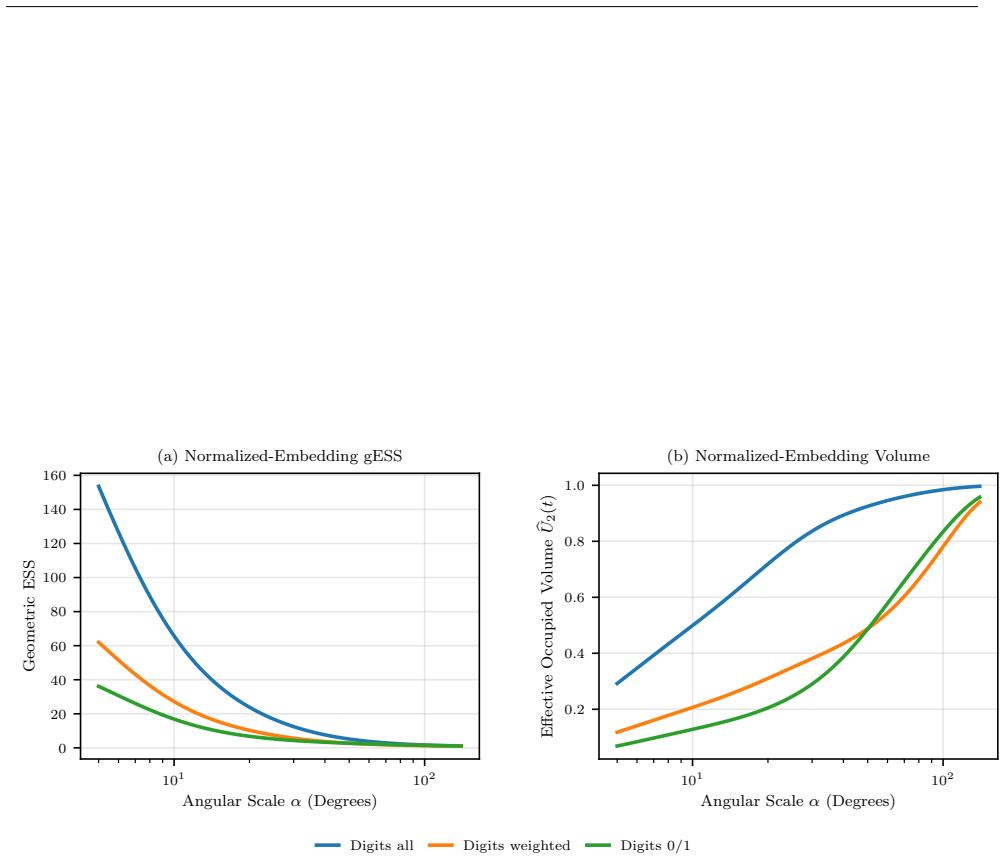
Summary. This paper introduces heat-kernel entropy profiles for weighted empirical measures on compact, connected, boundaryless Riemannian manifolds with normalized volume. For order-two Rényi entropy, it shows that the overlap integral of the heat-smoothed density equals the quadratic form wᵀK_{2t}w (Theorem 1). The inverse of this quantity is an effective occupied volume U₂(t); normalizing each heat kernel by its self-overlap yields a geometric effective sample size gESS(t). The paper proves profile monotonicity, bounds and scale limits for gESS, merge invariance, a two-atom merging law, a spectral expansion, a spherical-harmonic specialization with vMF/Bingham moment energies, and stability and consistency results including a self-normalized importance-sampling bound. Experiments on S² illustrate the profiles on unimodal, antipodal, girdle, multimodal, and duplicate configurations, and show that gESS reveals structure missed by ordinary ESS and first-moment summaries.
Significance. The central mathematical claims are clean and, as far as I can verify, correct. The pairwise identity makes the profile exactly computable from a Gram matrix, and the small- and large-time calibrations give the curve a clear operational meaning. The paper is careful about its domain assumptions (compact, boundaryless, connected, normalized volume) and explicitly states where gESS monotonicity is not proved. The availability of replication code and the self-contained appendix proofs are further strengths. If the results hold, the method is a useful geometry-aware complement to ordinary ESS and first-moment directional summaries. The principal weakness is empirical: the experiments are demonstrative, confined to S², and the main tables report single values without uncertainty bands, although the appendix provides replicated IQR curves and a truncation study.
minor comments (5)
- [Section 8, Tables 1 and 2] These tables report single values without any measure of variability. The replicated synthetic profiles in Figure 4 (Appendix B) show stable medians and IQRs, but the main-text tables do not refer to them. Please either state explicitly that the tabulated numbers are from a single representative construction or include uncertainty intervals (e.g., IQR over replications) so that the practical claims are not overstated.
- [Section 8, Figure 3] The 'Small-Time Guide' curve in panel (a) is not defined in the caption or text. Specify the formula (presumably the leading term V(8πt)^{-m/2}Sα from Theorem 4) so the comparison is reproducible.
- [References] The bibliography contains a formatting artifact: 'chung 1997 SpectralGraphTheory.' in the Chung reference. Also, García-Portugués and Verdebout (2018) lacks a publisher or arXiv identifier. Please clean up the reference list.
- [Author byline] The author line appears as 'Kisung Y ou Boram Cho' with an unintended line break. Please fix the byline formatting.
- [Section 4 / Algorithm 1] Since gESS monotonicity is not proved on nonhomogeneous manifolds (as noted in Section 9), a brief remark in Section 4 would help avoid over-generalizing the profile curves to nonhomogeneous settings.
Circularity Check
No significant circularity: the derivation chain is self-contained and no fitted input is relabeled as a prediction.
full rationale
The paper's central claims are derived from standard, external mathematical facts about heat kernels on compact boundaryless manifolds rather than from its own conclusions. Theorem 1's pairwise identity follows directly from the heat semigroup identity ∫ k_t(y,x_i)k_t(y,x_j)dν(y)=k_{2t}(x_i,x_j); monotonicity follows from the Dirichlet energy identity d/dt∫bp_t^2 dν = -2∫‖∇bp_t‖²dν. Definition 2 defines gESS as the inverse of a weighted sum of normalized heat-kernel overlaps. Theorem 3's bounds, merge invariance, and small/large-time limits are direct consequences of s_t(x,y)≤1, s_t(x,x)=1, the spectral gap, and standard heat-kernel asymptotics; no parameter is fitted to data and then called a prediction. Theorem 4 rests on the Minakshisundaram-Pleijel diagonal expansion and Gaussian off-diagonal bounds from Rosenberg/Grigoryan; Theorem 6 uses the spectral representation of the heat kernel; Corollary 7 uses standard spherical-harmonic identities; Theorem 8 uses Kantorovich-Rubinstein duality and McDiarmid's inequality. There are no self-citations, no imported uniqueness theorem, and no ansatz smuggled in via citation. Some properties are definitional (gESS is explicitly an order-two Leinster-Cobbold diversity), but the paper acknowledges this and does not present definitional consequences as empirical discoveries. The experiments are explicitly demonstrative and their limitations are stated in Section 9 and Appendix B; they are not used as evidence for the theorems. Therefore no circular step exists.
Axiom & Free-Parameter Ledger
free parameters (2)
- Diffusion time t (or angular scale α=√(8t))
- Spherical harmonic truncation Lmax =
120-180 in main figures; 360 reference
axioms (7)
- domain assumption M is compact, connected, boundaryless Riemannian manifold with normalized volume ν.
- standard math Heat kernel semigroup identity and spectral representation k_t(x,y)=Σ e^{-λt} φ_r(x)φ_r(y).
- standard math Minakshisundaram-Pleijel diagonal expansion and Gaussian/exponential heat-kernel bounds.
- standard math Kantorovich-Rubinstein duality and McDiarmid bounded-difference inequality.
- domain assumption Self-normalized IS: density ratio ρ=dP/dQ bounded with 0≤ρ≤M, E_Q ρ=1.
- standard math On S^{p-1}, spherical harmonic identities: √p x_a orthonormal and fourth-moment identity ∫(x^T A x)(x^T B x)dν=2tr(AB)/(p(p+2)).
- domain assumption On homogeneous manifolds, k_{2t}(x,x) is constant, so gESS(t)=k_{2t}(x,x)bU2(t).
read the original abstract
Weighted empirical measures on compact manifolds appear in importance sampling, particle approximations, posterior summaries, quadrature, and representation learning. Ordinary effective sample size and related weight summaries ignore the geometry of the support. We introduce heat-kernel entropy profiles to measure nonuniformity after intrinsic diffusion at a range of scales. For order-two R\'enyi entropy, pairwise heat-kernel overlaps give an exact profile and a geometric effective sample size. This effective sample size discounts nearby or duplicate particles. It approaches ordinary effective sample size as overlaps between distinct particles vanish. On compact boundaryless manifolds, we establish profile monotonicity, gESS scale limits, deterministic-weight consistency, and a bounded-ratio result for self-normalized importance sampling. On spheres, the unlogged profile decomposes into spherical-harmonic energies. The first terms are squared mean-resultant and traceless-second-moment energies, which give vMF- and Bingham-type scalar summaries. Experiments identify antipodal, girdle, multimodal, and duplicate-particle structures that weight-only and first-moment summaries miss.
Figures



Reference graph
Works this paper leans on
-
[1]
The Annals of Statistics , author =
Invariant. The Annals of Statistics , author =. doi:10.1214/aos/1176343283 , number =
-
[2]
and Gretton, Arthur and Fukumizu, Kenji and Schölkopf, Bernhard and Lanckriet, Gert R.G
Sriperumbudur, Bharath K. and Gretton, Arthur and Fukumizu, Kenji and Schölkopf, Bernhard and Lanckriet, Gert R.G. , month = aug, year =. Hilbert. Journal of Machine Learning Research , publisher =
-
[3]
R. On. Proceedings of the. 1961 , pages =
1961
-
[4]
Journal of the American Statistical Association , author =
Sequential. Journal of the American Statistical Association , author =. 1998 , pages =. doi:10.1080/01621459.1998.10473765 , language =
arXiv 1998
-
[6]
Journal of the Royal Statistical Society Series B: Statistical Methodology , author =
Sequential. Journal of the Royal Statistical Society Series B: Statistical Methodology , author =. 2006 , pages =. doi:10.1111/j.1467-9868.2006.00553.x , language =
arXiv 2006
-
[7]
Diversity and. Ecology , author =. 1973 , pages =. doi:10.2307/1934352 , abstract =
doi:10.2307/1934352 1973
-
[8]
Measuring
Gorham, Jackson and Mackey, Lester , year =. Measuring. Proceedings of the 34th
-
[9]
Measuring
Gorham, Jackson and Mackey, Lester , year =. Measuring. Proceedings of the 29th
-
[10]
De La Peña, Víctor H. and Giné, Evarist , editor =. Decoupling , isbn =. doi:10.1007/978-1-4612-0537-1 , urldate =
-
[11]
Journal of Multivariate Analysis , author =
Modifications of the. Journal of Multivariate Analysis , author =. 2001 , pages =. doi:10.1006/jmva.2000.1922 , language =
arXiv 2001
-
[12]
Causality:
Pearl, Judea , year =. Causality:
-
[13]
and Ivanov, Sergej and Ivanov, Sergei V
Burago, Dmitrij Jurʹevič and Burago, Jurij D. and Ivanov, Sergej and Ivanov, Sergei V. , year =. A
-
[14]
Methods of
Amari, Shun'ichi and Nagaoka, Hiroshi and Amari, Shun'ichi and Amari, Shun'ichi , translator =. Methods of
-
[15]
Lange, Richard D and Kwok, Devin and Matelsky, Jordan Kyle and Wang, Xinyue and Rolnick, David and Kording, Konrad , editor =. Deep. Proceedings of 2nd. 2023 , pages =
2023
-
[16]
Nature Communications , author =
Single-cell analysis reveals inflammatory interactions driving macular degeneration , volume =. Nature Communications , author =. 2023 , pages =. doi:10.1038/s41467-023-37025-7 , language =
-
[17]
The Annals of Statistics , author =
Data-driven. The Annals of Statistics , author =. doi:10.1214/009053607000000541 , number =
-
[18]
Brown, Lawrence D. , month = jan, year =. Fundamentals of. doi:10.1214/lnms/1215466757 , urldate =
-
[19]
Transactions of the American Mathematical Society , author =
Strong laws for \. Transactions of the American Mathematical Society , author =. 1996 , pages =. doi:10.1090/S0002-9947-96-01681-9 , language =
-
[20]
Journal of the American Statistical Association , author =
Asymptotic. Journal of the American Statistical Association , author =. 1987 , pages =. doi:10.1080/01621459.1987.10478472 , language =
arXiv 1987
-
[21]
Journal of Machine Learning Research , author =
Scikit-learn:. Journal of Machine Learning Research , author =. 2011 , pages =
2011
-
[22]
Saddlepoint approximations for the. Biometrika , author =. 2005 , pages =. doi:10.1093/biomet/92.2.465 , language =
-
[23]
Computational Statistics , author =
On maximum likelihood estimation of the concentration parameter of von. Computational Statistics , author =. 2014 , pages =. doi:10.1007/s00180-013-0471-0 , language =
-
[24]
IEEE Transactions on Information Theory , author =
Information projections revisited , volume =. IEEE Transactions on Information Theory , author =. 2003 , pages =. doi:10.1109/TIT.2003.810633 , language =
arXiv 2003
-
[26]
IEEE Transactions on Information Theory , author =
Information geometry on hierarchy of probability distributions , volume =. IEEE Transactions on Information Theory , author =. 2001 , pages =. doi:10.1109/18.930911 , number =
-
[27]
Nature Reviews Neuroscience , author =
Neural tuning and representational geometry , volume =. Nature Reviews Neuroscience , author =. 2021 , pages =. doi:10.1038/s41583-021-00502-3 , language =
-
[28]
New insights and perspectives on the natural gradient method , url =
Martens, James , month = sep, year =. New insights and perspectives on the natural gradient method , url =
-
[29]
International Statistical Review , author =
Directions. International Statistical Review , author =. 2022 , pages =. doi:10.1111/insr.12481 , abstract =
-
[30]
doi:10.1007/978-981-19-1044-9 , language =
Directional. doi:10.1007/978-981-19-1044-9 , language =
-
[31]
You, Kisung and Shung, Dennis , year =. On the spherical. doi:10.48550/ARXIV.2208.11929 , abstract =
-
[32]
Statistics and Computing , author =
Learning over von. Statistics and Computing , author =. 2026 , pages =. doi:10.1007/s11222-026-10844-6 , language =
-
[33]
Diethe, Tom , month = feb, year =. A. doi:10.48550/arXiv.1502.07104 , abstract =
-
[34]
doi:10.18637/jss.v058.i10 , language =
Journal of Statistical Software , author =. doi:10.18637/jss.v058.i10 , language =
-
[35]
Communications in Statistics - Theory and Methods , author =
A solution to the multivariate behrens-fisher problem , volume =. Communications in Statistics - Theory and Methods , author =. 1986 , pages =. doi:10.1080/03610928608829342 , language =
-
[36]
Proceedings of the Royal Society A: Mathematical, Physical and Engineering Sciences , author =
Dispersion on a. Proceedings of the Royal Society A: Mathematical, Physical and Engineering Sciences , author =. 1953 , pages =. doi:10.1098/rspa.1953.0064 , language =
arXiv 1953
-
[37]
The. Annals of Eugenics , author =. 1936 , pages =. doi:10.1111/j.1469-1809.1936.tb02137.x , language =
arXiv 1936
-
[38]
Translational Psychiatry , author =
Brain network dysfunctions in addiction: a meta-analysis of resting-state functional connectivity , volume =. Translational Psychiatry , author =. 2022 , pages =. doi:10.1038/s41398-022-01792-6 , number =
-
[39]
SIAM Journal on Matrix Analysis and Applications , author =
Permutation-. SIAM Journal on Matrix Analysis and Applications , author =. 2024 , pages =. doi:10.1137/22M1538144 , language =
-
[40]
Resting state functional connectivity in addiction:. NeuroImage , author =. 2012 , pages =. doi:10.1016/j.neuroimage.2012.01.117 , language =
-
[41]
Frontiers in Human Neuroscience , author =
Sex. Frontiers in Human Neuroscience , author =. 2019 , pages =. doi:10.3389/fnhum.2019.00104 , urldate =
arXiv 2019
-
[42]
Trends in Cognitive Sciences , author =
Functional connectomics from resting-state. Trends in Cognitive Sciences , author =. 2013 , pages =. doi:10.1016/j.tics.2013.09.016 , language =
-
[43]
Linked. Cerebral Cortex , author =. 2015 , pages =. doi:10.1093/cercor/bhu036 , language =
-
[44]
ETS Research Bulletin Series , author =
Estimating causal effects of treatments in randomized and nonrandomized studies , volume =. ETS Research Bulletin Series , author =. doi:10.1002/j.2333-8504.1972.tb00631.x , abstract =
arXiv 1972
-
[45]
The. Biometrika , author =. 1983 , pages =. doi:10.1093/biomet/70.1.41 , language =
-
[46]
Journal of the American Statistical Association , author =
Estimation of. Journal of the American Statistical Association , author =. 1994 , pages =. doi:10.1080/01621459.1994.10476818 , language =
arXiv 1994
-
[47]
Quasi-oracle estimation of heterogeneous treatment effects , volume =. Biometrika , author =. 2021 , pages =. doi:10.1093/biomet/asaa076 , abstract =
-
[48]
The Annals of Applied Statistics , author =
Propensity score weighting for causal inference with multiple treatments , volume =. The Annals of Applied Statistics , author =. doi:10.1214/19-AOAS1282 , number =
-
[49]
Journal of the American Statistical Association , author =
Balancing. Journal of the American Statistical Association , author =. 2018 , pages =. doi:10.1080/01621459.2016.1260466 , language =
arXiv 2018
-
[50]
Journal of the Royal Statistical Society Series B: Statistical Methodology , author =
Causal inference on distribution functions , volume =. Journal of the Royal Statistical Society Series B: Statistical Methodology , author =. 2023 , pages =. doi:10.1093/jrsssb/qkad008 , language =
-
[51]
Kurisu, Daisuke and Zhou, Yidong and Otsu, Taisuke and Müller, Hans-Georg , year =. Geodesic. doi:10.48550/ARXIV.2406.19604 , abstract =
-
[52]
Proceedings of the National Academy of Sciences , author =
Sex beyond the genitalia:. Proceedings of the National Academy of Sciences , author =. 2015 , pages =. doi:10.1073/pnas.1509654112 , abstract =
-
[53]
and Robins, James M
Hernan, Miguel A. and Robins, James M. , year =. Causal
-
[54]
The Econometrics Journal , author =
Double/debiased machine learning for treatment and structural parameters , volume =. The Econometrics Journal , author =. 2018 , pages =. doi:10.1111/ectj.12097 , language =
-
[55]
The Annals of Probability , author =
Central limit theorems and bootstrap in high dimensions , volume =. The Annals of Probability , author =. doi:10.1214/16-AOP1113 , number =
-
[56]
The Annals of Statistics , author =
Gaussian approximations and multiplier bootstrap for maxima of sums of high-dimensional random vectors , volume =. The Annals of Statistics , author =. doi:10.1214/13-AOS1161 , number =
-
[57]
Trends in Cognitive Sciences , author =
Large-scale brain systems in. Trends in Cognitive Sciences , author =. 2012 , pages =. doi:10.1016/j.tics.2011.11.007 , language =
-
[58]
Biological Psychiatry: Cognitive Neuroscience and Neuroimaging , author =
Intrinsic. Biological Psychiatry: Cognitive Neuroscience and Neuroimaging , author =. 2016 , pages =. doi:10.1016/j.bpsc.2016.03.004 , language =
-
[59]
Collas, Antoine and Ju, Ce and Salvy, Nicolas and Thirion, Bertrand , year =. Riemannian. doi:10.48550/ARXIV.2505.18193 , abstract =
-
[60]
Doubly. Biometrics , author =. 2005 , pages =. doi:10.1111/j.1541-0420.2005.00377.x , language =
arXiv 2005
-
[61]
The Annals of Statistics , author =
Generalized random forests , volume =. The Annals of Statistics , author =. doi:10.1214/18-AOS1709 , number =
-
[62]
Magnetic Resonance in Medicine , author =
Log‐. Magnetic Resonance in Medicine , author =. 2006 , pages =. doi:10.1002/mrm.20965 , abstract =
-
[63]
1998 , keywords =
Efficient and. 1998 , keywords =
1998
-
[64]
Chwialkowski, Kacper and Strathmann, Heiko and Gretton, Arthur , editor =. A. Proceedings of. 2016 , pages =
2016
-
[65]
On the. Physical Review , author =. 1930 , pages =. doi:10.1103/PhysRev.36.823 , language =
-
[66]
Orthogonal polynomials , isbn =
Szegő, Gábor , year =. Orthogonal polynomials , isbn =
-
[67]
Journal of Multivariate Analysis , author =
A new test for multivariate normality , volume =. Journal of Multivariate Analysis , author =. 2005 , pages =. doi:10.1016/j.jmva.2003.12.002 , language =
-
[68]
Rayner, J. C. W. and Thas, O. and Best, D. J. , month = apr, year =. Smooth. doi:10.1002/9780470824443 , language =
-
[69]
The Annals of Statistics , author =
\. The Annals of Statistics , author =. doi:10.1214/aos/1176350374 , number =
-
[70]
Scandinavian Actuarial Journal , author =
Smooth test for goodness of fit , volume =. Scandinavian Actuarial Journal , author =. 1937 , pages =. doi:10.1080/03461238.1937.10404821 , language =
arXiv 1937
-
[71]
Journal für die reine und angewandte Mathematik , author =
Ueber die. Journal für die reine und angewandte Mathematik , author =. 1866 , pages =
-
[72]
Measures of multivariate skewness and kurtosis with applications , volume =. Biometrika , author =. 1970 , pages =. doi:10.1093/biomet/57.3.519 , language =
-
[73]
Liu, Qiang and Lee, Jason and Jordan, Michael , editor =. A. Proceedings of. 2016 , pages =
2016
-
[74]
Janson, Svante , month = jun, year =. Gaussian. doi:10.1017/CBO9780511526169 , abstract =
-
[75]
IEEE Transactions on Neural Networks , author =
Iterative. IEEE Transactions on Neural Networks , author =. 2011 , pages =. doi:10.1109/TNN.2011.2106511 , number =
arXiv 2011
-
[76]
Journal of Machine Learning Research , author =
Composite. Journal of Machine Learning Research , author =. 2025 , pages =
2025
-
[77]
A one-sample test for normality with kernel methods , volume =. Bernoulli , author =. doi:10.3150/18-BEJ1037 , number =
-
[78]
Communications in Statistics - Theory and Methods , author =
A class of invariant consistent tests for multivariate normality , volume =. Communications in Statistics - Theory and Methods , author =. 1990 , pages =. doi:10.1080/03610929008830400 , language =
-
[79]
Journal of Machine Learning Research , author =
Spectral. Journal of Machine Learning Research , author =. 2024 , pages =
2024
-
[80]
A test for normality based on the empirical characteristic function , volume =. Biometrika , author =. 1983 , pages =. doi:10.1093/biomet/70.3.723 , language =
-
[81]
Gaussianization , volume =
Chen, Scott and Gopinath, Ramesh , editor =. Gaussianization , volume =. Advances in
-
[82]
Russian Mathematical Surveys , author =
Ornstein–. Russian Mathematical Surveys , author =. 2018 , pages =. doi:10.1070/RM9812 , number =
doi:10.1070/rm9812 2018
discussion (0)
Sign in with ORCID, Apple, or X to comment. Anyone can read and Pith papers without signing in.