REVIEW 3 major objections 6 minor 57 references
G-PROBE: Cross-FOV Place Recognition and Certainty-Coupled Localization for 3D Point Clouds
T0 review · 3 major / 6 minor · reviewed 2026-07-10 · grok-4.5
Pith's one-line read G-PROBE recovers place and 6-DoF pose from LiDAR even when the query sees only a narrow wedge of a panoramic map.
desk verdict A real learning-free cross-FOV localizer with honest multi-dataset evidence; the discrete-heading stress test is a fair caveat, not a collapse of the claim. read the letter →
The pith
A machine-rendered reading of the paper's core claim, the machinery that carries it, and where it could break.
The reading
What carries the argument
Virtual sensor decomposition partitions any contiguous azimuthal coverage into N≈Φ/90° sectors and all pairwise heading-hypothesis branches; γ-SGRT multiplies the best branch score by a score-scale-invariant uniqueness probability that is inert at 360° and suppresses aliasing under partial FOV; the same occupancy scoring yields a bird’s-eye-view certainty map that restricts CG-GICP’s fine pass to co-observed points.
What would settle it
Crop a panoramic database to 360° and the query stream to 60° on the same single-session sequences used for the asymmetric block of Table V; if G-PROBE’s mean Recall@1 falls to the single-digit levels of SC++/PROBE instead of staying near 54%, the cross-FOV ensemble claim fails.
Extended reading notes
Core claim
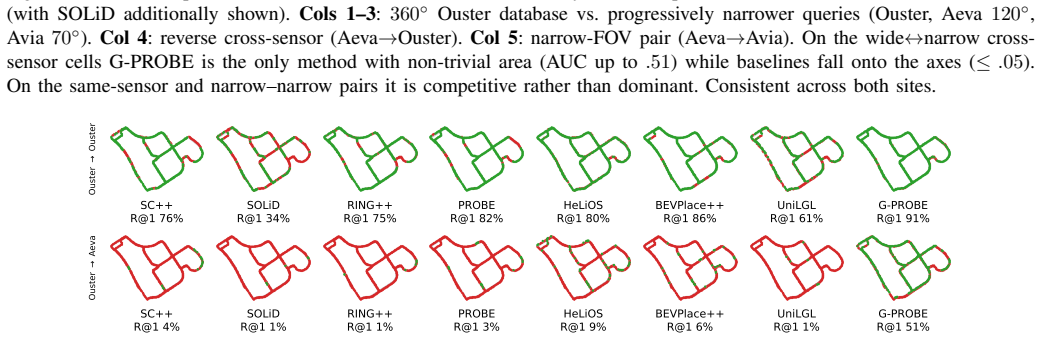
A single learning-free architecture built on virtual sensor decomposition and certainty coupling can perform heading-invariant place recognition and 6-DoF metric localization across arbitrary FOV configurations—from a 70° solid-state sensor to a panoramic multi-LiDAR rig—without retraining, remaining the only compared method that retains usable accuracy under severe FOV asymmetry and wide↔narrow cross-sensor pairing.
Load-bearing premise
Any sensor’s contiguous field of view can be chopped into a handful of fixed-width virtual sectors whose pairwise heading guesses, with no continuous search and no learning, are enough to match places under arbitrary FOV mixes.
Editorial extensions
If this is right
- Robots with narrow solid-state LiDARs can re-localize against panoramic maps without supervised domain adaptation.
- Multi-session and cross-day loop closure remains viable when sensors differ in FOV and modality.
- Place recognition and registration need not be separate modules: the descriptor’s internal reliability signal can directly condition metric refinement.
- Fixed hyperparameters across five datasets and three modalities imply geometric symmetries, not dataset-specific tuning, carry the performance.
- Under FOV asymmetry the collapse of column-shift polar descriptors is structural, not merely a data or training problem.
Reading between the lines
- The same virtual-sector logic could absorb new sensor types into lifelong maps without rebuilding descriptors from scratch.
- Discrete 90° heading bins leave oblique intersections fragile; continuous polar cross-correlation is the natural fix the paper leaves open.
- Certainty maps may transfer to radar or multi-modal fusion where co-observation is even sparser than narrow LiDAR.
- Absolute cross-sensor recall still tops out near 55%, so pairing learned retrieval keys with G-PROBE’s geometric scoring is a direct next experiment.
Editorial analysis
A structured set of objections, weighed in public.
Referee Report
Summary. G-PROBE is a learning-free, CPU-only global localization pipeline for 3D LiDAR that targets limited and asymmetric FOV. It partitions contiguous azimuthal coverage into virtual sensors (Definition 1), enumerates cross-FOV branch ensembles with FOV-overlap-masked ring keys and BKL scoring, applies an FOV-adaptive γ-SGRT to suppress heading aliasing, and couples a by-product BEV certainty map into a two-pass CG-GICP for 6-DoF refinement without an external verifier. Across KITTI, NCLT, HeLiPR, SNAIL, and GrandTour, the paper reports the strongest average learning-free multi-session F1, competitive panoramic single-session performance, ~54% Recall@1 under 360°→60° asymmetry (~18× the best learning-free baseline), and usable end-to-end wide↔narrow cross-sensor success (up to 55.0% vs ≤6.8%).
Significance. If the results hold under scrutiny, this is a substantial contribution to LiDAR global localization: it directly addresses FOV asymmetry and cross-sensor matching—open problems named in recent surveys—without supervised adaptation, while linking place recognition to metric registration via a free certainty map. Strengths include fixed hyperparameters across five datasets and three modalities, FOV co-visibility ground truth, a 3×3 cross-sensor matrix, registration ablations with a no-filter control, and short proofs for γ-SGRT (Proposition 1, Corollary 1). The GrandTour FOV-controlled study usefully disentangles FOV asymmetry from density/pattern heterogeneity. Absolute cross-sensor recall remains modest (as the authors note), but establishing a usable learning-free operating point under wide↔narrow pairing is practically important for solid-state and multi-LiDAR platforms.
major comments (3)
- [§IV-A/B, Table V, Fig. 1, §VII-D] The central heading-invariance claim under FOV asymmetry (Table V asymmetric block; Fig. 1; ~54% R@1 at 360°→60°) rests on discrete virtual-sector quantization N=max(1,round(Φ/90°)) and Δ_step=90° hypothesis grouping (§IV-A/B; Eqs. 2–6, 16–17), with FFT refinement only inside a narrow hint window W (~±50°, Eq. 10). Limitations §VII-D already note conservative rejection at oblique angles and inert SGRT when |A|=1. The manuscript never stratifies Recall@1 or end-to-end success (Tables V, IX) by ground-truth heading residual to the nearest virtual-pair center (or to the recovered Δψ). Without that breakdown—or an explicit continuous-heading control—it remains possible that the reported 18× gain partly reflects favorable near-cardinal/reverse revisit statistics common in KITTI/NCLT loops rather than full continuous invariance. Please add residual-to-hypothesis histograms and R@1 stratified b
- [§VI-G, Table IX] End-to-end success in Table IX is explicitly front-end-dominated (text: CG-GICP vs plain GICP differ by ~0.7 pp mean). The strongest system-level claim (up to 55.0% vs ≤6.8% on wide↔narrow cells) therefore hinges almost entirely on retrieval under FOV co-visibility GT (Eq. 24). Please report, for the same cells, (i) pure top-1 retrieval success under the same GT and (ii) conditional pose success given correct retrieval, so readers can separate place-recognition gains from registration. Also clarify whether UniLGL/SC++ failures are predominantly retrieval misses versus pose failures (the TE/RE medians are conditioned on each method’s own correct set, which varies by an order of magnitude).
- [Definition 1, §IV-A, Table XIa, §VI-J] The N-ablation (Table XIa) is only on two KAIST05 cells and forces N on 360° sensors; it does not stress non-cardinal relative headings or physical multi-sensor rigs with unequal sector FOVs (Definition 1 allows unequal FOVs but evaluation uses cropped single sensors or simultaneous full-FOV sensors). Given that O(N^4) branch count and the 90° base are free design choices fixed for all experiments, a short stress test with synthetic heading offsets (or GrandTour/HeLiPR queries rotated in yaw before cropping) would better support the claim that the same pipeline works for arbitrary FOV mixes “by design.”
minor comments (6)
- [Abstract, Fig. 1, Table V] Fig. 1 caption and abstract use “~54%” / “about 54%” while Table V reports 53.7% R@1 at 60°; align the rounded figures or cite the table value consistently.
- [Table I] Table I’s “Cross-FOV / Cross-Sensor” columns mark designed scope, not measured performance; a footnote already notes collapse OOD, but the table still reads as capability. Consider “designed for” wording or a third column for empirical OOD retention.
- [§IV-C, Eq. (11)] Eq. (11): the special cases CC_z ≜ 0 (<5 jointly height-observed cells) and CC_z ≜ 1 (vanishing weighted variance) are easy to miss; a short remark that these do not break S_b ≥ 0 would help implementers.
- [§VI-A, Tables V–VI] HeLiOS is in-distribution on HeLiPR (trained on DCC/KAIST/Riverside 04–06); the paper states this, but Tables V–VI would benefit from a clearer “in-distribution upper bound” marker on those cells so zero-shot vs adapted comparisons are not conflated at a glance.
- [Abstract, §IV-D] Typo/notation: “γ-SGRT” vs “gamma-SGRT” in the abstract; “SGRT” vs “γ-SGRT” elsewhere. Pick one form after first definition.
- [§VI-K, Table XII] Runtime Table XII excludes the pose stage; a one-line amortized CG-GICP cost under typical loop-closure trigger rates (already ~<5 ms in text) would make the “on par with SC++” claim fully self-contained.
Circularity Check
No load-bearing circularity: learning-free pipeline with fixed hyperparameters, external-dataset evaluation, and PROBE self-citation only as a generalized prior core—not as sole evidence for the cross-FOV claims.
-
self citation load bearing
[§I Relation to PROBE; §IV-C Reduction to PROBE; Ref. [11]]
"G-PROBE inherits this probabilistic core and extends it from a single descriptor to a complete global localization system... whose per-pair occupancy divergence reduces exactly to PROBE’s under homogeneous full co-visibility with column trimming disabled, a strict generalization."
The occupancy/BKL scoring and analytical polar blur are taken from the authors’ prior PROBE descriptor rather than re-derived from first principles here. This is ordinary cumulative research, not load-bearing circularity: the paper’s headline claims (cross-FOV R@1, wide↔narrow end-to-end success) are new empirical results on which PROBE itself collapses, so the self-citation does not force or redefine those outcomes.
full rationale
G-PROBE is an engineering systems paper whose central claims (asymmetric FOV Recall@1, cross-sensor end-to-end success, multi-session F1) are empirical results on public datasets (KITTI, NCLT, HeLiPR, SNAIL, GrandTour) against independent baselines, not theoretical predictions fitted to the target metrics. All front-end/back-end hyperparameters are fixed a priori (Table II) and held constant across every experiment; γ-SGRT is a score-ratio Softmax construction with proven inertness at 360° and non-degradation of unambiguous TPs (Prop. 1, Cor. 1), not a fit. BKL scoring and the certainty map are by-products of occupancy divergence, not circular redefinitions of the evaluation metrics. The only self-dependence is inheritance of PROBE’s probabilistic ring-key / BKL core [11] (same first author), which the paper explicitly generalizes and shows fails under FOV asymmetry (Table V: PROBE ~2% R@1 at 60° vs G-PROBE ~54%). That citation supplies a building block, not the sole justification of the new cross-FOV or end-to-end claims. No fitted-input-as-prediction, no uniqueness theorem imported to forbid alternatives, and no self-definitional reduction of the reported success rates. Score 1 reflects only the minor, non-load-bearing self-citation of the prior descriptor core.
Assumptions & free parameters
free parameters (7)
- Virtual sector quantization base (90°)
- SGRT sharpness κ
- Column-trim fraction η
- Certainty filter thresholds (τ_c, σ_thr, μ_thr)
- Min FOV overlap w_min and retrieval depths K, k_b
- Polar BEV resolution and range (N_r×N_s, R_max, σ_T, voxel sizes)
- Positive-match thresholds (d_pos, ν_cov, d_exc)
assumptions (5)
- ad hoc to paper Contiguous azimuthal coverage can be identity-preservingly partitioned into virtual sensors whose pairwise unions encode usable heading hypotheses (Definition 1).
- domain assumption Polar Jacobian marginalization of isotropic Cartesian translation yields distance-adaptive angular blur for occupancy BEV (inherited from PROBE).
- domain assumption Symmetric Bernoulli-KL on shrinkage occupancies plus occupancy-weighted height correlation is a valid place-identity score on co-observed wedges.
- standard math Generalized-ICP with local surface covariances is a suitable local metric refiner given a heading seed.
- ad hoc to paper Mutual occupancy/certainty in polar BEV bins identifies co-observed structure useful for suppressing FOV-boundary bias in registration.
invented entities (3)
-
Virtual sensor decomposition and cross-FOV branch ensembles
-
γ-SGRT (FOV-adaptive Softmax Gap Ratio Test)
-
BEV certainty map c(r,s) and CG-GICP
Cite this review
Pith. "Pith review of G-PROBE: Cross-FOV Place Recognition and Certainty-Coupled Localization for 3D Point Clouds." pith.science (2026). https://pith.science/paper/62CPUWQ6
@misc{pith2026260706782,
  author       = {Pith},
  title        = {Pith review of: G-PROBE: Cross-FOV Place Recognition and Certainty-Coupled Localization for 3D Point Clouds},
  year         = {2026},
  howpublished = {\url{https://pith.science/paper/62CPUWQ6}},
  note         = {Machine review of arXiv:2607.06782}
}
read the original abstract
Global localization from 3D point clouds remains challenging under limited or asymmetric fields of view (FOV), which fail to provide the dense, symmetric coverage that place recognition methods assume. We present G-PROBE, a learning-free global localization framework that removes this assumption. A virtual sensor decomposition runs the same pipeline, by design, on configurations ranging from a narrow-FOV sensor to a panoramic or multi-sensor rig. The front-end enumerates cross-FOV branch ensembles that encode heading hypotheses for heading-invariant place recognition. A score-scale-invariant, tuning-free gamma-SGRT suppresses heading aliasing under partial FOV and provably becomes inert at symmetric 360 degrees. The back-end, CG-GICP, refines a coarse full-cloud GICP with a pass restricted to high-certainty co-observed points selected by a bird's-eye-view certainty map (a by-product of front-end scoring). This certainty coupling links descriptor evaluation to 6-DoF metric pose estimation without an external verification module. Evaluated on five LiDAR datasets and three modalities (mechanical, solid-state, FMCW), G-PROBE attains the highest learning-free multi-session F1 on average and is competitive in panoramic single-session settings. Where hand-crafted and zero-shot supervised baselines collapse under wide-to-narrow cross-sensor pairing, it remains usable end-to-end (up to 55.0% vs. no more than 6.8% success), and under FOV asymmetry (360 to 60 degrees) it retains about 54% Recall@1, about 18x the strongest learning-free baseline.
Figures


Figures from the paper (6 more)



Reference graph
Works this paper leans on
-
[1]
Bags of binary words for fast place recognition in image sequences,
D. Gálvez-López and J. D. Tardós, “Bags of binary words for fast place recognition in image sequences,”IEEE Trans. Robot., vol. 28, no. 5, pp. 1188–1197, 2012. 18
work page 2012
-
[2]
Scan Context: Egocentric spatial descriptor for place recognition within 3D point cloud map,
G. Kim and A. Kim, “Scan Context: Egocentric spatial descriptor for place recognition within 3D point cloud map,” inProc. IEEE/RSJ IROS, 2018, pp. 4802–4809
work page 2018
-
[3]
G. Kim, S. Choi, and A. Kim, “Scan Context++: Structural place recog- nition robust to rotation and lateral variations in urban environments,” IEEE Trans. Robot., vol. 38, no. 3, pp. 1856–1874, 2022
work page 2022
-
[4]
A survey on global LiDAR localization: Challenges, advances and open problems,
H. Yinet al., “A survey on global LiDAR localization: Challenges, advances and open problems,”Int. J. Comput. Vis., vol. 132, no. 8, pp. 3139–3171, 2024
work page 2024
-
[5]
M. Jung, S. Jung, H. Gil, and A. Kim, “HeLiOS: Heterogeneous LiDAR place recognition via overlap-based learning and local spherical transformer,” inProc. IEEE ICRA, 2025, pp. 2204–2211
work page 2025
-
[6]
OverlapNet: Loop closing for LiDAR-based SLAM,
X. Chenet al., “OverlapNet: Loop closing for LiDAR-based SLAM,” inProc. RSS, 2020
work page 2020
-
[7]
UniLGL: Learning uniform place recognition for FOV- limited/panoramic LiDAR global localization,
H. Shenet al., “UniLGL: Learning uniform place recognition for FOV- limited/panoramic LiDAR global localization,”IEEE Trans. Robot., vol. 42, pp. 1556–1576, 2026
work page 2026
-
[8]
H. Kim, J. Choi, T. Sim, G. Kim, and Y . Cho, “Narrowing your FOV with SOLiD: Spatially organized and lightweight global descriptor for FOV-constrained LiDAR place recognition,”IEEE Robot. Autom. Lett., vol. 9, no. 11, pp. 9645–9652, 2024
work page 2024
Show all 57 references
-
[9]
X-ICP: Localizability-aware LiDAR registration for ro- bust localization in extreme environments,
T. Tunaet al., “X-ICP: Localizability-aware LiDAR registration for ro- bust localization in extreme environments,”IEEE Trans. Robot., vol. 40, pp. 452–471, 2024
2024
-
[10]
GenZ-ICP: Generalizable and degeneracy- robust LiDAR odometry using an adaptive weighting,
D. Lee, H. Lim, and S. Han, “GenZ-ICP: Generalizable and degeneracy- robust LiDAR odometry using an adaptive weighting,”IEEE Robot. Autom. Lett., vol. 10, no. 1, pp. 152–159, 2025
2025
-
[11]
PROBE: Probabilistic occu- pancy BEV encoding with analytical translation robustness for 3D place recognition,
J. Lee, B. Lee, and G. Yoo, “PROBE: Probabilistic occu- pancy BEV encoding with analytical translation robustness for 3D place recognition,”IEEE Robot. Autom. Lett., early access, 2026, doi: 10.1109/LRA.2026.3703245
2026 doi
-
[12]
Robust place recognition for 3D range data based on point features,
B. Steder, G. Grisetti, and W. Burgard, “Robust place recognition for 3D range data based on point features,” inProc. IEEE ICRA, 2010, pp. 1400–1405
2010
-
[13]
Place recognition using keypoint voting in large 3D lidar datasets,
M. Bosse and R. Zlot, “Place recognition using keypoint voting in large 3D lidar datasets,” inProc. IEEE ICRA, 2013, pp. 2677–2684
2013
-
[14]
M2DP: A novel 3D point cloud descriptor and its application in loop closure detection,
L. He, X. Wang, and H. Zhang, “M2DP: A novel 3D point cloud descriptor and its application in loop closure detection,” inProc. IEEE/RSJ IROS, 2016, pp. 231–237
2016
-
[15]
LiDAR Iris for loop-closure detection,
Y . Wanget al., “LiDAR Iris for loop-closure detection,” inProc. IEEE/RSJ IROS, 2020, pp. 5769–5775
2020
-
[16]
DELIGHT: An efficient descriptor for global localisation using LiDAR intensities,
K. P. Cop, P. V . K. Borges, and R. Dubé, “DELIGHT: An efficient descriptor for global localisation using LiDAR intensities,” inProc. IEEE ICRA, 2018, pp. 3653–3660
2018
-
[17]
Intensity scan context: Coding intensity and geometry relations for loop closure detection,
H. Wang, C. Wang, and L. Xie, “Intensity scan context: Coding intensity and geometry relations for loop closure detection,” inProc. IEEE ICRA, 2020, pp. 2095–2101
2020
-
[18]
BoW3D: Bag of words for real-time loop closing in 3D LiDAR SLAM,
Y . Cui, X. Chen, Y . Zhang, J. Dong, Q. Wu, and F. Zhu, “BoW3D: Bag of words for real-time loop closing in 3D LiDAR SLAM,”IEEE Robot. Autom. Lett., vol. 8, no. 5, pp. 2828–2835, 2023
2023
-
[19]
One RING to rule them all: Radon sinogram for place recognition, orientation and translation estimation,
S. Lu, X. Xu, H. Yin, Z. Chen, R. Xiong, and Y . Wang, “One RING to rule them all: Radon sinogram for place recognition, orientation and translation estimation,” inProc. IEEE/RSJ IROS, 2022, pp. 2778–2785
2022
-
[20]
RING++: Roto-translation invariant Gram for global localization on a sparse scan map,
X. Xuet al., “RING++: Roto-translation invariant Gram for global localization on a sparse scan map,”IEEE Trans. Robot., vol. 39, no. 6, pp. 4616–4635, 2023
2023
-
[21]
RING#: PR-by-PE global localization with roto-translation equivariant Gram learning,
S. Luet al., “RING#: PR-by-PE global localization with roto-translation equivariant Gram learning,”IEEE Trans. Robot., vol. 41, pp. 1861–1881, 2025
2025
-
[22]
STD: Stable triangle descriptor for 3D place recognition,
C. Yuan, J. Lin, Z. Zou, X. Hong, and F. Zhang, “STD: Stable triangle descriptor for 3D place recognition,” inProc. IEEE ICRA, 2023, pp. 1897–1903
2023
-
[23]
BTC: A binary and triangle combined descriptor for 3-D place recognition,
C. Yuan, J. Lin, Z. Liu, H. Wei, X. Hong, and F. Zhang, “BTC: A binary and triangle combined descriptor for 3-D place recognition,”IEEE Trans. Robot., vol. 40, pp. 1580–1599, 2024
2024
-
[24]
LiDAR-based place recognition for autonomous driving: A survey,
Y . Zhang, P. Shi, and J. Li, “LiDAR-based place recognition for autonomous driving: A survey,”ACM Comput. Surv., vol. 57, no. 4, Art. no. 106, 2024
2024
-
[25]
NetVLAD: CNN architecture for weakly supervised place recognition,
R. Arandjelovi ´c, P. Gronat, A. Torii, T. Pajdla, and J. Sivic, “NetVLAD: CNN architecture for weakly supervised place recognition,” inProc. IEEE CVPR, 2016, pp. 5297–5307
2016
-
[26]
PointNetVLAD: Deep point cloud based retrieval for large-scale place recognition,
M. A. Uy and G. H. Lee, “PointNetVLAD: Deep point cloud based retrieval for large-scale place recognition,” inProc. IEEE CVPR, 2018, pp. 4470–4479
2018
-
[27]
LPD-Net: 3D point cloud learning for large-scale place recognition and environment analysis,
Z. Liuet al., “LPD-Net: 3D point cloud learning for large-scale place recognition and environment analysis,” inProc. IEEE/CVF ICCV, 2019, pp. 2831–2840
2019
-
[28]
MinkLoc3D: Point cloud based large-scale place recognition,
J. Komorowski, “MinkLoc3D: Point cloud based large-scale place recognition,” inProc. IEEE/CVF WACV, 2021, pp. 1789–1798
2021
-
[29]
LoGG3D-Net: Locally guided global de- scriptor learning for 3D place recognition,
K. Vidanapathiranaet al., “LoGG3D-Net: Locally guided global de- scriptor learning for 3D place recognition,” inProc. IEEE ICRA, 2022, pp. 2215–2221
2022
-
[30]
DiSCO: Differentiable scan context with orientation,
X. Xuet al., “DiSCO: Differentiable scan context with orientation,” IEEE Robot. Autom. Lett., vol. 6, no. 2, pp. 2791–2798, 2021
2021
-
[31]
OverlapTransformer: An efficient and yaw-angle-invariant transformer network for LiDAR- based place recognition,
J. Ma, J. Zhang, J. Xu, R. Ai, W. Gu, and X. Chen, “OverlapTransformer: An efficient and yaw-angle-invariant transformer network for LiDAR- based place recognition,”IEEE Robot. Autom. Lett., vol. 7, no. 3, pp. 6958–6965, 2022
2022
-
[32]
BEVPlace++: Fast, robust, and lightweight LiDAR global localization for unmanned ground vehicles,
L. Luoet al., “BEVPlace++: Fast, robust, and lightweight LiDAR global localization for unmanned ground vehicles,”IEEE Trans. Robot., vol. 41, pp. 4479–4498, 2025
2025
-
[33]
CASSPR: Cross attention single scan place recognition,
Y . Xiaet al., “CASSPR: Cross attention single scan place recognition,” inProc. IEEE/CVF ICCV, 2023, pp. 8427–8438
2023
-
[34]
EgoNN: Egocentric neural network for point cloud based 6DoF relocalization at the city scale,
J. Komorowski, M. Wysocza ´nska, and T. Trzci´nski, “EgoNN: Egocentric neural network for point cloud based 6DoF relocalization at the city scale,”IEEE Robot. Autom. Lett., vol. 7, no. 2, pp. 722–729, 2022
2022
-
[35]
Efficiently closing loops in LiDAR-based SLAM using point cloud density maps,
S. Guptaet al., “Efficiently closing loops in LiDAR-based SLAM using point cloud density maps,”Int. J. Robot. Res., 2026
2026
-
[36]
SHeRLoc: Synchronized heterogeneous radar place recognition for cross-modal localization,
H. Kim, M. Jung, W. Yang, and A. Kim, “SHeRLoc: Synchronized heterogeneous radar place recognition for cross-modal localization,” IEEE Robot. Autom. Lett., vol. 10, no. 12, pp. 13264–13271, 2025
2025
-
[37]
A method for registration of 3-D shapes,
P. J. Besl and N. D. McKay, “A method for registration of 3-D shapes,” IEEE Trans. Pattern Anal. Mach. Intell., vol. 14, no. 2, pp. 239–256, 1992
1992
-
[38]
Generalized-ICP,
A. Segal, D. Haehnel, and S. Thrun, “Generalized-ICP,” inProc. RSS, 2009
2009
-
[39]
On degeneracy of optimization-based state estimation problems,
J. Zhang, M. Kaess, and S. Singh, “On degeneracy of optimization-based state estimation problems,” inProc. IEEE ICRA, 2016, pp. 809–816
2016
-
[40]
KISS-ICP: In defense of point-to-point ICP – Simple, accurate, and robust registration if done the right way,
I. Vizzoet al., “KISS-ICP: In defense of point-to-point ICP – Simple, accurate, and robust registration if done the right way,”IEEE Robot. Autom. Lett., vol. 8, no. 2, pp. 1029–1036, 2023
2023
-
[41]
DARE-SLAM: Degeneracy-aware and resilient loop closing in perceptually-degraded environments,
K. Ebadiet al., “DARE-SLAM: Degeneracy-aware and resilient loop closing in perceptually-degraded environments,”J. Intell. Robot. Syst., vol. 102, no. 1, Art. no. 2, 2021
2021
-
[42]
TEASER: Fast and certifiable point cloud registration,
H. Yang, J. Shi, and L. Carlone, “TEASER: Fast and certifiable point cloud registration,”IEEE Trans. Robot., vol. 37, no. 2, pp. 314–333, 2021
2021
-
[43]
3D registration with maximal cliques,
X. Zhang, J. Yang, S. Zhang, and Y . Zhang, “3D registration with maximal cliques,” inProc. IEEE/CVF CVPR, 2023, pp. 17745–17754
2023
-
[44]
A single correspondence is enough: Robust global registration to avoid degeneracy in urban environments,
H. Limet al., “A single correspondence is enough: Robust global registration to avoid degeneracy in urban environments,” inProc. IEEE ICRA, 2022, pp. 8010–8017
2022
-
[45]
G3Reg: Pyramid graph- based global registration using Gaussian ellipsoid model,
Z. Qiao, Z. Yu, B. Jiang, H. Yin, and S. Shen, “G3Reg: Pyramid graph- based global registration using Gaussian ellipsoid model,”IEEE Trans. Autom. Sci. Eng., vol. 22, pp. 3416–3432, 2025
2025
-
[46]
PREDATOR: Registration of 3D point clouds with low overlap,
S. Huang, Z. Gojcic, M. Usvyatsov, A. Wieser, and K. Schindler, “PREDATOR: Registration of 3D point clouds with low overlap,” in Proc. IEEE/CVF CVPR, 2021, pp. 4267–4276
2021
-
[47]
Geometric transformer for fast and robust point cloud registration,
Z. Qinet al., “Geometric transformer for fast and robust point cloud registration,” inProc. IEEE/CVF CVPR, 2022, pp. 11143–11152
2022
-
[48]
LCDNet: Deep loop closure detection and point cloud registration for LiDAR SLAM,
D. Cattaneo, M. Vaghi, and A. Valada, “LCDNet: Deep loop closure detection and point cloud registration for LiDAR SLAM,”IEEE Trans. Robot., vol. 38, no. 4, pp. 2074–2093, 2022
-
[49]
LIO-SAM: Tightly-coupled lidar inertial odometry via smoothing and mapping,
T. Shanet al., “LIO-SAM: Tightly-coupled lidar inertial odometry via smoothing and mapping,” inProc. IEEE/RSJ IROS, 2020, pp. 5135– 5142
2020
-
[50]
FAST-LIO2: Fast direct LiDAR-inertial odometry,
W. Xuet al., “FAST-LIO2: Fast direct LiDAR-inertial odometry,”IEEE Trans. Robot., vol. 38, no. 4, pp. 2053–2073, 2022
-
[51]
ImMesh: An immediate LiDAR localization and meshing framework,
J. Linet al., “ImMesh: An immediate LiDAR localization and meshing framework,”IEEE Trans. Robot., vol. 39, no. 6, pp. 4312–4331, 2023
2023
-
[52]
Distinctive image features from scale-invariant keypoints,
D. G. Lowe, “Distinctive image features from scale-invariant keypoints,” Int. J. Comput. Vis., vol. 60, no. 2, pp. 91–110, 2004
2004
-
[53]
Are we ready for autonomous driving? The KITTI vision benchmark suite,
A. Geiger, P. Lenz, and R. Urtasun, “Are we ready for autonomous driving? The KITTI vision benchmark suite,” inProc. IEEE CVPR, 2012, pp. 3354–3361
2012
-
[54]
University of Michigan North Campus long-term vision and lidar dataset,
N. Carlevaris-Bianco, A. K. Ushani, and R. M. Eustice, “University of Michigan North Campus long-term vision and lidar dataset,”Int. J. Robot. Res., vol. 35, no. 9, pp. 1023–1035, 2016
2016
-
[55]
HeLiPR: Heterogeneous LiDAR dataset for inter-LiDAR place recognition under spatiotemporal variations,
M. Junget al., “HeLiPR: Heterogeneous LiDAR dataset for inter-LiDAR place recognition under spatiotemporal variations,”Int. J. Robot. Res., vol. 43, no. 12, pp. 1867–1883, 2024
2024
-
[56]
SNAIL radar: A large-scale diverse benchmark for evaluating 4D-radar-based SLAM,
J. Huaiet al., “SNAIL radar: A large-scale diverse benchmark for evaluating 4D-radar-based SLAM,”Int. J. Robot. Res., vol. 44, no. 12, pp. 1941–1958, 2025
1941
-
[57]
GrandTour: A legged robotics dataset in the wild for multi-modal perception and state estimation,
J. Freyet al., “GrandTour: A legged robotics dataset in the wild for multi-modal perception and state estimation,” arXiv:2602.18164, 2026
2026 arXiv
Reviewed July 10, 2026 · model on record in the stance chip above.
Discussion (0). Continue with ORCID to comment.