REVIEW 3 major objections 6 minor 80 references
Disorder helps superconductivity emerge in a topological insulator
Reviewed by Pith at T0; open to challenge. T0 means a machine referee read the full paper against a public rubric. the ladder, T0–T4 →
Sign-problem-free QMC simulations show that strong impurities reduce the critical interaction for superconductivity in a BHZ-Hubbard model by nucleating Cooper pairs in impurity-induced subgap ring states.
T0 review reviewed 2026-07-09 challenge →
load-bearing objection Solid QMC result that disorder lowers the critical interaction for SC in the BHZ model; the quantum geometry attribution is undersupported. the 3 major comments →
Emergent superconductivity upon disordering a topological insulator
The pith
A machine-rendered reading of the paper's core claim, the machinery that carries it, and where it could break.
The reading
Core claim
Strong impurities in a topological insulator with substantial quantum geometry generate subgap ring-shaped bound states that act as nucleation centers for Cooper pairing, reducing the critical attractive interaction strength required for bulk superconductivity by roughly 35 percent. This disorder-driven enhancement is confirmed by both numerically exact quantum Monte Carlo simulations and self-consistent Bogoliubov-de Gennes calculations, and the effect is absent in a trivial two-band model where disorder instead suppresses superconducting correlations.
What carries the argument
The central mechanism is a two-step process: strong impurities with opposite signs on the two orbitals of the BHZ model create localized subgap ring states within the insulating gap, driven by the strong quantum geometry (orbital mixing) of the topological bands. These ring states enhance the local low-energy density of states, providing favorable sites where Cooper pairs first form. As the interaction strength increases, these locally paired regions overlap and establish global phase coherence, producing bulk superconductivity at interaction strengths far below what the clean system requires. The quantum metric — the symmetric part of the quantum geometric tensor that quantifies orbital_mix
Load-bearing premise
The claim that the enhancement arises specifically from quantum geometry rests on a comparison between the topological BHZ model and a trivial two-band model, but the two models use different interaction strengths and different band structures, so the comparison does not cleanly isolate quantum geometry as the causal factor rather than some other band-structure difference.
What would settle it
If the same disorder-driven reduction in critical interaction strength can be produced in a trivial multi-band insulator with weak quantum geometry — for instance, by tuning the trivial model to have comparable band gaps and densities of states — then quantum geometry would not be the essential ingredient and the central claim would need revision.
If this is right
- If the mechanism is general, engineered impurity arrays in moire materials with flat bands and strong quantum geometry could be used to tune superconductivity at interaction strengths that would otherwise be too weak.
- The intermediate Cooper-pair insulating regime — where local pairing nucleates around impurities without global coherence — predicts that edge modes of the topological insulator would be gapped out before bulk superconductivity sets in, which is testable by scanning tunneling microscopy.
- The result suggests that defect engineering in topological insulator-superconductor heterostructures could preferentially nucleate superconductivity at interfaces and impurity sites.
- The contrast between topological and trivial band structures implies that the response to disorder could serve as a diagnostic for quantum geometric effects in correlated materials.
Where Pith is reading between the lines
- If the ring-state mechanism depends on quantum geometry rather than topology per se, then trivial insulators engineered to have large quantum metric but zero Berry curvature should also exhibit disorder-enhanced superconductivity — a prediction the paper gestures toward but does not simulate directly.
- The intermediate locally-paired regime may host interesting collective phenomena — such as a pseudogap or Bose-glass-like state — that are not explored in the present work but could be accessible to the same simulation methods.
- If impurity spacing controls the overlap of paired regions, there may be an optimal impurity density that maximizes the disorder-induced enhancement, beyond which excessive disorder destroys coherence — the phase diagram in Fig. 4(a) hints at this but does not map the full re-entrant behavior.
Editorial analysis
A structured set of objections, weighed in public.
Referee Report
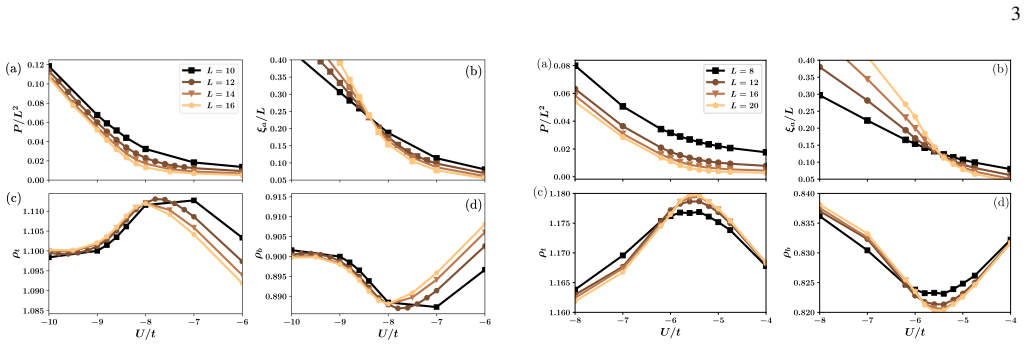
Summary. This manuscript studies the emergence of superconductivity in the attractive BHZ-Hubbard model on a square lattice using sign-problem-free auxiliary-field quantum Monte Carlo (AFQMC) simulations, supplemented by self-consistent Bogoliubov-de Gennes (BdG) calculations. The central result is that strong impurities—modeled as orbital-dependent potentials of opposite sign on the two orbitals—reduce the critical interaction strength |U_c| required for the onset of bulk superconductivity. In the clean system, the authors find U_c ≈ −8.5t; with impurity density f = 1/16, this drops to U_c ≈ −5.5t. The authors attribute this disorder-driven enhancement to impurity-induced subgap ring states that nucleate Cooper pairing, and they argue that the mechanism is tied to the strong quantum geometry of the BHZ model. A comparison with a trivial two-band model (Eq. 3) showing suppression of pairing with disorder is offered as evidence that the enhancement is geometry-specific. The paper also discusses an intermediate 'Cooper-pair insulating' regime where local pairing forms around impurities before global coherence is established.
Significance. The main result—that disorder can enhance superconductivity in a topological insulator model—is counterintuitive and physically interesting. The use of sign-problem-free AFQMC to establish this in an unbiased manner is a strength, as is the complementary BdG analysis providing real-space pairing profiles. The identification of an intermediate regime with local but incoherent pairing (Fig. 4c) is a falsifiable and experimentally relevant prediction. The connection to moiré materials and quantum geometry is timely. However, the causal attribution to quantum geometry is not independently verified within the paper (see major comments), which weakens the significance of the broader claims.
major comments (3)
- The paper's title, abstract, and conclusion attribute the disorder-driven enhancement of superconductivity to 'quantum geometry,' but the quantum metric and Berry curvature of the BHZ model are never computed. The attribution rests entirely on citations to prior work [35–44] linking ring states to quantum geometry, not on any calculation within this manuscript. The authors should either (i) compute the quantum geometric tensor (or at least the quantum metric) for the BHZ band structure and demonstrate that it is large in the relevant parameter regime, or (ii) soften the causal claim to state that the enhancement is associated with impurity-induced subgap states that are known (from prior work) to arise in systems with strong quantum geometry. As it stands, the central causal claim is not substantiated by the evidence presented.
- The control comparison in Fig. 3(b) does not cleanly isolate quantum geometry as the causal variable. The topological model uses U = −6t while the trivial model uses U = −4t; the two models also have different band structures (spin-orbit-coupled interorbital hopping vs. conventional interorbital hybridization, Eq. 3) and different orbital mixing properties. A proper control would compare the BHZ model against a trivial insulator with comparable quantum geometry, which the paper itself acknowledges exists (§V, citing [43, 44]). Without such a control, the contrast in Fig. 3(b) could be due to differences in band structure, density of states, or interaction strength rather than quantum geometry per se. The authors should either construct a more controlled comparison or explicitly acknowledge this limitation in the main text rather than only in the discussion.
- The mechanism described—impurity bound states enhancing the local density of states and promoting pairing—is generic to multi-band insulators with in-gap impurity states and does not inherently require quantum geometry. The authors should clarify what is specifically quantum-geometric about the mechanism beyond the ring-like spatial profile of the bound states. For instance, do the ring states have properties (e.g., orbital texture, spatial extent) that are quantitatively tied to the quantum metric? Without this, the reader cannot distinguish the authors' mechanism from the well-known Shiba-state physics in conventional superconductors, extended to the insulating case.
minor comments (6)
- §IV.B: The impurity strength V0 = ±40t is very large compared to the bandwidth. The authors should comment on whether the results are robust to more moderate impurity strengths, or whether the enhancement disappears.
- Fig. 3(a): The different curves for various f values do not include error bars or a discussion of statistical errors from the QMC sampling. Given that the differences between f = 0 and small f are subtle, some indication of statistical uncertainty would strengthen the figure.
- Appendix A: The BdG critical |U_c| values are systematically smaller than the AFQMC values. The authors attribute this to mean-field limitations but do not quantify the discrepancy. A table comparing the two would make the agreement more transparent.
- §II: The statement that 'the qualitative features are not sensitive to the specific impurity arrangement and persist for randomly distributed impurities' is made without supporting data. Either show results for random impurities or soften the claim.
- The paper uses M = 0.1 in the main text and M = 0.3 in Appendix C. The choice of M = 0.1 is quite small; the authors should comment on how close the system is to the gap-closing point M = 0 and whether the results are robust for larger M.
- Fig. 4(a) is labeled as a 'schematic phase diagram' but includes specific parameter values (U = −3.8t, f = 1/64) for the Cooper-pair insulating regime. It would be helpful to clarify which parts are schematic and which are from actual BdG calculations.
Circularity Check
No significant circularity; the central numerical result is from first-principles QMC, and the quantum-geometry attribution relies on self-cited prior work but is not circular by construction.
full rationale
The paper's central quantitative result — that strong impurities reduce |U_c| from ~8.5t to ~5.5t in the BHZ-Hubbard model — is obtained from sign-problem-free AFQMC simulations (Eqs. 1–5), a first-principles numerical method with no fitted parameters and no assumption of the target outcome. The BdG calculations (Appendix A) are an independent self-consistent mean-field computation that reproduces the same trend without assuming the QMC result. The causal attribution to quantum geometry rests on: (1) direct observation of ring-like subgap states in BdG calculations (Figs. 4b–d), which is an independent computation; (2) citations to prior work linking ring states to quantum geometry, including self-cited work by co-author Banerjee (Refs. 42, 44). These self-citations provide theoretical context for interpreting the observed ring states, but they are not load-bearing for the numerical result itself — the ring states are directly computed, not assumed. The paper does not define any quantity in terms of its own output, fit a parameter and rename it as a prediction, invoke a uniqueness theorem from self-cited work, or smuggle an ansatz via citation. The comparison with the trivial model (Fig. 3b, Eq. 3) is an imperfect control (different U, different band structure), but this is a correctness concern about isolating the causal variable, not a circularity concern — the trivial model's results are independently computed. The self-citations by Banerjee are supporting context, not the foundation of the derivation chain. Score 1 reflects the presence of non-load-bearing self-citation in the interpretive layer.
Axiom & Free-Parameter Ledger
free parameters (4)
- Hubbard interaction U =
varied; U_c ≈ -8.5t (clean), -5.5t (f=1/16)
- Orbital polarization M =
0.1 (main text), 0.3 (Appendix C)
- Impurity strength V0 =
±40t
- Impurity density f =
1/16, 1/64, etc.
axioms (3)
- domain assumption The attractive BHZ-Hubbard model is sign-problem-free at half-filling with the stated parameters.
- domain assumption Impurity-induced ring states require strong quantum geometry and act as Cooper pair nucleation centers.
- domain assumption The projective AFQMC ground-state results are converged in projection time and system size.
Cite this review
Pith. "Pith review of Emergent superconductivity upon disordering a topological insulator." pith.science (2026). https://pith.science/paper/TN7TAQ32
@misc{pith2026260707163,
  author       = {Pith},
  title        = {Pith review of: Emergent superconductivity upon disordering a topological insulator},
  year         = {2026},
  howpublished = {\url{https://pith.science/paper/TN7TAQ32}},
  note         = {Machine review of arXiv:2607.07163}
}
abstract
We study the emergence of superconductivity in a quantum spin Hall insulator and identify a disorder-driven enhancement of pairing arising from quantum geometry. Using sign-problem-free quantum Monte Carlo simulations of the attractive Bernevig-Hughes-Zhang (BHZ) Hubbard model, we obtain a quantum phase transition as a function of interaction strength for different impurity densities. In the clean limit, the system develops bulk superconductivity for Hubbard interaction $\vert U \vert$ above a finite critical strength. Interestingly, strong impurities significantly reduce such $\vert U \vert$ required for the onset of superconductivity. Our calculations indicate that Cooper pairing first nucleates in subgap ring states surrounding the impurities and then evolves into a globally coherent superconducting phase. Our results demonstrate that impurity-generated bound states can promote superconductivity in systems with strong quantum geometry. This mechanism is expected to be relevant in nearly flat-band systems like moir\'e materials where quantum geometry plays a dominant role.
Figures


Reference graph
Works this paper leans on
- [1]
-
[2]
E. Y . Andrei, D. K. Efetov, P. Jarillo-Herrero, A. H. MacDon- ald, K. F. Mak, T. Senthil, E. Tutuc, A. Yazdani, and A. F. Young, Nature Reviews Materials6, 201 (2021)
work page 2021
-
[3]
W. E. Pickett, Rev. Mod. Phys.95, 021001 (2023)
work page 2023
-
[4]
P. T ¨orm¨a, S. Peotta, and B. A. Bernevig, Nature Reviews 8 Physics4, 528 (2022)
work page 2022
-
[5]
X. Hu, T. Hyart, D. I. Pikulin, and E. Rossi, Phys. Rev. Lett. 123, 237002 (2019)
work page 2019
-
[6]
F. Xie, Z. Song, B. Lian, and B. A. Bernevig, Phys. Rev. Lett. 124, 167002 (2020)
work page 2020
- [7]
-
[8]
J. G. Bednorz and K. A. M ¨uller, Zeitschrift f¨ur Physik B Con- densed Matter64, 189 (1986)
work page 1986
-
[9]
Y . Cao, V . Fatemi, S. Fang, K. Watanabe, T. Taniguchi, E. Kaxi- ras, and P. Jarillo-Herrero, Nature556, 43 (2018)
work page 2018
-
[10]
D. Aoki, A. Nakamura, F. Honda, D. Li, Y . Homma, Y . Shimizu, Y . J. Sato, G. Knebel, J.-P. Brison, A. Pourret, D. Braithwaite, G. Lapertot, Q. Niu, M. Vali ˇska, H. Harima, and J. Flouquet, Journal of the Physical Society of Japan88, 043702 (2019)
work page 2019
-
[11]
B. Y . Wang, D. Li, B. H. Goodge, K. Lee, M. Osada, S. P. Harvey, L. F. Kourkoutis, M. R. Beasley, and H. Y . Hwang, Nature Physics17, 473 (2021)
work page 2021
-
[12]
E. Morosan, H. W. Zandbergen, B. S. Dennis, J. W. G. Bos, Y . Onose, T. Klimczuk, A. P. Ramirez, N. P. Ong, and R. J. Cava, Nature Physics2, 544 EP (2006), article
work page 2006
-
[13]
J. W. Park, H. Kim, and H. W. Yeom, ACS Nano20, 2337 (2026)
work page 2026
- [14]
-
[15]
L. Kong, M. Papaj, H. Kim, Y . Zhang, E. Baum, H. Li, K. Watanabe, T. Taniguchi, G. Gu, P. A. Lee, and S. Nadj-Perge, Nature640, 55 (2025)
work page 2025
-
[16]
X. Liu, Y . X. Chong, R. Sharma, and J. C. S. Davis, Science 372, 1447 (2021)
work page 2021
- [17]
-
[18]
C. L. Kane and E. J. Mele, Phys. Rev. Lett.95, 146802 (2005)
work page 2005
-
[20]
J. Yu, B. A. Bernevig, R. Queiroz, E. Rossi, P. T¨orm¨a, and B.-J. Yang, npj Quantum Materials10, 101 (2025)
work page 2025
- [21]
- [22]
- [23]
- [24]
- [25]
-
[26]
S. A. Chen and K. T. Law, Phys. Rev. Lett.132, 026002 (2024)
work page 2024
- [27]
-
[28]
H. Tian, X. Gao, Y . Zhang, S. Che, T. Xu, P. Cheung, K. Watan- abe, T. Taniguchi, M. Randeria, F. Zhang, C. N. Lau, and M. W. Bockrath, Nature614, 440 (2023)
work page 2023
-
[29]
M. Tovmasyan, S. Peotta, P. T¨orm¨a, and S. D. Huber, Phys. Rev. B94, 245149 (2016)
work page 2016
-
[30]
J. S. Hofmann, E. Berg, and D. Chowdhury, Phys. Rev. B102, 201112(R) (2020)
work page 2020
- [31]
-
[32]
J. S. Hofmann, E. Berg, and D. Chowdhury, Phys. Rev. Lett. 130, 226001 (2023)
work page 2023
- [33]
-
[34]
J. Skolimowski, W. Brzezicki, and C. Autieri, Phys. Rev. B109, 075147 (2024)
work page 2024
-
[35]
F. Wang, Q. Liu, T. Ma, and X. Jiang, Journal of Physics: Con- densed Matter24, 455701 (2012)
work page 2012
-
[36]
J. D. Sau and E. Demler, Physical Review B—Condensed Mat- ter and Materials Physics88, 205402 (2013)
work page 2013
-
[37]
W.-Y . Shan, J. Lu, H.-Z. Lu, and S.-Q. Shen, Physical Re- view B—Condensed Matter and Materials Physics84, 035307 (2011)
work page 2011
- [38]
- [39]
-
[40]
S.-S. Diop, L. Fritz, M. V ojta, and S. Rachel, Physical Review B101, 245132 (2020)
work page 2020
-
[41]
M. Mashkoori, K. Bj ¨ornson, and A. M. Black-Schaffer, Scien- tific Reports7, 44107 (2017)
work page 2017
- [42]
-
[43]
Ring states in topological materials
R. Queiroz, R. Ilan, Z. Song, B. A. Bernevig, and A. Stern, arXiv preprint arXiv:2406.03529 (2024)
work page internal anchor Pith review Pith/arXiv arXiv 2024
-
[44]
E. Pangburn, A. Banerjee, C. P ´epin, and C. Bena, Phys. Rev. B 112, 125157 (2025)
work page 2025
- [45]
- [46]
-
[47]
A. Lau, S. Peotta, D. Pikulin, E. Rossi, and T. Hyart, SciPost Phys.13, 086 (2022)
work page 2022
-
[48]
G. Sambandamurthy, L. W. Engel, A. Johansson, and D. Shahar, Phys. Rev. Lett.92, 107005 (2004)
work page 2004
- [49]
-
[50]
J. Yuan, J.-H. Gao, W.-Q. Chen, F. Ye, Y . Zhou, and F.-C. Zhang, Phys. Rev. B86, 104505 (2012)
work page 2012
- [51]
-
[52]
J. S. Hofmann, F. F. Assaad, and A. P. Schnyder, Phys. Rev. B 93, 201116(R) (2016)
work page 2016
-
[53]
M. Hohenadler, Z. Y . Meng, T. C. Lang, S. Wessel, A. Mura- matsu, and F. F. Assaad, Phys. Rev. B85, 115132 (2012)
work page 2012
-
[54]
H.-Y . Xie, P. Abbamonte, and B. Uchoa, arxiv (2026), 2606.18346 [cond-mat.mes-hall]
work page internal anchor Pith review Pith/arXiv arXiv 2026
-
[55]
J. Y . Yan, X. Guo, R. Bhandia, T. F. Rosenbaum, N. Drichko, and N. P. Armitage, arxiv (2026), 2606.21648 [cond-mat.str- el]
work page internal anchor Pith review Pith/arXiv arXiv 2026
-
[56]
B. A. Bernevig, T. L. Hughes, and S.-C. Zhang, Science314, 1757 (2006)
work page 2006
-
[57]
R. T. Scalettar, E. Y . Loh, J. E. Gubernatis, A. Moreo, S. R. White, D. J. Scalapino, R. L. Sugar, and E. Dagotto, Phys. Rev. Lett.62, 1407 (1989)
work page 1989
- [58]
- [59]
-
[60]
R. R. dos Santos, Phys. Rev. B46, 5496 (1992)
work page 1992
-
[61]
R. A. Fontenele, N. C. Costa, R. R. dos Santos, and T. Paiva, Phys. Rev. B105, 184502 (2022)
work page 2022
-
[62]
R. A. Fontenele, N. C. Costa, T. Paiva, and R. R. dos Santos, Phys. Rev. B113, 104519 (2026)
work page 2026
-
[63]
R. T. Scalettar, D. J. Scalapino, and R. L. Sugar, Phys. Rev. B 34, 7911 (1986)
work page 1986
-
[64]
F. F. Assaad, M. Bercx, F. Goth, A. G ¨otz, J. S. Hofmann, E. Huffman, Z. Liu, F. P. Toldin, J. S. E. Portela, and J. Schwab, SciPost Phys. Codebases , 1 (2025)
work page 2025
-
[65]
A. W. Sandvik, AIP Conference Proceedings1297, 135 (2010)
work page 2010
- [66]
-
[67]
K. L. Lee, K. Bouadim, G. G. Batrouni, F. H´ebert, R. T. Scalet- tar, C. Miniatura, and B. Gr ´emaud, Phys. Rev. B80, 245118 (2009)
work page 2009
-
[68]
I.-D. Potirniche, J. Maciejko, R. Nandkishore, and S. L. Sondhi, Phys. Rev. B90, 094516 (2014)
work page 2014
-
[69]
J. M. Park, C. V oinea, Y .-C. Tsui, S. Pu, K. Watanabe, T. Taniguchi, N. R. Cooper, M. P. Zaletel, Z. Papi´c, and A. Yaz- dani, arXiv preprint arXiv:2606.25024 (2026)
work page internal anchor Pith review Pith/arXiv arXiv 2026
-
[70]
Y . Xu, J. Chiu, L. Miao, H. He, Z. Alpichshev, A. Kapitul- nik, R. R. Biswas, and L. A. Wray, Nature Communications8, 14081 (2017)
work page 2017
-
[71]
Z. Alpichshev, R. R. Biswas, A. V . Balatsky, J. G. Analytis, J.- H. Chu, I. R. Fisher, and A. Kapitulnik, Phys. Rev. Lett.108, 206402 (2012)
work page 2012
-
[72]
F. Reis, G. Li, L. Dudy, M. Bauernfeind, S. Glass, W. Hanke, R. Thomale, J. Sch ¨afer, and R. Claessen, Science357, 287 (2017)
work page 2017
-
[73]
A. Roth, C. Br ¨une, H. Buhmann, L. W. Molenkamp, J. Ma- ciejko, X.-L. Qi, and S.-C. Zhang, Science325, 294 (2009)
work page 2009
- [74]
-
[75]
De Gennes,Superconductivity of Metals and Alloys, Frontiers in physics (Benjamin, 1966)
P. De Gennes,Superconductivity of Metals and Alloys, Frontiers in physics (Benjamin, 1966)
work page 1966
- [76]
- [77]
-
[78]
A. M. Black-Schaffer and A. V . Balatsky, Physical Review B 87, 220506 (2013), publisher: American Physical Society
work page 2013
- [79]
- [80]
- [81]
This paper was first reviewed by glm-5.2 on July 9, 2026.
discussion (0)
Sign in with ORCID, Apple, or X to comment. Anyone can read and Pith papers without signing in.