REVIEW 3 major objections 215 references
Strong code-solving models still fail at lowering cognitive demand for learners.
Reviewed by Pith at T0; open to challenge. T0 means a machine referee read the full paper against a public rubric. the ladder, T0–T4 →
T0 review · grok-4.5
2026-07-10 13:48 UTC pith:UO2SFACE
load-bearing objection Clean measurement paper: matched Qwen pair shows models raise Bloom demand easily and lower it poorly; judge-on-mutations is the real soft spot, not the design. the 3 major comments →
From Execution to Education: A Bloom-Aligned Framework for Measuring Educational Control in LLMs
The pith
A machine-rendered reading of the paper's core claim, the machinery that carries it, and where it could break.
Core claim
Across 2,520 programming tasks from three benchmarks, a matched general and code-specialized model pair both raise Bloom-level cognitive demand under Harder and Higher prompts, yet struggle to lower it under Easier and Lower prompts. Target-zone accuracy for Higher levels is high, while accuracy for Lower levels stays below about 30 percent overall, and general Easier requests still produce positive average cognitive shifts. Within this pair, the general model shows clearer middle-layer linear separability for both instruction contrasts, while the coder model is weaker on difficulty contrasts and peaks deeper for Bloom contrasts. Strong execution performance therefore does not automatically
What carries the argument
A Bloom-aligned educational-control framework that rewrites each task under matched Harder/Easier and Higher/Lower prompts, then scores outcomes with Observed Cognitive Shift (average movement on the 1-6 Bloom scale) and Target Zone Accuracy (whether the rewrite lands in the intended Bloom zone), with supporting semantic-delta clustering of surface mutations and layer-wise Fisher's Discriminant Ratio probes of residual-stream separability.
Load-bearing premise
The main results rest on an automated judge's Bloom labels for rewritten tasks, validated mainly by strong agreement with humans on original tasks rather than a full human audit of the mutated tasks themselves.
What would settle it
If independent human raters labeled a large sample of the same Harder/Easier and Higher/Lower rewrites and found that the models do in fact land in Remember/Understand zones about as often as Higher zones, or that Easier rewrites systematically lower Bloom level rather than raise it, the directional-asymmetry claim would fail.
Editorial analysis
A structured set of objections, weighed in public.
Referee Report
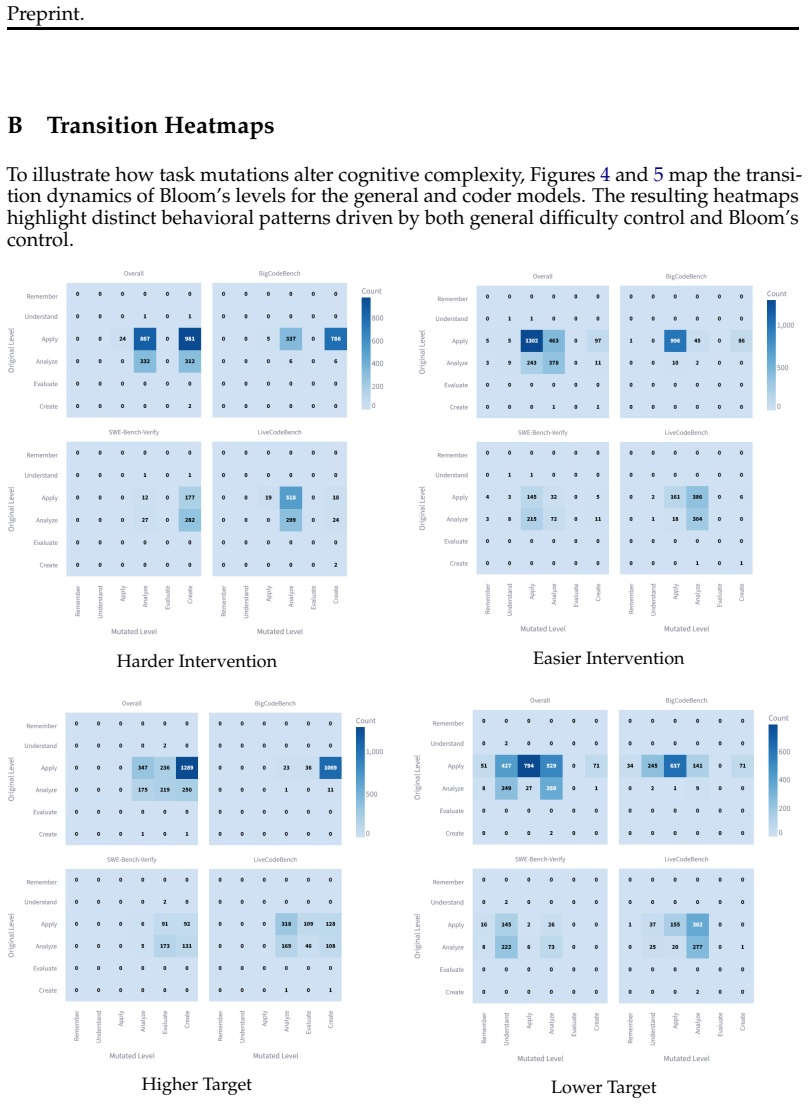
Summary. The paper proposes a Bloom-aligned framework for measuring educational control in LLMs: the ability to preserve a task’s instructional intent while shifting cognitive demand along revised Bloom’s Taxonomy. Using a matched Qwen3-Next general/coder pair on 2,520 programming tasks from BigCodeBench, LiveCodeBench, and SWE-Bench-Verified, it compares general difficulty interventions (Harder/Easier) with Bloom-targeted interventions (Higher/Lower). Outcomes are quantified by Observed Cognitive Shift (OCS; Eq. 1) and Target Zone Accuracy (TZA; Eq. 2) via an external Claude-3.5-Haiku judge, then characterized with semantic-delta keyword clustering and layer-wise Fisher’s Discriminant Ratio (FDR) probing of residual-stream activations. The central empirical claim is a robust upward asymmetry—both models raise cognitive demand more readily than they lower it—and that strong code-execution specialization does not automatically yield Bloom-aligned educational control.
Significance. If the directional asymmetry holds under stronger validation, the paper supplies a concrete, reusable evaluation protocol for a gap that execution benchmarks systematically miss: whether models can adapt tasks for learners rather than only solve them. Strengths include a carefully matched general/coder comparison (same architecture and tokenizer), fixed prompts and decoding, multi-benchmark coverage, explicit metrics (OCS/TZA), and complementary external (semantic-delta) and internal (FDR/projections) diagnostics. The work is timely for CS education and LLM tutoring, and the representation results offer a natural hook for future steering experiments. The contribution is primarily empirical and methodological rather than theoretical, but that is appropriate for the claim.
major comments (3)
- §3.2 and Limitations: The load-bearing OCS/TZA results (Tables 1–2) rest on Claude-3.5-Haiku labels of mutated tasks. Judge validity is grounded mainly in Gwet’s AC2 0.95 on a 150-question original-task subset, while the paper itself notes that mutations may leave that distribution. Relative-use is a reasonable design choice, but without a human audit (or second-judge agreement) on a stratified sample of mutated tasks—especially Easier/Lower failures and Appendix C-style surface rewrites—the upward-asymmetry claim remains only partially secured. A modest mutated-set audit with reported agreement would substantially strengthen the central result.
- §4.1–4.2 / Tables 1–2: “Preserve instructional intent” is part of the definition of educational control in the abstract and introduction, yet OCS and TZA measure only Bloom-level movement, not intent preservation (topic, learning objective, or solution-space fidelity). Without an explicit intent-preservation check—even a coarse human or secondary-judge rating on a sample—it is hard to distinguish successful educational adaptation from topic drift or problem replacement. Adding such a check, or narrowing the claim language to cognitive-level shift alone, is needed for the framework’s stated definition.
- §5.2 / Algorithm 2 and Figures 1–3: FDR and mean-difference projections are presented as representation diagnostics of instruction contrasts, which is appropriate, but the discussion sometimes invites a stronger causal reading (e.g., encoding loci, future steering). The paper correctly flags the need for causal interventions in Limitations; the main text should keep the same boundary more consistently so that weaker coder-model separability is not over-interpreted as the mechanistic cause of poorer downward control.
Circularity Check
No circular derivation: OCS/TZA and FDR are independent of the generators; the asymmetry is an empirical observation, not a fit or self-definition.
full rationale
The paper's central claim is an empirical comparison of two matched models under fixed intervention prompts, scored by an external judge and by parameter-free representation diagnostics. Observed Cognitive Shift and Target Zone Accuracy (Eqs. 1–2) are defined from judge-assigned Bloom labels of original vs. mutated tasks; they are not fitted parameters and do not redefine success in terms of the generators' own outputs. The judge is Claude-3.5-Haiku, justified by prior human agreement (Gwet's AC2 0.95) on a 150-question original-task subset, not by self-scoring from the Qwen models under test. Semantic-delta clustering and layer-wise FDR (Eq. 4) characterize observed contrasts rather than force the behavioral result. Self-citations (e.g., Zhang & Rayz 2026 on the judge; related Bloom/SOLO work) supply background and judge validation; they do not import a uniqueness theorem or ansatz that makes the upward-asymmetry claim true by construction. Distribution-shift risk for the judge is a validity concern, not circularity. The derivation chain is observational and self-contained against external benchmarks.
Axiom & Free-Parameter Ledger
free parameters (3)
- generation decoding settings =
T=0.1, top-p=0.95, freq_pen=0.1, max_tokens=2048, seed=42
- semantic-delta clustering hyperparameters =
UMAP dims=5; min_cluster_size=15
- FDR probe token choice =
LAST_INST residual stream
axioms (5)
- domain assumption Revised Bloom's Taxonomy levels form a usable ordinal scale of cognitive demand for programming tasks.
- domain assumption Claude-3.5-Haiku Bloom labels are reliable enough for relative movement comparisons on mutated tasks.
- domain assumption Matched architecture and tokenizer make the Qwen3-Next general/coder pair a controlled comparison of specialization effects.
- standard math Fisher's Discriminant Ratio on residual-stream activations measures linear separability of instruction contrasts across depth.
- domain assumption Semantic delta vectors E_mut - E_orig isolate mutation intent under the linear representation hypothesis.
invented entities (3)
-
Observed Cognitive Shift (OCS)
no independent evidence
-
Target Zone Accuracy (TZA)
no independent evidence
-
Educational control (Bloom-aligned)
no independent evidence
read the original abstract
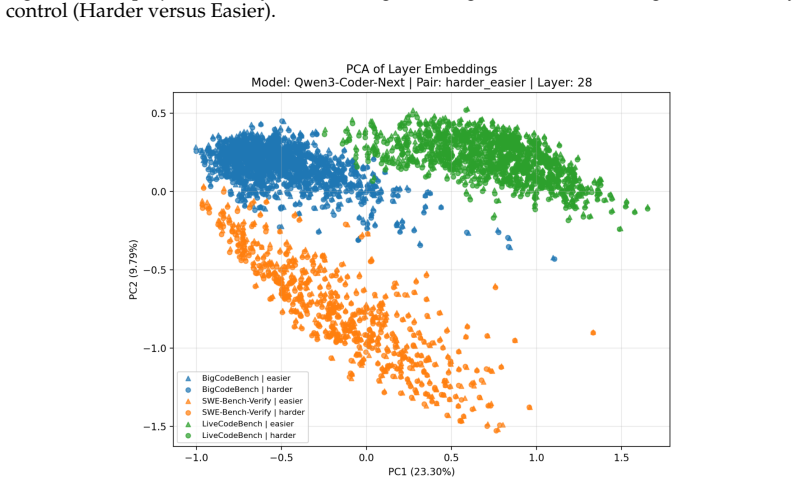
We introduce a Bloom-aligned framework for measuring educational control in Large Language Models (LLMs): the ability to preserve a task's instructional intent while shifting its cognitive demand toward specified learning objectives. We apply this framework to programming tasks in computer science education to study the gap between solving tasks and adapting them for learners. Using revised Bloom's Taxonomy as an operational scale of cognitive demand, we evaluate two intervention settings: general difficulty control, where models are asked to make tasks harder or easier, and Bloom's control, where models are asked to target higher or lower Bloom's levels. We evaluate a matched Qwen3-Next model pair, comparing Qwen3-Next-80B-A3B-Instruct with Qwen3-Coder-Next across 2,520 tasks from three benchmarks. The framework reveals a robust directional asymmetry: both models reliably increase cognitive demand, but struggle to lower it. We further characterize these outcomes with semantic-delta clustering and layer-wise Fisher's Discriminant Ratio probing. Within this controlled comparison, the general model shows clearer middle-layer separability for both general difficulty and Bloom-control contrasts, whereas the coder model shows weaker separability for general difficulty and a deeper peak for Bloom-control contrasts. These results show that strong execution performance does not automatically entail Bloom-aligned educational control.
Figures






Reference graph
Works this paper leans on
-
[1]
Abdin, Marah and Aneja, Jyoti and Awadalla, Hany and Awadallah, Ahmed and Awan, Ammar Ahmad and Bach, Nguyen and Bahree, Amit and Bakhtiari, Arash and Bao, Jianmin and Behl, Harkirat and Benhaim, Alon and Bilenko, Misha and Bjorck, Johan and Bubeck, S. Phi-3. doi:10.48550/arXiv.2404.14219 , archiveprefix =. 2404.14219 , primaryclass =
work page internal anchor Pith review Pith/arXiv arXiv doi:10.48550/arxiv.2404.14219
-
[2]
Categorical Data Analysis , author =
-
[3]
Understanding intermediate layers using linear classifier probes
Understanding Intermediate Layers Using Linear Classifier Probes , author =. doi:10.48550/arXiv.1610.01644 , archiveprefix =. 1610.01644 , primaryclass =
work page internal anchor Pith review Pith/arXiv arXiv doi:10.48550/arxiv.1610.01644
-
[4]
Allamanis, Miltiadis and Sutton, Charles , year = 2013, pages =. Mining. 2013 10th
work page 2013
-
[5]
and Inkpen, Kori and Teevan, Jaime and
Amershi, Saleema and Weld, Dan and Vorvoreanu, Mihaela and Fourney, Adam and Nushi, Besmira and Collisson, Penny and Suh, Jina and Iqbal, Shamsi and Bennett, Paul N. and Inkpen, Kori and Teevan, Jaime and. Guidelines for. Proceedings of the 2019. doi:10.1145/3290605.3300233 , isbn =
-
[6]
Anderson, John R. and Conrad, Frederick G. and Corbett, Albert T. , year = 1989, month = oct, journal =. Skill. doi:10.1207/s15516709cog1304_1 , langid =
-
[7]
A Taxonomy for Learning, Teaching, and Assessing:
Anderson, Lorin W and Krathwohl, David R , year = 2001, publisher =. A Taxonomy for Learning, Teaching, and Assessing:
work page 2001
-
[8]
Andrews, Robert W. and Lilly, J. Mason and Srivastava, Divya and Feigh, Karen M. , year = 2023, month = mar, journal =. The Role of Shared Mental Models in Human-. doi:10.1080/1463922X.2022.2061080 , langid =
-
[9]
Claude 3.5 Haiku , author =
-
[10]
Claude 3.7 Sonnet and Claude Code , author =
-
[11]
Claude 4.5 Haiku , author =
-
[12]
Arneson, Jessie B. and Offerdahl, Erika G. , editor =. Visual. CBE---Life Sciences Education , volume =. doi:10.1187/cbe.17-08-0178 , langid =
-
[13]
Austin, Jacob and Odena, Augustus and Nye, Maxwell and Bosma, Maarten and Michalewski, Henryk and Dohan, David and Jiang, Ellen and Cai, Carrie and Terry, Michael and Le, Quoc and Sutton, Charles , year = 2021, month = aug, number =. Program. doi:10.48550/arXiv.2108.07732 , archiveprefix =. 2108.07732 , primaryclass =
work page internal anchor Pith review Pith/arXiv arXiv doi:10.48550/arxiv.2108.07732 2021
-
[14]
Transactions on Machine Learning Research , issn =
Beyond the. Transactions on Machine Learning Research , issn =
-
[15]
Measuring the Impact of Early-2025 AI on Experienced Open-Source Developer Productivity
Becker, Joel and Rush, Nate and Barnes, Elizabeth and Rein, David , year = 2025, month = jul, number =. Measuring the. doi:10.48550/arXiv.2507.09089 , archiveprefix =. 2507.09089 , primaryclass =
work page internal anchor Pith review Pith/arXiv arXiv doi:10.48550/arxiv.2507.09089 2025
-
[16]
Belinkov, Yonatan , year = 2022, month = apr, journal =. Probing. doi:10.1162/coli_a_00422 , langid =
work page internal anchor Pith review doi:10.1162/coli_a_00422 2022
-
[17]
Graph of Thoughts: Solving Elaborate Problems with Large Language Models
Besta, Maciej and Blach, Nils and Kubicek, Ales and Gerstenberger, Robert and Gianinazzi, Lukas and Gajda, Joanna and Lehmann, Tomasz and Podstawski, Michal and Niewiadomski, Hubert and Nyczyk, Piotr and Hoefler, Torsten , year = 2023, month = nov, number =. Graph of. arXiv , keywords =:2308.09687 , primaryclass =
work page internal anchor Pith review Pith/arXiv arXiv 2023
-
[18]
Evaluating the Quality of Learning: The
Biggs, John Burville and Biggs, John Burville and Collis, Kevin Francis , year = 1982, series =. Evaluating the Quality of Learning: The
work page 1982
-
[19]
Bloom, Benjamin S. and Engelhart, Max D. , year = 1956, publisher =. Taxonomy of Educational Objectives: The Classification of Educational Goals
work page 1956
-
[20]
Boisseau,. Imitation and. Minds and Machines , volume =. doi:10.1007/s11023-024-09698-6 , langid =
-
[21]
Nature Reviews Genetics , volume =
Constraint-Based Models Predict Metabolic and Associated Cellular Functions , author =. Nature Reviews Genetics , volume =. doi:10.1038/nrg3643 , copyright =
-
[22]
Bricken, Trenton and Templeton, Adly and Batson, Joshua and Chen, Brian and Jermyn, Adam and Conerly, Tom and Turner, Nicholas and Anil, Cem and Denison, Carson and Askell, Amanda and Lasenby, Robert and Wu, Yuhuai and Kravec, Shauna and Schiefer, Nicholas and Maxwell, Todd and Joseph, Nicholas and. Towards Monosemanticity:
-
[23]
Bu. To. Proceedings of the ACM on Human-Computer Interaction , volume =. doi:10.1145/3449287 , langid =
work page internal anchor Pith review doi:10.1145/3449287
-
[24]
Campbell, Murray and Hoane, A.Joseph and Hsu, Feng-hsiung , year = 2002, month = jan, journal =. Deep. doi:10.1016/S0004-3702(01)00129-1 , copyright =
-
[25]
Campello, Ricardo J. G. B. and Moulavi, Davoud and Sander, Joerg , editor =. Density-. Advances in. doi:10.1007/978-3-642-37456-2_14 , isbn =
-
[26]
Cao, Ruisheng and Chen, Mouxiang and Chen, Jiawei and Cui, Zeyu and Feng, Yunlong and Hui, Binyuan and Jing, Yuheng and Li, Kaixin and Li, Mingze and Lin, Junyang and Ma, Zeyao and Shum, Kashun and Wang, Xuwu and Wei, Jinxi and Yang, Jiaxi and Zhang, Jiajun and Zhang, Lei and Zhang, Zongmeng and Zhao, Wenting and Zhou, Fan , year = 2026, month = feb, numb...
work page internal anchor Pith review Pith/arXiv arXiv doi:10.48550/arxiv.2603.00729 2026
-
[27]
Chan, Lawrence and. Causal
-
[28]
BeyondSWE: Can Current Code Agent Survive Beyond Single-Repo Bug Fixing?
Chen, Guoxin and Meng, Fanzhe and Zhao, Jiale and Li, Minghao and Cheng, Daixuan and Song, Huatong and Chen, Jie and Lin, Yuzhi and Chen, Hui and Zhao, Xin and Song, Ruihua and Liu, Chang and Chen, Cheng and Jia, Kai and Wen, Ji-Rong , year = 2026, month = mar, number =. doi:10.48550/arXiv.2603.03194 , archiveprefix =. 2603.03194 , primaryclass =
work page internal anchor Pith review Pith/arXiv arXiv doi:10.48550/arxiv.2603.03194 2026
-
[29]
Evaluating Large Language Models Trained on Code
Chen, Mark and Tworek, Jerry and Jun, Heewoo and Yuan, Qiming and Pinto, Henrique Ponde de Oliveira and Kaplan, Jared and Edwards, Harri and Burda, Yuri and Joseph, Nicholas and Brockman, Greg and Ray, Alex and Puri, Raul and Krueger, Gretchen and Petrov, Michael and Khlaaf, Heidy and Sastry, Girish and Mishkin, Pamela and Chan, Brooke and Gray, Scott and...
work page internal anchor Pith review Pith/arXiv arXiv doi:10.48550/arxiv.2107.03374
-
[30]
Chen, Xuelu and Hu, Ziniu and Sun, Yizhou , year = 2022, month = jun, journal =. Fuzzy
work page 2022
-
[31]
Chen, Jiaao and Yang, Diyi , year = 2021, pages =. Structure-. Proceedings of the 2021. doi:10.18653/v1/2021.naacl-main.109 , langid =
-
[32]
Chen, Liguo and Guo, Qi and Jia, Hongrui and Zeng, Zhengran and Wang, Xin and Xu, Yijiang and Wu, Jian and Wang, Yidong and Gao, Qing and Wang, Jindong and Ye, Wei and Zhang, Shikun , year = 2025, month = mar, number =. A. doi:10.48550/arXiv.2408.16498 , archiveprefix =. 2408.16498 , primaryclass =
work page internal anchor Pith review Pith/arXiv arXiv doi:10.48550/arxiv.2408.16498 2025
-
[33]
Church, Alonzo , year = 1936, month = apr, journal =. An. 2371045 , eprinttype =
work page 1936
-
[34]
Training Verifiers to Solve Math Word Problems
Cobbe, Karl and Kosaraju, Vineet and Bavarian, Mohammad and Chen, Mark and Jun, Heewoo and Kaiser, Lukasz and Plappert, Matthias and Tworek, Jerry and Hilton, Jacob and Nakano, Reiichiro and Hesse, Christopher and Schulman, John , year = 2021, month = nov, number =. Training. doi:10.48550/arXiv.2110.14168 , archiveprefix =. 2110.14168 , primaryclass =
work page internal anchor Pith review Pith/arXiv arXiv doi:10.48550/arxiv.2110.14168 2021
-
[35]
Cohen, Jacob , year = 1960, month = apr, journal =. A. doi:10.1177/001316446002000104 , copyright =
-
[36]
Cohen, Jacob , year = 2013, month = may, edition =. Statistical. doi:10.4324/9780203771587 , isbn =
-
[37]
Cohen, Jacob , year = 1968, journal =. Weighted Kappa:. doi:10.1037/h0026256 , langid =
-
[38]
Variables and Distributions in
CRAM. Variables and Distributions in. Mathematical Methods of Statistics (. j.ctt1bpm9r4.10 , eprinttype =
-
[39]
De Bruijn, N. G. , editor =. Automation of. doi:10.1007/978-3-642-81955-1_11 , isbn =
-
[40]
Desolda, Giuseppe and Esposito, Andrea and Greco, Francesco and Tucci, Cesare and Buono, Paolo and Piccinno, Antonio , year = 2025, month = aug, number =. Understanding. doi:10.48550/arXiv.2502.02194 , archiveprefix =. 2502.02194 , primaryclass =
-
[41]
Dewayani, Gracia Putri and Ngadiso, Ngadiso and Sarosa, Teguh , year = 2020, month = oct, journal =. Insufficient
work page 2020
-
[42]
Communications of the ACM , volume =
The Humble Programmer , author =. Communications of the ACM , volume =. doi:10.1145/355604.361591 , langid =
-
[43]
Du, Xueying and Liu, Mingwei and Wang, Kaixin and Wang, Hanlin and Liu, Junwei and Chen, Yixuan and Feng, Jiayi and Sha, Chaofeng and Peng, Xin and Lou, Yiling , year = 2024, month = apr, pages =. Evaluating. Proceedings of the. doi:10.1145/3597503.3639219 , isbn =
- [44]
-
[45]
Elazar, Yanai and Ravfogel, Shauli and Jacovi, Alon and Goldberg, Yoav , year = 2021, month = mar, journal =. Amnesic. doi:10.1162/tacl_a_00359 , langid =
-
[46]
A Mathematical Framework for Transformer Circuits , author =
-
[47]
Elhage, Nelson and Hume, Tristan and Olsson, Catherine and Schiefer, Nicholas and Henighan, Tom and Kravec, Shauna and. Toy. doi:10.48550/arXiv.2209.10652 , archiveprefix =. 2209.10652 , primaryclass =
work page internal anchor Pith review Pith/arXiv arXiv doi:10.48550/arxiv.2209.10652
-
[48]
Elkins, Sabina and Kochmar, Ekaterina and Cheung, Jackie C. K. and Serban, Iulian , year = 2024, month = mar, journal =. How
work page 2024
-
[49]
The Rating of Chessplayers, Past and Present , author =
-
[50]
Ensmenger, Nathan , year = 2010, series =. The Computer Boys Take over: Computers, Programmers, and the Politics of Technical Expertise , shorttitle =
work page 2010
-
[51]
Feinstein, Alvan R. and Cicchetti, Domenic V. , year = 1990, month = jan, journal =. High Agreement but Low. doi:10.1016/0895-4356(90)90158-L , copyright =
-
[52]
CodeBERT: A Pre-Trained Model for Programming and Natural Languages
Feng, Zhangyin and Guo, Daya and Tang, Duyu and Duan, Nan and Feng, Xiaocheng and Gong, Ming and Shou, Linjun and Qin, Bing and Liu, Ting and Jiang, Daxin and Zhou, Ming , year = 2020, month = sep, number =. doi:10.48550/arXiv.2002.08155 , archiveprefix =. 2002.08155 , primaryclass =
work page internal anchor Pith review Pith/arXiv arXiv doi:10.48550/arxiv.2002.08155 2020
-
[53]
Fisher, R. A. , year = 1922, month = jan, journal =. On the. 2340521 , eprinttype =
work page 1922
-
[54]
Building a Bridge between Skills and Thresholds:
Folk, Amanda and Blocksidge, Katie and Hammons, Jane and Primeau, Hanna , year = 2024, month = jun, journal =. Building a Bridge between Skills and Thresholds:. doi:10.11645/18.1.58 , copyright =
-
[55]
ACM SIGCSE Bulletin , volume =
Developing a Computer Science-Specific Learning Taxonomy , author =. ACM SIGCSE Bulletin , volume =. doi:10.1145/1345375.1345438 , langid =
-
[56]
LLM-based NLG Evaluation: Current Status and Challenges
Gao, Mingqi and Hu, Xinyu and Ruan, Jie and Pu, Xiao and Wan, Xiaojun , year = 2024, month = feb, number =. doi:10.48550/arXiv.2402.01383 , archiveprefix =. 2402.01383 , primaryclass =
work page internal anchor Pith review Pith/arXiv arXiv doi:10.48550/arxiv.2402.01383 2024
-
[57]
Gao, Leo and Biderman, Stella and Black, Sid and Golding, Laurence and Hoppe, Travis and Foster, Charles and Phang, Jason and He, Horace and Thite, Anish and Nabeshima, Noa and Presser, Shawn and Leahy, Connor , year = 2020, month = dec, number =. The. doi:10.48550/arXiv.2101.00027 , archiveprefix =. 2101.00027 , primaryclass =
work page internal anchor Pith review Pith/arXiv arXiv doi:10.48550/arxiv.2101.00027 2020
-
[58]
Retrieval-Augmented Generation for Large Language Models: A Survey
Gao, Yunfan and Xiong, Yun and Gao, Xinyu and Jia, Kangxiang and Pan, Jinliu and Bi, Yuxi and Dai, Yi and Sun, Jiawei and Wang, Meng and Wang, Haofen , year = 2024, month = mar, number =. Retrieval-. doi:10.48550/arXiv.2312.10997 , archiveprefix =. 2312.10997 , primaryclass =
work page internal anchor Pith review Pith/arXiv arXiv doi:10.48550/arxiv.2312.10997 2024
-
[59]
Scaling and Evaluating Sparse Autoencoders , booktitle =
Gao, Leo and. Scaling and Evaluating Sparse Autoencoders , booktitle =
-
[60]
Grattafiori, Aaron and Dubey, Abhimanyu and Jauhri, Abhinav and Pandey, Abhinav and Kadian, Abhishek and. The. doi:10.48550/arXiv.2407.21783 , archiveprefix =. 2407.21783 , primaryclass =
work page internal anchor Pith review Pith/arXiv arXiv doi:10.48550/arxiv.2407.21783
-
[61]
BERTopic: Neural topic modeling with a class-based TF-IDF procedure
Grootendorst, Maarten , year = 2022, month = mar, number =. doi:10.48550/arXiv.2203.05794 , archiveprefix =. 2203.05794 , primaryclass =
work page internal anchor Pith review Pith/arXiv arXiv doi:10.48550/arxiv.2203.05794 2022
-
[62]
Gupta, Akshat and Yeung, Jay and Anumanchipalli, Gopala and Ivanova, Anna , year = 2026, month = mar, number =. How. doi:10.48550/arXiv.2510.18871 , archiveprefix =. 2510.18871 , primaryclass =
-
[63]
Language Models Represent Space and Time , booktitle =
Gurnee, Wes and Tegmark, Max , editor =. Language Models Represent Space and Time , booktitle =
-
[64]
Guzdial, Mark , year = 2016, series =. Learner-. doi:10.1007/978-3-031-02216-6 , copyright =
-
[65]
British Journal of Mathematical and Statistical Psychology , volume =
Computing Inter-rater Reliability and Its Variance in the Presence of High Agreement , author =. British Journal of Mathematical and Statistical Psychology , volume =. doi:10.1348/000711006X126600 , copyright =
-
[66]
Habiballa, Hashim and Kotyrba, Martin and Volna, Eva and Bradac, Vladimir and Dusek, Martin , year = 2025, month = jan, journal =. Artificial. doi:10.3390/app15020581 , copyright =
-
[67]
The Thirteenth International Conference on Learning Representations , author =
- [68]
- [69]
-
[70]
Hochreiter, Sepp and Schmidhuber, J. Long. Neural Computation , volume =. doi:10.1162/neco.1997.9.8.1735 , langid =
-
[71]
Evaluating LLMs' Mathematical and Coding Competency through Ontology-guided Interventions
Hong, Pengfei and Majumder, Navonil and Ghosal, Deepanway and Aditya, Somak and Mihalcea, Rada and Poria, Soujanya , year = 2024, month = nov, number =. Evaluating. doi:10.48550/arXiv.2401.09395 , archiveprefix =. 2401.09395 , primaryclass =
work page internal anchor Pith review Pith/arXiv arXiv doi:10.48550/arxiv.2401.09395 2024
-
[72]
Hou, Irene and Mettille, Sophia and Man, Owen and Li, Zhuo and Zastudil, Cynthia and MacNeil, Stephen , year = 2024, month = jan, pages =. The. Proceedings of the 26th. doi:10.1145/3636243.3636248 , isbn =
-
[73]
Huber, Thomas and Niklaus, Christina , editor =. Proceedings of the 31st
-
[74]
Hu, Wenhao and Duan, Jinhao and Wei, Chunchen and Zhang, Li and Zhang, Yue and Xu, Kaidi , year = 2025, month = mar, number =. doi:10.48550/arXiv.2503.10452 , archiveprefix =. 2503.10452 , primaryclass =
work page internal anchor Pith review Pith/arXiv arXiv doi:10.48550/arxiv.2503.10452 2025
-
[75]
CodeSearchNet Challenge: Evaluating the State of Semantic Code Search
Husain, Hamel and Wu, Ho-Hsiang and Gazit, Tiferet and Allamanis, Miltiadis and Brockschmidt, Marc , year = 2020, month = jun, number =. doi:10.48550/arXiv.1909.09436 , archiveprefix =. 1909.09436 , primaryclass =
work page internal anchor Pith review Pith/arXiv arXiv doi:10.48550/arxiv.1909.09436 2020
-
[76]
Hutchins, Edwin L. and Hollan, James D. and Norman, Donald A. , year = 1985, month = dec, journal =. Direct. doi:10.1207/s15327051hci0104_2 , langid =
-
[77]
Iyer, Srinivasan and Konstas, Ioannis and Cheung, Alvin and Zettlemoyer, Luke , year = 2018, month = aug, number =. Mapping. doi:10.48550/arXiv.1808.09588 , archiveprefix =. 1808.09588 , primaryclass =
work page internal anchor Pith review Pith/arXiv arXiv doi:10.48550/arxiv.1808.09588 2018
-
[78]
LiveCodeBench: Holistic and Contamination Free Evaluation of Large Language Models for Code
Jain, Naman and Han, King and Gu, Alex and Li, Wen-Ding and Yan, Fanjia and Zhang, Tianjun and Wang, Sida and. doi:10.48550/arXiv.2403.07974 , archiveprefix =. 2403.07974 , primaryclass =
work page internal anchor Pith review Pith/arXiv arXiv doi:10.48550/arxiv.2403.07974
-
[79]
Jangra, Anubhav and Muresan, Smaranda , year = 2026, month = feb, number =. Designing and. doi:10.48550/arXiv.2510.21087 , archiveprefix =. 2510.21087 , primaryclass =
-
[80]
Design Fixation , author =. Design Studies , volume =. doi:10.1016/0142-694X(91)90003-F , copyright =
discussion (0)
Sign in with ORCID, Apple, or X to comment. Anyone can read and Pith papers without signing in.