REVIEW 2 major objections 5 minor 26 references
RadLoc: Radar-based 3-DoF Global Localization via Fast, Robust, and Lightweight Spatial Descriptor Across Diverse Environmental Scenarios
T0 review · 2 major / 5 minor · reviewed 2026-07-10 · grok-4.5
Pith's one-line read A compact radar descriptor and hierarchical search deliver full 3-DoF global localization faster and with less memory than prior methods across weather and terrain.
desk verdict Solid engineering pipeline that actually delivers the smallest/fastest radar descriptor with competitive accuracy across five datasets; free parameters are real but already quantified and not load-bearing. read the letter →
The pith
A machine-rendered reading of the paper's core claim, the machinery that carries it, and where it could break.
The reading
What carries the argument
The range-aware hierarchical descriptor: a 1-D vector formed by azimuth-averaged pooling of a CA-CFAR polar image, partitioned into a near-range segment that is mildly range-weighted for coarse Kd-tree search and a full unweighted vector for fine re-ranking, followed by log-polar then Cartesian phase correlation for metric pose.
What would settle it
Measure recall and pose success on a new long-range outdoor sequence whose strongest structural landmarks lie beyond the chosen near-range partition; if hierarchical search then under-performs a flat full-descriptor search by a clear margin, the fixed-partition premise fails.
Extended reading notes
Core claim
By replacing heavy feature extraction with 1-D CA-CFAR, collapsing the full azimuth into a range-ordered descriptor of only a few dozen elements, and searching first on a weighted near-range prefix before verifying with the full descriptor, a single lightweight pipeline can perform place recognition and metric 3-DoF pose estimation that is simultaneously accurate, memory-efficient, and real-time across diverse radar datasets and weather.
Load-bearing premise
The claim that a single fixed near-range cut-off and a simple square-root range weight, chosen on two sequences, remain optimal for every radar type, environment, and weather condition without retuning.
Signed reviews
Editorial analysis
A structured set of objections, weighed in public.
Referee Report
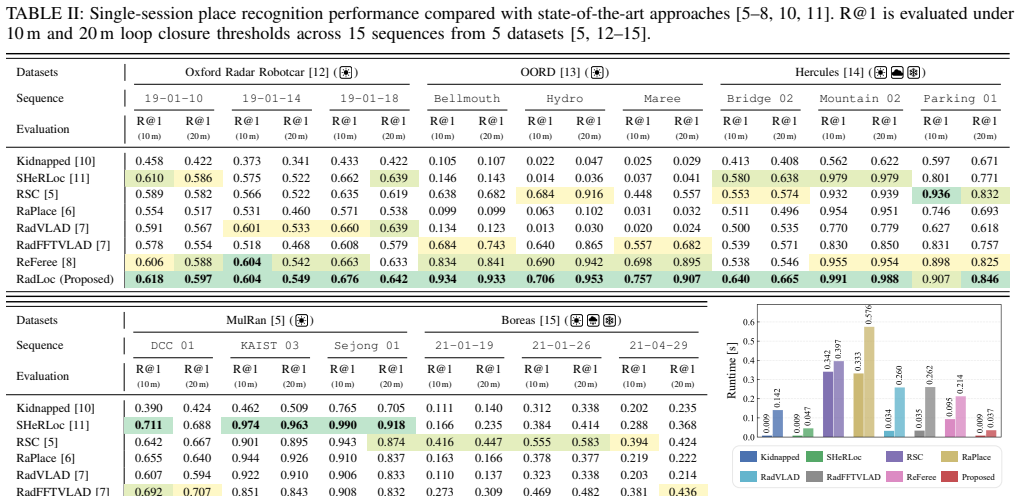
Summary. RadLoc is an end-to-end spinning-radar global localization pipeline that unifies fast pre-processing (1D CA-CFAR along range with continuous intensity), a compact rotation-invariant 1-D range-pooled descriptor, hierarchical coarse-to-fine retrieval that exploits near-range dominance (partition K and mild sqrt(k) weighting), and phase-correlation 3-DoF pose estimation. The authors claim that this design yields robust place recognition and metric pose estimates across diverse environments, weather, and radar types while producing the smallest descriptor and fastest retrieval among compared methods. Supporting evidence comprises single- and multi-session Recall@1 / AUC / F1 on 15 sequences from five public datasets (Tables II–III), RTE/RRE/success-rate and runtime for pose estimation (Table IV), SLAM and multi-session alignment figures, descriptor-size comparison (Table V), and ablations of weighting, hierarchical search, and the partition index K (Figs. 10–12, Table VI).
Significance. If the empirical claims hold, RadLoc supplies a practical, training-free radar global-localization module that is immediately usable for loop closure and multi-session map management under bandwidth or memory constraints. The combination of a 40-dimensional descriptor, hierarchical Kd-tree retrieval, and phase-correlation pose estimation is a clear engineering advance over prior radar place-recognition methods that stop at 1-DoF yaw or require heavy feature extraction / learned embeddings. Strengths that raise the paper above a pure engineering note include the multi-dataset, multi-weather, multi-radar evaluation, explicit runtime and storage comparisons, and the ablations that quantify the effect of the range-weighting and hierarchical design choices. The work therefore has clear utility for radar SLAM practitioners even if the individual algorithmic ingredients are incremental.
major comments (2)
- Sec. III-C and Fig. 4 fix the near-range partition K=20 (third-quartile of cumulative descriptor distance) and the weighting wk=sqrt(k) after inspecting two sequences (Mountain 03, 21-01-19). Table VI later reports the R@1/AUC/F1 trade-off of four quartile choices of K on those same two sequences, but the paper never shows that the identical fixed (K,w) pair remains near-optimal on the remaining thirteen sequences or on the three distinct radar types. Because the strongest claim is robust performance without per-dataset retuning, a short leave-one-dataset-out or cross-radar sensitivity table is needed to confirm that the free parameters are not inadvertently tuned to the evaluation set.
- Table IV evaluates 3-DoF pose estimation only on Hercules sequences and only against a single baseline (feature extraction + GICP). The abstract and introduction present full 3-DoF global localization as a core contribution that “forms a versatile global localization module.” Without RTE/RRE/success-rate numbers on at least one additional dataset (e.g., MulRan or Boreas) and against a second baseline (e.g., pure phase-correlation without the proposed descriptor, or ReFeree’s 1-DoF yaw + translation refinement), the generality of the pose-estimation claim remains under-supported relative to the place-recognition claims.
minor comments (5)
- Fig. 1 caption and the abstract claim “smallest descriptor size and fastest retrieval time among state-of-the-art approaches,” yet the runtime plot (Fig. 5) aggregates description generation + retrieval; a per-component breakdown would make the hierarchical-search contribution clearer.
- Eq. (1)–(2) define the descriptor dimension E = Nr / pr; the concrete values of pr used for each radar (Navtech CTS350-X, CIR204-H, etc.) are never stated, only the resulting E=40 for MulRan. Adding a one-line table of (Nr, pr, E) per dataset would aid reproducibility.
- The success criterion for pose estimation (5 m / 10°) is stated only in Sec. IV-A; it should also appear in the caption of Table IV for self-contained reading.
- Minor typographical inconsistencies: “RadLocconsistently” (Fig. 1 caption), missing spaces after some citations, and the arXiv identifier in the footer appears as 2607.08115 while the abstract header uses the same number—confirm consistency before camera-ready.
- Related-work Table I lists only ReFeree under radar methods that attempt any pose estimation; a brief sentence acknowledging that some radar odometry papers already perform 3-DoF registration (e.g., PhaRaO) would better situate the contribution.
Circularity Check
No significant circularity: empirical systems paper whose performance claims rest on multi-dataset measurements against external baselines, not on self-referential definitions or fitted-as-prediction reductions.
full rationale
RadLoc is a handcrafted algorithmic pipeline (1D CA-CFAR pre-processing, azimuth-averaged range-pooled descriptor, hierarchical near-range Kd-tree + full-descriptor re-rank, phase-correlation 3-DoF). Its strongest claims are measured Recall@1, descriptor size, and runtime on 15 public sequences from 5 external datasets versus independent SOTA (including learning-based methods). Hyper-parameters K=20 and wk=sqrt(k) are chosen after inspecting cumulative-distance statistics on two sequences (Fig. 4) and then frozen; Table VI quantifies the resulting R@1/AUC/F1 trade-off and the multi-dataset tables still show competitive numbers without per-sequence retuning. That is ordinary engineering practice, not a prediction forced by construction. Self-citations to the authors’ prior ReFeree work appear only as a baseline that is improved upon (different pre-processing, continuous intensities, hierarchical search, full 3-DoF), never as a uniqueness theorem or load-bearing premise. No equation reduces to its own input; no ansatz is smuggled via self-citation; no known result is merely renamed. Score 1 only for the minor, non-load-bearing self-citation and the acknowledged free-parameter selection already surfaced by the paper itself.
Assumptions & free parameters
free parameters (4)
- range pooling factor pr =
e.g. 84 (MulRan)
- near-range partition index K =
20
- range-weighting function wk =
sqrt(k)
- number of coarse candidates Nc
assumptions (3)
- domain assumption Received radar power decays with range according to the radar equation, so discriminative structural cues concentrate in the near-to-mid range.
- standard math The Fourier shift theorem permits recovery of planar rotation and translation from the peak of the normalized cross-power spectrum in log-polar and Cartesian domains.
- ad hoc to paper 1D CA-CFAR filtering along range plus continuous intensity yields a more discriminative and faster representation than classical radar feature extraction followed by binarization.
invented entities (1)
-
RadLoc range-aware 1-D descriptor with hierarchical coarse-to-fine retrieval
Cite this review
Pith. "Pith review of RadLoc: Radar-based 3-DoF Global Localization via Fast, Robust, and Lightweight Spatial Descriptor Across Diverse Environmental Scenarios." pith.science (2026). https://pith.science/paper/V42EJQA6
@misc{pith2026260708115,
  author       = {Pith},
  title        = {Pith review of: RadLoc: Radar-based 3-DoF Global Localization via Fast, Robust, and Lightweight Spatial Descriptor Across Diverse Environmental Scenarios},
  year         = {2026},
  howpublished = {\url{https://pith.science/paper/V42EJQA6}},
  note         = {Machine review of arXiv:2607.08115}
}
read the original abstract
While global localization using spinning radar has gained attention for its robustness to adverse weather and challenging environments, many studies have focused on individual components such as place recognition or pose estimation. In this paper, we take a holistic view of radar sensor-based global localization and present RadLoc, a fast, robust, and lightweight end-to-end pipeline from place recognition to 3-DoF pose estimation. RadLoc accelerates pre-processing using 1D CA-CFAR filtering and leverages the near-range dominance in spinning radar images to design a compact descriptor and an efficient hierarchical coarse-to-fine retrieval strategy. Moreover, coupled with phase correlation-based 3-DoF pose estimation, it forms a versatile global localization module applicable to SLAM and multi-session SLAM systems. Extensive experiments on 15 sequences across 5 datasets demonstrate that RadLoc achieves robust performance while maintaining the smallest descriptor size and fastest retrieval time among state-of-the-art approaches. The supplementary materials are available at https://sparolab.github.io/research/radloc/.
Figures


Figures from the paper (7 more)



Reference graph
Works this paper leans on
-
[1]
Tbv radar slam–trust but verify loop candidates,
D. Adolfsson, M. Karlsson, V . Kubelka, M. Magnusson, and H. Andreasson, “Tbv radar slam–trust but verify loop candidates,”IEEE Robot. and Automat. Lett., 2023
work page 2023
-
[2]
H. Kim, J. Choi, J. Kim, G. Yang, S. Jeong, H. Lim, and Y . Cho, “Commerge: Communication-efficient, robust, and fast lidar map merging framework for multi-robot co- ordination in resource-constrained scenarios,”arXiv preprint arXiv:2606.25386, 2026
work page Pith review arXiv 2026
-
[3]
H. Kim, J. Choi, J. Kim, G. Yang, D. Cho, H. Lim, and Y . Cho, “Skid-slam: Robust, lightweight, and distributed multi-robot lidar slam in resource-constrained field environments,”arXiv preprint arXiv:2505.08230, 2025
work page Pith review arXiv 2025
-
[4]
Radarslam: A robust simultaneous localization and mapping system for all weather conditions,
Z. Hong, Y . Petillot, A. Wallace, and S. Wang, “Radarslam: A robust simultaneous localization and mapping system for all weather conditions,”Intl. J. of Robot. Research, vol. 41, no. 5, pp. 519–542, 2022
work page 2022
-
[5]
Mulran: Multimodal range dataset for urban place recognition,
G. Kim, Y . S. Park, Y . Cho, J. Jeong, and A. Kim, “Mulran: Multimodal range dataset for urban place recognition,” in Proc. IEEE Intl. Conf. on Robot. and Automat.IEEE, 2020, pp. 6246–6253
work page 2020
-
[6]
Raplace: Place recognition for imaging radar using radon transform and mutable threshold,
H. Jang, M. Jung, and A. Kim, “Raplace: Place recognition for imaging radar using radon transform and mutable threshold,” inProc. IEEE/RSJ Intl. Conf. on Intell. Robots and Sys.IEEE, 2023, pp. 11 194–11 201
work page 2023
-
[7]
Open-RadVLAD: Fast and Robust Radar Place Recognition,
M. Gadd and P. Newman, “Open-RadVLAD: Fast and Robust Radar Place Recognition,” 2024
work page 2024
-
[8]
Referee: Radar- based lightweight and robust localization using feature and free space,
H. Kim, B. Choi, E. Choi, and Y . Cho, “Referee: Radar- based lightweight and robust localization using feature and free space,”IEEE Robot. and Automat. Lett., vol. 9, no. 12, pp. 11 042–11 049, 2024
work page 2024
Show all 26 references
-
[9]
Referee: Radar-based efficient global descriptor using a feature and free space for place recognition,
B. Choi, H. Kim, and Y . Cho, “Referee: Radar-based efficient global descriptor using a feature and free space for place recognition,”arXiv preprint arXiv:2403.14176, 2024
2024 arXiv
-
[10]
Kidnapped radar: Topological radar localisation using rotationally-invariant metric learning,
S ¸. S˘aftescu, M. Gadd, D. De Martini, D. Barnes, and P. New- man, “Kidnapped radar: Topological radar localisation using rotationally-invariant metric learning,” inProc. IEEE Intl. Conf. on Robot. and Automat.IEEE, 2020, pp. 4358–4364
2020
-
[11]
Sherloc: Synchro- nized heterogeneous radar place recognition for cross-modal localization,
H. Kim, M. Jung, W. Yang, and A. Kim, “Sherloc: Synchro- nized heterogeneous radar place recognition for cross-modal localization,”IEEE Robot. and Automat. Lett., 2025
2025
-
[12]
The oxford radar robotcar dataset: A radar extension to the oxford robotcar dataset,
D. Barnes, M. Gadd, P. Murcutt, P. Newman, and I. Posner, “The oxford radar robotcar dataset: A radar extension to the oxford robotcar dataset,” inProc. IEEE Intl. Conf. on Robot. and Automat., 2020, pp. 6433–6438
2020
-
[13]
Oord: The oxford offroad radar dataset,
M. Gadd, D. D. Martini, O. Bartlett, P. Murcutt, M. Towl- son, M. Widojo, V . Mus ¸at, L. Robinson, E. Panagiotaki, G. Pramatarov, M. A. K ¨uhn, L. Marchegiani, P. Newman, and L. Kunze, “Oord: The oxford offroad radar dataset,” 2024
2024
-
[14]
Hercules: Heterogeneous radar dataset in complex urban environment for multi-session radar slam,
H. Kim, M. Jung, C. Noh, S. Jung, H. Song, W. Yang, H. Jang, and A. Kim, “Hercules: Heterogeneous radar dataset in complex urban environment for multi-session radar slam,” inProc. IEEE Intl. Conf. on Robot. and Automat.IEEE, 2025, pp. 4649–4656
2025
-
[15]
Boreas: A multi-season autonomous driving dataset,
K. Burnett, D. J. Yoon, Y . Wu, A. Z. Li, H. Zhang, S. Lu, J. Qian, W.-K. Tseng, A. Lambert, K. Y . Leunget al., “Boreas: A multi-season autonomous driving dataset,”Intl. J. of Robot. Research, vol. 42, no. 1-2, pp. 33–42, 2023
2023
-
[16]
Precise ego-motion estimation with millimeter-wave radar under diverse and challenging conditions,
S. H. Cen and P. Newman, “Precise ego-motion estimation with millimeter-wave radar under diverse and challenging conditions,” inProc. IEEE Intl. Conf. on Robot. and Automat. IEEE, 2018, pp. 6045–6052
2018
-
[17]
Ordered statistic cfar technique-an overview,
H. Rohling, “Ordered statistic cfar technique-an overview,” in2011 12th International Radar Symposium (IRS). IEEE, 2011, pp. 631–638
2011
-
[18]
Scan context: Egocentric spatial de- scriptor for place recognition within 3d point cloud map,
G. Kim and A. Kim, “Scan context: Egocentric spatial de- scriptor for place recognition within 3d point cloud map,” in Proc. IEEE/RSJ Intl. Conf. on Intell. Robots and Sys.IEEE, 2018, pp. 4802–4809
2018
-
[19]
Scan context++: Structural place recognition robust to rotation and lateral variations in urban environments,
G. Kim, S. Choi, and A. Kim, “Scan context++: Structural place recognition robust to rotation and lateral variations in urban environments,”IEEE Trans. Robot., vol. 38, no. 3, pp. 1856–1874, 2021
2021
-
[20]
One ring to rule them all: Radon sinogram for place recognition, orientation and translation estimation,
S. Lu, X. Xu, H. Yin, Z. Chen, R. Xiong, and Y . Wang, “One ring to rule them all: Radon sinogram for place recognition, orientation and translation estimation,” inProc. IEEE/RSJ Intl. Conf. on Intell. Robots and Sys.IEEE, 2022, pp. 2778–2785
2022
-
[21]
Ring++: Roto-translation-invariant gram for global localization on a sparse scan map,
X. Xu, S. Lu, J. Wu, H. Lu, Q. Zhu, Y . Liao, R. Xiong, and Y . Wang, “Ring++: Roto-translation-invariant gram for global localization on a sparse scan map,”IEEE Trans. Robot., 2023
2023
-
[22]
Bevplace: Learning lidar-based place recognition using bird’s eye view images,
L. Luo, S. Zheng, Y . Li, Y . Fan, B. Yu, S.-Y . Cao, J. Li, and H.-L. Shen, “Bevplace: Learning lidar-based place recognition using bird’s eye view images,” inProc. IEEE Intl. Conf. on Comput. Vision, 2023, pp. 8700–8709
2023
-
[23]
Bevplace++: Fast, robust, and lightweight lidar global local- ization for unmanned ground vehicles,
L. Luo, S.-Y . Cao, X. Li, J. Xu, R. Ai, Z. Yu, and X. Chen, “Bevplace++: Fast, robust, and lightweight lidar global local- ization for unmanned ground vehicles,”IEEE Trans. Robot., 2025
2025
-
[24]
Narrowing your fov with solid: Spatially organized and lightweight global descriptor for fov-constrained lidar place recognition,
H. Kim, J. Choi, T. Sim, G. Kim, and Y . Cho, “Narrowing your fov with solid: Spatially organized and lightweight global descriptor for fov-constrained lidar place recognition,”IEEE Robot. and Automat. Lett., 2024
2024
-
[25]
Noise removal of fmcw scanning radar for single sensor performance improvement in autonomous driving,
W. Yang, M.-H. Jeon, and A. Kim, “Noise removal of fmcw scanning radar for single sensor performance improvement in autonomous driving,”The Journal of Korea Robotics Society, vol. 18, no. 3, pp. 271–280, 2023
2023
-
[26]
Pharao: Direct radar odometry using phase correlation,
Y . S. Park, Y .-S. Shin, and A. Kim, “Pharao: Direct radar odometry using phase correlation,” inProc. IEEE Intl. Conf. on Robot. and Automat.IEEE, 2020, pp. 2617–2623
2020
Reviewed July 10, 2026 · model on record in the stance chip above.
Discussion (0). Continue with ORCID to comment.