REVIEW 3 major objections 4 minor 81 references
Vision transformers match human texture perception better than CNNs, and architecture—not training objective—seems to drive how textures are coded.
Reviewed by Pith at T0; open to challenge. T0 means a machine referee read the full paper against a public rubric. the ladder, T0–T4 →
T0 review · grok-4.5
2026-07-10 09:25 UTC pith:NR2J5WBG
load-bearing objection Clean empirical package showing three ViTs track human texture odd-one-out better than VGG-19; the architecture claim is real but rests on a single CNN that also defines one stimulus class. the 3 major comments →
Texture Representations in Deep Vision Models: Comparing CNNs, Vision Transformers, and Human Perception
The pith
A machine-rendered reading of the paper's core claim, the machinery that carries it, and where it could break.
Core claim
Texture representations align across three vision transformers but not between those transformers and a CNN; the transformers form similar representations for textures of different complexity, and human odd-one-out performance on textures is better predicted from transformer representations than from CNN representations. Architecture (attention versus convolution) is the factor the authors identify as driving the difference.
What carries the argument
Information Imbalance, a rank-based, asymmetric measure of shared local neighborhood structure between high-dimensional representation spaces; used both to compare models on the same stimulus set and to relate model geometry to human accuracy on texture pairs.
Load-bearing premise
That one convolutional network is representative enough of the whole CNN family that the gap with transformers can be blamed on architecture rather than on that particular model or on the fact that one texture type is defined by that same network.
What would settle it
Repeat the same Information Imbalance and human-correlation analyses with several other CNNs (and preferably transformers not trained only on ImageNet); if other CNNs match human texture judgments as well as the transformers, the architecture claim fails.
Editorial analysis
A structured set of objections, weighed in public.
Referee Report
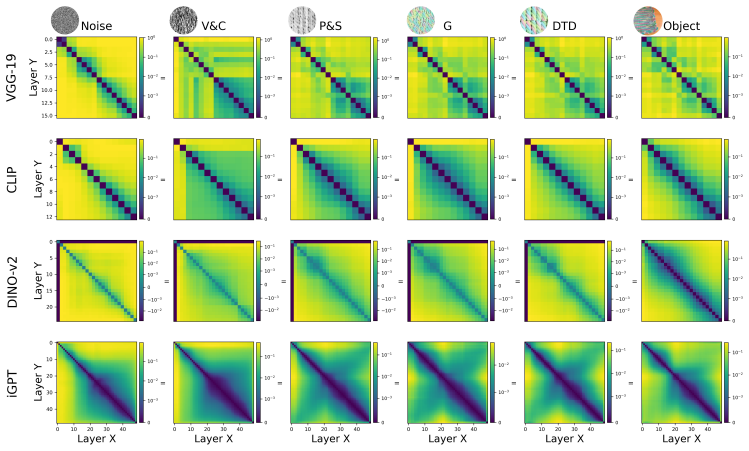
Summary. The paper compares texture representations in one CNN (VGG-19) and three Vision Transformers (CLIP, DINO-v2, iGPT) against human odd-one-out psychophysics. Stimuli form a complexity continuum (Noise, Victor–Conte, Portilla–Simoncelli, Gatys, DTD, ImageNet objects) generated from a shared DTD source. Using symmetrized Information Imbalance (II) on layer activations, the authors report that the three ViTs form mutually aligned representations of textures of varying complexity, that VGG-19 does not align with them except on high-semantic stimuli, and that human pairwise discrimination accuracy correlates strongly with ViT II scores (Pearson r ≈ 0.94–0.96) but not with VGG-19. They conclude that architecture (attention vs. convolution) is a primary driver of texture coding and that ViTs may better model human texture perception than CNNs.
Significance. If the architecture claim holds, the work usefully challenges the near-exclusive reliance on CNNs as models of biological vision for non-object tasks and supplies a concrete, rank-based pipeline (II + odd-one-out) that can be reused. Strengths include an independent human benchmark, a previously published metric (II), off-the-shelf models, and a carefully constructed continuum of textures that share source images. The human–ViT alignment result is the most novel and potentially impactful finding for computational vision science.
major comments (3)
- The central architecture claim (attention vs. convolution drives texture coding more than training objective) rests on a single CNN (VGG-19; Methods 2.2, Table 1). The Limitations section itself notes that other CNNs were omitted for compute reasons and only conjectures they would behave like VGG-19. Without at least one additional CNN family (e.g., ResNet-50 or AlexNet) run on the identical pipeline, the ViT–CNN gap cannot be securely attributed to architecture rather than to idiosyncrasies of VGG-19.
- Gatys (G) textures are defined by matching Gram matrices of VGG-19 feature maps (Methods 2.1, Appendix 6.3.3). When the same network is later asked to represent those textures, part of its internal geometry is tautological: the stimuli already live in its own second-order feature statistics. This can artificially inflate VGG–G similarity relative to other subsets and depress VGG–ViT alignment on the mid-to-high complexity textures that dominate the human correlation (Fig. 4b). The three ViTs never generated any of the stimuli, so their mutual consistency and human alignment are free of that circularity. A control that re-synthesizes G textures from a different backbone, or that excludes G from the human–model correlation, is needed before the architecture attribution can be trusted.
- Summary graphs (Figs. 2–3) and the human–model correlations (Fig. 4b) select the ‘best’ (most mutually predictive) layer pair for each model/dataset combination. This post-hoc selection can inflate apparent alignment. Reporting the full layer-wise matrices (already present in the appendix) as the primary result, or pre-registering a fixed relative-depth criterion, would make the claim more robust.
minor comments (4)
- Activation clipping to the 0.95 percentile is applied only to ViTs (Results §3); the choice of percentile and its effect on II should be justified or ablated.
- Figure 1 caption and Methods 2.1: the Object image is ‘chosen by hand for illustrative purposes’; a random or class-matched example would be preferable.
- Appendix Table 2 reports p-values for the human–model correlations; the main text should also state the number of pairs (n=6) so readers can judge degrees of freedom.
- Minor typographical issues: ‘neigborhoods’ (p. 3), ‘strenght’ (p. 6), inconsistent hyphenation of ‘odd-one-out’.
Circularity Check
No load-bearing circularity: central human–ViT alignments rest on independent psychophysics and a published metric; only mild self-reference via prior arXiv and VGG-defined Gatys stimuli.
specific steps
-
other
[Methods 2.1 / Appendix 6.3.3 + Limitations]
"The algorithm by Gatys synthesizes naturalistic textures by computing local correlations among the feature maps extracted from a CNN pretrained on object recognition (VGG-19…). The algorithm’s backbone is VGG-19_bn… Due to limited computational resources, we could not include other CNN models in the analyses. If this could be done, based on the representational similarities for textures across different CNN architectures [de Paolis et al., 2026], we would expect them to show similar results as VGG-19"
Gatys (G) stimuli are defined by matching VGG-19 second-order feature statistics; the same network is later used as the sole CNN whose texture representations are compared with ViTs and with humans. Combined with the self-citation that other CNNs would behave identically, this creates a mild non-independence for the architecture-attribution claim on the mid/high-complexity textures that dominate the human correlation. It does not, however, make any numerical II value or Pearson r equal to its input by construction.
full rationale
The paper is an empirical comparison, not a first-principles derivation. Features are extracted from four off-the-shelf pretrained models (VGG-19, CLIP, DINO-v2, iGPT), Information Imbalance (a previously published rank statistic of Glielmo et al.) is computed between layers/datasets, and the resulting pairwise II values are correlated with new human odd-one-out accuracies collected for this study. None of these steps reduces by construction to a fitted parameter, a definitional identity, or an unverified uniqueness claim. Self-citations to de Paolis et al. (2026) supply motivation (“texture quality does not correlate with object-recognition alignment”) and the public Gatys implementation; they are not required for the numerical results or the human correlations. The fact that Gatys textures are synthesized from VGG-19 Gram matrices while VGG-19 is also the sole CNN comparator is a potential validity confound for the architecture interpretation (and is openly noted in Limitations), but it does not force the reported II graphs or the Pearson correlations with human accuracy to equal their inputs. The three ViTs never generated any stimuli, their mutual consistency and human alignment are free of that loop, and the human data remain an external benchmark. Hence circularity is at most minor and non-load-bearing.
Axiom & Free-Parameter Ledger
free parameters (4)
- activation clipping percentile =
0.95
- best-layer selection for summary graphs
- Gatys synthesis hyperparameters =
30000 steps
- Portilla–Simoncelli pyramid parameters =
n=5,k=4,na=7,iter=10
axioms (4)
- domain assumption Information Imbalance (symmetrized) quantifies shared information between high-dimensional representational spaces via neighborhood ranks.
- domain assumption The ordered set Noise < V&C < P&S < G < DTD constitutes a meaningful perceptual-complexity continuum for textures.
- ad hoc to paper A single CNN (VGG-19) is sufficiently representative of the CNN family for the architecture comparison.
- domain assumption Odd-one-out accuracy on 200 ms grayscale presentations indexes the same representational geometry that II measures in network layers.
read the original abstract
In computational vision science, Convolutional Neural Networks (CNNs) have emerged as a popular model of biological vision because of the alignment they can exhibit with neural and behavioral data in humans and animals. However, it remains unclear to what extent this alignment persists for visual tasks that extend beyond the canonical object recognition paradigm based on well defined semantic content. In this study, we diverge from the common object-centric view by focusing on another aspect of vision: texture perception. We consider textures of different complexity generated with three different algorithms from the same source images. Using a rank-based statistic, we quantify the information encoded in the internal representations of a CNN and three Vision Transformers (ViTs), and we compare the similarity of these representations to those inferred from human psychophysics data. We find that the representation of textures is aligned in different ViTs, but not between the ViTs and the CNN; that ViTs form similar representations for textures of different complexity; that human performance in recognizing textures can be better predicted from ViTs representations rather than CNN representations. Taken together, these results suggest that ViTs may capture more faithfully than CNNs how texture patterns are visually processed by humans, and that the representations of texture stimuli in computational models may be driven by the network architecture.
Figures




Reference graph
Works this paper leans on
-
[1]
Frontiers in Cellular Neuroscience , volume =
Efficient Processing of Natural Scenes in Visual Cortex , author =. Frontiers in Cellular Neuroscience , volume =
-
[2]
Dosovitskiy, Alexey and Beyer, Lucas and Kolesnikov, Alexander and Weissenborn, Dirk and Zhai, Xiaohua and Unterthiner, Thomas and Dehghani, Mostafa and Minderer, Matthias and Heigold, Georg and Gelly, Sylvain and Uszkoreit, Jakob and Houlsby, Neil , date =. An
-
[3]
Proceedings of the Royal Society B: Biological Sciences , volume =
Predisposed and Learned Preferences for Multipoint Visual Statistics in Visually Naive Newly Hatched Chicks , author =. Proceedings of the Royal Society B: Biological Sciences , volume =. doi:10.1098/rspb.2025.3157 , urldate =
-
[4]
doi:10.1073/pnas.91.18.8482 , url =
Striate Cortex Extracts Higher-Order Spatial Correlations from Visual Textures , author =. doi:10.1073/pnas.91.18.8482 , url =. 8078907 , eprinttype =
-
[5]
Visual Processing of Informative Multipoint Correlations Arises Primarily in
Yu, Yunguo and Schmid, Anita M and Victor, Jonathan D , date =. Visual Processing of Informative Multipoint Correlations Arises Primarily in. doi:10.7554/eLife.06604 , url =
-
[6]
IRE Transactions on Information Theory , year =
Julesz, Bela , title =. IRE Transactions on Information Theory , year =
- [7]
- [8]
-
[9]
Julesz, Bela and Gilbert, E. N. and Shepp, L. A. and Frisch, H. L. , title =. Perception , year =
-
[10]
Turner, M. R. , title =. Biological Cybernetics , year =
-
[11]
Journal of the Optical Society of America A , year =
Malik, Jitendra and Perona, Pietro , title =. Journal of the Optical Society of America A , year =
- [12]
-
[13]
Zhu, S. C. and Liu, X. W. and Wu, Y. N. , title =. IEEE Transactions on Pattern Analysis and Machine Intelligence , year =
-
[14]
IEEE Conference on Computer Vision and Pattern Recognition (CVPR) , year =
Deng, Jia and Dong, Wei and Socher, Richard and Li, Li-Jia and Li, Kai and Fei-Fei, Li , title =. IEEE Conference on Computer Vision and Pattern Recognition (CVPR) , year =
-
[15]
Local Statistics in Natural Scenes Predict the Saliency of Synthetic Textures , journal =
Tka. Local Statistics in Natural Scenes Predict the Saliency of Synthetic Textures , journal =. 2010 , volume =
work page 2010
- [16]
-
[17]
Victor, Jonathan D. and Conte, Mary M. , title =. Journal of the Optical Society of America A , year =
-
[18]
and Zoccolan, Davide and Rust, Nicole C
DiCarlo, James J. and Zoccolan, Davide and Rust, Nicole C. , title =. Neuron , year =
-
[19]
Proceedings of the IEEE Conference on Computer Vision and Pattern Recognition , year =
Cimpoi, Mircea and Maji, Subhransu and Kokkinos, Iasonas and Mohamed, Sammy and Vedaldi, Andrea , title =. Proceedings of the IEEE Conference on Computer Vision and Pattern Recognition , year =
-
[20]
and Hong, Ha and Yamins, Daniel L
Cadieu, Charles F. and Hong, Ha and Yamins, Daniel L. K. and Pinto, Nicolas and Ardila, Diego and Solomon, Ethan A. and Majaj, Najib and DiCarlo, James J. , title =. Proceedings of the National Academy of Sciences , year =
-
[21]
G. Deep Neural Networks Reveal a Gradient in the Complexity of Neural Representations across the Ventral Stream , journal =. 2015 , volume =
work page 2015
-
[22]
Yu, Yunguo and Schmid, Anita M. and Victor, Jonathan D. , title =. eLife , year =
-
[23]
Vaswani, Ashish and Shazeer, Noam and Parmar, Niki and Uszkoreit, Jakob and Jones, Llion and Gomez, Aidan N. and Kaiser,. Attention Is All You Need , booktitle =. 2017 , volume =
work page 2017
-
[24]
Gatys, Leon A. and Ecker, Alexander S. and Bethge, Matthias , title =. Advances in Neural Information Processing Systems , year =
-
[25]
Gatys, Leon A. and Ecker, Alexander S. and Bethge, Matthias , title =. Proceedings of the IEEE Conference on Computer Vision and Pattern Recognition , year =
-
[26]
and Bashivan, Pouya and Kar, Kohitij and Schmidt, Kailyn and DiCarlo, James J
Rajalingham, Rishi and Issa, Elias B. and Bashivan, Pouya and Kar, Kohitij and Schmidt, Kailyn and DiCarlo, James J. , title =. Journal of Neuroscience , year =
-
[27]
Hermundstad, Ann M. and Briguglio, John J. and Conte, Mary M. and Victor, Jonathan D. and Balasubramanian, Vijay and Tka. Variance Predicts Salience in Central Sensory Processing , journal =. 2014 , volume =
work page 2014
-
[28]
Caramellino, Riccardo and Piasini, Eugenio and Buccellato, Andrea and Carboncino, Anna and Balasubramanian, Vijay and Zoccolan, Davide , title =. eLife , year =
-
[29]
Tesileanu, Tiberiu and Conte, Mary M. and Briguglio, John J. and Hermundstad, Ann M. and Victor, Jonathan D. and Balasubramanian, Vijay , title =. eLife , year =
-
[30]
Victor, Jonathan D. and Conte, Mary M. and Chubb, Charles F. , title =. Annual Review of Vision Science , year =
-
[31]
Freeman, Jeremy and Ziemba, Corey M. and Heeger, David J. and Simoncelli, Eero P. and Movshon, J. Anthony , title =. Nature Neuroscience , year =
-
[32]
and Freeman, Jeremy and Movshon, J
Ziemba, Corey M. and Freeman, Jeremy and Movshon, J. Anthony and Simoncelli, Eero P. , title =. Proceedings of the National Academy of Sciences , year =
-
[33]
Okazawa, Gouki and Tajima, Satohiro and Komatsu, Hidehiko , title =. Cerebral Cortex , year =
-
[34]
Zhivago, Kalathupiriyan A. and Arun, Sripati P. , title =. Journal of Neurophysiology , year =
-
[35]
Henderson, Margaret M. and Tarr, Michael J. and Wehbe, Leila , title =. Journal of Neuroscience , year =
-
[36]
Jagadeesh, Akshay V. and Gardner, Justin L. , title =. Nature Neuroscience , year =
-
[37]
Storrs, Katherine R. and Kietzmann, Tim C. and Walther, Alexander and Mehrer, Johannes and Kriegeskorte, Nikolaus , title =. Journal of Cognitive Neuroscience , year =
-
[38]
Wichmann, Felix A. and Geirhos, Robert , title =. Annual Review of Vision Science , year =
-
[39]
Feather, Jenelle and Leclerc, Guillaume and M. Model Metamers Reveal Divergent Invariances between Biological and Artificial Neural Networks , journal =. 2023 , volume =
work page 2023
-
[40]
and Brendel, Wieland , title =
Geirhos, Robert and Narayanappa, Kantharaju and Mitzkus, Benjamin and Thieringer, Tizian and Bethge, Matthias and Wichmann, Felix A. and Brendel, Wieland , title =. Advances in Neural Information Processing Systems , year =
-
[41]
and Rajalingham, Rishi and Issa, Elias B
Schrimpf, Martin and Kubilius, Jonas and Hong, Ha and Majaj, Najib J. and Rajalingham, Rishi and Issa, Elias B. and Kar, Kohitij and Bashivan, Pouya and Prescott-Roy, Jonathan and Schmidt, Kailyn and Yamins, Daniel L. K. and DiCarlo, James J. , title =. bioRxiv , year =
-
[42]
Yamins, Daniel L. K. and Hong, Ha and Cadieu, Charles F. and Solomon, Ethan A. and Seibert, Darren and DiCarlo, James J. , title =. Proceedings of the National Academy of Sciences , year =
-
[43]
Proceedings of the 38th International Conference on Machine Learning , year =
Radford, Alec and Kim, Jong Wook and Hallacy, Chris and Ramesh, Aditya and Goh, Gabriel and Agarwal, Sandhini and Sastry, Girish and Askell, Amanda and Mishkin, Pamela and Clark, Jack and Krueger, Gretchen and Sutskever, Ilya , title =. Proceedings of the 38th International Conference on Machine Learning , year =
-
[44]
From BoW to CNN: Two Decades of Texture Representation for Texture Classification , journal =
Liu, Li and Chen, Jie and Fieguth, Paul and Zhao, Guoying and Chellappa, Rama and Pietik. From BoW to CNN: Two Decades of Texture Representation for Texture Classification , journal =. 2019 , volume =
work page 2019
-
[45]
Wallis, Thomas S. A. and Funke, Christina M. and Ecker, Alexander S. and Gatys, Leon A. and Wichmann, Felix A. and Bethge, Matthias , title =. Journal of Vision , year =
- [46]
-
[47]
Proceedings of the IEEE Conference on Computer Vision and Pattern Recognition (CVPR) , year =
Deng, Jia and Dong, Wei and Socher, Richard and Li, Li-Jia and Li, Kai and Fei-Fei, Li , title =. Proceedings of the IEEE Conference on Computer Vision and Pattern Recognition (CVPR) , year =
-
[48]
Russakovsky, Olga and Deng, Jia and Su, Hao and Krause, Jonathan and Satheesh, Sanjeev and Ma, Sean and Huang, Zhiheng and Karpathy, Andrej and Khosla, Aditya and Bernstein, Michael and Berg, Alexander C. and Fei-Fei, Li , title =. International Journal of Computer Vision , year =
-
[49]
International Conference on Learning Representations (ICLR) , year =
Simonyan, Karen and Zisserman, Andrew , title =. International Conference on Learning Representations (ICLR) , year =
-
[50]
DINOv2: Learning Robust Visual Features without Supervision , journal =
Oquab, Maxime and Darcet, Timoth. DINOv2: Learning Robust Visual Features without Supervision , journal =. 2024 , note =
work page 2024
-
[51]
Proceedings of the 37th International Conference on Machine Learning , year =
Chen, Mark and Radford, Alec and Child, Rewon and Wu, Jeff and Jun, Heewoo and Dhariwal, Prafulla and Luan, David and Sutskever, Ilya , title =. Proceedings of the 37th International Conference on Machine Learning , year =
-
[52]
Glielmo, Aldo and Zeni, Claudio and Cheng, Bingqing and Csanyi, Gabor and Laio, Alessandro , title =. PNAS Nexus , year =
-
[53]
Perceptual misalignment of texture representations in convolutional neural networks
de Paolis, Ludovica and Anselmi, Fabio and Ansuini, Alessio and Piasini, Eugenio , title =. arXiv preprint arXiv:2604.01341 , year =
work page internal anchor Pith review Pith/arXiv arXiv
-
[54]
Prefixing Attention Sinks can Mitigate Activation Outliers for Large Language Model Quantization , author =. Proceedings of the 2024 Conference on Empirical Methods in Natural Language Processing (EMNLP) , year =
work page 2024
-
[55]
International Conference on Learning Representations (ICLR) , year =
From Attention to Activation: Unraveling the Enigmas of Large Language Models , author =. International Conference on Learning Representations (ICLR) , year =
-
[56]
International Conference on Learning Representations (ICLR) , year =
See What You Are Told: Visual Attention Sink in Large Multimodal Models , author =. International Conference on Learning Representations (ICLR) , year =
-
[57]
Ravishankar and Lohse, Gerald L
Bhushan, Nalini and Rao, A. Ravishankar and Lohse, Gerald L. , title = ". Cognitive Science, 21. 1997
work page 1997
-
[58]
Self-Guided Contrastive Learning for BERT Sentence Representations
Kim, Taeuk and Yoo, Kang Min and Lee, Sang-goo. Self-Guided Contrastive Learning for BERT Sentence Representations. Proceedings of the 59th Annual Meeting of the Association for Computational Linguistics and the 11th International Joint Conference on Natural Language Processing (Volume 1: Long Papers). 2021. doi:10.18653/v1/2021.acl-long.197
-
[59]
Universal Text Representation from BERT: An Empirical Study
Ma, Xiaofei and Wang, Zhiguo and Ng, Patrick and Nallapati, Ramesh and Xiang, Bing , title =. doi:10.48550/arXiv.1910.07973 , year =. 1910.07973 , archivePrefix =
work page internal anchor Pith review Pith/arXiv arXiv doi:10.48550/arxiv.1910.07973 1910
-
[60]
The geometry of hidden representations of large transformer models
Valeriani, Lucrezia and Doimo, Diego and Cuturello, Francesca and Laio, Alessandro and Ansuini, Alessio and Cazzaniga, Alberto , title =. Advances in Neural Information Processing Systems , year =. 2302.00294 , archivePrefix =
work page internal anchor Pith review Pith/arXiv arXiv
-
[61]
doi:10.48550/arXiv.2601.21621 , year =
Mahaut, Mat. doi:10.48550/arXiv.2601.21621 , year =. 2601.21621 , archivePrefix =
-
[62]
doi:doi:10.5281/zenodo.5561807 , url =
Piasini, Eugenio , title =. doi:doi:10.5281/zenodo.5561807 , url =
- [63]
-
[64]
Acevedo, Santiago and Laio, Alessandro and Baroni, Marco , title =. 2026 , eprint =
work page 2026
-
[65]
DADApy: Distance-based analysis of data-manifolds in Python , journal =. 2022 , issn =. doi:https://doi.org/10.1016/j.patter.2022.100589 , url =
-
[66]
Geirhos, Robert and Rubisch, Patricia and Michaelis, Claudio and Bethge, Matthias and Wichmann, Felix A. and Brendel, Wieland , date =. doi:10.48550/ARXIV.1811.12231 , url =
work page internal anchor Pith review Pith/arXiv arXiv doi:10.48550/arxiv.1811.12231
-
[67]
The Origins and Prevalence of Texture Bias in Convolutional Neural Networks , booktitle =
Hermann, Katherine and Chen, Ting and Kornblith, Simon , editor =. The Origins and Prevalence of Texture Bias in Convolutional Neural Networks , booktitle =
-
[68]
Shape or Texture: Understanding Discriminative Features in CNNs
Islam, Md Amirul and Kowal, Matthew and Esser, Patrick and Jia, Sen and Ommer, Bjorn and Derpanis, Konstantinos G. and Bruce, Neil , date =. Shape or. doi:10.48550/ARXIV.2101.11604 , url =
work page internal anchor Pith review Pith/arXiv arXiv doi:10.48550/arxiv.2101.11604
-
[69]
Kubilius, Jonas and Schrimpf, Martin and Nayebi, Aran and Bear, Daniel and Yamins, Daniel L. K. and DiCarlo, James J. , date =. doi:10.1101/408385 , url =
-
[70]
Proceedings of the 41st International Conference on Machine Learning , pages =
Position: The Platonic Representation Hypothesis , author =. Proceedings of the 41st International Conference on Machine Learning , pages =. 2024 , editor =
work page 2024
-
[71]
Riesenhuber, Maximilian and Poggio, Tomaso , title =. Nature Neuroscience , year =. doi:10.1038/81479 , pmid =
-
[72]
Biological Cybernetics , year =
Fukushima, Kunihiko , title =. Biological Cybernetics , year =. doi:10.1007/BF00344251 , pmid =
-
[73]
Hubel, David H. and Wiesel, Torsten N. , title =. The Journal of Physiology , year =. doi:10.1113/jphysiol.1962.sp006837 , pmid =
-
[74]
Lindsay, Grace W. , title =. Journal of Cognitive Neuroscience , year =. doi:10.1162/jocn_a_01544 , pmid =
- [75]
-
[76]
Annual Review of Vision Science , year =
Kriegeskorte, Nikolaus , title =. Annual Review of Vision Science , year =
- [77]
- [78]
-
[79]
International Conference on Learning Representations , year =
Yu, Jiahui and Li, Xin and Koh, Jing Yu and Zhang, Han and Pang, Ruoming and Qin, James and Ku, Alexander and Xu, Yuanzhong and Baldridge, Jason and Wu, Yonghui , title =. International Conference on Learning Representations , year =
-
[80]
A quantitative analysis of semantic information in deep representations of text and images , author=. 2026 , eprint=
work page 2026
discussion (0)
Sign in with ORCID, Apple, or X to comment. Anyone can read and Pith papers without signing in.