REVIEW 1 major objections 2 minor 2 cited by
CNNs that model the visual system well do not necessarily align better with human texture perception.
Reviewed by Pith at T0; open to challenge. T0 means a machine referee read the full paper against a public rubric. the ladder, T0–T4 →
T0 review · grok-4.3
2026-05-21 09:22 UTC pith:D4KKCPYQ
load-bearing objection The null correlation between Brain-Score and human texture alignment is the main result, but it may rest on Gram matrices missing spatial or higher-order structure that the networks actually use. the 1 major comments →
Perceptual misalignment of texture representations in convolutional neural networks
The pith
A machine-rendered reading of the paper's core claim, the machinery that carries it, and where it could break.
Core claim
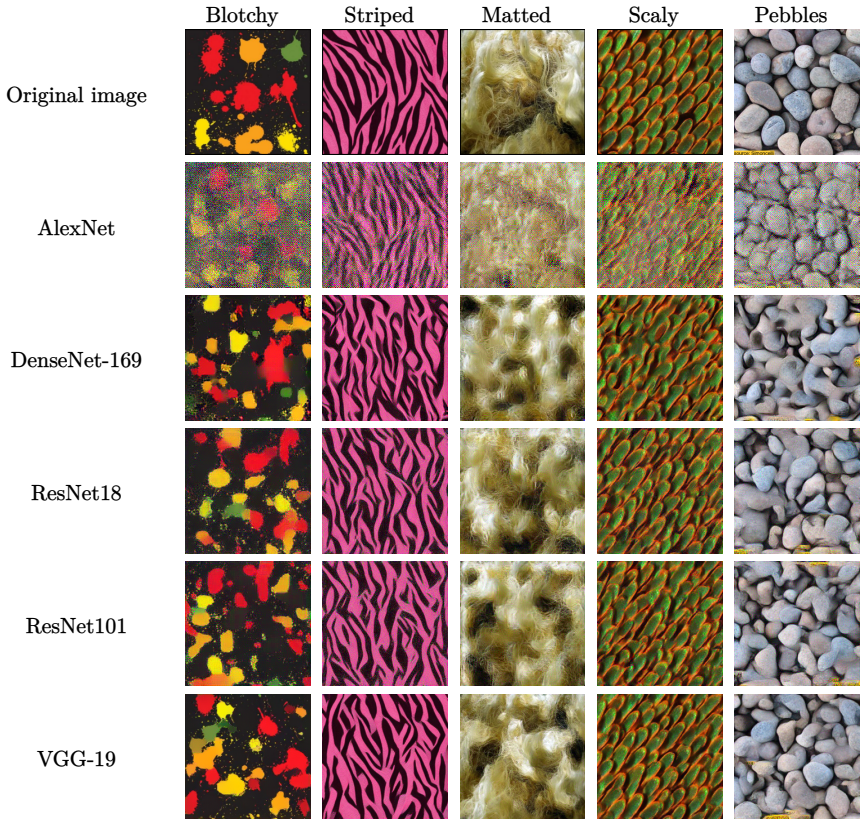
There is no connection between conventional measures of CNN quality as a model of the visual system and its alignment with human texture perception. The study quantifies the perceptual content captured by feature correlations in a diverse pool of CNNs and finds it does not correlate with Brain-Score.
What carries the argument
Gram matrices compiling linear correlations between nonlinear CNN features as texture representations.
Load-bearing premise
Gram matrices of CNN features are a sufficient and unbiased summary of the texture information the network uses for perceptual comparisons.
What would settle it
Finding a CNN with high Brain-Score that also shows strong alignment with human texture judgments, or a low Brain-Score one with high alignment, would test the no-connection claim.
If this is right
- Texture perception likely involves integration of contextual information not captured by standard CNN feature correlations.
- Approaches based on CNNs trained on object recognition may miss important aspects of human texture processing.
- New modeling strategies beyond object recognition training are needed for accurate texture perception models.
Where Pith is reading between the lines
- Texture perception might rely on different neural pathways or computations than those optimized for object recognition.
- Testing CNNs on texture-specific tasks could reveal whether alignment improves independently of Brain-Score.
- These results highlight potential gaps in using Brain-Score as a sole indicator of perceptual fidelity across all visual tasks.
Editorial analysis
A structured set of objections, weighed in public.
Referee Report
Summary. The manuscript claims that CNNs regarded as better models of the visual system (per Brain-Score) do not exhibit correspondingly better alignment with human texture perception when texture representations are quantified via Gram matrices of CNN features. Across a diverse pool of CNNs, the authors report no correlation between these two quantities and conclude that texture perception depends on mechanisms distinct from those captured by standard object-recognition-trained CNNs, possibly requiring contextual integration.
Significance. If the dissociation holds, the result would indicate that conventional CNN-based models of the visual system, optimized for object recognition, capture only a subset of human perceptual capabilities and that texture judgments may rely on separate computations. The work explicitly leverages the independence of the external Brain-Score benchmark and human texture judgments, yielding a clear, falsifiable prediction about model alignment that can be tested with future architectures.
major comments (1)
- [Results (texture alignment quantification)] The central null-correlation result rests on texture alignment being measured exclusively via Gram-matrix summaries of CNN features. No ablation is reported that replaces or augments this statistic with alternatives (feature means, higher-order moments, or spatially-aware descriptors) and re-computes the correlation with Brain-Score. This is load-bearing for the headline claim: if Gram matrices omit phase or higher-order spatial structure that the network actually uses for texture, the observed lack of correlation could be an artifact of the chosen summary rather than evidence of a genuine mechanistic dissociation.
minor comments (2)
- [Abstract] The abstract and introduction would benefit from an explicit statement of the exact number of CNN architectures tested, the precise human texture judgment dataset, and the statistical test used for the reported null correlation.
- [Methods] Notation for the Gram-matrix construction and the subsequent correlation with human judgments should be defined once in a dedicated methods subsection rather than introduced piecemeal.
Simulated Author's Rebuttal
We thank the referee for their constructive comments. We address the major comment on the texture alignment quantification below.
read point-by-point responses
-
Referee: [Results (texture alignment quantification)] The central null-correlation result rests on texture alignment being measured exclusively via Gram-matrix summaries of CNN features. No ablation is reported that replaces or augments this statistic with alternatives (feature means, higher-order moments, or spatially-aware descriptors) and re-computes the correlation with Brain-Score. This is load-bearing for the headline claim: if Gram matrices omit phase or higher-order spatial structure that the network actually uses for texture, the observed lack of correlation could be an artifact of the chosen summary rather than evidence of a genuine mechanistic dissociation.
Authors: Gram matrices were selected because they constitute the canonical summary of second-order feature correlations in the CNN texture literature, directly extending Julesz's conjecture on local feature statistics and the successful texture synthesis framework of Gatys et al. The study was scoped to test whether better Brain-Score alignment predicts better perceptual alignment under this established representation. We acknowledge that the absence of ablations with alternative descriptors (means, higher-order moments, or spatial descriptors) leaves open the possibility that the null result is specific to Gram matrices. In the revised manuscript we will add an ablation that recomputes texture alignment using first-order moments and spatially-aware statistics and re-evaluates the correlation with Brain-Score. revision: yes
Circularity Check
No circularity: empirical null result uses independent external benchmarks
full rationale
The paper's central claim is an observed lack of correlation between Brain-Score (an external benchmark for CNN alignment with mammalian visual system data) and a texture alignment score computed from Gram matrices of CNN features versus human perceptual judgments. Neither quantity is defined in terms of the other, and the comparison is a direct empirical measurement rather than a derivation or prediction that reduces to fitted inputs or self-referential equations by construction. The Gram matrix approach follows standard prior literature applied to a pool of models, with no self-citation load-bearing the null result and no ansatz or uniqueness theorem imported from the authors' own prior work. The derivation chain remains self-contained against these external benchmarks.
Axiom & Free-Parameter Ledger
axioms (2)
- domain assumption Feature correlations compiled into Gram matrices provide a sufficient representation of texture content for perceptual comparison.
- domain assumption Brain-Score is an appropriate measure of a model's alignment with the mammalian visual system.
read the original abstract
Mathematical modeling of visual textures traces back to Julesz's intuition that texture perception in humans is based on local correlations between image features. An influential approach for texture analysis and generation generalizes this notion to linear correlations between the nonlinear features computed by convolutional neural networks (CNNs), compiled into Gram matrices. Given that CNNs are often used as models for the visual system, it is natural to ask whether such "texture representations" spontaneously align with the textures' perceptual content, and in particular whether those CNNs that are regarded as better models for the visual system also possess more human-like texture representations. Here we quantify the perceptual content captured by feature correlations computed for a diverse pool of CNNs, and we compare it to the models' perceptual alignment with the mammalian visual system as measured by Brain-Score. Surprisingly, we find that there is no connection between conventional measures of CNN quality as a model of the visual system and its alignment with human texture perception. We conclude that texture perception involves mechanisms that are distinct from those that are commonly modeled using approaches based on CNNs trained on object recognition, possibly depending on the integration of contextual information.
Figures


Lean theorems connected to this paper
-
IndisputableMonolith/Cost/FunctionalEquation.leanwashburn_uniqueness_aczel unclear?
unclearRelation between the paper passage and the cited Recognition theorem.
Gram matrices formed by spatial correlations between intermediate-layer activations of a CNN trained for object recognition
-
IndisputableMonolith/Foundation/RealityFromDistinction.leanreality_from_one_distinction unclear?
unclearRelation between the paper passage and the cited Recognition theorem.
no connection between conventional measures of CNN quality as a model of the visual system and its alignment with human texture perception
What do these tags mean?
- matches
- The paper's claim is directly supported by a theorem in the formal canon.
- supports
- The theorem supports part of the paper's argument, but the paper may add assumptions or extra steps.
- extends
- The paper goes beyond the formal theorem; the theorem is a base layer rather than the whole result.
- uses
- The paper appears to rely on the theorem as machinery.
- contradicts
- The paper's claim conflicts with a theorem or certificate in the canon.
- unclear
- Pith found a possible connection, but the passage is too broad, indirect, or ambiguous to say the theorem truly supports the claim.
Forward citations
Cited by 2 Pith papers
-
Texture Representations in Deep Vision Models: Comparing CNNs, Vision Transformers, and Human Perception
ViT texture representations align with each other and with human psychophysics better than VGG-19 representations, suggesting architecture drives texture coding more than training objective.
-
A Fourier perspective on the learning dynamics of neural networks: from sample complexities to mechanistic insights
Neural networks prioritize amplitude over phase in Fourier space during training on translation-invariant data; power-law spectra accelerate phase learning despite not aiding classification.
Reference graph
Works this paper leans on
-
[1]
Textons, the Elements of Texture Perception, and Their Interactions
Bela Julesz. “Textons, the Elements of Texture Perception, and Their Interactions”. In:Nature290.5802(Mar.1981),pp.91–97.issn:1476-4687.doi:10.1038/290091a0. url:https://www.nature.com/articles/290091a0(visited on 12/10/2025). 16
-
[2]
Texture Synthesis Using Convolutional Neural Networks
L. A. Gatys et al. “Texture Synthesis Using Convolutional Neural Networks”. In: Advances in Neural Information Processing Systems 28 (NIPS 2015)(2015)
work page 2015
-
[3]
Brain-Score: Which Artificial Neural Network for Object Recog- nition is most Brain-Like?
M. Schrimpf et al. “Brain-Score: Which Artificial Neural Network for Object Recog- nition is most Brain-Like?” In:bioRxiv(2018)
work page 2018
-
[5]
B. Julesz. “Visual Pattern Discrimination”. In:IRE Transactions on Information Theory8.2 (Feb. 1962), pp. 84–92.issn: 2168-2712.doi:10 . 1109 / TIT . 1962 . 1057698
work page 1962
-
[6]
On Perceptual Analyzers Underlying Visual Texture Dis- crimination: Part I
T. Caelli and B. Julesz. “On Perceptual Analyzers Underlying Visual Texture Dis- crimination: Part I”. In:Biological Cybernetics28.3 (Sept. 1, 1978), pp. 167–175. issn: 1432-0770.doi:10 . 1007 / BF00337138.url:https : / / doi . org / 10 . 1007 / BF00337138(visited on 03/01/2022)
work page 1978
-
[7]
Textons, the elements of texture perception, and their interactions
B. Julesz. “Textons, the elements of texture perception, and their interactions”. In: Nature290 (1981), pp. 91–97
work page 1981
-
[8]
ExploringTextureEnsemblesbyEfficientMarkov Chain Monte Carlo-Toward a
S.C.Zhu,X.W.Liu,andY.N.Wu.“ExploringTextureEnsemblesbyEfficientMarkov Chain Monte Carlo-Toward a "Trichromacy" Theory of Texture”. In:IEEE Transac- tions on Pattern Analysis and Machine Intelligence22.6 (June 2000), pp. 554–569. issn: 1939-3539.doi:10.1109/34.862195.url:https://ieeexplore.ieee.org/ abstract/document/862195(visited on 12/08/2025)
work page doi:10.1109/34.862195.url:https://ieeexplore.ieee.org/ 2000
-
[9]
From BoW to CNN: Two Decades of Texture Representation for Texture Classification
Li Liu et al. “From BoW to CNN: Two Decades of Texture Representation for Texture Classification”. In:International Journal of Computer Vision127.1 (Jan. 1, 2019), pp. 74–109.issn: 1573-1405.doi:10 . 1007 / s11263 - 018 - 1125 - z.url:https : //doi.org/10.1007/s11263-018-1125-z(visited on 12/08/2025)
-
[10]
A parametric texture model based on joint statistics of complex wavelet coefficients
J. Portilla E. P. Simoncelli. “A parametric texture model based on joint statistics of complex wavelet coefficients”. In:International Journal of Computer Vision40 (2000), pp. 49–70. 17
work page 2000
-
[11]
Local Statistics in Natural Scenes Predict the Saliency of Synthetic Textures
G. Tkačik et al. “Local Statistics in Natural Scenes Predict the Saliency of Synthetic Textures”. In:Proceedings of the National Academy of Sciences107.42 (Oct. 5, 2010), pp. 18149–18154.doi:10.1073/pnas.0914916107. PMID:20923876.url:http: //dx.doi.org/10.1073/pnas.0914916107
-
[12]
Local Image Statistics: Maximum-Entropy Constructions and Perceptual Salience
Jonathan D. Victor and Mary M. Conte. “Local Image Statistics: Maximum-Entropy Constructions and Perceptual Salience”. In:JOSA A29.7 (July 1, 2012), pp. 1313– 1345.issn: 1520-8532.doi:10.1364/JOSAA.29.001313.url:https://opg.optica. org/josaa/abstract.cfm?uri=josaa-29-7-1313(visited on 02/20/2022)
work page doi:10.1364/josaa.29.001313.url:https://opg.optica 2012
-
[13]
Variance Predicts Salience in Central Sensory Pro- cessing
Ann M Hermundstad et al. “Variance Predicts Salience in Central Sensory Pro- cessing”. In:eLife3 (Nov. 14, 2014), e03722.issn: 2050-084X.doi:10 . 7554 / eLife . 03722.url:https : / / elifesciences . org / articles / 03722(visited on 01/10/2022)
work page 2014
-
[14]
Tiberiu Tesileanu et al. “Efficient Coding of Natural Scene Statistics Predicts Dis- crimination Thresholds for Grayscale Textures”. In:eLife9 (Aug. 3, 2020). Ed. by Stephanie Palmer and Timothy E Behrens, e54347.issn: 2050-084X.doi:10 . 7554/eLife.54347.url:https://doi.org/10.7554/eLife.54347(visited on 05/08/2023)
-
[15]
Rat Sensitivity to Multipoint Statistics Is Predicted by Efficient Coding of Natural Scenes
Riccardo Caramellino et al. “Rat Sensitivity to Multipoint Statistics Is Predicted by Efficient Coding of Natural Scenes”. In:eLife10 (Dec. 7, 2021), e72081.issn: 2050- 084X.doi:10.7554/eLife.72081.url:https://elifesciences.org/articles/ 72081(visited on 01/08/2022)
work page doi:10.7554/elife.72081.url:https://elifesciences.org/articles/ 2021
-
[16]
Mirko Zanon et al.Predisposed and Learned Preferences for Multipoint Visual Statis- tics in Visually Naïve Newly Hatched Chicks. June 17, 2025.doi:10.1101/2025. 06.16.659971.url:https://www.biorxiv.org/content/10.1101/2025.06.16. 659971v1(visited on 12/10/2025). Pre-published
-
[17]
Image Style Transfer Using Convolutional Neural Networks
Leon A. Gatys, Alexander S. Ecker, and Matthias Bethge. “Image Style Transfer Using Convolutional Neural Networks”. In: Proceedings of the IEEE Conference on Computer Vision and Pattern Recognition. 2016, pp. 2414–2423.url:https : / / openaccess . thecvf . com / content _ cvpr _ 2016 / html / Gatys _ Image _ Style _ Transfer_CVPR_2016_paper.html(visited o...
work page 2016
-
[18]
Diversified Texture Synthesis With Feed-Forward Networks
Yijun Li et al. “Diversified Texture Synthesis With Feed-Forward Networks”. In: Proceedings of the IEEE Conference on Computer Vision and Pattern Recognition. 2017, pp. 3920–3928.url:https://openaccess.thecvf.com/content_cvpr_2017/ html/Li_Diversified_Texture_Synthesis_CVPR_2017_paper.html(visited on 06/10/2024)
work page 2017
-
[19]
Dmitry Ulyanov, Andrea Vedaldi, and Victor Lempitsky. “Improved Texture Net- works: Maximizing Quality and Diversity in Feed-forward Stylization and Texture Synthesis”. In:Computer Vision and Pattern Recognition(2017)
work page 2017
-
[20]
Perceptual losses for real-time style transfer and super-resolution
Justin Johnson, Alexandre Alahi, and Li Fei-Fei. “Perceptual Losses for Real-Time Style Transfer and Super-Resolution”. In:Computer Vision – ECCV 2016. Ed. by Bastian Leibe et al. Cham: Springer International Publishing, 2016, pp. 694–711. isbn: 978-3-319-46475-6.doi:10.1007/978-3-319-46475-6_43
-
[21]
Texture Mixer: A Network for Controllable Synthesis and Interpo- lation of Texture
Ning Yu et al. “Texture Mixer: A Network for Controllable Synthesis and Interpo- lation of Texture”. In: Proceedings of the IEEE/CVF Conference on Computer Vi- sion and Pattern Recognition. 2019, pp. 12164–12173.url:https://openaccess. thecvf . com / content _ CVPR _ 2019 / html / Yu _ Texture _ Mixer _ A _ Network _ for _ Controllable_Synthesis_and_Inter...
work page 2019
-
[22]
High-Resolution Multi-Scale Neural Texture Synthesis
Xavier Snelgrove. “High-Resolution Multi-Scale Neural Texture Synthesis”. In:SA ’17: SIGGRAPH Asia 2017 Technical Briefs. 2017, pp. 1–4
work page 2017
-
[23]
Deep Correlations for Texture Synthesist
Omry Sednik and Daniel Cohen-Or. “Deep Correlations for Texture Synthesist”. In: ACM Transactions on Graphics36 (2017), pp. 161–176
work page 2017
-
[24]
Incorporating long-range consistency in CNN-based texture generation
G. Berger and R. Memisevic. “Incorporating Long-Range Consistency in CNN-based Texture Generation”. In:International Conference on Learning Representations. In- ternational Conference on Learning Representations. arXiv, 2017.doi:10.48550/ arXiv.1606.01286. arXiv:1606.01286 [cs].url:http://arxiv.org/abs/1606. 01286(visited on 12/08/2025)
work page internal anchor Pith review Pith/arXiv arXiv 2017
-
[25]
A Sliced Wasserstein Loss for Neural Texture Synthesis
Eric Heitz et al. “A Sliced Wasserstein Loss for Neural Texture Synthesis”. In: IEEE/CVF Conference on Computer Vision and Pattern Recognition (CVPR). 2021, pp. 9407–9415
work page 2021
-
[26]
Texture Interpolation for Probing Visual Perception
J. Vacher et al. “Texture Interpolation for Probing Visual Perception”. In:NeurIPS 2020(2020). 19
work page 2020
-
[27]
Performance-optimized hierarchical models predict neural re- sponses in higher visual cortex
D. K. L Yamins et al. “Performance-optimized hierarchical models predict neural re- sponses in higher visual cortex”. In:Proceedings of the National Academy of Sciences 111.23 (2014), pp. 8619–8624
work page 2014
-
[28]
Deep Neural Networks Rival the Representation of Primate IT Cortical Neurons
Charles F. Cadieu et al. “Deep Neural Networks Rival the Representation of Primate IT Cortical Neurons”. In:Proceedings of the National Academy of Sciences111.23 (2014), pp. 8519–8524
work page 2014
-
[29]
Deep Supervised, But Not Unsupervised, Models May Explain IT Cortical Representation
Seyed-Mahdi Khaligh-Razavi and Nikolaus Kriegeskorte. “Deep Supervised, But Not Unsupervised, Models May Explain IT Cortical Representation”. In:PNAS111.23 (2014), pp. 8619–8624
work page 2014
-
[30]
SantiagoA.Cadenaetal.“Deepconvolutionalmodelsimprovepredictionsofmacaque V1 responses to natural images”. In:PLOS Computational Biology15.4 (2019), e1006897.doi:10.1371/journal.pcbi.1006897
-
[31]
Neural Population Control via Deep Image Synthesis
Pouya Bashivan, Kohitij Kar, and James J. DiCarlo. “Neural Population Control via Deep Image Synthesis”. In:Science364.6439 (May 3, 2019), eaav9436.issn: 0036- 8075, 1095-9203.doi:10.1126/science.aav9436.url:https://www.science. org/doi/10.1126/science.aav9436(visited on 01/17/2022)
work page doi:10.1126/science.aav9436.url:https://www.science 2019
-
[32]
Katherine R. Storrs et al. “Diverse Deep Neural Networks All Predict Human Inferior Temporal Cortex Well, After Training and Fitting”. In:Journal of Cognitive Neuro- science33.10 (Sept. 1, 2021), pp. 2044–2064.issn: 0898-929X.doi:10.1162/jocn_ a_01755.url:https://doi.org/10.1162/jocn_a_01755(visited on 12/08/2025)
-
[33]
Umut Güçlü and Marcel A. J. van Gerven. “Deep Neural Networks Reveal a Gradient in the Complexity of Neural Representations across the Ventral Stream”. In:Journal of Neuroscience35.27 (July 8, 2015), pp. 10005–10014.issn: 0270-6474, 1529-2401. doi:10.1523/JNEUROSCI.5023- 14.2015. PMID:26157000.url:https://www. jneurosci.org/content/35/27/10005(visited on ...
-
[34]
Santiago A. Cadena et al. “How well do deep neural networks trained on object recog- nition characterize the mouse visual system?” In:Real Neurons & Hidden Units: Fu- ture directions at the intersection of neuroscience and AI, NeurIPS 2019 Workshop. 2019
work page 2019
-
[35]
Aran Nayebi et al. “Mouse Visual Cortex as a Limited Resource System That Self- Learns an Ecologically-General Representation”. In:PLOS Computational Biology 19.10 (Oct. 2, 2023), e1011506.issn: 1553-7358.doi:10 . 1371 / journal . pcbi . 20 1011506.url:https : / / journals . plos . org / ploscompbiol / article ? id = 10 . 1371/journal.pcbi.1011506(visited...
work page 2023
-
[36]
Paolo Muratore et al. “Prune and distill: similar reformatting of image information along rat visual cortex and deep neural networks”. In:Advances in Neural Informa- tion Processing Systems. Vol. 35. 2022, pp. 30206–30218
work page 2022
-
[37]
Unraveling the complexity of rat object vision requires a full convolutional network and beyond
Paolo Muratore, Alireza Alemi, and Davide Zoccolan. “Unraveling the complexity of rat object vision requires a full convolutional network and beyond”. In:Patterns6.2 (2025). Patterns (N Y), p. 101149
work page 2025
-
[38]
Model Metamers Reveal Divergent Invariances between Bio- logical and Artificial Neural Networks
Jenelle Feather et al. “Model Metamers Reveal Divergent Invariances between Bio- logical and Artificial Neural Networks”. In:Nature Neuroscience26.11 (Nov. 2023), pp. 2017–2034.issn: 1546-1726.doi:10.1038/s41593-023-01442-0.url:https: //www.nature.com/articles/s41593-023-01442-0(visited on 05/19/2025)
-
[39]
Partial Success in Closing the Gap between Human and Ma- chine Vision
Robert Geirhos et al. “Partial Success in Closing the Gap between Human and Ma- chine Vision”. In:Advances in Neural Information Processing Systems. Vol. 34. Cur- ran Associates, Inc., 2021, pp. 23885–23899.url:https://proceedings.neurips. cc/paper/2021/hash/c8877cff22082a16395a57e97232bb6f-Abstract.html(vis- ited on 12/08/2025)
work page 2021
-
[40]
Felix A. Wichmann and Robert Geirhos. “Are Deep Neural Networks Adequate Be- havioral Models of Human Visual Perception?” In:Annual Review of Vision Science 9 (Volume 9, 2023 Sept. 15, 2023), pp. 501–524.issn: 2374-4642, 2374-4650.doi: 10.1146/annurev- vision- 120522- 031739.url:https://www.annualreviews. org/content/journals/10.1146/annurev- vision- 1205...
-
[41]
Rishi Rajalingham et al. “Large-Scale, High-Resolution Comparison of the Core Vi- sual Object Recognition Behavior of Humans, Monkeys, and State-of-the-Art Deep Artificial Neural Networks”. In:Journal of Neuroscience38.33 (Aug. 15, 2018), pp. 7255–7269.issn: 0270-6474, 1529-2401.doi:10 . 1523 / JNEUROSCI . 0388 - 18
work page 2018
-
[42]
PMID:30006365.url:https://www.jneurosci.org/content/38/33/7255 (visited on 12/08/2025)
work page 2025
-
[43]
K. Vinken, X. Boix, and G. Kreiman. “Incorporating Intrinsic Suppression in Deep Neural Networks Captures Dynamics of Adaptation in Neurophysiology and Percep- tion”. In:Science Advances6.42 (Oct. 16, 2020), eabd4205.issn: 2375-2548.doi: 21 10 . 1126 / sciadv . abd4205.url:https : / / www . science . org / doi / 10 . 1126 / sciadv.abd4205(visited on 01/31/2022)
work page 2020
-
[44]
Texture Discrimination by Gabor Functions
M. R. Turner. “Texture Discrimination by Gabor Functions”. In:Biological Cyber- netics55.2 (Nov. 1, 1986), pp. 71–82.issn: 1432-0770.doi:10.1007/BF00341922. url:https://doi.org/10.1007/BF00341922(visited on 12/08/2025)
-
[45]
Preattentive Texture Discrimination with Early Vision Mechanisms
Jitendra Malik and Pietro Perona. “Preattentive Texture Discrimination with Early Vision Mechanisms”. In:JOSA A7.5 (May 1, 1990), pp. 923–932.issn: 1520-8532. doi:10.1364/JOSAA.7.000923.url:https://opg.optica.org/josaa/abstract. cfm?uri=josaa-7-5-923(visited on 12/08/2025)
work page doi:10.1364/josaa.7.000923.url:https://opg.optica.org/josaa/abstract 1990
-
[46]
Metamers of the Ventral Stream
Jeremy Freeman and Eero P. Simoncelli. “Metamers of the Ventral Stream”. In: Nature Neuroscience14.9 (9 Sept. 2011), pp. 1195–1201.issn: 1546-1726.doi:10. 1038/nn.2889.url:https://www.nature.com/articles/nn.2889(visited on 02/16/2022)
work page 2011
-
[47]
A Functional and Perceptual Signature of the Second Visual Area in Primates
Jeremy Freeman et al. “A Functional and Perceptual Signature of the Second Visual Area in Primates”. In:Nature Neuroscience16.7 (July 2013), pp. 974–981.issn: 1546- 1726.doi:10.1038/nn.3402.url:https://www.nature.com/articles/nn.3402 (visited on 12/08/2025)
work page doi:10.1038/nn.3402.url:https://www.nature.com/articles/nn.3402 2013
-
[48]
Visual processing of informa- tive multipoint correlations arises primarily in V2
Yaping Yu, Ann M. Schmid, and Jonathan D. Victor. “Visual processing of informa- tive multipoint correlations arises primarily in V2”. In:eLife4 (2015), e06604
work page 2015
-
[49]
Gouki Okazawa, Satohiro Tajima, and Hidehiko Komatsu. “Gradual Development of VisualTexture-SelectivePropertiesBetweenMacaqueAreasV2andV4”.In:Cerebral Cortex27.10 (Oct. 1, 2017), pp. 4867–4880.issn: 1047-3211.doi:10.1093/cercor/ bhw282.url:https://doi.org/10.1093/cercor/bhw282(visited on 12/08/2025)
-
[50]
Selectivity and tolerance for visual texture in macaque V2
Corey M. Ziemba et al. “Selectivity and tolerance for visual texture in macaque V2”. In:Proceedings of the National Academy of Sciences113.22 (2016)
work page 2016
-
[51]
Margaret M. Henderson, Michael J. Tarr, and Leila Wehbe. “A Texture Statistics En- coding Model Reveals Hierarchical Feature Selectivity across Human Visual Cortex”. In:The Journal of Neuroscience43 (2023), pp. 4144–4161
work page 2023
-
[52]
Unsupervised learning of mid-level visual representations
Giorgio Matteucci, Eugenio Piasini, and Davide Zoccolan. “Unsupervised learning of mid-level visual representations”. In:Current Opinion in Neurobiology84 (2024), p. 102834. 22
work page 2024
-
[53]
Neuronal and behavioral responses to naturalistic texture images in macaque monkeys
Corey M. Ziemba et al. “Neuronal and behavioral responses to naturalistic texture images in macaque monkeys”. In:Journal of Neuroscience44.42 (2024)
work page 2024
-
[54]
Describing Textures in the Wild
M. Cimpoi et al. “Describing Textures in the Wild”. In:CVPR 2014(2014)
work page 2014
-
[55]
Very Deep Convolutional Networks for Large Scale Image Recognition
K. Simonyan A. Zisserman. “Very Deep Convolutional Networks for Large Scale Image Recognition”. In:ICLR 2015(2015)
work page 2015
-
[56]
Alex Krizhevsky, Vinod Nair, and Geoffrey Hinton.The CIFAR-10 Dataset. 1994. url:https://www.cs.toronto.edu/~kriz/cifar.html
work page 1994
-
[57]
Densely Connected Convolutional Networks
G. Huang et al. “Densely Connected Convolutional Networks”. In:Proceedings of the IEEE Conference on Computer Vision and Pattern Recognition (CVPR). 2017, pp. 4700–4708
work page 2017
-
[58]
MobileNets: Efficient Convolutional Neural Networks for Mobile Vision Applications
A. G. Howard et al. “MobileNets: Efficient Convolutional Neural Networks for Mobile Vision Applications”. In:arXiv preprint arXiv:1704.04861(2017)
work page internal anchor Pith review Pith/arXiv arXiv 2017
-
[59]
Rethinking the Inception Architecture for Computer Vision
C. Szegedy et al. “Rethinking the Inception Architecture for Computer Vision”. In: Proceedings of the IEEE Conference on Computer Vision and Pattern Recognition (CVPR). 2016, pp. 2818–2826
work page 2016
-
[60]
Deep Residual Learning for Image Recognition
K. He et al. “Deep Residual Learning for Image Recognition”. In:Proceedings of the IEEE Conference on Computer Vision and Pattern Recognition (CVPR). 2016, pp. 770–778
work page 2016
-
[61]
N. Bhushan et al. “The Texture Lexicon: Understanding the Categorization of Visual Texture Terms and Their Relationship to Texture Images”. In:Cognitive Science, 21 (1997), pp. 219–246
work page 1997
-
[62]
Representational similarity analysis - connecting the branches of systems neuroscience
Nikolaus Kriegeskorte, Marieke Mur, and Peter A. Bandettini. “Representational Similarity Analysis – Connecting the Branches of Systems Neuroscience”. In:Fron- tiers in Systems Neuroscience2 (2008), p. 4.doi:10.3389/neuro.06.004.2008. url:https://doi.org/10.3389/neuro.06.004.2008
-
[63]
A Tutorial for Information Theory in Neuroscience
Nicholas M. Timme and Christopher Lapish. “A Tutorial for Information Theory in Neuroscience”. In:eNeuro5.3 (2018)
work page 2018
-
[64]
Entropy and Inference, Revis- ited
Ilya Nemenman, Fariel Shafee, and William Bialek. “Entropy and Inference, Revis- ited”. In:Advances in Neural Information Processing Systems 14. 2002, pp. 471–478
work page 2002
-
[65]
Simone Marsili.ndd.https://github.com/simomarsili/ndd. 2021. 23
work page 2021
-
[66]
Ludovica de Paolis. “Supplementary materials: Representational Dissimilarity Matrix (RDM) plots for texture representations in CNNs.” In: (Dec. 2025).doi:10.5281/ zenodo.17856135.url:https://doi.org/10.5281/zenodo.17856135
-
[67]
A vailable: https://www.physiology.org/doi/full/10.1152/jn
Kalathupiriyan A. Zhivago and Sripati P. Arun. “Texture Discriminability in Monkey Inferotemporal Cortex Predicts Human Texture Perception”. In:Journal of Neuro- physiology112.11 (Dec. 2014), pp. 2745–2755.issn: 0022-3077.doi:10.1152/jn. 00532.2014.url:https://journals.physiology.org/doi/full/10.1152/jn. 00532.2014(visited on 12/08/2025)
work page doi:10.1152/jn 2014
-
[68]
Learning Transferable Visual Models From Natural Language Supervision
Alec Radford et al. “Learning Transferable Visual Models From Natural Language Supervision”.In:Proceedings of the 38th International Conference on Machine Learn- ing. 2021. arXiv:2103.00020
work page internal anchor Pith review Pith/arXiv arXiv 2021
-
[69]
Ashish Vaswani et al. “Attention Is All You Need”. In:Advances in Neural Informa- tion Processing Systems. Vol. 30. 2017
work page 2017
-
[70]
U-Attention to Textures: Hierarchical Hourglass Vision Trans- former for Universal Texture Synthesis
Shouchang Guo et al. “U-Attention to Textures: Hierarchical Hourglass Vision Trans- former for Universal Texture Synthesis”. In:Proceedings of the 19th ACM SIG- GRAPH European Conference on Visual Media Production. 2022, pp. 1–10. 24 9 Appendix 9.1 Loss normalization In this section we derive the weighting rule we used to combine the Gram losses from mult...
work page 2022
discussion (0)
Sign in with ORCID, Apple, or X to comment. Anyone can read and Pith papers without signing in.