REVIEW 2 major objections 6 minor 123 references
A simple time-varying spherical solar-wind model is enough to protect nanohertz gravitational-wave results at typical PTA frequencies once interstellar DM is also modelled.
Reviewed by Pith at T0; open to challenge. T0 means a machine referee read the full paper against a public rubric. the ladder, T0–T4 →
T0 review · grok-4.5
2026-07-13 01:04 UTC pith:7YQJE7BP
load-bearing objection Solid empirical result: IPS-UCSD cubes bias real MPTA CRN/HD recovery, while the usual spherical SW model plus DMGP still recovers injected GWB correlations. the 2 major comments →
Interplanetary scintillation-informed heliospheric modelling for the MeerKAT Pulsar Timing Array 4.5 yr dataset
The pith
A machine-rendered reading of the paper's core claim, the machinery that carries it, and where it could break.
Core claim
Direct application of the IPS-UCSD three-dimensional heliosphere reconstruction to the MeerKAT PTA 4.5-year data set fails to correct heliosphere-induced timing delays and biases the recovered common-red-noise / gravitational-wave parameters. When the same reconstruction is treated as a realistic injected signal, the conventional time-varying spherical model also leaves residuals; those residuals are largely absorbed by the interstellar DM Gaussian process, so that the injected gravitational-wave spectrum and Hellings–Downs correlations remain recoverable. Hence a time-varying spherical model is sufficient at typical PTA radio frequencies once other signal components are modelled.
What carries the argument
The IPS-UCSD three-dimensional tomography of heliospheric electron density, converted to line-of-sight dispersion measure (SWIPS) and compared with the standard deterministic-plus-Gaussian-process spherical model (SWmean + SWGP) inside the enterprise Bayesian noise analysis.
Load-bearing premise
That the cleaned and hybrid-corrected IPS-UCSD density cubes are a faithful enough stand-in for the true heliosphere both when subtracted from real data and when injected as “truth” into simulations.
What would settle it
A joint analysis in which an independent, higher-fidelity heliospheric density map (or a longer, lower-frequency PTA data set) is substituted for IPS-UCSD; if the spherical-plus-DM model then leaves residual common power that biases the Hellings–Downs amplitude, the sufficiency claim fails.
Editorial analysis
A structured set of objections, weighed in public.
Referee Report
Summary. The paper tests whether IPS-UCSD 3-D heliospheric density reconstructions can replace or improve the standard time-varying spherically symmetric solar-wind model (SWmean+SWGP) in PTA analyses. Applied to the MeerKAT PTA 4.5 yr DR2, direct use of cleaned IPS-derived DM delays (SWIPS) biases recovered interstellar DM spectral indices and common-red-noise parameters and reduces Hellings–Downs S/N; adding a residual SWGP component restores consistency with the spherical model. Controlled simulations that inject the IPS cubes as a plausible complex heliosphere show that SWmean+SWGP plus a DM Gaussian process still recovers the injected GWB correlation and spectral index, even though the spherical model does not capture the full IPS structure. The authors conclude that a time-varying spherical model is sufficient for GWB recovery at L-band frequencies when other chromatic processes are modelled, and that high-precision pulsars may later help improve data-driven heliosphere models.
Significance. The result is of direct practical importance for ongoing PTA GWB searches: it justifies continued use of the computationally simple SWmean+SWGP model at typical PTA frequencies and quantifies the residual risk from heliospheric misspecification. Strengths include a transparent three-model comparison on real MPTA DR2 data (posteriors, time-domain realisations, optimal-statistic ORFs), three carefully designed injection simulations that isolate heliospheric leakage, and an explicit free-spectrum test of the power-law assumption for n1AU. The work also opens a concrete path for using the best-timed MSPs as independent constraints on IPS tomography.
major comments (2)
- Section 2.3: the hybrid correction that supplies DM beyond 3 AU is constructed from the maximum-likelihood SWmean+SWGP realisation of the same MPTA DR2 data set. This introduces a mild circular dependence when SWIPS is later compared with SWmean+SWGP on real data (Figs. 4–6). The simulations inject the IPS map independently and therefore remain clean, but the real-data claim that SWIPS alone is inadequate would be stronger if the outer-heliosphere patch were derived from an independent density model (or if a pure IPS-only integration truncated at 3 AU were shown as a control).
- Section 2.3 and Fig. 3: the outlier rejection thresholds (error bar >15 imes the global std and DMIPS >3 imes the SWmean+SWGP prediction) are purely empirical. A short sensitivity test—re-running the CRN search after modest changes to these cuts—would confirm that the reported bias in CRN spectral index and HD S/N is not an artefact of the particular cleaning choices.
minor comments (6)
- Abstract and §4: the statement that the spherical model “also fails to fully capture” IPS-like variations is accurate for the free-spectrum test (Fig. 9) but can be misread as contradicting the sufficiency claim; a clarifying clause that the residual is absorbed by DMGP would help.
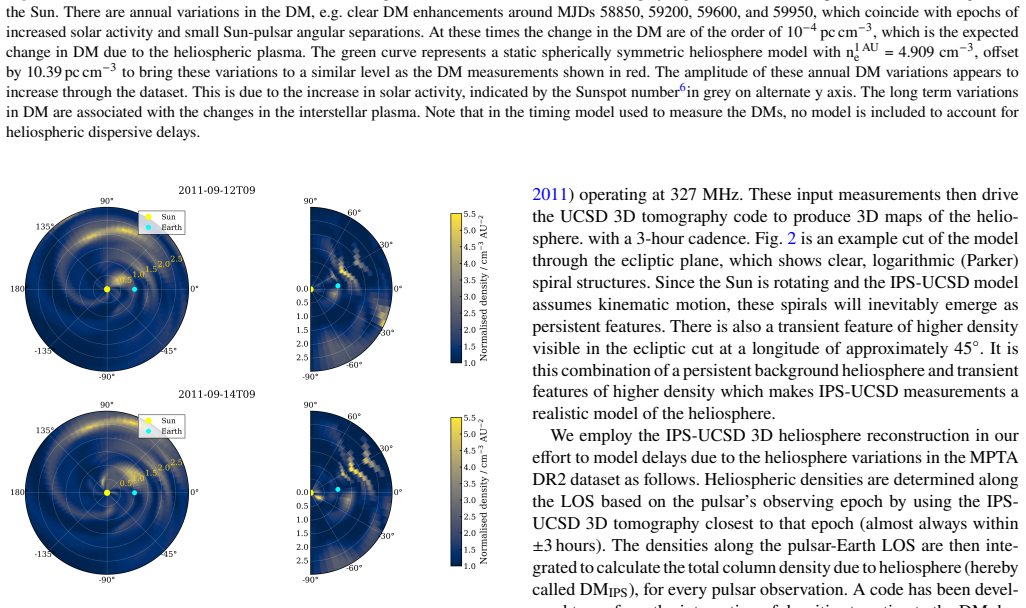
- Fig. 2 caption: “threcliptic” and “SUn’s” are typos; also clarify that the colour bar is normalised electron density.
- Eq. (3) and surrounding text: rEarth is written without a space or subscript consistency; a uniform notation for Earth–Sun distance would improve readability.
- Section 2.4: the choice of 100 ns white-noise floor and the fixed γDMGP=8/3 are reasonable, but a one-sentence justification that these values do not drive the recovered GWB correlation would be useful.
- Affiliation 10: “Imperial Colledge London” is misspelled.
- Data-availability statement: the promise that the IPS-derived DM series and simulation seeds will be shared on request is welcome; depositing them with the AAO Data Central release would further aid reproducibility.
Circularity Check
Mild construction dependence in the SWIPS outer-heliosphere patch (uses MPTA SWmean+SWGP ML realisation) does not force the central sufficiency claim; simulations inject IPS independently.
specific steps
-
fitted input called prediction
[Section 2.3, steps (i)–(ii) of the beyond-3 AU correction for DMIPS,final]
"Estimate a time-varying spherically symmetric heliosphere from the maximum likelihood realisation of “SWmean+SWGP” from the MPTA DR2 noise analysis. Compute the excess DM from 3AU to the pulsar as the difference between this spherically symmetric model and the DM obtained by integrating that same model only to 3AU. Add that excess DM to the DMIPS to form an updated DMIPS, known as DMIPS,updated. ... from the updated DMIPS,updated, compute the time-varying n1AU e using eq. 3. Smooth this n1AU e with a spline model ... Add this smoothed excess DM to the original DMIPS, known as DMIPS,final."
The outer-heliosphere contribution that completes SWIPS is constructed from the maximum-likelihood SWmean+SWGP realisation of the identical MPTA DR2 data set that is later used as the comparison baseline. Consequently, when SWIPS is compared with SWmean+SWGP on real data, part of the outer spherical component is shared by construction. The dependence is mild (inner 3 AU remains pure IPS; a subsequent spline smooths long-term structure) and does not affect the injection simulations, but it is a fitted-input dependence that slightly softens the independence of the real-data SWIPS vs SWmean+SWGP contrast.
full rationale
The paper's central claim—that a time-varying spherically-symmetric model (SWmean+SWGP) plus interstellar DMGP is sufficient to protect recovered GW parameters at L-band, while direct use of cleaned IPS-UCSD cubes biases CRN/HD—is supported by independent real-data posteriors (Figs. 4–6), time-domain realisations (Fig. 5), and controlled injection simulations (Figs. 7–9) that treat the IPS cubes as an external plausible realisation. The only circular step is the two-step beyond-3 AU correction for SWIPS, which re-uses the maximum-likelihood SWmean+SWGP realisation of the same MPTA DR2 data set to supply the outer spherical excess; this creates a mild dependence when SWIPS is later compared with SWmean+SWGP on real data. That dependence is confined to an outer-heliosphere patch, is partially mitigated by subsequent spline smoothing of n1AU, and does not enter the injection simulations. No equation reduces by construction to a fitted parameter that is then claimed as a prediction, and no uniqueness theorem or load-bearing self-citation forces the result. Score 2 reflects one minor, acknowledged construction dependence that does not undercut the main sufficiency conclusion.
Axiom & Free-Parameter Ledger
free parameters (4)
- outlier rejection thresholds (15× error-bar std and 3× SWmean+SWGP prediction)
- n1AU_e mean and power-law amplitude/spectral index for SWGP
- DMGP amplitude (drawn from MPTA DR2 distribution) and fixed gamma=8/3
- number of Fourier components for free-spectrum SWGP (10/30/100)
axioms (4)
- domain assumption Interstellar DM variations follow a power-law spectrum with Kolmogorov index 8/3 and are independent across pulsars.
- ad hoc to paper The IPS-UCSD 3-D tomography (after cleaning) is a sufficiently realistic realisation of the true time-varying heliosphere for injection tests.
- ad hoc to paper Heliospheric density beyond 3 AU can be adequately approximated by a time-varying spherical model whose n1AU is taken from the IPS cubes themselves.
- domain assumption Gaussian-process Fourier-basis modelling with power-law PSDs is an adequate description of all stochastic processes (RN, DM, SW, GWB).
read the original abstract
Heliospheric density variations impart delays on pulse times of arrivals from millisecond pulsars. Improper modelling of these variations may affect gravitational wave detection and characterisation by pulsar timing arrays (PTAs). Currently, PTAs typically employ a time-varying, spherically symmetric heliosphere model, which does not capture the full spatial and temporal complexity of the heliosphere. Instead, we investigate whether a three-dimensional, time-dependent model of the inner heliosphere from interplanetary scintillation (IPS) measurements - the IPS-UCSD model - can be employed to mitigate the solar wind in PTA analyses. We applied the IPS-UCSD model to the MeerKAT PTA 4.5-year dataset to assess whether it could correct for heliospheric density variations, and the impact on GW sensitivity compared to a spherically-symmetric model. We find that the model does not accurately correct for heliosphere-induced timing distortions, leading to bias in recovered GW parameters. Using simulations, we show that the spherically symmetric heliosphere model also fails to fully capture heliospheric density variations like those in the IPS-UCSD model. However, if interstellar dispersion measure (DM) variations are also modelled, then the heliospheric model errors are partially absorbed by DM variations, reducing contamination of the GW signal. Therefore we find that a time-varying spherically symmetric model is sufficient to mitigate the effect of heliospheric time delays on recovered GW results at typical PTA radio frequencies, provided other signal components are also modelled. We propose that the most precisely timed pulsars may be used to improve data-driven heliospheric density models in the future.
Figures



Reference graph
Works this paper leans on
-
[1]
A Relation between Distance and Radial Velocity among Extra-Galactic Nebulae. Proceedings of the National Academy of Science , year = "1929", month = "Mar", volume =. doi:10.1073/pnas.15.3.168 , adsurl =
-
[2]
Rotation of the Andromeda Nebula from a Spectroscopic Survey of Emission Regions. , year = "1970", month = "Feb", volume =. doi:10.1086/150317 , adsurl =
doi:10.1086/150317 1970
-
[3]
Rotational properties of 21 SC galaxies with a large range of luminosities and radii, from NGC 4605 (R=4kpc) to UGC 2885 (R=122kpc). , keywords =. 1980. doi:10.1086/158003 , adsurl =
doi:10.1086/158003 1980
-
[4]
Abbott, B. P. and Abbott, R. and Abbott, T. D. and Abernathy, M. R. and Acernese, F. and Ackley, K. and Adams, C. and Adams, T. and Addesso, P. and Adhikari, R. X. and Adya, V. B. and Affeldt, C. and Agathos, M. and Agatsuma, K. and Aggarwal, N. and Aguiar, O. D. and Aiello, L. and Ain, A. and Ajith, P. and Allen, B. and Allocca, A. and Altin, P. A. and A...
-
[5]
2007 , eprint=
LISA sources and science , author=. 2007 , eprint=
2007
-
[6]
Branchesi, Marica and Maggiore, Michele and Alonso, David and Badger, Charles and Banerjee, Biswajit and Beirnaert, Freija and Belgacem, Enis and Bhagwat, Swetha and Boileau, Guillaume and Borhanian, Ssohrab and Brown, Daniel David and Leong Chan, Man and Cusin, Giulia and Danilishin, Stefan L. and Degallaix, Jerome and De Luca, Valerio and Dhani, Arnab a...
-
[7]
Detecting the cosmic gravitational wave background with the Big Bang Observer , volume=
Corbin, Vincent and Cornish, Neil J , year=. Detecting the cosmic gravitational wave background with the Big Bang Observer , volume=. Classical and Quantum Gravity , publisher=. doi:10.1088/0264-9381/23/7/014 , number=
-
[8]
Pulsars as gravitational wave detectors , ISBN=
Hobbs, George , year=. Pulsars as gravitational wave detectors , ISBN=. doi:10.1007/978-3-642-17251-9_20 , booktitle=
-
[9]
and Zic, Andrew and Shannon, Ryan M
Reardon, Daniel J. and Zic, Andrew and Shannon, Ryan M. and Hobbs, George B. and Bailes, Matthew and Di Marco, Valentina and Kapur, Agastya and Rogers, Axl F. and Thrane, Eric and Askew, Jacob and Bhat, N. D. Ramesh and Cameron, Andrew and Curyło, Małgorzata and Coles, William A. and Dai, Shi and Goncharov, Boris and Kerr, Matthew and Kulkarni, Atharva an...
-
[10]
and Zic, Andrew and Shannon, Ryan M
Reardon, Daniel J. and Zic, Andrew and Shannon, Ryan M. and Di Marco, Valentina and Hobbs, George B. and Kapur, Agastya and Lower, Marcus E. and Mandow, Rami and Middleton, Hannah and Miles, Matthew T. and Rogers, Axl F. and Askew, Jacob and Bailes, Matthew and Bhat, N. D. Ramesh and Cameron, Andrew and Kerr, Matthew and Kulkarni, Atharva and Manchester, ...
-
[11]
and Arzoumanian, Zaven and Baker, Paul T
Agazie, Gabriella and Anumarlapudi, Akash and Archibald, Anne M. and Arzoumanian, Zaven and Baker, Paul T. and Bécsy, Bence and Blecha, Laura and Brazier, Adam and Brook, Paul R. and Burke-Spolaor, Sarah and Burnette, Rand and Case, Robin and Charisi, Maria and Chatterjee, Shami and Chatziioannou, Katerina and Cheeseboro, Belinda D. and Chen, Siyuan and C...
-
[12]
Antoniadis, J. and Arumugam, P. and Arumugam, S. and Babak, S. and Bagchi, M. and Bak Nielsen, A.-S. and Bassa, C. G. and Bathula, A. and Berthereau, A. and Bonetti, M. and Bortolas, E. and Brook, P. R. and Burgay, M. and Caballero, R. N. and Chalumeau, A. and Champion, D. J. and Chanlaridis, S. and Chen, S. and Cognard, I. and Dandapat, S. and Deb, D. an...
-
[13]
Xu, Heng and Chen, Siyuan and Guo, Yanjun and Jiang, Jinchen and Wang, Bojun and Xu, Jiangwei and Xue, Zihan and Nicolas Caballero, R. and Yuan, Jianping and Xu, Yonghua and Wang, Jingbo and Hao, Longfei and Luo, Jingtao and Lee, Kejia and Han, Jinlin and Jiang, Peng and Shen, Zhiqiang and Wang, Min and Wang, Na and Xu, Renxin and Wu, Xiangping and Manche...
-
[14]
Miles, Matthew T and Shannon, Ryan M and Reardon, Daniel J and Bailes, Matthew and Champion, David J and Geyer, Marisa and Gitika, Pratyasha and Grunthal, Kathrin and Keith, Michael J and Kramer, Michael and Kulkarni, Atharva D and Nathan, Rowina S and Parthasarathy, Aditya and Singha, Jaikhomba and Theureau, Gilles and Thrane, Eric and Abbate, Federico a...
-
[15]
Miles, Matthew T and Shannon, Ryan M and Reardon, Daniel J and Bailes, Matthew and Champion, David J and Geyer, Marisa and Gitika, Pratyasha and Grunthal, Kathrin and Keith, Michael J and Kramer, Michael and Kulkarni, Atharva D and Nathan, Rowina S and Parthasarathy, Aditya and Porayko, Nataliya K and Singha, Jaikhomba and Theureau, Gilles and Abbate, Fed...
-
[16]
Manchester, R. N. and Hobbs, G. B. and Teoh, A. and Hobbs, M. , year=. The Australia Telescope National Facility Pulsar Catalogue , volume=. The Astronomical Journal , publisher=. doi:10.1086/428488 , number=
-
[17]
, year = 1968, month = feb, volume =
Observation of a Rapidly Pulsating Radio Source. , year = 1968, month = feb, volume =. doi:10.1038/217709a0 , adsurl =
doi:10.1038/217709a0 1968
-
[18]
Handbook of Pulsar Astronomy
-
[19]
Manchester, R. N. , year=. Millisecond Pulsars, their Evolution and Applications , volume=. Journal of Astrophysics and Astronomy , publisher=. doi:10.1007/s12036-017-9469-2 , number=
-
[20]
Lorimer, Duncan R. , year=. Binary and Millisecond Pulsars , volume=. Living Reviews in Relativity , publisher=. doi:10.12942/lrr-2008-8 , number=
-
[21]
Pulsar Timing and Relativistic Gravity. Philosophical Transactions of the Royal Society of London Series A , year = 1992, month = oct, volume =. doi:10.1098/rsta.1992.0088 , adsurl =
-
[22]
Hobbs, G. B. and Edwards, R. T. and Manchester, R. N. , year=. tempo2, a new pulsar-timing package - I. An overview: tempo2, a new pulsar-timing package - I. Overview , volume=. Monthly Notices of the Royal Astronomical Society , publisher=. doi:10.1111/j.1365-2966.2006.10302.x , number=
-
[23]
Shannon, Ryan M. and Cordes, James M. , year=. ASSESSING THE ROLE OF SPIN NOISE IN THE PRECISION TIMING OF MILLISECOND PULSARS , volume=. The Astrophysical Journal , publisher=. doi:10.1088/0004-637x/725/2/1607 , number=
-
[24]
Measurement and correction of variations in interstellar dispersion in high-precision pulsar timing. , keywords =. doi:10.1093/mnras/sts486 , archivePrefix =. 1211.5887 , primaryClass =
-
[26]
Upper limits on the isotropic gravitational radiation background from pulsar timing analysis. , keywords =. doi:10.1086/183954 , adsurl =
-
[27]
and Charisi, Maria and Dolch, Timothy and Hazboun, Jeffrey S
Burke-Spolaor, Sarah and Taylor, Stephen R. and Charisi, Maria and Dolch, Timothy and Hazboun, Jeffrey S. and Holgado, A. Miguel and Kelley, Luke Zoltan and Lazio, T. Joseph W. and Madison, Dustin R. and McMann, Natasha and Mingarelli, Chiara M. F. and Rasskazov, Alexander and Siemens, Xavier and Simon, Joseph J. and Smith, Tristan L. , year=. The astroph...
-
[28]
Manchester, R. N. and Burgay, Marta and D’Amico, Nicolò and Esposito, Paolo and Pellizzoni, Alberto and Possenti, Andrea , year=. Pulsar Timing Arrays and their Applications , ISSN=. doi:10.1063/1.3615080 , booktitle=
-
[29]
2023 , eprint=
The Parkes Pulsar Timing Array Third Data Release , author=. 2023 , eprint=
2023
-
[30]
The MeerKAT Pulsar Timing Array: first data release , volume=
Miles, M T and Shannon, R M and Bailes, M and Reardon, D J and Keith, M J and Cameron, A D and Parthasarathy, A and Shamohammadi, M and Spiewak, R and van Straten, W and Buchner, S and Camilo, F and Geyer, M and Karastergiou, A and Kramer, M and Serylak, M and Theureau, G and Venkatraman Krishnan, V , year=. The MeerKAT Pulsar Timing Array: first data rel...
-
[31]
and Arzoumanian, Zaven and Baker, Paul T
Agazie, Gabriella and Alam, Md Faisal and Anumarlapudi, Akash and Archibald, Anne M. and Arzoumanian, Zaven and Baker, Paul T. and Blecha, Laura and Bonidie, Victoria and Brazier, Adam and Brook, Paul R. and Burke-Spolaor, Sarah and Bécsy, Bence and Chapman, Christopher and Charisi, Maria and Chatterjee, Shami and Cohen, Tyler and Cordes, James M. and Cor...
-
[32]
Antoniadis, J. and Babak, S. and Bak Nielsen, A.-S. and Bassa, C. G. and Berthereau, A. and Bonetti, M. and Bortolas, E. and Brook, P. R. and Burgay, M. and Caballero, R. N. and Chalumeau, A. and Champion, D. J. and Cłianlaridis, S. and Chen, S. and Cognard, I. and Desvignes, G. and Falxa, M. and Ferdman, R. D. and Franchini, A. and Gair, J. R. and Goncha...
-
[33]
Tarafdar, Pratik and Nobleson, K and Rana, Prerna and Singha, Jaikhomba and Krishnakumar, M. A. and Joshi, Bhal Chandra and Paladi, Avinash Kumar and Kolhe, Neel and Batra, Neelam Dhanda and Agarwal, Nikita and Bathula, Adarsh and Dandapat, Subhajit and Desai, Shantanu and Dey, Lankeswar and Hisano, Shinnosuke and Ingale, Prathamesh and Kato, Ryo and Khar...
-
[34]
The International Pulsar Timing Array: second data release , volume=
Perera, B B P and DeCesar, M E and Demorest, P B and Kerr, M and Lentati, L and Nice, D J and Osłowski, S and Ransom, S M and Keith, M J and Arzoumanian, Z and Bailes, M and Baker, P T and Bassa, C G and Bhat, N D R and Brazier, A and Burgay, M and Burke-Spolaor, S and Caballero, R N and Champion, D J and Chatterjee, S and Chen, S and Cognard, I and Corde...
-
[35]
ENTERPRISE: Enhanced Numerical Toolbox Enabling a Robust PulsaR Inference SuitE
-
[36]
2021 , eprint=
The Nanohertz Gravitational Wave Astronomer , author=. 2021 , eprint=
2021
-
[37]
Edwards, R. T. and Hobbs, G. B. and Manchester, R. N. , year=. TEMPO2, a new pulsar timing package - II. The timing model and precision estimates , volume=. Monthly Notices of the Royal Astronomical Society , publisher=. doi:10.1111/j.1365-2966.2006.10870.x , number=
-
[38]
An Improved Solar Wind Electron Density Model for Pulsar Timing. , keywords =. doi:10.1086/522227 , archivePrefix =. 0709.0135 , primaryClass =
-
[39]
Measurement of the electron density and magnetic field of the solar wind using millisecond pulsars. , keywords =. doi:10.1111/j.1365-2966.2012.20688.x , archivePrefix =. 1202.2263 , primaryClass =
-
[40]
and Simon, Joseph and Madison, Dustin R
Hazboun, Jeffrey S. and Simon, Joseph and Madison, Dustin R. and Arzoumanian, Zaven and Cromartie, H. Thankful and Crowter, Kathryn and DeCesar, Megan E. and Demorest, Paul B. and Dolch, Timothy and Ellis, Justin A. and Ferdman, Robert D. and Ferrara, Elizabeth C. and Fonseca, Emmanuel and Gentile, Peter A. and Jones, Glenn and Jones, Megan L. and Lam, Mi...
-
[41]
Journal of Geophysical Research (Space Physics) , keywords =
On the sources of fast and slow solar wind. Journal of Geophysical Research (Space Physics) , keywords =. doi:10.1029/2004JA010918 , adsurl =
-
[42]
Talpeanu, D.-C. and Poedts, S. and D’Huys, E. and Mierla, M. and Richardson, I. G. , year=. Interaction of coronal mass ejections and the solar wind: A force analysis , volume=. doi:10.1051/0004-6361/202243150 , journal=
-
[43]
Advances in Space Research , year = 1999, month = jan, volume =
Corotating interaction regions. Advances in Space Research , year = 1999, month = jan, volume =. doi:10.1016/S0273-1177(99)80013-1 , adsurl =
-
[44]
On the usefulness of existing solar wind models for pulsar timing corrections , volume=
Tiburzi, C and Verbiest, J P W and Shaifullah, G M and Janssen, G H and Anderson, J M and Horneffer, A and Künsemöller, J and Osłowski, S and Donner, J Y and Kramer, M and Kumari, A and Porayko, N K and Zucca, P and Ciardi, B and Dettmar, R-J and Grießmeier, J-M and Hoeft, M and Serylak, M , year=. On the usefulness of existing solar wind models for pulsa...
-
[45]
Tiburzi, C. and Shaifullah, G. M. and Bassa, C. G. and Zucca, P. and Verbiest, J. P. W. and Porayko, N. K. and van der Wateren, E. and Fallows, R. A. and Main, R. A. and Janssen, G. H. and Anderson, J. M. and Bak Nielsen, A.-S. and Donner, J. Y. and Keane, E. F. and Künsemöller, J. and Osłowski, S. and Grießmeier, J.-M. and Serylak, M. and Brüggen, M. and...
-
[46]
Susarla, S. C. and Chalumeau, A. and Tiburzi, C. and Keane, E. F. and Verbiest, J. P. W. and Hazboun, J. S. and Krishnakumar, M. A. and Iraci, F. and Shaifullah, G. M. and Golden, A. and Bak Nielsen, A.-S. and Donner, J. and Grießmeier, J.-M. and Keith, M. J. and Osłowski, S. and Porayko, N. K. and Serylak, M. and Anderson, J. M. and Brüggen, M. and Ciard...
-
[47]
2024 , eprint=
A Gaussian-processes approach to fitting for time-variable spherical solar wind in pulsar timing data , author=. 2024 , eprint=
2024
-
[48]
Tiburzi, C. and Jackson, B.V. and Cota, L. and Shaifullah, G.M. and Fallows, R.A. and Tokumaru, M. and Zucca, P. , year=. Validation of heliospheric modeling algorithms through pulsar observations I: Interplanetary scintillation-based tomography , volume=. Advances in Space Research , publisher=. doi:10.1016/j.asr.2022.04.070 , number=
-
[49]
Frontiers in Astronomy and Space Sciences , year = 2023, month = jul, volume =
Interplanetary scintillation observation and space weather modelling. Frontiers in Astronomy and Space Sciences , year = 2023, month = jul, volume =. doi:10.3389/fspas.2023.1159166 , adsurl =
-
[50]
Frontiers in Astronomy and Space Sciences , keywords =
Iterative Tomography: A Key to Providing Time- dependent 3-D Reconstructions of the Inner Heliosphere and the Unification of Space Weather Forecasting Techniques. Frontiers in Astronomy and Space Sciences , keywords =. doi:10.3389/fspas.2020.568429 , adsurl =
-
[51]
, keywords =
Determination of solar-wind velocities using single-station measurements of interplanetary scintillation. , keywords =
-
[52]
A newly developed UHF radiotelescope for interplanetary scintillation observations: Solar Wind Imaging Facility. Radio Science , keywords =. doi:10.1029/2011RS004694 , adsurl =
-
[53]
2024 , eprint=
Pulsar timing methods for evaluating dispersion measure time series , author=. 2024 , eprint=
2024
-
[54]
Kramer, M. and Backer, D.C. and Cordes, J.M. and Lazio, T.J.W. and Stappers, B.W. and Johnston, S. , year=. Strong-field tests of gravity using pulsars and black holes , volume=. New Astronomy Reviews , publisher=. doi:10.1016/j.newar.2004.09.020 , number=
-
[55]
Structure of Matter below Nuclear Saturation Density , author =. Phys. Rev. Lett. , volume =. 1983 , month =. doi:10.1103/PhysRevLett.50.2066 , url =
-
[56]
Pulsar Distances and the Galactic Distribution of Free Electrons. , keywords =. doi:10.1086/172870 , adsurl =
-
[57]
New Rotation Measures of Distant Pulsars in the Inner Galaxy and Magnetic Field Reversals. , keywords =. doi:10.1093/mnras/268.2.497 , adsurl =
-
[58]
Pulsar timing measurements and the search for gravitational waves. , keywords =. doi:10.1086/157593 , adsurl =
-
[59]
2023 , eprint=
The International Pulsar Timing Array checklist for the detection of nanohertz gravitational waves , author=. 2023 , eprint=
2023
-
[60]
40th COSPAR Scientific Assembly , year = 2014, volume =
OMNI: A Description of Near-Earth Solar Wind Environment. 40th COSPAR Scientific Assembly , year = 2014, volume =
2014
-
[61]
Tiburzi, C. and Hobbs, G. and Kerr, M. and Coles, W. A. and Dai, S. and Manchester, R. N. and Possenti, A. and Shannon, R. M. and You, X. P. , year=. A study of spatial correlations in pulsar timing array data , volume=. Monthly Notices of the Royal Astronomical Society , publisher=. doi:10.1093/mnras/stv2143 , number=
-
[62]
Dispersion measure variations and their effect on precision pulsar timing. , keywords =. doi:10.1111/j.1365-2966.2007.11617.x , archivePrefix =. astro-ph/0702366 , primaryClass =
-
[63]
Ulysses solar wind plasma observations from pole to pole. , keywords =. doi:10.1029/95GL03094 , adsurl =
-
[64]
Essential Radio Astronomy
-
[65]
2015 , eprint=
Timing analysis for 20 millisecond pulsars in the Parkes Pulsar Timing Array , author=. 2015 , eprint=
2015
-
[66]
and Bailes, Matthew and Shannon, Ryan M
Reardon, Daniel J. and Bailes, Matthew and Shannon, Ryan M. and Flynn, Chris and Askew, Jacob and Bhat, N. D. Ramesh and Chen, Zu-Cheng and Curyło, Małgorzata and Feng, Yi and Hobbs, George B. and Kapur, Agastya and Kerr, Matthew and Liu, Xiaojin and Manchester, Richard N. and Mandow, Rami and Mishra, Saurav and Russell, Christopher J. and Shamohammadi, M...
-
[67]
The impact of a stochastic gravitational-wave background on pulsar timing parameters. , keywords =. doi:10.1111/j.1365-2966.2011.19413.x , archivePrefix =. 1107.4014 , primaryClass =
-
[68]
and Cornish, Neil and Crowter, Kathryn and Demorest, Paul B
Arzoumanian, Zaven and Brazier, Adam and Burke-Spolaor, Sarah and Chamberlin, Sydney and Chatterjee, Shami and Christy, Brian and Cordes, James M. and Cornish, Neil and Crowter, Kathryn and Demorest, Paul B. and Dolch, Timothy and Ellis, Justin A. and Ferdman, Robert D. and Fonseca, Emmanuel and Garver-Daniels, Nathan and Gonzalez, Marjorie E. and Jenet, ...
-
[69]
Journal of Physics Conference Series , year = 2024, series =
Pulsars as Clocks. Journal of Physics Conference Series , year = 2024, series =. doi:10.1088/1742-6596/2889/1/012001 , adsurl =
-
[70]
Noise in pulsar timing arrays , volume=
Wang, Yan , year=. Noise in pulsar timing arrays , volume=. doi:10.1088/1742-6596/610/1/012019 , journal=
-
[71]
Gersbach, Kyle A. and Taylor, Stephen R. and Meyers, Patrick M. and Romano, Joseph D. , year=. Spatial and spectral characterization of the gravitational-wave background with the PTA optimal statistic , volume=. Physical Review D , publisher=. doi:10.1103/physrevd.111.023027 , number=
-
[72]
Chamberlin, Sydney J. and Creighton, Jolien D. E. and Siemens, Xavier and Demorest, Paul and Ellis, Justin and Price, Larry R. and Romano, Joseph D. , year=. Time-domain implementation of the optimal cross-correlation statistic for stochastic gravitational-wave background searches in pulsar timing data , volume=. Physical Review D , publisher=. doi:10.110...
-
[73]
2025 , eprint=
Latitudinal dependence of the solar wind during periods of high and low activity through interplanetary scintillation , author=. 2025 , eprint=
2025
-
[74]
libstempo: Python wrapper for Tempo2
-
[75]
and Archibald, Anne and Kerr, Matthew and Jennings, Ross J
Luo, Jing and Ransom, Scott and Demorest, Paul and Ray, Paul S. and Archibald, Anne and Kerr, Matthew and Jennings, Ross J. and Bachetti, Matteo and van Haasteren, Rutger and Champagne, Chloe A. and Colen, Jonathan and Phillips, Camryn and Zimmerman, Josef and Stovall, Kevin and Lam, Michael T. and Jenet, Fredrick A. , year=. PINT: A Modern Software Packa...
-
[76]
Parthasarathy, A and Bailes, M and Shannon, R M and van Straten, W and Osłowski, S and Johnston, S and Spiewak, R and Reardon, D J and Kramer, M and Venkatraman Krishnan, V and Pennucci, T T and Abbate, F and Buchner, S and Camilo, F and Champion, D J and Geyer, M and Hugo, B and Jameson, A and Karastergiou, A and Keith, M J and Serylak, M , year=. Measur...
-
[77]
Aksim, Dan and Melnikov, Alexey and Pavlov, Dmitry and Kurdubov, Sergey , year=. Exploring the Asymmetry of the Solar Corona Electron Density with Very Long Baseline Interferometry , volume=. The Astrophysical Journal , publisher=. doi:10.3847/1538-4357/ab499a , number=
-
[78]
The NANOGrav Nine-year Data Set: Measurement and Analysis of Variations in Dispersion Measures. , keywords =. doi:10.3847/1538-4357/aa73df , archivePrefix =. 1612.03187 , primaryClass =
-
[79]
Time Variability of Pulsar Dispersion Measures. , keywords =. doi:10.1086/186206 , adsurl =
-
[80]
and Islo, Kristina and Taylor, Stephen R
Vigeland, Sarah J. and Islo, Kristina and Taylor, Stephen R. and Ellis, Justin A. , year=. Noise-marginalized optimal statistic: A robust hybrid frequentist-Bayesian statistic for the stochastic gravitational-wave background in pulsar timing arrays , volume=. Physical Review D , publisher=. doi:10.1103/physrevd.98.044003 , number=
-
[81]
2025 , eprint=
Beyond diagonal approximations: improved covariance modeling for pulsar timing array data analysis , author=. 2025 , eprint=
2025
discussion (0)
Sign in with ORCID, Apple, or X to comment. Anyone can read and Pith papers without signing in.