REVIEW 5 minor 90 references
Distributed Symmetry Breaking on Hyperbolic Random Graphs
T0 review · 0 major / 5 minor · reviewed 2026-07-13 · grok-4.5
Pith's one-line read MIS and maximal matching stay super-constant on hyperbolic random graphs, even though colouring collapses to two rounds.
desk verdict Solid, self-contained complexity separation for MIS/MM on HRGs: new geometric shattering upper bounds and a tree-embedding lower bound that cleanly separates them from 2-round colouring. read the letter →
The pith
A machine-rendered reading of the paper's core claim, the machinery that carries it, and where it could break.
The reading
What carries the argument
Geometric construction of polynomially many induced d-ary trees of height Θ(log log n / log log log n) and degree Θ(log log n), each attached to the giant component by a unique cut edge at the root; these trees let classical round-elimination lower bounds on regular trees be lifted to hyperbolic random graphs.
What would settle it
Either exhibit an o(log log n / log log log n)-round randomised LOCAL algorithm that succeeds with high probability on the giant component of every sufficiently large threshold hyperbolic random graph, or prove that such graphs contain no induced d-ary trees of the claimed height and degree.
Extended reading notes
Core claim
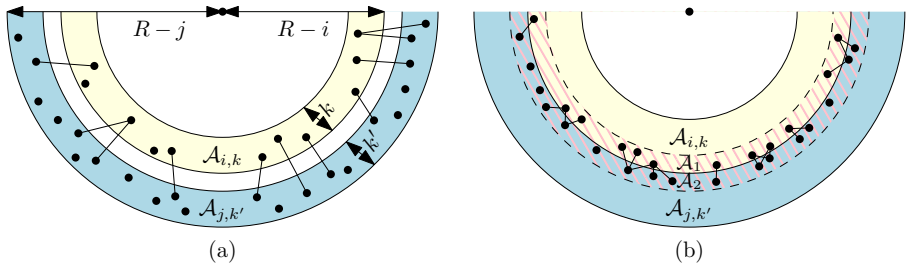
Asymptotically almost surely, any randomised LOCAL algorithm for MIS or maximal matching on the giant component of a threshold hyperbolic random graph needs Ω(log log n / log log log n) rounds, while both problems can be solved in Õ(log^{5/3} log n) LOCAL rounds (and Õ(log^{3} log n) CONGEST rounds) by constant-round geometric shattering followed by deterministic cleanup of the residual components.
Load-bearing premise
An algorithm that runs for fewer rounds than roughly one-hundredth of the constructed tree height cannot notice the single cut edge that joins the tree to the rest of the giant component, so the tree lower bound still applies.
Editorial analysis
A structured set of objections, weighed in public.
Referee Report
Summary. The paper studies distributed MIS and maximal matching on threshold hyperbolic random graphs. It proves that both problems require Ω(log log n / log log log n) rounds a.a.s. on the giant component in the LOCAL model (Theorem 2), by constructing polynomially many induced d-ary trees of height θ(log_d log n) attached by a single cut-edge (Theorem 18 / Corollary 23) and transferring known tree lower bounds via a careful coupling (Lemma 24). Matching upper bounds of Õ(log^{5/3} log n) LOCAL and Õ(log^{3} log n) CONGEST are obtained by a constant-round geometric shattering procedure that realises angular separators (Theorem 1, Propositions 14 and 17). When nodes know their hyperbolic coordinates, MM improves further to O(log log log n) CONGEST rounds (Theorem 3).
Significance. The work cleanly separates the complexity of MIS/MM from that of Δ+1-colouring on the same generative model, showing that the dramatic constant-round colouring result of Maus–Ruff does not extend to all classical symmetry-breaking problems. The geometric tree-embedding theorem is of independent structural interest and supplies a reusable lower-bound transfer technique for other locally checkable problems on HRGs. The shattering analysis is self-contained and does not rely on the flawed off-the-shelf shattering arguments recently identified in the literature. The embedding-aware separation for MM is a clean illustration that geometric side information can beat pure combinatorial lower bounds. Full proofs, concentration arguments, and an explicit generalisation of round-elimination to arbitrary error probability (Appendix C) are supplied.
minor comments (5)
- [Abstract / Theorem 1] In the abstract and Theorem 1 the CONGEST bound is written Õ(log^{3} log n); the footnote and the MM analysis claim the slightly stronger O(log^{3} log n). Align the statements.
- [Section 7, Tiling] The constant 40 appearing in the tiling (Eq. (26) and Lemma 27) is chosen for convenience; a short remark that any sufficiently large constant works would help readers who wish to re-use the tiling.
- [Figure 1] Figure 1 caption refers to “Theorem 3 (MM)” and “Theorem 3 (MIS)”; the figure itself would be clearer if the two embedding-aware bounds were drawn with distinct markers.
- [Section 4, Lemma 9] Lemma 9 is used repeatedly; a one-sentence geometric intuition (shared neighbour of larger radius forces a triangle) would make later applications easier to follow.
- [Appendix A] In Appendix A the parameter ε = (1-1/(2α))/(2t(t+2)) is tuned so that the residual degree stays polynomial after any constant number of Luby rounds; a brief numerical example for a concrete α would make the calculation more transparent.
Circularity Check
No significant circularity; geometric tree construction and shattering are independent of the imported external lower-bound sequences, with only non-load-bearing self-citation to the authors' prior colouring result.
full rationale
The paper's central claims (Theorems 1–2) rest on two independent pillars that do not reduce to their own inputs by construction. Upper bounds (Propositions 14 and 17) follow from a constant-round geometric shattering argument that uses only standard Chernoff/Poisson concentration on the HRG measure (Lemmas 6–8) together with off-the-shelf deterministic solvers of Ghaffari–Grunau and Faour et al.; no parameters are fitted to the target runtime. Lower bounds are obtained by an a.a.s. geometric embedding of polynomially many induced d-ary trees of controlled height and degree (Theorem 18 / Corollary 23, via the explicit box construction of Definition 19 and the niceness probability of Lemma 21), followed by a coupling transfer (Lemma 24) that maps any fast HRG algorithm onto an abstract regular tree, and only then by invoking the external round-elimination sequences of Balliu et al. (Lemma 25, extended in Appendix C to general error probability). The sole self-citation of substance is the authors' own SODA'26 colouring result, used only for contrast and not as a premise of either the shattering or the tree construction. No equation equates a claimed prediction to a fitted quantity, no uniqueness theorem is imported from the same authors to forbid alternatives, and no ansatz is smuggled via citation. The derivation is therefore self-contained against external benchmarks.
Assumptions & free parameters
free parameters (2)
- activation-degree thresholds (log^4 n, log^{3/2} n, …)
- tiling constant 40
assumptions (4)
- domain assumption Poisson point process representation of threshold HRGs with intensity n·ρ(r, heta) and connection radius R=2 log n+C
- standard math Chernoff and Poisson-Chernoff tail bounds (Lemmas 42–43)
- domain assumption Round-elimination sequences of length Θ(d) with label complexity O(d) for MIS and constant for MM on regular trees (Balliu et al., Brandt–Olivetti)
- domain assumption Existence of a unique giant component of linear size and the absence of vertices too close to the origin a.a.s.
invented entities (2)
-
nice sector / box construction for d-ary trees
-
angular separator pattern realised by two Luby steps
Cite this review
Pith. "Pith review of Distributed Symmetry Breaking on Hyperbolic Random Graphs." pith.science (2026). https://pith.science/paper/HTG3GSAM
@misc{pith2026260709170,
  author       = {Pith},
  title        = {Pith review of: Distributed Symmetry Breaking on Hyperbolic Random Graphs},
  year         = {2026},
  howpublished = {\url{https://pith.science/paper/HTG3GSAM}},
  note         = {Machine review of arXiv:2607.09170}
}
abstract
Real-world networks like the internet share patterns like a power law degree distribution and a high clustering coefficient. Many of these properties are captured by the generative model of hyperbolic random graphs (HRGs), which provides a theoretical framework for studying such networks. Motivated by the observation that several algorithms perform better on real-world networks than their worst-case guarantees suggest, we design and analyse distributed algorithms under the assumption that the input graph is an HRG. Indeed, prior work has shown that the classical symmetry-breaking problem of $\Delta+1$ colouring, where $\Delta$ is the maximum degree of the graph, can be solved in 2 rounds on HRGs [Maus and Ruff; SODA'26]. In stark contrast to this 2-round algorithm for $\Delta+1$ colouring, we prove that the related symmetry-breaking problems of maximal independent set (MIS) and maximal matching (MM) are substantially harder: we establish a lower bound of $\Omega\left(\frac{\log\log n}{\log\log\log n}\right)$ for MIS and MM on HRGs. Our lower bound techniques rely on new structural insights that may be of independent interest: we show that HRGs contain $d$-ary trees with large height and degree which enables us to adapt and lift prior impossibility results for distributed algorithms to the setting of HRGs. We also show that these lower bounds are polynomial tight: we design algorithms tailored to HRGs that solve MIS and MM in $\tilde{\mathcal{O}}(\log^{5/3}\log n)$ rounds with high probability in the LOCAL model, improving over the general worst-case lower bound of $\Omega\left(\min\left\{\log \Delta, \sqrt{\log n}\right\}\right)$ rounds [Khoury and Schild; FOCS'25].
Figures


Figures from the paper (6 more)


Reference graph
Works this paper leans on
-
[1]
Typical distances in a geo- metric model for complex networks
Mohammed Amin Abdullah, Nikolaos Fountoulakis, and Michel Bode. “Typical distances in a geo- metric model for complex networks”. In:Internet Math.(2017).doi:10.24166/IM.13.2017
-
[2]
A fast and simple randomized parallel algorithm for the maximal independent set problem
Noga Alon, László Babai, and Alon Itai. “A fast and simple randomized parallel algorithm for the maximal independent set problem”. In:Journal of Algorithms(1986).doi: 10.1016/0196-6774(86) 90019-2.url:http://dx.doi.org/10.1016/0196-6774(86)90019-2
-
[3]
Hyperbolic Random Graphs: Clique Number and Degeneracy with Implications for Colouring
Samuel Baguley, Yannic Maus, Janosch Ruff, and George Skretas. “Hyperbolic Random Graphs: Clique Number and Degeneracy with Implications for Colouring”. In:STACS’25. 2025.doi:10.4230/ LIPICS.STACS.2025.13
2025
-
[4]
Distributed Quantum Advantage for Local Problems
Alkida Balliu, Sebastian Brandt, Xavier Coiteux-Roy, Francesco d’Amore, Massimo Equi, François Le Gall, Henrik Lievonen, Augusto Modanese, Dennis Olivetti, Marc-Olivier Renou, Jukka Suomela, Lucas Tendick, and Isadora Veeren. “Distributed Quantum Advantage for Local Problems”. In:STOC’25. 2025
2025
-
[5]
Lower Bounds for Maximal Matchings and Maximal Independent Sets
Alkida Balliu, Sebastian Brandt, Juho Hirvonen, Dennis Olivetti, Mikaël Rabie, and Jukka Suomela. “Lower Bounds for Maximal Matchings and Maximal Independent Sets”. In:J. ACM(2021).doi: 10.1145/3461458.url:https://doi.org/10.1145/3461458
work page doi:10.1145/3461458.url:https://doi.org/10.1145/3461458 2021
-
[6]
DistributedΔ-coloring plays hide-and-seek
Alkida Balliu, Sebastian Brandt, Fabian Kuhn, and Dennis Olivetti. “DistributedΔ-coloring plays hide-and-seek”. In:STOC’22. 2022.doi: 10.1145/3519935.3520027.url: https://doi.org/ 10.1145/3519935.3520027
-
[7]
New Hardness Results for the LOCAL Model via a Simple Self-Reduction
Alkida Balliu, Filippo Casagrande, Francesco d’Amore, and Dennis Olivetti. “New Hardness Results for the LOCAL Model via a Simple Self-Reduction”. In:PODC’26(2026).doi: 10.48550/ARXIV. 2510.19972
doi:10.48550/arxiv 2026
-
[8]
Distributed Quantum Advantage in Locally Checkable Labeling Problems
Alkida Balliu, Filippo Casagrande, Francesco d’Amore, Massimo Equi, Barbara Keller, Henrik Lievo- nen, Dennis Olivetti, Gustav Schmid, and Jukka Suomela. “Distributed Quantum Advantage in Locally Checkable Labeling Problems”. In:SODA’26.doi: 10.1137/1.9781611978971.49.url: https://epubs.siam.org/doi/abs/10.1137/1.9781611978971.49
Show all 90 references
-
[9]
Node and edge averaged complex- ities of local graph problems
Alkida Balliu, Mohsen Ghaffari, Fabian Kuhn, and Dennis Olivetti. “Node and edge averaged complex- ities of local graph problems”. In:Distributed Comput.(2023).doi: 10.1007/S00446-023-00453-1 . url:https://doi.org/10.1007/s00446-023-00453-1. 44
2023 doi
-
[10]
Emergence of Scaling in Random Networks
Albert-László Barabási and Réka Albert. “Emergence of Scaling in Random Networks”. In:Science (1999).doi:10.1126/science.286.5439.509
1999 doi
-
[11]
Morgan & Claypool Publishers, 2013
Leonid Barenboim and Michael Elkin.Distributed Graph Coloring: Fundamentals and Recent Develop- ments. Morgan & Claypool Publishers, 2013
2013
-
[13]
The Locality of Distributed Symmetry Breaking
Leonid Barenboim, Michael Elkin, Seth Pettie, and Johannes Schneider. “The Locality of Distributed Symmetry Breaking”. In:Journal of the ACM (JACM)(2016).doi:10.1145/2903137
2016 doi
-
[14]
The Diameter of (Threshold) Geometric Inhomogeneous Random Graphs
Zylan Benjert, Kostas Lakis, Johannes Lengler, and Raghu Raman Ravi. “The Diameter of (Threshold) Geometric Inhomogeneous Random Graphs”. In:STACS’26. 2026
2026
-
[15]
Localized geometry detection in scale-free random graphs
Gianmarco Bet, Riccardo Michielan, and Clara Stegehuis. “Localized geometry detection in scale-free random graphs”. In:Journal of Applied Probability(2025).doi:10.1017/jpr.2025.10038
2025 doi
-
[16]
Product Structure and Treewidth of Hyperbolic Uniform Disk Graphs
Thomas Bläsius, Emil Dohse, Deborah Haun, and Laura Merker. “Product Structure and Treewidth of Hyperbolic Uniform Disk Graphs”. In:SoCG’26. 2026.doi: 10.4230/LIPICS.SOCG.2026.18. url:https://doi.org/10.4230/LIPIcs.SoCG.2026.18
2026 doi
-
[17]
On the External Validity of Average-case Analyses of Graph Algorithms
Thomas Bläsius and Philipp Fischbeck. “On the External Validity of Average-case Analyses of Graph Algorithms”. In:ACM Transactions on Algorithms (TALG)(2024).doi:10.1145/3633778
2024 doi
-
[18]
Solving Vertex Cover in Polynomial Time on Hyperbolic Random Graphs
Thomas Bläsius, Philipp Fischbeck, Tobias Friedrich, and Maximilian Katzmann. “Solving Vertex Cover in Polynomial Time on Hyperbolic Random Graphs”. In:Theory Comput. Syst.(2023)
2023
-
[19]
Efficient Shortest Paths in Scale-Free Networks with Underlying Hyperbolic Geometry
Thomas Bläsius, Cedric Freiberger, Tobias Friedrich, Maximilian Katzmann, Felix Montenegro-Retana, and Marianne Thieffry. “Efficient Shortest Paths in Scale-Free Networks with Underlying Hyperbolic Geometry”. In:ACM Transactions on Algorithms (TALG)(2022).doi:10.1145/3516483
2022 doi
-
[20]
Efficiently Approximating Vertex Cover on Scale-Free Networks with Underlying Hyperbolic Geometry
Thomas Bläsius, Tobias Friedrich, and Maximilian Katzmann. “Efficiently Approximating Vertex Cover on Scale-Free Networks with Underlying Hyperbolic Geometry”. In:Algorithmica(2023)
2023
-
[21]
Efficiently generating geometric inhomogeneous and hyperbolic random graphs
Thomas Bläsius, Tobias Friedrich, Maximilian Katzmann, Ulrich Meyer, Manuel Penschuck, and Christopher Weyand. “Efficiently generating geometric inhomogeneous and hyperbolic random graphs”. In:Network Science(2022).doi:10.1017/nws.2022.32
2022 doi
-
[22]
On the Giant Component of Geometric Inhomogeneous Random Graphs
Thomas Bläsius, Tobias Friedrich, Maximilian Katzmann, Janosch Ruff, and Ziena Zeif. “On the Giant Component of Geometric Inhomogeneous Random Graphs”. In:ESA’23. 2023.doi: 10.4230/ LIPICS.ESA.2023.20
2023
-
[23]
Strongly Hyperbolic Unit Disk Graphs
Thomas Bläsius, Tobias Friedrich, Maximilian Katzmann, and Daniel Stephan. “Strongly Hyperbolic Unit Disk Graphs”. In:STACS’23. 2023.doi:10.4230/LIPIcs.STACS.2023.13
2023 doi
-
[24]
Cliques in Hyperbolic Random Graphs
Thomas Bläsius, Tobias Friedrich, and Anton Krohmer. “Cliques in Hyperbolic Random Graphs”. In: Algorithmica(2018).doi:10.1007/s00453-017-0323-3
2018 doi
-
[25]
Hyperbolic Random Graphs: Separators and Treewidth
Thomas Bläsius, Tobias Friedrich, and Anton Krohmer. “Hyperbolic Random Graphs: Separators and Treewidth”. In:ESA. 2016.doi:10.4230/LIPIcs.ESA.2016.15
2016 doi
-
[26]
Structure and Independence in Hyperbolic Uniform Disk Graphs
Thomas Bläsius, Jean-Pierre von der Heydt, Sándor Kisfaludi-Bak, Marcus Wilhelm, and Geert van Wordragen. “Structure and Independence in Hyperbolic Uniform Disk Graphs”. In:SoCG’25. 2025. doi: 10.4230/LIPICS.SOCG.2025.21 .url: https://doi.org/10.4230/LIPIcs.SoCG. 2025.21
2025 doi
-
[27]
Maximal cliques in scale-free random graphs
Thomas Bläsius, Maximilian Katzmann, and Clara Stegehuis. “Maximal cliques in scale-free random graphs”. In:Network Science(2024).doi:10.1017/nws.2024.13. 45
2024 doi
-
[28]
On the largest component of a hyperbolic model of complex networks
Michel Bode, N. Fountoulakis, and Tobias Müller. “On the largest component of a hyperbolic model of complex networks”. In:Electronic Journal of Combinatorics(2015).doi:10.1214/17-AAP1314
2015 doi
-
[29]
Sustaining the Internet with hyperbolic mapping
Marián Boguñá, Fragkiskos Papadopoulos, and Dmitri Krioukov. “Sustaining the Internet with hyperbolic mapping”. In:Nature Communications(2010).doi:10.1038/ncomms1063
2010 doi
-
[30]
Truly Tight-in-ΔBounds for Bipartite Maximal Matching and Variants
Sebastian Brandt and Dennis Olivetti. “Truly Tight-in-ΔBounds for Bipartite Maximal Matching and Variants”. In:PODC’20. 2020.doi: 10.1145/3382734.3405745.url: https://doi.org/10. 1145/3382734.3405745
2020 doi
-
[31]
Geometric inhomogeneous random graphs
Karl Bringmann, Ralph Keusch, and Johannes Lengler. “Geometric inhomogeneous random graphs”. In:Theoretical Computer Science(2019).doi: 10.1016/j.tcs.2018.08.014 .url: http://dx. doi.org/10.1016/j.tcs.2018.08.014
2019 doi
-
[32]
Greedy routing and the algorithmic small-world phenomenon
Karl Bringmann, Ralph Keusch, Johannes Lengler, Yannic Maus, and Anisur R. Molla. “Greedy routing and the algorithmic small-world phenomenon”. In:Journal of Computer and System Sciences (2022).doi: https : / / doi . org / 10 . 1016 / j . jcss . 2021 . 11 . 003.url: https : / /...
2022
-
[33]
Balanced Bidirectional Breadth-First Search on Scale-Free Networks
Sacha Cerf, Benjamin Dayan, Umberto De Ambroggio, Marc Kaufmann, Johannes Lengler, and Ulysse Schaller. “Balanced Bidirectional Breadth-First Search on Scale-Free Networks”. In:arXiv(2024).doi: 10.48550/ARXIV.2410.22186.url:https://arxiv.org/abs/2410.22186
-
[34]
An Exponential Separation between Randomized and Deterministic Complexity in the LOCAL Model
Yi-Jun Chang, Tsvi Kopelowitz, and Seth Pettie. “An Exponential Separation between Randomized and Deterministic Complexity in the LOCAL Model”. In:SIAM J. Comput.(2019).doi: 10.1137/ 17M1117537.url:https://doi.org/10.1137/17M1117537
2019 doi
-
[35]
An optimal distributed (Δ+1)-coloring algorithm?
Yi-Jun Chang, Wenzheng Li, and Seth Pettie. “An optimal distributed (Δ+1)-coloring algorithm?” In: STOC’18. 2018
2018
-
[36]
Connected Components in Random Graphs with Given Expected Degree Sequences
Fan Chung and Linyuan Lu. “Connected Components in Random Graphs with Given Expected Degree Sequences”. In:Annals of Combinatorics(2002).doi:10.1007/PL00012580
2002 doi
-
[37]
The Average Distances in Random Graphs with Given Expected Degrees
Fan Chung and Linyuan Lu. “The Average Distances in Random Graphs with Given Expected Degrees”. In:Proceedings of the National Academy of Sciences(2002).doi:10.1073/pnas.252631999
2002 doi
-
[38]
A Breezing Proof of the KMW Bound
Corinna Coupette and Christoph Lenzen. “A Breezing Proof of the KMW Bound”. In:SOSA’21. 2021.doi: 10 . 1137 / 1 . 9781611976496 . 21.url: http : / / dx . doi . org / 10 . 1137 / 1 . 9781611976496.21
2021
-
[39]
On power-law relationships of the internet topology
Michalis Faloutsos, Petros Faloutsos, and Christos Faloutsos. “On power-law relationships of the internet topology”. In:ACM SIGCOMM computer communication review(1999)
1999
-
[40]
Local Dis- tributed Rounding: Generalized to MIS, Matching, Set Cover, and Beyond
Salwa Faour, Mohsen Ghaffari, Christoph Grunau, Fabian Kuhn, and Václav Rozhon. “Local Dis- tributed Rounding: Generalized to MIS, Matching, Set Cover, and Beyond”. In:SODA’23. 2023.doi: 10.1137/1.9781611977554.CH168 .url: https://doi.org/10.1137/1.9781611977554. ch168
2023 doi
-
[41]
Improved deterministic distributed matching via rounding
Manuela Fischer. “Improved deterministic distributed matching via rounding”. In:Distributed Com- puting(2020)
2020
-
[42]
Law of large numbers for the largest component in a hyperbolic model of complex networks
Nikolaos Fountoulakis and Tobias Müller. “Law of large numbers for the largest component in a hyperbolic model of complex networks”. In:The Annals of Applied Probability(2018).url: https: //www.jstor.org/stable/26542317
2018
-
[43]
On the Diameter of Hyperbolic Random Graphs
Tobias Friedrich and Anton Krohmer. “On the Diameter of Hyperbolic Random Graphs”. In:SIAM Journal on Discrete Mathematics(2018).doi:10.1137/17M1123961. 46
2018 doi
-
[44]
An Improved Distributed Algorithm for Maximal Independent Set
Mohsen Ghaffari. “An Improved Distributed Algorithm for Maximal Independent Set”. In:SODA’16. 2016.doi: 10 . 1137 / 1 . 9781611974331 . CH20.url: https : / / doi . org / 10 . 1137 / 1 . 9781611974331.ch20
2016
-
[45]
Distributed Maximal Independent Set using Small Messages
Mohsen Ghaffari. “Distributed Maximal Independent Set using Small Messages”. In:SODA’19. 2019. doi: 10.1137/1.9781611975482.50.url: https://doi.org/10.1137/1.9781611975482. 50
2019 doi
-
[46]
Faster deterministic distributed MIS and approximate matching
Mohsen Ghaffari and Christoph Grunau. “Faster deterministic distributed MIS and approximate matching”. In:STOC’23. 2023
2023
-
[47]
Near-Optimal Deterministic Network Decomposition and Ruling Set, and Improved MIS
Mohsen Ghaffari and Christoph Grunau. “Near-Optimal Deterministic Network Decomposition and Ruling Set, and Improved MIS”. In:FOCS’24. 2024.doi:10.1109/FOCS61266.2024.00007
2024 doi
-
[48]
Improved Distributed Network Decomposition, Hitting Sets, and Spanners, via Derandomization
Mohsen Ghaffari, Christoph Grunau, Bernhard Haeupler, Saeed Ilchi, and Václav Rozhoň. “Improved Distributed Network Decomposition, Hitting Sets, and Spanners, via Derandomization”. In:SODA’23. 2023.doi: 10.1137/1.9781611977554.ch97.url: https://epubs.siam.org/doi/abs/10. 1137/...
2023 doi
-
[49]
Halldórsson, Yannic Maus, and Alexandre Nolin.Robust Shattering Arguments
Mohsen Ghaffari, Magnús M. Halldórsson, Yannic Maus, and Alexandre Nolin.Robust Shattering Arguments. 2026. arXiv:2606.27847.url:https://arxiv.org/abs/2606.27847
2026 arXiv
-
[50]
Improved Network Decompositions Using Small Messages with Applications on MIS, Neighborhood Covers, and Beyond
Mohsen Ghaffari and Julian Portmann. “Improved Network Decompositions Using Small Messages with Applications on MIS, Neighborhood Covers, and Beyond”. In:DISC’19. 2019.doi: 10.4230/ LIPIcs . DISC . 2019 . 18.url: https : / / drops . dagstuhl . de / entities / document / 10 . 4...
2019
-
[51]
Random Hyperbolic Graphs: Degree Sequence and Clustering
Luca Gugelmann, Konstantinos Panagiotou, and Ueli Peter. “Random Hyperbolic Graphs: Degree Sequence and Clustering”. In:ICALP’12. 2012.doi:10.1007/978-3-642-31585-5_51
2012 doi
-
[52]
Distributed (Δ+1)-Coloring in Sublogarith- mic Rounds
David G. Harris, Johannes Schneider, and Hsin-Hao Su. “Distributed (Δ+1)-Coloring in Sublogarith- mic Rounds”. In:J. ACM(2018).url:https://doi.org/10.1145/3178120
2018 doi
-
[53]
Cluster-size decay in supercritical kernel-based spatial random graphs
Joost Jorritsma, Júlia Komjáthy, and Dieter Mitsche. “Cluster-size decay in supercritical kernel-based spatial random graphs”. In:The Annals of Probability(2025).doi: 10 . 1214 / 24 - aop1742.url: http://dx.doi.org/10.1214/24-AOP1742
2025 doi
-
[54]
About the analysis of algorithms on networks with underlying hyperbolic geometry
Maximilian Katzmann. “About the analysis of algorithms on networks with underlying hyperbolic geometry”. PhD thesis. Universität Potsdam, 2023.doi: 10 . 25932 / PUBLISHUP - 58296.url: https://publishup.uni-potsdam.de/58296
2023
-
[55]
Rumour Spreading Depends on the Latent Geometry and Degree Distribution in Social Network Models
Marc Kaufmann, Kostas Lakis, Johannes Lengler, Raghu Raman Ravi, Ulysse Schaller, and Konstantin Sturm. “Rumour Spreading Depends on the Latent Geometry and Degree Distribution in Social Network Models”. In:SODA’26. 2026.doi: 10.1137/1.9781611978971.226.url: https://doi. org/1...
2026 doi
-
[56]
Breaking Barriers for Distributed MIS by Faster Degree Reduction
Seri Khoury and Aaron Schild. “Breaking Barriers for Distributed MIS by Faster Degree Reduction”. In:STOC’26(2026).doi: 10 . 1145 / 3798129 . 3800816.url: https : / / doi . org / 10 . 1145 / 3798129.3800816
2026
-
[57]
Round Elimination via Self-Reduction: Closing Gaps for Distributed Maximal Matching
Seri Khoury and Aaron Schild. “Round Elimination via Self-Reduction: Closing Gaps for Distributed Maximal Matching”. In:FOCS’25(2025).doi: 10.1109/FOCS63196.2025.00120 .url: https: //doi.org/10.1109/FOCS63196.2025.00120
2025 doi
-
[58]
Hyperbolic intersection graphs and (quasi)-polynomial time
Sándor Kisfaludi-Bak. “Hyperbolic intersection graphs and (quasi)-polynomial time”. In:SODA’20. 2020.doi: 10 . 1137 / 1 . 9781611975994 . 100 .url: https : / / doi . org / 10 . 1137 / 1 . 9781611975994.100. 47
2020
-
[59]
A Bound for the Diameter of Random Hyperbolic Graphs
Marcos Kiwi and Dieter Mitsche. “A Bound for the Diameter of Random Hyperbolic Graphs”. In: ANALCO’15. 2015.doi:10.1137/1.9781611973761.3
2015 doi
-
[60]
On the Second Largest Component of Random Hyperbolic Graphs
Marcos Kiwi and Dieter Mitsche. “On the Second Largest Component of Random Hyperbolic Graphs”. In:SIAM Journal on Discrete Mathematics(2019).doi:10.1137/18M121201X
2019 doi
-
[61]
Spectral gap of random hyperbolic graphs and related parameters
Marcos Kiwi and Dieter Mitsche. “Spectral gap of random hyperbolic graphs and related parameters”. In:The Annals of Applied Probability(2018).doi:10.1214/17-aap1323
2018 doi
-
[62]
Cover and hitting times of hyperbolic random graphs
Marcos Kiwi, Markus Schepers, and John Sylvester. “Cover and hitting times of hyperbolic random graphs”. In:Random Structures & Algorithms(2024).doi:10.1002/rsa.21249
2024 doi
-
[63]
Polynomial growth in degree- dependent first passage percolation on spatial random graphs
Júlia Komjáthy, John Lapinskas, Johannes Lengler, and Ulysse Schaller. “Polynomial growth in degree- dependent first passage percolation on spatial random graphs”. In:Electronic Journal of Probability (2024).doi:10.1214/24-ejp1216.url:http://dx.doi.org/10.1214/24-EJP1216
2024 doi
-
[64]
Explosion in weighted hyperbolic random graphs and geometric inhomogeneous random graphs
Júlia Komjáthy and Bas Lodewijks. “Explosion in weighted hyperbolic random graphs and geometric inhomogeneous random graphs”. In:Stochastic Processes and their Applications(2020).doi: 10.1016/ j.spa.2019.04.014.url:http://dx.doi.org/10.1016/j.spa.2019.04.014
2020 doi
-
[65]
Koonin, Yuri I
Eugene V. Koonin, Yuri I. Wolf, and Georgy P. Karev.Power Laws, Scale-Free Networks and Genome Biology. Springer US, 2006.doi: 10.1007/0- 387- 33916- 7 .url: http://dx.doi.org/10. 1007/0-387-33916-7
2006 doi
-
[66]
Hyperbolic Geometry of Complex Networks
Dmitri Krioukov, Fragkiskos Papadopoulos, Maksim Kitsak, Amin Vahdat, and Marián Boguñá. “Hyperbolic Geometry of Complex Networks”. In:Physical Review E(2010).doi: 10.1103/PhysRevE. 82.036106
2010 doi
-
[67]
Structures & algorithms in hyperbolic random graphs
Anton Krohmer. “Structures & algorithms in hyperbolic random graphs”. doctoralthesis. Universität Potsdam, 2016.url: https : / / publishup . uni - potsdam . de / frontdoor / index / index / docId/39597
2016
-
[68]
Fast Deterministic Dis- tributed Maximal Independent Set Computation on Growth-Bounded Graphs
Fabian Kuhn, Thomas Moscibroda, Tim Nieberg, and Roger Wattenhofer. “Fast Deterministic Dis- tributed Maximal Independent Set Computation on Growth-Bounded Graphs”. In:DISC’05. 2005.url: https://www.microsoft.com/en- us/research/publication/fast- deterministic- distributed-max...
2005
-
[69]
Local Computation: Lower and Upper Bounds
Fabian Kuhn, Thomas Moscibroda, and Roger Wattenhofer. “Local Computation: Lower and Upper Bounds”. In:J. ACM(2016).doi: 10.1145/2742012.url: https://doi.org/10.1145/2742012
2016 doi
-
[70]
MIS on trees
Christoph Lenzen and Roger Wattenhofer. “MIS on trees”. In:PODC’11. 2011
2011
-
[71]
Distributive graph algorithms Global solutions from local data
Nathan Linial. “Distributive graph algorithms Global solutions from local data”. In:FOCS’87. 1987. doi:10.1109/SFCS.1987.20
1987 doi
-
[72]
Locality in Distributed Graph Algorithms
Nathan Linial. “Locality in Distributed Graph Algorithms”. In:SIAM Journal on Computing(1992). doi:10.1137/0221015
1992 doi
-
[73]
A Simple Parallel Algorithm for the Maximal Independent Set Problem
M. Luby. “A Simple Parallel Algorithm for the Maximal Independent Set Problem”. In:SIAM Journal on Computing(1986)
1986
-
[74]
On Distributed Colouring of Hyperbolic Random Graphs
Yannic Maus and Janosch Ruff. “On Distributed Colouring of Hyperbolic Random Graphs”. In: SODA’26. 2026.doi: 10.1137/1.9781611978971.91 .url: https://doi.org/10.1137/1. 9781611978971.91
2026 doi
-
[75]
An optimal bit complexity randomized distributed MIS algorithm
Y. Métivier, J. M. Robson, N. Saheb-Djahromi, and A. Zemmari. “An optimal bit complexity randomized distributed MIS algorithm”. In:Distributed Computing(2010).doi: 10.1007/s00446-010-0121-5 . url:http://dx.doi.org/10.1007/s00446-010-0121-5. 48
2010 doi
-
[76]
Cliques in geometric inhomogeneous random graphs
Riccardo Michielan and Clara Stegehuis. “Cliques in geometric inhomogeneous random graphs”. In:J. Complex Networks(2021).doi: 10.1093/COMNET/CNAC002 .url: https://doi.org/10. 1093/comnet/cnac002
2021 doi
-
[77]
Optimal deterministic distributed algorithms for maximal independent set in geometric graphs
Anisur Rahaman Molla, Supantha Pandit, and Sasanka Roy. “Optimal deterministic distributed algorithms for maximal independent set in geometric graphs”. In:Journal of Parallel and Distributed Computing(2019).doi:10.1016/j.jpdc.2019.05.012
2019 doi
-
[78]
The Diameter of KPKVB Random Graphs
Tobias Müller and Merlijn Staps. “The Diameter of KPKVB Random Graphs”. In:Advances in Applied Probability(2019).doi:10.1017/apr.2019.23
2019 doi
-
[79]
A Lower Bound on Probabilistic Algorithms for Distributive Ring Coloring
M. Naor. “A Lower Bound on Probabilistic Algorithms for Distributive Ring Coloring”. In:SIAM J. Discrete Math.(1991)
1991
-
[80]
Why social networks are different from other types of networks
M. E. J. Newman and Juyong Park. “Why social networks are different from other types of networks”. In:Phys. Rev. E(2003).doi:10.1103/physreve.68.036122
2003 doi
-
[81]
Greedy Forwarding in Dynamic Scale-Free Networks Embedded in Hyperbolic Metric Spaces
Fragkiskos Papadopoulos, Dmitri V. Krioukov, Marián Boguñá, and Amin Vahdat. “Greedy Forwarding in Dynamic Scale-Free Networks Embedded in Hyperbolic Metric Spaces”. In:INFOCOM’10. 2010. doi:10.1109/INFCOM.2010.5462131
2010 doi
-
[82]
David Peleg.Distributed computing: a locality-sensitive approach. 2000
2000
-
[83]
Using Read-k Inequalities to Analyze a Distributed MIS Algorithm
Sriram V. Pemmaraju and Talal Riaz. “Using Read-k Inequalities to Analyze a Distributed MIS Algorithm”. In:OPODIS’16. 2016.doi: 10.4230/LIPICS.OPODIS.2016.9 .url: https://doi. org/10.4230/LIPIcs.OPODIS.2016.9
2016 doi
-
[84]
Oxford University Press, 2003.isbn: 9780198506263
Mathew Penrose.Random Geometric Graphs. Oxford University Press, 2003.isbn: 9780198506263
2003
-
[85]
Polylogarithmic-time deterministic network decomposition and distributed derandomization
Václav Rozhoň and Mohsen Ghaffari. “Polylogarithmic-time deterministic network decomposition and distributed derandomization”. In:STOC’20. 2020
2020
-
[86]
An optimal maximal independent set algorithm for bounded-independence graphs
Johannes Schneider and Roger Wattenhofer. “An optimal maximal independent set algorithm for bounded-independence graphs”. In:Distributed Computing(2010).doi: 10.1007/s00446- 010- 0097-1.url:http://dx.doi.org/10.1007/s00446-010-0097-1
2010 doi
-
[87]
Clustering in complex networks. I. General formalism
M. Ángeles Serrano and Marián Boguñá. “Clustering in complex networks. I. General formalism”. In: Phys. Rev. E(2006).doi:10.1103/PhysRevE.74.056114
2006 doi
-
[88]
Self-Similarity of Complex Networks and Hidden Metric Spaces
M. Ángeles Serrano, Dmitri Krioukov, and Marián Boguñá. “Self-Similarity of Complex Networks and Hidden Metric Spaces”. In:Physical Review Letters(2008).doi: 10.1103/physrevlett.100. 078701
2008 doi
-
[89]
Scale-free Networks Well Done
Ivan Voitalov, Pim van der Hoorn, Remco van der Hofstad, and Dmitri Krioukov. “Scale-free Networks Well Done”. In:Physical Review Research(2019).doi:10.1103/PhysRevResearch.1.033034
2019 doi
-
[90]
Collective dynamics of ‘small-world’ networks
Duncan J. Watts and Steven H. Strogatz. “Collective dynamics of ‘small-world’ networks”. In:Nature (1998).doi:10.1038/30918. 49 A Luby’s Algorithm Retains a Polynomial Degree After Constant Rounds In this section, we show that a standard Luby algorithm requires more than const...
1998 doi
-
[91]
remaining leaves
Similar degree path of 𝑢: For any constant 𝑡∈(1),𝑢has a similar degree path 𝑊(𝑢)of length at least2𝑡. Moreover, for any pair𝑢,𝑢′∈𝑈(𝜀)it holds that for any pair𝑣∈𝐿(𝑢)∪𝑊(𝑢)∪{𝑢}and𝑣′∈𝐿(𝑢′)∪𝑊(𝑢′)∪{𝑢′} that{𝑣,𝑣′}∉𝐸(𝐺). Proof. We partition the disk 𝑅into ⌊ 𝑛⋅2𝜋 𝑛1/(2𝛼)+𝜀⌋=∶𝑘sector...
Reviewed July 13, 2026 · model on record in the stance chip above.
Discussion (0). Continue with ORCID to comment.