REVIEW 2 major objections 5 minor 77 references
One pathology foundation model can absorb the strengths of eight specialized teachers through staged distillation.
Reviewed by Pith at T0; open to challenge. T0 means a machine referee read the full paper against a public rubric. the ladder, T0–T4 →
T0 review · grok-4.5
2026-07-13 02:22 UTC pith:RAQLMDDX
load-bearing objection Solid engineering paper that consolidates eight pathology teachers into one backbone and wins average rank on a 96-task suite; the novelty is staged modular distillation, not a new learning principle. the 2 major comments →
ALICE: Learning a General-Purpose Pathology Foundation Model from Vision, Vision-Language, and Slide-Level Experts
The pith
A machine-rendered reading of the paper's core claim, the machinery that carries it, and where it could break.
Core claim
Agglomerative distillation can consolidate complementary morphology-oriented, language-aligned, and whole-slide expertise from eight specialized pathology foundation models into a single modular backbone, and that unified model achieves the best average rank across vision-only, vision-language, and slide-level benchmarks among task-matched models.
What carries the argument
Multi-stage agglomerative distillation: three sequential stages that freeze earlier modules and align teacher-specific summary tokens (plus shift-equivariant patch tokens) with frozen teacher embeddings via a balanced angular distillation loss, so morphology, language, and slide-level knowledge accumulate without overwriting prior stages.
Load-bearing premise
That freezing earlier modules and using separate teacher-specific summary tokens lets complementary expert knowledge transfer cleanly without destructive interference or loss of the teachers’ specialized strengths.
What would settle it
A controlled ablation that trains only on the final slide-level stage, or collapses all eight teachers into one simultaneous distillation step, and then re-runs the full 96-task benchmark: if average ranks fall below the strongest individual teachers in each regime, the staged-consolidation claim fails.
If this is right
- A single frozen backbone can replace separate vision-only, multimodal, and slide-level extractors for ROI classification, retrieval, segmentation, zero-shot and few-shot diagnosis, biomarker prediction, and survival analysis.
- New specialized teachers can be absorbed later by adding a distillation stage rather than training an entirely new foundation model from scratch.
- Clinical pipelines that currently switch models by task type can standardize on one representation while retaining or improving accuracy.
- High-resolution WSI features distilled this way remain adaptable under both frozen linear probes and task-specific fine-tuning.
Where Pith is reading between the lines
- If the modular design continues to scale, future pathology systems may treat foundation models as composable knowledge sources rather than monolithic end-points.
- The same staged-distillation pattern could be applied outside pathology whenever complementary specialists exist at different spatial or semantic scales.
- Prospective multi-site validation would be the next practical test of whether the consolidated representation survives real staining, scanner, and population shifts.
Editorial analysis
A structured set of objections, weighed in public.
Referee Report
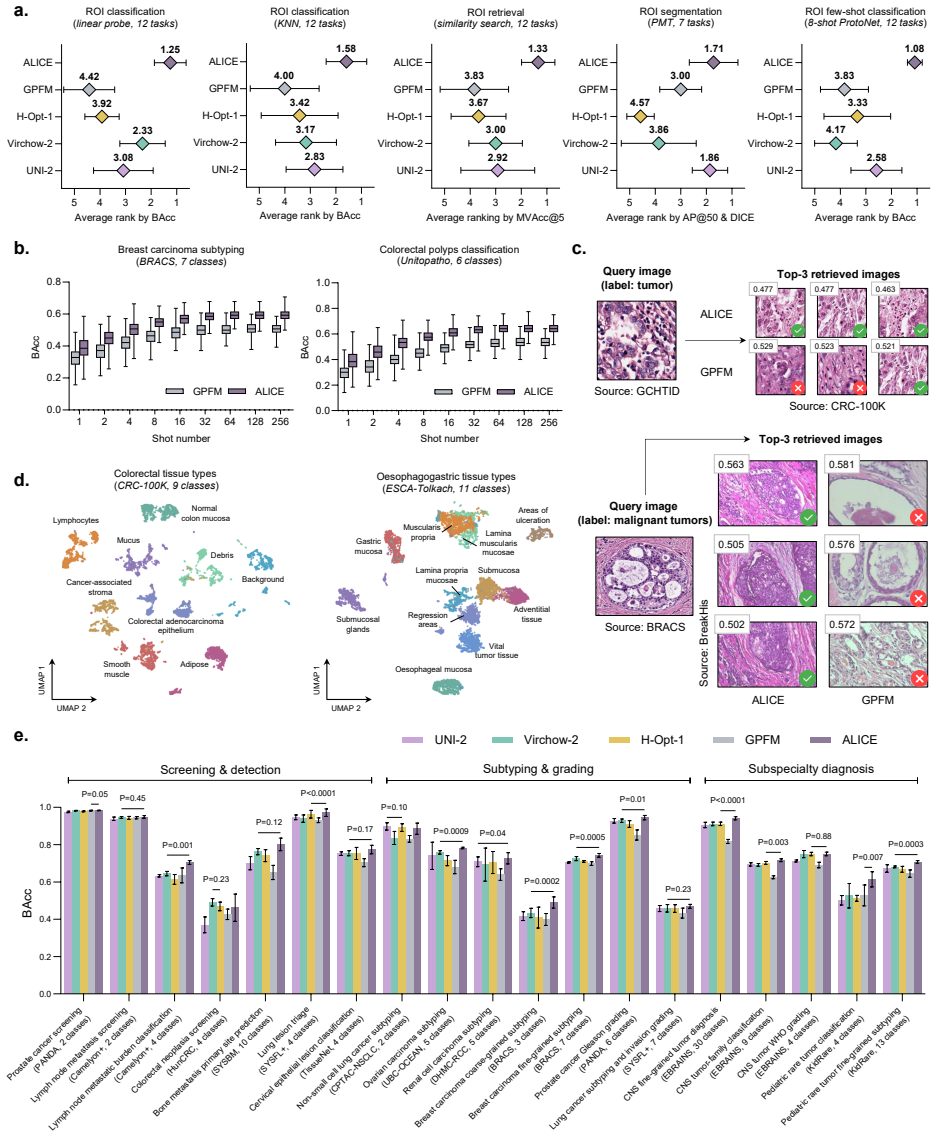
Summary. ALICE is a unified pathology foundation model obtained by multi-stage agglomerative distillation of eight specialist teachers (UNI-2, Virchow-2, H-Opt-1; CONCH, MUSK, KEEP; TITAN, CARE) into a modular backbone with vision-only, multimodal, and slide-level transformers. Pretraining uses ~25M low-resolution TCGA tiles and ~156k high-resolution TCGA/HISTAI regions. The student is evaluated as a frozen or lightly adapted feature extractor across 21 scenarios, 96 tasks, and 48 sources spanning ROI classification/retrieval/segmentation/few-shot, vision–language zero-shot/retrieval/VQA/MI-Zero/PathPT/MICA, and WSI KNN/linear/biomarker/survival/fine-tuning. The central claim is that ALICE attains the best average rank among task-matched PFMs in all three evaluation settings (exceeding the second-best by 1.79, 6.39, and 3.04 percentage points).
Significance. If the ranking results hold, the paper provides strong empirical evidence that structured multi-stage distillation can consolidate morphology-oriented, language-aligned, and whole-slide expertise into a single deployable backbone, reducing the need to maintain separate specialist PFMs. Strengths include the unusually broad 96-task / 48-source benchmark with means, SDs, p-values and average ranks; public code and weights; and an explicit modular architecture with teacher-specific summary tokens and balanced angular / shift-equivariant patch losses (Eqs. 1–2). The work is of clear practical interest to computational pathology and is a natural next step beyond GPFM-style unified distillation.
major comments (2)
- Methods (multi-stage agglomerative distillation) and Results: the load-bearing premise is that freezing earlier modules and using teacher-specific summary tokens transfers complementary expertise without catastrophic interference. The three-setting average-rank claim is already a strong empirical test of that premise, but the manuscript still lacks a controlled ablation that isolates (i) sequential freezing vs joint multi-teacher training and (ii) teacher-specific summary tokens vs a single shared summary. Without these, it remains unclear how much of the gain is due to the staged architecture versus simply having access to eight strong teachers and large pretraining data. A compact ablation table on a representative subset of ROI / multimodal / WSI tasks would make the central architectural claim fully load-bearing rather than correlational.
- Discussion and Data availability: pretraining draws heavily on TCGA-12K / TCGA-UT-8K and HISTAI, while many downstream WSI tasks also use TCGA-derived or overlapping public cohorts (CPTAC, EBRAINS, etc.). The paper does not quantify possible teacher–student or pretrain–downstream slide-level leakage (e.g., whether any teacher was itself trained on the same TCGA slides later used for evaluation). Even a short overlap audit or a held-out non-TCGA-only subset analysis would strengthen the claim that the ranking gains are not partly explained by shared data exposure.
minor comments (5)
- Figure 1 and Extended Data Figure 1: the modular three-transformer schematic is clear, but the exact mapping from student summary tokens to each teacher (and which heads are active at inference for multimodal tasks) could be stated more explicitly in the caption or Methods.
- Results text reports average-rank improvements of 1.79 / 6.39 / 3.04 percentage points; clarify whether these are rank differences or absolute performance (BAcc/AUC) differences, and ensure consistency with the radar plots and Extended Data tables.
- Several Extended Data tables (e.g., segmentation, survival) show ALICE second-best on individual tasks while still winning average rank; a short sentence acknowledging this pattern would help readers interpret the aggregate claim.
- Typos and wording: Abstract/Introduction “unifed” → “unified”; occasional figure-panel lettering inconsistencies (e.g., Figure 3e/e); ensure all 48 data sources listed in Methods appear in the Data availability section with stable URLs.
- Hyperparameter tables (Extended Data Tables 1–3) are thorough; a one-line note on total GPU-hours or wall-clock would aid reproducibility comparisons with GPFM and the teachers.
Circularity Check
No significant circularity: empirical ranks on external downstream tasks are not forced by the distillation objectives or by self-citation.
full rationale
ALICE is trained by multi-stage agglomerative distillation that aligns student summary and patch tokens to frozen teacher embeddings via angular and L2 losses (Methods, Eqs. 1–2 and stage descriptions). The load-bearing claim is that the resulting unified backbone attains the best average rank among task-matched PFMs across 21 scenarios / 96 tasks on 48 data sources. Those ranks are computed from independent evaluation protocols (linear probe, KNN, ProtoNet, PMT, zero-shot, MI-Zero, PathPT, MICA, Coxph, fine-tuning, etc.) on held-out public and institutional cohorts; they are not algebraic rearrangements of the distillation losses, nor are they obtained by fitting a parameter to a subset and then “predicting” a closely related quantity. Teacher models are independently released external checkpoints; self-citations (authors’ prior datasets such as SYSBM/SYSFL+, or GPFM) supply data or a baseline but do not define the ranking metrics or forbid alternatives. The architecture (teacher-specific summary tokens, frozen earlier modules) is an explicit design choice inspired by RADIO, not a uniqueness theorem imported from the authors. Consequently the central empirical result is self-contained against external benchmarks and exhibits no circular reduction of the claimed derivation chain.
Axiom & Free-Parameter Ledger
free parameters (4)
- peak learning rate / cosine schedule
- DAMP multiplicative noise strength
- number of summary / register tokens and projection heads
- patch-crop size, grid, and loss weights (e.g., TITAN patch loss 0.5)
axioms (4)
- domain assumption Frozen teacher embeddings constitute useful, complementary supervision that a student can absorb without access to the teachers' original training data or objectives.
- ad hoc to paper Freezing earlier modules after each stage preserves previously acquired capabilities while later modules specialize.
- standard math Standard self-supervised and contrastive losses (angular distillation, shift-equivariant patch matching, ALiBi attention) transfer morphological and semantic structure.
- domain assumption Public TCGA / HISTAI patches and the 48 downstream sources are sufficiently representative for ranking claims.
invented entities (2)
-
ALICE modular three-transformer backbone (vision-only + multimodal adaptor + slide-level ALiBi aggregator)
independent evidence
-
Teacher-specific summary tokens with balanced angular distillation loss
no independent evidence
read the original abstract
Foundation models are reshaping computational pathology, yet their capabilities remain shaped by pretraining objectives, data sources, and spatial scales, fragmenting complementary expertise across separate backbones. Here we present ALICE, a unified foundation model trained through multi-stage agglomerative distillation that sequentially distills eight vision-only, vision-language, and slide-level teacher models into dedicated modules of a single backbone. ALICE is pretrained on 24,985,184 tile-level pathology images and 155,604 high-resolution images, and evaluated across 21 task scenarios, 96 downstream tasks, and 48 data sources, spanning region-of-interest tissue analysis, vision-language multimodal evaluation, and whole-slide clinical assessment. In all three evaluation settings, ALICE achieved the best average rank among task-matched pathology foundation models. These results demonstrate that agglomerative distillation can consolidate complementary capabilities from specialized models into a unified backbone for broad computational pathology applications. The model is available at https://github.com/WonderLandxD/ALICE.
Figures



Reference graph
Works this paper leans on
-
[1]
H.et al.Artificial intelligence for digital and computational pathology.Nature Reviews Bioengineering1, 930–949 (2023)
Song, A. H.et al.Artificial intelligence for digital and computational pathology.Nature Reviews Bioengineering1, 930–949 (2023)
2023
-
[2]
Zheng, Y .et al.Lazyslide: accessible and interoperable whole-slide image analysis.Nature Methods1–4 (2026)
2026
-
[3]
Y .et al.Data-efficient and weakly supervised computational pathology on whole-slide images.Nature Biomedical Engineering5, 555–570 (2021)
Lu, M. Y .et al.Data-efficient and weakly supervised computational pathology on whole-slide images.Nature Biomedical Engineering5, 555–570 (2021)
2021
-
[4]
Jiang, R.et al.A transformer-based weakly supervised computational pathology method for clinical-grade diagnosis and molecular marker discovery of gliomas.Nature Machine Intelli- gence6, 876–891 (2024)
2024
-
[5]
Campanella, G.et al.Clinical-grade computational pathology using weakly supervised deep learning on whole slide images.Nature Medicine25, 1301–1309 (2019)
2019
-
[6]
Tsai, P.-C.et al.Histopathology images predict multi-omics aberrations and prognoses in colorectal cancer patients.Nature Communications14, 2102 (2023)
2023
-
[7]
Zhu, L.et al.An accurate prediction of the origin for bone metastatic cancer using deep learning on digital pathological images.EBioMedicine87(2023)
2023
-
[8]
J.et al.Towards a general-purpose foundation model for computational pathology
Chen, R. J.et al.Towards a general-purpose foundation model for computational pathology. Nature Medicine30, 850–862 (2024)
2024
-
[9]
Y .et al.A visual-language foundation model for computational pathology.Nature Medicine30, 863–874 (2024)
Lu, M. Y .et al.A visual-language foundation model for computational pathology.Nature Medicine30, 863–874 (2024)
2024
-
[10]
Yan, F.et al.Pathorchestra: A comprehensive foundation model for computational pathology with over 100 diverse clinical-grade tasks.npj Digital Medicine8, 695 (2025)
2025
-
[11]
Nature630, 181–188 (2024)
Xu, H.et al.A whole-slide foundation model for digital pathology from real-world data. Nature630, 181–188 (2024)
2024
-
[12]
Neidlinger, P.et al.Benchmarking foundation models as feature extractors for weakly super- vised computational pathology.Nature Biomedical Engineering1–11 (2025)
2025
-
[13]
Tizhoosh, H. R. Rethinking foundation models in pathology.Nature Biomedical Engineering 1–6 (2026)
2026
-
[14]
V orontsov, E.et al.A foundation model for clinical-grade computational pathology and rare cancers detection.Nature Medicine30, 2924–2935 (2024)
2024
-
[15]
Xiang, J.et al.A vision–language foundation model for precision oncology.Nature638, 769–778 (2025). 30
2025
-
[16]
Campanella, G.et al.A clinical benchmark of public self-supervised pathology foundation models.Nature Communications16, 3640 (2025)
2025
-
[17]
Ding, T.et al.A multimodal whole-slide foundation model for pathology.Nature Medicine 1–13 (2025)
2025
-
[18]
InProceedings of the Computer Vision and Pattern Recognition Conference, 22487–22497 (2025)
Heinrich, G.et al.Radiov2.5: Improved baselines for agglomerative vision foundation models. InProceedings of the Computer Vision and Pattern Recognition Conference, 22487–22497 (2025)
2025
-
[19]
Zhu, C.et al.Efficient universal perception encoder.arXiv preprint arXiv:2603.22387(2026)
arXiv 2026
-
[20]
Ma, J.et al.A generalizable pathology foundation model using a unified knowledge distilla- tion pretraining framework.Nature Biomedical Engineering10, 545–564 (2026)
2026
-
[21]
Zimmermann, E.et al.Virchow2: Scaling self-supervised mixed magnification models in pathology.arXiv preprint arXiv:2408.00738(2024)
Pith/arXiv arXiv 2024
-
[22]
Scalbert, M.et al.Abstract lb174: H-optimus-1: A foundation model for computational histopathology.Cancer Research86, LB174–LB174 (2026)
2026
-
[23]
Zhou, X.et al.Knowledge-enhanced pretraining for vision-language pathology foundation model on cancer diagnosis.Cancer Cell44, 777–791 (2026)
2026
-
[24]
InProceedings of the IEEE/CVF Conference on Computer Vision and Pattern Recognition, 21078–21088 (2026)
Zhang, D.et al.Care: A molecular-guided foundation model with adaptive region modeling for whole slide image analysis. InProceedings of the IEEE/CVF Conference on Computer Vision and Pattern Recognition, 21078–21088 (2026)
2026
-
[25]
& Welling, M
Ilse, M., Tomczak, J. & Welling, M. Attention-based deep multiple instance learning. In International conference on machine learning, 2127–2136 (PMLR, 2018)
2018
-
[26]
N., Falcone, G
Acosta, J. N., Falcone, G. J., Rajpurkar, P. & Topol, E. J. Multimodal biomedical ai.Nature medicine28, 1773–1784 (2022)
2022
-
[27]
Y .et al.Visual language pretrained multiple instance zero-shot transfer for histopathol- ogy images
Lu, M. Y .et al.Visual language pretrained multiple instance zero-shot transfer for histopathol- ogy images. InProceedings of the IEEE/CVF conference on computer vision and pattern recognition, 19764–19775 (2023)
2023
-
[28]
He, D.et al.Boosting pathology foundation models via few-shot prompt-tuning for rare cancer subtyping.Nature Communications(2026)
2026
-
[29]
Nature Communications16, 7163 (2025)
D ¨orrich, M.et al.A multimodal dataset for precision oncology in head and neck cancer. Nature Communications16, 7163 (2025)
2025
-
[30]
Chowdhury, S.et al.Proteogenomic analysis of chemo-refractory high-grade serous ovarian cancer.Cell186, 3476–3498 (2023). 31
2023
-
[31]
Li, Z.et al.Ai-enabled virtual spatial proteomics from histopathology for interpretable biomarker discovery in lung cancer.Nature Medicine1–14 (2026)
2026
-
[32]
Nature634, 970–978 (2024)
Wang, X.et al.A pathology foundation model for cancer diagnosis and prognosis prediction. Nature634, 970–978 (2024)
2024
-
[33]
Nature Communications(2025)
Xu, Y .et al.A multimodal knowledge-enhanced whole-slide pathology foundation model. Nature Communications(2025)
2025
-
[34]
Nechaev, D., Pchelnikov, A. & Ivanova, E. Histai: an open-source, large-scale whole slide image dataset for computational pathology.arXiv preprint arXiv:2505.12120(2025)
Pith/arXiv arXiv 2025
-
[35]
Nature Medicine30, 1174–1190 (2024)
Vaidya, A.et al.Demographic bias in misdiagnosis by computational pathology models. Nature Medicine30, 1174–1190 (2024)
2024
-
[36]
InMedical Imaging with Deep Learning, 544–569 (PMLR, 2026)
Li, J.et al.Stainnet: Scaling self-supervised foundation models on immunohistochemistry and special stains for computational pathology. InMedical Imaging with Deep Learning, 544–569 (PMLR, 2026)
2026
-
[37]
InInternational Conference on Medical Image Computing and Computer- Assisted Intervention, 573–583 (Springer, 2025)
Karasikov, M.et al.Training state-of-the-art pathology foundation models with orders of mag- nitude less data. InInternational Conference on Medical Image Computing and Computer- Assisted Intervention, 573–583 (Springer, 2025)
2025
-
[38]
Oquab, M.et al.Dinov2: Learning robust visual features without supervision.arXiv preprint arXiv:2304.07193(2023)
Pith/arXiv arXiv 2023
-
[39]
Press, O., Smith, N. A. & Lewis, M. Train short, test long: Attention with linear biases enables input length extrapolation.arXiv preprint arXiv:2108.12409(2021)
Pith/arXiv arXiv 2021
-
[40]
Chu, X., Tian, Z., Zhang, B., Wang, X. & Shen, C. Conditional positional encodings for vision transformers.arXiv preprint arXiv:2102.10882(2021)
Pith/arXiv arXiv 2021
-
[41]
& Bojanowski, P
Darcet, T., Oquab, M., Mairal, J. & Bojanowski, P. Vision transformers need registers. In International conference on learning representations, vol. 2024, 2632–2652 (2024)
2024
-
[42]
& Kaski, S
Trinh, T., Heinonen, M., Acerbi, L. & Kaski, S. Improving robustness to corruptions with multiplicative weight perturbations.Advances in Neural Information Processing Systems37, 35492–35516 (2024)
2024
-
[43]
Huo, X.et al.A comprehensive ai model development framework for consistent gleason grading.Communications Medicine4, 84 (2024)
2024
-
[44]
Database2022, baac093 (2022)
Brancati, N.et al.Bracs: A dataset for breast carcinoma subtyping in h&e histology images. Database2022, baac093 (2022)
2022
-
[45]
A., Oliveira, L
Spanhol, F. A., Oliveira, L. S., Petitjean, C. & Heutte, L. A dataset for breast cancer histopathological image classification.IEEE Transactions on Biomedical Engineering63, 1455–1462 (2015). 32
2015
-
[46]
& Br ¨uck, O
Brummer, O., P ¨ol¨onen, P., Mustjoki, S. & Br ¨uck, O. Computational textural mapping harmonises sampling variation and reveals multidimensional histopathological fingerprints. British Journal of Cancer129, 683–695 (2023)
2023
-
[47]
& Jin, M
Zhu, C., Chen, W., Peng, T., Wang, Y . & Jin, M. Hard sample aware noise robust learning for histopathology image classification.IEEE Transactions on Medical Imaging41, 881–894 (2021)
2021
-
[48]
Kather, J. N., Halama, N. & Marx, A. 100,000 histological images of human colorectal cancer and healthy tissue (2018). URLhttps://doi.org/10.5281/zenodo.1214456
-
[49]
N.et al.Deep learning can predict microsatellite instability directly from histology in gastrointestinal cancer.Nature medicine25, 1054–1056 (2019)
Kather, J. N.et al.Deep learning can predict microsatellite instability directly from histology in gastrointestinal cancer.Nature medicine25, 1054–1056 (2019)
2019
-
[50]
Tolkach, Y .et al.Artificial intelligence for tumour tissue detection and histological regression grading in oesophageal adenocarcinomas: a retrospective algorithm development and valida- tion study.The Lancet Digital Health5, e265–e275 (2023)
2023
-
[51]
Lou, S.et al.A large histological images dataset of gastric cancer with tumour microenviron- ment annotation for ai.Scientific Data12, 138 (2025)
2025
-
[52]
Leavey, P.et al.Osteosarcoma data from ut southwestern/ut dallas for viable and necrotic tumor assessment [data set].Cancer Imaging Arch14(2019)
2019
-
[53]
A.et al.Unitopatho, a labeled histopathological dataset for colorectal polyps classification and adenoma dysplasia grading
Barbano, C. A.et al.Unitopatho, a labeled histopathological dataset for colorectal polyps classification and adenoma dysplasia grading. In2021 IEEE International Conference on Image Processing (ICIP), 76–80 (IEEE, 2021)
2021
-
[54]
Graham, S.et al.Hover-net: Simultaneous segmentation and classification of nuclei in multi- tissue histology images.Medical Image Analysis58, 101563 (2019)
2019
-
[55]
Graham, S.et al.Mild-net: Minimal information loss dilated network for gland instance segmentation in colon histology images.Medical Image Analysis52, 199–211 (2019)
2019
-
[56]
Sirinukunwattana, K.et al.Gland segmentation in colon histology images: The glas challenge contest.Medical Image Analysis35, 489–502 (2017)
2017
-
[57]
Sitnik, D.et al.A dataset and a methodology for intraoperative computer-aided diagnosis of a metastatic colon cancer in a liver.Biomedical Signal Processing and Control66, 102402 (2021)
2021
-
[58]
Hu, W.et al.Ebhi: A new enteroscope biopsy histopathological h&e image dataset for image classification evaluation.Physica Medica107, 102534 (2023)
2023
-
[59]
& Madabhushi, A
Janowczyk, A. & Madabhushi, A. Deep learning for digital pathology image analysis: A comprehensive tutorial with selected use cases.Journal of Pathology Informatics7, 29 (2016). 33
2016
-
[60]
& Rajpoot, N
Gamper, J. & Rajpoot, N. Multiple instance captioning: Learning representations from histopathology textbooks and articles. InProceedings of the IEEE Conference on Computer Vision and Pattern Recognition(2021)
2021
-
[61]
InEuropean Conference on Computer Vision, 56–73 (Springer, 2024)
Sun, Y .et al.Pathmmu: A massive multimodal expert-level benchmark for understanding and reasoning in pathology. InEuropean Conference on Computer Vision, 56–73 (Springer, 2024)
2024
-
[62]
A.et al.Lung and colon cancer histopathological image dataset (lc25000)
Borkowski, A. A.et al.Lung and colon cancer histopathological image dataset (lc25000). arXiv preprint arXiv:1912.12142(2019)
Pith/arXiv arXiv 1912
-
[63]
B.et al.Viable and necrotic tumor assessment from whole slide images of osteosarcoma using machine-learning and deep-learning models.PloS One14, e0210706 (2019)
Arunachalam, H. B.et al.Viable and necrotic tumor assessment from whole slide images of osteosarcoma using machine-learning and deep-learning models.PloS One14, e0210706 (2019)
2019
-
[64]
A., Molina, R
Silva-Rodr ´ıguez, J., Colomer, A., Sales, M. A., Molina, R. & Naranjo, V . Going deeper through the gleason scoring scale: An automatic end-to-end system for histology prostate grading and cribriform pattern detection.Computer Methods and Programs in Biomedicine 195, 105637 (2020)
2020
-
[65]
Kriegsmann, K.et al.Deep learning for the detection of anatomical tissue structures and neoplasms of the skin on scanned histopathological tissue sections.Frontiers in Oncology12, 1022967 (2022)
2022
-
[66]
Han, C.et al.Wsss4luad: Grand challenge on weakly-supervised tissue semantic segmentation for lung adenocarcinoma.arXiv preprint arXiv:2204.06455(2022)
Pith/arXiv arXiv 2022
-
[67]
Xu, F.et al.Predicting axillary lymph node metastasis in early breast cancer using deep learning on primary tumor biopsy slides.Frontiers in Oncology11, 759007 (2021)
2021
-
[68]
Ling, X.et al.Comprehensive benchmark dataset for pathological lymph node metastasis in breast cancer sections.Scientific Data12, 1381 (2025)
2025
-
[69]
Zhu, M.et al.Development and evaluation of a deep neural network for histologic classifi- cation of renal cell carcinoma on biopsy and surgical resection slides.Scientific Reports11, 7080 (2021)
2021
-
[70]
Scientific Data9, 55 (2022)
Roetzer-Pejrimovsky, T.et al.The digital brain tumour atlas, an open histopathology resource. Scientific Data9, 55 (2022)
2022
-
[71]
´A.et al.Huncrc: annotated pathological slides to enhance deep learning applications in colorectal cancer screening.Scientific Data9, 370 (2022)
Pataki, B. ´A.et al.Huncrc: annotated pathological slides to enhance deep learning applications in colorectal cancer screening.Scientific Data9, 370 (2022)
2022
-
[72]
Bulten, W.et al.Artificial intelligence for diagnosis and gleason grading of prostate cancer: the panda challenge.Nature medicine28, 154–163 (2022)
2022
-
[73]
Li, J.et al.Diagnostic text-guided representation learning in hierarchical classification for pathological whole slide image.Medical Image Analysis103894 (2025). 34
2025
-
[74]
H.et al.A partial label-based machine learning approach for cervical whole-slide image classification: the winning tissuenet solution
Fick, R. H.et al.A partial label-based machine learning approach for cervical whole-slide image classification: the winning tissuenet solution. In2021 43rd Annual International Con- ference of the IEEE Engineering in Medicine & Biology Society (EMBC), 2127–2131 (IEEE, 2021)
2021
-
[75]
Asadi-Aghbolaghi, M.et al.Machine learning-driven histotype diagnosis of ovarian carci- noma: insights from the ocean ai challenge.medRxiv2024–04 (2024)
2024
-
[76]
H., Marshall, C., Harris-Birtill, D
Myles, C., Um, I. H., Marshall, C., Harris-Birtill, D. & Harrison, D. J. Surgen: 1020 h&e-stained whole-slide images with survival and genetic markers.GigaScience14, giaf086 (2025)
2025
-
[77]
Snell, J., Swersky, K. & Zemel, R. Prototypical networks for few-shot learning.Advances in Neural Information Processing Systems30(2017). 35 … … Transformer layer Transformer layer … … Transformer layer Transformer layer Patch tokens Register tokens Summary tokens Transformer layer × 32 𝑙𝑎𝑦𝑒𝑟𝑠 a. Vision-only transformer … … … … × 2 𝑙𝑎𝑦𝑒𝑟𝑠 Teacher-align to...
arXiv 2017
discussion (0)
Sign in with ORCID, Apple, or X to comment. Anyone can read and Pith papers without signing in.