REVIEW 3 major objections 5 minor
A hierarchical global-to-local diffusion framework generates stable, high-definition dance videos longer than one minute directly from music and text.
Reviewed by Pith at T0; open to challenge. T0 means a machine referee read the full paper against a public rubric. the ladder, T0–T4 →
T0 review · grok-4.5
2026-07-14 15:09 UTC pith:PIEIHLAX
load-bearing objection Solid engineering that actually pushes music-to-dance past the ~20 s wall; the hierarchical split works in practice, but the long-horizon stability claim rests on soft metrics and a proprietary set. the 3 major comments →
Wan-Dancer: A Hierarchical Framework for Minute-scale Coherent Music-to-Dance Generation
The pith
A machine-rendered reading of the paper's core claim, the machinery that carries it, and where it could break.
Core claim
The authors establish that a hierarchical framework which first plans a sparse set of keyframes from full-track musical context and then refines dense local segments can generate stable, high-resolution dance videos longer than one minute. This global-to-local split, combined with time-mapped positional embeddings, optical-flow loss, and motion-speed control, eliminates the temporal drift and identity degradation that plague both skeleton-based pipelines and pure end-to-end video diffusion methods.
What carries the argument
Hierarchical Global-to-Local Generation: a unified DiT network trained with a keyframe mask that forces either full-sequence planning from the first frame or sparse-anchor interpolation, then used at inference to produce 38 global keyframes that condition parallel local 149-frame refinements.
Load-bearing premise
A sparse set of 38 evenly spaced global keyframes conditioned only on the full music track and one reference image is enough to keep identity and choreography from collapsing when the local stage fills in the dense frames.
What would settle it
Generate a one-minute video under the exact global-to-local protocol, then measure identity consistency (face/clothing embedding distance) and beat alignment across the full length; if either metric degrades to the level of naive 5-second stitching, the claim that the hierarchy prevents drift fails.
Editorial analysis
A structured set of objections, weighed in public.
Referee Report
Summary. The paper introduces Wan-Dancer, a hierarchical music-to-dance video generation framework built on Wan-I2V. It decouples generation into a global keyframe planning stage (conditioned on full-track music, a reference image, text, and a sparse mask) and a local temporal refinement stage that interpolates dense 149-frame segments around those anchors. Claimed innovations are time-mapped RoPE for dynamic FPS adaptation to arbitrary music lengths, an optical-flow-weighted rectified-flow velocity loss (Eq. 3), and motion-speed stratification/control. Training uses a unified DiT with keyframe masks that switch between global (first-frame only) and local (random sparse anchors) phases; inference produces exactly 38 global keyframes that are evenly spaced and used as fixed conditions for parallel local passes, yielding claimed stable 720p/30 fps videos longer than one minute across five dance genres. Quantitative tables compare dance quality, video quality and prompt alignment against MusicInfuser and X-Dancer; qualitative results and ablations (Figs. 3–8) are presented as evidence of reduced drift, identity preservation and style control, plus a LoRA customization path.
Significance. If the minute-scale coherence claim holds under rigorous long-horizon measurement, the work would be a practically useful advance for end-to-end music-to-dance synthesis, moving past the ~5–20 s barrier of current diffusion video models while retaining 720p fidelity and multi-genre text+audio control. The hierarchical schedule, dynamic-FPS RoPE injection, and optical-flow weighting are concrete engineering contributions that other long-video pipelines could reuse. Ablations isolating the global-to-local schedule, optical-flow term and speed tiers (Figs. 6–7) and the multi-condition diversity checks (Fig. 8) are positive empirical strengths. The proprietary high-resolution multi-genre corpus and LoRA mimicry path further increase application value, though reproducibility is limited by the closed data.
major comments (3)
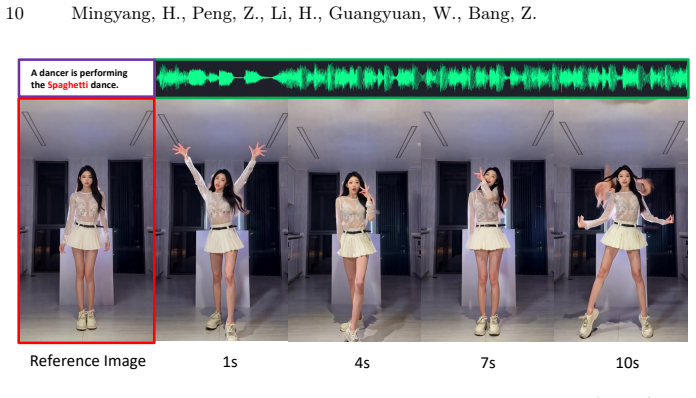
- §4.1 Inference and Abstract/§4.2 central claim: the pipeline fixes exactly 38 evenly spaced global keyframes (Global DiT, 50 steps) that later anchor parallel 149-frame local segments. Global-phase training (§3.1) only ever conditions on the first frame (mask zeros elsewhere), so the network must invent the entire long-horizon skeleton from one reference image + full music. No quantitative long-horizon metric—face-embedding distance, identity-drift curve, long-sequence FVD/beat-alignment score, or even simple keypoint consistency past ~20 s—is reported on the stitched minute-scale outputs. Figs. 3 and 6a show selected frames and short ablations; they do not close the possibility that the reported “superior temporal stability” is an artifact of excerpt selection rather than a property of the full concatenated video. This measurement gap is load-bearing for the duration claim.
- Tables 1–3 (§4.3): the SOTA numbers (e.g., Dance Quality average 8.46, Video Quality 7.46, Prompt Alignment 9.03) are presented without any description of the evaluation protocol beyond “followed MusicInfuser.” Number of raters, inter-rater reliability, statistical significance tests, confidence intervals, and whether scores are human Likert or automated are all omitted. Without these details the numerical superiority over X-Dancer and MusicInfuser cannot be assessed as reliable evidence for the central claim.
- §4.1 Dataset and comparisons: all training and reported results use a proprietary ~200 h 720p corpus; public benchmarks (AIST, FineDance, etc.) are explicitly discarded. Consequently there is no head-to-head evaluation on any shared long-form test set, and the two baselines are themselves short-clip systems. This leaves open whether the hierarchical gains generalize beyond the authors’ data distribution and weakens the “new state-of-the-art” assertion.
minor comments (5)
- Eq. (3) and surrounding text: the optical-flow weight w_optical_flow is described as “optical flow latents encoded by the VAE,” yet the precise normalization, channel alignment with the velocity residual, and whether the weight is applied only in the local phase (as later stated) are left underspecified.
- Fig. 1 caption and §3.1: the distinction between “Music block” and “DiT block” injection of fm is not diagrammed clearly; a short equation or pseudo-code for the cross-attention would help.
- §4.1 “Customize dancing via LoRA”: rank-32, 800 steps, 16 videos is given, but no quantitative before/after metrics (or even a simple pose-error number) accompany the qualitative Fig. 4.
- Typographical: “EfficientChoreographyCustomization” (missing space) in the contributions list; “umT5” vs. “Unimax” citation inconsistency; occasional missing spaces after periods in the abstract and §1.
- Limitations section correctly flags identity consistency and multi-dancer extension; adding a short quantitative identity-drift baseline (even on the current model) would strengthen the future-work discussion.
Circularity Check
No circularity: empirical hierarchical diffusion pipeline with standard RF loss and self-contained experimental claims.
full rationale
The paper is an applied video-generation system paper. Its central claims (minute-scale 720p/30 fps coherence via global-to-local DiT stages, dynamic time-mapped RoPE, optical-flow-weighted RF objective, LoRA customization) are architectural and empirical; they are not derived from first-principles equations that reduce to their own inputs. The training objective (Eq. 3) is ordinary rectified-flow MSE with an optional optical-flow mask weight; nothing is fitted then re-labeled a prediction. The 38-keyframe global schedule and 149-frame local segments are design choices validated by qualitative figures and tables against external baselines (X-Dancer, MusicInfuser), not forced by a self-citation uniqueness theorem. Citations to the Wan backbone and related Alibaba works supply the pretrained DiT/VAE, which is normal engineering practice and does not make the duration or quality results true by construction. No self-definitional loop, no fitted-input-as-prediction, no load-bearing uniqueness import, and no renaming of a known empirical pattern appear. The derivation chain is therefore non-circular; any remaining risks are ordinary empirical ones (identity drift under long stitching, limited quantitative long-horizon metrics) outside the circularity criteria.
Axiom & Free-Parameter Ledger
free parameters (5)
- number of global keyframes =
38
- motion-speed stratification ratios =
10/80/10
- LoRA rank and fine-tune steps =
rank=32, 800 steps
- optical-flow loss weight schedule
- pre-train / fine-tune step counts and learning rate =
20k+4k @ 1e-5
axioms (4)
- domain assumption Rectified-flow velocity matching (Eqs. 1–3) is a valid generative objective for video latents.
- ad hoc to paper Absolute-time identifiers injected into RoPE correctly encode variable frame rates for arbitrary music durations.
- domain assumption A single reference image plus CLIP embedding is sufficient identity conditioning for minute-scale generation.
- domain assumption Optical-flow latents from SEA-RAFT provide a reliable motion prior for the weighted MSE loss.
invented entities (3)
-
time-mapped RoPE (absolute-time identifiers inside rotary embeddings)
independent evidence
-
unified keyframe-mask training for global and local phases
independent evidence
-
optical-flow-weighted velocity residual (w_optical_flow ⊙ ·)
independent evidence
read the original abstract
Generating long-duration, high-definition, and rhythmically synchronized dance videos directly from music remains a significant challenge, primarily due to the temporal constraints of current diffusion models, which typically fail beyond 20 seconds. Existing approaches, whether they rely on intermediate 3D skeletons or on end-to-end video synthesis, suffer from temporal drift, identity inconsistency, and repetitive motion patterns when extended to longer horizons. To address these limitations, we propose a novel hierarchical framework for minute-scale coherent music-to-dance generation. Our method decouples the process into global keyframe planning and local temporal refinement, leveraging full-track musical context to ensure long-range coherence. Key innovations include dynamic frame rate adaptation via time-mapped RoPE embeddings for precise alignment, an optical-flow-based loss function to enhance motion continuity, and motion-speed control to preserve high-fidelity details during rapid movements. Extensive experiments demonstrate that our framework surpasses the conventional duration barrier, generating stable, 720p/30fps videos exceeding one minute with superior temporal stability. Furthermore, the model exhibits robust versatility across five distinct dance genres, conditioned on both audio and textual prompts, establishing a new state-of-the-art in coherent, long-form dance video synthesis.
Figures




discussion (0)
Sign in with ORCID, Apple, or X to comment. Anyone can read and Pith papers without signing in.