REVIEW 2 major objections 5 minor 90 references
A full-stack pipeline turns noisy egocentric human videos into steerable dexterous-hand policies that follow free-form language across dozens of real-robot tasks.
Reviewed by Pith at T0; open to challenge. T0 means a machine referee read the full paper against a public rubric. the ladder, T0–T4 →
T0 review · grok-4.5
2026-07-14 17:30 UTC pith:4GEUJCBX
load-bearing objection Solid full-stack engineering paper: real multi-task free-form dexterous results and few-shot long-horizon transfer, with the main residual risk being monocular reconstruction fidelity rather than any internal contradiction. the 2 major comments →
EgoSteer: A Full-Stack System Towards Steerable Dexterous Manipulation from Egocentric Videos
The pith
A machine-rendered reading of the paper's core claim, the machinery that carries it, and where it could break.
Core claim
Large-scale, carefully curated egocentric human video can supply language-guided manipulation priors that, once grounded with a modest amount of real-robot teleoperation and human-in-the-loop DAgger data in a unified wrist-plus-fingertip action space, produce a steerable dual-dexterous-hand policy that executes free-form instructions across dozens of tasks and few-shot adapts to complex long-horizon skills.
What carries the argument
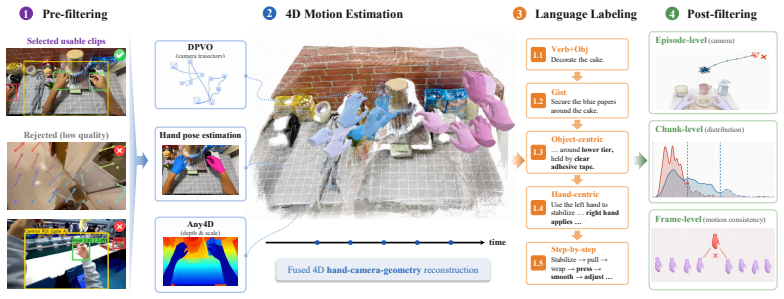
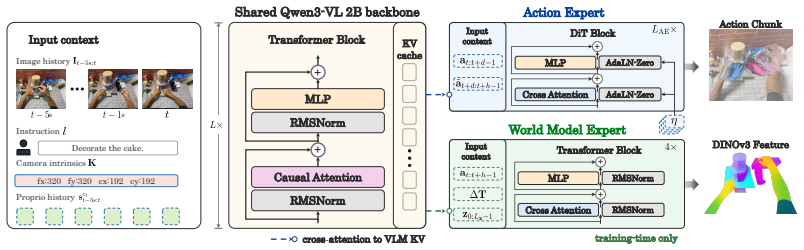
EgoSmith (pre-filter → DPVO+Any4D metric 4D reconstruction → multi-level language labels → multi-scale post-filter) plus a world-model expert that predicts future DINOv3 features during training only, both feeding a flow-matching action expert with training-time real-time chunking in a shared wrist-pose and fingertip-keypoint space.
Load-bearing premise
That monocular egocentric reconstructions and automatic language labels, after EgoSmith’s filters, are accurate enough in world space and language that they transfer to real robot kinematics with only modest post-training.
What would settle it
Train the same EgoSteer architecture from scratch on the robot data alone (or on unfiltered noisy egocentric data) and show that free-form multi-task success and few-shot long-horizon adaptation collapse to near zero, or that measured world-space hand trajectory error on held-out annotated video rises enough that downstream success falls below the reported baselines.
If this is right
- Dexterous-hand systems can gain free-form language following without collecting robot-scale multi-task corpora from scratch.
- Scaling curated egocentric hours further should continue to improve recovery, instruction following, and action precision on the same post-training budget.
- The open-sourced pipeline, robot stack, and checkpoints let others reproduce or extend steerable multi-finger control on new dual-arm embodiments.
- Few-shot adaptation of the same pre-trained priors can unlock long-horizon contact-rich skills that pure imitation learning from limited demos fails on.
Where Pith is reading between the lines
- If reconstruction noise is the true bottleneck, tighter multi-view or tactile-aligned human capture may yield larger gains than simply adding more monocular hours.
- The same wrist-plus-fingertip interface could serve as a common pre-training target for other multi-finger hands, reducing embodiment-specific re-labeling.
- Absent tactile sensing, residual failures on contact-rich wiping and pouring will likely remain even as language following improves.
Editorial analysis
A structured set of objections, weighed in public.
Referee Report
Summary. The paper presents a full-stack system for steerable dual-dexterous-hand manipulation. EgoSmith curates ~9.6K hours of in-the-wild egocentric video into language-aligned, world-space wrist/fingertip trajectories (pre-filter, DPVO+Any4D 4D estimation, multi-level Qwen labeling, multi-granularity post-filter), claiming 9× throughput and better accuracy than HaWoR. A unified robot stack supports teleoperation, inference, and relative-motion DAgger handover; 187 h of multi-task teleop data are collected. EgoSteer is a Qwen3-VL + DiT flow-matching VLA with a training-only world-model expert that regresses future DINOv3 features, training-time RTC, and a shared SE(3)+fingertip-keypoint action space. After pre-training, post-training, and three DAgger rounds, the policy reaches ~75% average success on 40 free-form tasks (seen/compositional/unseen) and few-shot adapts to long-horizon box folding / cake unboxing on two embodiments at 75+% success, outperforming π0.5, Being-H0.5, DP, IMLE, and from-scratch ablations. Scaling, data-quality, world-model, RTC, and DAgger ablations are reported; code/data/models are promised open-source.
Significance. If the reported real-robot numbers hold under independent reimplementation, the work is a substantial systems contribution: it is one of the first demonstrations that large-scale curated monocular egocentric video can supply language-steerable priors for high-DoF dexterous hands, with data-efficient grounding and few-shot long-horizon transfer across embodiments. Strengths that raise the bar include the open-source commitment, the quantitative 4D-reconstruction benchmark (Table 2), the multi-task free-form evaluation with N=10 trials, the component ablations (scale, noisy data, WM, RTC, DAgger), and the clear failure of strong imitation baselines on the hard long-horizon tasks. The residual risk is hardware- and reconstruction-specific transfer; the paper already lists DoF, tactile, and scale limitations honestly.
major comments (2)
- The central transfer premise (§3–§5) rests on monocular EgoSmith reconstructions (DPVO + Any4D metric scaling + HaWoR-style MANO + Qwen labels) producing action-accurate world-space wrist/fingertip trajectories that transfer via the unified SE(3)+keypoint space with only modest robot post-training. Table 2 shows clear gains over HaWoR on annotated subsets, and the scale / noisy-data / few-shot ablations (§6.3–6.5) are consistent with useful priors, but residual reconstruction bias is not quantified on the full 9.6K-hour corpus or against robot kinematics. A short additional analysis (e.g., held-out reconstruction error vs. downstream success, or a controlled noise-injection study beyond the binary “noisy data” ablation) would make the load-bearing claim more falsifiable without changing the empirical results.
- §6.1 / Fig. 5 and Table 1 report 75% average success and 75+% few-shot rates under free-form instructions with N=10 trials per task. The evaluation protocol is stronger than many concurrent VLA papers, yet variance, confidence intervals, and exact success criteria (especially for contact-rich and multi-step tasks) are not stated. Adding per-task standard errors or a short protocol appendix would strengthen the central empirical claim without requiring new experiments.
minor comments (5)
- Clarify the subjective quality weights w_i ∈ [1,10] and the sampling formula W_i = w_i √n_i (Appendix A.2 / C.2); a short sensitivity check or fixed weights would improve reproducibility.
- Fig. 5 packs 40 tasks into a single bar chart; a tabular supplement (already partially present in the appendix) would make per-category and per-task numbers easier to cite.
- Notation for the relative action chunk a^{c_t} and the RTC prefix/suffix split (Eq. for L_CFM) is dense; a short expanded definition or diagram would help readers implement training-time RTC.
- The VLM co-training mixture (Appendix C.1) is useful but its contribution is not ablated; a one-sentence note on whether it is essential or optional would be helpful.
- Minor typos and formatting: “9x” vs “9×”, occasional missing spaces around citations, and inconsistent capitalization of “EgoSteer” / “EgoSmith” in figure captions.
Circularity Check
No significant circularity: empirical systems paper whose success rates, ablations, and scaling results are measured on held-out real-robot trials rather than derived by construction from fitted inputs.
full rationale
EgoSteer is a full-stack empirical robotics paper. Its load-bearing claims (75% average free-form success across 40+ tasks after EgoSmith pre-training + 187 h robot post-training + DAgger; 75%+ few-shot long-horizon adaptation; component ablations; pre-training scale curves) are evaluated by randomized real-robot trials (N=10 per task) under free-form language, not by algebraic reduction of a fitted constant or self-defined quantity. EgoSmith’s 4D reconstruction (DPVO + Any4D metric scaling + HaWoR-style MANO) is benchmarked against external annotated subsets via RPE/ATE/WA-MPJPE/W-MPJPE (Table 2) and is not used to “predict” those same metrics. The world-model expert regresses future DINOv3 features under an auxiliary MSE loss discarded at inference; the CFM action objective and RTC delay sampling are standard training choices, not uniqueness theorems. Self-citations (HaWoR, Being-H0.5, π0.5, DAgger, etc.) supply components or baselines; none is a load-bearing uniqueness result that forces the reported success rates. No fitted parameter is renamed a prediction of a closely related quantity, and no ansatz is smuggled in as a first-principles derivation. The paper is therefore self-contained against its own external benchmarks; residual risk lies in reconstruction-transfer assumptions and hardware replication, not circularity.
Axiom & Free-Parameter Ledger
free parameters (5)
- EgoSmith pre-filter thresholds (optical-flow translation ≤10% image, YOLO conf≥0.3, area [2%,50%], spatial gate, ≥2 hand
- Post-filter IQR multiplier 2.5 and physical ceilings (1.5 m reach, 0.20–0.30 m/frame, 28–41°/frame)
- Subjective per-dataset quality weights w_i ∈[1,10] and sampling W_i = w_i √n_i
- Learning rates, freeze/warmup steps, batch sizes, RTC delay distribution U[0,5], CFM Beta schedule, loss weights (1,1,0.
- Proprioception mask probability 75%, chest-camera drop 50%
axioms (4)
- domain assumption World-space wrist SE(3) + 15-D fingertip keypoints form a transferable action space between human hands and 6-DoF robot hands after a simple palm-length offset.
- ad hoc to paper DINOv3 latent features of future frames are a stable, informative target for a training-only world-model expert that improves action accuracy with zero inference cost.
- domain assumption Relative-motion mapping at intervention time yields smooth, high-success (>85%) human-in-the-loop corrections usable for DAgger.
- standard math Standard flow-matching / DiT / Qwen3-VL training dynamics and CFM loss produce usable continuous action chunks.
invented entities (3)
-
EgoSmith four-stage curation pipeline (pre-filter + DPVO/Any4D 4D estimation + multi-level Qwen labeling + multi-granularity post-filter)
no independent evidence
-
EgoSteer world-model expert (4-layer Transformer predicting future DINOv3 features, discarded at inference)
no independent evidence
-
Relative-motion mapping scheme for seamless teleop ↔ policy handover
no independent evidence
read the original abstract
Steerability is a defining capability of generalist robot policies, yet remains largely absent in dexterous-hand systems for lack of large-scale, language-aligned, and action-accurate demonstration data. To address this bottleneck, we present a full-stack system that scales dexterous VLA pre-training from egocentric human videos and enables data-efficient real-robot post-training. It integrates EgoSmith, a data pipeline that curates in-the-wild egocentric videos into 9.6K hours of high-quality pre-training data with 9x higher throughput and better accuracy than prior SOTA; a unified robot stack for teleoperation and human-in-the-loop correction; and EgoSteer, a world-model-enhanced VLA trained on optimized infrastructure. Human-data pre-training equips EgoSteer with language-guided manipulation priors, which are grounded through robot post-training and improved by DAgger refinement. Empirically, EgoSteer robustly executes free-form instructions across 40+ diverse tasks, demonstrating failure recovery, dexterity, and generalization. The pre-trained model also few-shot adapts to complex long-horizon tasks, including box folding, on two embodiments with 75+% success. We open-source the system, data, and model at https://egosteer.github.io/.
Figures




Reference graph
Works this paper leans on
-
[1]
K. Black, N. Brown, D. Driess, A. Esmail, M. Equi, C. Finn, N. Fusai, L. Groom, K. Haus- man, B. Ichter, S. Jakubczak, T. Jones, L. Ke, S. Levine, A. Li-Bell, M. Mothukuri, S. Nair, K. Pertsch, L. X. Shi, J. Tanner, Q. Vuong, A. Walling, H. Wang, and U. Zhilinsky.π 0: A vision-language-action flow model for general robot control, 2026. URLhttps://arxiv. o...
Pith/arXiv arXiv 2026
-
[2]
P. Intelligence, K. Black, N. Brown, J. Darpinian, K. Dhabalia, D. Driess, A. Esmail, M. Equi, C. Finn, N. Fusai, M. Y . Galliker, D. Ghosh, L. Groom, K. Hausman, B. Ichter, S. Jakubczak, T. Jones, L. Ke, D. LeBlanc, S. Levine, A. Li-Bell, M. Mothukuri, S. Nair, K. Pertsch, A. Z. Ren, L. X. Shi, L. Smith, J. T. Springenberg, K. Stachowicz, J. Tanner, Q. V...
Pith/arXiv arXiv 2025
-
[3]
P. Intelligence, A. Amin, R. Aniceto, A. Balakrishna, K. Black, K. Conley, G. Connors, J. Darpinian, K. Dhabalia, J. DiCarlo, et al.π ∗ 0.6: a vla that learns from experience.arXiv preprint arXiv:2511.14759, 2025
Pith/arXiv arXiv 2025
-
[4]
S. Liu, L. Wu, B. Li, H. Tan, H. Chen, Z. Wang, K. Xu, H. Su, and J. Zhu. Rdt-1b: a diffu- sion foundation model for bimanual manipulation. InInternational Conference on Learning Representations, volume 2025, pages 29982–30009, 2025
2025
-
[5]
S. Liu, B. Li, K. Ma, L. Wu, H. Tan, X. Ouyang, H. Su, and J. Zhu. Rdt2: Exploring the scaling limit of umi data towards zero-shot cross-embodiment generalization.arXiv preprint arXiv:2602.03310, 2026
arXiv 2026
- [6]
-
[7]
H. Luo, Y . Feng, W. Zhang, S. Zheng, Y . Wang, H. Yuan, J. Liu, C. Xu, Q. Jin, and Z. Lu. Being-h0: Vision-language-action pretraining from large-scale human videos, 2025. URL https://arxiv.org/abs/2507.15597
Pith/arXiv arXiv 2025
-
[8]
H. Luo, Y . Wang, W. Zhang, S. Zheng, Z. Xi, C. Xu, H. Xu, H. Yuan, C. Zhang, Y . Wang, Y . Feng, and Z. Lu. Being-h0.5: Scaling human-centric robot learning for cross-embodiment generalization, 2026. URLhttps://arxiv.org/abs/2601.12993
arXiv 2026
-
[9]
H. Luo, W. Zhang, Y . Feng, S. Zheng, H. Xu, C. Xu, Z. Xi, Y . Fu, and Z. Lu. Being-h0. 7: A latent world-action model from egocentric videos.arXiv preprint arXiv:2605.00078, 2026
Pith/arXiv arXiv 2026
-
[10]
J. Lyu, K. Liu, X. Zhang, H. Liao, Y . Feng, W. Zhu, T. Shen, J. Chen, J. Zhang, Y . Dong, et al. Lda-1b: Scaling latent dynamics action model via universal embodied data ingestion.arXiv preprint arXiv:2602.12215, 2026
Pith/arXiv arXiv 2026
-
[11]
L. Li, Q. Zhang, Y . Luo, S. Yang, R. Wang, F. Han, M. Yu, Z. Gao, N. Xue, X. Zhu, Y . Shen, and Y . Xu. Causal world modeling for robot control.CoRR, abs/2601.21998, January 2026. URLhttps://doi.org/10.48550/arXiv.2601.21998
-
[12]
W. Wu, F. Lu, Y . Wang, S. Yang, S. Liu, F. Wang, Q. Zhu, H. Sun, Y . Wang, S. Ma, et al. A pragmatic vla foundation model.arXiv preprint arXiv:2601.18692, 2026. 9
Pith/arXiv arXiv 2026
-
[13]
A. Brohan, N. Brown, J. Carbajal, Y . Chebotar, J. Dabis, C. Finn, K. Gopalakrishnan, K. Haus- man, A. Herzog, J. Hsu, J. Ibarz, B. Ichter, A. Irpan, T. Jackson, S. Jesmonth, N. J. Joshi, R. Julian, D. Kalashnikov, Y . Kuang, I. Leal, K.-H. Lee, S. Levine, Y . Lu, U. Malla, D. Man- junath, I. Mordatch, O. Nachum, C. Parada, J. Peralta, E. Perez, K. Pertsc...
Pith/arXiv arXiv 2023
-
[14]
Zitkovich, T
B. Zitkovich, T. Yu, S. Xu, P. Xu, T. Xiao, F. Xia, J. Wu, P. Wohlhart, S. Welker, A. Wahid, et al. Rt-2: Vision-language-action models transfer web knowledge to robotic control. In Conference on Robot Learning, pages 2165–2183. PMLR, 2023
2023
-
[15]
P. Intelligence, B. Ai, A. Amin, R. Aniceto, A. Balakrishna, G. Balke, K. Black, G. Bokin- sky, S. Cao, T. Charbonnier, et al.π 0.7: a steerable generalist robotic foundation model with emergent capabilities.arXiv preprint arXiv:2604.15483, 2026
Pith/arXiv arXiv 2026
-
[16]
S. Ye, Y . Ge, K. Zheng, S. Gao, S. Yu, G. Kurian, S. Indupuru, Y . L. Tan, C. Zhu, J. Xi- ang, A. Malik, K. Lee, W. Liang, N. Ranawaka, J. Gu, Y . Xu, G. Wang, F. Hu, A. Narayan, J. Bjorck, J. Wang, G. Kim, D. Niu, R. Zheng, Y . Xie, J. Wu, Q. Wang, R. Julian, D. Xu, Y . Du, Y . Chebotar, S. Reed, J. Kautz, Y . Zhu, L. J. Fan, and J. Jang. World action m...
Pith/arXiv arXiv 2026
-
[17]
R. Hoque, P. Huang, D. J. Yoon, M. Sivapurapu, and J. Zhang. Egodex: Learning dexterous manipulation from large-scale egocentric video.arXiv preprint arXiv:2505.11709, 2025
Pith/arXiv arXiv 2025
-
[18]
R. Punamiya, S. Kareer, Z. Liu, J. Citron, R.-Z. Qiu, X. Cai, A. Gavryushin, J. Chen, D. Li- conti, L. Y . Zhu, et al. Egoverse: An egocentric human dataset for robot learning from around the world.arXiv preprint arXiv:2604.07607, 2026
Pith/arXiv arXiv 2026
-
[19]
Zhang, J
J. Zhang, J. Deng, C. Ma, and R. A. Potamias. Hawor: World-space hand motion reconstruc- tion from egocentric videos. InProceedings of the Computer Vision and Pattern Recognition Conference, pages 1805–1815, 2025
2025
-
[20]
S. Ross, G. Gordon, and D. Bagnell. A reduction of imitation learning and structured predic- tion to no-regret online learning. InProceedings of the fourteenth international conference on artificial intelligence and statistics, pages 627–635. JMLR Workshop and Conference Pro- ceedings, 2011
2011
-
[21]
O. Sim ´eoni, H. V . V o, M. Seitzer, F. Baldassarre, M. Oquab, C. Jose, V . Khalidov, M. Szafraniec, S. Yi, M. Ramamonjisoa, et al. Dinov3.arXiv preprint arXiv:2508.10104, 2025
Pith/arXiv arXiv 2025
- [22]
-
[23]
Y . Fu, N. Chen, J. Zhao, S. Shan, G. Yao, P. Wang, Z. Wang, and S. Zhang. Metis: Multi-source egocentric training for integrated dexterous vision-language-action model.arXiv preprint arXiv:2511.17366, 2025
arXiv 2025
- [24]
-
[25]
C. Chi, Z. Xu, S. Feng, E. Cousineau, Y . Du, B. Burchfiel, R. Tedrake, and S. Song. Diffusion policy: Visuomotor policy learning via action diffusion.The International Journal of Robotics Research, 44(10-11):1684–1704, 2025. 10
2025
-
[26]
K. Rana, R. Lee, D. Pershouse, and N. Suenderhauf. Imle policy: Fast and sample effi- cient visuomotor policy learning via implicit maximum likelihood estimation.arXiv preprint arXiv:2502.12371, 2025
Pith/arXiv arXiv 2025
-
[27]
Y . Zhong, F. Bai, S. Cai, X. Huang, Z. Chen, X. Zhang, Y . Wang, S. Guo, T. Guan, K. N. Lui, Z. Qi, Y . Liang, Y . Chen, and Y . Yang. A survey on vision-language-action models: An action tokenization perspective, 2025. URLhttps://arxiv.org/abs/2507.01925
Pith/arXiv arXiv 2025
-
[28]
O. M. Team, D. Ghosh, H. Walke, K. Pertsch, K. Black, O. Mees, S. Dasari, J. Hejna, T. Kreiman, C. Xu, J. Luo, Y . L. Tan, L. Y . Chen, P. Sanketi, Q. Vuong, T. Xiao, D. Sadigh, C. Finn, and S. Levine. Octo: An open-source generalist robot policy, 2024. URLhttps: //arxiv.org/abs/2405.12213
Pith/arXiv arXiv 2024
-
[29]
M. J. Kim, K. Pertsch, S. Karamcheti, T. Xiao, A. Balakrishna, S. Nair, R. Rafailov, E. Foster, G. Lam, P. Sanketi, Q. Vuong, T. Kollar, B. Burchfiel, R. Tedrake, D. Sadigh, S. Levine, P. Liang, and C. Finn. Openvla: An open-source vision-language-action model, 2024. URL https://arxiv.org/abs/2406.09246
Pith/arXiv arXiv 2024
-
[30]
NVIDIA, :, J. Bjorck, F. Casta ˜neda, N. Cherniadev, X. Da, R. Ding, L. J. Fan, Y . Fang, D. Fox, F. Hu, S. Huang, J. Jang, Z. Jiang, J. Kautz, K. Kundalia, L. Lao, Z. Li, Z. Lin, K. Lin, G. Liu, E. Llontop, L. Magne, A. Mandlekar, A. Narayan, S. Nasiriany, S. Reed, Y . L. Tan, G. Wang, Z. Wang, J. Wang, Q. Wang, J. Xiang, Y . Xie, Y . Xu, Z. Xu, S. Ye, Z...
Pith/arXiv arXiv 2025
-
[31]
Grauman, A
K. Grauman, A. Westbury, E. Byrne, Z. Chavis, A. Furnari, R. Girdhar, J. Hamburger, H. Jiang, M. Liu, X. Liu, et al. Ego4d: Around the world in 3,000 hours of egocentric video. In Proceedings of the IEEE/CVF conference on computer vision and pattern recognition, pages 18995–19012, 2022
2022
-
[32]
B. AI. Egocentric-10k, 2025. URLhttps://huggingface.co/datasets/builddotai/ Egocentric-10K
2025
-
[33]
X. Wang, T. Kwon, M. Rad, B. Pan, I. Chakraborty, S. Andrist, D. Bohus, A. Feniello, B. Tekin, F. V . Frujeri, et al. Holoassist: an egocentric human interaction dataset for interactive ai assis- tants in the real world. InProceedings of the IEEE/CVF International Conference on Computer Vision, pages 20270–20281, 2023
2023
-
[34]
X. Zhan, L. Yang, Y . Zhao, K. Mao, H. Xu, Z. Lin, K. Li, and C. Lu. Oakink2: A dataset of bimanual hands-object manipulation in complex task completion. InProceedings of the IEEE/CVF Conference on Computer Vision and Pattern Recognition, pages 445–456, 2024
2024
-
[35]
Y . Liu, H. Yang, X. Si, L. Liu, Z. Li, Y . Zhang, Y . Liu, and L. Yi. Taco: Benchmarking generalizable bimanual tool-action-object understanding. InProceedings of the IEEE/CVF Conference on Computer Vision and Pattern Recognition, pages 21740–21751, 2024
2024
-
[36]
Banerjee, S
P. Banerjee, S. Shkodrani, P. Moulon, S. Hampali, S. Han, F. Zhang, L. Zhang, J. Fountain, E. Miller, S. Basol, et al. Hot3d: Hand and object tracking in 3d from egocentric multi- view videos. InProceedings of the IEEE/CVF Conference on Computer Vision and Pattern Recognition, pages 7061–7071, 2025
2025
-
[37]
B. AI. Egocentric-100k, 2025. URLhttps://huggingface.co/datasets/builddotai/ Egocentric-100K
2025
-
[38]
Q. Li, Y . Deng, Y . Liang, L. Luo, L. Zhou, C. Yao, L. Zeng, Z. Feng, H. Liang, S. Xu, et al. Scalable vision-language-action model pretraining for robotic manipulation with real-life hu- man activity videos.arXiv preprint arXiv:2510.21571, 2025. 11
arXiv 2025
-
[39]
R. Yang, Q. Yu, Y . Wu, R. Yan, B. Li, A.-C. Cheng, X. Zou, Y . Fang, X. Cheng, R.-Z. Qiu, H. Yin, S. Liu, S. Han, Y . Lu, and X. Wang. Egovla: Learning vision-language-action models from egocentric human videos, 2025. URLhttps://arxiv.org/abs/2507.12440
Pith/arXiv arXiv 2025
-
[40]
J. Luo, C. Xu, J. Wu, and S. Levine. Precise and dexterous robotic manipulation via human- in-the-loop reinforcement learning.Science Robotics, 10(105):eads5033, 2025
2025
-
[41]
X. Xu, Y . Hou, Z. Liu, and S. Song. Compliant residual dagger: Improving real-world contact- rich manipulation with human corrections.Advances in Neural Information Processing Sys- tems, 38:139559–139581, 2026
2026
-
[42]
Y . Han, Z. Chen, Y . Zhao, C. Xu, Y . Shao, Y . Peng, Y . Mu, and W. Lian. Dexhil: A human-in- the-loop framework for vision-language-action model post-training in dexterous manipulation,
-
[43]
URLhttps://arxiv.org/abs/2603.09121
-
[44]
Z. Li, L. Huang, W. Xu, Z. Zhu, N. Lin, X. Ma, X. Sheng, and R. Wen. Hand-in-the-loop: Improving vla policies for dexterous manipulation via seamless hand-arm intervention, 2026. URLhttps://arxiv.org/abs/2605.15157
Pith/arXiv arXiv 2026
-
[46]
URLhttp://arxiv.org/abs/1804.02767
-
[47]
R. A. Potamias, J. Zhang, J. Deng, and S. Zafeiriou. Wilor: End-to-end 3d hand localization and reconstruction in-the-wild. InProceedings of the Computer Vision and Pattern Recognition Conference, pages 12242–12254, 2025
2025
-
[48]
Teed and J
Z. Teed and J. Deng. Droid-slam: Deep visual slam for monocular, stereo, and rgb-d cameras. Advances in neural information processing systems, 34:16558–16569, 2021
2021
-
[49]
Z. Teed, L. Lipson, and J. Deng. Deep patch visual odometry.Advances in Neural Information Processing Systems, 36:39033–39051, 2023
2023
-
[50]
J. Karhade, N. Keetha, Y . Zhang, T. Gupta, A. Sharma, S. Scherer, and D. Ramanan. Any4d: Unified feed-forward metric 4d reconstruction.arXiv preprint arXiv:2512.10935, 2025
arXiv 2025
-
[51]
Qwen3.5: Towards native multimodal agents, February 2026
Qwen Team. Qwen3.5: Towards native multimodal agents, February 2026. URLhttps: //qwen.ai/blog?id=qwen3.5
2026
-
[52]
T. Kwon, B. Tekin, J. St ¨uhmer, F. Bogo, and M. Pollefeys. H2o: Two hands manipulating objects for first person interaction recognition. InProceedings of the IEEE/CVF international conference on computer vision, pages 10138–10148, 2021
2021
-
[53]
Garcia-Hernando, S
G. Garcia-Hernando, S. Yuan, S. Baek, and T.-K. Kim. First-person hand action benchmark with rgb-d videos and 3d hand pose annotations. InProceedings of the IEEE conference on computer vision and pattern recognition, pages 409–419, 2018
2018
-
[54]
Damen, H
D. Damen, H. Doughty, G. M. Farinella, S. Fidler, A. Furnari, E. Kazakos, D. Moltisanti, J. Munro, T. Perrett, W. Price, et al. Scaling egocentric vision: The epic-kitchens dataset. In Proceedings of the European conference on computer vision (ECCV), pages 720–736, 2018
2018
-
[55]
K. Zakka. Mink: Python inverse kinematics based on MuJoCo, Feb. 2026. URLhttps: //github.com/kevinzakka/mink
2026
-
[56]
S. Bai, Y . Cai, R. Chen, K. Chen, X. Chen, Z. Cheng, L. Deng, W. Ding, C. Gao, C. Ge, W. Ge, Z. Guo, Q. Huang, J. Huang, F. Huang, B. Hui, S. Jiang, Z. Li, M. Li, M. Li, K. Li, Z. Lin, J. Lin, X. Liu, J. Liu, C. Liu, Y . Liu, D. Liu, S. Liu, D. Lu, R. Luo, C. Lv, R. Men, L. Meng, X. Ren, X. Ren, S. Song, Y . Sun, J. Tang, J. Tu, J. Wan, P. Wang, P. Wang,...
Pith/arXiv arXiv 2025
-
[57]
Peebles and S
W. Peebles and S. Xie. Scalable diffusion models with transformers. InProceedings of the IEEE/CVF international conference on computer vision, pages 4195–4205, 2023
2023
-
[58]
Lipman, R
Y . Lipman, R. T. Chen, H. Ben-Hamu, M. Nickel, and M. Le. Flow matching for generative modeling. InThe Eleventh International Conference on Learning Representations, 2023
2023
-
[59]
Y . Zhao, A. Gu, R. Varma, L. Luo, C.-C. Huang, M. Xu, L. Wright, H. Shojanazeri, M. Ott, S. Shleifer, et al. Pytorch fsdp: experiences on scaling fully sharded data parallel.arXiv preprint arXiv:2304.11277, 2023
Pith/arXiv arXiv 2023
-
[60]
J. Dong, B. Feng, D. Guessous, Y . Liang, and H. He. Flex attention: A programming model for generating optimized attention kernels.arXiv preprint arXiv:2412.05496, 2(3):4, 2024
Pith/arXiv arXiv 2024
-
[61]
Bouguet et al
J.-Y . Bouguet et al. Pyramidal implementation of the affine lucas kanade feature tracker de- scription of the algorithm.Intel corporation, 5(1-10):4, 2001
2001
-
[62]
Hartley and A
R. Hartley and A. Zisserman.Multiple view geometry in computer vision. Cambridge univer- sity press, 2003
2003
-
[63]
Romero, D
J. Romero, D. Tzionas, and M. J. Black. Embodied hands: Modeling and capturing hands and bodies together.ACM Transactions on Graphics, (Proc. SIGGRAPH Asia), 36(6), Nov. 2017
2017
-
[64]
B. Wen, W. Yang, J. Kautz, and S. Birchfield. Foundationpose: Unified 6d pose estimation and tracking of novel objects. InProceedings of the IEEE/CVF conference on computer vision and pattern recognition, pages 17868–17879, 2024
2024
-
[65]
L. Wiedmann, O. Zohar, A. Mahla, X. Wang, R. Li, T. Frere, L. von Werra, A. R. Gosthipaty, and A. Marafioti. Finevision: Open data is all you need.arXiv preprint arXiv:2510.17269, 2025
Pith/arXiv arXiv 2025
-
[66]
E. Zhou, J. An, C. Chi, Y . Han, S. Rong, C. Zhang, P. Wang, Z. Wang, T. Huang, L. Sheng, et al. Roborefer: Towards spatial referring with reasoning in vision-language models for robotics. Advances in Neural Information Processing Systems, 38:28404–28481, 2026
2026
-
[67]
H. Li, Z. Wang, Z.-h. Ding, S. Yang, Y . Chen, Y . Tian, X. Hu, T. Wang, D. Lin, F. Zhao, et al. Robointer: A holistic intermediate representation suite towards robotic manipulation.arXiv preprint arXiv:2602.09973, 2026
arXiv 2026
-
[68]
W. Yuan, J. Duan, V . Blukis, W. Pumacay, R. Krishna, A. Murali, A. Mousavian, and D. Fox. Robopoint: A vision-language model for spatial affordance prediction for robotics.arXiv preprint arXiv:2406.10721, 2024
Pith/arXiv arXiv 2024
-
[69]
Y . Tang, L. Zhang, S. Zhang, Y . Zhao, and X. Hao. Roboafford: A dataset and benchmark for enhancing object and spatial affordance learning in robot manipulation. InProceedings of the 33rd ACM International Conference on Multimedia, pages 12706–12713, 2025
2025
-
[70]
K. Chen, S. Xie, Z. Ma, P. R. Sanketi, and K. Goldberg. Robo2vlm: Visual question answering from large-scale in-the-wild robot manipulation datasets.arXiv preprint arXiv:2505.15517, 2025
Pith/arXiv arXiv 2025
-
[71]
status":
Y . Ji, H. Tan, J. Shi, X. Hao, Y . Zhang, H. Zhang, P. Wang, M. Zhao, Y . Mu, P. An, et al. Robobrain: A unified brain model for robotic manipulation from abstract to concrete. In Proceedings of the IEEE/CVF Conference on Computer Vision and Pattern Recognition, pages 1724–1734, 2025. 13 Appendix Table of Contents A Details of EgoSmith 15 A.1 Implementat...
2025
-
[72]
It generally has a grey base and black fingers
**The Agent’s Hand:** The moving entity is the agent’s bare end-effector. It generally has a grey base and black fingers
-
[73]
THESE ARE PART OF THE FINGERS
**COLORED TIPS WARNING:** The tips/pads of the fingers often have GREEN, ORANGE, or RED tape/ markers on them. THESE ARE PART OF THE FINGERS. They are NOT separate tools
-
[74]
NEVER describe the agent as holding or using a ’green-tipped tool’, ’hot knife’, ’pliers’, or any handheld instrument
**EMPTY-HANDED PRIOR:** The agent is operating empty-handed. NEVER describe the agent as holding or using a ’green-tipped tool’, ’hot knife’, ’pliers’, or any handheld instrument
-
[75]
This task name is your absolute ground truth for interpreting WHAT is being manipulated (Objects) and HOW it is being manipulated (Verbs)
**ABSOLUTE GROUND TRUTH (TASK ALIGNMENT):** The specific task is **[{task_name}]**. This task name is your absolute ground truth for interpreting WHAT is being manipulated (Objects) and HOW it is being manipulated (Verbs). You MUST use the exact nouns implied by the task name
-
[76]
Write in fluent English, avoid awkward phrasing
**GRAMMAR:** Your description must be in **simple present tense**. Write in fluent English, avoid awkward phrasing. **OBJECTIVE:** Describe the agent’s actions (focusing strictly on hand-object interactions) in **simple present tense** by integrating information from both views into a single, unified description at three levels of detail. **Since this is ...
-
[77]
**Unified Description:** Provide ONE consolidated set of descriptions
-
[78]
Should always be a verb+noun phrase (i .e Ring a bell) (<20 words)
**Levels of Detail:** - **Level 1 (Gist):** A concise summary of the main action. Should always be a verb+noun phrase (i .e Ring a bell) (<20 words). - **Level 2 (Descriptive):** Main action + features and spatial layout of the **ACTIVELY MANIPULATED OBJECTS ONLY** (<40 words). **DO NOT list or describe any stationary background clutter.** In your descrip...
-
[79]
DO NOT use subjects (e.g., ’The person’, ’The robot’, ’The hand’, ’It’)
**Zero Subjects (Strict):** **Start every single sentence directly with a verb** (e.g., ’Reach for ...’, ’Grasp...’). DO NOT use subjects (e.g., ’The person’, ’The robot’, ’The hand’, ’It’)
-
[80]
**Completely IGNORE all irrelevant background items** (e.g., wipes, boxes, tubes, stands that are not part of the task)
**Strict Focus on Interaction (NO CLUTTER):** Focus ONLY on the objects being actively touched, moved, or interacted with (and their immediate targets/receptacles). **Completely IGNORE all irrelevant background items** (e.g., wipes, boxes, tubes, stands that are not part of the task) . Never write phrases like ’other items remain unchanged’ or ’in the background’
-
[81]
- DO NOT output colors of the agent’s hand/tips
**Vocabulary Restrictions:** - DO NOT output words like ’robot’, ’mechanical arm’, ’gripper’, ’human’, or ’finger’. - DO NOT output colors of the agent’s hand/tips
discussion (0)
Sign in with ORCID, Apple, or X to comment. Anyone can read and Pith papers without signing in.