REVIEW 5 minor 142 references
Verification of machine learning is essential only when its outputs enter statistical modeling, inference, or hypothesis testing for discovery claims.
Reviewed by Pith at T0; open to challenge. T0 means a machine referee read the full paper against a public rubric. the ladder, T0–T4 →
T0 review · grok-4.5
2026-07-14 00:49 UTC pith:FKYLUFS7
load-bearing objection Solid community synthesis that maps when ML verification is load-bearing for discovery claims; useful reference, not a new result.
Are We Ready for AI-Driven Discovery? AI Verification Before the Next Fundamental Physics Breakthrough
The pith
A machine-rendered reading of the paper's core claim, the machinery that carries it, and where it could break.
Core claim
Verification of machine learning is essential precisely when its outputs form part of the statistical model used for inference or hypothesis testing; at other stages of the discovery workflow imperfect models are acceptable provided residual uncertainties are quantified and systematic biases are either calibrated out or demonstrably absent.
What carries the argument
The four-stage statistical workflow (data collection, summarization, modeling, inference) together with the aleatoric/epistemic uncertainty distinction; these locate every ML tool and dictate whether, and which, verification is required.
Load-bearing premise
That the four-stage workflow and the aleatoric/epistemic split cleanly cover every present and future machine-learning use in fundamental physics, so the verification rules derived from them stay complete.
What would settle it
A concrete ML application whose outputs enter a discovery claim yet cannot be classified as either (a) a summarization/exploratory step whose imperfections only reduce power or (b) a modeling/surrogate step whose residual bias and epistemic uncertainty can be quantified and propagated, thereby leaving the paper’s decision rules incomplete.
Editorial analysis
A structured set of objections, weighed in public.
Referee Report
Summary. This VERaiPHY community review argues that ML verification in fundamental physics is essential precisely when model outputs enter statistical modeling, inference, or hypothesis testing, while imperfect models remain tolerable in summarization, exploratory analysis, and calibrated surrogates provided residual uncertainties are quantified and unmodeled systematic bias is avoided. It situates ML within a four-stage discovery workflow (data collection, summarization, modeling, inference), surveys computational bottlenecks and emerging paradigms (differentiable design, foundation models, anomaly detection, agentic AI), and articulates irreducible limits (inductive bias, observational constraints, computational bounds, verification incompleteness). The closing sections discuss the physicist’s evolving role as designer, evaluator, and teacher of AI systems and offer high-level guidelines for responsible deployment.
Significance. As a synthesis paper rather than a primary-result claim, its value lies in organizing a fragmented literature into a coherent, workflow-based verification framework that spans particle physics, astrophysics, and cosmology. The contextual distinction between performance degradation and statistical invalidity (Sections 3.1–3.3), the explicit treatment of agentic systems and verification limits (2.3, 4.4), and the reflection on human oversight (Section 5) are timely contributions for a community facing increasingly autonomous ML. The paper correctly grounds its arguments in standard statistical practice (look-elsewhere effects, calibration, coverage) and citable results (No Free Lunch, data-processing inequality, SBI surveys). It does not overclaim completeness and is well positioned as an entry point to the broader VERaiPHY series.
minor comments (5)
- Several companion VERaiPHY reviews are cited as “in preparation” (e.g., Refs. [36], [61], [103], [114], [118]). For archival permanence, either update with arXiv identifiers where available or flag more clearly which claims rest only on forthcoming companion pieces.
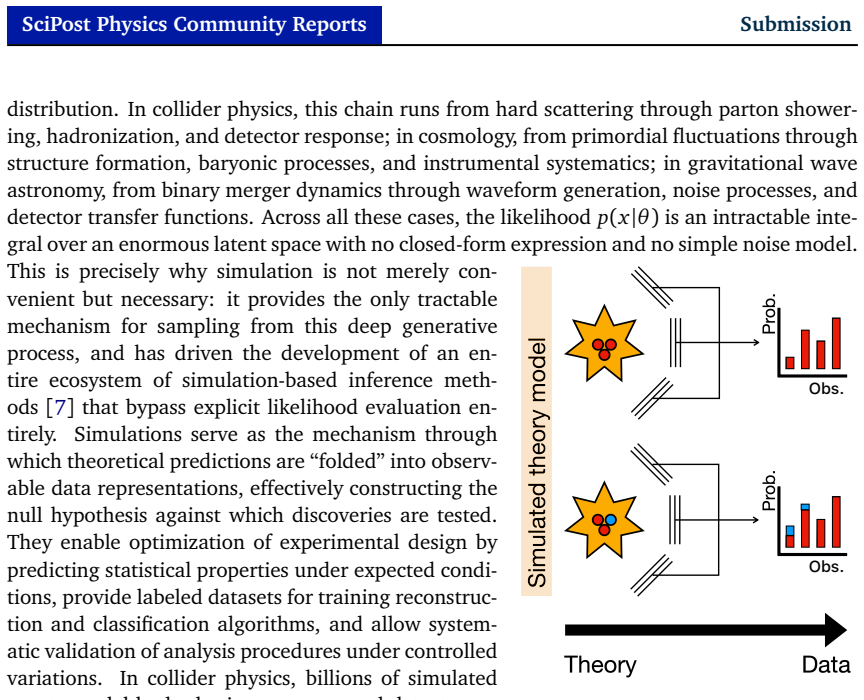
- Figure 1 and Figure 3 are conceptually clear but would benefit from slightly more explicit captions linking each panel to the corresponding workflow stage or uncertainty type discussed in the text.
- Section 2.3 on agentic AI is appropriately cautious; a short forward pointer to concrete verification protocols (even if only as open problems) would strengthen the bridge to Section 4.4.
- Minor typographical and formatting inconsistencies appear (e.g., spacing around citations, occasional hyphenation of “black-box” / “black boxes”). A light copy-edit pass would polish the manuscript.
- The abstract and concluding guidelines are strong; ensuring the five bullet guidelines in Section 6 map one-to-one onto the section structure would improve navigability for practitioners.
Circularity Check
No circularity: community review with normative framing, no fitted predictions or self-definitional reductions.
full rationale
This is a VERaiPHY community review that organizes existing statistical practice around a four-stage workflow (data collection, summarization, modeling, inference) and an aleatoric/epistemic taxonomy. It does not claim to derive quantitative predictions, uniqueness theorems, or first-principles results from fitted parameters or self-defined quantities. Load-bearing external anchors (Wolpert No Free Lunch, Cover data-processing inequality, Cranmer SBI survey, standard frequentist/Bayesian practice) are independent of the authors. Companion VERaiPHY citations supply depth on subtopics but are not required to force the central normative claim that verification is essential precisely when ML outputs enter statistical modeling, inference, or hypothesis testing. No equation reduces to its own input by construction; no ansatz is smuggled via self-citation; no known empirical pattern is merely renamed. Score 0 is the correct honest finding.
Axiom & Free-Parameter Ledger
axioms (4)
- standard math No Free Lunch theorems: no learning algorithm is universally superior; inductive bias is unavoidable.
- standard math Data Processing Inequality: deterministic or stochastic transformations cannot increase mutual information with the quantity of interest.
- domain assumption Discovery in fundamental physics proceeds via statistical inference on noisy, incomplete observables rather than direct observation of the target entities.
- domain assumption The four-stage workflow (collection, summarization, modeling, inference) plus the aleatoric/epistemic distinction covers the relevant ML insertion points.
read the original abstract
Machine learning (ML) has become integral to fundamental physics, accelerating statistical workflows from data acquisition through inference and hypothesis testing. As ML systems grow increasingly autonomous, ensuring their reliability for discovery claims becomes critical. This review synthesizes the VERaiPHY (Validation & Evaluation for Robust AI in PHYsics) initiative's frameworks for rigorous ML assessment across particle physics, astrophysics, and cosmology. We establish when verification is essential by contextualizing ML within the statistical discovery workflow. We emphasize fundamental limitations: inductive bias is unavoidable, sample complexity bounds learning, and experimental constraints limit discovery. We reflect on physicists' evolving role as both experimental designers and evaluators whose judgments encode scientific rigor into AI systems. Responsible integration requires understanding ML's transformative potential alongside its intrinsic boundaries.
Figures



Reference graph
Works this paper leans on
-
[1]
2025 , month =
Cho, Kyunghyun , title =. 2025 , month =
2025
-
[2]
Coffea: Columnar Object Framework For Effective Analysis
Smith, Nicholas and others. Coffea: Columnar Object Framework For Effective Analysis. EPJ Web Conf. 2020. doi:10.1051/epjconf/202024506012. arXiv:2008.12712
-
[3]
Proceedings of the 24th International Conference on Computing in High Energy and Nuclear Physics (CHEP 2019) , journal =
Awkward Arrays in Python, C++, and Numba , author =. Proceedings of the 24th International Conference on Computing in High Energy and Nuclear Physics (CHEP 2019) , journal =. 2020 , doi =
2019
-
[4]
Brun, R. and Rademakers, F. ROOT: An object oriented data analysis framework. Nucl. Instrum. Meth. A. 1997. doi:10.1016/S0168-9002(97)00048-X
-
[5]
Active Learning reinterpretation of an ATLAS Dark Matter search constraining a model of a dark Higgs boson decaying to two b-quarks. 2022
2022
-
[6]
Observation of Gravitational Waves from a Binary Black Hole Merger , author =. Phys. Rev. Lett. , volume =. 2016 , month =. doi:10.1103/PhysRevLett.116.061102 , url =
-
[7]
The Astronomical Journal , volume=
Data release 1 of the dark energy spectroscopic instrument , author=. The Astronomical Journal , volume=. 2026 , publisher=
2026
-
[8]
Monthly Notices of the Royal Astronomical Society , volume=
Cosmic confusion: degeneracies among cosmological parameters derived from measurements of microwave background anisotropies , author=. Monthly Notices of the Royal Astronomical Society , volume=. 1999 , publisher=
1999
-
[9]
Monthly Notices of the Royal Astronomical Society , volume=
Massively parallel Bayesian inference for transient gravitational-wave astronomy , author=. Monthly Notices of the Royal Astronomical Society , volume=. 2020 , publisher=
2020
-
[10]
Toward Early-Warning Detection of Gravitational Waves from Compact Binary Coalescence
Cannon, Kipp and others. Toward Early-Warning Detection of Gravitational Waves from Compact Binary Coalescence. Astrophys. J. 2012. doi:10.1088/0004-637X/748/2/136. arXiv:1107.2665
-
[11]
Aad, Georges and others. Observation of a new particle in the search for the Standard Model Higgs boson with the ATLAS detector at the LHC. Phys. Lett. B. 2012. doi:10.1016/j.physletb.2012.08.020. arXiv:1207.7214
-
[12]
Observation of a New Boson at a Mass of 125 GeV with the CMS Experiment at the LHC
Chatrchyan, Serguei and others. Observation of a New Boson at a Mass of 125 GeV with the CMS Experiment at the LHC. Phys. Lett. B. 2012. doi:10.1016/j.physletb.2012.08.021. arXiv:1207.7235
-
[13]
Asymptotic formulae for likelihood-based tests of new physics
Cowan, Glen and Cranmer, Kyle and Gross, Eilam and Vitells, Ofer. Asymptotic formulae for likelihood-based tests of new physics. Eur. Phys. J. C. 2011. doi:10.1140/epjc/s10052-011-1554-0. arXiv:1007.1727
-
[14]
Journal of Instrumentation , volume=
The CMS trigger system , author=. Journal of Instrumentation , volume=
-
[15]
Journal of Instrumentation , volume=
Operation of the ATLAS trigger system in Run 2 , author=. Journal of Instrumentation , volume=
-
[16]
arXiv preprint arXiv:1902.08960 , year=
Precision laser-based measurements of the single electron response of SPCs for the NEWS-G light dark matter search experiment , author=. arXiv preprint arXiv:1902.08960 , year=
Pith/arXiv arXiv 1902
-
[17]
Physical Review D , volume=
First results from the CRESST-III low-mass dark matter program , author=. Physical Review D , volume=. 2019 , publisher=
2019
-
[18]
Fast neural-net based fake track rejection in the LHCb reconstruction , author=
-
[19]
The Phase-2 Upgrade of the CMS Level-1 Trigger
Zabi, Alexandre and Berryhill, Jeffrey Wayne and Perez, Emmanuelle and Tapper, Alexander D. The Phase-2 Upgrade of the CMS Level-1 Trigger. 2020
2020
-
[20]
Journal of instrumentation , volume=
Fast inference of deep neural networks in FPGAs for particle physics , author=. Journal of instrumentation , volume=. 2018 , publisher=
2018
-
[21]
arXiv preprint arXiv:2509.24371 , year=
Advancing the CMS Level-1 Trigger: Jet Tagging with DeepSets at the HL-LHC , author=. arXiv preprint arXiv:2509.24371 , year=
-
[22]
Govorkova, Ekaterina and others. Autoencoders on field-programmable gate arrays for real-time, unsupervised new physics detection at 40 MHz at the Large Hadron Collider. Nature Mach. Intell. 2022. doi:10.1038/s42256-022-00441-3. arXiv:2108.03986
-
[23]
Matching Matched Filtering with Deep Networks for Gravitational-Wave Astronomy , author =. Phys. Rev. Lett. , volume =. 2018 , month =. doi:10.1103/PhysRevLett.120.141103 , url =
-
[24]
Physical Review D , volume=
Generalized approach to matched filtering using neural networks , author=. Physical Review D , volume=. 2022 , publisher=
2022
-
[25]
Physical Review D , volume=
Deep neural networks to enable real-time multimessenger astrophysics , author=. Physical Review D , volume=. 2018 , publisher=
2018
-
[26]
Machine Learning: Science and Technology , volume=
GWAK: gravitational-wave anomalous knowledge with recurrent autoencoders , author=. Machine Learning: Science and Technology , volume=. 2024 , publisher=
2024
-
[27]
SEAL - A Symmetry EncourAging Loss for High Energy Physics
Hebbar, Pradyun and Madula, Thandikire and Mikuni, Vinicius and Nachman, Benjamin and Outmezguine, Nadav and Savoray, Inbar. SEAL - A Symmetry EncourAging Loss for High Energy Physics. 2025. arXiv:2511.01982
arXiv 2025
-
[28]
Machine Learning: Science and Technology , volume=
Probing the effects of broken symmetries in machine learning , author=. Machine Learning: Science and Technology , volume=. 2024 , publisher=
2024
-
[29]
Physical Review D , volume=
Learning broken symmetries with approximate invariance , author=. Physical Review D , volume=. 2025 , publisher=
2025
-
[30]
Aarts, Gert and Habibi, Diaa E. and Ipp, Andreas and M. Generalizable Equivariant Diffusion Models for Non-Abelian Lattice Gauge Theory. 2026. arXiv:2601.19552
arXiv 2026
-
[31]
A Living Review of Machine Learning for Particle Physics
Feickert, Matthew and Nachman, Benjamin. A Living Review of Machine Learning for Particle Physics. 2021. arXiv:2102.02770
Pith/arXiv arXiv 2021
-
[32]
OmniJet- : The first cross-task foundation model for particle physics
Birk, Joschka and Hallin, Anna and Kasieczka, Gregor. OmniJet- : The first cross-task foundation model for particle physics. 2024. arXiv:2403.05618
Pith/arXiv arXiv 2024
-
[33]
Foundation models for high-energy physics
Hallin, Anna. Foundation models for high-energy physics. 2nd European AI for Fundamental Physics Conference. 2025. arXiv:2509.21434
arXiv 2025
-
[34]
Re-Simulation-based Self-Supervised Learning for Pre-Training Foundation Models
Harris, Philip and Kagan, Michael and Krupa, Jeffrey and Maier, Benedikt and Woodward, Nathaniel. Re-Simulation-based Self-Supervised Learning for Pre-Training Foundation Models. 2024. arXiv:2403.07066
Pith/arXiv arXiv 2024
-
[35]
Masked particle modeling on sets: towards self-supervised high energy physics foundation models
Golling, Tobias and Heinrich, Lukas and Kagan, Michael and Klein, Samuel and Leigh, Matthew and Osadchy, Margarita and Raine, John Andrew. Masked particle modeling on sets: towards self-supervised high energy physics foundation models. Mach. Learn. Sci. Tech. 2024. doi:10.1088/2632-2153/ad64a8. arXiv:2401.13537
-
[36]
Finetuning foundation models for joint analysis optimization in High Energy Physics
Vigl, Matthias and Hartman, Nicole and Heinrich, Lukas. Finetuning foundation models for joint analysis optimization in High Energy Physics. Mach. Learn. Sci. Tech. 2024. doi:10.1088/2632-2153/ad55a3. arXiv:2401.13536
-
[37]
Method to simultaneously facilitate all jet physics tasks
Mikuni, Vinicius and Nachman, Benjamin. Method to simultaneously facilitate all jet physics tasks. Phys. Rev. D. 2025. doi:10.1103/PhysRevD.111.054015. arXiv:2502.14652
-
[38]
Solving key challenges in collider physics with foundation models
Mikuni, Vinicius and Nachman, Benjamin. Solving key challenges in collider physics with foundation models. Phys. Rev. D. 2025. doi:10.1103/PhysRevD.111.L051504. arXiv:2404.16091
-
[39]
Is Tokenization Needed for Masked Particle Modelling?
Leigh, Matthew and Klein, Samuel and Charton, Fran c ois and Golling, Tobias and Heinrich, Lukas and Kagan, Michael and Ochoa, In \^e s and Osadchy, Margarita. Is Tokenization Needed for Masked Particle Modelling?. 2024. arXiv:2409.12589
Pith/arXiv arXiv 2024
-
[40]
HEP-JEPA: A foundation model for collider physics using joint embedding predictive architecture
Bardhan, Jai and Agrawal, Radhikesh and Tilak, Abhiram and Neeraj, Cyrin and Mitra, Subhadip. HEP-JEPA: A foundation model for collider physics using joint embedding predictive architecture. 2025. arXiv:2502.03933
Pith/arXiv arXiv 2025
-
[41]
Particle transformers for identifying Lorentz-boosted Higgs bosons decaying to a pair of W bosons
Hayrapetyan, Aram and others. Particle transformers for identifying Lorentz-boosted Higgs bosons decaying to a pair of W bosons. 2026. arXiv:2604.09809
Pith/arXiv arXiv 2026
-
[42]
OmniCosmos: Transferring Particle Physics Knowledge Across the Cosmos
Mikuni, Vinicius and Elsharkawy, Ibrahim and Nachman, Benjamin. OmniCosmos: Transferring Particle Physics Knowledge Across the Cosmos. 2025. arXiv:2512.24422
arXiv 2025
-
[43]
OmniMol: Transferring Particle Physics Knowledge to Molecular Dynamics with Point-Edge Transformers
Elsharkawy, Ibrahim and Mikuni, Vinicius and Bhimji, Wahid and Nachman, Benjamin. OmniMol: Transferring Particle Physics Knowledge to Molecular Dynamics with Point-Edge Transformers. 2026. arXiv:2601.10791
Pith/arXiv arXiv 2026
-
[44]
Lu, Junjian and Liu, Siwei and Kobylianskii, Dmitrii and Dreyer, Etienne and Gross, Eilam and Liang, Shangsong. PASCL: supervised contrastive learning with perturbative augmentation for particle decay reconstruction. Mach. Learn. Sci. Tech. 2024. doi:10.1088/2632-2153/ad8060. arXiv:2402.11538
work page internal anchor Pith review Pith/arXiv arXiv doi:10.1088/2632-2153/ad8060 2024
-
[46]
Advances in Neural Information Processing Systems , volume=
Autoscidact: Automated scientific discovery through contrastive embedding and hypothesis testing , author=. Advances in Neural Information Processing Systems , volume=
-
[47]
MACK: Mismodeling Addressed with Contrastive Knowledge
Sheldon, Liam Rankin and Rankin, Dylan Sheldon and Harris, Philip. MACK: Mismodeling addressed with contrastive knowledge. SciPost Phys. 2025. doi:10.21468/SciPostPhys.18.5.150. arXiv:2410.13947
work page internal anchor Pith review Pith/arXiv arXiv doi:10.21468/scipostphys.18.5.150 2025
-
[48]
A cautionary tale of decorrelating theory uncertainties
Ghosh, Aishik and Nachman, Benjamin. A cautionary tale of decorrelating theory uncertainties. Eur. Phys. J. C. 2022. doi:10.1140/epjc/s10052-022-10012-w. arXiv:2109.08159
-
[49]
A unified approach for jet tagging in Run 3 at s =13.6 TeV in CMS. 2024
2024
-
[50]
Transforming jet flavour tagging at ATLAS
Aad, Georges and others. Transforming jet flavour tagging at ATLAS. Nature Commun. 2026. doi:10.1038/s41467-025-65059-6. arXiv:2505.19689
-
[51]
SciPost Physics , volume=
Machine learning and LHC event generation , author=. SciPost Physics , volume=
-
[52]
CaloChallenge 2022: a community challenge for fast calorimeter simulation
Amram, Oz and others. CaloChallenge 2022: a community challenge for fast calorimeter simulation. Rept. Prog. Phys. 2025. doi:10.1088/1361-6633/ae1304. arXiv:2410.21611
-
[53]
arXiv preprint arXiv:2110.07925 , year=
Machine learning for the LHCb simulation , author=. arXiv preprint arXiv:2110.07925 , year=
-
[54]
Machine Learning: Science and Technology , volume=
Particle-based fast jet simulation at the LHC with variational autoencoders , author=. Machine Learning: Science and Technology , volume=. 2022 , publisher=
2022
-
[55]
2024 , institution=
The Fast Simulation Program of ATLAS at the LHC , author=. 2024 , institution=
2024
-
[56]
arXiv preprint arXiv:2511.02020 , year=
Machine learning in LHCb Simulation: From fast to flash , author=. arXiv preprint arXiv:2511.02020 , year=
-
[57]
Proceedings of the National Academy of Sciences , volume =
Siyu He and Yin Li and Yu Feng and Shirley Ho and Siamak Ravanbakhsh and Wei Chen and Barnabás Póczos , title =. Proceedings of the National Academy of Sciences , volume =. 2019 , doi =
2019
-
[58]
Computational Astrophysics and Cosmology , volume=
Fast cosmic web simulations with generative adversarial networks , author=. Computational Astrophysics and Cosmology , volume=. 2018 , publisher=
2018
-
[59]
Machine Learning: Science and Technology , url=
Cappelli, Pietro and Grosso, Gaia and Letizia, Marco and Reyes-González, Humberto and Zanetti, Marco , title=. Machine Learning: Science and Technology , url=
-
[60]
Evaluating generative models in high energy physics
Kansal, Raghav and Li, Anni and Duarte, Javier and Chernyavskaya, Nadezda and Pierini, Maurizio and Orzari, Breno and Tomei, Thiago. Evaluating generative models in high energy physics. Phys. Rev. D. 2023. doi:10.1103/PhysRevD.107.076017. arXiv:2211.10295
-
[61]
hydrodynamical simulations , author=
Machine learning and cosmological simulations--ii. hydrodynamical simulations , author=. Monthly Notices of the Royal Astronomical Society , volume=. 2016 , publisher=
2016
-
[62]
Proceedings of the National Academy of Sciences , volume=
The frontier of simulation-based inference , author=. Proceedings of the National Academy of Sciences , volume=. 2020 , publisher=
2020
-
[63]
Artificial Intelligence for High Energy Physics , pages=
Simulation-based inference methods for particle physics , author=. Artificial Intelligence for High Energy Physics , pages=. 2022 , publisher=
2022
-
[64]
Reports on Progress in Physics , volume=
An implementation of neural simulation-based inference for parameter estimation in ATLAS , author=. Reports on Progress in Physics , volume=. 2025 , publisher=
2025
-
[65]
Machine Learning: Science and Technology , volume=
Robust simulation-based inference in cosmology with Bayesian neural networks , author=. Machine Learning: Science and Technology , volume=. 2023 , publisher=
2023
-
[66]
Nature Astronomy , volume=
A deep-learning algorithm to disentangle self-interacting dark matter and AGN feedback models , author=. Nature Astronomy , volume=. 2024 , publisher=
2024
-
[67]
Machine Learning: Science and Technology , abstract =
Astrand, S and Boggia, L and Borsato, M and Bozianu, L and Cocha Toapaxi, C E and Giasemis, F I and Hansen, J and Inkaew, P and Iversen, K E and Jawahar, P and Pineiro Monteagudo, H and Olocco, M and Schramm, S , title =. Machine Learning: Science and Technology , abstract =. 2026 , month =. doi:10.1088/2632-2153/ae35cc , url =
-
[68]
arXiv preprint arXiv:1702.08608 , year=
Towards a rigorous science of interpretable machine learning , author=. arXiv preprint arXiv:1702.08608 , year=
-
[69]
Nature machine intelligence , volume=
Stop explaining black box machine learning models for high stakes decisions and use interpretable models instead , author=. Nature machine intelligence , volume=. 2019 , publisher=
2019
-
[70]
, author=
The mythos of model interpretability: In machine learning, the concept of interpretability is both important and slippery. , author=. Queue , volume=. 2018 , publisher=
2018
-
[71]
arXiv preprint arXiv:2601.03220 , year=
From Entropy to Epiplexity: Rethinking Information for Computationally Bounded Intelligence , author=. arXiv preprint arXiv:2601.03220 , year=
-
[72]
arXiv preprint arXiv:2503.02113 , year=
Deep learning is not so mysterious or different , author=. arXiv preprint arXiv:2503.02113 , year=
-
[73]
arXiv preprint arXiv:2304.05366 , year=
The no free lunch theorem, kolmogorov complexity, and the role of inductive biases in machine learning , author=. arXiv preprint arXiv:2304.05366 , year=
-
[74]
Neural computation , volume=
The lack of a priori distinctions between learning algorithms , author=. Neural computation , volume=. 1996 , publisher=
1996
-
[75]
1995 , institution=
No free lunch theorems for search , author=. 1995 , institution=
1995
-
[76]
IEEE transactions on evolutionary computation , volume=
No free lunch theorems for optimization , author=. IEEE transactions on evolutionary computation , volume=. 2002 , publisher=
2002
-
[77]
arXiv preprint arXiv:1805.08522 , year=
Deep learning generalizes because the parameter-function map is biased towards simple functions , author=. arXiv preprint arXiv:1805.08522 , year=
-
[78]
arXiv preprint arXiv:2103.10427 , year=
The low-rank simplicity bias in deep networks , author=. arXiv preprint arXiv:2103.10427 , year=
-
[79]
arXiv preprint arXiv:2509.22445 , year=
Bridging Kolmogorov Complexity and Deep Learning: Asymptotically Optimal Description Length Objectives for Transformers , author=. arXiv preprint arXiv:2509.22445 , year=
-
[80]
Resimulation-based self-supervised learning for pretraining physics foundation models , author =. Phys. Rev. D , volume =. 2025 , month =. doi:10.1103/PhysRevD.111.032010 , url =
-
[81]
Anomaly-preserving contrastive neural embeddings for end-to-end model-independent searches at the LHC , author =. Phys. Rev. D , volume =. 2025 , month =. doi:10.1103/5n77-ynsp , url =
discussion (0)
Sign in with ORCID, Apple, or X to comment. Anyone can read and Pith papers without signing in.