REVIEW 4 major objections 5 minor 34 references
Learning the Brain's Dynamics as a Port-Hamiltonian System: A GNN-Surrogate Metriplectic Twin for Non-Equilibrium Cortical Dynamics and Closed-Loop Neuromodulation
T0 review · 4 major / 5 minor · reviewed 2026-08-02 · deepseek-v4-flash
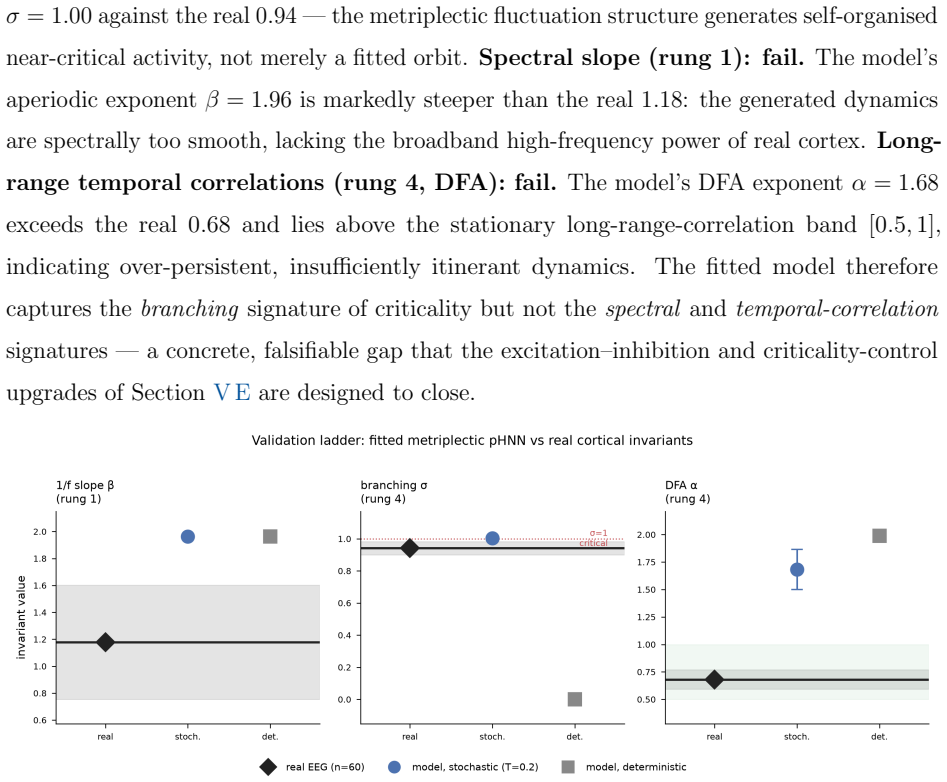
Pith's one-line read A port-Hamiltonian GNN surrogate of cortex, fitted to scalp EEG phasors, reproduces near-critical avalanche branching (σ=1.00 against observed 0.94) but fails the 1/f and DFA rungs; the paper presents the gap as a concrete upgrade path.
desk verdict Interesting framework with honest failure reporting, but the implemented model doesn't match the advertised theory and the one success may be a tuning artifact. read the letter →
The pith
A machine-rendered reading of the paper's core claim, the machinery that carries it, and where it could break.
The reading
What carries the argument
The load-bearing object is the metriplectic/port-Hamiltonian cortical twin: canonical phasor coordinates x=[φ,ω], a Hamiltonian decomposed into five band sub-energies, a skew-symmetric connectome J(x) gated by a phase-locking prior, state-dependent dissipation R(x), and a single 'arousal temperature' T that scales the fluctuation-dissipation noise. Its role is to guarantee structure: conservative routing in one bracket, entropy production in the other, a steady-state power balance instead of decay to silence, and stability guarantees under stimulation. The GNN surrogate makes the state-dependent operators learnable at 64 channels while preserving the physical shape constraints by constructio
What would settle it
Re-run the stochastic free-run with T swept from, say, 0 to 1 (or learned from data) and check whether σ stays near 1 across a broad range; also replace the learned R(x) with scalar dissipation and re-score. If branching collapses or moves with T, the invariant is an artifact of tuning rather than an emergent property.
Extended reading notes
Core claim
The central claim, on the author's own terms, is that a 'Cortical GNN-pHNN'—a graph-neural-network surrogate embedded in a port-Hamiltonian/metriplectic structure over band-limited neural phasors—can be fitted to large-scale scalp EEG from multiple subjects and then evaluated as a physical model rather than a classifier. The Hamiltonian is stratified into five interpretable sub-energies (delta through gamma); the coupling matrix J(x) is kept skew-symmetric by construction and gated by measured phase-locking; dissipation R(x) is state-dependent and positive-semidefinite; and a fluctuation-dissipation noise channel with a single arousal temperature T turns the system into a non-equilibrium ste
Load-bearing premise
The avalanche-branching match rests on the unexamined choice of arousal temperature T=0.2 and the learned dissipation matrix; if that choice is doing the work, the port-Hamiltonian structure adds little beyond a stochastic oscillator.
Editorial extensions
If this is right
- If the branching match is not a temperature artifact, a physics-constrained EEG model can reproduce a model-independent invariant it never trained on, lending support to cortical criticality as a genuine dynamical signature.
- The two reported failures set quantitative targets: an excitatory–inhibitory criticality control and a volume-conduction-robust connectome should shallow the 1/f slope and pull the DFA exponent below 1.
- The metriplectic reformulation replaces relaxation-to-silence with a non-equilibrium steady state, so resting cortex can sustain oscillation indefinitely—matching the waking brain.
- Fluctuation-dissipation noise gives trial-to-trial variability and a single arousal axis, linking discrete EEG conditions to locations on a continuous temperature scale.
- The neuroanatomical stimulation ports plus energy-shaping control provide a stability-guaranteed route to closed-loop neuromodulation, contingent on TMS-EEG perturbational validation.
Reading between the lines
- Editorial inference: the branching result is currently overdetermined by the unexamined choice T=0.2 and the learned dissipation R(x); until a temperature sweep is reported, the port-Hamiltonian structure cannot be separated from fitted noise.
- Editorial inference: because the metabolic port is absent from the implemented free-run, the validated model is closer to a stochastic dissipative oscillator than to the advertised metriplectic non-equilibrium steady state; the non-equilibrium claim is prospective.
- Editorial inference: a cheap control experiment—train a black-box recurrent surrogate on the same phasor objective and score the same invariants—would show whether the branching pass comes from structure preservation or merely from stochastic dissipation.
- Editorial inference: if the proposed criticality-control upgrade closes the spectral and DFA gaps, the same validation ladder could be applied to pathological regimes, interpreting seizure as dissipation failure and anaesthesia as metabolic collapse.
Editorial analysis
A structured set of objections, weighed in public.
Referee Report
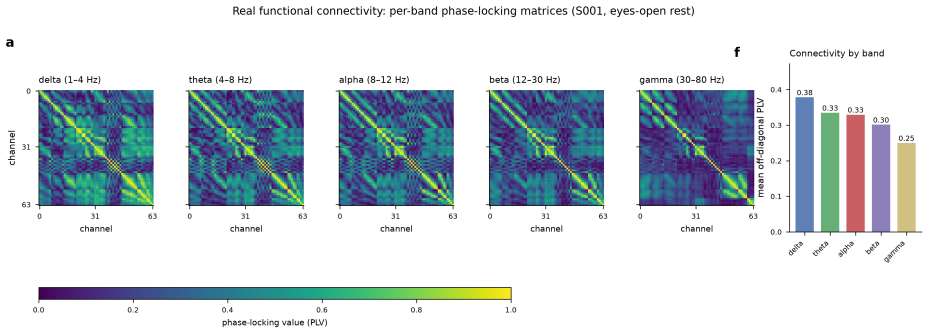
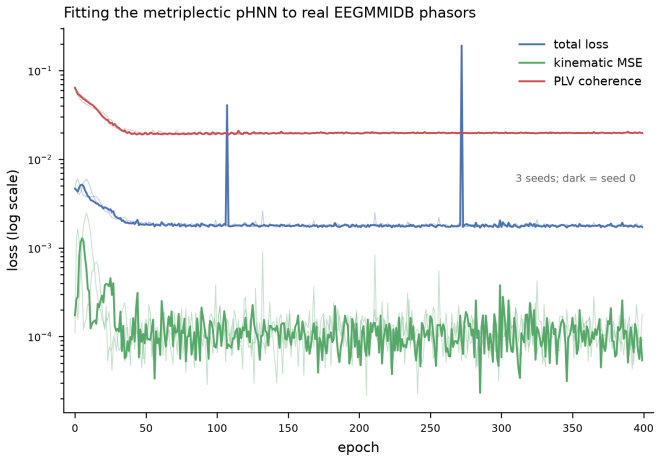
Summary. The paper proposes a port-Hamiltonian/GNN model of cortical dynamics. The state is an alpha-band phase/frequency phasor vector; the Hamiltonian is decomposed into five band sub-energies; the skew-symmetric coupling J(x) is gated by an empirical alpha-band phase-locking value (PLV); dissipation is a diagonal positive-semidefinite R(x) learned with a softplus network; and the training loss combines kinematic reconstruction with passivity, energy-balance, PLV, and PAC regularizers. The model is trained on ~1.1M phasor samples from the PhysioNet EEGMMIDB with three held-out subjects, reaching a held-out kinematic MSE of 1.30e-4. The free-running stochastic model is then scored against model-independent invariants: avalanche branching is reported as sigma = 1.00 versus a measured 0.94 (pass), while the 1/f spectral slope (1.96 vs 1.18) and DFA exponent (1.68 vs 0.68) fail. The paper frames the branching result as evidence for the port-Hamiltonian/metriplectic structure and outlines an extensive upgrade path toward closed-loop neuromodulation.
Significance. The paper has real strengths: it reports a leakage-free by-subject split, it states its validation ladder explicitly, it honestly reports the failed spectral and DFA rungs, and it makes code and data availability commitments. If the branching match were robust and attributable to the metriplectic structure, it would be a noteworthy result. However, the sole passing invariant is not established as a consequence of the advertised physics: the implemented model is not the non-equilibrium steady-state system described in the theory, the PLV-based connectome validation is circular, and the branching result depends on an uncalibrated noise temperature. The significance is therefore substantially below what the abstract claims.
major comments (4)
- [II E, III F, V A] The implemented and validated model is not the metriplectic NESS system described in the theory. Equation (8) introduces the metabolic port b_met(x) and the irreversible bracket M∇S, and Eq. (10) defines a steady-state power balance P_met = P_diss. But the training loss (19b) explicitly penalizes positive energy increase via L_p = E[ReLU(H_dot)], and Eq. (19c) enforces the port-Hamiltonian power balance without any metabolic port. The stochastic free-run (Eq. 11) also omits b_met. Thus the validated dynamics are a passive stochastic system, not the NESS system with a metabolic supply; the branching result cannot be credited to the metriplectic non-equilibrium structure.
- [V A, Eq. (11)] The branching result sigma = 1.00 versus 0.94 is the only passing rung, but it is not shown to be a prediction of the port-Hamiltonian/metriplectic structure. The noise covariance is sigma sigma^T = 2 T R(x), with T = 0.2 chosen without a priori justification or sensitivity analysis. Since R(x) is a learned MLP whose overall scale is not pinned by the loss, T and R(x) enter multiplicatively and the effective noise amplitude is effectively free. The deterministic noiseless rollout produces no avalanches by construction, so the fluctuation level is doing the work. The paper provides no T-sweep, no null model with J=0, and no comparison with a generic diffusion process having the same covariance. A non-critical stochastic process can produce descendant/ancestor ratios near 1 under suitable thresholding.
- [III C, Eq. (16), IV D, Fig. 10] The connectome validation is circular. The learned coupling J(x) is multiplied by the measured alpha PLV matrix in Eq. (16), and the PLV coherence prior L_PLV in Eq. (19d) explicitly anchors |J| to the same measured PLV. Figure 10b then reports a positive association between |J| and the empirical alpha PLV as evidence of anchoring. That association is enforced by the loss and the multiplicative gate, not discovered independently. It therefore cannot serve as evidence that the model 'recovers' synchrony structure.
- [III H, V A] The avalanche estimator is not clearly defined on the model output. The model state is x = [phi, omega] (Eq. 5), i.e., phase and angular frequency variables, not an EEG voltage or amplitude. Section III H describes thresholding a 'multichannel signal' at 2.5 standard deviations to define avalanches, but Section V A does not specify what observable of the free-run is thresholded, how it relates to the recorded EEG, or how the same estimator is applied to both. Without this specification, the reported sigma = 1.00 is not interpretable as a cortical avalanche branching parameter.
minor comments (5)
- [V A vs Fig. 9] The text states the model's aperiodic exponent is beta = 1.96, while the Fig. 9 caption gives beta ~ 2.1 for the same model spectrum. Please reconcile the two numbers.
- [II E] Eq. (3) is introduced in Section II A, but Section II E refers to 'the Stuart-Landau oscillator of Section II E'. The cross-reference should be corrected.
- [III F] The notation in Eq. (19d), f|J| - PLV(alpha) with tilde over PLV, is not defined precisely. Specify the normalization and the Frobenius-norm indexing.
- [II E, V A] Equation (11) drops the metabolic port b_met that appears in Eq. (8), without comment. Either include it consistently or state explicitly that the implemented free-run neglects the metabolic port and justify that simplification.
- [Abstract] The abstract claims the model is a 'physically principled, structure-preserving substrate for closed-loop neuromodulation', but the paper itself notes in Section V I that only about 5% of the state space is directly reachable with the three anatomical ports and that closed-loop control results are deferred. Softening the abstract claim would better match the evidence.
Circularity Check
Two validation rungs reduce to model inputs: the PLV-connectome correlation is forced by Eq. 16 + Eq. 19d, and the branching pass is attributed by the paper itself to an uncalibrated noise channel (T=0.2, learned R(x)); the honest 1/f and DFA failures keep the paper partially independent.
-
fitted input called prediction
[Section III C (Eq. 16), Section III F (Eq. 19d), Section V A (Fig. 10b)]
"The alpha-band phase-locking matrix then acts as a multiplicative coupling prior, J(x)←J(x)⊙PLV(α), suppressing off-diagonal coupling wherever empirical phase coherence is absent. ... LPLV = ‖ |J| − PLV(α) ‖²_F ... anchors the coupling magnitude to empirically measured synchrony. ... [T]he learned coupling magnitude |Jjk| is ... positively associated with the empirical alpha PLV prior across all channel pairs (Spearman ρ=0.08, p<0.001) — the mechanism by which the model's functional connectome is anchored to measured synchrony rather than free to invent coupling."
The connectome is gated by the measured alpha PLV (Eq. 16: J←J⊙PLV(α)) and the training loss explicitly anchors |J| to that same PLV (Eq. 19d). Reporting the resulting association as evidence that coupling is 'anchored to measured synchrony' is validating the model against its own construction: a multiplicative gate forces near-zero coupling wherever the prior is zero, so a positive association with the prior is guaranteed rather than discovered. Because the gate suppresses rather than prescribes, the correlation is modest, but its direction and existence are built in. This is a designed feature exhibited, not an independent validation rung; Table II rung 2 (source-space connectivity on held-out subjects) is not demonstrated.
-
fitted input called prediction
[Section V A; Eq. 11 (Section II E)]
"Because criticality is a fluctuation phenomenon, the theory-correct free-run of a metriplectic non-equilibrium steady-state model is the fluctuation–dissipation-consistent stochastic rollout (Eq. 11) at an arousal temperature T = 0.2; the noiseless deterministic rollout is reported as a reference and, as expected, relaxes onto a low-dimensional orbit that produces no avalanches. ... The stochastic free-run reproduces near-critical avalanche dynamics, with a branching parameter σ = 1.00 against the real 0.94 — the metriplectic fluctuation structure generates self-organised near-critical activit"
The only passing rung (branching σ≈1) is produced by the stochastic channel with covariance σσᵀ=2TR(x) (Eq. 11), where T=0.2 is set without reported calibration or sensitivity analysis and R(x) is a learned MLP whose scale is not pinned by the loss. The paper states that the noiseless rollout produces no avalanches, so the fluctuation amplitude is what generates the avalanches; the advertised metabolic port b_met (Eq. 8) is absent from the rollout, so the pass applies to a differently-structured stochastic dissipative system. Without a noise-level sweep or a null model, σ≈1 is not established as a port-Hamiltonian prediction — the fitted noise level may be doing the work — so the central positive validation reduces to an uncalibrated fitted input.
full rationale
The paper is largely self-contained: there is no self-citation chain (the author cites only external, standard references such as van der Schaft, Morrison/Grmela/Öttinger, and Beggs & Plenz), the by-subject leakage-free split is a genuine methodological control, and the two failing rungs (1/f slope β=1.96 vs 1.18; DFA α=1.68 vs 0.68) are honestly reported and are independent, non-circular results that let the reader falsify the model. What raises the score to 6 is that the paper's positive evidence reduces, in part, to its own construction. The functional-connectivity correlation (Fig. 10b) is forced by the multiplicative PLV gate (Eq. 16) plus the PLV-anchoring loss (Eq. 19d) — a by-construction association presented as the 'mechanism' of anchoring and reported in the validation section. The branching pass, the single strongest positive rung, is explicitly attributed by the paper to the fluctuation–dissipation noise at T=0.2, with the noiseless model producing no avalanches; since T and the learned R(x) scale are uncalibrated and no sensitivity or null model is given, the σ≈1 result is at risk of being a tuned noise-amplitude artifact rather than a metriplectic prediction. The paper itself flags the uncalibrated energy budget and the failed rungs in its Limitations, which is honest and prevents a higher score, but the central claim that the port-Hamiltonian structure reproduces a model-independent criticality invariant is not yet demonstrated. Overall: partial circularity (score 6), not full circularity: the spectral and DFA failures are genuine independent content, and the branching target itself (Table I: σ=0.942±0.041) is measured independently of the fitted model.
Assumptions & free parameters
free parameters (4)
- arousal temperature T =
T=0.2 (stochastic free-run, Sec. V A)
- loss weights λ_k, λ_p, λ_eb, λ_PLV, λ_PAC =
1.0, 0.5, 0.1, 0.05, 0.02
- per-channel baseline dissipation r0_j =
learned, 64 values
- GNN/MLP weights for H(x), J(x), R(x) =
optimized on 1,109,250 training samples
assumptions (5)
- standard math Port-Hamiltonian passivity inequality ˙H=-∇H^T R∇H + y^T u holds for the cortical energy surrogate
- domain assumption Stuart-Landau oscillators near Hopf bifurcation describe EEG band oscillations
- domain assumption Scalp-EEG alpha PLV measures true neural coupling rather than volume conduction
- ad hoc to paper Metriplectic degeneracy J∇S=0 and M∇H=0 with an unspecified entropy S can be imposed on cortical dynamics
- ad hoc to paper Fluctuation-dissipation relation σσ^T=2TR(x) with a single scalar temperature T applies to EEG
invented entities (3)
-
metabolic port b_met(x)
-
cortical entropy functional S(x)
-
single 'arousal temperature' T
Cite this review
Pith. "Pith review of Learning the Brain's Dynamics as a Port-Hamiltonian System: A GNN-Surrogate Metriplectic Twin for Non-Equilibrium Cortical Dynamics and Closed-Loop Neuromodulation." pith.science (2026). https://pith.science/paper/T4KIMJ2A
@misc{pith2026260710439,
  author       = {Pith},
  title        = {Pith review of: Learning the Brain's Dynamics as a Port-Hamiltonian System: A GNN-Surrogate Metriplectic Twin for Non-Equilibrium Cortical Dynamics and Closed-Loop Neuromodulation},
  year         = {2026},
  howpublished = {\url{https://pith.science/paper/T4KIMJ2A}},
  note         = {Machine review of arXiv:2607.10439}
}
abstract
We model human motor cortex, recorded during rest and motor-imagery BCI conditions, as a port-Hamiltonian system: a conservative interconnection (skew-symmetric coupling between band-limited neural phasors) together with a dissipative port whose state-dependent decay is set by a graph-neural-network surrogate. The Hamiltonian is resolved into five interpretable frequency sub-energies, and a phase-locking prior measured from the recordings gates the learned functional connectome so that coupling is admitted only where phase coherence is present. A metriplectic formulation places the resting cortex at a non-equilibrium steady state sustained by an explicit metabolic port, with a fluctuation-dissipation-consistent noise channel governed by a single arousal temperature. Fitting the model to 'FitTrainN' phasor samples from the PhysioNet EEG Motor Movement/Imagery database, under a leakage-free split with three subjects held out entirely, yields a held-out kinematic reconstruction error of 'FitTestMSE' that is stable across random seeds. We then score the free-running model against model-independent dynamical invariants it did not author: it reproduces near-critical avalanche branching ($\sigma\approx1$) but not yet the aperiodic $1/f$ spectral slope or the long-range temporal correlations of real cortex a concrete, falsifiable gap that we trace to specific, testable upgrades. The port-Hamiltonian structure supplies neuroanatomically grounded stimulation ports with stability guarantees, positioning the model as a physically principled, structure-preserving substrate for closed-loop neuromodulation.
Figures


Figures from the paper (9 more)





Reference graph
Works this paper leans on
-
[1]
Oxford University Press, New York, 2006
Gy¨ orgy Buzs´ aki.Rhythms of the Brain. Oxford University Press, New York, 2006
2006
-
[2]
A review of classification algorithms for EEG-based brain–computer interfaces: a 10 year update.Journal of Neural Engineering, 15(3):031005, 2018
Fabien Lotte, Laurent Bougrain, Andrzej Cichocki, Maureen Clerc, Marco Congedo, Alain Rakotomamonjy, and Florian Yger. A review of classification algorithms for EEG-based brain–computer interfaces: a 10 year update.Journal of Neural Engineering, 15(3):031005, 2018
2018
-
[3]
Hamiltonian neural networks
Samuel Greydanus, Misko Dzamba, and Jason Yosinski. Hamiltonian neural networks. In Advances in Neural Information Processing Systems, volume 32, pages 15379–15389. Curran Associates, Inc., 2019
2019
-
[4]
Zhong, Biswadip Dey, and Amit Chakraborty
Yaofeng D. Zhong, Biswadip Dey, and Amit Chakraborty. Dissipative SymODEN: Encoding Hamiltonian dynamics with dissipation and control into deep learning, 2020
2020
-
[5]
Port-Hamiltonian systems theory: An introductory overview.Foundations and Trends in Systems and Control, 1(2–3):173–378, 2014
Arjan van der Schaft and Dimitri Jeltsema. Port-Hamiltonian systems theory: An introductory overview.Foundations and Trends in Systems and Control, 1(2–3):173–378, 2014
2014
-
[6]
Strogatz.Nonlinear Dynamics and Chaos: With Applications to Physics, Biology, Chemistry, and Engineering
Steven H. Strogatz.Nonlinear Dynamics and Chaos: With Applications to Physics, Biology, Chemistry, and Engineering. CRC Press, Boca Raton, FL, 2nd edition, 2018
2018
-
[7]
Springer, Berlin, 1984
Yoshiki Kuramoto.Chemical Oscillations, Waves, and Turbulence. Springer, Berlin, 1984
1984
-
[8]
Fronto-parietal EEG coherence in theta and upper alpha reflect central executive functions of working memory
Paul Sauseng, Wolfgang Klimesch, Manuel Schabus, and Michael Doppelmayr. Fronto-parietal EEG coherence in theta and upper alpha reflect central executive functions of working memory. International Journal of Psychophysiology, 57(2):97–103, 2005
2005
Show all 34 references
-
[9]
The theta-gamma neural code.Neuron, 77(6):1002–1016, 2013
John Lisman and Ole Jensen. The theta-gamma neural code.Neuron, 77(6):1002–1016, 2013. 32
2013
-
[10]
Jirsa, and Anthony R
Gustavo Deco, Viktor K. Jirsa, and Anthony R. McIntosh. Emerging concepts for the dynamical organization of resting-state activity in the brain.Nature Reviews Neuroscience, 12(1):43–56, 2011
2011
-
[11]
Dynamic models of large-scale brain activity.Nature Neuroscience, 20(3):340–352, 2017
Michael Breakspear. Dynamic models of large-scale brain activity.Nature Neuroscience, 20(3):340–352, 2017
2017
-
[12]
Morrison
Philip J. Morrison. A paradigm for joined Hamiltonian and dissipative systems.Physica D: Nonlinear Phenomena, 18(1–3):410–419, 1986
1986
-
[13]
¨Ottinger
Miroslav Grmela and Hans C. ¨Ottinger. Dynamics and thermodynamics of complex fluids. I. development of a general formalism (GENERIC).Physical Review E, 56(6):6620–6632, 1997
1997
-
[14]
Wiley-Interscience, Hoboken, NJ, 2005
Hans Christian ¨Ottinger.Beyond Equilibrium Thermodynamics. Wiley-Interscience, Hoboken, NJ, 2005
2005
-
[15]
The fluctuation-dissipation theorem.Reports on Progress in Physics, 29(1):255– 284, 1966
Ryogo Kubo. The fluctuation-dissipation theorem.Reports on Progress in Physics, 29(1):255– 284, 1966
1966
-
[16]
McFarland, Thilo Hinterberger, Niels Birbaumer, and Jonathan R
Gerwin Schalk, Dennis J. McFarland, Thilo Hinterberger, Niels Birbaumer, and Jonathan R. Wolpaw. BCI2000: A general-purpose brain-computer interface (BCI) system.IEEE Transac- tions on Biomedical Engineering, 51(6):1034–1043, 2004
2004
-
[17]
Goldberger, Luis A
Ary L. Goldberger, Luis A. N. Amaral, Leon Glass, Jeffrey M. Hausdorff, Plamen Ch. Ivanov, Roger G. Mark, Joseph E. Mietus, George B. Moody, Chung-Kang Peng, and H. Eugene Stanley. PhysioBank, PhysioToolkit, and PhysioNet: Components of a new research resource for complex phys...
2000
-
[18]
Identifying true brain interaction from EEG data using the imaginary part of coherency
Guido Nolte, Ou Bai, Lewis Wheaton, Zoltan Mari, Sherry Vorbach, and Mark Hallett. Identifying true brain interaction from EEG data using the imaginary part of coherency. Clinical Neurophysiology, 115(10):2292–2307, 2004
2004
-
[19]
Stam, Guido Nolte, and Andreas Daffertshofer
Cornelis J. Stam, Guido Nolte, and Andreas Daffertshofer. Phase lag index: Assessment of functional connectivity from multi channel EEG and MEG with diminished bias from common sources.Human Brain Mapping, 28(11):1178–1193, 2007
2007
-
[20]
Martin Vinck, Robert Oostenveld, Marijn van Wingerden, Francesco Battaglia, and Cyriel M. A. Pennartz. An improved index of phase-synchronization for electrophysiological data in the presence of volume-conduction, noise and sample-size bias.NeuroImage, 55(4):1548–1565, 2011. 33
2011
-
[21]
Pascual-Marqui, Dietrich Lehmann, Martha Koukkou, Kieko Kochi, Peter Anderer, Bernd Saletu, Hideki Tanaka, Koichi Hirata, E
Roberto D. Pascual-Marqui, Dietrich Lehmann, Martha Koukkou, Kieko Kochi, Peter Anderer, Bernd Saletu, Hideki Tanaka, Koichi Hirata, E. Roy John, Leslie Prichep, Rolando Biscay- Lirio, and Toshihiko Kinoshita. Assessing interactions in the brain with exact low-resolution elect...
1952
-
[22]
Knock, M
Paula Sanz Leon, Stuart A. Knock, M. Marmaduke Woodman, Lia Domide, Jochen Mersmann, Anthony R. McIntosh, and Viktor Jirsa. The Virtual Brain: a simulator of primate brain network dynamics.Frontiers in Neuroinformatics, 7:10, 2013
2013
-
[23]
Resting-state functional connectivity emerges from structurally and dynamically shaped slow fluctuations.Journal of Neuroscience, 33(27):11239–11252, 2013
Gustavo Deco, Adri´ an Ponce-Alvarez, Dante Mantini, Gian Luca Romani, Patric Hagmann, and Maurizio Corbetta. Resting-state functional connectivity emerges from structurally and dynamically shaped slow fluctuations.Journal of Neuroscience, 33(27):11239–11252, 2013
2013
-
[24]
Jansen and Vincent G
Ben H. Jansen and Vincent G. Rit. Electroencephalogram and visual evoked potential generation in a mathematical model of coupled cortical columns.Biological Cybernetics, 73(4):357–366, 1995
1995
-
[25]
A recurrent network mechanism of time integration in perceptual decisions.Journal of Neuroscience, 26(4):1314–1328, 2006
Kong-Fatt Wong and Xiao-Jing Wang. A recurrent network mechanism of time integration in perceptual decisions.Journal of Neuroscience, 26(4):1314–1328, 2006
2006
-
[26]
Beggs and Dietmar Plenz
John M. Beggs and Dietmar Plenz. Neuronal avalanches in neocortical circuits.Journal of Neuroscience, 23(35):11167–11177, 2003
2003
-
[27]
Nikouline, J
Klaus Linkenkaer-Hansen, Vadim V. Nikouline, J. Matias Palva, and Risto J. Ilmoniemi. Long-range temporal correlations and scaling behavior in human brain oscillations.Journal of Neuroscience, 21(4):1370–1377, 2001
2001
-
[28]
The frontier of simulation-based inference
Kyle Cranmer, Johann Brehmer, and Gilles Louppe. The frontier of simulation-based inference. Proceedings of the National Academy of Sciences, 117(48):30055–30062, 2020
2020
-
[29]
Peterson, Paroma Varma, Priyadarshini Sebastian, Richard Gao, Torben Noto, Antonio H
Thomas Donoghue, Matar Haller, Erik J. Peterson, Paroma Varma, Priyadarshini Sebastian, Richard Gao, Torben Noto, Antonio H. Lara, Jonathan D. Wallis, Robert T. Knight, Dario L. Bhatt, and Bradley Voytek. Parameterizing neural power spectra into periodic and aperiodic componen...
2020
-
[30]
Casali, Olivia Gosseries, Mario Rosanova, M´ elanie Boly, Simone Sarasso, Karina R
Adenauer G. Casali, Olivia Gosseries, Mario Rosanova, M´ elanie Boly, Simone Sarasso, Karina R. Casali, Silvia Casarotto, Marie-Aur´ elie Bruno, Steven Laureys, Giulio Tononi, and Marcello Massimini. A theoretically based index of consciousness independent of sensory processin...
2013
-
[31]
Interconnection and damping assignment passivity-based control of port-controlled Hamiltonian systems
Romeo Ortega, Arjan van der Schaft, Bernhard Maschke, and Gerardo Escobar. Interconnection and damping assignment passivity-based control of port-controlled Hamiltonian systems. Automatica, 38(4):585–596, 2002
2002
-
[32]
Saturnino
Axel Thielscher, Andr´ e Antunes, and Guilherme B. Saturnino. Field modeling for transcranial magnetic stimulation: A useful tool to understand the physiological effects of TMS? In37th Annual International Conference of the IEEE Engineering in Medicine and Biology Society (EMB...
2015
-
[33]
Kovachki, Kamyar Azizzadenesheli, Burigede Liu, Kaushik Bhattacharya, Andrew M
Zongyi Li, Nikola B. Kovachki, Kamyar Azizzadenesheli, Burigede Liu, Kaushik Bhattacharya, Andrew M. Stuart, and Anima Anandkumar. Fourier neural operator for parametric partial differential equations. InInternational Conference on Learning Representations. OpenReview, 2021
2021
-
[34]
The non-invasive Berlin Brain-Computer Interface: Fast acquisition of effective perfor- mance in untrained subjects.NeuroImage, 37(2):539–550, 2007
Benjamin Blankertz, Guido Dornhege, Matthias Krauledat, Klaus-Robert M¨ uller, and Gabriel Curio. The non-invasive Berlin Brain-Computer Interface: Fast acquisition of effective perfor- mance in untrained subjects.NeuroImage, 37(2):539–550, 2007. 35
2007
Reviewed August 2, 2026 · model on record in the stance chip above.
Discussion (0). Sign in to comment.