REVIEW 5 minor 41 references
Machines that Predict Trajectories from Templates
T0 review · 0 major / 5 minor · reviewed 2026-07-14 · grok-4.5
Pith's one-line read Stored output trajectories form behavioral spaces that predict futures without identifying the generating system.
desk verdict Solid theory paper that turns multi-system trajectory libraries into exact predictors, with clean spectral and interconnection extensions; classical assumptions, no load-bearing holes. read the letter →
The pith
A machine-rendered reading of the paper's core claim, the machinery that carries it, and where it could break.
The reading
What carries the argument
The continuation map of the aggregate (or interconnection-generated) library: the linear relation Hf = Lmix Hp that turns any feasible encoding of the past into an exact future decoding, independent of which particular coefficient vector is chosen.
What would settle it
Build a library from several diagonalizable linear systems whose visible eigenvalues are known; generate a new scalar-output trajectory whose spectrum is not contained in that set and check whether the least-squares predictor still recovers the future exactly for past length equal to the aggregate observability index.
Extended reading notes
Core claim
Libraries of stored output trajectories define behavioral spaces that serve as exact prediction machines: under data richness and a past window at least as long as the aggregate observability index, any coefficient vector that matches an observed past against the library yields the correct future for every trajectory generated by any system represented in the library, and for many systems outside it whose output-visible spectrum is covered by the library.
Load-bearing premise
The stored trajectories must be rich enough to span every mode of every template system, and the observed past must be at least as long as the observability index of the whole library.
Editorial analysis
A structured set of objections, weighed in public.
Referee Report
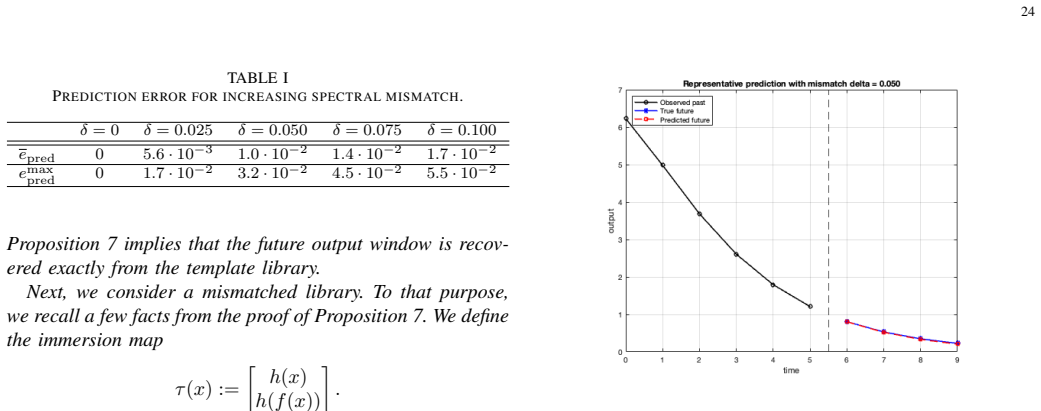
Summary. The paper develops a theory of trajectory prediction from libraries of stored output templates, without identifying the generating state-space model. Libraries of finite-length output windows from one or more LTI systems define behavioral spaces; exact prediction is characterized via continuation maps (Lemma 3), mixed-library factorization (Lemma 4, Theorem 1), and, for out-of-library systems, spectral inclusion of output-visible eigenvalues (Proposition 2 / Theorem 5). Robustness to noisy observations and libraries is quantified by exact error identities (Theorems 3–4); interconnection constraints (feedback, series, parallel) generate new libraries with emergent modes (Lemmas 5–10, Theorem 6, Proposition 6); and the framework extends to nonlinear systems whose outputs are contained in or immersed into finite-dimensional linear behaviors (Proposition 7). Numerical examples illustrate noisy prediction, sparse modal recovery, feedback-generated modes, and nonlinear immersion.
Significance. If the results hold, the paper supplies a clean algebraic foundation for template-based prediction machines that generalize beyond stored trajectories and, via spectral inclusion or interconnection, beyond the generating systems themselves. The core contributions rest on standard linear-algebra and systems-theory facts (observability index, data richness, Vandermonde structure) with explicit hypotheses and exact error identities; the interconnection construction and the immersion route to nonlinear trajectories are particularly distinctive. Strengths include parameter-free exact statements under clearly scoped assumptions, explicit equivalence between spectral inclusion, output inclusion and linear immersion (Lemmas 11–12, Corollary 2), and concrete numerical illustrations. The work sits naturally at the intersection of behavioral data-driven control and sequence completion, and opens well-defined directions (library design, inputs, online recursion).
minor comments (5)
- The manuscript is long and dense; a short roadmap or table of main theorems (Theorem 1, Proposition 2, Theorem 6, Proposition 7) early in Section II would help readers navigate the progression from single-system to multi-system, out-of-library, interconnection and nonlinear cases.
- Notation for the continuation map switches among L*, Lmix and L; a single consistent symbol (with subscripts only when needed) would reduce cognitive load, especially in Sections V–VII.
- Figure 1 (noisy-data histogram) and Figure 3 (sparse modal prediction) would benefit from explicit axis units and a brief caption statement of the SNR / r / T values used, so that the plots are self-contained.
- The restriction of the spectral results (Propositions 2–4, 6–7) to scalar-output diagonalizable systems is clearly stated, but a short remark on the multi-output or non-diagonalizable obstacles (and whether they are merely technical) would help readers assess the scope.
- A few typographical slips remain (e.g., “visible the spectral inclusion” in the proof of Proposition 2; occasional missing spaces around math). A final copy-edit pass would polish the presentation.
Circularity Check
No significant circularity: exact-prediction claims follow from observability-index continuation maps, data-richness image factorizations, and spectral-to-output inclusion, all proved algebraically under explicit hypotheses.
full rationale
The derivation chain is self-contained linear algebra and classical systems theory. Lemma 3 constructs the continuation map L* from the definition of the observability index (Fact 1 / Definition 1) and shows that any feasible latent g (or any L solving the data equation) recovers the future exactly when rank(X)=n; Theorem 1 simply applies the same argument to the block-diagonal aggregate pair. Proposition 2 / Theorem 5 prove that visible spectral inclusion implies Im(OT(Anew,Cnew))subseteq Im(OT(Amix,Cmix)) by expanding diagonalizable trajectories in Vandermonde modes, then invoke data richness to place every such trajectory in Im(HY) so that the continuation identity applies; the converse necessity (Proposition 3) is likewise a linear-independence argument on Vandermonde columns. Interconnection libraries (Lemmas 5-10) are constructed by explicit kernel constraints on atomic input-output matrices and factorized by the closed-loop realization; the same continuation then yields Theorem 6 / Proposition 6. Nonlinear extension (Proposition 7) uses the standard immersion of a finite-dimensional observation space into a companion linear system, then reduces to the linear spectral case. No parameter is fitted to data and then re-used as a prediction; numerical examples merely illustrate the exact or bounded-error statements under prescribed SNRs and eigenvalues. Self-citations to the authors' earlier data-driven-control papers are background only and are not load-bearing for any uniqueness or existence claim. Consequently the central theorems do not reduce to their inputs by construction.
Assumptions & free parameters
assumptions (4)
- standard math Observability index s of (A,C) is the smallest integer such that rank Os = rank Os+1; for r >= s a linear continuation map exists (Fact 1 / Definition 1).
- domain assumption Data richness: rank Xi = ni for every template system i (Definition 2).
- standard math For scalar-output diagonalizable systems, visible spectral inclusion implies output-trajectory inclusion (Corollary 2 / Proposition 2).
- domain assumption Nonlinear systems with finite-dimensional observation space can be immersed into a linear companion-form system whose spectrum is the observation-space characteristic roots (Definition 4, Proposition 7).
invented entities (3)
-
Continuation map L* (or Lmix)
independent evidence
-
Visible spectrum specC(A)
independent evidence
-
Interconnection-generated library (feedback/series/parallel via compatibility kernel Theta)
independent evidence
Cite this review
Pith. "Pith review of Machines that Predict Trajectories from Templates." pith.science (2026). https://pith.science/paper/2SP25NXA
@misc{pith2026260711551,
  author       = {Pith},
  title        = {Pith review of: Machines that Predict Trajectories from Templates},
  year         = {2026},
  howpublished = {\url{https://pith.science/paper/2SP25NXA}},
  note         = {Machine review of arXiv:2607.11551}
}
read the original abstract
We study trajectory prediction from libraries of stored output templates. Given the past of an unknown trajectory, the goal is to predict its future without identifying the state-space model that generated it. We show that libraries of trajectories generated by one or more dynamical systems define behavioral spaces that can be used as prediction mechanisms. For linear systems, we characterize exact prediction in terms of continuation maps, behavioral containment, and spectral conditions on output-visible eigenvalues. We also analyze robustness to noisy observations and noisy libraries, derive error bounds for out-of-library trajectories, and show how interconnection constraints can compose template libraries into new behavioral spaces with emergent modes. Finally, we extend the framework to nonlinear systems whose output trajectories are contained in, or immersed into, finite-dimensional linear behaviors. These results provide a theory of template-based prediction machines capable of generalizing beyond the stored trajectories and, in some cases, beyond the systems that generated them.
Figures


Figures from the paper (4 more)


Reference graph
Works this paper leans on
-
[1]
Vapnik,The Nature of Statistical Learning Theory
V . Vapnik,The Nature of Statistical Learning Theory. Springer-Verlag, New York, 1995
1995
-
[2]
A tutorial on support vector machines for pattern recog- nition,
C. Burges, “A tutorial on support vector machines for pattern recog- nition,”Data Mining and Knowledge Discovery, vol. 2, pp. 121–167, 1998
1998
-
[3]
Instance-based learning algorithms,
D. W. Aha, D. Kibler, and M. K. Albert, “Instance-based learning algorithms,”Machine Learning, vol. 6, pp. 37–66, 1991
1991
-
[4]
A survey of fault diagnosis and fault-tolerant techniques–part i: Fault diagnosis with model-based and signal-based approaches,
Z. Gao, C. Cecati, and S. X. Ding, “A survey of fault diagnosis and fault-tolerant techniques–part i: Fault diagnosis with model-based and signal-based approaches,”IEEE Transactions on Industrial Electronics, vol. 62, no. 6, pp. 3757–3767, 2015
2015
-
[5]
Linear predictors for nonlinear dynamical sys- tems: Koopman operator meets model predictive control,
M. Korda and I. Mezi ´c, “Linear predictors for nonlinear dynamical sys- tems: Koopman operator meets model predictive control,”Automatica, vol. 93, pp. 149–160, 2018
2018
-
[6]
Data-driven approximation of the Koopman generator: Model reduction, system identification, and control,
S. Klus, F. Nuske, J. Peitz, C. Clementi, and C. Sch ¨utte, “Data-driven approximation of the Koopman generator: Model reduction, system identification, and control,”Physica D: Nonlinear Phenomena, vol. 406, p. 132416, 2020
2020
-
[7]
Koopman operator theory: fundamentals, control, and applications,
I. Mezi ´c, J. Cort´es, K. Worthmann, M. Lazar, and A. Lederer, “Koopman operator theory: fundamentals, control, and applications,”arXiv preprint arXiv:2607.01819, 2026
arXiv 2026
-
[8]
Finite-dimensional observation-spaces for non-linear sys- tems,
M. Fliess, “Finite-dimensional observation-spaces for non-linear sys- tems,” inFeedback Control of Linear and Nonlinear Systems.Proceed- ings of the Joint Workshop on Feedback and Synthesis of Linear and Nonlinear Systems Bielefeld/Roma. Springer, 2005, pp. 73–77
2005
Show all 41 references
-
[9]
Exact finite Koopman embedding of block-oriented polynomial systems,
L. Iacob, R. T ´oth, and M. Schoukens, “Exact finite Koopman embedding of block-oriented polynomial systems,”arXiv preprint arXiv:2507.15093, 2025
2025 arXiv
-
[10]
Great: Grassmannian recursive algorithm for tracking & online system identification,
A. Sasfi, A. Padoan, I. Markovsky, and F. D ¨orfler, “Great: Grassmannian recursive algorithm for tracking & online system identification,”IEEE Transactions on Automatic Control, 2025
2025
-
[11]
Data-driven unknown-input ob- servers and state estimation,
M. S. Turan and G. Ferrari-Trecate, “Data-driven unknown-input ob- servers and state estimation,”IEEE Control Systems Letters, vol. 6, pp. 1424–1429, 2021
2021
-
[12]
Data-driven input reconstruction and experimental validation,
J. Shi, Y . Lian, and C. N. Jones, “Data-driven input reconstruction and experimental validation,”IEEE Control Systems Letters, vol. 6, pp. 3259–3264, 2022
2022
-
[13]
Data-driven inverse of linear systems and application to disturbance observers,
Y . Eun, J. Lee, and H. Shim, “Data-driven inverse of linear systems and application to disturbance observers,” in2023 American Control Conference (ACC). IEEE, 2023, pp. 2806–2811
2023
-
[14]
On the equivalence of model-based and data-driven approaches to the design of unknown-input observers,
G. Disar `o and M. E. Valcher, “On the equivalence of model-based and data-driven approaches to the design of unknown-input observers,”IEEE Transactions on Automatic Control, vol. 70, no. 3, pp. 2074–2081, 2024
-
[15]
Data-enabled predictive control: In the shallows of the DeePC,
J. Coulson, J. Lygeros, and F. D ¨orfler, “Data-enabled predictive control: In the shallows of the DeePC,” in18th European Control Conference, 2019
2019
-
[16]
Linear tracking MPC for nonlinear systems–Part ii: The data-driven case,
J. Berberich, K. K ¨ohler, M. M ¨uller, and F. Allg ¨ower, “Linear tracking MPC for nonlinear systems–Part ii: The data-driven case,”IEEE Trans- actions on Automatic Control, vol. 67, no. 9, pp. 4406–4421, 2022
2022
-
[17]
Learning- based model predictive control: Toward safe learning in control,
L. Hewing, K. P. Wabersich, M. Menner, and M. N. Zeilinger, “Learning- based model predictive control: Toward safe learning in control,”Annual Review of Control, Robotics, and Autonomous Systems, vol. 3, pp. 269– 296, 2020
2020
-
[18]
On direct vs indirect data-driven predictive control,
V . Krishnan and F. Pasqualetti, “On direct vs indirect data-driven predictive control,” in60th IEEE Conference on Decision and Control (CDC), 2021, pp. 736–741
2021
-
[19]
From system models to class models: An in-context learning paradigm,
M. Forgione, F. Pura, and D. Piga, “From system models to class models: An in-context learning paradigm,”IEEE Control Systems Letters, vol. 7, pp. 3513–3518, 2023
2023
-
[20]
The asymptotic behavior of attention in transformers,
´A. R. Abella, J. P. Silvestre, and P. Tabuada, “The asymptotic behavior of attention in transformers,”arXiv preprint arXiv:2412.02682, 2024
2024
-
[21]
Multistability of self-attention dynamics in transformers,
C. Altafini, “Multistability of self-attention dynamics in transformers,” IEEE Transactions on Automatic Control, 2026
2026
-
[22]
Generalization error analysis for selective state-space models through the lens of attention,
A. Honarpisheh, M. Bozdag, O. Camps, and M. Sznaier, “Generalization error analysis for selective state-space models through the lens of attention,”Advances in Neural Information Processing Systems, vol. 38, pp. 170 805–170 839, 2026
2026
-
[23]
Selection mechanisms for sequence modeling using linear state space models,
U. Casti, S. Zampieri, and F. Pasqualetti, “Selection mechanisms for sequence modeling using linear state space models,”arXiv preprint arXiv:2505.17932, 2025
2025
-
[24]
A note on persistency of excitation,
J. C. Willems, P. Rapisarda, I. Markovsky, and B. L. De Moor, “A note on persistency of excitation,”Systems & Control Letters, vol. 54, no. 4, pp. 325–329, 2005
2005
-
[25]
Willems’ fundamental lemma for state-space systems and its extension to multiple datasets,
H. van Waarde, C. De Persis, K. Camlibel, and P. Tesi, “Willems’ fundamental lemma for state-space systems and its extension to multiple datasets,”IEEE Control Systems Letters, vol. 4, no. 3, pp. 602–607, 2020
2020
-
[26]
On the design of persistently exciting inputs for data-driven control of linear and nonlinear systems,
M. Alsalti, V . G. Lopez, and M. A. M¨uller, “On the design of persistently exciting inputs for data-driven control of linear and nonlinear systems,” IEEE Control Systems Letters, vol. 7, pp. 2629–2634, 2023
2023
-
[27]
On controllability and persistency of excitation in data-driven control: Extensions of willems’ fundamental lemma,
Y . Yu, S. Talebi, H. van Waarde, U. Topcu, M. M, and B. Ac ¸ikmes ,e, “On controllability and persistency of excitation in data-driven control: Extensions of willems’ fundamental lemma,” in2021 60th IEEE Con- ference on Decision and Control (CDC), 2021, pp. 14–17
2021
-
[28]
Willems’ fundamental lemma for nonlinear systems with koopman linear embedding,
X. Shang, J. Cort ´es, and Y . Zheng, “Willems’ fundamental lemma for nonlinear systems with koopman linear embedding,”IEEE Control Systems Letters, vol. 8, pp. 3135–3140, 2024
2024
-
[29]
From product hilbert spaces to the generalized koop- man operator and the nonlinear fundamental lemma,
M. Lazar, “From product hilbert spaces to the generalized koop- man operator and the nonlinear fundamental lemma,”arXiv preprint arXiv:2508.07494, 2025
2025
-
[30]
Data-driven simulation and control,
I. Markovsky and P. Rapisarda, “Data-driven simulation and control,” International Journal of Control, vol. 81, no. 12, pp. 1946–1959, 2008
1946
-
[31]
Formulas for data-driven control: Stabilization, optimality, and robustness,
C. De Persis and P. Tesi, “Formulas for data-driven control: Stabilization, optimality, and robustness,”IEEE Transactions on Automatic Control, vol. 65, no. 3, pp. 909–924, 2020
2020
-
[32]
Learning controllers for nonlinear systems from data,
C. De Persis and P. Tesi, “Learning controllers for nonlinear systems from data,”Annual Reviews in Control, vol. 56, p. 100915, 2023
2023
-
[33]
Data-driven control of large- scale networks with formal guarantees: A small-gain-free approach,
D. Ajeleye, A. Lavaei, and M. Zamani, “Data-driven control of large- scale networks with formal guarantees: A small-gain-free approach,” IEEE Control Systems Letters, vol. 7, pp. 3453–3458, 2023
2023
-
[34]
Bridging direct and indirect data-driven control formulations via regularizations and relaxations,
F. D ¨orfler, J. Coulson, and I. Markovsky, “Bridging direct and indirect data-driven control formulations via regularizations and relaxations,” IEEE Transactions on Automatic Control, vol. 68, no. 2, pp. 883–897, 2023
2023
-
[35]
Verhaegen and V
M. Verhaegen and V . Verdult,Filtering and System Identification: A Least Squares Approach. Cambridge University Press, 2007
2007
-
[36]
Subspace angles between ARMA models,
K. De Cock and B. De Moor, “Subspace angles between ARMA models,”Systems & Control Letters, vol. 46, pp. 265–270, 2002
2002
-
[37]
Behavioral uncertainty quantification for data-driven control,
A. Padoan, J. Coulson, H. J. Van Waarde, J. Lygeros, and F. D ¨orfler, “Behavioral uncertainty quantification for data-driven control,” in2022 IEEE 61st Conference on Decision and Control (CDC). IEEE, 2022, pp. 4726–4731
2022
-
[38]
G. H. Golub and C. F. Van Loan,Matrix computations. John Hopkins University Press, 2013
2013
-
[39]
J. R. Partington,Linear operators and linear systems: an analytical approach to control theory. Cambridge University Press, 2004, no. 60
2004
-
[40]
Isidori,Nonlinear control systems
A. Isidori,Nonlinear control systems. Springer, London, Third Edition, 1995
1995
-
[41]
Linear observer synthesis for nonlinear systems linear observer synthesis for nonlinear systems using Koopman operator framework,
A. Surana and A. Banaszuk, “Linear observer synthesis for nonlinear systems linear observer synthesis for nonlinear systems using Koopman operator framework,” inIFAC-PapersOnLine 49-18, 2016, p. 716.723
2016
Reviewed July 14, 2026 · model on record in the stance chip above.
Discussion (0). Continue with ORCID to comment.