REVIEW 3 major objections 4 minor 60 references
A modular state-space model of human perception, cognition, and decision dynamics
T0 review · 3 major / 4 minor · reviewed 2026-08-02 · deepseek-v4-flash
Pith's one-line read A modular state-space model aims to make human perception, cognition, and decision dynamics jointly analyzable and controllable.
desk verdict A well-built modular state-space framework with honest stability analysis, but the psychological labels are a labeling convention until human data appears. read the letter →
The pith
A machine-rendered reading of the paper's core claim, the machinery that carries it, and where it could break.
The reading
What carries the argument
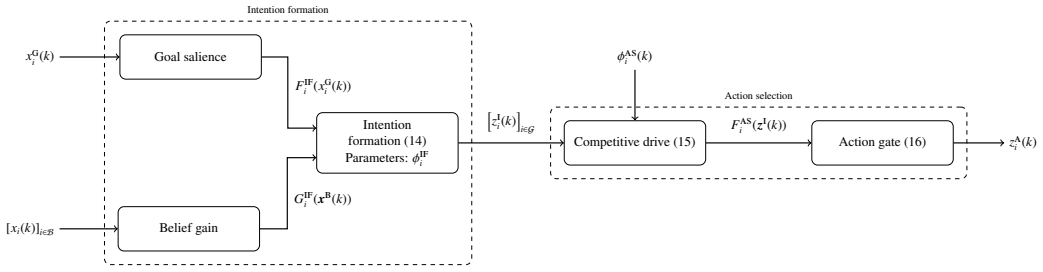
The load-bearing object is the coupled state-space recursion: the LPE update (equation 7) rewrites predictive inference as a convex combination, guaranteeing boundedness; the cognition update (equation 8) combines an exponential self-inhibition term (9), a DCM-style coupling matrix (10) with baseline, input-gated, and state-gated components, and an additive perceptual drive; and the decision module (equations 14–16) maps goals and beliefs to intentions and then to actions through a sigmoid gate with competition and thresholding. The stability proofs rest on a norm-ball dissipativity certificate and a contraction condition α_R < 1 that quantifies when self-inhibition dominates recurrent ampli
What would settle it
Fit the model to human behavioral data and check two things: whether the estimated latent 'threat' and 'fatigue' states track independent physiological or self-report measures, and whether the forward-invariance and ISS conditions hold on real trajectories; failure on either would undercut the central claim, given the paper's own acknowledgment that the rehabilitation showcase is model-class-matched and not an empirical validation.
Extended reading notes
Core claim
The central claim is that a modular state-space model—composed of divisive-normalization attentional selection, a convex-combination predictive-inference update for a latent perceptual estimate, DCM-style self-inhibition and bilinear couplings among cognitive states, and gated intention/action selection—simultaneously achieves psychological interpretability and mathematical tractability. Under stated regularity, boundedness, and dissipativity assumptions, the paper establishes forward invariance of the perceptual-estimate set, exponential contraction of perceptual inference under constant input, and input-to-state stability of the cognitive-state dynamics on a bounded operating set. The clos
Load-bearing premise
The paper's interpretability and personalization claims stand or fall on whether the psychological labels attached to its latent states (goals, beliefs, emotions) correspond to measurable, validated constructs—Remark 2 states these labels are interpretive, not implied by the equations—and the stability analysis assumes a fixed-step forward-Euler discretization faithfully approximates human cognitive dynamics.
Editorial extensions
If this is right
- If the central claim holds, latent cognitive states such as goals, beliefs, and emotions can be estimated and constrained inside a bounded operating set, making them usable in feedback control without divergence.
- The model's parameters have interpretable directional effects: increasing prior precision smooths perceptual estimates but worsens tracking, while stronger self-inhibition stabilizes cognition and reduces state excursions.
- A receding-horizon controller using the model can keep a simulated patient in the 'perform' regime longer than feedback-free baselines, suggesting a path toward difficulty adaptation in rehabilitation.
- The stability conditions identify parameter regimes in which the model is safe for prediction and control, while deliberately excluding regimes intended to represent dysregulated or strongly conflicted internal states.
- The modular structure supports compositional analysis and future extensions to observer-based state estimation and robust or stochastic cognitive MPC.
Reading between the lines
- If the model's qualitative predictions generalize to humans, they imply that simple mechanisms—divisive normalization, leaky integrators, and gated thresholds—may be sufficient to reproduce observed trade-offs between perceptual tracking and smoothing in sensorimotor tasks.
- The stability certificates could be used to design 'safe' personalization algorithms that keep intervention parameters within a region where the model's latent states remain bounded, avoiding experimentally induced dysregulation.
- A testable extension suggested by the sensitivity analysis is that increasing attention gain should improve perceptual tracking while increasing reactivity, a prediction that could be checked in controlled human psychophysics experiments.
- Because the controller relies on exhaustive enumeration, scaling to richer action spaces would require approximate optimization; a natural next test is whether a learned residual model can correct structural mismatch between the model class and real human behavior.
Editorial analysis
A structured set of objections, weighed in public.
Referee Report
Summary. The paper proposes a modular discrete-time state-space model of the perception–cognition–decision loop, with explicit attentional selection, predictive inference, DCM-inspired cognitive-state dynamics, intention formation, and action selection. Section 4 derives sufficient conditions for boundedness, Lipschitz regularity, forward invariance, contraction of the perceptual inference under constant input, and regional ISS of the cognitive dynamics. Section 5 reports one-at-a-time parameter sensitivity analyses with synthetic inputs and a closed-loop rehabilitation showcase in which a receding-horizon controller uses a perturbed copy of the same model to adapt movement difficulty for a simulated, model-class-matched patient. The mathematical development is self-contained and detailed, and the authors candidly state several limitations, including the absence of human-participant validation, the model-class-matched nature of the rehabilitation study, and the lack of formal identifiability results.
Significance. The main strength is the formal, modular dynamical formulation: the constituent mappings are explicit, the assumptions are stated, and the stability analysis in Appendix A is substantive rather than ornamental. The paper also ships public code and reports precise sensitivity metrics, which supports reproducibility. If the framework is later connected to measured human behavior, it could provide a useful white-box template for estimation and control in human-centered systems. However, the significance is currently prospective: the psychological interpretability rests on latent-state labels that the authors themselves state are not implied by the equations, and the numerical/control results do not involve human data or structural model mismatch. The paper would be strengthened by either adding an empirical/identifiability component or explicitly reframing the contribution as a formal modeling framework whose psychological semantics are hypotheses to be tested, not established properties.
major comments (3)
- [§3.2, Remark 2; §5.5] The central value proposition is a psychologically interpretable latent-state model, but Remark 2 concedes that the labels 'beliefs', 'goals', and 'emotions' are not properties implied by the state equations. Section 5.5 further states that the sensitivity analysis is 'not a formal identifiability result'. Without construct-relevant measurements or an identifiability study, the interpretability claim is a labeling convention rather than an established property. This is load-bearing because the paper's contribution is framed as white-box and interpretable. I recommend either adding a validation or identifiability component, or substantially reframing the contribution as a mathematically analyzable mechanistic model whose psychological semantics remain to be established.
- [§5.6 and Conclusion] The rehabilitation showcase uses a simulated patient generated by the same model class as the robot's prediction model. The authors acknowledge in the conclusion that the experiment 'does not test robustness to structural mismatch with real human behavior', but the abstract states without qualification that the controller 'achieves lower realized cumulative cost' than baselines. The reported advantage is a self-consistency check, not evidence of control efficacy for real patients. The abstract and Section 5.6 should carry the same caveat as the conclusion, and the claim should be explicitly scoped to the model-class-matched simulation setting.
- [§5.1 and §5.4, Table 4] Several of the 'working hypotheses' are effectively enforced by the model assumptions, so the sensitivity analyses do not provide independent tests of the underlying mechanisms. For example, H2 (precision modulates update gain) follows from the monotonicity conditions imposed on F_pi in Definition 3, and H5 (supportive/suppressive beliefs modulate intention gain) follows from the coordinate-wise monotonicity of G_if in Definition 6. The numerical sweeps are consistency checks of the chosen parameterization, not validations of the neuro-cognitive mechanisms. This should be stated more prominently in Section 5.1 and the abstract, otherwise readers may over-interpret the sensitivity results as empirical support.
minor comments (4)
- [§4.2, Lemma 5 and Proposition 2] The notation for the lower and upper self-inhibition bounds is hard to distinguish in the text: both appear as 'Λ' in some passages. Please use a clearly different symbol or explicit under/overbar throughout, including in equations (21) and (A2).
- [Appendix B.2, Table B2] The row 'd 10.0' appears to be a unit/formatting inconsistency; if d is the maximum difficulty, state it as an integer or clarify the normalization.
- [§5.6] The claim that the model-based controller 'sustains simulated task participation' is based on a representative run in Figure 12a, while the cumulative-cost comparison is over 50 runs. Please clarify whether task participation (margin staying positive) holds across all repeated simulations or only in the illustrated run.
- [§3.2] The forward-Euler discretization of the DCM-style ODE with fixed step size Δt is introduced as a modeling choice, but the empirical appropriateness of this discretization for human cognitive dynamics is not discussed. A sentence noting the range of Δt used and its relation to the stability conditions would help.
Circularity Check
No circular derivation found: the formal stability and regularity results are self-contained, and the interpretability and model-matched simulation issues are disclosed validation limitations rather than circular reasoning.
full rationale
The paper's analytical claims in Section 4 are derived from explicit assumptions (Assumptions 1–3) and proved directly in Appendix A; the LPE invariance/contraction, cognition-module forward invariance, and ISS results are standard consequences of the model's defining bounds and are stated as sufficient, feasibility-type conditions (e.g., Eq. (21), Corollary 1) rather than empirical predictions. The self-citations [6], [7], and [12] are motivational or future-extension references and are not load-bearing for the formal derivation. Remark 2 explicitly disclaims that the latent-state labels are not implied by the equations, so the interpretability claim is an interpretive/validation limitation, not a circular derivation. Similarly, the sensitivity hypotheses in Section 5.1 are explicitly said not to constitute independent empirical validation, and the closed-loop rehabilitation showcase in Section 5.6 is explicitly called a model-class-matched proof of concept, with the Conclusion acknowledging that the simulated patient is generated by the same model class used by the controller. These passages show that the authors do not present the self-consistency checks as independent predictions. Because the actual formal results are self-contained and the limitations are disclosed, no circularity is present.
Assumptions & free parameters
free parameters (9)
- Attentional Naka–Rushton parameters η1, η2 =
1.80, 0.60 (sensitivity); 1.80, 0.25 (rehab)
- Normalization offset β_ats and pooling weights γ_ats =
0.65; 0.70
- Precision parameters φ_pi, θ_pi, χ_pi =
1.0, 1.0, 1.0
- Self-inhibition gain κ and log-leak vector γ =
0.90 (sensitivity), 0.55 (rehab); γ vector in Table B3/B2
- Coupling matrices Φ_base, Ψ_base, Θ_base =
Matrices in Tables B3/B2
- State-gated couplings Ξ =
Zero in sensitivity; sparse entries in rehab
- Decision function parameters η8–η12, w±, sigmoid slopes =
Various values in Table B3/B2
- MPC cost weights λ1–λ7 and target schedule =
λ = (2.0, 1.5, 20, 1, 3, 1, 0.1); d_target pattern
- Robot perturb/model mismatch and noise settings =
σ_par=0.10, σ_ω=0.008, σ_comfort=0.03
assumptions (5)
- standard math Standard real analysis: mean value theorem, compactness, induced matrix norm sub-multiplicativity.
- domain assumption Input sets U_ℓ are compact and convex and contain zero; attentional drive functions are continuously differentiable and bounded.
- domain assumption Cognitive dynamics are a forward-Euler discretization of DCM-style ODEs with fixed step size Δt, and Δt ≤ 1/Λ in stability results.
- domain assumption Sufficient dissipation condition (21) and σ<0 in Corollary 1: self-inhibition dominates coupling.
- ad hoc to paper Goal/belief partition of cognitive states and product-form intention mapping (goal salience × belief gain).
invented entities (1)
-
Interpretable latent cognitive state vector x (beliefs, goals, emotions)
Cite this review
Pith. "Pith review of A modular state-space model of human perception, cognition, and decision dynamics." pith.science (2026). https://pith.science/paper/HXHVJYTA
@misc{pith2026260714078,
  author       = {Pith},
  title        = {Pith review of: A modular state-space model of human perception, cognition, and decision dynamics},
  year         = {2026},
  howpublished = {\url{https://pith.science/paper/HXHVJYTA}},
  note         = {Machine review of arXiv:2607.14078}
}
read the original abstract
Human-centered adaptive systems require behavioral models that are both psychologically interpretable and mathematically analyzable. Many existing predictors either operate as black-box input-output mappings or provide limited access to latent internal dynamics. This paper addresses this gap by modeling behavior as a perception-cognition-decision pipeline. We propose a modular state-space model in which attentional selection, predictive inference, cognitive-state evolution, intention formation, and action selection are represented by coupled mathematical mappings. The model links sensory inputs to observable behavior through latent internal states while retaining interpretable connections to neuro-cognitive mechanisms. We establish sufficient conditions for boundedness, Lipschitz regularity, forward invariance, contraction of perceptual inference under constant input, and input-to-state stability of the cognitive state dynamics. Numerical sensitivity analyses show that the model yields interpretable changes in perceptual tracking, cognitive amplification, intention expression, and action decisiveness. We further demonstrate a closed-loop rehabilitation case study in which a receding-horizon controller uses the model to adapt movement difficulty from partial feedback. In this proof-of-concept setting, the model-based controller sustains simulated task participation and achieves lower realized cumulative cost than target-following and random baselines. Overall, the framework provides a white-box dynamical structure for estimation, validation, and model-based control in human-centered settings.
Figures


Figures from the paper (9 more)


Reference graph
Works this paper leans on
-
[1]
T. Schürmann, P. Beckerle, Personalizing human-agent interaction through cognitive models, Frontiers in Psy- chology V olume 11 - 2020 (2020). doi:10.3389/fpsyg. 2020.561510
arXiv 2020
-
[2]
Leite, C
I. Leite, C. Martinho, A. Paiva, Social robots for long-term interaction: A survey, International Jour- nal of Social Robotics 5 (2013) 291–308. doi:10.1007/ s12369-013-0178-y
2013
-
[3]
M. K. Ho, T. L. Griffiths, Cognitive science as a source of forward and inverse models of human 20 decisions for robotics and control, Annual Re- view of Control, Robotics, and Autonomous Sys- tems 5 (2022) 33–53. doi:https://doi.org/10.1146/ annurev-control-042920-015547
2022
-
[4]
Y . Huang, B. Yang, T. W.-L. Wong, S. S. M. Ng, X. Hu, Personalized robots for long-term telerehabilitation af- ter stroke: a perspective on technological readiness and clinical translation, Frontiers in Rehabilitation Sciences V olume 4 - 2023 (2024). doi:10.3389/fresc.2023. 1329927
-
[5]
W. Zu, X. Huang, T. Xu, L. Du, Y . Wang, L. Wang, W. Nie, Machine learning in predicting outcomes for stroke patients following rehabilitation treatment: A sys- tematic review, PLOS ONE 18 (2023) 1–14. doi:10. 1371/journal.pone.0287308
2023
-
[6]
M. L. Morão Patrício, A. Jamshidnejad, Leveraging sys- tems and control theory for social robotics: a model- based behavioral control approach to human-robot inter- action, Applied Intelligence 56 (2026). doi:10.1007/ s10489-026-07100-9
2026
-
[7]
M. L. M. Patrício, A. Jamshidnejad, Dynamic math- ematical models of theory of mind for socially assis- tive robots, IEEE Access 11 (2023) 103956–103975. doi:10.1109/ACCESS.2023.3316603
arXiv 2023
-
[8]
Powers, Quantitative analysis of purposive systems: Some spadework at the foundations of scientific psychol- ogy, Psychological Review 85 (1978) 417–435
W. Powers, Quantitative analysis of purposive systems: Some spadework at the foundations of scientific psychol- ogy, Psychological Review 85 (1978) 417–435. doi:10. 1037/0033-295X.85.5.417
1978
Show all 60 references
-
[9]
M. Han, L. Zhang, J. Wang, W. Pan, Actor-critic rein- forcement learning for control with stability guarantee, IEEE Robotics and Automation Letters 5 (2020) 6217–
2020
-
[10]
Z. C. Lipton, The mythos of model interpretability, Com- mun. ACM 61 (2018) 36–43. doi:10.1145/3233231
2018 doi
-
[11]
A. S. Rao, M. P. Georgeff, Bdi agents: From theory to practice, in: International Conference on Multiagent Sys- tems, 1995, pp. 312–319
1995
-
[12]
M. L. M. Patrício, A. Jamshidnejad, A systems-theoretic approach to mental state estimation for theory-of-mind- aware social robots, IEEE Access 13 (2025) 158467– 158482. doi:10.1109/ACCESS.2025.3607165
2025
-
[13]
Feldman, K
H. Feldman, K. Friston, Attention, uncertainty, and free- energy, Frontiers in Human Neuroscience V olume 4 - 2010 (2010). doi:10.3389/fnhum.2010.00215
2010 arXiv
-
[14]
Friston, A theory of cortical responses, Philosophical Transactions of the Royal Society B: Biological Sciences 360 (2005) 815–836
K. Friston, A theory of cortical responses, Philosophical Transactions of the Royal Society B: Biological Sciences 360 (2005) 815–836. doi:10.1098/rstb.2005.1622
2005
-
[15]
T. Parr, K. J. Friston, Generalised free energy and active inference, Biological Cybernetics 113 (2019) 495–513. doi:10.1007/s00422-019-00805-w
2019 doi
-
[16]
Friston, L
K. Friston, L. Harrison, W. Penny, Dynamic causal mod- elling, NeuroImage 19 (2003) 1273–1302. doi:10.1016/ S1053-8119(03)00202-7
2003
-
[17]
K. E. Stephan, L. Kasper, L. M. Harrison, J. Daunizeau, H. E. den Ouden, M. Breakspear, K. J. Friston, Nonlinear dynamic causal models for fmri, NeuroImage 42 (2008) 649–662. doi:10.1016/j.neuroimage.2008.04.262
2008 doi
-
[18]
Ratcliff, G
R. Ratcliff, G. McKoon, The diffusion decision model: Theory and data for two-choice decision tasks, Neu- ral Computation 20 (2008) 873–922. doi:10.1162/neco. 2008.12-06-420
2008 doi
-
[19]
M. A. Bertolero, B. T. T. Yeo, D. S. Bassett, M. D’Esposito, A mechanistic model of connector hubs, modularity and cognition, Nature Human Behaviour 2 (2018) 765–777. doi:10.1038/s41562-018-0420-6
2018 doi
-
[20]
Kotseruba, J
I. Kotseruba, J. K. Tsotsos, 40 years of cognitive ar- chitectures: core cognitive abilities and practical appli- cations, Artificial Intelligence Review 53 (2020) 17–94. doi:10.1007/s10462-018-9646-y
2020 doi
-
[21]
J. I. Gold, M. N. Shadlen, The neural basis of decision making, Annual Review of Neuroscience 30 (2007) 535–574. doi:10.1146/annurev.neuro.29. 051605.113038
2007
-
[22]
Rauss, G
K. Rauss, G. Pourtois, What is bottom-up and what is top- down in predictive coding?, Frontiers in Psychology V ol- ume 4 - 2013 (2013). doi:10.3389/fpsyg.2013.00276
2013
-
[23]
Dijkstra, P
N. Dijkstra, P. Zeidman, S. Ondobaka, M. A. J. van Gerven, K. Friston, Distinct top-down and bottom- up brain connectivity during visual perception and im- agery, Scientific Reports 7 (2017) 5677. doi:10.1038/ s41598-017-05888-8
2017
-
[24]
A. M. Treisman, G. Gelade, A feature-integration the- ory of attention, Cognitive Psychology 12 (1980) 97–136. doi:10.1016/0010-0285(80)90005-5
1980 doi
-
[25]
Carandini, D
M. Carandini, D. J. Heeger, Normalization as a canoni- cal neural computation, Nature Reviews Neuroscience 13 (2012) 51–62. doi:10.1038/nrn3136
2012 doi
-
[26]
J. H. Reynolds, D. J. Heeger, The normal- ization model of attention, Neuron 61 (2009) 168–185. doi:10.1016/j.neuron.2009.01.002, doi: 10.1016/j.neuron.2009.01.002
2009 doi
-
[27]
Moore, M
T. Moore, M. Zirnsak, Neural mechanisms of selective visual attention, Annual Review of Psychology 68 (2017) 47–72. doi:10.1146/ annurev-psych-122414-033400
2017
-
[28]
D. J. Heeger, Normalization of cell responses in cat striate cortex, Visual Neuroscience 9 (1992) 181–197. doi:10. 1017/S0952523800009640. 21
1992
-
[29]
Sajid, P
N. Sajid, P. J. Ball, T. Parr, K. J. Friston, Active infer- ence: Demystified and compared, Neural Computation 33 (2021) 674–712. doi:10.1162/neco_a_01357
2021 doi
-
[30]
D. C. Knill, A. Pouget, The bayesian brain: the role of uncertainty in neural coding and computation, Trends in Neurosciences 27 (2004) 712–719. doi:https://doi. org/10.1016/j.tins.2004.10.007
2004 doi
-
[31]
M. R. Nassar, K. M. Rumsey, R. C. Wilson, K. Parikh, B. Heasly, J. I. Gold, Rational regulation of learning dy- namics by pupil-linked arousal systems, Nature Neuro- science 15 (2012) 1040–1046. doi:10.1038/nn.3130
2012 doi
-
[32]
Friston, K
K. Friston, K. H. Preller, C. Mathys, H. Cagnan, J. Hein- zle, A. Razi, P. Zeidman, Dynamic causal modelling re- visited, NeuroImage 199 (2019) 730–744. doi:10.1016/ j.neuroimage.2017.02.045
2019
-
[33]
L. S. Petro, A. T. Paton, L. Muckli, Contextual modulation of primary visual cortex by auditory signals, Philosoph- ical Transactions of the Royal Society B: Biological Sci- ences 372 (2017) 20160104. doi:10.1098/rstb.2016. 0104
2017 doi
-
[35]
P. R. Cohen, H. J. Levesque, Intention is choice with commitment, Artificial Intelligence 42 (1990) 213–261. doi:10.1016/0004-3702(90)90055-5
1990 doi
-
[36]
Cisek, J
P. Cisek, J. F. Kalaska, Neural mechanisms for interact- ing with a world full of action choices, Annual Review of Neuroscience 33 (2010) 269–298. doi:https://doi. org/10.1146/annurev.neuro.051508.135409
2010
-
[38]
R. C. O’Reilly, M. J. Frank, Making working memory work: A computational model of learning in the prefrontal cortex and basal ganglia, Neural Comput. 18 (2006) 283–328. doi:10.1162/089976606775093909
2006 doi
-
[39]
Ajzen, The theory of planned behavior, Organizational Behavior and Human Decision Processes 50 (1991) 179–
I. Ajzen, The theory of planned behavior, Organizational Behavior and Human Decision Processes 50 (1991) 179–
1991
-
[40]
R. C. Wilson, Y . K. Takahashi, G. Schoenbaum, Y . Niv, Orbitofrontal cortex as a cognitive map of task space, Neuron 81 (2014) 267–279. doi:10.1016/j.neuron. 2013.11.005
2014 doi
-
[41]
R. L. Albin, A. B. Young, J. B. Penney, The func- tional anatomy of basal ganglia disorders, Trends in Neurosciences 12 (1989) 366–375. doi:10.1016/ 0166-2236(89)90074-X
1989
-
[42]
J. W. Mink, The basal ganglia: Focused selection and inhibition of competing motor programs, Progress in Neurobiology 50 (1996) 381–425. doi:10.1016/ S0301-0082(96)00042-1
1996
-
[43]
Nambu, H
A. Nambu, H. Tokuno, M. Takada, Functional signif- icance of the cortico–subthalamo–pallidal ‘hyperdirect’ pathway, Neuroscience Research 43 (2002) 111–117. doi:10.1016/S0168-0102(02)00027-5
2002 doi
-
[45]
Gurney, T
K. Gurney, T. J. Prescott, P. Redgrave, A computational model of action selection in the basal ganglia. i. a new functional anatomy, Biological Cybernetics 84 (2001) 401–410. doi:10.1007/PL00007984
2001 doi
-
[46]
Gurney, T
K. Gurney, T. J. Prescott, P. Redgrave, A computational model of action selection in the basal ganglia. ii. analysis and simulation of behaviour, Biological Cybernetics 84 (2001) 411–423. doi:10.1007/PL00007985
2001 doi
-
[47]
Schwedhelm, B
P. Schwedhelm, B. S. Krishna, S. Treue, An extended nor- malization model of attention accounts for feature-based attentional enhancement of both response and coherence gain, PLOS Computational Biology 12 (2016) 1–22. doi:10.1371/journal.pcbi.1005225
2016 doi
-
[48]
A. J. Yu, P. Dayan, Uncertainty, neuromodulation, and attention, Neuron 46 (2005) 681–692. doi:10.1016/j. neuron.2005.04.026
2005 doi
-
[49]
Zeidman, A
P. Zeidman, A. Jafarian, N. Corbin, M. L. Seghier, A. Razi, C. J. Price, K. J. Friston, A guide to group effective connectivity analysis, part 1: First level analy- sis with dcm for fmri, NeuroImage 200 (2019) 174–190. doi:10.1016/j.neuroimage.2019.06.031
2019 doi
-
[50]
Bartra, J
O. Bartra, J. T. McGuire, J. W. Kable, The valua- tion system: A coordinate-based meta-analysis of bold fmri experiments examining neural correlates of subjec- tive value, NeuroImage 76 (2013) 412–427. doi:10. 1016/j.neuroimage.2013.02.063
2013
-
[51]
E. K. Miller, J. D. Cohen, An integrative theory of pre- frontal cortex function, Annual Review of Neuroscience 24 (2001) 167–202. doi:https://doi.org/10.1146/ annurev.neuro.24.1.167
2001
-
[52]
D. W. D. , J. J. A. , Statistics of natural time-varying im- ages, Network: Computation in Neural Systems 6 (1995)
1995
-
[53]
Haegens, E
S. Haegens, E. Zion Golumbic, Rhythmic facilitation of sensory processing: A critical review, Neuroscience & Biobehavioral Reviews 86 (2018) 150–165. doi:10. 1016/j.neubiorev.2017.12.002
2018
-
[54]
J. H. McDermott, E. P. Simoncelli, Sound texture percep- tion via statistics of the auditory periphery: Evidence from sound synthesis, Neuron 71 (2011) 926–940. doi:10. 1016/j.neuron.2011.06.032
2011
-
[55]
Poeppel, M
D. Poeppel, M. F. Assaneo, Speech rhythms and their neu- ral foundations, Nature Reviews Neuroscience 21 (2020) 322–334. doi:10.1038/s41583-020-0304-4
2020 doi
-
[56]
E. P. Simoncelli, B. A. Olshausen, Natural image statis- tics and neural representation, Annual Review of Neu- roscience 24 (2001) 1193–1216. doi:10.1146/annurev. neuro.24.1.1193
2001 doi
-
[57]
L. N. Vinke, I. M. Bloem, S. Ling, Saturating nonlinear- ities of contrast response in human visual cortex, Jour- nal of Neuroscience 42 (2022) 1292–1302. doi:10.1523/ JNEUROSCI.0106-21.2021
2022
-
[58]
D. J. Heeger, Half-squaring in responses of cat striate cells, Visual Neuroscience 9 (1992) 427–443. doi:10. 1017/S095252380001124X
1992
-
[59]
C. R. Fetsch, G. C. DeAngelis, D. E. Angelaki, Bridg- ing the gap between theories of sensory cue integration and the physiology of multisensory neurons, Nature Re- views Neuroscience 14 (2013) 429–442. doi:10.1038/ nrn3503
2013
-
[60]
1.2 0.00.0 1.2 # ,
C. R. Fetsch, A. Pouget, G. C. DeAngelis, D. E. Ange- laki, Neural correlates of reliability-based cue weighting during multisensory integration, Nature Neuroscience 15 (2012) 146–154. doi:10.1038/nn.2983. Appendix A. Proof of analytical results This appendix contains the proo...
2012 doi
-
[211]
doi:10.1016/0749-5978(91)90020-T, theories of Cognitive Self-Regulation
-
[345]
doi:10.1088/0954-898X/6/3/003. 22
-
[6224]
doi:10.1109/LRA.2020.3011351
2020
Reviewed August 2, 2026 · model on record in the stance chip above.
Discussion (0). Continue with ORCID to comment.