REVIEW 2 major objections 6 minor
DriftWorld: Fast World Modeling through Drifting
T0 review · 2 major / 6 minor · reviewed 2026-08-02 · deepseek-v4-flash
Pith's one-line read DriftWorld claims that a drifting generative model can produce action-conditioned future frames in one forward pass, running 17x faster than diffusion world models at equal or better rollout quality, making large-scale action search and off
desk verdict Strong empirical case for single-step drifting world models, with a theory section that overclaims and timing that needs auditing; send to review. read the letter →
The pith
A machine-rendered reading of the paper's core claim, the machinery that carries it, and where it could break.
The reading
What carries the argument
The drifting field V^{p,q}(x) = V^+_p(x) - V^-_q(x), a kernel-based mean-shift vector that attracts a generated video chunk toward the single ground-truth future chunk and repels it from N_neg self-generated negative chunks. It is computed per spatial location in either pixel space or a pretrained visual feature space and aggregated over multiple kernel temperatures; training is a fixed-point regression toward the stop-gradient drifted sample. Three additions carry the action-conditioned adaptation: frame-wise action conditioning in the U-Net, motion weighting that upweights moving regions of the feature map, and an action-accentuated negative distribution that mixes generated futures with r
What would settle it
Train DriftWorld with the same objective but replace the ground-truth positive future chunk with a randomly chosen future chunk from a different trajectory; if rollout visual quality and action-following metrics are unchanged, the positive sample is not carrying the conditioning signal and the drifting loss is not the source of the reported gains.
Extended reading notes
Core claim
On the paper's own terms, the discovery is that a one-step generator is sufficient for high-fidelity action-conditioned world modeling. Instead of iteratively denoising at inference, DriftWorld learns an action-conditioned drift during training and regresses the generator toward the drifted target, moving the model's pushforward distribution onto the true conditional distribution of future frames. With the right adaptations—frame-wise action conditioning, a drifting loss measured in a pretrained visual feature space for real-world scenes, motion weighting to stop the model from collapsing to copying the previous frame, and action-accentuated negative samples—the single forward pass produces
Load-bearing premise
That the drift field estimated from one ground-truth future chunk and a set of self-generated negatives accurately measures how far the generated distribution is from the true action-conditioned future distribution; if that estimate is biased or too noisy, the one-step generator can settle into copying the last observed frame instead of following the action.
Editorial extensions
If this is right
- A planner can evaluate many more proposals per control cycle: each rollout is one forward pass at 30+ fps, compared with 0.03–3.2 s/frame for diffusion baselines.
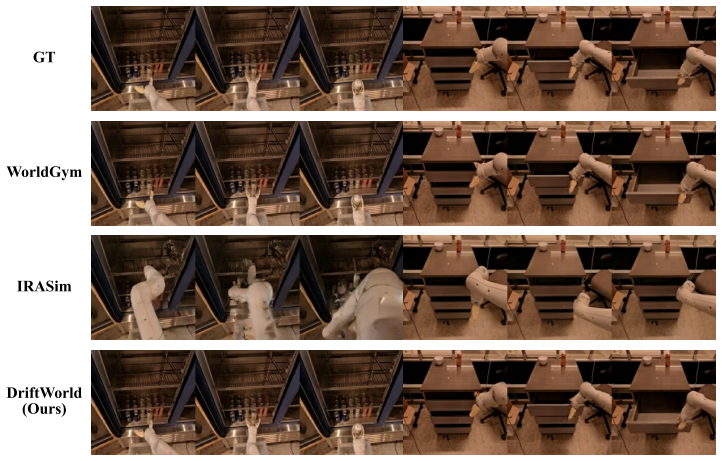
- Visual rollout quality matches or exceeds baselines on Push-T, Robomimic, Bridge-V2, RT-1, and Language Table across SSIM, PSNR, LPIPS, FID, and FVD.
- Inference-time action search over 50 proposals lifts Push-T IoU from 0.635 to 0.781, beating diffusion world models at a fraction of the runtime.
- Offline, rolling out policies in DriftWorld ranks them with 0.9515–0.9916 Pearson correlation to ground-truth performance, enabling hardware-free policy screening.
Reading between the lines
- Beyond the paper: the single-positive-sample drift estimator generalizes to any conditional generative task with exactly one correct continuation, such as instruction-conditioned video, where diffusion-based alternatives still pay a sampling tax.
- Beyond the paper: at 30+ fps, closed-loop model-predictive control with hundreds of sampled futures becomes plausible at deployment time, not just in offline analysis.
- Beyond the paper: the 0.95–0.99 ranking correlations suggest using DriftWorld as a cheap pretest filter—screen many policy checkpoints or hyperparameters in simulation and deploy only the survivors.
Editorial analysis
A structured set of objections, weighed in public.
Referee Report
Summary. The paper introduces DriftWorld, an action-conditioned world model for robot manipulation that generates future frames in a single forward pass by training a U-Net with a drifting loss. The model uses one ground-truth future chunk as the positive sample and multiple self-generated chunks as negatives, with feature-space drift (DINOv2/v3), motion weighting, and self-forcing as key components. The authors report that DriftWorld matches or exceeds diffusion-based world-model baselines in image/video quality metrics on Push-T, Robomimic, Bridge-V2, RT-1, and Language Table while being on average 17x faster, that GPC-RANK with K=50 improves Push-T IoU from 0.635 to 0.781, and that offline policy rankings correlate with ground truth up to 0.99.
Significance. If the empirical results hold, DriftWorld is a practically important contribution: it demonstrates that a single-step world model can compete with much slower diffusion-based world models on standard benchmarks, and the speed advantage is directly leveraged for inference-time planning and offline policy evaluation. The paper includes a clean MSE-baseline control (same U-Net, one step, pixel MSE) that isolates the drifting loss, and the ablations in Table 5 show that feature-space drift, motion weighting, and self-forcing each contribute. The code link is provided. However, the theoretical justification in Section 3.2 is incorrect as stated, and the Robomimic policy-ranking results in Section 4.4 may be affected by circular post-training. These issues are substantial enough that the manuscript needs revision before the claims can be accepted at face value.
major comments (2)
- [Section 3.2] The claim that 'equilibrium is reached when the generated distribution q_i matches the true conditional video distribution p' is false with a single positive sample. With one positive sample y+, the kernel cancels and V+(x) = y+ - x, so E[V+(x)] = E_p[y] - x, which is not zero at a typical x ~ p. At q = p, V- is the kernel mean-shift of p toward the nearest mode. Concrete counterexample: p = 0.5*delta_{-10} + 0.5*delta_{10} with a localized kernel at x = -10 gives V+ approx 10 and V- approx 0, so V approx 10 != 0. Thus p is not a fixed point of the drift map. This is load-bearing because it justifies the training objective. Please provide a corrected fixed-point analysis or explicitly present the method as heuristic.
- [Section 4.4 / Appendix D.3] The Robomimic policy-ranking correlations (0.9916, 0.9250) may be inflated by circular evaluation. The paper says the model is post-trained on failure demonstrations 'created by rolling out early checkpoints of a diffusion policy,' and the evaluated policies are exactly such checkpoints (Lift epochs 2,4,...,18; Can epochs 50,...,400 plus 75). If the post-training data comes from the same checkpoint epochs that are later evaluated, this is test-set contamination. Please clarify the overlap, and report correlations using held-out policies or without post-training.
minor comments (6)
- [Section 3.2 vs Algorithm 1] The text says negative samples are model-generated chunks, but Algorithm 1 includes obs[-1] in the negative set. Clarify the composition of the negative set and how it relates to the 'no-action distribution' mixture in Section 3.3.
- [Section 3.3 / Appendix C.2] The accentuation scale alpha is used in Figure 13 and Appendix C.2 but is never defined in the main text. Define alpha when the action-accentuation mixture is introduced.
- [Section 4.2] 'Across all four environments' should be 'across all five datasets' (Push-T, Robomimic, Bridge-V2, RT-1, Language Table).
- [Table 1] Clarify how 'seconds per generated frame' is measured for multi-frame chunks, and why the full-episode timing differs from the 64-frame timing for the same model.
- [Table 1] The baseline 'A VDC' is not spelled out at first use; state what the acronym stands for.
- [Notation] The history length is F in Sections 3.1 and 3.3 but H in Section 3.4; use one symbol consistently.
Circularity Check
No circularity found: DriftWorld's drift field, fixed-point loss, and validation benchmarks are self-contained and externally compared.
full rationale
DriftWorld's central derivation is presented directly in the paper: the drift field V = V+ - V- in Sec. 3.2, the fixed-point training loss in Sec. 3.3, the action-conditioned U-Net in Sec. 3.4, and single-pass inference in Sec. 3.5. The headline predictions (SSIM/PSNR/LPIPS/FID/FVD, Push-T IoU gains, and policy-ranking correlations) are measured on validation data against external baselines (GPC, Ctrl-World, IRASim, VDM, LVDM) plus a purpose-built MSE baseline that shares the U-Net backbone but not the drifting loss. Thus the quality gains are not a fitted constant relabeled as a prediction. The paper cites the authors' prior drifting paper [6] and GPC [5], and these are foundational references, but the load-bearing argument does not reduce to them: the training equations are written out, no uniqueness theorem is imported, no ansatz is adopted solely by citation, and the empirical claims are externally falsifiable. The Sec. 3.2 assertion that equilibrium is reached when q = p is an unproven convergence/consistency statement; with a single positive sample the realized drift is noisy and the fixed point may not be exactly p. That is a theoretical correctness risk, not a case where a prediction is equivalent to an input by construction. No circular step meeting the evidentiary bar was found.
Assumptions & free parameters
free parameters (6)
- Number of negative samples N_neg per forward pass =
8 (Push-T), 32 (Robomimic), 64 (Bridge-V2/RT-1/Language Table)
- Kernel temperatures tau (multi-temperature aggregation) =
{0.02, 0.05, 0.2} or {0.02, 0.05} per dataset
- Action-accentuation scale alpha =
Sampled log-uniform over [1,4] during training; tested 1.0-3.5 at inference
- Motion-weighting scalars lambda, alpha_mw =
c_{h,w} = 1 + lambda*tanh(alpha_mw * n_{h,w}); numeric values not reported
- Prediction horizon T per dataset =
4 (Push-T), 2 (Robomimic), 1 (Bridge-V2, RT-1, Language Table)
- No-action mixture weight gamma =
Not reported numerically (defined gamma in [0,1))
assumptions (4)
- ad hoc to paper The conditional drifting field V_{p,q}(x)=V+_p(x)-V-_q(x), estimated with a single positive sample and N_neg self-generated negatives, is a consistent estimator of the displacement that moves the pushforward q to p(obs | action, history), and the fixed-point MSE training converges to that equilibriu
- domain assumption DINOv2/v3 feature space (and SD3 VAE latent space) provides a metric in which kernel attraction/repulsion drives samples toward perceptually and semantically correct futures.
- domain assumption Training/evaluation distributions match: world-model quality is measured on validation sets of the same five benchmarks, and the learned drift generalizes to the policy-rollout distribution (with failure demos added via post-training for Robomimic).
- standard math Background mathematics of kernel mean-shift / fixed-point iteration, and the correctness of DINOv3/SD3-VAE features as used.
Cite this review
Pith. "Pith review of DriftWorld: Fast World Modeling through Drifting." pith.science (2026). https://pith.science/paper/5P2LEISL
@misc{pith2026260715065,
  author       = {Pith},
  title        = {Pith review of: DriftWorld: Fast World Modeling through Drifting},
  year         = {2026},
  howpublished = {\url{https://pith.science/paper/5P2LEISL}},
  note         = {Machine review of arXiv:2607.15065}
}
read the original abstract
Predictive world models enable robots to plan by imagining the outcomes of their actions, but their value for control hinges on generating many rollouts quickly. This creates a bottleneck for diffusion-based world models: multistep sampling makes each rollout expensive, limiting large-scale action search at inference time. We introduce DriftWorld, an action-conditioned world model based on drifting generative models. Rather than denoising iteratively at inference, DriftWorld learns an action-conditioned drift during training, allowing it to generate future frames from the current observation and a candidate action sequence in a single forward pass at 30+ fps, which is 17x faster on average than diffusion based baselines. We evaluate DriftWorld on standard vision-based robotic manipulation benchmarks, including Bridge-V2, RT-1, Language Table, Push-T, and Robomimic. By producing rollouts that are both accurate and fast, DriftWorld achieves state-of-the-art decision-making performance with far less inference time than diffusion-based world model baselines. Beyond online control, DriftWorld can also serve as an offline simulator for ranking real-world robot policies, with rollout-based scores correlating with ground truth at up to 0.99. These results show that drifting models are a strong fit for robot world modeling, where fast, high-quality imagination directly supports planning and policy evaluation.
Figures


Figures from the paper (11 more)




Reviewed August 2, 2026 · model on record in the stance chip above.
Discussion (0). Sign in to comment.