REVIEW 3 major objections 4 minor 300 references
By decomposing the 10–400 GHz radio spectra of 20 protostars into dust and ionised-gas emission, this paper finds circumstellar disks tens to hundreds of times more massive than millimeter-only estimates, with grains already grown to millim
Reviewed by Pith at T0; open to challenge. T0 means a machine referee read the full paper against a public rubric. the ladder, T0–T4 →
T0 review · deepseek-v4-flash
2026-08-01 23:14 UTC pith:YZYBHLLI
load-bearing objection Valuable new dataset and outflow connections, but the headline dust-mass factors rest on a thermal-only radio model that the paper's own spectral indices undermine. the 3 major comments →
A JWST, ALMA and VLA survey of the Ophiuchus-A star-forming region: Unveiling hidden dust mass and connecting infrared outflows to their radio origins
The pith
A machine-rendered reading of the paper's core claim, the machinery that carries it, and where it could break.
Core claim
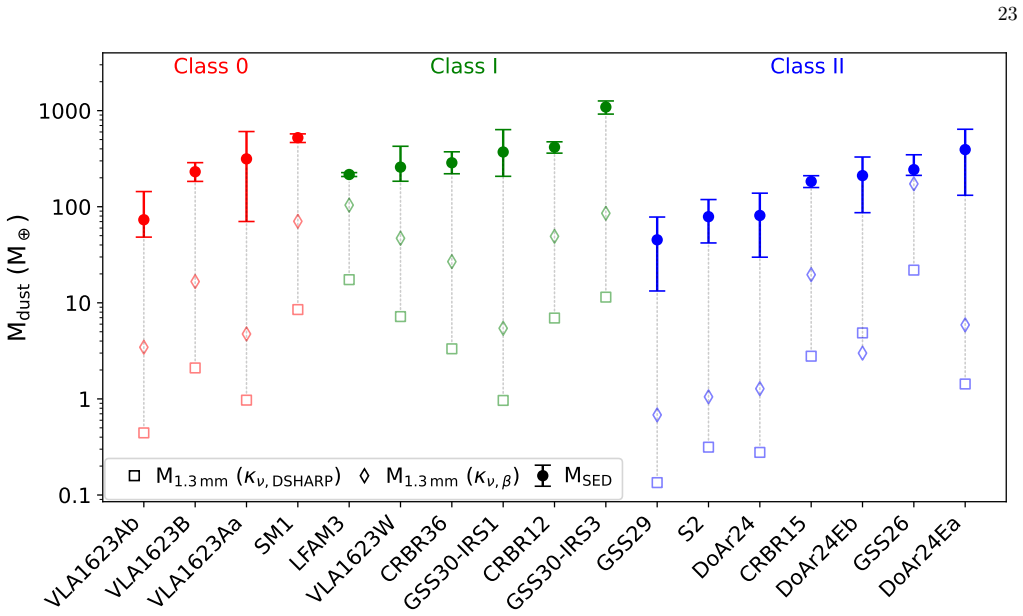
The central claim is that single-wavelength millimeter flux densities severely underestimate the mass of dust in young circumstellar disks. Fitting a physical model to each object's 10–400 GHz SED—dust emission with a size distribution, self-scattering, and DSHARP opacities, plus a thermal free-free component from ionised gas—the authors find disk-integrated dust masses that are, on average, 150 times (DSHARP opacities) and 34 times (Beckwith power-law opacities) the mass derived from a 1.3 mm flux density alone, with a minimum increase of 11 times. They also infer maximum grain sizes of order a millimeter even at the Class 0 stage, and attribute the large mass difference to high optical dep
What carries the argument
The load-bearing tool is the millimetre–centimetre radio spectral energy distribution (SED) decomposition. Each source's observed flux densities from 10 GHz to 400 GHz are fitted with a two-component model: (1) dust emission assuming an MRN grain-size power law, uniform temperature and maximum grain size, DSHARP dust opacities, and the inclusion of dust self-scattering; and (2) ionised gas as a modified blackbody free-free source with a fixed electron temperature of 8000 K. The fit yields dust column density, solid angle, maximum grain size, temperature, and an emission measure. These SED-derived masses are then compared with the standard single-wavelength mass formula using a 1.3 mm flux de
Load-bearing premise
The load-bearing assumption is that all emission below roughly 45 GHz that is not accounted for by a single thermal free-free component with an electron temperature of 8000 K is optically thin dust emission with uniform temperature, one maximum grain size, and DSHARP opacities—if some of that cm-wave emission is non-thermal gyrosynchrotron radiation, or if the opacity model is wrong, the 'tens to hundreds of times' mass inflation collapses.
What would settle it
Measure the 10–45 GHz spectral index, circular polarisation, and short-timescale variability of a few of these sources (for example GSS30-IRS3 or VLA 1623 W) with VLA A-configuration. A negative spectral index, high degree of circular polarisation, or minute-to-hour variability would indicate gyrosynchrotron emission contaminating the cm-wave band, invalidating the thermal free-free plus dust decomposition. Alternatively, if a next-generation interferometer resolves the 44 GHz continuum of a Class 0 disk and finds it compact and optically thick rather than extended and optically thin, the infe
If this is right
- Millimeter-only disk mass surveys are biased low by large factors, so the apparent deficit of solid material in protoplanetary disks is partly an observational artifact rather than a real shortage.
- Even Class II disks in this sample retain 10s–100s of Earth masses of dust, enough to assemble multiple gas-giant cores without requiring near-100% planet formation efficiency.
- Dust growth to millimeter sizes occurs already in Class 0 and Class I stages, not just in older disks, constraining when the growth barriers of bouncing, fragmentation, and radial drift must be overcome.
- At 10 GHz, ionised gas dominates most of the sample (more than 70% of the flux), so cm-wave data cannot be interpreted as dust without a spectral decomposition.
- The sharp drop in flux density between 40 and 100 GHz seen in roughly half the sample is explained by a transition from optically thick to optically thin dust emission, not by an ionised-gas excess.
- Future high-resolution, low-frequency observations with facilities like SKA and ngVLA should spatially resolve the optically thin dust and confirm the launching radii of the jets the authors identify.
Where Pith is reading between the lines
- If the mass-inflation factors are correct, then disk evolution models and exoplanet demographics should be re-calibrated: the same observed millimeter fluxes imply much larger initial mass reservoirs, softening the tension between measured disk masses and the masses of observed exoplanets.
- A direct testable extension would be to spatially resolve 7–10 mm continuum of a Class 0 disk with next-generation interferometers; the model predicts extended, optically thin dust emission that traces the millimeter disk, whereas compact, variable, or polarised emission would betray a non-thermal origin.
- The same SED decomposition could be applied to other nearby star-forming regions to test whether Ophiuchus is typical; if similar mass inflation appears everywhere, the 'missing disk mass' problem may be largely a wavelength-coverage bias.
- The fixed 8000 K electron temperature and the single-zone dust model are simplifications; a radially stratified dust model with a temperature gradient could alter the derived masses, though the broadband spectral shape would need to remain consistent with the observed SED.
Editorial analysis
A structured set of objections, weighed in public.
Referee Report
Summary. The paper presents a multi-wavelength survey of 20 Class 0–III YSOs in Ophiuchus A, combining new VLA 10/22/44 GHz continuum imaging with JWST/NIRCam images and archival ALMA fluxes. The authors fit power-law and physical two-component SED models to derive dust and ionised-gas properties, infer maximum grain sizes and dust masses, and connect 10 GHz extensions to jet/outflow cavities seen by JWST. The headline claim is that SED-derived dust masses are tens to hundreds of times larger than standard 1.3 mm-only estimates, with mm-sized grains present even at Class 0, offering a partial solution to the 'missing disk mass' problem.
Significance. The observational dataset itself is valuable: homogeneous VLA A-configuration continuum at 7–25 au resolution, careful variability screening, and a rich morphological connection between 10 GHz emission and NIRCam outflow cavities. If the mass-enhancement claim survived model-selection scrutiny, it would be important for early grain growth and the planet-formation mass budget. However, the central claim is conditional on an assumption that all ionised gas emission is thermal free-free and on a specific DSHARP opacity model; the paper does not propagate model-selection or opacity-systematic uncertainties into the headline factors. The survey and outflow-origin results are solid and publishable, but the mass claim needs substantial additional testing or reframing.
major comments (3)
- [§3.4.1 / §3.4.2 / Table 2] The physical SED model in §3.4.2 includes only one ionised-gas component: thermal free-free with Te fixed at 8000 K. Yet §3.4.1 finds α_ionised ≈ −0.2 ± 0.2 for Class II objects, states that these are 'more dominated by non-thermal gyro-emission', and explicitly notes for GSS30-IRS2 that its α_ionised is 'consistent with non-thermal gyro-emission... which is not captured in our thermal free-free model'. Table 2 shows f_ion > 70% at 10 GHz for most sources, so the low-frequency dust component is a small residual. If gyrosynchrotron emission contributes at 22–44 GHz, the thermal-only fit will tend to absorb its steep negative spectral index into the dust component, directly inflating the fitted Mdust and the 11–380x enhancement factors. No polarization or spectral-index test is offered to rule out this contamination. The abstract's opacity caveat does not cover this model-selection uncerta
- [§4.2 / Eq. (5) / Table 3] The mass-enhancement ratios are not an independent validation. Equation (5) is evaluated using 1.3 mm flux densities and T_dust, α_dust, and κ taken from the same SED model that produced Table 3. For κ_ν,DSHARP, the comparison is essentially between the integrated SED-model mass and a single-frequency projection of that model; for κ_ν,β, the opacity is derived from the model's α_dust. The reported 'minimum increase of 11 times' and the averages of 150 and 34 times are therefore conditional on the assumed opacity law and on the dust/ionised-gas decomposition. The text acknowledges opacity sensitivity in general terms, but no systematic uncertainty from opacity composition, porosity, or non-thermal contamination is propagated into the headline factors. The central claim should either be quoted with a range that includes these systematics or explicitly restricted to a sub-sample where the t
- [§3.4.2 / DoAr24, DoAr24Eb / Table 3] The imposed EM upper limit for DoAr24 and DoAr24Eb is justified only as providing 'solutions in line with the rest of the sample'. This is a per-object prior adjustment made after inspecting the data, and it directly affects the inferred dust component. DoAr24Eb then receives amax = 239 mm and Mdust = 211 M⊕, and it is included in the sample-level claims. No independent constraint on EM is given, and no sensitivity test shows that the headline mass-enhancement factors are robust to this choice. This needs either external justification or an explicit statement of how the results change if the cap is relaxed.
minor comments (4)
- [§3.4.2] A paragraph discussing optically thick emission at >200 GHz, dust self-scattering, and DSHARP opacities appears twice nearly verbatim. Please remove the duplication.
- [§2] Typo: 'Table 1 gives they key information' should read 'the key information'.
- [§3.4.1] The prior description says the ionised gas spectral index may vary 'between 1.5, the lower limit expected from dust self scattering, and –2'. This mixes dust and ionised-gas regimes; presumably the intended upper limit is 1.5 for the ionised component, and the parenthetical should be corrected.
- [Figure 7 / §3.4.2] VSSG27 is absent from Figure 7 because 'no valid solution was found', but the caption and discussion do not explain this. Please note in the caption that VSSG27 is excluded and state how its exclusion affects any sample averages.
Circularity Check
No circular reduction; SED-derived masses are model inferences, not identities; self-citations are methodological and non-load-bearing; gyrosynchrotron caveat is a correctness risk, not circularity.
full rationale
The central claim (Section 4.2, 'a minimum increase of 11 times the mass derived from a 1.3mm flux density measurement') arises from comparing two quantities derived from the same observational data: the full radio-SED model mass (Section 3.4.2) and the single-band Hildebrand mass (Eq. 5). This is an internal model comparison, not a prediction from withheld data. The SED model mass is not defined in terms of the 1.3mm mass; it is fit from free parameters (T_dust, a_max, Sigma_dust, Omega_dust, EM, Omega_ionised) across 10-400 GHz. The ratio M_SED/M_1.3mm is a function of the fitted optical depth and scattering treatment, not an algebraic identity; in the optically thin limit the two coincide, but the large ratios are reported precisely when the model departs from that limit. The paper transparently acknowledges the opacity sensitivity in the abstract and Section 3.4.2. Self-citations to I. C. Radley et al. (2025) are used for variability methodology, ALMA beam parameters, and outflow context, but none is load-bearing for the mass-enhancement inference. The DSHARP opacity prescription is externally sourced from Birnstiel et al. (2018). The genuine limitation, flagged explicitly in Section 3.4.2, is that GSS30-IRS2 has 'an ionised gas spectral index consistent with non-thermal gyro-emission... which is not captured in our thermal free-free model'; this and the fixed Te=8000K are modeling/robustness risks to the low-frequency dust residual, not evidence of circular derivation. The score of 2 reflects only the presence of minor, non-load-bearing self-citations; no circular step was found.
Axiom & Free-Parameter Ledger
free parameters (7)
- T_dust =
20–151 K (Table 3)
- a_max =
0.3–239 mm (Table 3; DoAr24Eb excluded from averages)
- Sigma_dust =
7.7e-4 to 27.7 g/cm2 (Table 3)
- Omega_dust =
Fixed from ALMA for most objects; free for DoAr24, DoAr24Eb, S2, GSS29
- EM (emission measure) =
10^6–10^12 cm^-6 pc; capped at 10^10 for DoAr24/Eb
- Omega_ionised =
Free, with upper limit Omega_ionised <= Omega_dust
- Power-law amplitudes and indices (A_dust, A_ionised, alpha_dust, alpha_ionised) =
Table 2
axioms (9)
- domain assumption MRN grain size distribution with q = -3.5
- domain assumption DSHARP dust compositions and opacities
- domain assumption Uniform T_dust, a_max, and electron temperature within each source
- domain assumption No mutual obscuration between dust and ionised gas emission sources
- domain assumption Free-free opacity follows Mezger & Henderson (1967), and applies equally to jets, winds, and HII regions
- domain assumption Electron temperature fixed to Te = 8000 K for all objects
- standard math Distance to Ophiuchus L1688 = 138.4 pc
- domain assumption Hildebrand (1983) mass formula is used for mm-only mass comparison, despite being valid only in the optically thin limit
- ad hoc to paper The 45 GHz break in the broken power law model is fixed a priori
read the original abstract
We present an infrared, millimetre, and radio survey of 20 Class 0-III young stellar objects in the Ophiuchus A L1688 star-forming cluster, combining high-resolution (7-25 au) VLA and JWST observations with archival ALMA data. We implement physically motivated models to derive dust and ionised gas properties, spectral behaviour and their relative contributions through the millimetre-centimetre radio spectral energy distribution. Our models reveal circumstellar dust disks that are, on average, tens to hundreds of times more massive than millimetre-only estimates (subject to uncertainties arising from the choice of dust opacity) and contain millimetre-sized grains even at the Class 0 stage. Owing to the VLA's high resolution we are able to connect outflows to their origins, detecting protostellar jet emission on scales of 10s-1000s au. Our results represent a homogeneous characterisation of the dust and ionised gas properties in Ophiuchus and present a potential solution to the long-standing 'missing disk mass' problem. However, our understanding is still limited by resolution and sensitivity at frequencies <40 GHz. Future facilities like the SKA and ngVLA are needed to provide the necessary capabilities to fully spatially resolve this emission (<0.18") even in one of the closest star-forming regions.
Figures




Reference graph
Works this paper leans on
-
[1]
Early Planet Formation in Embedded Disks (eDisk): XVI. Asymmetric dust disk driving a multicomponent molecular outflow in the young Class 0 protostar GSS30 IRS3. , keywords =. doi:10.1051/0004-6361/202449981 , archivePrefix =. 2407.20885 , primaryClass =
-
[2]
A systematic survey of millimetre-wavelength flaring variability of young stellar objects in the Orion Nebula Cluster. , keywords =. doi:10.1093/mnras/stad926 , archivePrefix =. 2303.15516 , primaryClass =
-
[3]
The Disk Substructures at High Angular Resolution Project (DSHARP). IX. A High-definition Study of the HD 163296 Planet-forming Disk. , keywords =. doi:10.3847/2041-8213/aaf747 , archivePrefix =. 1812.04047 , primaryClass =
Pith/arXiv arXiv 2041
-
[4]
Multi-frequency analysis of the ALMA and VLA high resolution continuum observations of the substructured disc around CI Tau: Preference for submillimetre-sized low-porosity amorphous carbon grains. , keywords =. doi:10.1051/0004-6361/202452986 , archivePrefix =. 2507.08797 , primaryClass =
-
[5]
Simulation of clustering by a modified continuous distribution of ellipsoids
Optical constants of cosmic carbon analogue grains - I. Simulation of clustering by a modified continuous distribution of ellipsoids. , keywords =. doi:10.1093/mnras/282.4.1321 , adsurl =
-
[6]
Time Monitoring of Radio Jets and Magnetospheres in the Nearby Young Stellar Cluster R Coronae Australis. , keywords =. doi:10.1088/0004-637X/780/2/155 , archivePrefix =. 1311.4761 , primaryClass =
-
[7]
One Solution to the Mass Budget Problem for Planet Formation: Optically Thick Disks with Dust Scattering. , keywords =. doi:10.3847/2041-8213/ab1f8c , archivePrefix =. 1904.02127 , primaryClass =
Pith/arXiv arXiv 2041
-
[8]
SMA 200 400 GHz Survey for Dust Properties in the Icy Class II Disks in the Taurus Molecular Cloud. , keywords =. doi:10.3847/1538-4365/ad528b , archivePrefix =. 2405.19867 , primaryClass =
-
[9]
On the Effects of Self-obscuration in the (Sub)Millimeter Spectral Indices and the Appearance of Protostellar Disks. , keywords =. doi:10.3847/1538-4357/aae779 , archivePrefix =. 1810.00904 , primaryClass =
-
[10]
An ALMA Survey of Protoplanetary Disks in the Orionis Cluster. , keywords =. doi:10.3847/1538-3881/aa69c0 , archivePrefix =. 1703.08546 , primaryClass =
-
[11]
On the excitation of the infrared knots along protostellar jets. , keywords =. doi:10.1051/0004-6361:20040087 , archivePrefix =. astro-ph/0402395 , primaryClass =
-
[12]
The ALMA Survey of Gas Evolution of PROtoplanetary Disks (AGE-PRO). II. Dust and Gas Disk Properties in the Ophiuchus Star-forming Region. , keywords =. doi:10.3847/1538-4357/add2ec , archivePrefix =. 2506.10731 , primaryClass =
-
[13]
The Ophiuchus DIsk Survey Employing ALMA (ODISEA): Disk Dust Mass Distributions across Protostellar Evolutionary Classes. , keywords =. doi:10.3847/2041-8213/ab1338 , archivePrefix =. 1904.06471 , primaryClass =
Pith/arXiv arXiv 2041
-
[14]
, archivePrefix = "arXiv", eprint =
emcee: The MCMC Hammer. , archivePrefix = "arXiv", eprint =. doi:10.1086/670067 , adsurl =
-
[15]
Protostars and Planets VI , year = 2014, editor =
Dust Evolution in Protoplanetary Disks. Protostars and Planets VI , year = 2014, editor =. doi:10.2458/azu_uapress_9780816531240-ch015 , archivePrefix =. 1402.1354 , primaryClass =
Pith/arXiv arXiv 2014
-
[16]
A Ballistic Bow Shock Model for Jet-driven Protostellar Outflow Shells. , keywords =. doi:10.1086/321649 , archivePrefix =. astro-ph/0104374 , primaryClass =
-
[17]
UV-irradiated outflows from low-mass protostars in Ophiuchus with JWST/MIRI. arXiv e-prints , keywords =. doi:10.48550/arXiv.2509.10256 , archivePrefix =. 2509.10256 , primaryClass =
-
[18]
Progress of Theoretical Physics , year = 1980, month = aug, volume =
Formation of the Giant Planets. Progress of Theoretical Physics , year = 1980, month = aug, volume =. doi:10.1143/PTP.64.544 , adsurl =
-
[19]
The protostellar disc of VLA 1623-2417W and its streamers imaged by ALMA
FAUST - VIII. The protostellar disc of VLA 1623-2417W and its streamers imaged by ALMA. , keywords =. doi:10.1093/mnras/stad964 , archivePrefix =. 2303.16257 , primaryClass =
-
[20]
The VLA Nascent Disk and Multiplicity Survey of Perseus Protostars (VANDAM). IV. Free-Free Emission from Protostars: Links to Infrared Properties, Outflow Tracers, and Protostellar Disk Masses. , keywords =. doi:10.3847/1538-4365/aaceae , archivePrefix =. 1806.02434 , primaryClass =
-
[21]
The VLA Nascent Disk And Multiplicity Survey of Perseus Protostars (VANDAM). III. Extended Radio Emission from Protostars in Perseus. , keywords =. doi:10.3847/1538-4357/aa9980 , archivePrefix =. 1711.03035 , primaryClass =
-
[22]
Experimental Investigations on Aggregate-Aggregate Collisions in the Early Solar Nebula. , keywords =. doi:10.1006/icar.1993.1163 , adsurl =
arXiv 1993
-
[23]
Experimental Studies on the Aggregation Properties of Ice and Dust in Planet-Forming Regions. Proc. 58th Int. Astronautical Congress 2007 (Paris: Int. Astronautical Federation) , year = 2007, month = sep, pages =. doi:10.48550/arXiv.1106.4760 , archivePrefix =. 1106.4760 , primaryClass =
work page internal anchor Pith review Pith/arXiv arXiv doi:10.48550/arxiv.1106.4760 2007
-
[24]
, year = 2008, month = sep, volume =
The growth mechanisms of macroscopic bodies in protoplanetary disks. , year = 2008, month = sep, volume =. doi:10.1146/annurev.astro.46.060407.145152 , adsurl =
arXiv 2008
-
[25]
Breaking through: The effects of a velocity distribution on barriers to dust growth. , keywords =. doi:10.1051/0004-6361/201220004 , archivePrefix =. 1208.0304 , primaryClass =
-
[26]
Characterizing the Multiple Protostellar System VLA 1623-2417 with JWST, ALMA, and VLA: Outflow Origins, Dust Growth, and an Unsettled Disk. , keywords =. doi:10.3847/1538-4357/adb0b9 , archivePrefix =. 2501.18348 , primaryClass =
-
[27]
Distribution of solids in the rings of the HD 163296 disk: a multiwavelength study. , keywords =. doi:10.1051/0004-6361/202142303 , archivePrefix =. 2207.01496 , primaryClass =
-
[28]
A pathfinder for Square Kilometre Array studies
VLA cm-wave survey of young stellar objects in the Oph A cluster: constraining extreme UV- and X-ray-driven disk photoevaporation. A pathfinder for Square Kilometre Array studies. , keywords =. doi:10.1051/0004-6361/201935340 , archivePrefix =. 1909.03515 , primaryClass =
Pith/arXiv arXiv 1909
-
[29]
Misaligned Rotations of the Envelope, Outflow, and Disks in the Multiple Protostellar System of VLA 1623-2417: FAUST. III. , keywords =. doi:10.3847/1538-4357/ac4cae , archivePrefix =. 2201.07334 , primaryClass =
-
[30]
Effects of Scattering, Temperature Gradients, and Settling on the Derived Dust Properties of Observed Protoplanetary Disks. , keywords =. doi:10.3847/1538-4357/ab7d32 , archivePrefix =. 2003.02982 , primaryClass =
Pith/arXiv arXiv 2003
-
[31]
``Ashfall'' Induced by Molecular Outflow in Protostar Evolution. , keywords =. doi:10.3847/2041-8213/ac2b2f , archivePrefix =. 2109.12779 , primaryClass =
Pith/arXiv arXiv 2041
-
[32]
Connection between jets, winds and accretion in T Tauri stars. The X-shooter view. , keywords =. doi:10.1051/0004-6361/201730834 , archivePrefix =. 1710.05587 , primaryClass =
-
[33]
The JWST Early Release Observations. , keywords =. doi:10.3847/2041-8213/ac8a4e , archivePrefix =. 2207.13067 , primaryClass =
Pith/arXiv arXiv 2041
-
[34]
, keywords =
Molecular outflows entrained by jet bowshocks. , keywords =
-
[35]
Towards a population synthesis model of objects formed by self-gravitating disc fragmentation and tidal downsizing. , keywords =. doi:10.1093/mnras/stt672 , archivePrefix =. 1304.4978 , primaryClass =
-
[36]
Hydraulic/Shock Jumps in Protoplanetary Disks. , keywords =. doi:10.1086/500396 , archivePrefix =. astro-ph/0510305 , primaryClass =
-
[37]
Gravitoviscous protoplanetary disks with a dust component. III. Evolution of gas, dust, and pebbles. , keywords =. doi:10.1051/0004-6361/201937198 , archivePrefix =. 2004.00126 , primaryClass =
Pith/arXiv arXiv 2004
-
[38]
Protostars and Planets VII , year = 2023, editor =
Planet-Disk Interactions and Orbital Evolution. Protostars and Planets VII , year = 2023, editor =. doi:10.48550/arXiv.2203.09595 , archivePrefix =. 2203.09595 , primaryClass =
-
[39]
Snow lines can be thermally unstable. , keywords =. doi:10.1093/mnras/staa1309 , archivePrefix =. 2005.03665 , primaryClass =
Pith/arXiv arXiv 2005
-
[40]
Early Planet Formation in Embedded Disks (eDisk). I. Overview of the Program and First Results. , keywords =. doi:10.3847/1538-4357/acd384 , archivePrefix =. 2306.15406 , primaryClass =
-
[41]
Anticipated Performance of the Square Kilometre Array -- Phase 1 (SKA1). arXiv e-prints , keywords =. doi:10.48550/arXiv.1912.12699 , archivePrefix =. 1912.12699 , primaryClass =
-
[42]
Science with a Next Generation Very Large Array , year = 2018, editor =
The ngVLA Reference Design. Science with a Next Generation Very Large Array , year = 2018, editor =. doi:10.48550/arXiv.1810.08197 , archivePrefix =. 1810.08197 , primaryClass =
-
[43]
Measuring Dust Masses of Protoplanetary Disks in Serpens and L1641/L1647 with ALMA. , keywords =. doi:10.3847/1538-4357/ae1588 , archivePrefix =. 2511.20817 , primaryClass =
-
[44]
870 m Dust Continuum of the Youngest Protostars in Ophiuchus. , keywords =. doi:10.3847/1538-4357/abf4fd , archivePrefix =. 2105.00514 , primaryClass =
-
[45]
Extremely Dense Cores Associated with Chandra Sources in Ophiuchus A: Forming Brown Dwarfs Unveiled?. , keywords =. doi:10.3847/1538-4357/aae153 , archivePrefix =. 1810.00573 , primaryClass =
-
[46]
Super-resolution Imaging of the Protoplanetary Disk HD 142527 Using Sparse Modeling. , keywords =. doi:10.3847/1538-4357/ab899f , archivePrefix =. 2004.10989 , primaryClass =
arXiv 2004
-
[47]
Towards a population synthesis model of self-gravitating disc fragmentation and tidal downsizing II: the effect of fragment-fragment interactions. , keywords =. doi:10.1093/mnras/stx2870 , archivePrefix =. 1711.01133 , primaryClass =
-
[48]
The effect of cooling on the global stability of self-gravitating protoplanetary discs. , keywords =. doi:10.1046/j.1365-8711.2003.06253.x , archivePrefix =. astro-ph/0211088 , primaryClass =
arXiv 2003
-
[49]
The Eccentric Cavity, Triple Rings, Two-armed Spirals, and Double Clumps of the MWC 758 Disk. , keywords =. doi:10.3847/1538-4357/aac6cb , archivePrefix =. 1805.12141 , primaryClass =
-
[50]
Gravitational instability in a planet-forming disk. , keywords =. doi:10.1038/s41586-024-07877-0 , archivePrefix =. 2409.02196 , primaryClass =
-
[51]
Asymmetric features in the protoplanetary disk MWC 758. , keywords =. doi:10.1051/0004-6361/201526011 , archivePrefix =. 1505.05325 , primaryClass =
-
[52]
Continuum Spectra of Collimated, Ionized Stellar Winds. , keywords =. doi:10.1086/164209 , adsurl =
-
[53]
The Gould's Belt Very Large Array Survey. IV. The Taurus-Auriga Complex. , keywords =. doi:10.1088/0004-637X/801/2/91 , archivePrefix =. 1412.6445 , primaryClass =
-
[54]
Massive discs around low-mass stars. , keywords =. doi:10.1093/mnras/staa883 , archivePrefix =. 2001.06225 , primaryClass =
Pith/arXiv arXiv 2001
-
[55]
Generation of radiative knots in a randomly pulsed protostellar jet. I. Dynamics and energetics. , keywords =. doi:10.1051/0004-6361/200913595 , archivePrefix =. 0912.2757 , primaryClass =
-
[56]
Protostellar outflows: a window to the past. , keywords =. doi:10.1093/mnras/stab3572 , archivePrefix =. 2201.02999 , primaryClass =
-
[57]
, keywords =
Discovery of a remarkable bipolar flow and exciting source in the rho Ophiuchi cloud core. , keywords =
-
[58]
Radio emission from the sun and stars. , keywords =. doi:10.1146/annurev.aa.23.090185.001125 , adsurl =
-
[59]
Essential Radio Astronomy
-
[60]
Imaging the Photoevaporating Disk and Radio Jet of GM Aur. , keywords =. doi:10.3847/0004-637X/829/1/1 , archivePrefix =. 1607.04225 , primaryClass =
-
[61]
Dust characterization of protoplanetary disks: A guide to multi-wavelength analyses and accurate dust mass measurements. , keywords =. doi:10.1051/0004-6361/202452935 , archivePrefix =. 2501.13877 , primaryClass =
-
[62]
The Radial Distribution of Dust Particles in the HL Tau Disk from ALMA and VLA Observations. , keywords =. doi:10.3847/1538-4357/ab3d33 , archivePrefix =. 1908.07140 , primaryClass =
Pith/arXiv arXiv 1908
-
[63]
Radio survey of the stellar population in the infrared dark cloud G14.225-0.506. , keywords =. doi:10.1051/0004-6361/202348085 , archivePrefix =. 2311.12542 , primaryClass =
-
[64]
Protostellar Jets Enclosed by Low-velocity Outflows. , keywords =. doi:10.1088/2041-8205/796/1/L17 , archivePrefix =. 1411.7124 , primaryClass =
Pith/arXiv arXiv 2041
-
[65]
ALMA chemical survey of disk-outflow sources in Taurus (ALMA-DOT). VI. Accretion shocks in the disk of DG Tau and HL Tau. , keywords =. doi:10.1051/0004-6361/202141264 , archivePrefix =. 2110.13820 , primaryClass =
-
[66]
Performance of NIRCam on JWST in Flight. , keywords =. doi:10.1088/1538-3873/acac53 , archivePrefix =. 2212.12069 , primaryClass =
-
[67]
Disks around T Tauri Stars with SPHERE (DARTTS-S). I. SPHERE/IRDIS Polarimetric Imaging of Eight Prominent T Tauri Disks. , keywords =. doi:10.3847/1538-4357/aab846 , archivePrefix =. 1803.10882 , primaryClass =
-
[68]
Investigating Protostellar Accretion-driven Outflows across the Mass Spectrum: JWST NIRSpec Integral Field Unit 3 5 m Spectral Mapping of Five Young Protostars. , keywords =. doi:10.3847/1538-4357/ad2fa0 , archivePrefix =. 2310.03803 , primaryClass =
-
[69]
Morphological Evolution of Bipolar Outflows from Young Stellar Objects. , keywords =. doi:10.1086/526766 , adsurl =
-
[70]
Submillimeter Continuum Observations of rho Ophiuchi A: The Candidate Protostar VLA 1623 and Prestellar Clumps. , keywords =. doi:10.1086/172425 , adsurl =
-
[71]
A 2 au Resolution View by ALMA of the Planet-hosting WISPIT 2 Disk. , keywords =. doi:10.3847/2041-8213/ae3c0a , archivePrefix =. 2601.15948 , primaryClass =
arXiv 2041
-
[72]
On the theory of disc photoevaporation. , keywords =. doi:10.1111/j.1365-2966.2011.20337.x , archivePrefix =. 1112.1087 , primaryClass =
arXiv 2011
-
[73]
IRAS4A1: Multiwavelength continuum analysis of a very flared Class 0 disk. , keywords =. doi:10.1051/0004-6361/202347685 , archivePrefix =. 2310.11999 , primaryClass =
-
[74]
Temperature Structures of Embedded Disks: Young Disks in Taurus Are Warm. , keywords =. doi:10.3847/1538-4357/abb1a2 , archivePrefix =. 2008.08106 , primaryClass =
Pith/arXiv arXiv 2008
-
[75]
The Open Journal of Astrophysics , keywords =
Detailed Microwave Continuum Spectra from Bright Protoplanetary Disks in Taurus. The Open Journal of Astrophysics , keywords =. doi:10.33232/001c.144268 , archivePrefix =. 2507.21268 , primaryClass =
-
[76]
Into the thick of it: ALMA 0.45 mm observations of HL Tau at a resolution of 2 au. , keywords =. doi:10.1051/0004-6361/202349046 , archivePrefix =. 2404.04164 , primaryClass =
-
[77]
Observations of edge-on protoplanetary disks with ALMA. I. Results from continuum data. , keywords =. doi:10.1051/0004-6361/202038087 , archivePrefix =. 2008.06518 , primaryClass =
Pith/arXiv arXiv 2008
-
[78]
Determining Dust Properties in Protoplanetary Disks: SED-derived Masses and Settling with ALMA. , keywords =. doi:10.3847/1538-4357/aca905 , archivePrefix =. 2211.16732 , primaryClass =
-
[79]
The Metallicity Electron Temperature Relationship in H II Regions. , keywords =. doi:10.3847/1538-4357/ad2458 , archivePrefix =. 2401.17969 , primaryClass =
-
[80]
The Electron Temperature Gradient in the Galactic Disk. , keywords =. doi:10.1086/508803 , archivePrefix =. astro-ph/0609006 , primaryClass =
discussion (0)
Sign in with ORCID, Apple, or X to comment. Anyone can read and Pith papers without signing in.