REVIEW 5 major objections 5 minor 56 references
Reducing Per-Sample Harm in Stochastic Optimization
T0 review · 5 major / 5 minor · reviewed 2026-08-02 · deepseek-v4-flash
Pith's one-line read Mini-batch updates can hurt individual samples; the paper shows a cheap last-layer reweighting that reduces this harm and improves test accuracy.
desk verdict Novel per-sample harm-reduction framework with a sound vanilla-SGD core and a clever last-layer implicit computation; the headline gain is real but the central proportionality approximation is rough and the experimental reporting lacks variance, so this is promising, not settled. read the letter →
The pith
A machine-rendered reading of the paper's core claim, the machinery that carries it, and where it could break.
The reading
What carries the argument
The load-bearing object is the per-sample gradient Gram matrix Q = G G^T in batch space, and the argument's hinge is the proportionality Q ≈ α Q_L with the last-layer Gram matrix, which kills the unknown scale α. For a linear layer, the Khatri-Rao (row-wise Kronecker) factorization Q_L = (x x^T + I) ⊙ (g_y g_y^T) computes the surrogate without building per-sample gradients, aided for AdamW by a rank-r SVD of the adaptive scaling. The surrogate is a convex non-smooth program—an ellipsoidal trust region plus a hinge-like harm objective—solved by a first-order primal-dual method whose output weights are folded back into the loss as a per-sample reweighting.
What would settle it
On a model whose last layer is small (e.g., 10 outputs, 64-dim penultimate), compute the full per-sample Gram matrix Q and the last-layer Q_L at batch 1024, then solve the surrogate with Q_L and measure the true full-network harm H(G dθ*) of the resulting update. If the relative effective objective reduction is negative on average—or if replacing Q_L with a random PSD matrix of the same size leaves test accuracy unchanged—the last-layer proportionality is not the causal ingredient the paper claims.
Extended reading notes
Core claim
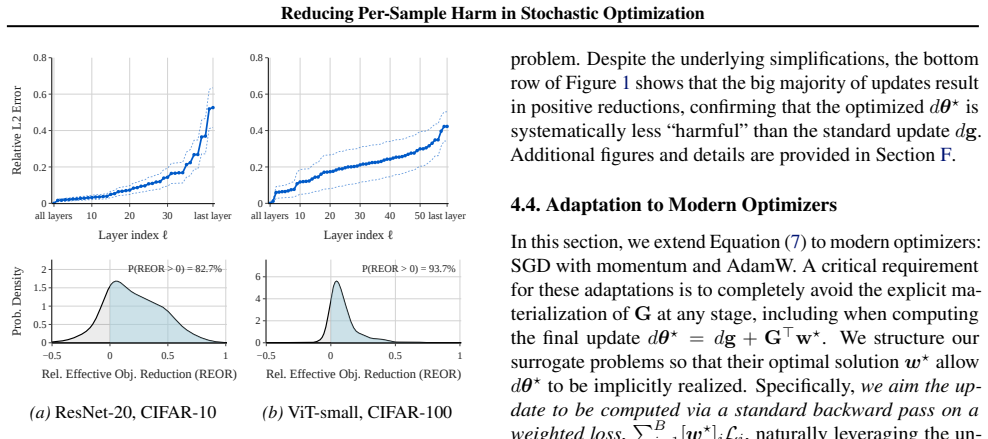
On the paper's own terms, the central discovery is that the last linear layer alone reliably captures the second-order statistics of the full per-sample gradients: the full Gram matrix Q is approximately a scalar multiple of the last-layer Gram matrix Q_L (Q ≈ α Q_L), and under vanilla SGD the unknown scale α cancels out of the resulting surrogate problem. This makes it possible to reweight the current batch's losses so that the effective update stays near the standard optimizer update while minimizing the total harm to individual samples, all without ever materializing per-sample gradients. The paper argues this last-layer fidelity is what makes the whole pipeline cheap and representative.
Load-bearing premise
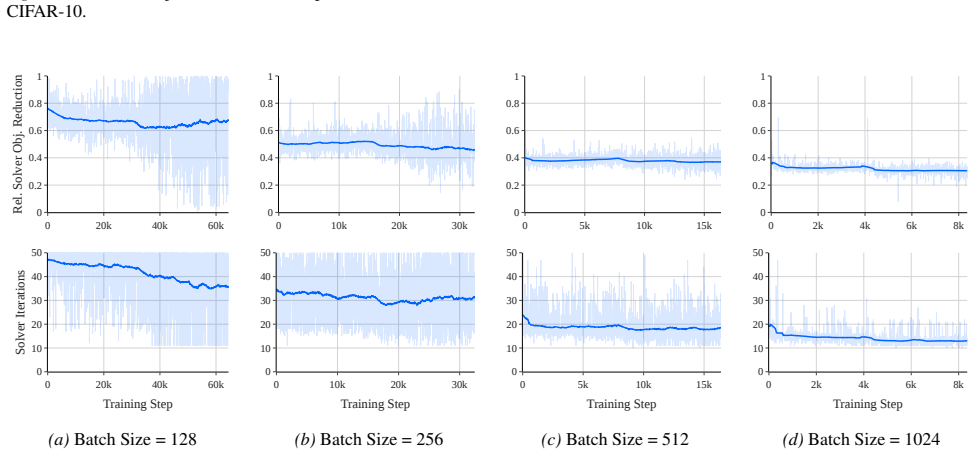
The entire method rests on the assumption that the full per-sample gradient Gram matrix is a scalar multiple of the last-layer Gram matrix; the paper's measurements show only rough agreement (relative error around 0.5), and in the small-head/large-batch regime (ResNet-44, batch 1024) the approximation fails visibly, requiring a shrunken trust region to avoid accuracy loss.
Editorial extensions
If this is right
- If the last-layer proportionality holds, harm reduction is almost free: the per-step overhead is O(B^2(d_in + d_out)) and does not grow with model depth, so relative cost shrinks as backbones scale.
- Larger batches, where per-sample gradient conflicts are more frequent, show the largest accuracy gains (e.g., +2.24% for ViT on CIFAR-100 at batch 1024), pointing to a concrete fix for the large-batch generalization gap.
- Because the reweighted loss is a standard backward pass, the method plugs into SGD-momentum and AdamW without changing the optimizer's state machinery, and composes with distributed training at the cost of two extra synchronization steps.
- The method accelerates convergence: gains are larger under short schedules (100 vs 300 epochs) and stronger augmentation, suggesting harm reduction is most valuable when the training budget is tight.
- The same surrogate machinery could be adapted to other optimizers, since the derivation only needs the update rule to be expressed as a sum of a current-batch term and history.
Reading between the lines
- A testable extension is to apply the same last-layer surrogate to language models, where the final linear head is often the largest parameter block; the proportionality assumption may hold even more strongly there.
- The paper's own failure case (tiny head, huge batch) suggests a natural diagnostic: track the relative Frobenius error ∥Q − αQ_L∥/∥Q∥ online and fall back to including a second layer when it exceeds a threshold.
- Because the method is equivalent to an adaptive per-sample loss weighting, it could be composed with techniques that already compute per-sample gradients, such as differential privacy clipping, where the reweighting might offset the harm caused by clipped gradients.
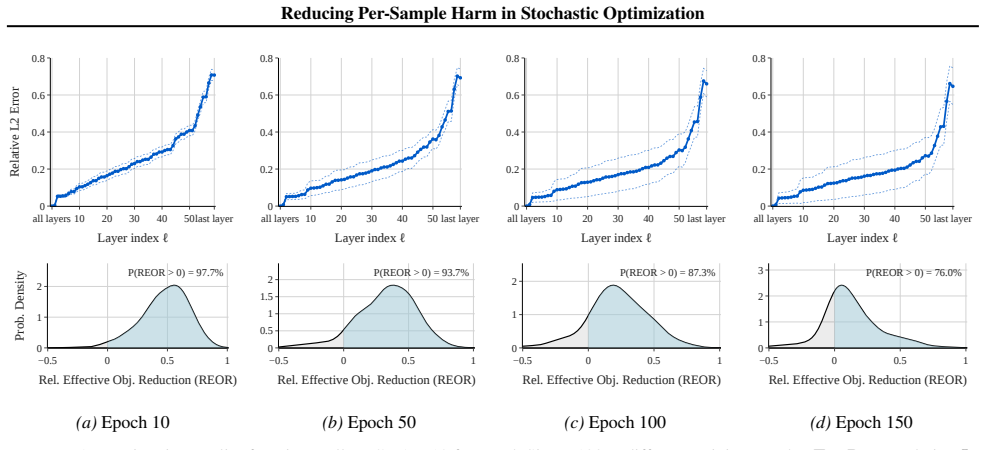
- The REOR distribution (the paper reports 80–95% positive) implies that in a non-trivial fraction of steps the surrogate 'fix' actually increases harm; a variant that only applies the reweighting when REOR is predicted positive could improve robustness.
Editorial analysis
A structured set of objections, weighed in public.
Referee Report
Summary. The paper proposes a method to reduce per-sample harm in mini-batch stochastic optimizers. It formulates the parameter update as a constrained convex problem that penalizes per-sample loss increases, proves a representer-type result (Prop. 4.1) that reduces the problem from parameter space to batch space, and then approximates the full per-sample gradient Gram matrix by the last linear layer's Gram matrix under a proportionality assumption (Eq. 6). The surrogate is solved with a Chambolle–Pock primal-dual solver, using Khatri-Rao factorizations to avoid materializing per-sample gradients, and is extended heuristically to SGD with momentum and AdamW. Experiments on CIFAR-10/100, Tiny-ImageNet, and ImageNet-100 report modest accuracy gains with small runtime overhead and include open-source code.
Significance. If the last-layer proportionality finding were robust, the paper would be a useful contribution: it offers a practical, memory-efficient way to incorporate per-sample conflict information into standard optimizers, with a correct vanilla-SGD derivation, a clean complexity analysis, and a REOR sanity check computed against the full per-sample objective. The Khatri-Rao factorization and the α-invariance observation are genuinely elegant. However, the central approximation is only weakly validated, the AdamW/momentum extensions rest on acknowledged heuristics, and one key configuration requires a special-case hyperparameter change. The significance is therefore conditional on substantially stronger empirical and theoretical support for the surrogate.
major comments (5)
- [§4.3, Eq. (6), Fig. 1] The paper's central premise is Q≈αQ_{ℓ:L} with exact proportionality, which lets α cancel from the surrogate. Figure 1 reports a best-fit relative Frobenius error of roughly 0.5 for the last layer alone on ResNet-20 and ViT-small; this is a rough approximation, and no error bound or regime characterization is given. The failure in §5.2 (ResNet-44, CIFAR-10, BS=1024), where Q_L is rank-deficient and the authors resort to a setting-specific c=0.1, shows that the approximation can break in a plausible configuration. The method is then applied to ResNet-50 and ConvNeXt-T without any approximation-quality measurement. I ask for (i) a systematic study of the approximation error as a function of batch size, head dimension, and training stage, and (ii) either a theoretical justification or an explicit statement of the regime in which the surrogate is trustworthy.
- [§4.3–§4.4, Eqs. (10), (14)] The α-cancellation argument is derived for vanilla SGD with dg=-lr G^T1. For SGD with momentum and for AdamW, dg contains historical terms, so G dg and ||dg||^2 are not proportional to their last-layer counterparts under Eq. (6); replacing them by last-layer quantities is an additional, unstated approximation. For AdamW, Proposition 4.1 does not apply because the update lies in Dκ G^T span rather than G^T span, and the w≥0 and Q_{2,L} constraint choices are ad hoc. Since most of the positive test-accuracy results use AdamW, this gap is load-bearing. The REOR checks in Fig. 1 are only on small models; please provide an end-to-end validation of the surrogate on the architectures actually used in Tables 1–2, or narrow the theoretical claims accordingly.
- [§5.2, Table 1] The only configuration that required changing the global hyperparameter c (ResNet-44, CIFAR-10, BS=1024, c=0.1) is also the one with a negative result (-0.22%). This suggests a sensitivity to rank deficiency of the last-layer Gram matrix that is not captured by the proposed safeguards. The paper should either give a principled rule for adapting c when Q_L is singular or ill-conditioned, or report results under a fixed protocol; otherwise the claim of consistent improvements is overstated.
- [§5.2, Table 2] BatchNorm and Mixup/Cutmix break the per-sample independence assumption underlying the last-layer quantities. The ResNet-50 BatchNorm row shows a degradation (56.37→56.20), which is acknowledged but not analyzed. Because BatchNorm is standard in modern CNNs, the method's coverage is materially limited. Please either provide a treatment for BatchNorm or state the restriction explicitly in the abstract and conclusion.
- [§5, Tables 1–2] The generalization claim rests on small absolute differences (often +0.2–0.3%), but no standard deviations, confidence intervals, or per-seed results are reported for the 5-seed averages, and the ImageNet-100 results are single-seed. The reader cannot assess whether the gains are significant. Please report seed-wise results or error bars.
minor comments (5)
- [Eq. (7)] The constraint is written as w^T Q w ≤ c^2||dg||^2, but after the last-layer approximation it should be w^T Q_{ℓ:L} w ≤ c^2||dg_{ℓ:L}||^2; as written it appears to use the full Gram matrix.
- [§4.6, §D.1] The Chambolle–Pock step-size condition has inconsistent notation: the text writes τσ||Q1||^2_σ < 1, which should be τσ||Q1||_2^2 < 1 with the spectral norm. Please make the norm notation uniform.
- [Appendix A] In the proof of Prop. 4.1, the displacement vector is declared as δ:=dθ−dg∈R^B; it should be in R^Θ (the parameter dimension), not R^B.
- [Appendix E, Table 1] The naming 'ViT-c' vs 'ViT-small' is confusing; clarify which architecture appears in Table 1 and which in Figure 1.
- [§4.6, Algorithm 5] The approximate projection in Algorithm 5 is called Π_C but is not the true Euclidean projection onto C; this should be stated explicitly in the main text because it means the CP convergence guarantee is not directly inherited.
Circularity Check
No significant circularity: the surrogate derivation rests on an explicit approximation (Eq. 6) that is empirically validated against the full objective, and the main claims are supported by independent test accuracy.
full rationale
The paper's derivation chain is not circular. The harm objective (Eq. 3) is a first-order, convex formulation; Proposition 4.1 reduces it to batch space (Eq. 5); the layer-wise decomposition is additive; and Eq. (6), Q ≈ αQ_{ℓ:L}, is introduced explicitly as a 'simple approximation' rather than as a consequence of the target. The α-cancellation is algebraic: under vanilla SGD, Gdg = -lr Q1 and ∥dg∥² = lr²1ᵀQ1, so a single scalar α scaling Q also scales all three defining quantities and cancels from objective and constraint. This is not fitting a parameter to the target and then calling it a prediction. The approximation's quality is checked against the full Q computed from materialized per-sample gradients (Figure 1), and the resulting dθ* is evaluated on the original full-G harm objective via REOR, not on the surrogate. The final claims of improved generalization rest on external test accuracy on CIFAR, Tiny-ImageNet, and ImageNet-100, which is independent of the surrogate objective. There are no self-citations or imported uniqueness theorems. The acknowledged limitations—Eq. (6) holds only roughly (relative error ~0.5), the special-case c=0.1 for ResNet-44/CIFAR-10 at B=1024, and the statement that applying Eq. (7) to momentum/AdamW 'introduces a theoretical inconsistency'—are robustness and validity concerns, not circularity. A failed or rough approximation is an empirical weakness, not a reduction of the output to the input.
Assumptions & free parameters
free parameters (6)
- c (trust-region radius) =
0.2 (0.1 in one special case)
- Sample weight cap t (w≤2) =
2
- Solver iterations and warm-up (IPGD, Isolver) =
10, 50
- SVD rank r (AdamW) =
5
- Safeguard EMAs (mom_dg, max_raise_dg, mom_k, max_raise_k) =
0.98, 1.25, 0.98, 1.25
- Solver step-size safety factors =
0.5, 0.9
assumptions (5)
- domain assumption First-order Taylor approximation Li(θ+dθ) ≈ Li(θ) + G_i^T dθ (Eq. 1) is accurate for the allowed updates
- ad hoc to paper Q ≈ α Q_{ℓ:L} for the last layer (Eq. 6) with α cancelling in the surrogate
- domain assumption For AdamW, ṽ_t ≈ v_t and ~κ ≈ κ because β2=0.999 is close to 1
- ad hoc to paper The approximate projection onto C (box clip then radial scaling, Algorithm 5) is a sufficient stand-in for the true Euclidean projection in the CP solver
- domain assumption The last-layer per-sample gradient Gram matrix captures the core second-order statistics of the full network
Cite this review
Pith. "Pith review of Reducing Per-Sample Harm in Stochastic Optimization." pith.science (2026). https://pith.science/paper/GILW2YNB
@misc{pith2026260716261,
  author       = {Pith},
  title        = {Pith review of: Reducing Per-Sample Harm in Stochastic Optimization},
  year         = {2026},
  howpublished = {\url{https://pith.science/paper/GILW2YNB}},
  note         = {Machine review of arXiv:2607.16261}
}
read the original abstract
Modern optimizers combine gradients from the current mini-batch with historical optimization state, such as momentum or adaptive moments. While highly effective, aggregating across the batch and incorporating this history can produce parameter updates that increase the loss of individual samples. We term this effect harm and formalize the parameter update as an optimization problem that explicitly minimizes the conflicting impact of both batch averaging and past optimization state on current data. Because the exact formulation is intractable, we introduce a highly efficient proxy. We first reduce the problem's dimensionality to the batch size, and then drastically cut memory and speed bottlenecks by successfully restricting the optimization to the last linear layer. This hinges on the unexpected finding that this layer alone reliably captures the second-order statistics of the per-sample gradients. The resulting surrogate problem integrates readily into standard optimizers like SGD and AdamW, and can be solved using a small number of GPU-friendly iterations. Crucially, the method exhibits favorable scaling properties, as the relative computational overhead shrinks as the model size or input grows. Experiments on image classification benchmarks confirm reduced per-sample interference and improved generalization.
Figures


Figures from the paper (8 more)





Reference graph
Works this paper leans on
-
[1]
SIAM Journal on Imaging Sciences , volume=
A Fast Iterative Shrinkage-Thresholding Algorithm for Linear Inverse Problems , author=. SIAM Journal on Imaging Sciences , volume=. 2009 , publisher=
2009
-
[2]
International conference on computational learning theory , pages=
A generalized representer theorem , author=. International conference on computational learning theory , pages=. 2001 , organization=
2001
-
[3]
Advances in neural information processing systems , volume=
Attention is all you need , author=. Advances in neural information processing systems , volume=
-
[4]
Advances in neural information processing systems , volume=
Gradient episodic memory for continual learning , author=. Advances in neural information processing systems , volume=
-
[5]
Proceedings of the national academy of sciences , volume=
Overcoming catastrophic forgetting in neural networks , author=. Proceedings of the national academy of sciences , volume=. 2017 , publisher=
2017
-
[6]
Workshop on Multi-Task and Lifelong Reinforcement Learning , year=
Continual learning with tiny episodic memories , author=. Workshop on Multi-Task and Lifelong Reinforcement Learning , year=
-
[7]
Efficient Lifelong Learning with A-
Arslan Chaudhry and Marc’Aurelio Ranzato and Marcus Rohrbach and Mohamed Elhoseiny , booktitle=. Efficient Lifelong Learning with A-. 2019 , url=
2019
-
[8]
arXiv preprint arXiv:2011.07801 , year=
Gradient episodic memory with a soft constraint for continual learning , author=. arXiv preprint arXiv:2011.07801 , year=
arXiv 2011
Show all 56 references
-
[9]
Advances in neural information processing systems , volume=
Gradient surgery for multi-task learning , author=. Advances in neural information processing systems , volume=
-
[10]
International conference on artificial intelligence and statistics , pages=
Orthogonal gradient descent for continual learning , author=. International conference on artificial intelligence and statistics , pages=. 2020 , organization=
2020
-
[11]
International Conference on Learning Representations , year=
Gradient Projection Memory for Continual Learning , author=. International Conference on Learning Representations , year=
-
[12]
Nature Machine Intelligence , volume=
Continual learning of context-dependent processing in neural networks , author=. Nature Machine Intelligence , volume=. 2019 , publisher=
2019
-
[13]
IEEE Transactions on Audio, Speech and Language Processing , year=
An empirical study of catastrophic forgetting in large language models during continual fine-tuning , author=. IEEE Transactions on Audio, Speech and Language Processing , year=
-
[14]
Joint European Conference on Machine Learning and Knowledge Discovery in Databases , pages=
Gradient similarity surgery in multi-task deep learning , author=. Joint European Conference on Machine Learning and Knowledge Discovery in Databases , pages=. 2025 , organization=
2025
-
[15]
Proceedings of the 39th International Conference on Machine Learning , pages =
Multi-Task Learning as a Bargaining Game , author =. Proceedings of the 39th International Conference on Machine Learning , pages =. 2022 , volume =
2022
-
[16]
Proceedings of the 31st ACM International Conference on Information & Knowledge Management , pages=
Gdod: Effective gradient descent using orthogonal decomposition for multi-task learning , author=. Proceedings of the 31st ACM International Conference on Information & Knowledge Management , pages=
-
[17]
Advances in Neural Information Processing Systems , volume=
Conflict-averse gradient descent for multi-task learning , author=. Advances in Neural Information Processing Systems , volume=
-
[18]
Proceedings of the IEEE/CVF Conference on Computer Vision and Pattern Recognition , pages=
Independent component alignment for multi-task learning , author=. Proceedings of the IEEE/CVF Conference on Computer Vision and Pattern Recognition , pages=
-
[19]
International conference on learning representations , year=
Towards impartial multi-task learning , author=. International conference on learning representations , year=
-
[20]
Proceedings of the AAAI conference on artificial intelligence , volume=
Adatask: A task-aware adaptive learning rate approach to multi-task learning , author=. Proceedings of the AAAI conference on artificial intelligence , volume=
-
[21]
Advances in Neural Information Processing Systems , volume=
Famo: Fast adaptive multitask optimization , author=. Advances in Neural Information Processing Systems , volume=
-
[22]
arXiv preprint arXiv:1412.6980 , year=
Adam: A method for stochastic optimization , author=. arXiv preprint arXiv:1412.6980 , year=
-
[23]
International Conference on Learning Representations , year=
Large Batch Optimization for Deep Learning: Training BERT in 76 minutes , author=. International Conference on Learning Representations , year=
-
[24]
Advances in neural information processing systems , volume=
Symbolic discovery of optimization algorithms , author=. Advances in neural information processing systems , volume=
-
[25]
URL https://kellerjordan
Muon: An optimizer for hidden layers in neural networks, 2024 , author=. URL https://kellerjordan. github. io/posts/muon , volume=
2024
-
[26]
International Conference on Machine Learning , pages=
Adafactor: Adaptive learning rates with sublinear memory cost , author=. International Conference on Machine Learning , pages=. 2018 , organization=
2018
-
[27]
Proceedings of the IEEE/CVF conference on computer vision and pattern recognition , pages=
Scaling vision transformers , author=. Proceedings of the IEEE/CVF conference on computer vision and pattern recognition , pages=
-
[28]
, author=
Adaptive subgradient methods for online learning and stochastic optimization. , author=. Journal of machine learning research , volume=
-
[29]
International Conference on Machine Learning , pages=
Shampoo: Preconditioned stochastic tensor optimization , author=. International Conference on Machine Learning , pages=. 2018 , organization=
2018
-
[30]
arXiv preprint arXiv:2409.11321 , year=
Soap: Improving and stabilizing shampoo using adam , author=. arXiv preprint arXiv:2409.11321 , year=
-
[31]
Proceedings of the 30th International Conference on Machine Learning , year=
On the importance of initialization and momentum in deep learning , author=. Proceedings of the 30th International Conference on Machine Learning , year=
-
[32]
Doklady Akademii Nauk SSSR , volume=
A method for solving the convex programming problem with convergence rate O(1/k^2) , author=. Doklady Akademii Nauk SSSR , volume=
-
[33]
International Conference on Learning Representations , year=
On the Variance of the Adaptive Learning Rate and Beyond , author=. International Conference on Learning Representations , year=
-
[34]
International Conference on Learning Representations , year=
Decoupled Weight Decay Regularization , author=. International Conference on Learning Representations , year=
-
[35]
arXiv preprint arXiv:2510.00236 , year=
Per-example gradients: a new frontier for understanding and improving optimizers , author=. arXiv preprint arXiv:2510.00236 , year=
-
[36]
Proceedings of the 2016 ACM SIGSAC conference on computer and communications security , pages=
Deep learning with differential privacy , author=. Proceedings of the 2016 ACM SIGSAC conference on computer and communications security , pages=
2016
-
[37]
arXiv preprint arXiv:2109.12298 , year=
Opacus: User-friendly differential privacy library in PyTorch , author=. arXiv preprint arXiv:2109.12298 , year=
-
[38]
International Conference on Learning Representations , year=
BackPACK: Packing more into Backprop , author=. International Conference on Learning Representations , year=
-
[39]
International Conference on Learning Representations , year=
Large Language Models Can Be Strong Differentially Private Learners , author=. International Conference on Learning Representations , year=
-
[40]
ArXiv , year=
Efficient Per-Example Gradient Computations in Convolutional Neural Networks , author=. ArXiv , year=
-
[41]
International Conference on Artificial Intelligence and Statistics , pages=
Gradient diversity: a key ingredient for scalable distributed learning , author=. International Conference on Artificial Intelligence and Statistics , pages=. 2018 , organization=
2018
-
[42]
International Conference on Machine Learning , pages=
Differentially private optimization on large model at small cost , author=. International Conference on Machine Learning , pages=. 2023 , organization=
2023
-
[43]
Journal of mathematical imaging and vision , volume=
A first-order primal-dual algorithm for convex problems with applications to imaging , author=. Journal of mathematical imaging and vision , volume=. 2011 , publisher=
2011
-
[44]
Advances in Order Restricted Statistical Inference: Proceedings of the Symposium on Order Restricted Statistical Inference held in Iowa City, Iowa, September 11--13, 1985 , pages=
A method for finding projections onto the intersection of convex sets in Hilbert spaces , author=. Advances in Order Restricted Statistical Inference: Proceedings of the Symposium on Order Restricted Statistical Inference held in Iowa City, Iowa, September 11--13, 1985 , pages...
1985
-
[45]
Fixed-point algorithms for inverse problems in science and engineering , pages=
Proximal splitting methods in signal processing , author=. Fixed-point algorithms for inverse problems in science and engineering , pages=. 2011 , publisher=
2011
-
[46]
SIAM review , volume=
On projection algorithms for solving convex feasibility problems , author=. SIAM review , volume=. 1996 , publisher=
1996
-
[47]
International Conference on Learning Representations , year=
An Image is Worth 16x16 Words: Transformers for Image Recognition at Scale , author=. International Conference on Learning Representations , year=
-
[48]
Proceedings of the European conference on computer vision (ECCV) , pages=
Group normalization , author=. Proceedings of the European conference on computer vision (ECCV) , pages=
-
[49]
International conference on machine learning , pages=
Batch normalization: Accelerating deep network training by reducing internal covariate shift , author=. International conference on machine learning , pages=. 2015 , organization=
2015
-
[50]
2021 , journal =
omihub777 , title =. 2021 , journal =
2021
-
[51]
Proceedings of the IEEE conference on computer vision and pattern recognition , pages=
Deep residual learning for image recognition , author=. Proceedings of the IEEE conference on computer vision and pattern recognition , pages=
-
[52]
Advances in neural information processing systems , volume=
Train longer, generalize better: closing the generalization gap in large batch training of neural networks , author=. Advances in neural information processing systems , volume=
-
[53]
arXiv preprint arXiv:1706.02677 , year=
Accurate, large minibatch sgd: Training imagenet in 1 hour , author=. arXiv preprint arXiv:1706.02677 , year=
-
[54]
Journal of research of the National Bureau of Standards , volume=
An iteration method for the solution of the eigenvalue problem of linear differential and integral operators , author=. Journal of research of the National Bureau of Standards , volume=
-
[55]
Proceedings of the IEEE/CVF Conference on Computer Vision and Pattern Recognition (CVPR) , month =
Liu, Zhuang and Mao, Hanzi and Wu, Chao-Yuan and Feichtenhofer, Christoph and Darrell, Trevor and Xie, Saining , title =. Proceedings of the IEEE/CVF Conference on Computer Vision and Pattern Recognition (CVPR) , month =. 2022 , pages =
2022
-
[56]
Proceedings of the IEEE/CVF conference on computer vision and pattern recognition workshops , pages=
Randaugment: Practical automated data augmentation with a reduced search space , author=. Proceedings of the IEEE/CVF conference on computer vision and pattern recognition workshops , pages=
Reviewed August 2, 2026 · model on record in the stance chip above.
Discussion (0). Continue with ORCID to comment.