REVIEW 3 major objections 6 minor 33 references
Self-distillation lets rubric-based RL fix two hidden failure modes and train twice as fast.
Reviewed by Pith at T0; open to challenge. T0 means a machine referee read the full paper against a public rubric. the ladder, T0–T4 →
T0 review · deepseek-v4-flash
2026-08-04 04:09 UTC pith:ZOORX4VP
load-bearing objection CriPO gives a clear on-policy fix for two real rubric-RL failure modes, but the suppressed-criteria mechanism is only qualitatively validated and the headline numbers lack runs. the 3 major comments →
CriPO: Enhancing Rubric-based RL via Self-Distillation
The pith
A machine-rendered reading of the paper's core claim, the machinery that carries it, and where it could break.
Core claim
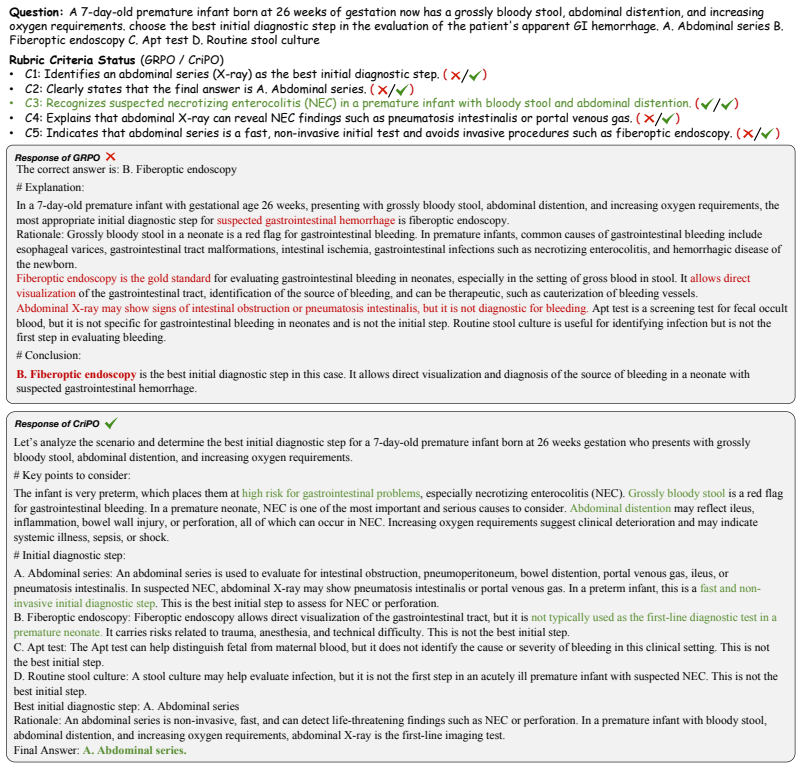
CriPO's central claim is that the two common failure modes of rubric-based RL—unexplored criteria (UC) and suppressed criteria (SC)—can be fixed without introducing a train-inference mismatch by using on-policy self-distillation. For UC, a criterion-injection self-teacher revises the best rollout conditioned on the unmet criteria, and a forward-KL loss is applied only on tokens that contribute most of the divergence. For SC, a counterfactual self-teacher is asked to weaken the satisfied criteria, and token-level probability shifts localize the criterion-relevant spans in negative-advantage rollouts; these tokens get their advantages flipped to a small positive value within the GRPO loss. The
What carries the argument
The core mechanism is a pair of on-policy self-teachers built from the policy itself. For unexplored criteria, a criterion-injection self-teacher (the same model given the previous best response plus the unmet criteria) produces revised distributions, and a cumulative-KL token filter restricts distillation to the informative positions. For suppressed criteria, a counterfactual self-teacher (the same model told to weaken the satisfied criteria) is compared with the student; token positions where the original token's log-probability drops and the teacher confidently prefers an alternative are selected as criterion-relevant, and the GRPO advantage at those tokens is flipped from negative to a s
Load-bearing premise
The suppressed-criteria branch assumes that the counterfactual self-teacher's token-level probability drops reliably identify the tokens encoding the criterion; if that localization is noisy, flipping advantages to positive values reinforces arbitrary or incidental tokens rather than the desired behavior.
What would settle it
A ground-truth evaluation of token localization: annotate the criterion-relevant spans in a set of negative-advantage rollouts, then measure precision/recall of the tokens selected by the counterfactual teacher (Eq. 8). If the selected tokens frequently fall outside the annotated spans, the advantage-flipping benefit should disappear or reverse when compared with random token selection in a controlled experiment.
If this is right
- If the claims hold, rubric-based RL can be made more sample-efficient, hitting the same performance in roughly half the optimization steps, which directly cuts training compute.
- The two-module design suggests that unexplored and suppressed criteria are separable failure modes, so future rubric-RL methods can target each independently.
- The localized forward-KL approach may generalize beyond rubrics: any sparse, criterion-like feedback could be injected via self-teaching without off-policy rollouts.
- The counterfactual advantage-flipping mechanism could be applied to any scalar-reward RL where certain desirable behaviors are masked by aggregate rewards, not just rubric-based settings.
Where Pith is reading between the lines
- Editorial inference: The suppressed-criteria token localization is the most fragile component; the paper only tests random-token selection and one qualitative case, not a ground-truth measure of whether the located tokens truly encode the criterion, so the benefit of CriPO-S could come from indiscriminate positive pressure rather than precise localization.
- Editorial inference: The 2x step-speedup claim could be sensitive to the training budget and judge model; the paper uses 200 steps and GPT-4o-mini for evaluation, so a longer-horizon or different-judge setting might change the efficiency comparison.
- Editorial inference: The method's reliance on a separate judge model (Qwen3-32B) for training means the reported improvements may partly reflect the judge's biases; using a different judge during training might shrink the gap to GRPO.
- Editorial inference: A natural testable extension is to apply CriPO to other open-ended domains such as long-form writing or dialogue, where rubric criteria are equally common and the same failure modes likely appear.
Editorial analysis
A structured set of objections, weighed in public.
Referee Report
Summary. The paper identifies two failure modes in rubric-based GRPO for open-ended LLM tasks: Unexplored Criteria (UC), which receive no optimization signal because no rollout satisfies them, and Suppressed Criteria (SC), where criterion-satisfying rollouts receive non-positive aggregate advantages due to scalar reward aggregation. The authors propose CriPO, which keeps GRPO as the backbone and adds two on-policy self-distillation corrections: (1) a criterion-injection self-teacher that distills missing UC behaviors into the highest-advantage rollout via localized forward-KL, and (2) a counterfactual self-teacher that localizes SC-relevant tokens in negative-advantage rollouts (Eq. 8) and flips their advantages to a small positive value τ_flip. Experiments on RaR-Medicine/RaR-Science and cross-domain benchmarks with Qwen3-1.7B/4B claim consistent improvements over GRPO and HeRL, with roughly 2× fewer optimization steps to reach GRPO's converged performance.
Significance. If the empirical claims hold, CriPO is a useful contribution: it offers a principled, on-policy way to address two real limitations of rubric-based GRPO without the train-inference mismatch of external-guidance rollouts. The problem formulation is clear, the failure-mode statistics (57% SC, 1.8 per sample) are informative, and the ablations show that both the token-filtering and the token-localization choices matter. The paper also includes cross-judge evaluation (GPT-4o-mini vs. Qwen3-32B) and an OOD instruction-following check, which strengthen confidence in the general claims. However, the central empirical support is weakened by the absence of multiple seeds, standard deviations, and significance tests, and the SC branch's mechanism is validated only by a single qualitative case and a random-token ablation, not by a direct measure of token-localization accuracy.
major comments (3)
- [§4.2, Table 1; §4.4, Table 2; §A.2, Table 4] All reported accuracies are from single training runs, with no standard deviations, no multiple seeds, and no significance tests. The main claim 'CriPO improves the average score from 59.2 to 62.4' (+3.2 on Qwen3-1.7B) and the SC-specific gain on Qwen3-4B (+0.8 over CriPO-U, 69.6 vs. 68.8) could be run-to-run noise under typical RL training variance in this setting. The '2× fewer steps' claim in Figure 5 is also based on one trajectory. Please report mean±std over at least 3 seeds, or provide a clear justification for why single-run comparisons are sufficient here (e.g., low variance observed in practice).
- [Eq. (8), §3.2; §4.3 'Case Study'; §4.4 Table 2] The load-bearing premise of the SC branch is that the heuristic in Eq. (8)—tokens where Δ>0 and p_T(y_t) < α·max_v p_T(v)—correctly locates tokens that encode the suppressed criterion. The evidence is one qualitative case (Figure 8) and a random-token ablation (Table 2). The random-token ablation only shows that nonrandom selection matters; it does not show that the selected tokens are criterion-relevant. A heuristic selecting high-entropy tokens, or tokens where the teacher confidently prefers any alternative, could also beat random without isolating the target criterion. Moreover, Appendix B's observation that boundary tokens have large KL and must be masked (Figure 10) indicates that the teacher distribution is contaminated by prompt-revision artifacts; the same contamination could affect the counterfactual comparison in Eq. (8). Please provide a quantitative localization evaluation,
- [§4.4 Table 2; Appendix B (β values)] The method introduces several free hyperparameters (γ=0.95, α=0.1, τ_flip=0.1, β=0.05/0.03, K=3, boundary mask fraction). The paper reports no sensitivity analysis for α, τ_flip, or β, and the β values differ between model sizes with only a one-line mention. Since the SC branch's advantage flipping value τ_flip directly controls how strongly the localized tokens are reinforced, and the UC branch's loss weight β controls the distillation strength, the absence of any robustness check leaves the reader unable to judge whether the reported gains are stable or cherry-picked. Please add at least a small sensitivity sweep for the most critical hyperparameters.
minor comments (6)
- [Figure 1 title] The left panel's legend reads 'Unexplorable Criteria' but the text and main body use 'Unexplored Criteria' (and 'Suppressed Critieria' has a typo). Please unify terminology.
- [Figure 8 caption] The caption text is garbled: 'The teacher primarily shifts its prediction at the token “Avoid”, correctly attributing the blind criterion to the relevant span in the rollout.' The word 'blind' should be 'suppressed' (or similar), and the sentence flow is broken. Please fix.
- [Appendix B, token masking] The first/last 1% token masking is an important design choice that affects the KL-based token selection, but it is not mentioned in the main text's description of Eq. (6) or Eq. (8). Please state this explicitly in Section 3, since it changes the definition of T_u and T_s_i.
- [§3.1, 'Best-Rollout Selection'] The choice to apply UC behavior injection only to the highest-advantage rollout is justified conceptually, but the ablation in Table 2 shows a small drop when removing it (66.4→65.6). The text says this 'suggests' the benefit is real, but the magnitude is close to the single-run noise level. Please temper the wording or add seed variance.
- [§2, Eq. (4)] The zero-advantage suppression case (ΣA_i = 0 ∧ |S_j| < G/2) is defined but never explicitly analyzed in the experiments. Figure 7 reports total SC counts but does not separate negative-advantage from zero-advantage suppression. Reporting this breakdown would make the failure-mode analysis more precise.
- [Appendix A.1, Table 3] OOD instruction-following results show small fluctuations on individual benchmarks (e.g., -0.6 on IFEval for Qwen3-4B CriPO-RM). The conclusion 'does not substantially degrade' is fair, but the differences are within what single-run noise would produce; please avoid over-interpreting these numbers.
Circularity Check
No significant circularity: CriPO is an empirical method evaluated against external benchmarks; no derived quantity reduces to its inputs by construction.
full rationale
This paper is an empirical methods paper rather than a formal derivation, and its central claims are benchmark evaluations. The definitions of unexplored and suppressed criteria (Eqs. 3-4) are descriptive failure-mode characterizations, not quantities fitted to the outcome and then renamed as predictions. The two CriPO interventions—forward-KL behavior injection and counterfactual token-level advantage flipping—are explicitly designed to address those failure modes, but whether they improve final performance is tested on held-out medicine and science benchmarks, including a second judge model, cross-domain sets, and ablations. The self-teacher is the same policy, so the supervision is self-referential in mechanism, which raises a soundness question about whether Eq. 8 accurately localizes criterion-relevant tokens; however, this is an empirical validation concern, not a logical circularity. Nothing in the paper equates the prediction metric to the training signal by construction. There are no load-bearing self-citations, no imported uniqueness theorems, and no renamed known result. The lack of error bars and the qualitative validation of token localization are experimental robustness issues, not circularity.
Axiom & Free-Parameter Ledger
free parameters (6)
- γ (cumulative KL threshold) =
0.95
- α (teacher confidence threshold) =
0.1
- τ_flip (flipped advantage value) =
0.1
- β (OPSD loss weight) =
0.05 for Qwen3-1.7B, 0.03 for Qwen3-4B
- K (max criteria in teacher prompt) =
3
- boundary mask fraction =
first and last 1% of response tokens
axioms (4)
- domain assumption The rubric judge (Qwen3-32B) produces reliable binary criterion scores; UC/SC statistics and rewards rest on this.
- ad hoc to paper Conditioning the policy on 'revise to satisfy missing criteria' prompts produces token-level distributions that reflect the missing (or covered) criterion behavior.
- ad hoc to paper Locally flipping token advantages inside the GRPO clipped surrogate objective is a valid optimization direction.
- domain assumption Group-relative normalization of aggregated rubric rewards is an appropriate backbone for open-ended QA.
invented entities (2)
-
Criterion-injection self-teacher distribution p_T^t = πθ(· | x, C_u, y*_<t)
no independent evidence
-
Counterfactual self-teacher distribution p_T^t = πθ(· | C_s, y_i,<t)
no independent evidence
read the original abstract
Rubric-based RL has recently shown promise in improving LLMs on open-ended tasks. A widely recognized limitation of rubric-based RL is limited exploration: criteria that no rollout manages to satisfy (Unexplored Criteria, UC) receive no optimization signal. Recent methods address this by incorporating rubric information as external guidance during rollout, yet they introduce a train-inference mismatch: the policy is optimized on rollouts produced under external guidance while this guidance is absent at inference time, causing error accumulation through autoregressive decoding. Moreover, these exploration-focused approaches overlook a fundamentally different failure mode that we term Suppressed Criteria (SC) -- criteria that are satisfied by some rollouts yet whose learning signals are lost during optimization because scalar reward aggregation assigns them non-positive aggregate advantages. Our analysis reveals that SC are remarkably prevalent: over 57% of samples exhibit this failure mode throughout training, with an average of 1.8 SC per sample. To simultaneously address both UC and SC without introducing training-inference mismatch, we propose Criterion-Distilled Policy Optimization (CriPO), which enhances rubric-based RL via on-policy self-distillation. For UC, CriPO constructs a criterion-injection self-teacher and computes a localized forward-KL loss to inject missing behaviors into the policy. For SC, CriPO employs a counterfactual self-teacher to locate criterion-relevant tokens in negative-advantage rollouts and flips their token-level advantages to positive values, preserving useful patterns that would otherwise be suppressed. Experiments on medicine and science benchmarks demonstrate that CriPO consistently outperforms rubric-based RL, achieving stronger final performance with approximately $2\times$ fewer optimization steps.
Figures




Reference graph
Works this paper leans on
-
[4]
Deepseek-r1: Incentivizing reasoning capability in llms via reinforcement learning
DeepSeek-AI. Deepseek-r1: Incentivizing reasoning capability in llms via reinforcement learning. CoRR, abs/2501.12948,
-
[5]
Deepresearch bench: A comprehensive benchmark for deep research agents.CoRR, abs/2506.11763,
Mingxuan Du, Benfeng Xu, Chiwei Zhu, Xiaorui Wang, and Zhendong Mao. Deepresearch bench: A comprehensive benchmark for deep research agents.CoRR, abs/2506.11763,
-
[6]
Jiawei Gu, Xuhui Jiang, Zhichao Shi, Hexiang Tan, Xuehao Zhai, Chengjin Xu, Wei Li, Yinghan Shen, Shengjie Ma, Honghao Liu, Yuanzhuo Wang, and Jian Guo. A survey on llm-as-a-judge. CoRR, abs/2411.15594, 2024a. Siyi Gu, Jialin Chen, Sophia Zhou, Arman Cohan, and Rex Ying. Rethinking reward supervision: Rubric-conditioned self-distillation.arXiv preprint ar...
-
[7]
Minillm: Knowledge distillation of large language models
Yuxian Gu, Li Dong, Furu Wei, and Minlie Huang. Minillm: Knowledge distillation of large language models. InICLR, 2024b. Anisha Gunjal, Anthony Wang, Elaine Lau, Vaskar Nath, Bing Liu, and Sean Hendryx. Rubrics as rewards: Reinforcement learning beyond verifiable domains.CoRR, abs/2507.17746,
-
[8]
Reinforcement learning via self-distillation.CoRR, abs/2601.20802,
Jonas Hübotter, Frederike Lübeck, Lejs Behric, Anton Baumann, Marco Bagatella, Daniel Marta, Ido Hakimi, Idan Shenfeld, Thomas Kleine Buening, Carlos Guestrin, and Andreas Krause. Reinforcement learning via self-distillation.CoRR, abs/2601.20802,
-
[9]
Jeonghye Kim, Jiwon Jeon, Dongsheng Li, and Yuqing Yang. Rebellious student: Reversing teacher signals for reasoning exploration with self-distilled RLVR.CoRR, abs/2605.10781, 2026a. Jeonghye Kim, Xufang Luo, Minbeom Kim, Sangmook Lee, Dohyung Kim, Jiwon Jeon, Dongsheng Li, and Yuqing Yang. Why does self-distillation (sometimes) degrade the reasoning capa...
-
[10]
12 Gengsheng Li, Tianyu Yang, Junfeng Fang, Mingyang Song, Mao Zheng, Haiyun Guo, Dan Zhang, Jinqiao Wang, and Tat-Seng Chua. Unifying group-relative and self-distillation policy optimization via sample routing.CoRR, abs/2604.02288, 2026a. Yaxuan Li, Yuxin Zuo, Bingxiang He, Jinqian Zhang, Chaojun Xiao, Cheng Qian, Tianyu Yu, Huan- ang Gao, Wenkai Yang, Z...
- [11]
-
[12]
GPT-4 technical report.CoRR, abs/2303.08774,
OpenAI. GPT-4 technical report.CoRR, abs/2303.08774,
-
[14]
MohammadHossein Rezaei, Anas Mahmoud, Zihao Wang, Utkarsh Tyagi, Advait Gosai, Razvan- Gabriel Dumitru, Aakash Sabharwal, Bing Liu, and Yunzhong He. Rubric-guided self-distillation: Post-training without rubric verifiers.arXiv preprint arXiv:2606.12507,
-
[15]
Proximal policy optimization algorithms.CoRR, abs/1707.06347,
John Schulman, Filip Wolski, Prafulla Dhariwal, Alec Radford, and Oleg Klimov. Proximal policy optimization algorithms.CoRR, abs/1707.06347,
-
[17]
Hybridflow: A flexible and efficient RLHF framework
Guangming Sheng, Chi Zhang, Zilingfeng Ye, Xibin Wu, Wang Zhang, Ru Zhang, Yanghua Peng, Haibin Lin, and Chuan Wu. Hybridflow: A flexible and efficient RLHF framework. InProceedings of the Twentieth European Conference on Computer Systems, EuroSys 2025, Rotterdam, The Netherlands, 30 March 2025 - 3 April 2025, pages 1279–1297,
2025
-
[18]
A survey of on-policy distillation for large language models.CoRR, abs/2604.00626,
Mingyang Song and Mao Zheng. A survey of on-policy distillation for large language models.CoRR, abs/2604.00626,
-
[19]
Qwen3 technical report.CoRR, abs/2505.09388,
Qwen Team. Qwen3 technical report.CoRR, abs/2505.09388,
-
[20]
Checklists are better than reward models for aligning language models.CoRR, abs/2507.18624,
Vijay Viswanathan, Yanchao Sun, Shuang Ma, Xiang Kong, Meng Cao, Graham Neubig, and Tongshuang Wu. Checklists are better than reward models for aligning language models.CoRR, abs/2507.18624,
-
[21]
TRACE: distilling where it matters via token-routed self on-policy alignment.CoRR, abs/2605.10194,
Jiaxuan Wang, Xuan Ouyang, Zhiyu Chen, Yulan Hu, Zheng Pan, Xin Li, and Lan-Zhe Guo. TRACE: distilling where it matters via token-routed self on-policy alignment.CoRR, abs/2605.10194,
-
[22]
Yuxiang Wei, Olivier Duchenne, Jade Copet, Quentin Carbonneaux, Lingming Zhang, Daniel Fried, Gabriel Synnaeve, Rishabh Singh, and Sida I. Wang. SWE-RL: advancing LLM reasoning via reinforcement learning on open software evolution.CoRR, abs/2502.18449,
-
[23]
Writingbench: A comprehensive benchmark for generative writing.CoRR, abs/2503.05244,
Yuning Wu, Jiahao Mei, Ming Yan, Chenliang Li, Shaopeng Lai, Yuran Ren, Zijia Wang, Ji Zhang, Mengyue Wu, Qin Jin, and Fei Huang. Writingbench: A comprehensive benchmark for generative writing.CoRR, abs/2503.05244,
-
[24]
13 Tianze Xu, Yanzhao Zheng, Pengrui Lu, Lyumanshan Ye, Yong Wu, ZhenTao Zhang, YuanQiang Yu, Chao Ma, JiHuai Zhu, Pengfei Liu, Baohua Dong, Hangcheng Zhu, Ruohui Huang, and Gang Yu. Rubrics to tokens: Bridging response-level rubrics and token-level rewards in instruction following tasks.CoRR, abs/2604.02795,
-
[25]
Self-distilled RLVR.CoRR, abs/2604.03128,
Chenxu Yang, Chuanyu Qin, Qingyi Si, Minghui Chen, Naibin Gu, Dingyu Yao, Zheng Lin, Weiping Wang, Jiaqi Wang, and Nan Duan. Self-distilled RLVR.CoRR, abs/2604.03128,
-
[26]
On-policy context distillation for language models.CoRR, abs/2602.12275,
Tianzhu Ye, Li Dong, Xun Wu, Shaohan Huang, and Furu Wei. On-policy context distillation for language models.CoRR, abs/2602.12275,
-
[27]
Yifei, Allen Chang, Chaitanya Malaviya, and Mark Yatskar
Li S. Yifei, Allen Chang, Chaitanya Malaviya, and Mark Yatskar. Researchqa: Evaluating scholarly question answering at scale across 75 fields with survey-mined questions and rubrics.CoRR, abs/2509.00496,
-
[28]
Yang Yue, Zhiqi Chen, Rui Lu, Andrew Zhao, Zhaokai Wang, Yang Yue, Shiji Song, and Gao Huang. Does reinforcement learning really incentivize reasoning capacity in llms beyond the base model? CoRR, abs/2504.13837,
-
[29]
Wenjian Zhang, Kongcheng Zhang, Jiaxin Qi, Baisheng Lai, and Jianqiang Huang. Experience is the best teacher: Motivating effective exploration in reinforcement learning for llms.CoRR, abs/2603.20046,
-
[30]
Siyan Zhao, Zhihui Xie, Mengchen Liu, Jing Huang, Guan Pang, Feiyu Chen, and Aditya Grover. Self- distilled reasoner: On-policy self-distillation for large language models.CoRR, abs/2601.18734,
-
[31]
Yang Zhou, Sunzhu Li, Shunyu Liu, Wenkai Fang, Jiale Zhao, Jingwen Yang, Jianwei Lv, Kongcheng Zhang, Yihe Zhou, Hengtong Lu, Wei Chen, Yan Xie, and Mingli Song. Breaking the explo- ration bottleneck: Rubric-scaffolded reinforcement learning for general LLM reasoning.CoRR, abs/2508.16949,
-
[32]
The many faces of on-policy distillation: Pitfalls, mechanisms, and fixes.CoRR, abs/2605.11182,
Siqi Zhu, Xuyan Ye, Hongyu Lu, Weiye Shi, and Ge Liu. The many faces of on-policy distillation: Pitfalls, mechanisms, and fixes.CoRR, abs/2605.11182,
-
[33]
Table 3:Supplementary OOD evaluation.We report instruction-following performance on IFE- val, IFBench, and MulDimIF
A Supplementary Experiments A.1 OOD Generalization on Instruction Following. Table 3:Supplementary OOD evaluation.We report instruction-following performance on IFE- val, IFBench, and MulDimIF. CriPO-RM and CriPO-RS are trained on RaR-Medicine and RaR-Science, respectively. Model IFEval IFBench MulDimIF Qwen3-1.7B 69.7 18.7 14.9 + CriPO-RM 69.5↓0.2 19.0↑0...
2000
-
[2017]
Zhihong Shao, Peiyi Wang, Qihao Zhu, Runxin Xu, Junxiao Song, Mingchuan Zhang, Y . K. Li, Y . Wu, and Daya Guo. Deepseekmath: Pushing the limits of mathematical reasoning in open language models.CoRR, abs/2402.03300,
-
[2023]
Leyi Pan, Shuchang Tao, Yunpeng Zhai, Lingzhe Zhang, Zhaoyang Liu, Bolin Ding, Aiwei Liu, and Lijie Wen. Rlcsd: Reinforcement learning with contrastive on-policy self-distillation.arXiv preprint arXiv:2606.11709,
-
[2024]
Rahul K. Arora, Jason Wei, Rebecca Soskin Hicks, Preston Bowman, Joaquin Quiñonero Candela, Foivos Tsimpourlas, Michael Sharman, Meghan Shah, Andrea Vallone, Alex Beutel, Johannes Heidecke, and Karan Singhal. Healthbench: Evaluating large language models towards improved human health.CoRR, abs/2505.08775,
-
[2025]
Yukun Chen, Jiaming Li, Longze Chen, Ze Gong, Jingpeng Li, Zhen Qin, Hengyu Chang, Ancheng Xu, Zhihao Yang, Hamid Alinejad-Rokny, Qiang Qu, Bo Zheng, and Min Yang. Rucl: Strati- fied rubric-based curriculum learning for multimodal large language model reasoning.CoRR, abs/2602.21628,
-
[2026]
Process reinforcement through implicit rewards.Trans
Ganqu Cui, Lifan Yuan, Zefan Wang, Hanbin Wang, Yuchen Zhang, Jiacheng Chen, Wendi Li, Bingxiang He, Yuchen Fan, Tianyu Yu, Qixin Xu, Weize Chen, Jiarui Yuan, Huayu Chen, Kaiyan Zhang, Xingtai Lv, Shuo Wang, Yuan Yao, Xu Han, Hao Peng, Yu Cheng, Zhiyuan Liu, Maosong Sun, Bowen Zhou, and Ning Ding. Process reinforcement through implicit rewards.Trans. Mach...
2026
discussion (0)
Sign in with ORCID, Apple, or X to comment. Anyone can read and Pith papers without signing in.