REVIEW 4 major objections 4 minor 17 references
Long-context reasoning models copy prompts instead of reasoning; a grounding reward that rewards key evidence and penalizes distractors improves accuracy and token efficiency.
Reviewed by Pith at T0; open to challenge. T0 means a machine referee read the full paper against a public rubric. the ladder, T0–T4 →
T0 review · deepseek-v4-flash
2026-08-01 12:41 UTC pith:EBBXJUN2
load-bearing objection A solid diagnosis and a plausible but not fully isolated intervention; worth reviewing, but ask for seeds and a length-matched control. the 4 major comments →
Copy Less, Ground More: Overcoming Repetitive Copying in Long-Context Reasoning via Evidence-Aware Reinforcement Learning
The pith
A machine-rendered reading of the paper's core claim, the machinery that carries it, and where it could break.
Core claim
The central claim is that the failure of long-context reasoning models is not copying per se but indiscriminate copying, and that this follows from weak evidence grounding. On a procedurally generated long-context arithmetic benchmark, the authors show that correctly answered samples have significantly higher overlap with key evidence and lower overlap with distractor content than incorrect ones, and that beyond an overlap threshold accuracy collapses while thinking length triples. They then propose GEAR (Grounding Evidence-Aware Reward), which adds α·Overlap_n(y∥x_key) − β·Overlap_n(y∥x_dist) to the accuracy reward, with α=0.1, β=0.3, n=3. Trained on 3,200 evidence-annotated problems spanni
What carries the argument
The central object is the GEAR reward (Eq. 3): an accuracy signal augmented by n-gram overlap with key evidence minus n-gram overlap with distractor context. This turns a binary verifiable reward into a dense, evidence-grounded reward computable from support annotations. A three-stage automated pipeline — analyze document, generate a question constrained to a sampled evidence region, verify by re-answering from that region only — is what makes the reward available for natural-language data.
Load-bearing premise
The causal story stands on the assumption that n-gram overlap between the reasoning trace and annotated evidence spans is a valid and sufficient proxy for 'grounding' — that rewarding overlap with key evidence and penalizing overlap with distractors is what drives the accuracy gains, rather than a generic verbosity or regularization effect.
What would settle it
A direct test: train the same models with a reward that penalizes all repeated n-grams in the trace (including self-repetition) but ignores evidence annotations, or that penalizes copying alone without any grounding reward. If that matches or beats GEAR's accuracy, the evidence-grounding mechanism would be falsified. Similarly, if GEAR-trained models are evaluated on a task where the key evidence is deliberately placed in the distractor region (i.e., mislabeled annotations) and accuracy does not drop, the reward is not actually teaching selective grounding.
If this is right
- If the central claim is right, accuracy-only RL on long contexts leaves a trainable performance margin on the table; evidence-aware reward shaping captures it.
- The larger gains at 128k (4× the training context) imply that the grounding behavior learned at moderate length transfers to much longer inputs.
- Reducing repetitive copying and thinking length simultaneously means accuracy gains do not come at the cost of token efficiency; in fact, efficiency improves.
- The ablation result that grounding alone hurts performance cautions that encouraging evidence use without discouraging irrelevant copying backfires, informing future reward design.
- The method needs no external verifier or retrieval module; n-gram statistics over annotated evidence suffice.
Where Pith is reading between the lines
- The same n-gram reward logic could be extended to other trace-level pathologies, such as self-repetition loops, by penalizing overlap with the model's own previous tokens; the paper observes 'Wait' cycles but never rewards against them.
- The evidence-grounding diagnosis suggests a test for other long-context failure modes: if a model's errors do not correlate with distractor overlap, a different intervention (e.g., memory or retrieval) may be needed.
- Reversing the annotation workflow — picking the evidence region first and constraining question generation to it — is a reusable data-generation trick beyond RL reward shaping.
- The recipe's balance (small α, larger β) may be specific to this setup; whether aggressive distractor suppression transfers to other task families is an open empirical question.
Editorial analysis
A structured set of objections, weighed in public.
Referee Report
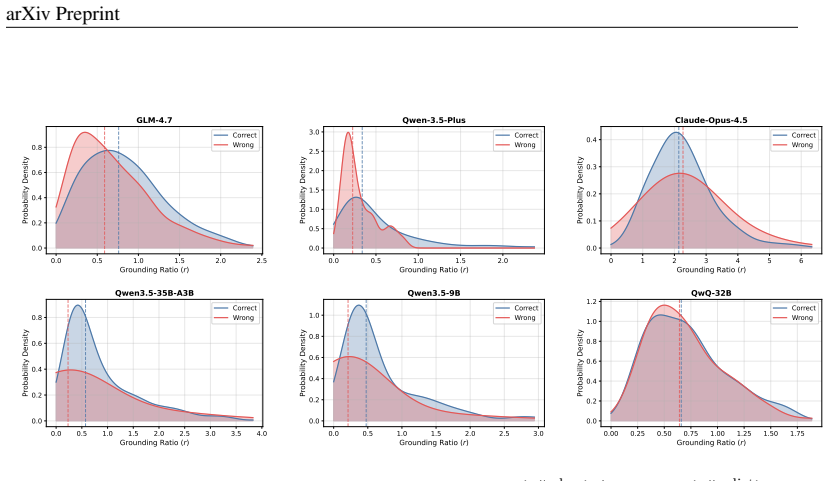
Summary. This paper studies long-context reasoning LLMs and identifies 'repetitive copying'—excessive n-gram overlap between the model's reasoning trace and the input prompt—as a failure mode that grows with context length and correlates with lower accuracy. Using GSM-Infinite's support annotations, the authors define a grounding ratio r = Overlap_10(y‖x_key)/Overlap_10(y‖x_dist) and show that correctly answered samples are more selective. They propose GEAR, which augments a binary accuracy reward with α·Overlap_n(y‖x_key) − β·Overlap_n(y‖x_dist) (Eq. 3), and an automated pipeline that creates evidence-annotated QA pairs from arbitrary documents. Training Qwen3.5-9B, 27B, and 35B-A3B with GSPO on 3.2k samples, they report consistent average gains over accuracy-only GSPO across five held-out benchmarks at 32k and 128k contexts (up to +4.6 at 128k), with reduced 3-gram overlap and thinking length. The central claim is that evidence-aware reward shaping is the active ingredient behind these gains.
Significance. If the main results hold, this is a useful contribution: a simple reward-shaping method that consistently outperforms accuracy-only RL on long-context reasoning benchmarks, with gains that generalize to 4× the training context length, plus a diagnostic linking copying behavior to evidence selectivity. The arithmetic in Table 1 is internally consistent, the evaluation benchmarks are disjoint from the training data, and the 128k results are not used for hyperparameter selection, which makes the core empirical claim reasonably credible. The proposed method is straightforward to reproduce. However, the evidence that the accuracy gains come specifically from improved evidence grounding, rather than from a generic verbosity/regularization effect, is incomplete. The paper lacks a control that isolates the key/distractor distinction, and the mechanism claims in §5.2 and Appendix A.3.2 are partly unsupported. These gaps prevent the paper from being fully convincing in its current form.
major comments (4)
- [§5.2, Table 2, Eq. (3)] The causal mechanism is not isolated from generic verbosity reduction. Table 2 reports only total 3-gram overlap with the whole prompt and thinking length; it does not report post-training key vs. distractor overlap or the grounding ratio r from Eq. (2). Since the distractor penalty β·Overlap(y‖x_dist) is itself an overlap/length penalty, the observed reductions in thinking length and copying could by themselves explain the accuracy gains via regularization. A control that matches GEAR's thinking-length reduction—e.g., a token-length penalty or a uniform overlap penalty without a key/distractor split—is needed to show that the evidence-aware split is the active ingredient. The α=0, β=0.3 row in Table 3 is not an adequate control because it changes the reward scale and suppresses all prompt copying, not just distractor copying.
- [Table 1; Tables 3–4] All RL results are from single runs with no variance estimates. The reported improvements include small effects (e.g., +1.5 points at 32k for Qwen3.5-27B), and the claim of 'consistent gains' across six model–context combinations is load-bearing for the quantitative headline. Without at least three seeds with mean±std, or some other variance evidence, it is unclear whether the smaller gains are within RL training noise.
- [§4.3, Tables 3–4, Table 1] The hyperparameters n=3, α=0.1, β=0.3 are selected by ablations on the same 32k evaluation benchmarks (Ruler, LongBench-v2, BrowseComp-LC, GraphWalks) that appear in Table 1. The 32k gains are therefore partly a product of tuning on the test set and may be optimistic. The 128k results are less affected, but the paper should either select hyperparameters on a separate validation split or explicitly acknowledge and re-analyze the 32k numbers as post-selection.
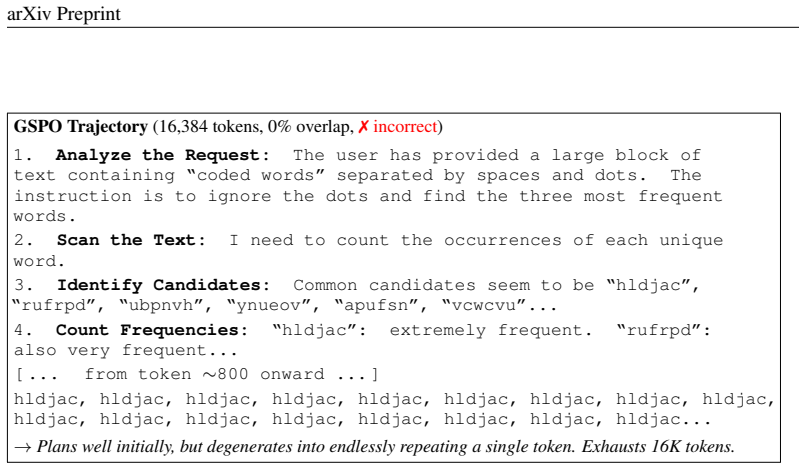
- [Appendix A.3.2; §5.2, Eq. (3)] The case study in A.3.2 attributes GEAR's reduction of self-generated 'Wait' cycles to the distractor penalty, but this penalty in Eq. (3) only fires on n-grams that appear in the prompt (x_dist). Self-generated repetitions of the model's own tokens are not directly penalized. If the intended claim is an indirect behavioral effect, that needs explicit support; as written, this is an internal inconsistency in the mechanism story.
minor comments (4)
- [Eq. (2)] The grounding ratio r is undefined when the denominator Overlap_10(y‖x_dist) is zero. Please specify a convention for such cases (e.g., set r to a large constant or exclude those samples), as this affects the distributions in Figures 3 and 5.
- [§5.1] The sentence 'Conversely, Table 3 we demonstrate that training with only the distractor penalty...' is grammatically malformed and should be rephrased.
- [§5.1, Table 1] The '32k subset' is not precisely defined. It would help to state whether samples with contexts longer than 32k are filtered out or truncated, and how the per-benchmark subset sizes compare across Ruler, LongBench-v2, BrowseComp-LC, and GraphWalks.
- [Table 3] The α=0, β=0.3 row reports an average of 72.0, which is 6.5 points below the accuracy-only GSPO baseline (78.5). The text says only that this is 'worse than the baseline'; the magnitude is striking and deserves a sentence of interpretation.
Circularity Check
Main accuracy claims are held-out and independent; the mechanism confirmation in §5.2 re-measures the shaped reward's own overlap terms, making the grounding explanation partially circular.
specific steps
-
self definitional
[§5.2, Table 2; Eq. 1 and Eq. 3]
"The main results demonstrate that GEAR improves task accuracy, but do these gains stem from the intended mechanism, i.e., reducing indiscriminate copying and improving evidence grounding? Table 2 reports answer-input overlap (token-level 3-gram) and thinking length ... Only when the distractor penalty Rdist is added does the overlap drop below all other configurations: 27.0% on Ruler and 22.6% on LongBench-v2."
The overlap rate reported in Table 2 is the same n-gram overlap statistic from Eq. 1 that the GEAR reward in Eq. 3 directly optimizes: +α·Overlap_n(y||x_key) − β·Overlap_n(y||x_dist). Because the distractor component is most of the prompt, total prompt overlap is largely the quantity being penalized. Thus the observation that GEAR 'reduces repetitive copying' is a direct consequence of the training objective, not an independent confirmation that selective grounding is the causal driver of the accuracy gains. The mechanism claim reduces to showing the model optimized its shaped reward; key/distractor overlaps (the actual grounding ratio, Eq. 2) are not reported for trained models.
full rationale
The central accuracy finding is not circular: Table 1 evaluates GEAR on held-out benchmarks with a binary accuracy signal that is distinct from the shaped training reward, and the gains at 128k from 16k-32k training are not forced by the reward definition. No load-bearing self-citation is used; the Fang et al. reference is only related work. The circularity is confined to §5.2's mechanism confirmation, where the behavioral metric (n-gram overlap with the prompt) is essentially the objective Eq. 3 optimizes. The thinking-length reduction is partly emergent (no explicit length penalty), so not all of the evidence is definitional. Score 4 reflects partial circularity in the mechanism story while the headline result stands independently.
Axiom & Free-Parameter Ledger
free parameters (5)
- α (grounding reward weight) =
0.1
- β (distractor penalty weight) =
0.3
- n-gram size n for training =
3
- Training mixture composition (1k GSM-Infinite, 1k PhantomWiki, 1.2k RedPajama-v2) =
3/8, 3/8, 1/4 of 3,200
- Pipeline chunk size and evidence count (1,024 chars, 1–3 chunks) =
1,024 chars; 1–3 chunks
axioms (5)
- domain assumption n-gram overlap between the reasoning trace and prompt spans is a valid proxy for evidence grounding
- domain assumption GSM-Infinite support indices and op-counts faithfully separate key evidence from distractors and capture task difficulty
- domain assumption The observed correlation between grounding ratio and correctness is causal and actionable via reward shaping
- domain assumption Single-run RL results without seed variance are stable enough to rank configurations
- domain assumption No significant topic leakage between RedPajama-v2 training documents and web-derived eval benchmarks (LongBench-v2, BrowseComp-LC)
read the original abstract
Large language models that generate step-by-step reasoning traces have achieved strong performance on complex tasks, and extending them to long-context settings has emerged as an important frontier. However, we identify a critical failure mode in this regime: \emph{repetitive copying}, where models extensively copy text from the input into their reasoning traces rather than productively solving the problem. We show that this behavior is pervasive across frontier long-context LLMs and intensifies with context length. By separating each prompt into task-relevant key evidence and irrelevant distractor context, we further show that the root cause is insufficient grounding: models copy from the prompt indiscriminately, and those that fail to focus on key evidence are far more likely to answer incorrectly. Motivated by this diagnosis, we propose GEAR (Grounding Evidence-Aware Reward), a reward shaping method that augments the accuracy signal with a grounding reward for overlap with key evidence and a distractor penalty for overlap with irrelevant context. To enable GEAR on natural-language data, we develop an automated pipeline that constructs evidence-annotated training data from arbitrary documents. We validate GEAR across multiple model scales and benchmarks, showing consistent improvements of up to +4.6 average points over standard RL with accuracy-based rewards, with larger gains at longer contexts, while also reducing repetitive copying and thinking length. Our findings suggest that, even as long-context evaluation shifts from simple retrieval toward complex reasoning, accurate grounding in relevant evidence remains an indispensable capability with substantial room for improvement.
Figures





Reference graph
Works this paper leans on
-
[3]
Daya Guo, Dejian Yang, Haowei Zhang, Junxiao Song, Peiyi Wang, Qihao Zhu, Runxin Xu, Ruoyu Zhang, Shirong Ma, Xiao Bi, et al. Deepseek-r1: Incentivizing reasoning capability in llms via reinforcement learning.arXiv preprint arXiv:2501.12948,
-
[4]
Cheng-Ping Hsieh, Simeng Sun, Samuel Kriman, Shantanu Acharya, Dima Rekesh, Fei Jia, Yang Zhang, and Boris Ginsburg. Ruler: What’s the real context size of your long-context language models?arXiv preprint arXiv:2404.06654,
-
[6]
Minxuan Lv, Tiehua Mei, Tanlong Du, Junmin Chen, Zhenpeng Su, Ziyang Chen, Ziqi Wang, Zhennan Wu, Ruotong Pan, Ruiming Tang, et al. Golongrl: Capability-oriented long context reinforcement learning with multitask alignment.arXiv preprint arXiv:2605.19577,
-
[7]
Matéo Mahaut and Francesca Franzon. Repetitions are not all alike: distinct mechanisms sustain repetition in language models.arXiv preprint arXiv:2504.01100,
-
[8]
Bowen Ping, Zijun Chen, Yiyao Yu, Tingfeng Hui, Junchi Yan, and Baobao Chang. Longr: Unleashing long-context reasoning via reinforcement learning with dense utility rewards.arXiv preprint arXiv:2602.05758,
-
[9]
Zhihong Shao, Peiyi Wang, Qihao Zhu, Runxin Xu, Junxiao Song, Xiao Bi, Haowei Zhang, Mingchuan Zhang, YK Li, Yang Wu, et al. Deepseekmath: Pushing the limits of mathemat- ical reasoning in open language models.arXiv preprint arXiv:2402.03300,
-
[11]
URL https://qwenlm.github.io/blog/qwq-32b/. Fanqi Wan, Weizhou Shen, Shengyi Liao, Yingcheng Shi, Chenliang Li, Ziyi Yang, Ji Zhang, Fei Huang, Jingren Zhou, and Ming Yan. Qwenlong-l1: Towards long-context large reasoning models with reinforcement learning.arXiv preprint arXiv:2505.17667,
-
[12]
Siyuan Wang, Gaokai Zhang, Li Lyna Zhang, Ning Shang, Fan Yang, Dongyao Chen, and Mao Yang. Loongrl: Reinforcement learning for advanced reasoning over long contexts.arXiv preprint arXiv:2510.19363,
-
[13]
Browsecomp: A simple yet challenging benchmark for browsing agents.arXiv preprint arXiv:2504.12516,
Jason Wei, Zhiqing Sun, Spencer Papay, Scott McKinney, Jeffrey Han, Isa Fulford, Hyung Won Chung, Alex Tachard Passos, William Fedus, and Amelia Glaese. Browsecomp: A simple yet challenging benchmark for browsing agents.arXiv preprint arXiv:2504.12516,
-
[14]
When more is less: Understanding chain-of-thought length in llms.arXiv preprint arXiv:2502.07266,
Yuyang Wu, Yifei Wang, Ziyu Ye, Tianqi Du, Stefanie Jegelka, and Yisen Wang. When more is less: Understanding chain-of-thought length in llms.arXiv preprint arXiv:2502.07266,
-
[15]
Qwen3 technical report.arXiv preprint arXiv:2505.09388,
An Yang, Anfeng Li, Baosong Yang, Beichen Zhang, Binyuan Hui, Bo Zheng, Bowen Yu, Chang Gao, Chengen Huang, Chenxu Lv, et al. Qwen3 technical report.arXiv preprint arXiv:2505.09388,
-
[16]
Dapo: An open-source llm reinforcement learning system at scale
Qiying Yu, Zheng Zhang, Ruofei Zhu, Yufeng Yuan, Xiaochen Zuo, Yu Yue, Weinan Dai, Tiantian Fan, Gaohong Liu, Lingjun Liu, et al. Dapo: An open-source llm reinforcement learning system at scale. InNeurIPS, 2025a. Tianyu Yu, Bo Ji, Shouli Wang, Shu Yao, Zefan Wang, Ganqu Cui, Lifan Yuan, Ning Ding, Yuan Yao, Zhiyuan Liu, et al. Rlpr: Extrapolating rlvr to ...
-
[17]
Yang Zhou, Hongyi Liu, Zhuoming Chen, Yuandong Tian, and Beidi Chen. Gsm-infinite: How do your llms behave over infinitely increasing context length and reasoning complexity?arXiv preprint arXiv:2502.05252,
-
[2023]
Aixin Liu, Aoxue Mei, Bangcai Lin, Bing Xue, Bingxuan Wang, Bingzheng Xu, Bochao Wu, Bowei Zhang, Chaofan Lin, Chen Dong, et al. Deepseek-v3. 2: Pushing the frontier of open large language models.arXiv preprint arXiv:2512.02556,
-
[2024]
Weizhou Shen, Ziyi Yang, Chenliang Li, Zhiyuan Lu, Miao Peng, Huashan Sun, Yingcheng Shi, Shengyi Liao, Shaopeng Lai, Bo Zhang, et al. Qwenlong-l1. 5: Post-training recipe for long-context reasoning and memory management.arXiv preprint arXiv:2512.12967,
-
[2025]
Team Glm, Aohan Zeng, Bin Xu, Bowen Wang, Chenhui Zhang, Da Yin, Dan Zhang, Diego Rojas, Guanyu Feng, Hanlin Zhao, et al. Chatglm: A family of large language models from glm-130b to glm-4 all tools.arXiv preprint arXiv:2406.12793,
-
[2026]
Xingyu Chen, Jiahao Xu, Tian Liang, Zhiwei He, Jianhui Pang, Dian Yu, Linfeng Song, Qiuzhi Liu, Mengfei Zhou, Zhuosheng Zhang, et al. Do not think that much for 2+ 3=? on the overthinking of o1-like llms.arXiv preprint arXiv:2412.21187,
discussion (0)
Sign in with ORCID, Apple, or X to comment. Anyone can read and Pith papers without signing in.