REVIEW 4 major objections 6 minor
EA-Nav: Learning Safe Visual Navigation Policies with Embodiment Awareness
T0 review · 4 major / 6 minor · reviewed 2026-08-01 · deepseek-v4-flash
Pith's one-line read This paper proposes that visual navigation policies should be conditioned on the agent's body geometry—length, width, height, and maximum traversable step—and paired with risk-perception and trajectory-correction modules; doing so yields sa
desk verdict A useful dataset plus a sensible embodiment-conditioned IL pipeline, but the safety gains rest more on the paper's own augmentation generator than on independent evidence. read the letter →
The pith
A machine-rendered reading of the paper's core claim, the machinery that carries it, and where it could break.
The reading
What carries the argument
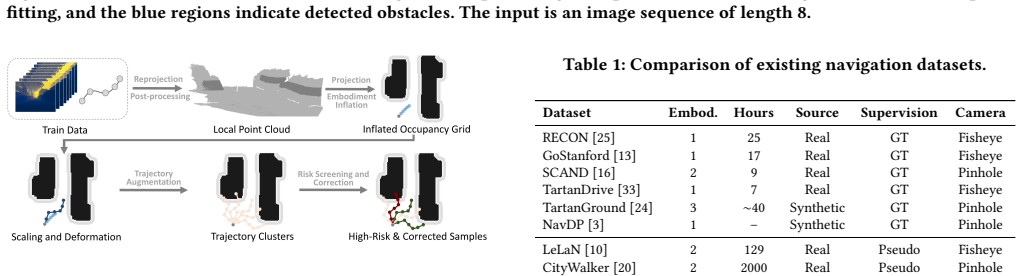
The load-bearing object is the embodiment vector m = [L_b, W_b, H_b, P_max], a four-dimensional geometric description that is injected as a conditional token so the policy can produce different actions from the same image sequence. Around it, the architecture is a decoupled prediction–perception–correction pipeline: a shared input encoder with unidirectional cross-attention keeps the context feature clean; an action head emits velocity commands; a spatial-perception head converts the trajectory into features and regresses the nearest-obstacle distance for each waypoint; and, when risk exceeds a threshold, a correction head classifies nineteen yaw-offset bins covering -45 to +45 degrees and s
What would settle it
Deploy the final policy on a robot with an enlarged embodiment in a cluttered corridor while feeding the spatial-perception module either the paper's monocular-depth-derived occupancy grid or a LiDAR-derived ground-truth grid; if collision rates do not worsen with the pseudo-labels, the safety benefit is not attributable to the geometric labels the augmentation pipeline depends on.
Extended reading notes
Core claim
The paper's central claim is that embodiment geometry—body length, width, height, and maximum traversable step height—should be a condition on which the navigation policy is trained, not a property it must guess from pixels. The claim is established through a two-stage imitation-learning pipeline: an internet-video pretraining stage that injects the embodiment vector as conditional tokens alongside visual, depth, and goal tokens, and a fine-tuning stage in which a spatial-perception head regresses per-waypoint minimum obstacle distance and a risk-aware correction head picks a global yaw offset from discretized bins when the distance falls below a threshold. The same predicted trajectory is s
Load-bearing premise
The collision and correction labels that supervise the risk modules are computed offline from monocular depth estimates and a fitted ground plane; if those pseudo-geometric labels are inaccurate in cluttered scenes, or if the future observations used to build the point cloud are unavailable at deployment, the reported safety gains may come from the augmentation generator rather than from genuine geometry.
Editorial extensions
If this is right
- One imitation-learned policy can serve robots of different sizes if body geometry is supplied as an input; in qualitative runs the small body threads gaps while the large body detours.
- In simulated cluttered scenes, adding the perception and correction modules lifts success rate over the base model by roughly a third, with larger gains where obstacles are denser.
- Training with augmented high-risk trajectories raises recognition of collision samples roughly fivefold over training without augmentation, with near-zero additional false alarms.
- On physical robots, the embodiment-conditioned policy sustains nonzero success when the body is enlarged, while vision-only point-goal and image-goal baselines fall to zero success or full collision.
- The correction head keeps mean deflection between roughly 12 and 18 degrees, allowing recovery from risky trajectories with small, controllable turns even as the feasible angular region shrinks for large bodies.
Reading between the lines
- Because the risk modules are decoupled from the action head, their supervision could in principle be used to audit any existing waypoint-based navigation policy for embodiment-specific collision risk before deployment—a use the paper does not pursue.
- The reliance on offline, future-looking geometry suggests a testable boundary: if the augmentation labels were recomputed from a live sensor (e.g., LiDAR) instead of monocular depth, the reported safety margins would likely change; measuring that shift would separate the conditioning effect from the label-source effect.
- The paper's own limitation points to a concrete extension: adding turning radius and acceleration bounds to the embodiment vector should let the correction head respect non-holonomic constraints, which may matter more for vehicles and legged robots than size alone.
- The pretraining-stage analysis implies that a visual-only model averages over behavioral modes; if so, balancing the internet-video dataset across embodiment categories may matter more than raw hours for cross-embodiment generalization.
Editorial analysis
A structured set of objections, weighed in public.
Referee Report
Summary. The paper proposes EA-Nav, an imitation-learning navigation framework that conditions the policy on embodiment geometry m=[L_b,W_b,H_b,P_max] (Eq. 1) and uses a decoupled action-prediction, spatial-perception, and risk-aware-correction architecture (Eqs. 5--6). Pretraining uses a newly collected ~1,000-hour cross-embodiment internet-video dataset with pseudo-depth labels; fine-tuning augments real navigation data with a risk-trajectory augmentation pipeline (Sec. 3.3) that builds an embodiment-inflated occupancy grid and synthesizes collision trajectories and feasible correction bins. The paper reports spatial-perception metrics on i2Nav, correction metrics on augmented trajectories, simulation results on three scenes, and real-world results with TurtleBot and Unitree Go2, claiming improved success and collision rates over point-goal and image-goal baselines.
Significance. If the claims are fully supported, the paper makes a useful contribution: it introduces a large heterogeneous multi-embodiment pretraining dataset, a practical IL-based alternative to RL for cross-embodiment navigation, and a modular way to inject embodiment geometry into perception and correction. The decoupled training design and the explicit handling of scarce high-risk samples are sensible and potentially reusable. I particularly credit the paper for reporting the limitations in Sec. 5 and Sec. A.6, and for providing results in both simulation and real-world settings. However, the current evidence for the safety-critical submodules is weaker than the narrative suggests: the perception and correction evaluations are based on labels produced by the same augmentation pipeline used for training, and the real-world results are based on only five trials per condition. The central navigation claim is not fully circular, because the simulation comparison in Table 4 is independent of the augmentation generator, but the magnitude of the claimed safety gains is not yet established.
major comments (4)
- [Sec. 4.4 / Sec. 3.3, Table 3] The trajectory-correction evaluation is circular. Sec. 4.4 states: "we use the risk augmentation module to generate collision trajectories and their corresponding correction targets." This is the same module that produces the training supervision for Risk-Aware Correction in Sec. 3.3. Consequently, the CSR and IoU values in Table 3 measure how well the network reproduces the generator's feasible-bin labels, not how well it avoids real obstacles. Because the generator relies on Depth-Anything-3 depth and a RANSAC ground-plane fit, any systematic bias in monocular depth, ground-plane estimation, or cluttered scenes is shared by the training and evaluation labels. In addition, the point-cloud fusion in Sec. 3.3 uses short-horizon future observations that are not available at deployment, making the evaluation task easier than the deployment task. I request an evaluation on independently obta
- [Sec. 4.3, Table 2] The spatial-perception metrics are computed against the same pseudo-geometric targets used to train the module. The augmented condition improves TPR by roughly 5x, but the targets are produced by the same Depth-Anything-3 + RANSAC pipeline described in Sec. 3.3, not by an independent geometric sensor or simulator. If the depth estimates or ground-plane fits are biased, the same bias is present in both training labels and evaluation labels, so high TPR/FAR/MAE values do not establish accurate risk perception in real cluttered scenes. Please add an independent ground-truth comparison, for example simulator depth/occupancy or LiDAR-derived grids, and report perception metrics separately for near/far and cluttered scenarios.
- [Sec. 4.5, Table 5] The real-world comparison is based on only five trials per method and embodiment size, with no variance or confidence intervals. On five trials, a single success/failure changes SR or CR by 0.2, so the differences between 0.8 and 0.6 in Table 5 are well within sampling noise. The statement that the method "maintains a high SR and a low CR" is not statistically supported at this sample size. I also could not find a description of how the Body, Body+, and Body++ embodiment sizes were physically or virtually realized on TurtleBot and Unitree Go2. Please report exact binomial confidence intervals (or more trials) and specify the embodiment-parameter changes used for each condition.
- [Tables 4--5, Sec. 4.5] The baseline comparison mixes point-goal navigation methods (iPlanner, NavDP) with image-goal methods (NoMaD*, ExAug*). Because goal representations and task definitions differ, the reported SR/CR differences may reflect the task formulation rather than navigation quality or embodiment awareness. For example, image-goal methods can fail from goal-image ambiguity rather than lack of embodiment conditioning. Please compare within the same task setting, or clearly separate and interpret the two groups. In addition, the claimed "average performance by approximately 31%" refers to the internal comparison between Ours(w/o corr) and Ours(w/ corr) in Table 4, not to improvements over baselines; this should be stated explicitly to avoid overstatement.
minor comments (6)
- [Sec. 3.1, Eqs. (3), (5), (6)] There are several formatting/notation errors: Eq. (3) has an improperly displayed norm, Eq. (5) shows an inconsistent assignment of \hat d, and Eq. (6) is missing parentheses in the printed text. These should be corrected.
- [Sec. 4.1] The hyperparameters \delta_s (0.5 m) and \tau (correction feasibility threshold) are fixed without sensitivity analysis. Since they directly determine what is counted as a high-risk sample and what correction is selected, please report the results for a small range of threshold values.
- [Table 4] No number of episodes, seeds, or variance measures are reported. Adding mean and std over multiple seeds (or at least episode counts) would make the simulation comparison more reliable.
- [Sec. 4.5 / Ref. [35]] The text refers to the simulation environment as InternUtopia, but reference [35] is titled Grutopia. Please reconcile the naming.
- [Sec. 4.2 / Fig. 5] The t-SNE and loss-curve analysis is suggestive but qualitative. Consider reporting a numeric measure of action ambiguity, such as the variance of action predictions or a conditional-entropy estimate, to support the claim that embodiment tokens reduce ambiguity.
- [Sec. 5 / Appendix A.6] The stated limitation is honest but incomplete: it omits the evaluation limitations discussed above (circular generation of perception/correction labels, small real-world sample size). Adding these caveats would make the limitation section more accurate.
Circularity Check
Correction/perception metrics are evaluated on labels produced by the same risk-augmentation pipeline that generated their training supervision; the headline navigation claim retains independent support from Tables 4-5.
-
self definitional
[Sec. 4.4 / Table 3; Sec. 3.3 (collision candidates and feasible bins)]
"Since collision samples are scarce in real-world data, we use the risk augmentation module to generate collision trajectories and their corresponding correction targets. ... Colliding candidates are treated as risk trajectories, while collision-free candidates define feasible correction bins. These bins provide multi-hot supervision over the discretized correction space, enabling large-scale supervision from limited fine-tuning data."
The evaluation in Table 3 is built from the same Risk Trajectory Augmentation module that supplies the training supervision for Risk-Aware Correction (Eq. 6). The 'feasible correction bins' used as ground truth in the evaluation are, by construction, the outputs of the augmentation module's inflated-occupancy collision check. CSR and IoU therefore measure how well the model reproduces the augmentation generator, not whether the corrected trajectory is safe against independent geometry. This is an in-distribution evaluation of a module trained on the same labels, so the reported correction capability is partially circular.
-
fitted input called prediction
[Sec. 4.3 / Table 2; Sec. 3.3-3.4 (point cloud, ground plane, occupancy grid)]
"Given depth observations, trajectories, and camera intrinsics over the next H timesteps, we fuse them into a robot-centric local point cloud map. ... We then estimate the ground plane and identify obstacles under embodiment constraints. ... obstacle regions are inflated to construct an embodiment-aware occupancy grid for subsequent collision checking. ... short image sequences are fused into local point clouds, from which the ground plane and obstacle regions are extracted to construct geometric supervision."
The perception metrics in Table 2 (TPR/FAR/MAE) are defined against minimum obstacle distances on i2Nav, but the paper does not report an independent LiDAR or simulator ground truth. The same Depth-Anything-3 depth estimations, RANSAC ground-plane fit, and inflated occupancy grid that generate the augmented high-risk training samples are used to construct 'geometric supervision' in Sec. 3.4. Thus the spatial-perception 'predictions' are fitted to a pseudo-label generator and then evaluated against the same generator; the w/ Aug vs w/o Aug comparison quantifies agreement with that generator rather than true geometric safety.
full rationale
The central derivation chain is: pretrain a BC policy on Internet video with embodiment-geometry tokens (Eqs. 1-3), then fine-tune with a decoupled action/perception/correction architecture (Eqs. 5-6) supervised by Risk Trajectory Augmentation (Sec. 3.3). The headline cross-embodiment navigation claim is supported by Table 4, which uses NavDP/InternUtopia simulation assets, and by Table 5, which uses real TurtleBot and Unitree Go2 trials; those environments are external to the augmentation pipeline, so the main claim is not circular. The circularity is component-level: Table 3's correction targets are explicitly generated by the same risk-augmentation module that produces the multi-hot correction labels, and Table 2's perception targets come from the same pseudo-geometric pipeline (Depth-Anything-3 + RANSAC + occupancy inflation) used to create augmented training data. These tables therefore measure in-distribution fit to the label generator, not independent safety. The real-world evidence in Table 5 is too small (five trials per condition) to independently confirm the safety gain, but small sample size is a statistical limitation rather than a circularity. Self-citations are not load-bearing: ExAug is prior work by other authors, and external models (Depth-Anything-3, DINOv3, ConvNeXt) are independent tools. Score 4 reflects one clear construction-level circularity in the correction evaluation, with the central navigation result still carrying independent content; not a 6+ because the headline claim does not reduce to the augmentation generator.
Assumptions & free parameters
free parameters (3)
- Risk threshold δ_s =
0.5 m
- Correction feasibility threshold τ =
not reported
- Augmentation scale sampling α =
sampled around safety coefficient s_d
assumptions (3)
- domain assumption Depth-Anything-3 produces enough geometric accuracy for pseudo-labeling internet video.
- domain assumption RANSAC ground-plane and inflated occupancy grid correctly reflect traversability.
- ad hoc to paper Scale consistency, not metric accuracy, is sufficient for pretraining.
Cite this review
Pith. "Pith review of EA-Nav: Learning Safe Visual Navigation Policies with Embodiment Awareness." pith.science (2026). https://pith.science/paper/FJ2237G5
@misc{pith2026260719880,
  author       = {Pith},
  title        = {Pith review of: EA-Nav: Learning Safe Visual Navigation Policies with Embodiment Awareness},
  year         = {2026},
  howpublished = {\url{https://pith.science/paper/FJ2237G5}},
  note         = {Machine review of arXiv:2607.19880}
}
read the original abstract
Cross-embodiment navigation is a key challenge in embodied intelligence. Due to differences in embodiment, the same visual observation may imply different actions for different agents, making prediction ambiguous when relying solely on vision. Existing studies mainly rely on reinforcement learning, which requires large-scale interaction and careful reward design, making it difficult to support scalable pretraining and real-world adaptation. In contrast, imitation-learning-based approaches remain limited. To address these challenges, we propose an imitation-learning-based embodiment-aware navigation framework with a modular multi-stage design. In pretraining, we construct a cross-embodiment navigation dataset from Internet videos and introduce embodiment geometry as conditional tokens to reduce action ambiguity under the same observation. In fine-tuning, we design a multimodal information injection mechanism based on a decoupled architecture. Specifically, we design a trajectory augmentation strategy to generate high-risk samples, which are used to train spatial perception and risk-aware correction separately, thereby explicitly incorporating embodiment geometry for safe navigation. Experimental results show that the proposed method effectively improves navigation performance across different embodiment settings, demonstrating the effectiveness of incorporating embodiment geometry into embodied navigation.
Figures


Figures from the paper (8 more)


Reviewed August 1, 2026 · model on record in the stance chip above.
Discussion (0). Sign in to comment.