REVIEW 4 major objections 4 minor 25 references
World-model persistence failures are, for a tested class, serving-layer state discard rather than missing model capability.
Reviewed by Pith at T0; open to challenge. T0 means a machine referee read the full paper against a public rubric. the ladder, T0–T4 →
T0 review · deepseek-v4-flash
2026-08-01 07:40 UTC pith:WMZEBUBP
load-bearing objection A solid serving-layer runtime with a real eviction result, wrapped in an attribution claim the experiments do not support. the 4 major comments →
Persistent Computational State: A Session-Centric Runtime for Generative World Models
The pith
A machine-rendered reading of the paper's core claim, the machinery that carries it, and where it could break.
Core claim
On the paper's own terms, the discovery is that the benchmark-measured persistence failure of generative world models is, for the model classes tested, a serving-layer state-discard problem rather than a model capability gap. The argument is constructive: a Markovian observation-conditioned diffusion model, a non-Markovian model with an explicit memory bank, and an autoregressive model with a windowed addressable key-value context are each driven through a leave–return excursion, and restoring the runtime-held state—an observation plus RNG state, a memory bank plus pose and RNG, or a windowed KV context—reproduces the never-left continuation byte-identically on all three, including across a
What carries the argument
Persistent Computational State (PCS) is the central object: the minimal non-recomputable subset of runtime state whose restoration makes the continuation indistinguishable from never having left, defined formally as the smallest S with D(continue(restore(S)), oracle) ≤ ε. It carries the argument by partitioning full runtime state into PCS plus derivable state, where derivable means recomputable by re-running—the crucial fact being that sampling RNG streams, memory banks, and recurrent activations are not derivable, so request-centric 'recompute caching' is not inefficient but incorrect. A fingerprinting procedure discovers PCS per model by ablating each addressable buffer over a leave-and-re
Load-bearing premise
The claim collapses if the benchmark-measured failures occur under a serving setup that already keeps the session alive across departure and return—so nothing was discarded—because then the demonstrated restore is an external-memory splice rather than the recovery of state the runtime threw away.
What would settle it
Instrument the original benchmark harnesses or their serving topology to record whether a departure–return trajectory is one continuous rollout or spans request boundaries that reclaim generator state; also run the paper's snapshot protocol on a hidden-target scenario where a target leaves the view and must return consistent with unobserved evolution. If a single-session rollout already fails, or if saving observation+RNG does not restore the hidden target, the persistence failure is not entirely server discard.
If this is right
- For Markovian observation-conditioned world models, a runtime that saves the last observation and the generator's RNG state at request boundaries reproduces a departed-and-returned scene byte-identically, with no retraining or new memory module.
- Checkpoint and restore cost roughly 0.012 ms against a 1.85 s generation step, so persistent state management is about 0.00035% of wall time—effectively free.
- Externalizing PCS to host memory keeps device memory constant in the number of resident sessions (measured to 1,024), versus a device-bound runtime that would run out of memory near 108 sessions on the same hardware.
- When host memory binds, eviction must be relevance-keyed to the return—the anchor-side frames—not recency; in the paper's measurements relevance holds 16 of 16 worlds where recency holds 6, and in a planner trace recency orphans the search tree while relevance loses none.
- A session outlives the process that created it: restoring PCS from disk in a fresh interpreter yields byte-identical continuation across a process boundary on all three model classes.
Where Pith is reading between the lines
- Extension: if the serving-layer diagnosis holds, benchmark prescriptions for new memory modules and training objectives should be re-scoped; for models that expose a snapshot port, the default recommendation should be a session-centric serving contract, and evaluation harnesses should report whether trajectory requests share a session.
- Extension: the derivability partition suggests a general serving principle for stochastic generators—anything a runtime can recompute is cache, anything it cannot is state, and the two need different eviction and durability policies; this may transfer to other stochastic serviced models beyond video.
- Extension: the paper deliberately excludes hidden events, so a natural decomposition is that PCS fixes recovery of the observed world while a separate hidden-state estimator fixes continued unobserved evolution; combining them predicts that benchmark hidden-target scores improve only when the second component is present.
- Extension: the relevance-over-recency eviction result can be tested as a caching policy in embodied planning systems where returning to a goal or home configuration is the anchor; the prediction is that recency-based caches systematically discard the states a backtracking planner needs, independent of retention budget.
Editorial analysis
A structured set of objections, weighed in public.
Referee Report
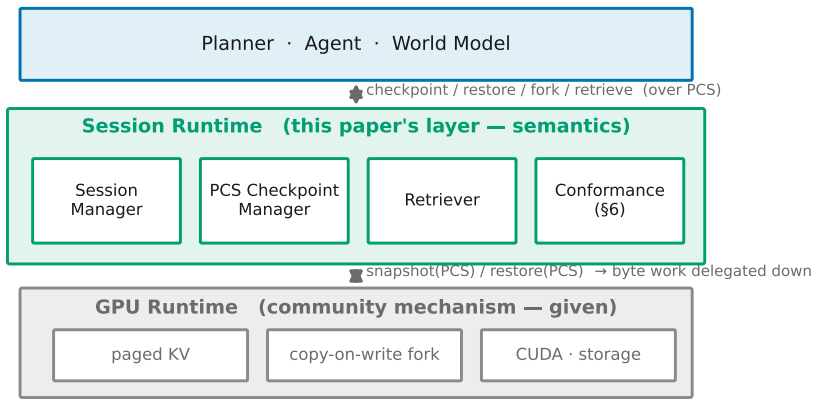
Summary. The paper argues that the persistence failures of video world models measured in MBench and WRBench are, for an important class of models, caused by request-centric serving discarding recoverable runtime state rather than by a model capability gap. It defines Persistent Computational State (PCS) as the minimal non-recomputable state that must survive request boundaries, gives a fingerprinting procedure to discover PCS by measurement, builds a session-centric runtime over it, and reports experiments on three architecturally different models (Cosmos3, WorldMem, Matrix-Game 2.0). The core experimental results are that checkpoint/restore of PCS yields byte-identical or latent-exact continuation versus a never-left oracle, corrupting only the RNG degrades the continuation, durability holds across a process boundary, checkpoint/restore costs ∼0.012 ms versus a 1.85 s generation step, device memory stays constant to 1,024 resident sessions, and relevance-keyed eviction beats recency-keyed eviction under memory pressure.
Significance. If the central claims hold, this is a valuable systems contribution. It identifies a concrete serving-layer failure mode for generative world models, gives a measurable operational definition of world state, and shows that one model-agnostic fingerprinting procedure recovers architecture-specific state sets. The paper is particularly strong in its honest reporting: the RNG-corruption control establishes that the snapshot is load-bearing, cross-process durability is tested with a real process death, the return-time scoring correction is motivated by an explicit failure mode, and the negative scheduling results bound the runtime's claims. The reproducible experiments and explicit limitations are also to the paper's credit. The main concern is not the internal validity of the measured restores but the breadth of the attribution claim: the paper does not establish that the benchmark harnesses actually discard state at request boundaries, so the headline 'the capability was never missing' is not fully supported by the evidence as presented.
major comments (4)
- [§1.2, §7.1, §7.2] The paper's central attribution claim — that the benchmark-measured persistence failure is a runtime state-discard problem rather than a model capability gap — is not supported by the experiments as reported. The authors do not inspect or cite the serving topology of MBench/WRBench. Their own protocol in §7.1 explicitly issues anchor/excursion/return as three requests per session, creating the request boundary that the session-centric runtime then repairs. If a benchmark runs departure-return as one continuous generation call, no runtime state is reclaimed mid-trajectory, and the demonstrated bit-exact restore is an external-memory splice. Furthermore, §1.4 concedes that the runtime does not simulate hidden events, so WRBench's 'what-memory records hidden change' failure cannot be a serving artifact. The authors should either demonstrate that the benchmark harnesses contain at least one
- [Definition 1 / §6] The formal core of the paper is not checkable because the return-consistency metric D is never defined. Definition 1 defines PCS via D(continue(restore(S)), oracle) ≤ ε, and the fingerprinting procedure in §4 depends on D and ε, but Section 6 gives only a claim ('a restore or fork is correct iff the continuation preserves the world'), a threshold ('return-consistency > floor'), and tables of numeric values. There is no formula, algorithm, or operational description of D. As written, neither Definition 1 nor the fingerprinting procedure can be reproduced or verified. The authors need to specify D, the probe distribution, and how ε is chosen.
- [§3, §4 (Fingerprint)] The claimed 'minimality' property of PCS is asserted but not established. The Procedure Fingerprint tests individual necessity by removing one component at a time, then uses a greedy sufficiency fallback. This does not certify that no proper subset of the returned set satisfies D ≤ ε. In particular, if two components are only jointly necessary, the greedy fallback may return both, but no check rules out a redundant member. For the three concrete models, an explicit subset ablation may suffice, but the procedure as stated cannot support the general 'arg min |S|' definition or the text's 'no proper subset suffices' claim.
- [§7.3, Table 2] There is a factor-of-roughly-26 inconsistency in the reported per-session host memory cost, which is load-bearing for the 'host-bound rather than device-bound' scaling claim. Table 2 shows peak host memory of 0.964 MB at S=1, 1.927 MB at S=2, and 15.416 MB at S=16, i.e., approximately 0.96 MB per WorldMem session. The text in §7.3 states 'Host cost is 0.0364 MB per session,' and the 1,024-session sweep reports 0.0373 MB per resident session. The S=256 mock sweep gives 247 MB, again ≈0.96 MB per session. These numbers need to be reconciled, and the configuration that produces each constant must be stated; otherwise the host-memory ceiling and the 2,300× session-count factor are not reproducible.
minor comments (4)
- [Throughout] Typographical issues: 'W e' appears at the start of the abstract and again in §1.1, and several table captions use 'T able' with a spurious space. These should be cleaned up.
- [§7.11] The 'No positional-injection result' paragraph is long and mixes a declared invalid experiment with a new reachability measurement. Consider splitting it: state the invalid experiment in one sentence, and move the Matrix-Game 2.0 reachability/excursion measurement to a separate, clearly labeled result.
- [§7.7] The narrative about the 'pcs-aware' policy is clear in the end, but the mapping from the original four policy names to the CheckpointPolicy×EvictionPolicy×SchedulePolicy triples is described only in prose. A small table or explicit mapping would help readers interpret earlier tables (e.g., Tables 5 and 6).
- [Section 4 / Figure 2] Figure 2's caption says 'state model obtained by measurement, per model' — this is grammatically awkward and slightly confusing. Consider 'the state is obtained by measurement, per model'.
Circularity Check
No significant circularity: core restore results are empirical and externally anchored; the benchmark-attribution gap is an external-validity threat, not a definitional reduction.
full rationale
The paper's central derivation chain is: (1) define PCS as the minimal subset S of runtime state satisfying D(continue(restore(S)), oracle) ≤ ε (Definition 1); (2) discover S by the Fingerprint ablation procedure; (3) verify bit-exact restore against never-left continuations. None of these steps reduces to its inputs. The restore is measured against external anchors (DINOv2 similarity 1.0, pixel error 0.0, torch.equal on latents, cross-process byte identity), and the RNG-corruption control (DINOv2 drops to 0.979/0.970; latent exactness to 3%) demonstrates the snapshot is load-bearing rather than ignored. The PCS definition is operational, not circular: it specifies a target set, and the fingerprint is a search over that definition, not a fitted parameter renamed as a prediction. The paper explicitly disclaims the circular version of its argument in §1.2 ('an argument of the form ... is circular; a bit-exact restore is not') and lists scope limitations (procedure not theorem, three model families, metric-dependence, model-bounded persistence) in §10. The strongest challenge is external validity, not circularity: the paper's own §7.1 protocol 'issued as three requests per session' creates a request boundary, and the paper does not establish that MBench/WRBench harnesses actually discard recoverable state at such boundaries. If those benchmarks run continuous single-session rollouts, nothing was discarded and the bit-exact restore is an external-memory splice. That is a substantive evidential gap about the target benchmarks, but it does not make the paper's own restore results equivalent to their inputs by construction. There are no load-bearing self-citations (references are external; no author-overlap uniqueness theorem is invoked), no ansatz smuggled by citation, and no empirical pattern merely renamed. Hence no significant circularity.
Axiom & Free-Parameter Ledger
free parameters (5)
- tolerance ε =
ε=0 for headline; unstated for fingerprint (D > ε)
- retention fraction =
12%
- conformance metric D and its floor =
not specified
- fingerprint probe distribution =
not specified
- workload arrival/think-time parameters =
Poisson arrivals, think times, leg lengths 4/8/8
axioms (5)
- standard math Deterministic generator: identical (input, RNG, weights) ⇒ identical continuation
- ad hoc to paper The benchmarks' failure occurs under a serving path that discards recoverable state
- domain assumption Sampling RNG is part of world identity — a return is 'the same world' only if the RNG stream matches
- domain assumption A buffer is PCS iff restore reads it (state-vs-witness test)
- domain assumption Re-supplying the saved anchor frame/bank at the return step is a legitimate world-model operation
invented entities (3)
-
Persistent Computational State (PCS)
independent evidence
-
Non-recomputable kernel
independent evidence
-
Session with four invariants (round-trip, durability, fork-independence, snapshot-completeness)
independent evidence
read the original abstract
Generative world models are increasingly driven as simulators: a planner forks a state, rolls out futures, backtracks, and returns to a visited viewpoint. Recent benchmarks establish that current video world models fail this usage, and attribute it to the model, prescribing new architectures and training objectives. We show this attribution is incomplete, and for an important class of models simply wrong. Snapshotting the state the runtime already holds -- an observation plus RNG state, a memory bank, or a windowed KV context, by architecture -- and restoring it after a genuine excursion reproduces the never-left continuation byte-identically on all three; corrupting only the RNG degrades it. The capability was never missing: request-centric serving discarded it, inheriting from language-model serving the assumption that runtime state is recomputable -- but world-model state carries a non-recomputable kernel. We define Persistent Computational State (PCS), the minimal non-recomputable state that must survive across requests, show it can be discovered by measurement, and build a session-centric runtime over it. Checkpoint and restore cost 0.012 ms against a 1.85 s generation step; resident sessions become host- rather than device-bounded (measured to 1,024); and world memory must be evicted by relevance to the return, not recency -- the inverse of LLM practice.
Figures




Reference graph
Works this paper leans on
-
[1]
MBench: A Comprehensive Benchmark on Memory Capability for Video World Models
Shengjun Zhang et al. MBench: A Comprehensive Benchmark on Memory Capability for Video World Models. arXiv:2606.00793, 2026
Pith/arXiv arXiv 2026
-
[2]
Current World Models Lack a Persistent State Core (WRBench). arXiv:2606.20545, 2026
Pith/arXiv arXiv 2026
-
[3]
MemoBench: Benchmarking World Modeling in Dynamically Changing Environments
Haoyu Chen et al. MemoBench: Benchmarking World Modeling in Dynamically Changing Environments. arXiv:2606.27537, 2026
Pith/arXiv arXiv 2026
-
[4]
The Trinity of Consistency as a Defining Principle for General World Models (CoW-Bench)
Jingxuan Wei et al. The Trinity of Consistency as a Defining Principle for General World Models (CoW-Bench). arXiv:2602.23152, 2026
arXiv 2026
-
[5]
A Definition and Roadmap for World Models
Xinyuan Chen et al. A Definition and Roadmap for World Models. arXiv:2607.06401, 2026
Pith/arXiv arXiv 2026
-
[6]
WorldMem: Long-term Consistent World Simulation with Memory
Zeqi Xiao et al. WorldMem: Long-term Consistent World Simulation with Memory. arXiv:2504.12369, 2025
arXiv 2025
-
[7]
Cosmos World Foundation Model Platform for Physical AI
NVIDIA. Cosmos World Foundation Model Platform for Physical AI. arXiv:2501.03575, 2025
Pith/arXiv arXiv 2025
-
[8]
Matrix-Game 2.0: An Open-Source, Real-Time, and Streaming Interactive World Model
Skywork AI. Matrix-Game 2.0: An Open-Source, Real-Time, and Streaming Interactive World Model. arXiv:2508.13009, 2025
Pith/arXiv arXiv 2025
-
[9]
Genie: Generative Interactive Environments
Jake Bruce et al. Genie: Generative Interactive Environments. In ICML, 2024. arXiv:2402.15391
Pith/arXiv arXiv 2024
-
[10]
GAIA-1: A Generative World Model for Autonomous Driving
Anthony Hu et al. GAIA-1: A Generative World Model for Autonomous Driving. arXiv:2309.17080, 2023
Pith/arXiv arXiv 2023
-
[11]
Mastering Diverse Domains through World Models (DreamerV3)
Danijar Hafner et al. Mastering Diverse Domains through World Models (DreamerV3). arXiv:2301.04104, 2023
Pith/arXiv arXiv 2023
-
[12]
Learning Latent Dynamics for Planning from Pixels (PlaNet)
Danijar Hafner et al. Learning Latent Dynamics for Planning from Pixels (PlaNet). In ICML,
-
[13]
Addressable Memory for Closed-Loop Video World Models (WorldTrace)
Xindi Wu, Sven Elflein, James Lucas, Olga Russakovsky, Laura Leal-Taix´ e, Despoina Paschali- dou, Jonathan Lorraine, and Aljoˇ sa Oˇ sep. Addressable Memory for Closed-Loop Video World Models (WorldTrace). In CVPR Workshop on World Models, 2026.https://cvpr26wmas. github.io/papers/wu26addressable.pdf
2026
-
[14]
DINOv2: Learning Robust Visual Features without Supervision
Maxime Oquab et al. DINOv2: Learning Robust Visual Features without Supervision. arXiv:2304.07193, 2023
Pith/arXiv arXiv 2023
-
[15]
Efficient Memory Management for Large Language Model Serving with PagedAttention
Woosuk Kwon et al. Efficient Memory Management for Large Language Model Serving with PagedAttention. In SOSP, 2023. arXiv:2309.06180
Pith/arXiv arXiv 2023
-
[16]
Orca: A Distributed Serving System for Transformer-Based Generative Models
Gyeong-In Yu et al. Orca: A Distributed Serving System for Transformer-Based Generative Models. In OSDI, 2022
2022
-
[17]
Taming Throughput-Latency Tradeoff in LLM Inference with Sarathi- Serve
Amey Agrawal et al. Taming Throughput-Latency Tradeoff in LLM Inference with Sarathi- Serve. In OSDI, 2024. arXiv:2403.02310
Pith/arXiv arXiv 2024
-
[18]
DistServe: Disaggregating Prefill and Decoding for Goodput-optimized Large Language Model Serving
Yinmin Zhong et al. DistServe: Disaggregating Prefill and Decoding for Goodput-optimized Large Language Model Serving. In OSDI, 2024. arXiv:2401.09670
Pith/arXiv arXiv 2024
-
[19]
TensorRT-LLM.https://github.com/NVIDIA/TensorRT-LLM
NVIDIA. TensorRT-LLM.https://github.com/NVIDIA/TensorRT-LLM
-
[20]
SGLang: Efficient Execution of Structured Language Model Programs (RadixAttention)
Lianmin Zheng et al. SGLang: Efficient Execution of Structured Language Model Programs (RadixAttention). arXiv:2312.07104, 2023
Pith/arXiv arXiv 2023
-
[21]
CacheGen: KV Cache Compression and Streaming for Fast Large Language Model Serving
Yuhan Liu et al. CacheGen: KV Cache Compression and Streaming for Fast Large Language Model Serving. In SIGCOMM, 2024. arXiv:2310.07240
Pith/arXiv arXiv 2024
-
[22]
CacheBlend: Fast Large Language Model Serving for RAG with Cached Knowledge Fusion
Jiayi Yao et al. CacheBlend: Fast Large Language Model Serving for RAG with Cached Knowledge Fusion. In EuroSys, 2025. arXiv:2405.16444
Pith/arXiv arXiv 2025
-
[23]
LayerKV: Optimizing Large Language Model Serving with Layer-wise KV Cache Management
Yi Xiong et al. LayerKV: Optimizing Large Language Model Serving with Layer-wise KV Cache Management. arXiv:2410.00428, 2024
Pith/arXiv arXiv 2024
-
[24]
CRIU: Checkpoint/Restore In Userspace.https://criu.org. 29
-
[2019]
arXiv:1811.04551. 28
discussion (0)
Sign in with ORCID, Apple, or X to comment. Anyone can read and Pith papers without signing in.