REVIEW 2 major objections 3 minor 1 cited by
MemoBench shows that no video world model reliably remembers an object once it leaves view; the best score still misses much of the reappearance, and models that barely move the camera inflate their apparent consistency.
Reviewed by Pith at T0; open to challenge. T0 means a machine referee read the full paper against a public rubric. the ladder, T0–T4 →
T0 review · deepseek-v4-flash
2026-08-02 09:55 UTC pith:FMUZ4NF3
load-bearing objection MemoBench is a genuinely new diagnostic benchmark for object permanence in video world models; its ORS headline is more about re-detection than state recovery, but the broader protocol and conclusions hold up. the 2 major comments →
MemoBench: Benchmarking World Modeling in Dynamically Changing Environments
The pith
A machine-rendered reading of the paper's core claim, the machinery that carries it, and where it could break.
Core claim
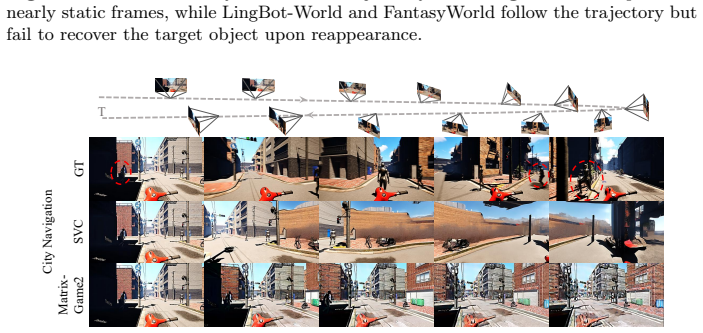
The paper's central claim is that current world-generation models lack a persistent internal representation of objects that leave the field of view. Using a Visible–Disappear–Reappear protocol, MemoBench forces a target object out of view while its physical process continues and then asks the model to regenerate it in its evolved state. The strongest result is that no evaluated model exceeds an Object Reappearance Score of 0.582, and the leading camera-conditioned model still fails to recover the target's updated state upon reappearance. A second key finding is that models without camera conditioning (and sometimes one with it) inflate consistency-oriented metrics by generating near-static v
What carries the argument
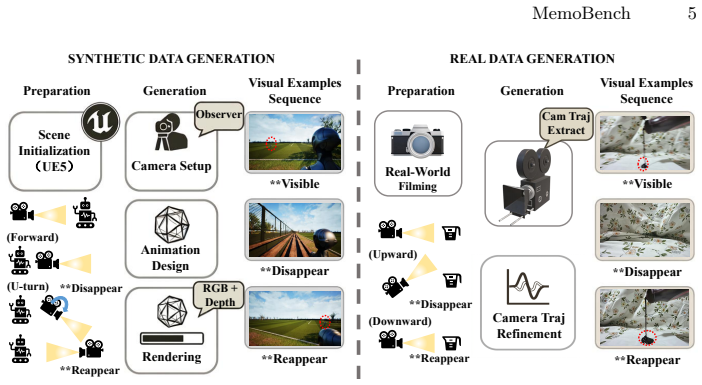
The central device is the disappear-and-reappear clip, divided into three phases by human-annotated keyframes: Visible, Disappeared, and Reappear. The load-bearing metric is the Object Reappearance Score (ORS), defined as the fraction of reappearance frames in which a text-prompted segmentation model detects the target, multiplied by the mean detection confidence across those frames. This detection-based design avoids pixel-level mask alignment when the camera viewpoint at reappearance differs from the original view. The benchmark also pairs ORS with camera-controllability scoring and motion-gated evaluation, so that a model cannot earn memory credit simply by holding the camera still.
Load-bearing premise
The Object Reappearance Score assumes that a text-prompted detector, queried with the object's original description, fairly measures reappearance success even when the physical process changes the object's appearance; a model that correctly shows the dissolved or melted state may score low simply because the prompt no longer matches what it sees.
What would settle it
Re-run the ORS evaluation on the same generated videos but prompt the detector with the expected post-occlusion appearance (e.g., 'molten wax' instead of 'wax candle'). If these re-prompted scores rise to near-perfect while original-prompt scores stay low, the paper's headline claim that all models lack object memory would be overstated.
If this is right
- If the paper is right, video quality and consistency metrics alone cannot certify a model as a world model; occlusion memory must be tested explicitly.
- Camera conditioning alone, even with explicit 3D representations, does not induce object permanence; memory needs its own training objective.
- Consistency scores from near-static video are a false signal, so evaluations should always report camera controllability alongside them.
- Phase-level analysis matters: aggregate fidelity hides the fact that all evaluated models degrade sharply when a previously seen object reappears.
- Future world models will need a persistent state layer that updates hidden objects and is read back out when they re-enter view.
Where Pith is reading between the lines
- The ORS detector is prompted with the object's initial appearance, so a model that correctly renders a melted or dissolved state may be scored low; re-prompting with the expected post-occlusion state would separate detector mismatch from genuine memory failure.
- The 'static camera cheat' suggests a natural correction for future leaderboards: report memory scores normalized by how much viewpoint change the model actually executed.
- The consistent R-phase fidelity drop implies a testable architectural fix: feed the model an explicit state map or scene-graph memory that updates during occlusion, then measure whether ORS rises above the current ceiling.
- If applied as a go/no-go test for embodied deployment, a reasonable threshold (e.g., motion-gated ORS above 0.9) would exclude every current model, clarifying how far the field is from usable world simulation.
Editorial analysis
A structured set of objections, weighed in public.
Referee Report
Summary. MemoBench introduces a benchmark for world-model memory under the disappear-and-reappear paradigm: a target object undergoes a physical process, leaves the field of view, and must be recovered in its updated state when the camera returns. The dataset contains 360 synthetic and real-world clips with annotated visible/disappeared/reappeared phase boundaries, camera trajectories, and depth maps. The evaluation combines automated metrics (e.g., Object Reappearance Score, pixel-level fidelity, camera controllability) with a filtered LLM-based VQA suite across four dimensions. Ten video-generation models are evaluated. The main findings are that no model exceeds an ORS of about 0.58, that camera-inactive models such as LTX-Video inflate consistency-oriented scores by generating near-static video, and that camera conditioning does not by itself yield reliable object memory.
Significance. The benchmark is well constructed in several respects: the three-phase V-D-R decomposition is natural and useful; the authors provide careful keyframe annotation, metric sensitivity analyses (Table S7), motion-gated evaluation (Table S5), pose validation (Table S8), and a failure taxonomy (Table S10). The release of dataset, code, and leaderboard is a genuine contribution, and the paper correctly identifies camera inactivity as a confound for standard consistency metrics. However, the central inference that current models "lack a persistent internal representation of disappeared objects" and "fail to recover the target's updated state" rests on the ORS metric, which is a text-prompted detection score rather than a state-recovery measure. That gap is load-bearing and needs to be addressed before the headline conclusions can be accepted.
major comments (2)
- [§3.4, Eq. (6); §4.1; §5] ORS is defined as a SAM-3 text-prompted detection score: SAM-3 is prompted with the initially visible target description and reports a confidence if a matching mask is found in the Reappear phase. This measures re-detection of the initial appearance, not recovery of the updated state. Consequently, (a) a model that performs a 'State reset' (a failure type listed in Table S10) would receive a high SAM-3 confidence because the prompt matches the reset appearance; and (b) a model that correctly renders a dissolved, melted, or color-changed target may receive a low confidence because the prompt no longer matches. Table S4 probes prompt phrasing but does not test updated-state prompts, and no stratification by state-change magnitude is provided. The headline claim 'no model exceeds 0.582 ORS' therefore does not by itself establish that current models fail to recover the target's updated state
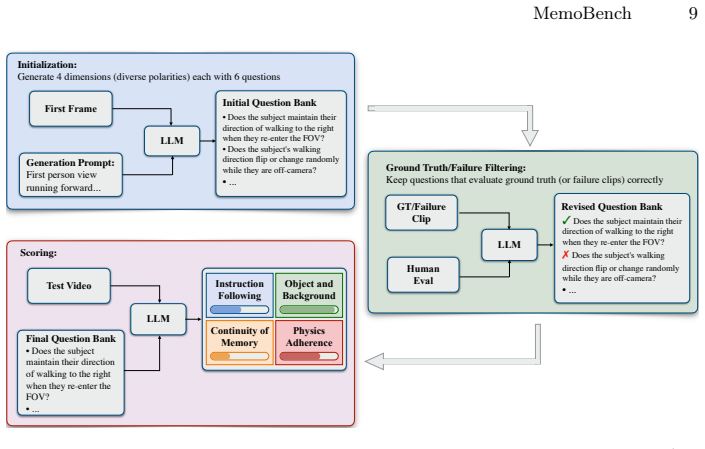
- [§3.5, Fig. 4] The VQA-based evaluation is scored by the same LLM (Gemini-3.1-Pro) that performs ground-truth filtering and failure filtering, and the reported human validation (Fig. 4) is conducted only on ground-truth videos, not on generated outputs. The conclusion that 'Continuity of Memory remains a major bottleneck' therefore rests on LLM judgments that have not been validated on the artifact-rich, state-reset, and hallucination-laden videos the benchmark is designed to distinguish. Please collect human ratings on a stratified sample of generated videos across multiple models and report human--LLM agreement on those clips, not only on ground-truth clips.
minor comments (3)
- [Abstract vs. §4] The abstract says 'eight state-of-the-art models' while the body and Table 2 evaluate ten models. Please make the numbers consistent.
- [Table S3] The caption uses 'Object Revisit Score' while the metric is defined elsewhere as 'Object Reappearance Score' (ORS). Harmonize terminology.
- [§4.1, Table 2 and Table S5] The camera-inactivity discussion is well supported by Table S5, but the main text's 'no model exceeds 0.6 ORS' statement uses aggregate un-gated ORS. Since the paper explicitly argues that camera inactivity inflates consistency scores, consider reporting the motion-gated ORS in the main table or prominently alongside the aggregate values.
Circularity Check
No significant circularity: MemoBench is an externally grounded measurement benchmark whose conclusions are empirical readings of defined metrics, not derivations from their own inputs.
full rationale
MemoBench is a measurement benchmark rather than a derivation chain, and its conclusions are empirical readings of externally defined metrics. The automated scores (Eqs. 2-7) are built from independent off-the-shelf tools—LAION aesthetic predictor, CLIP-IQA+, RAFT-Large, DINOv2, Depth Anything V2, SAM-3, MapAnything, ImageReward—with fixed normalization ranges; no parameter is fit to the scored model outputs and then relabeled as a prediction. The VQA pipeline is validated by GT/failure filtering and a human correlation study (92.9% agreement, Cohen's kappa = 0.85) before being applied to test videos, so the LLM judge's scores are not the same as the question-generation inputs. The only citations with author overlap ([35], [86]) are contextual/implementation support—motivating object permanence and supporting MapAnything's scalability—and neither is load-bearing for the benchmark's central findings. The ORS metric (Eq. 6) detects reappearance via SAM-3 text-prompted segmentation; inferring 'failure to recover the updated state' from low ORS is an interpretive or construct-validity step (ORS does not directly compare the updated physical state), but it is not a circular reduction because ORS is not defined in terms of 'updated state' and the paper separately triangulates with Continuity-of-Memory VQA and per-phase R-phase fidelity drops. Thus no circular step is present, and the appropriate score is 0.
Axiom & Free-Parameter Ledger
free parameters (8)
- Motion Smoothness temperature τ =
0.15
- Foreground patch fraction k in Object Identity Consistency =
40 (top-k%)
- Per-phase aggregation weight α =
0.7
- Camera Controllability stability offset θ0 =
10°
- ORS coverage filtering thresholds =
0.05%–50% (fallback 0.05%–70%)
- SAM-3 prompt template =
Original subject phrase
- VQA question budget =
24 questions/clip (6 per dimension)
- Normalization ranges [a, b] =
Aesthetic [1,10]; CLIP-IQA+ [0,1]; ImageReward [0,1] after sigmoid
axioms (5)
- domain assumption Physical processes continue correctly during the disappearance interval in ground-truth clips; the human-annotated keyframes (d_start, r_start) define the true V/D/R phases.
- domain assumption Linear interpolation of GT frames to generated-video length preserves phase alignment across frame rates, resolutions, and motion speeds.
- domain assumption SAM-3 can detect the target object in its post-occlusion, possibly transformed state using a text description of the initial state.
- domain assumption The LLM judge (Gemini-3.1-Pro) answers are valid proxies for human judgment after GT/failure filtering.
- domain assumption External tool models (RAFT, DINOv2, Depth Anything V2, MapAnything) provide sufficiently accurate signals for the metrics that use them.
read the original abstract
Video generation models aspire to simulate dynamic environments, and several benchmarks now evaluate memory consistency across frames. However, most assess consistency only while the target remains in view, and the few that force objects out of view evaluate static scenes where nothing changes during occlusion. To bridge this gap, we introduce MemoBench, a diagnostic benchmark built around the disappear-and-reappear paradigm in dynamically changing environments: a target object undergoes a physical process, disappears from view, and must be correctly recovered in its updated state upon reappearance. We curate 360 ground-truth clips spanning synthetic and real-world scenes, and design an evaluation suite combining automated metrics with VQA-based assessment across four diagnostic pillars. Evaluation of eight state-of-the-art models reveals key insights and open challenges regarding memory consistency under the disappear-and-reappear paradigm.
Figures



Forward citations
Cited by 1 Pith paper
-
Persistent Computational State: A Session-Centric Runtime for Generative World Models
World-model persistence failures are partly a serving-layer bug: restoring the runtime's non-recomputable state (observation+RNG, memory bank, or KV context) after an excursion reproduces the never-left continuation b...
Reference graph
Works this paper leans on
-
[1]
arXiv preprint arXiv:2406.03520 (2024) 2, 3
Bansal, H., Lin, Z., Xie, T., Zong, Z., Yarom, M., Bitton, Y., Jiang, C., Sun, Y., Chang, K.W., Grover, A.: Videophy: Evaluating physical commonsense for video generation. arXiv preprint arXiv:2406.03520 (2024) 2, 3
Pith/arXiv arXiv 2024
-
[2]
arXiv preprint arXiv:2503.06800 (2025) 3, 4
Bansal, H., Peng, C., Bitton, Y., Goldenberg, R., Grover, A., Chang, K.W.: Videophy-2: A challenging action-centric physical commonsense evaluation in video generation. arXiv preprint arXiv:2503.06800 (2025) 3, 4
Pith/arXiv arXiv 2025
-
[3]
arXiv preprint arXiv:2511.16719 (2025) 7
Carion, N., Gustafson, L., Hu, Y.T., Debnath, S., Hu, R., Suris, D., Ryali, C., Alwala,K.V.,Khedr,H.,Huang,A.,etal.:Sam3:Segmentanythingwithconcepts. arXiv preprint arXiv:2511.16719 (2025) 7
Pith/arXiv arXiv 2025
-
[4]
arXiv preprint arXiv:2310.19512 (2023) 3
Chen, H., Xia, M., He, Y., Zhang, Y., Cun, X., Yang, S., Xing, J., Liu, Y., Chen, Q., Wang, X., et al.: Videocrafter1: Open diffusion models for high-quality video generation. arXiv preprint arXiv:2310.19512 (2023) 3
Pith/arXiv arXiv 2023
-
[5]
In: CVPR (2024) 3
Chen, H., Zhang, Y., Cun, X., Xia, M., Wang, X., Weng, C., Shan, Y.: Videocrafter2: Overcoming data limitations for high-quality video diffusion models. In: CVPR (2024) 3
2024
-
[6]
arXiv preprint arXiv:2304.14404 (2023) 3
Chen, T.S., Lin, C.H., Tseng, H.Y., Lin, T.Y., Yang, M.H.: Motion-conditioned diffusion model for controllable video synthesis. arXiv preprint arXiv:2304.14404 (2023) 3
Pith/arXiv arXiv 2023
-
[7]
In: ICLR (2023) 3
Chen, X., Wang, Y., Zhang, L., Zhuang, S., Ma, X., Yu, J., Wang, Y., Lin, D., Qiao, Y., Liu, Z.: Seine: Short-to-long video diffusion model for generative transition and prediction. In: ICLR (2023) 3
2023
-
[8]
arXiv preprint arXiv:2509.21657 (2025) 3, 10, 11, 14, S2, S3
Dai, Y., Jiang, F., Wang, C., Xu, M., Qi, Y.: Fantasyworld: Geometry- consistent world modeling via unified video and 3d prediction. arXiv preprint arXiv:2509.21657 (2025) 3, 10, 11, 14, S2, S3
arXiv 2025
-
[9]
arXiv preprint arXiv:2504.00983 (2025) 2, 3, 4
Duan, H., Yu, H.X., Chen, S., Fei-Fei, L., Wu, J.: Worldscore: A unified evaluation benchmark for world generation. arXiv preprint arXiv:2504.00983 (2025) 2, 3, 4
arXiv 2025
-
[10]
Feng, Y., Li, Y., Liu, C., Chen, Y., Jiang, F., Huang, Y., Hua, H., Yuan, Z., Zheng, K., Niu, L., et al.: Visual aesthetic benchmark: Can frontier models judge beauty? arXiv preprint arXiv:2605.12684 (2026) 8
Pith/arXiv arXiv 2026
-
[11]
In: CVPR (2026) 3
Ge, X., Pan, Y., Zhang, Y., Li, X., Zhang, W., Zhang, D., Wan, Z., Lin, X., Zhang, X., Liang, J., et al.: Airsim360: A panoramic simulation platform within drone view. In: CVPR (2026) 3
2026
-
[12]
Google: Gemini 3.1 pro (2026),https://blog.google/innovation- and- ai/ models- and- research/gemini- models/gemini- 3- 1- pro/, accessed: 2026-03-02 8
2026
-
[13]
arXiv preprint arXiv:1803.10122 (2018) 1, 3
Ha, D., Schmidhuber, J.: World models. arXiv preprint arXiv:1803.10122 (2018) 1, 3
Pith/arXiv arXiv 2018
-
[14]
arXiv preprint arXiv:2501.00103 (2024) 3, 10, 11, 14, S2, S3
HaCohen, Y., Chiprut, N., Brazowski, B., Shalem, D., Moshe, D., Richardson, E., Levin, E., Shiran, G., Zabari, N., Gordon, O., et al.: Ltx-video: Realtime video latent diffusion. arXiv preprint arXiv:2501.00103 (2024) 3, 10, 11, 14, S2, S3
Pith/arXiv arXiv 2024
-
[15]
arXiv preprint arXiv:2301.04104 (2023) 1, 3
Hafner, D., Pasukonis, J., Ba, J., Lillicrap, T.: Mastering diverse domains through world models. arXiv preprint arXiv:2301.04104 (2023) 1, 3
Pith/arXiv arXiv 2023
-
[16]
He, H., Xu, Y., Guo, Y., Wetzstein, G., Dai, B., Li, H., Yang, C.: Cameractrl: En- ablingcameracontrolfortext-to-videogeneration.arXivpreprintarXiv:2404.02101 (2024) 3
Pith/arXiv arXiv 2024
-
[17]
arXiv preprint arXiv:2508.13009 (2025) 10, 11, 14, S2, S3 MemoBench 17
He, X., Peng, C., Liu, Z., Wang, B., Zhang, Y., Cui, Q., Kang, F., Jiang, B., An, M., Ren, Y., et al.: Matrix-game 2.0: An open-source real-time and streaming interactive world model. arXiv preprint arXiv:2508.13009 (2025) 10, 11, 14, S2, S3 MemoBench 17
Pith/arXiv arXiv 2025
-
[18]
arXiv preprint arXiv:2211.13221 (2022) 3
He, Y., Yang, T., Zhang, Y., Shan, Y., Chen, Q.: Latent video diffusion models for high-fidelity long video generation. arXiv preprint arXiv:2211.13221 (2022) 3
Pith/arXiv arXiv 2022
-
[19]
Ho, J., Salimans, T., Gritsenko, A., Chan, W., Norouzi, M., Fleet, D.J.: Video diffusion models. Adv. Neural Inform. Process. Syst. (2022) 3
2022
-
[20]
Hore, A., Ziou, D.: Image quality metrics: Psnr vs. ssim. In: ICPR (2010) 8
2010
-
[21]
In: CVPR (2023) 8
Hu, Y., Hua, H., Yang, Z., Shi, W., Smith, N.A., Luo, J.: Promptcap: Prompt- guided image captioning for vqa with gpt-3. In: CVPR (2023) 8
2023
-
[22]
In: CVPR (2023) 8
Hu, Y., Liu, B., Kasai, J., Wang, Y., Ostendorf, M., Krishna, R., Smith, N.A.: Tifa: Accurate and interpretable text-to-image faithfulness evaluation with ques- tion answering. In: CVPR (2023) 8
2023
-
[23]
In: ECCV (2024) 8
Hua, H., Shi, J., Kafle, K., Jenni, S., Zhang, D., Collomosse, J., Cohen, S., Luo, J.: Finematch: Aspect-based fine-grained image and text mismatch detection and correction. In: ECCV (2024) 8
2024
-
[24]
arXiv preprint arXiv:2410.09733 (2024) 8
Hua, H., Tang, Y., Zeng, Z., Cao, L., Yang, Z., He, H., Xu, C., Luo, J.: Mmcompo- sition: Revisiting the compositionality of pre-trained vision-language models. arXiv preprint arXiv:2410.09733 (2024) 8
Pith/arXiv arXiv 2024
-
[25]
arXiv preprint arXiv:2505.19415 (2025) 8
Hua, H., Zeng, Z., Song, Y., Tang, Y., He, L., Aliaga, D., Xiong, W., Luo, J.: Mmig-bench: Towards comprehensive and explainable evaluation of multi-modal image generation models. arXiv preprint arXiv:2505.19415 (2025) 8
Pith/arXiv arXiv 2025
-
[26]
In: CVPR (2024) 2, 3, 4, 6
Huang, Z., He, Y., Yu, J., Zhang, F., Si, C., Jiang, Y., Zhang, Y., Wu, T., Jin, Q., Chanpaisit, N., et al.: Vbench: Comprehensive benchmark suite for video genera- tive models. In: CVPR (2024) 2, 3, 4, 6
2024
-
[27]
arXiv preprint (2025) 3, 10, 11, 14, S2, S3
HunyuanWorld, T.: Hy-world 1.5: A systematic framework for interactive world modeling with real-time latency and geometric consistency. arXiv preprint (2025) 3, 10, 11, 14, S2, S3
2025
-
[28]
arXiv preprint arXiv:2411.02385 (2024) 3
Kang, B., Yue, Y., Lu, R., Lin, Z., Zhao, Y., Wang, K., Huang, G., Feng, J.: How far is video generation from world model: A physical law perspective. arXiv preprint arXiv:2411.02385 (2024) 3
Pith/arXiv arXiv 2024
-
[29]
arXiv preprint arXiv:2509.13414 (2025) 5, 8
Keetha, N., Müller, N., Schönberger, J., Porzi, L., Zhang, Y., Fischer, T., Knapitsch, A., Zauss, D., Weber, E., Antunes, N., et al.: Mapanything: Univer- sal feed-forward metric 3d reconstruction. arXiv preprint arXiv:2509.13414 (2025) 5, 8
Pith/arXiv arXiv 2025
-
[30]
Kuaishou: Kling (2024),https://kling.kuaishou.com/en, accessed: 2026-03-01 3
2024
-
[31]
arXiv preprint arXiv:2502.20694 (2025) 2, 3, 4
Li, D., Fang, Y., Chen, Y., Yang, S., Cao, S., Wong, J., Luo, M., Wang, X., Yin, H., Gonzalez, J.E., et al.: Worldmodelbench: Judging video generation models as world models. arXiv preprint arXiv:2502.20694 (2025) 2, 3, 4
Pith/arXiv arXiv 2025
-
[32]
arXiv preprint arXiv:2506.17201 (2025) 3, 10, 11, 14, S2, S3
Li, J., Tang, J., Xu, Z., Wu, L., Zhou, Y., Shao, S., Yu, T., Cao, Z., Lu, Q.: Hunyuan-gamecraft: High-dynamic interactive game video generation with hybrid history condition. arXiv preprint arXiv:2506.17201 (2025) 3, 10, 11, 14, S2, S3
Pith/arXiv arXiv 2025
-
[33]
arXiv preprint arXiv:2601.03444 (2026) 8
Li, W., Zhao, M., Dong, W., Cai, J., Wei, Y., Pocress, M., Li, Y., Yuan, W., Wang, X., Hou, R., et al.: Grading scale impact on llm-as-a-judge: Human-llm alignment is highest on 0-5 grading scale. arXiv preprint arXiv:2601.03444 (2026) 8
arXiv 2026
-
[34]
Authorea Preprints (2026) 3
Li, Y., Meng, S., Yang, C., Feng, W., Liu, J., An, Z., Wang, Y., Tian, Y.: A comprehensive survey of interaction techniques in 3d scene generation. Authorea Preprints (2026) 3
2026
-
[35]
arXiv preprint arXiv:2601.01075 (2026) 2 18 H
Lillemark, H.J., Huang, B., Zhan, F., Du, Y., Keller, T.A.: Flow equivariant world models: Memory for partially observed dynamic environments. arXiv preprint arXiv:2601.01075 (2026) 2 18 H. Chen et al
Pith/arXiv arXiv 2026
-
[36]
arXiv preprint arXiv:2412.00131 (2024) 3
Lin, B., Ge, Y., Cheng, X., Li, Z., Zhu, B., Wang, S., He, X., Ye, Y., Yuan, S., Chen, L., et al.: Open-sora plan: Open-source large video generation model. arXiv preprint arXiv:2412.00131 (2024) 3
Pith/arXiv arXiv 2024
-
[37]
In: CVPR (2026) 3
Lin, X., Song, M., Zhang, D., Lu, W., Li, H., Du, B., Yang, M.H., Nguyen, T., Qi, L.: Depth any panoramas: A foundation model for panoramic depth estimation. In: CVPR (2026) 3
2026
-
[38]
arXiv preprint arXiv:2404.01291 (2024) 8
Lin, Z., Pathak, D., Li, B., Li, J., Xia, X., Neubig, G., Zhang, P., Ramanan, D.: Evaluating text-to-visual generation with image-to-text generation. arXiv preprint arXiv:2404.01291 (2024) 8
Pith/arXiv arXiv 2024
-
[39]
arXiv preprint arXiv:2603.06022 (2026) 3
Liu, C., Wang, X., Lin, Q., Xiao, A., Chen, H., Wen, S., Zhang, H., Qi, L., Yang, M.H., Jeni, L.A., et al.: Mosiv: Multi-object system identification from videos. arXiv preprint arXiv:2603.06022 (2026) 3
arXiv 2026
-
[40]
In: Proceedings of the AAAI Conference on Artificial Intelligence (2026) 3
Liu,M.,Liu,J.,Zhang,Y.,Li,J.,Yang,M.Y.,Nex,F.,Cheng,H.:4dstr:Advancing generative 4d gaussians with spatial-temporal rectification for high-quality and consistent 4d generation. In: Proceedings of the AAAI Conference on Artificial Intelligence (2026) 3
2026
-
[41]
arXiv preprint arXiv:2604.04198 (2026) 3
Liu, M., Zhang, D., Liu, J., Cui, J., Xie, H., Chen, G., Ye, H., Yang, M.Y., Nex, F., Cheng, H.: Driveva: Video action models are zero-shot drivers. arXiv preprint arXiv:2604.04198 (2026) 3
Pith/arXiv arXiv 2026
-
[42]
arXiv preprint arXiv:2402.008271(2024) 3
Liu, P., Song, L., Zhang, D., Hua, H., Tang, Y., Tu, H., Luo, J., Xu, C.: Emo- avatar: Efficient monocular video style avatar through texture rendering. arXiv preprint arXiv:2402.008271(2024) 3
Pith/arXiv arXiv 2024
-
[43]
Liu, Y., Li, L., Ren, S., Gao, R., Li, S., Chen, S., Sun, X., Hou, L.: Fetv: A benchmark for fine-grained evaluation of open-domain text-to-video generation. Adv. Neural Inform. Process. Syst. (2023) 3
2023
-
[44]
arXiv preprint arXiv:2603.30045 (2026) 3
Liu, Y., Lin, X., Li, X., Yang, B., Wang, C., Sunkavalli, K., Hold-Geoffroy, Y., Tan, H., Zhang, K., Xie, X., et al.: Omniroam: World wandering via long-horizon panoramic video generation. arXiv preprint arXiv:2603.30045 (2026) 3
arXiv 2026
-
[45]
Luma AI: Luma dream machine (2024),https://lumalabs.ai/dream-machine, accessed: 2026-03-01 3
2024
-
[46]
arXiv preprint arXiv:2303.08320 (2023) 3
Luo, Z., Chen, D., Zhang, Y., Huang, Y., Wang, L., Shen, Y., Zhao, D., Zhou, J., Tan, T.: Videofusion: Decomposed diffusion models for high-quality video genera- tion. arXiv preprint arXiv:2303.08320 (2023) 3
Pith/arXiv arXiv 2023
-
[47]
In: ICCV (2025) 8
Ma, W., Chen, H., Zhang, G., Chou, Y.C., Chen, J., de Melo, C., Yuille, A.: 3dsrbench: A comprehensive 3d spatial reasoning benchmark. In: ICCV (2025) 8
2025
-
[48]
OpenAI: Sora (2024),https://openai.com/index/sora/, accessed: 2026-03-01 3
2024
-
[49]
OpenAI: Sora2 (2025),https://openai.com/index/sora-2/, accessed: 2026-03-01 3
2025
-
[50]
arXiv preprint arXiv:2304.07193 (2023) 6
Oquab, M., Darcet, T., Moutakanni, T., Vo, H., Szafraniec, M., Khalidov, V., Fernandez, P., Haziza, D., Massa, F., El-Nouby, A., et al.: Dinov2: Learning robust visual features without supervision. arXiv preprint arXiv:2304.07193 (2023) 6
Pith/arXiv arXiv 2023
-
[51]
arXiv preprint arXiv:2503.09642 (2025) 1, 3, 10, 11, 14, S2, S3
Peng, X., Zheng, Z., Shen, C., Young, T., Guo, X., Wang, B., Xu, H., Liu, H., Jiang, M., Li, W., et al.: Open-sora 2.0: Training a commercial-level video generation model in 200 k. arXiv preprint arXiv:2503.09642 (2025) 1, 3, 10, 11, 14, S2, S3
Pith/arXiv arXiv 2025
-
[52]
arXiv preprint arXiv:2410.18072 (2024) 3, 4
Qin, Y., Shi, Z., Yu, J., Wang, X., Zhou, E., Li, L., Yin, Z., Liu, X., Sheng, L., Shao, J., et al.: Worldsimbench: Towards video generation models as world simulators. arXiv preprint arXiv:2410.18072 (2024) 3, 4
Pith/arXiv arXiv 2024
-
[53]
com / research / introducing-gen-3-alpha, accessed: 2026-03-01 3 MemoBench 19
Runway ML: Gen-3 alpha (2024),https : / / runwayml . com / research / introducing-gen-3-alpha, accessed: 2026-03-01 3 MemoBench 19
2024
-
[54]
Schuhmann, C., Beaumont, R., Vencu, R., Gordon, C., Wightman, R., Cherti, M., Coombes, T., Katta, A., Mullis, C., Wortsman, M., et al.: Laion-5b: An open large- scale dataset for training next generation image-text models. Adv. Neural Inform. Process. Syst. (2022) 6
2022
-
[55]
arXiv preprint arXiv:2209.14792 (2022) 3
Singer, U., Polyak, A., Hayes, T., Yin, X., An, J., Zhang, S., Hu, Q., Yang, H., Ashual, O., Gafni, O., et al.: Make-a-video: Text-to-video generation without text- video data. arXiv preprint arXiv:2209.14792 (2022) 3
Pith/arXiv arXiv 2022
-
[56]
In: CVPR (2025) 3
Sun, K., Huang, K., Liu, X., Wu, Y., Xu, Z., Li, Z., Liu, X.: T2v-compbench: A comprehensive benchmark for compositional text-to-video generation. In: CVPR (2025) 3
2025
-
[57]
arXiv preprint arXiv:2601.20540 (2026) 1, 3, 10, 11, 14, S2
Team, R., Gao, Z., Wang, Q., Zeng, Y., Zhu, J., Cheng, K.L., Li, Y., Wang, H., Xu, Y., Ma, S., Chen, Y., Liu, J., Cheng, Y., Yao, Y., Zhu, J., Meng, Y., Zheng, K., Bai, Q., Chen, J., Shen, Z., Yu, Y., Zhu, X., Shen, Y., Ouyang, H.: Advancing open-source world models. arXiv preprint arXiv:2601.20540 (2026) 1, 3, 10, 11, 14, S2
Pith/arXiv arXiv 2026
-
[58]
In: ECCV (2020) 6
Teed, Z., Deng, J.: Raft: Recurrent all-pairs field transforms for optical flow. In: ECCV (2020) 6
2020
-
[59]
In: ECCV (2024) 3
Voleti, V., Yao, C.H., Boss, M., Letts, A., Pankratz, D., Tochilkin, D., Laforte, C., Rombach, R., Jampani, V.: Sv3d: Novel multi-view synthesis and 3d generation from a single image using latent video diffusion. In: ECCV (2024) 3
2024
-
[60]
arXiv preprint arXiv:2503.20314 (2025) 3, 10, 11, 14, S2
Wan, T., Wang, A., Ai, B., Wen, B., Mao, C., Xie, C.W., Chen, D., Yu, F., Zhao, H., Yang, J., et al.: Wan: Open and advanced large-scale video generative models. arXiv preprint arXiv:2503.20314 (2025) 3, 10, 11, 14, S2
Pith/arXiv arXiv 2025
-
[61]
arXiv preprint arXiv:2605.13169 (2026) 8
Wang, C., Lin, X., Liu, J., Liu, Y., Wang, Z., Qi, D., Yan, Y., Chen, X.: PanoWorld: Towards spatial supersensing in 360-degree panorama world. arXiv preprint arXiv:2605.13169 (2026) 8
Pith/arXiv arXiv 2026
-
[62]
In: AAAI (2023) 6
Wang, J., Chan, K.C., Loy, C.C.: Exploring clip for assessing the look and feel of images. In: AAAI (2023) 6
2023
-
[63]
arXiv preprint arXiv:2308.06571 (2023) 3
Wang, J., Yuan, H., Chen, D., Zhang, Y., Wang, X., Zhang, S.: Modelscope text- to-video technical report. arXiv preprint arXiv:2308.06571 (2023) 3
Pith/arXiv arXiv 2023
-
[64]
arXiv preprint arXiv:2506.19291 (2025) 3
Wang, X., Zhao, Y., Ye, B., Shan, X., Lyu, W., Qi, L., Chan, K.C., Li, Y., Yang, M.H.: Holigs: Holistic gaussian splatting for embodied view synthesis. arXiv preprint arXiv:2506.19291 (2025) 3
Pith/arXiv arXiv 2025
-
[65]
IJCV (2025) 3
Wang, Y., Chen, X., Ma, X., Zhou, S., Huang, Z., Wang, Y., Yang, C., He, Y., Yu, J., Yang, P., et al.: Lavie: High-quality video generation with cascaded latent diffusion models. IJCV (2025) 3
2025
-
[66]
IEEE TIP (2004) 8
Wang, Z., Bovik, A.C., Sheikh, H.R., Simoncelli, E.P.: Image quality assessment: from error visibility to structural similarity. IEEE TIP (2004) 8
2004
-
[67]
In: SIGGRAPH (2024) 3
Wang,Z.,Yuan,Z.,Wang,X.,Li,Y.,Chen,T.,Xia,M.,Luo,P.,Shan,Y.:Motionc- trl: A unified and flexible motion controller for video generation. In: SIGGRAPH (2024) 3
2024
-
[68]
arXiv preprint arXiv:2406.09455 (2024) 3
Xiang, J., Liu, G., Gu, Y., Gao, Q., Ning, Y., Zha, Y., Feng, Z., Tao, T., Hao, S., Shi, Y., et al.: Pandora: Towards general world model with natural language actions and video states. arXiv preprint arXiv:2406.09455 (2024) 3
Pith/arXiv arXiv 2024
-
[69]
In: ECCV (2024) 3
Xing,J.,Xia,M.,Zhang,Y.,Chen,H.,Yu,W.,Liu,H.,Liu,G.,Wang,X.,Shan,Y., Wong, T.T.: Dynamicrafter: Animating open-domain images with video diffusion priors. In: ECCV (2024) 3
2024
-
[70]
arXiv preprint arXiv:2406.02509 (2024) 3 20 H
Xu, D., Nie, W., Liu, C., Liu, S., Kautz, J., Wang, Z., Vahdat, A.: Camco: Camera-controllable 3d-consistent image-to-video generation. arXiv preprint arXiv:2406.02509 (2024) 3 20 H. Chen et al
Pith/arXiv arXiv 2024
-
[71]
Xu, J., Liu, X., Wu, Y., Tong, Y., Li, Q., Ding, M., Tang, J., Dong, Y.: Imagere- ward: Learning and evaluating human preferences for text-to-image generation. Adv. Neural Inform. Process. Syst. (2023) 8
2023
-
[72]
Yang, L., Kang, B., Huang, Z., Zhao, Z., Xu, X., Feng, J., Zhao, H.: Depth anything v2. Adv. Neural Inform. Process. Syst. (2024) 7
2024
-
[73]
arXiv preprint arXiv:2408.06072 (2024) 3, 10, 11, 14, S2, S3
Yang, Z., Teng, J., Zheng, W., Ding, M., Huang, S., Xu, J., Yang, Y., Hong, W., Zhang, X., Feng, G., et al.: Cogvideox: Text-to-video diffusion models with an expert transformer. arXiv preprint arXiv:2408.06072 (2024) 3, 10, 11, 14, S2, S3
Pith/arXiv arXiv 2024
-
[74]
arXiv preprint arXiv:2409.02048 (2024) 3
Yu, W., Xing, J., Yuan, L., Hu, W., Li, X., Huang, Z., Gao, X., Wong, T.T., Shan, Y., Tian, Y.: Viewcrafter: Taming video diffusion models for high-fidelity novel view synthesis. arXiv preprint arXiv:2409.02048 (2024) 3
Pith/arXiv arXiv 2024
-
[75]
Yuan, S., Huang, J., Xu, Y., Liu, Y., Zhang, S., Shi, Y., Zhu, R.J., Cheng, X., Luo, J., Yuan, L.: Chronomagic-bench: A benchmark for metamorphic evaluation of text-to-time-lapse video generation. Adv. Neural Inform. Process. Syst. (2024) 3
2024
-
[76]
IJCV (2025) 3
Zhang, D.J., Wu, J.Z., Liu, J.W., Zhao, R., Ran, L., Gu, Y., Gao, D., Shou, M.Z.: Show-1: Marrying pixel and latent diffusion models for text-to-video generation. IJCV (2025) 3
2025
-
[77]
arXiv preprint arXiv:2510.18135 (2025) 3, 4
Zhang, J., Jiang, M., Dai, N., Lu, T., Uzunoglu, A., Zhang, S., Wei, Y., Wang, J., Patel, V.M., Liang, P.P., et al.: World-in-world: World models in a closed-loop world. arXiv preprint arXiv:2510.18135 (2025) 3, 4
arXiv 2025
-
[78]
In: CVPR (2018) 8
Zhang, R., Isola, P., Efros, A.A., Shechtman, E., Wang, O.: The unreasonable effectiveness of deep features as a perceptual metric. In: CVPR (2018) 8
2018
-
[79]
arXiv preprint arXiv:2508.01112 (2025) 3
Zhao, Y., Chen, H., Liu, C., Li, Z., Herrmann, C., Hur, J., Li, Y., Yang, M.H., Raj, B., Xu, M.: Masiv: Toward material-agnostic system identification from videos. arXiv preprint arXiv:2508.01112 (2025) 3
Pith/arXiv arXiv 2025
-
[80]
In: Proceedings of the IEEE/CVF International Conference on Computer Vision (2025) 3
Zhao, Y., Liu, C., Chen, H., Raj, B., Xu, M., Baltrusaitis, T., Rundle, M., Wu, H., Ghasedi, K.: Total-editing: Head avatar with editable appearance, motion, and lighting. In: Proceedings of the IEEE/CVF International Conference on Computer Vision (2025) 3
2025
discussion (0)
Sign in with ORCID, Apple, or X to comment. Anyone can read and Pith papers without signing in.