REVIEW 2 major objections 4 minor 97 references
The paper proves that any gravitational response writable as a Gauss sum appears as the projective phase (ST)^3=Y of an SL(2,Z_N) relation, so lattice states that field theory identifies can differ by a nontrivial quantum cellular automaton
Reviewed by Pith at T0; open to challenge. T0 means a machine referee read the full paper against a public rubric. the ladder, T0–T4 →
T0 review · deepseek-v4-flash
2026-08-01 06:52 UTC pith:DKBXL63P
load-bearing objection The Gauss-sum modular algebra is clean and the Z3 lattice check is real, but the paper's headline claim that gravitational Stiefel-Whitney responses are nontrivial QCAs rests on an unproved conjecture that does not even apply to its central w2w3 example. the 2 major comments →
Quantum Cellular Automata from Kramers-Wannier Dualities and Modular Relations
The pith
A machine-rendered reading of the paper's core claim, the machinery that carries it, and where it could break.
Core claim
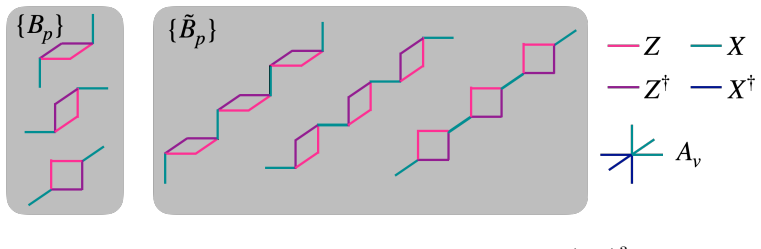
On the authors' own terms: gauging abelian higher-form symmetries (S) and stacking symmetry-protected phases (T) generate the modular group up to a phase, and that phase is a gravitational response Y; on the lattice, Y may be a nontrivial QCA. More precisely, Theorem 2.1 states that for Y = Σ_b e^{i∫q(b)} with quadratic form q and non-degenerate polarization ⟨b,b'⟩, the operations SZ[B]=Σ_b Z[b]e^{i∫⟨b,B⟩} and TZ[B]=Z[B]e^{i∫q(B)} satisfy S^2=C and (ST)^3=Y. The paper then shows that three families of gravitational responses—Pontryagin classes, Arf-Brown-Kervaire invariants, and Stiefel-Whitney classes—can be cast as such Gauss sums, producing new SL(2,Z_N) relations. A conjecture quoted fro
What carries the argument
The Gauss sum Y[{c_i},{ρ_i}] = Σ_{b_i} e^{i∫q(b_i,c_i,ρ_i)} is the central object. q is a quadratic form with non-degenerate polarization ⟨b,b'⟩; the identity q(b+b')=q(b)+q(b')+⟨b,b'⟩ does the work in the proof that (ST)^3=Y. Writing a gravitational response as a Gauss sum simultaneously defines the S operation (gauging, via the polarization) and the T operation (stacking the SPT e^{i∫q(B)}). The three families of Y are realized by choosing q as the Pontryagin square, a Wu-structure-dependent quadratic refinement, or a pairing of Stiefel-Whitney classes split into two factors.
Load-bearing premise
The claim that these gravitational responses correspond to genuinely nontrivial QCAs rests on the unproved conjecture (Conjecture 2.1) that a state is a nontrivial QCA whenever the invertible phase it entangles has a nontrivial partition function on some orientable manifold; the paper itself notes that a rigorous lattice proof is future work.
What would settle it
Find a closed orientable manifold on which one of the paper's gravitational responses, say Y=(-1)^{∫w2^2}, is nontrivial, and construct a finite-depth circuit that maps the associated lattice state to a product state; that would disprove Conjecture 2.1 and remove the QCA interpretation. Conversely, prove Conjecture 2.1 for Y=(-1)^{∫w2w3} by exhibiting an obstruction to commuting-projector realization on the Wu manifold W^5.
If this is right
- Lattice states that continuum field theory treats as identical are distinguished by QCA entanglement when gravitational counterterms are present.
- New projective SL(2,Z_N) relations exist for Stiefel-Whitney gravitational responses, so gauging-plus-stacking generates phases not captured by earlier Pontryagin or Arf-Brown-Kervaire examples.
- QCA-entangled states from these relations can be prepared by a finite sequence of finite-depth circuits, measurements, and error correction, making them accessible in principle to quantum simulation.
- The (ST)^3=Y algebra is a standalone exact identity; even without the QCA interpretation it yields nontrivial Gauss-sum identities relating gauging and SPT stacking.
- Generalized time-reversal symmetries, both higher-group and non-invertible, stabilize these phases, distinguishing QCA-entangled invertible phases from ordinary SPTs.
Where Pith is reading between the lines
- If Conjecture 2.1 is true, any effective-field-theory computation that discards gravitational counterterms is systematically blind to a lattice invariant; this suggests defining a 'lattice gravitational anomaly' valued in QCA classes.
- The same Gauss-sum mechanism may produce projective modular relations for responses built from spin or string structures, not just Stiefel-Whitney classes, predicting new QCA classes in those settings.
- The measurement-and-error-correction preparation protocol is concrete enough that the Z_3 one-form example in 3+1d could be tested on small quantum processors, distinguishing a nontrivial QCA from a finite-depth circuit.
- The paper's equivalence check between (ST)[1] and (ST)^3[1] via boundary skew-Hermitian forms suggests a general criterion: two QCA constructions are equivalent iff their boundary algebras are Witt-equivalent; this could be formalized as a classification tool.
Editorial analysis
A structured set of objections, weighed in public.
Referee Report
Summary. The paper studies lattice implementations of topological operations: S (gauging of finite higher-form symmetries) and T (stacking SPTs). The central mathematical result, Theorem 2.1, states that if a gravitational response Y can be written as a Gauss sum over a quadratic form q with polarization, then the associated S and T satisfy S² = C and (ST)³ = Y. This is applied to three families of Y: gravitational Pontryagin terms, Arf-Brown-Kervaire invariants, and Stiefel-Whitney terms. The class-(3) construction uses the identity (2.27), which correctly rewrites a Stiefel-Whitney monomial as a Gauss sum. The paper then interprets (ST)³ = Y as evidence that S and T mix with a nontrivial QCA when Y is a nontrivial gravitational response, using Conjecture 2.1 from Ref. [54]. It provides a lattice implementation for a Z3 example, showing that the stabilizer states produced by ST and (ST)³ are related by a FDQC via locally flippable separators and boundary skew-Hermitian forms. It also discusses squares of dualities, generalized Wu gauging, and time-reversal symmetries that distinguish QCA-entangled phases from FDQC-entangled ones.
Significance. If fully established, the paper would unify gravitational topological responses, higher-dimensional Kramers-Wannier dualities, and QCA entanglement, and would show that continuum field-theoretic identifications that ignore gravitational terms miss genuine lattice distinctions. The strengths of the paper are substantial: Theorem 2.1 is a clean, parameter-free derivation; the class-(3) Gauss-sum identity is explicit and correct; and the lattice computation in Sec. 4.1 with Appendix B is detailed, including explicit polynomial matrices Ξ_ST, Ξ_(ST)³, and the local basis change E. These are nontrivial, verifiable computations. The proposed preparation protocol via FDQC, measurement, and error correction is also valuable. However, the headline QCA interpretation is conditional on Conjecture 2.1, which is external and unproved, and in the specially emphasized w₂w₃ example the conjecture is applied in a regime where its stated orientability hypothesis fails. The modular-relation algebra can stand independently, but the paper's central physics claim is not yet fully proven.
major comments (2)
- [Sec. 2.1, Conjecture 2.1, Sec. 6] The step from (ST)³ = Y to 'S and T mix with a nontrivial QCA' relies on Conjecture 2.1, quoted from Ref. [54]. This conjecture is not proved here, and Sec. 6 explicitly lists a rigorous lattice proof as future work. Since the nontrivial-QCA interpretation is the central claim of the abstract and introduction, and is used for all three classes of Y, the main physical conclusion is conditional. The algebraic content of Theorem 2.1 is sound, but the paper should either prove the conjecture in the relevant cases or clearly state in the abstract and conclusions that the QCA claims are conditional on it.
- [Sec. 2.2.3, Y = (−1)^{∫w₂w₃}] The text asserts that Y = (−1)^{∫w₂w₃} is nontrivial on the non-orientable Wu manifold W⁵ and therefore 'is entangled by a nontrivial QCA according to Ref. [54,60]'. However, Conjecture 2.1, as stated in Sec. 2.1, requires nontriviality on some orientable manifold. On orientable 5-manifolds ∫w₂w₃ vanishes because Ω₅^SO = 0, so the stated conjecture never applies to this example. The paper neither proves nor cites a non-orientable version of the conjecture. This is an unstated extension of a load-bearing input. Without a non-orientable version of Conjecture 2.1, the 'absolutely stable' example, which is the flagship class-(3) application, is not supported.
minor comments (4)
- [Sec. 2.2.1, Eq. (2.17)] In the definition of T, the exponent is written as e^{2πi t_N / 2N ∫P(b)}. The variable should be the background field B, not b; this typo is confusing because b is later used as the dynamical gauge field.
- [Sec. 4.1 and Appendix B] The explicit polynomial computations are a strength, but the acknowledgment mentions use of ChatGPT for these calculations. It would improve reproducibility to include the verification script or a Mathematica/Python notebook for the key identities, especially E†Ξ_{ST}E = λ₁⊕λ₁⊕Ξ_{(ST)³}.
- [Sec. 4.1] The explicit lattice equivalence between ST[1] and (ST)³[1] is only performed for the Z₃ example. The text says a similar calculation likely applies for general Z_N, at least for odd N, and that even N may be non-Clifford. This limitation should be stated more prominently so the reader does not infer a general lattice proof for all classes.
- [Appendix B.3] The displayed formula for log₃ GSD has an unclear line break: 'log3 GSD_ST = 0 L odd L² L even' is hard to parse. Please format separately for clarity.
Circularity Check
No circular derivation: the modular-relation theorem is a self-contained algebraic lemma; the main caveat is that the QCA interpretation rests on an unproved external conjecture and one self-citation, not on any circular reduction.
full rationale
The central derivation chain is not circular. Theorem 2.1 is a self-contained algebraic statement: for any Y writable as a Gauss sum Y = Σ_b e^{i∫q(b)} with quadratic form q and polarization ⟨·,·⟩, the paper defines T Z[B] = Z[B] e^{i∫q(B)} and S Z[B] = Σ_b Z[b] e^{i⟨b,B⟩}, and proves (ST)^3 Z = Y Z by completing the square in the threefold sum and using q(b+b') = q(b) + q(b') + ⟨b,b'⟩. The final sum over b'' sets b_i = B_i, leaving Y Z. Thus the modular relation is derived, not assumed. The class-(3) Stiefel-Whitney examples are obtained from the exact Fourier identity (2.27): summing over b enforces c = w_i and leaves (-1)^{∫ w_i ∪ (w_j ∪ ... ∪ w_k)}. Defining S and T by the displayed quadratic form is an explicit construction rather than a fitted input disguised as a prediction. The only load-bearing external input is Conjecture 2.1 quoted from Ref. [54] (Fidkowski–Haah–Hastings, no author overlap), used to translate a nontrivial partition function into a nontrivial QCA. The paper itself discloses in Sec. 6 that a rigorous lattice proof of this conjecture is future work, so this is a limitation, not a circular restatement. One minor caveat: for the example Y = (-1)^{∫w2 w3}, the paper cites Ref. [54,60] for nontriviality on the non-orientable Wu manifold W^5, although Conjecture 2.1 as quoted is stated for orientable manifolds. To the extent that the non-orientable extension relies on Ref. [60] (Chen–Hsin, sharing author P.-S. Hsin), it is a self-citation that is potentially load-bearing for that specific example; however it does not enter the algebraic derivation of (ST)^3=Y and is presented as conjecture-based. Overall: no definitional circularity or constructed equivalence; score 2 for minor self-citation and an acknowledged conjecture-dependent step.
Axiom & Free-Parameter Ledger
axioms (5)
- domain assumption Conjecture 2.1 (QCA-nontriviality criterion): Y is a nontrivial QCA if its partition function is nontrivial on some orientable manifold.
- domain assumption A 2+1d boundary topological order with nonzero chiral central charge mod 8 has no commuting-projector parent Hamiltonian.
- domain assumption Boundary algebra equivalence (up to ⊕λ_q and a local change of basis) implies bulk QCA equivalence.
- standard math Fourier/Gauss-sum evaluation over finite abelian groups: summing a phase localizes to a delta function.
- standard math Properties of Pontryagin square, higher cup products, and Wu formulas.
read the original abstract
Recent work has constructed higher-dimensional analogs of non-invertible symmetries similar to 1+1d Kramers-Wannier duality. Although their continuum descriptions often treat purely gravitational topological terms as inessential counterterms, these terms can have an essential lattice manifestation: they distinguish states prepared by finite-depth quantum circuits (FDQCs) from those entangled by nontrivial quantum cellular automata (QCAs). Motivated by this mismatch, we show that QCAs associated with gravitational topological responses arise in several related settings: (1) lattice realizations of projective $\mathrm{SL}(2,\mathbb{Z}_N)$ relations generated by topological operations on symmetries; (2) squares of dualities that generalize the relation between fermionization and Kramers-Wannier duality; (3) lattice implementations of QCAs through higher-form gauging; and (4) invertible phases protected by generalized time-reversal symmetries. We derive new projective $\mathrm{SL}(2,\mathbb{Z}_N)$ relations whose projective phases are gravitational topological responses constructed from Stiefel-Whitney classes. We furthermore give a general protocol for preparing the associated QCA-entangled states using finite-depth unitary circuits, measurements, and error correction. These results unify the study of gravitational topological responses in field theories, higher dimensional dualities, and quantum cellular automata.
Figures


Reference graph
Works this paper leans on
-
[1]
Non-invertible topological defects in 4-dimensionalZ 2 pure lattice gauge theory,
M. Koide, Y. Nagoya, and S. Yamaguchi, “Non-invertible topological defects in 4-dimensionalZ 2 pure lattice gauge theory,”PTEP2022no. 1, (2022) 013B03, arXiv:2109.05992 [hep-th]
Pith/arXiv arXiv 2022
-
[2]
Noninvertible duality defects in 3+1 dimensions,
Y. Choi, C. Cordova, P.-S. Hsin, H. T. Lam, and S.-H. Shao, “Noninvertible duality defects in 3+1 dimensions,”Phys. Rev. D105no. 12, (2022) 125016, arXiv:2111.01139 [hep-th]
Pith/arXiv arXiv 2022
-
[3]
Kramers-Wannier-like Duality Defects in (3+1)D Gauge Theories,
J. Kaidi, K. Ohmori, and Y. Zheng, “Kramers-Wannier-like Duality Defects in (3+1)D Gauge Theories,”Phys. Rev. Lett.128no. 11, (2022) 111601,arXiv:2111.01141 [hep-th]
Pith/arXiv arXiv 2022
-
[4]
Noninvertible Time-Reversal Symmetry,
Y. Choi, H. T. Lam, and S.-H. Shao, “Noninvertible Time-Reversal Symmetry,”Phys. Rev. Lett.130no. 13, (2023) 131602,arXiv:2208.04331 [hep-th]
Pith/arXiv arXiv 2023
-
[5]
What’s Done Cannot Be Undone: TASI Lectures on Non-Invertible 61 Symmetries,
S.-H. Shao, “What’s Done Cannot Be Undone: TASI Lectures on Non-Invertible 61 Symmetries,” inTheoretical Advanced Study Institute in Elementary Particle Physics 2023: Aspects of Symmetry. 8, 2023.arXiv:2308.00747 [hep-th]
Pith/arXiv arXiv 2023
-
[6]
ICTP lectures on (non-)invertible generalized symmetries,
S. Schafer-Nameki, “ICTP lectures on (non-)invertible generalized symmetries,”Phys. Rept.1063(2024) 1–55,arXiv:2305.18296 [hep-th]
Pith/arXiv arXiv 2024
-
[7]
Topological Defects on the Lattice: Dualities and Degeneracies,
D. Aasen, P. Fendley, and R. S. K. Mong, “Topological Defects on the Lattice: Dualities and Degeneracies,”arXiv:2008.08598 [cond-mat.stat-mech]
Pith/arXiv arXiv 2008
-
[8]
L. Lootens, C. Delcamp, G. Ortiz, and F. Verstraete, “Dualities in One-Dimensional Quantum Lattice Models: Symmetric Hamiltonians and Matrix Product Operator Intertwiners,”PRX Quantum4no. 2, (2023) 020357, arXiv:2112.09091 [quant-ph]
Pith/arXiv arXiv 2023
-
[9]
Majorana chain and Ising model - (non-invertible) translations, anomalies, and emanant symmetries,
N. Seiberg and S.-H. Shao, “Majorana chain and Ising model - (non-invertible) translations, anomalies, and emanant symmetries,”SciPost Phys.16no. 3, (2024) 064, arXiv:2307.02534 [cond-mat.str-el]
Pith/arXiv arXiv 2024
-
[10]
Cluster State as a Noninvertible Symmetry-Protected Topological Phase,
S. Seifnashri and S.-H. Shao, “Cluster State as a Noninvertible Symmetry-Protected Topological Phase,”Phys. Rev. Lett.133no. 11, (2024) 116601,arXiv:2404.01369 [cond-mat.str-el]
arXiv 2024
-
[11]
Lattice models for phases and transitions with non-invertible symmetries,
L. Bhardwaj, L. E. Bottini, S. Schafer-Nameki, and A. Tiwari, “Lattice models for phases and transitions with non-invertible symmetries,”SciPost Phys.20no. 5, (2026) 134,arXiv:2405.05964 [cond-mat.str-el]
Pith/arXiv arXiv 2026
-
[12]
Fractionalization of coset non-invertible symmetry and exotic Hall conductance,
P.-S. Hsin, R. Kobayashi, and C. Zhang, “Fractionalization of coset non-invertible symmetry and exotic Hall conductance,”SciPost Phys.17no. 3, (2024) 095, arXiv:2405.20401 [cond-mat.str-el]
Pith/arXiv arXiv 2024
-
[13]
Quantum phases and transitions in spin chains with non-invertible symmetries,
A. Chatterjee, ¨O. M. Aksoy, and X.-G. Wen, “Quantum phases and transitions in spin chains with non-invertible symmetries,”SciPost Phys.17no. 4, (2024) 115, arXiv:2405.05331 [cond-mat.str-el]
Pith/arXiv arXiv 2024
-
[14]
Non-invertible symmetries and LSM-type constraints on a tensor product Hilbert space,
N. Seiberg, S. Seifnashri, and S.-H. Shao, “Non-invertible symmetries and LSM-type constraints on a tensor product Hilbert space,”SciPost Phys.16(2024) 154, arXiv:2401.12281 [cond-mat.str-el]
Pith/arXiv arXiv 2024
-
[15]
Tensor Networks for Noninvertible Symmetries in 3+1D and Beyond,
P. Gorantla, S.-H. Shao, and N. Tantivasadakarn, “Tensor Networks for Noninvertible Symmetries in 3+1D and Beyond,”Phys. Rev. X15no. 4, (2025) 041006, arXiv:2406.12978 [quant-ph]
arXiv 2025
-
[16]
Kennedy-Tasaki transformation and noninvertible symmetry in lattice models beyond one dimension,
A. Parayil Mana, Y. Li, H. Sukeno, and T.-C. Wei, “Kennedy-Tasaki transformation and noninvertible symmetry in lattice models beyond one dimension,”Phys. Rev. B109 no. 24, (2024) 245129,arXiv:2402.09520 [cond-mat.str-el]. 62
Pith/arXiv arXiv 2024
-
[17]
Generating lattice non-invertible symmetries,
W. Cao, L. Li, and M. Yamazaki, “Generating lattice non-invertible symmetries,” SciPost Phys.17no. 4, (2024) 104,arXiv:2406.05454 [cond-mat.str-el]
Pith/arXiv arXiv 2024
-
[18]
Anomalies of coset non-invertible symmetries,
P.-S. Hsin, R. Kobayashi, and C. Zhang, “Anomalies of coset non-invertible symmetries,” SciPost Phys.20no. 1, (2026) 006,arXiv:2503.00105 [cond-mat.str-el]
arXiv 2026
-
[19]
(2+1)d lattice models and tensor networks for gapped phases with categorical symmetry,
K. Inamura, S.-J. Huang, A. Tiwari, and S. Schafer-Nameki, “(2+1)d lattice models and tensor networks for gapped phases with categorical symmetry,”SciPost Phys.20no. 2, (2026) 043,arXiv:2506.09177 [cond-mat.str-el]
arXiv 2026
-
[20]
Non-Invertible Symmetries on Tensor-Product Hilbert Spaces and Quantum Cellular Automata,
R. Wen, K. Inamura, and S. Schafer-Nameki, “Non-Invertible Symmetries on Tensor-Product Hilbert Spaces and Quantum Cellular Automata,”arXiv:2605.15194 [cond-mat.str-el]
-
[21]
C. S. Lent, P. D. Tougaw, W. Porod, and G. H. Bernstein, “Quantum cellular automata,”Nanotechnology4no. 1, (Jan, 1993) 49. https://doi.org/10.1088/0957-4484/4/1/004
-
[22]
Index Theory of One Dimensional Quantum Walks and Cellular Automata,
D. Gross, V. Nesme, H. Vogts, and R. F. Werner, “Index Theory of One Dimensional Quantum Walks and Cellular Automata,”Commun. Math. Phys.310no. 2, (2012) 419–454,arXiv:0910.3675 [quant-ph]
Pith/arXiv arXiv 2012
-
[23]
Nontrivial Quantum Cellular Automata in Higher Dimensions,
J. Haah, L. Fidkowski, and M. B. Hastings, “Nontrivial Quantum Cellular Automata in Higher Dimensions,”Commun. Math. Phys.398no. 1, (2023) 469–540, arXiv:1812.01625 [quant-ph]
Pith/arXiv arXiv 2023
-
[24]
An overview of quantum cellular automata,
P. Arrighi, “An overview of quantum cellular automata,”Natural Comput.18no. 4, (2019) 885–899,arXiv:1904.12956 [quant-ph]
Pith/arXiv arXiv 2019
-
[25]
Clifford quantum cellular automata: Trivial group in 2D and Witt group in 3D,
J. Haah, “Clifford quantum cellular automata: Trivial group in 2D and Witt group in 3D,”J. Math. Phys.62no. 9, (2021) 092202,arXiv:1907.02075 [quant-ph]
Pith/arXiv arXiv 2021
-
[26]
A review of Quantum Cellular Automata,
T. Farrelly, “A review of Quantum Cellular Automata,”Quantum4(2020) 368, arXiv:1904.13318 [quant-ph]
Pith/arXiv arXiv 2020
-
[27]
Three-Dimensional Quantum Cellular Automata from Chiral Semion Surface Topological Order and beyond,
W. Shirley, Y.-A. Chen, A. Dua, T. D. Ellison, N. Tantivasadakarn, and D. J. Williamson, “Three-Dimensional Quantum Cellular Automata from Chiral Semion Surface Topological Order and beyond,”PRX Quantum3no. 3, (2022) 030326, arXiv:2202.05442 [quant-ph]
Pith/arXiv arXiv 2022
-
[28]
Chiral Floquet Phases of Many-Body Localized Bosons,
H. C. Po, L. Fidkowski, T. Morimoto, A. C. Potter, and A. Vishwanath, “Chiral Floquet Phases of Many-Body Localized Bosons,”Phys. Rev. X6no. 4, (2016) 041070, arXiv:1609.00006 [cond-mat.dis-nn]. 63
Pith/arXiv arXiv 2016
-
[29]
Radical chiral floquet phases in a periodically driven kitaev model and beyond,
H. C. Po, L. Fidkowski, A. Vishwanath, and A. C. Potter, “Radical chiral floquet phases in a periodically driven kitaev model and beyond,”Physical Review B96no. 24, (Dec., 2017) .http://dx.doi.org/10.1103/PhysRevB.96.245116
-
[30]
Interacting invariants for floquet phases of fermions in two dimensions,
L. Fidkowski, H. C. Po, A. C. Potter, and A. Vishwanath, “Interacting invariants for floquet phases of fermions in two dimensions,”Physical Review B99no. 8, (Feb., 2019) .http://dx.doi.org/10.1103/PhysRevB.99.085115
-
[31]
Generalized Global Symmetries,
D. Gaiotto, A. Kapustin, N. Seiberg, and B. Willett, “Generalized Global Symmetries,” JHEP02(2015) 172,arXiv:1412.5148 [hep-th]
Pith/arXiv arXiv 2015
-
[32]
Comments on One-Form Global Symmetries and Their Gauging in 3d and 4d,
P.-S. Hsin, H. T. Lam, and N. Seiberg, “Comments on One-Form Global Symmetries and Their Gauging in 3d and 4d,”SciPost Phys.6no. 3, (2019) 039, arXiv:1812.04716 [hep-th]
Pith/arXiv arXiv 2019
-
[33]
Lattice models that realizeZ n-1 symmetry-protected topological states for evenn,
L. Tsui and X.-G. Wen, “Lattice models that realizeZ n-1 symmetry-protected topological states for evenn,”Phys. Rev. B101no. 3, (2020) 035101, arXiv:1908.02613 [cond-mat.str-el]
Pith/arXiv arXiv 2020
-
[34]
Non-invertible Condensation, Duality, and Triality Defects in 3+1 Dimensions,
Y. Choi, C. Cordova, P.-S. Hsin, H. T. Lam, and S.-H. Shao, “Non-invertible Condensation, Duality, and Triality Defects in 3+1 Dimensions,”Commun. Math. Phys. 402no. 1, (2023) 489–542,arXiv:2204.09025 [hep-th]
Pith/arXiv arXiv 2023
-
[35]
Anomalies of non-invertible symmetries in (3+1)d,
C. Cordova, P.-S. Hsin, and C. Zhang, “Anomalies of non-invertible symmetries in (3+1)d,”SciPost Phys.17no. 5, (2024) 131,arXiv:2308.11706 [hep-th]
Pith/arXiv arXiv 2024
-
[36]
(3+1)-tqfts and topological insulators,
K. Walker and Z. Wang, “(3+1)-tqfts and topological insulators,” 2011. https://arxiv.org/abs/1104.2632
Pith/arXiv arXiv 2011
-
[37]
Three-dimensional topological lattice models with surface anyons,
C. W. von Keyserlingk, F. J. Burnell, and S. H. Simon, “Three-dimensional topological lattice models with surface anyons,”Physical Review B87no. 4, (Jan., 2013) . http://dx.doi.org/10.1103/PhysRevB.87.045107
-
[38]
SL(2,Z) action on three-dimensional conformal field theories with Abelian symmetry,
E. Witten, “SL(2,Z) action on three-dimensional conformal field theories with Abelian symmetry,” inFrom Fields to Strings: Circumnavigating Theoretical Physics: A Conference in Tribute to Ian Kogan, pp. 1173–1200. 7, 2003.arXiv:hep-th/0307041
Pith/arXiv arXiv 2003
-
[39]
SL(2,Z) action on QFTs withZ 2 symmetry and the Brown-Kervaire invariants,
L. Bhardwaj, Y. Lee, and Y. Tachikawa, “SL(2,Z) action on QFTs withZ 2 symmetry and the Brown-Kervaire invariants,”JHEP11(2020) 141,arXiv:2009.10099 [hep-th]
Pith/arXiv arXiv 2020
-
[40]
Exotic invertible phases with higher-group symmetries,
P.-S. Hsin, W. Ji, and C.-M. Jian, “Exotic invertible phases with higher-group symmetries,”SciPost Phys.12no. 2, (2022) 052,arXiv:2105.09454 [cond-mat.str-el]. 64
Pith/arXiv arXiv 2022
-
[41]
Gauging Lie group symmetry in (2+1)d topological phases,
M. Cheng, P.-S. Hsin, and C.-M. Jian, “Gauging Lie group symmetry in (2+1)d topological phases,”SciPost Phys.14no. 5, (2023) 100,arXiv:2205.15347 [cond-mat.str-el]
Pith/arXiv arXiv 2023
-
[42]
Obstructions to Gapped Phases from Non-Invertible Symmetries,
A. Apte, C. C´ ordova, and H. T. Lam, “Obstructions to Gapped Phases from Non-Invertible Symmetries,” (12, 2022) ,arXiv:2212.14605 [hep-th]
Pith/arXiv arXiv 2022
-
[43]
Topological Transition on the Conformal Manifold,
W. Ji, S.-H. Shao, and X.-G. Wen, “Topological Transition on the Conformal Manifold,” Phys. Rev. Res.2no. 3, (2020) 033317,arXiv:1909.01425 [cond-mat.str-el]
Pith/arXiv arXiv 2020
-
[44]
Long-Range Entanglement from Measuring Symmetry-Protected Topological Phases,
N. Tantivasadakarn, R. Thorngren, A. Vishwanath, and R. Verresen, “Long-Range Entanglement from Measuring Symmetry-Protected Topological Phases,”Phys. Rev. X 14no. 2, (2024) 021040,arXiv:2112.01519 [cond-mat.str-el]
Pith/arXiv arXiv 2024
-
[45]
Exploring 2-Group Global Symmetries,
C. C´ ordova, T. T. Dumitrescu, and K. Intriligator, “Exploring 2-Group Global Symmetries,”JHEP02(2019) 184,arXiv:1802.04790 [hep-th]
Pith/arXiv arXiv 2019
-
[46]
On 2-Group Global Symmetries and their Anomalies,
F. Benini, C. C´ ordova, and P.-S. Hsin, “On 2-Group Global Symmetries and their Anomalies,”JHEP03(2019) 118,arXiv:1803.09336 [hep-th]
Pith/arXiv arXiv 2019
-
[47]
High-threshold and low-overhead fault-tolerant quantum memory,
S. Bravyi, A. W. Cross, J. M. Gambetta, D. Maslov, P. Rall, and T. J. Yoder, “High-threshold and low-overhead fault-tolerant quantum memory,”Nature627 no. 8005, (2024) 778–782,arXiv:2308.07915 [quant-ph]
Pith/arXiv arXiv 2024
-
[48]
Scalable, High-Fidelity All-Electronic Control of Trapped-Ion Qubits,
C. M. L¨ oschnaueret al., “Scalable, High-Fidelity All-Electronic Control of Trapped-Ion Qubits,”PRX Quantum6no. 4, (2025) 040313,arXiv:2407.07694 [quant-ph]
arXiv 2025
-
[49]
Blueprint for All-to-All-Connected Superconducting Spin Qubits,
M. Pita-Vidal, J. J. Wesdorp, and C. K. Andersen, “Blueprint for All-to-All-Connected Superconducting Spin Qubits,”PRX Quantum6no. 1, (2025) 010308, arXiv:2405.09988 [quant-ph]
Pith/arXiv arXiv 2025
-
[50]
A 98-qubit trapped-ion quantum computer with all-to-all connectivity,
A. Ransfordet al., “A 98-qubit trapped-ion quantum computer with all-to-all connectivity,”Nature655no. 8121, (2026) 81–86,arXiv:2511.05465 [quant-ph]
Pith/arXiv arXiv 2026
-
[51]
Superconducting qubit-resonator quantum processor with effective all-to-all connectivity,
M. Renger, J. Verjauw, N. Wurz, A. Hosseinkhani, C. Ockeloen-Korppi, W. Liu, A. Rath, M. J. Thapa, F. Vigneau, E. Wybo, V. Bergholm, C. F. Chan, B. Csat´ ari, S. Dahl, R. Davletkaliyev, R. Giri, D. Gusenkova, H. Heimonen, T. Hiltunen, H. Hsu, E. Hyypp¨ a, J. Ikonen, T. Jones, S. Khalid, S.-G. Kim, M. Koistinen, A. Komlev, J. Kotilahti, V. Kukushkin, J. La...
2026
-
[52]
N. Berthusenet al., “Experiments with the four-dimensional surface code on a quantum charge-coupled device quantum computer,”Phys. Rev. A110no. 6, (2024) 062413, arXiv:2408.08865 [quant-ph]
Pith/arXiv arXiv 2024
-
[53]
A Duality Web in 2+1 Dimensions and Condensed Matter Physics,
N. Seiberg, T. Senthil, C. Wang, and E. Witten, “A Duality Web in 2+1 Dimensions and Condensed Matter Physics,”Annals Phys.374(2016) 395–433, arXiv:1606.01989 [hep-th]
Pith/arXiv arXiv 2016
-
[55]
Exactly solvable model for a 4 + 1D beyond-cohomology symmetry-protected topological phase,
L. Fidkowski, J. Haah, and M. B. Hastings, “Exactly solvable model for a 4 + 1D beyond-cohomology symmetry-protected topological phase,”Phys. Rev. B101(Apr,
-
[56]
Generalized global symmetries of T [M ] theories. Part I,
S. Gukov, P.-S. Hsin, and D. Pei, “Generalized global symmetries of T [M ] theories. Part I,”JHEP04(2021) 232,arXiv:2010.15890 [hep-th]
Pith/arXiv arXiv 2021
-
[57]
Generalized Statistics on Lattices,
R. Kobayashi, Y. Li, H. Xue, P.-S. Hsin, and Y.-A. Chen, “Generalized Statistics on Lattices,”Phys. Rev. X16no. 1, (2026) 011010,arXiv:2412.01886 [quant-ph]
arXiv 2026
-
[58]
Anyonic Membranes and Pontryagin Statistics,
Y. Feng, H. Xue, Y. Li, M. Cheng, R. Kobayashi, P.-S. Hsin, and Y.-A. Chen, “Anyonic Membranes and Pontryagin Statistics,”Phys. Rev. Lett.136no. 8, (2026) 086601, arXiv:2509.14314 [quant-ph]
arXiv 2026
-
[59]
Generalized global symmetries of T[M] theories. Part II,
S. Gukov, P.-S. Hsin, D. Pei, and S. Park, “Generalized global symmetries of T[M] theories. Part II,”JHEP05(2026) 087,arXiv:2511.13696 [hep-th]
arXiv 2026
-
[60]
Exactly solvable lattice Hamiltonians and gravitational anomalies,
Y.-A. Chen and P.-S. Hsin, “Exactly solvable lattice Hamiltonians and gravitational anomalies,”SciPost Phys.14no. 5, (2023) 089,arXiv:2110.14644 [cond-mat.str-el]
Pith/arXiv arXiv 2023
-
[61]
X.-G. Wen, “Construction of bosonic symmetry-protected-trivial states and their topological invariants viaG×SO(∞) non-linearσ-models,”Phys. Rev. B91(2015) 205101,arXiv:1410.8477 [cond-mat.str-el]
Pith/arXiv arXiv 2015
-
[62]
Z.-C. Gu and X.-G. Wen, “Symmetry-protected topological orders for interacting fermions: Fermionic topological nonlinearσmodels and a special group supercohomology theory,”Phys. Rev. B90(Sep, 2014) 115141. https://link.aps.org/doi/10.1103/PhysRevB.90.115141. 66
-
[64]
Lattice models that realize𭟋 n-1 symmetry-protected topological states for evenn,
L. Tsui and X.-G. Wen, “Lattice models that realize𭟋 n-1 symmetry-protected topological states for evenn,”Phys. Rev. B101(Jan, 2020) 035101
2020
-
[65]
Commuting Pauli Hamiltonians as Maps between Free Modules,
J. Haah, “Commuting Pauli Hamiltonians as Maps between Free Modules,”Commun. Math. Phys.324no. 2, (2013) 351–399,arXiv:1204.1063 [quant-ph]
Pith/arXiv arXiv 2013
-
[66]
State sum constructions of spin-TFTs and string net constructions of fermionic phases of matter,
L. Bhardwaj, D. Gaiotto, and A. Kapustin, “State sum constructions of spin-TFTs and string net constructions of fermionic phases of matter,”JHEP04(2017) 096, arXiv:1605.01640 [cond-mat.str-el]
Pith/arXiv arXiv 2017
-
[67]
Exact bosonization in two spatial dimensions and a new class of lattice gauge theories,
Y.-A. Chen, A. Kapustin, and D. Radicevic, “Exact bosonization in two spatial dimensions and a new class of lattice gauge theories,”Annals of Physics393(2018) 234–253.http://dx.doi.org/10.1016/j.aop.2018.03.024
-
[68]
Lattice construction of exotic invertible topological phases,
R. Kobayashi, “Lattice construction of exotic invertible topological phases,”Phys. Rev. B105no. 3, (2022) 035153,arXiv:2106.10703 [cond-mat.str-el]
Pith/arXiv arXiv 2022
-
[69]
M. Sun, B. Yang, Z. Wang, N. Tantivasadakarn, and Y.-A. Chen, “Clifford quantum cellular automata from topological quantum field theories and invertible subalgebras,” PRX Quantum7(Mar, 2026) 010362. https://link.aps.org/doi/10.1103/4519-v15s
-
[70]
Gapped boundaries of (3 + 1)-dimensional topological order,
Z.-X. Luo, “Gapped boundaries of (3 + 1)-dimensional topological order,”Phys. Rev. B 107(Mar, 2023) 125425. https://link.aps.org/doi/10.1103/PhysRevB.107.125425
-
[71]
M. Sun, B. Yang, Z. Wang, N. Tantivasadakarn, and Y.-A. Chen, “Clifford Quantum Cellular Automata from Topological Quantum Field Theories and Invertible Subalgebras,”PRX Quantum7no. 1, (2026) 010362,arXiv:2509.07099 [math.QA]
Pith/arXiv arXiv 2026
-
[72]
Milnor, J
J. Milnor, J. Stasheff, J. Stasheff, and P. University,Characteristic Classes. Annals of mathematics studies. Princeton University Press, 1974. https://books.google.com/books?id=5zQ9AFk1i4EC
1974
-
[73]
Higher cup products on hypercubic lattices: Application to lattice models of topological phases,
Y.-A. Chen and S. Tata, “Higher cup products on hypercubic lattices: Application to lattice models of topological phases,”J. Math. Phys.64no. 9, (2023) 091902, arXiv:2106.05274 [cond-mat.str-el]. 67
Pith/arXiv arXiv 2023
-
[74]
Long-range entanglement from measuring symmetry-protected topological phases,
N. Tantivasadakarn, R. Thorngren, A. Vishwanath, and R. Verresen, “Long-range entanglement from measuring symmetry-protected topological phases,”Phys. Rev. X14 (Jun, 2024) 021040.https://link.aps.org/doi/10.1103/PhysRevX.14.021040
-
[75]
Symmetry protected topological orders and the group cohomology of their symmetry group,
X. Chen, Z.-C. Gu, Z.-X. Liu, and X.-G. Wen, “Symmetry protected topological orders and the group cohomology of their symmetry group,”Phys. Rev. B87no. 15, (2013) 155114,arXiv:1106.4772 [cond-mat.str-el]
Pith/arXiv arXiv 2013
-
[76]
Braiding statistics approach to symmetry-protected topological phases,
M. Levin and Z.-C. Gu, “Braiding statistics approach to symmetry-protected topological phases,”Physical Review B86no. 11, (2012) . http://dx.doi.org/10.1103/PhysRevB.86.115109
-
[77]
Three-dimensional quantum cellular automata from chiral semion surface topological order and beyond,
W. Shirley, Y.-A. Chen, A. Dua, T. D. Ellison, N. Tantivasadakarn, and D. J. Williamson, “Three-dimensional quantum cellular automata from chiral semion surface topological order and beyond,”PRX Quantum3(Aug, 2022) 030326. https://link.aps.org/doi/10.1103/PRXQuantum.3.030326
-
[78]
Lorentz Symmetry Fractionalization and Dualities in (2+1)d,
P.-S. Hsin and S.-H. Shao, “Lorentz Symmetry Fractionalization and Dualities in (2+1)d,”SciPost Phys.8(2020) 018,arXiv:1909.07383 [cond-mat.str-el]
Pith/arXiv arXiv 2020
-
[79]
AdS / CFT correspondence and topological field theory,
E. Witten, “AdS / CFT correspondence and topological field theory,”JHEP12(1998) 012,arXiv:hep-th/9812012
Pith/arXiv arXiv 1998
-
[80]
Extended higher cup-product Chern-Simons theories,
D. Fiorenza, H. Sati, and U. Schreiber, “Extended higher cup-product Chern-Simons theories,”J. Geom. Phys.74(2013) 130–163,arXiv:1207.5449 [hep-th]
Pith/arXiv arXiv 2013
-
[81]
A quantum cellular automaton for every symmetry protected topological phase,
L. Fidkowski, J. Haah, and M. B. Hastings, “A quantum cellular automaton for every symmetry protected topological phase,”Phys. Rev. B112no. 3, (2025) 035123, arXiv:2407.07951 [cond-mat.str-el]
arXiv 2025
-
[82]
Subsystem non-invertible symmetry operators and defects,
W. Cao, L. Li, M. Yamazaki, and Y. Zheng, “Subsystem non-invertible symmetry operators and defects,”SciPost Phys.15no. 4, (2023) 155,arXiv:2304.09886 [cond-mat.str-el]
Pith/arXiv arXiv 2023
discussion (0)
Sign in with ORCID, Apple, or X to comment. Anyone can read and Pith papers without signing in.