REVIEW 2 major objections 4 minor 131 references
Disk-bearing young stars in the metal-poor Sh2-284 region accrete gas at rates comparable to those in solar-metallicity star-forming regions, with tentative evidence that the emission-line scaling relations used to measure accretion may dep
Reviewed by Pith at T0; open to challenge. T0 means a machine referee read the full paper against a public rubric. the ladder, T0–T4 →
T0 review · deepseek-v4-flash
2026-08-01 04:24 UTC pith:TRNT5KSU
load-bearing objection Useful wide-field accretion census of a metal-poor region, with an honest calibration caveat — but the abstract oversells a flattening that the body itself says is not statistically significant. the 2 major comments →
LBT-MODS spectroscopy of young stellar objects in the distant metal-poor star forming region Sh2-284: Stellar and accretion properties
The pith
A machine-rendered reading of the paper's core claim, the machinery that carries it, and where it could break.
Core claim
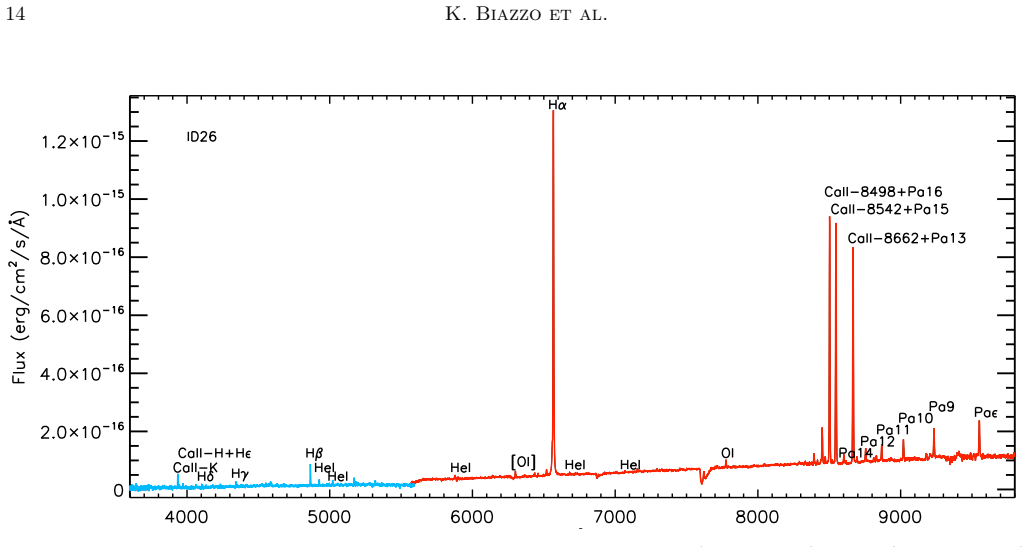
In the metal-poor (Z~1/3 Zsun) star-forming complex Sh2-284, the paper measures stellar and accretion properties of 68 YSOs across a 45 arcmin by 45 arcmin field, using nine emission-line tracers. The derived mass accretion rates span from about 2.3×10⁻¹⁰ to 1.0×10⁻⁶ solar masses per year, with a median of roughly 2.2×10⁻⁸ solar masses per year, statistically overlapping with solar-metallicity samples when masses and ages are matched. The central new claim is a tentative flattening of the flux-flux relations (H-alpha versus H-beta, H-gamma, CaII infrared triplet, and Paschen lines) relative to solar-metallicity regions, interpreted as evidence that the thermal and ionization structure of the
What carries the argument
The analysis rests on the magnetospheric accretion paradigm: line luminosities from accreting gas are converted to accretion luminosity using empirical L_line-L_acc relations calibrated in Lupus, then to mass accretion rate via the free-fall relation Mdot = 1.25 L_acc R*/GM*, adopting an inner disk truncation radius of five stellar radii. The multi-tracer approach—Balmer, CaII, and Paschen lines observed simultaneously—serves as an internal consistency check and is the basis for the flux-flux slope comparison with Lupus.
Load-bearing premise
The conclusion that accretion rates are normal in metal-poor Sh2-284 assumes that the relationship between hydrogen-line luminosity and accretion luminosity, calibrated in solar-metallicity Lupus, is unchanged when the gas has one-third the metal content.
What would settle it
Measure accretion luminosity for a subset of Sh2-284 YSOs through U-band excess continuum veiling, independently of the line-luminosity relations; if the continuum-based L_acc disagrees systematically with the H-alpha-based values as metallicity changes, the invariance assumption fails. Alternatively, a sample of several hundred YSOs with the same multi-tracer observations would narrow the error bars on the flux-flux slopes enough to test whether they truly converge to Lupus values.
If this is right
- Gas accretion persists at normal levels in sub-solar metallicity environments, countering suggestions that low-metallicity disks dissipate too quickly to sustain accretion.
- If the flux-flux flattening is real, line-based accretion diagnostics calibrated at solar metallicity will systematically misestimate accretion rates in metal-poor regions, affecting JWST and other surveys of low-Z star formation.
- Disk-bearing stars in Sh2-284 at ages of about 1–2 Myr still accrete, consistent with dust-based disk fractions and indicating that planet-forming gas reservoirs remain available in low-metallicity disks.
- The ratio of Balmer to CaII/Paschen emission may become a metallicity-sensitive probe of accretion flows in future spectroscopic surveys.
Where Pith is reading between the lines
- A concrete testable extension is to combine the Sh2-284 spectra with U-band excess (continuum veiling) measurements to check whether the L_acc scale itself depends on metallicity, independently of the line-luminosity calibrations.
- If the flattening is genuine, the H-alpha/H-beta flux ratio in metal-poor accretors should correlate with iron abundance within a single region; surveying additional outer-Galactic clouds could reveal a monotonic trend with Z.
- The paper's matched-mass comparison suggests that intrinsic scatter in accretion rate at fixed stellar mass is dominated by factors other than metallicity, so isolating metallicity effects will require larger, homogeneous samples with matched ages.
- The outer Galaxy may serve as a bridge between local solar-metallicity regions and Magellanic Cloud metallicities, so expanding the sample to more anticenter clouds could turn the tentative trend into a quantitative scaling law.
Editorial analysis
A structured set of objections, weighed in public.
Referee Report
Summary. The paper presents LBT-MODS spectroscopy of 68 YSO candidates in Sh2-284, a metal-poor (Z ~ 1/3 Z_sun) star-forming region at ~4.7 kpc toward the Galactic anticenter. Using up to nine emission-line accretion diagnostics (Hα, Hβ, Hγ, Ca II IRT, Paη, Paζ, Paε), the authors derive stellar parameters, extinction-corrected line fluxes, accretion luminosities, and mass accretion rates. They report a median Mdot of ~2.2e-8 Msun/yr, spanning ~2.3e-10 to ~1.0e-6 Msun/yr, and compare their sample with solar-metallicity and low-metallicity regions (Lupus, NGC 3603, NGC 346, Dolidze 25). They also present tentative evidence that the flux–flux relations between Hα and other lines are flatter in Sh2-284 than in Lupus, which they interpret as a possible metallicity-dependent behavior of accretion diagnostics.
Significance. If the results hold, this is the first wide-field spectroscopic census of accretion in a Galactic low-metallicity region, bridging nearby solar-metallicity studies and extragalactic JWST programs. The paper has notable strengths: a multi-diagnostic approach with internal cross-checks (Sect. 3.3), proper-motion filtering (Sect. 3.1.1), photometric flux anchoring of the spectra (Sect. 2.3.2), and consistency checks against previous measurements by Kalari & Vink (2015) and Ashraf et al. (2026). The tentative flattening of the flux–flux relations, if confirmed, would have direct implications for the use of solar-metallicity calibrations in low-Z environments. However, the absolute accretion scale and the cross-metallicity comparison rest on the empirical L_line–L_acc calibrations of Alcalá et al. (2017), calibrated in Lupus at solar metallicity; the paper explicitly acknowledges this but does not quantify how a metallicity-dependent shift would affect the conclusions. The flattening claim is also based on small samples (4–16 sources per diagnostic) and is statistically weak for several lines.
major comments (2)
- [Sect. 4.1, Eqs. (2)–(9), Sect. 2.1] The central conclusion that accretion rates in Sh2-284 are comparable to solar-metallicity regions (median ~2.2e-8 Msun/yr, Sect. 3.4 and Fig. 15) relies entirely on the Alcalá et al. (2017) L_line–L_acc calibrations derived in Lupus. The paper acknowledges this in Sect. 3.3 ('does not constitute an independent validation of our absolute accretion scale') and Sect. 3.5 ('both methods rely on empirical calibrations... may mask subtle chemical dependencies'), but no quantitative estimate is given for how large a metallicity-dependent correction could be. This is not an internal inconsistency, but it is load-bearing: if the accretion column in Z~1/3 Z_sun gas cools or ionizes differently, the absolute Mdot values and the Fig. 15 comparison with solar-metallicity samples would shift. The paper's own tentative finding of flatter flux–flux relations (Sect. 4.1) suggests that line ratios do dep
- [Sect. 4.1] The flux–flux slopes (Sect. 4.1) are derived from a sample that was pre-selected on Hα excess (Sect. 2.1: IPHAS Hα excess criterion and R-band magnitude range). This selection truncates the observed Hα distribution at the low-flux end, which can bias the fitted slope of log FHα versus log F_line even if the underlying relation is universal. The paper does not address this selection effect. Because the flattening is the main new physical claim (even if hedged as tentative), the authors should quantify the bias. Concretely, simulate Lupus-like flux–flux relations with the same intrinsic scatter, apply the selection thresholds used here (Hα excess, R range, line detectability), and show how much the fitted slopes are expected to shift. This is important for the Ca II and Paschen diagnostics, where the claimed difference from Lupus appears largest but the sample sizes are only 4–13 sources.
minor comments (4)
- [Sect. 3.4] The reporting of the central accretion rate is inconsistent: the Abstract and Sect. 3.4 quote a median of ~2.2e-8 Msun/yr, Sect. 4.3 states a 'mean level of 3×10^-8 M⊙/yr', and Table 4 gives <log Mdot> = -7.76 (≈1.7e-8 Msun/yr). Please harmonize and explicitly state how upper limits (weak accretors) are included in the median and mean.
- [Various] Typos: 'calalogues' (Conclusions), 'alghough' (Sect. 4.1), 'overastimate' (Sect. 3.4), 'Finaal' (Sect. 3.4), 'irrispective' (Sect. 3.2.1), 'NGC 3606' (Sect. 4.2), 'reelations' (Sect. 4.1 header).
- [Fig. 7] The red-channel wavelength range is given as '540 nm–1 mm' in the Figure 7 caption; this should be '540 nm–1 µm' (or '1000 nm').
- [Sect. 4.1] For the Lupus comparison slopes, no uncertainties are quoted. Given that the Sh2-284 slopes for Hβ and Hγ overlap with the Lupus values at the 1-σ level, it would be helpful to report the Lupus slope uncertainties so the reader can judge the significance of the flattening, especially for the Ca II lines where the difference appears largest.
Circularity Check
No circularity: new line-flux data are interpreted with standard external calibrations, with the metallicity-transfer limitation explicitly acknowledged.
full rationale
The paper's central quantitative step is to convert measured line luminosities into accretion luminosities/rates using the empirical L_line-L_acc calibrations of Alcala et al. (2017), a work co-authored by several of the present authors. This is load-bearing for the absolute Ṃdot scale, but it is not circular: the calibrations were fitted to Lupus data, not to the present Sh2-284 line fluxes, and they are externally anchored, falsifiable empirical relations. The paper itself flags the only real limitation, stating (Sect. 3.3) that internal agreement across diagnostics 'does not constitute an independent validation of our absolute accretion scale' because 'all line diagnostics are anchored to the empirical calibrations of Alcala et al. (2017)', and (Sect. 3.5) that 'both methods rely on empirical calibrations derived from nearby, solar-metallicity populations... may mask subtle chemical dependencies in the gas cooling rates'. Those are caveats about external validity at low metallicity, not circular derivations. The flux-flux flattening claim is a direct empirical comparison of measured line fluxes with published Lupus relations; the paper explicitly states the slopes overlap within 1σ and that the null hypothesis cannot be rejected. The selection of Hα-excess, disk-bearing targets does favor accretors, but the paper is transparent about that selection and the derived accretion rates are not merely echoes of the selection thresholds. No equation in the paper reduces to its own input by construction, and no load-bearing premise depends on an unverified self-citation.
Axiom & Free-Parameter Ledger
free parameters (4)
- L_acc/L_line calibration coefficients (Alcala+2017, Table B.1) =
slopes and intercepts from Lupus YSOs
- R_in/R_star ratio =
5
- Per-target visual extinction A_V =
individual values from Guarcello+2021
- Cluster distance =
4.7 +/- 0.5 kpc
axioms (6)
- domain assumption Solar-metallicity Lacc-Lline empirical calibrations apply unchanged at Z ~ 1/3 Zsun.
- domain assumption Magnetospheric accretion geometry with Rin = 5 Rstar (Gullbring+1998) describes all targets.
- domain assumption A common cluster distance of 4.7 +/- 0.5 kpc is valid for all targets.
- domain assumption Extinction law and A_V values from Guarcello+2021 are reliable for this region.
- domain assumption MIST/PARSEC pre-main-sequence tracks at Z ~ 0.005 provide correct masses, radii, and ages.
- domain assumption BT-Settl synthetic spectra with [Fe/H]=-0.5 and log g=4.7 define the Teff scale.
read the original abstract
We present a spectroscopic survey of young stellar objects (YSOs) in Sh2-284, a distant (~4.5 kpc), low-metallicity (Z~1/3 Zsun) star-forming region (SFR) toward the Galactic anticenter. Candidate YSOs were selected using mid-infrared Spitzer/IRAC data with optical and near-infrared photometry. Follow-up spectroscopy was conducted with MODS at the Large Binocular Telescope. We characterize the stellar and accretion properties of the disk-bearing population in a metal-poor environment, probing stellar masses from ~2.95 Msun to ~0.35 Msun. This work constitutes the first wide-field (~45'x45') spectroscopic investigation of YSOs in Sh2-284, providing a comprehensive view of star formation in this Galactic environment. We provide tentative first estimates of iron abundance for three low-mass targets and lithium abundance for a limited number of objects, offering an initial characterization of the chemical properties of these stars. We adopt a multi-diagnostic approach based on nine tracers, exploiting the spectral coverage of the instrument, using H_alpha, H_beta, H_gamma, CaII infrared triplet, Pa_eta, Pa_zeta, and Pa_epsilon emission lines. We derive key accretion properties and compare them with those measured in nearby, solar-metallicity SFRs to explore potential metallicity-driven differences in accretion behavior and disk evolution. We tentatively find indications of a flattening in the flux-flux relations of the metal-poor YSOs compared to solar-metallicity samples, a behavior that is recovered across diagnostics. Our observations indicate that the selected disk-bearing YSOs in this metal-poor environment exhibit resilient accretion activity, spanning from ~2.3x10^(-10) Msun/yr and ~1.0x10^(-6) Msun/yr, and a median rate of ~2.2x10^(-8) Msun/yr. Overall, this demonstrates that gas accretion can be efficiently sustained in sub-solar metallicity environments.
Figures




Reference graph
Works this paper leans on
-
[1]
, year = 1973, month = sep, volume =
The nitrogen abundance of the very metal-poor star HD 122563. , year = 1973, month = sep, volume =. doi:10.1086/152374 , adsurl =
doi:10.1086/152374 1973
-
[2]
SIPGI: an interactive pipeline for spectroscopic data reduction. , keywords =. doi:10.1093/mnras/stac1065 , archivePrefix =. 2209.05441 , primaryClass =
-
[3]
The ATLAS All-Sky Stellar Reference Catalog. , keywords =. doi:10.3847/1538-4357/aae386 , archivePrefix =. 1809.09157 , primaryClass =
-
[4]
SExtractor: Software for source extraction. , keywords =. doi:10.1051/aas:1996164 , adsurl =
-
[5]
The Hawk-I UDS and GOODS Survey (HUGS): Survey design and deep K-band number counts. , keywords =. doi:10.1051/0004-6361/201423543 , archivePrefix =. 1409.7082 , primaryClass =
-
[6]
Astronomical Data Analysis Software and Systems XV , year = 2006, editor =
Automatic Astrometric and Photometric Calibration with SCAMP. Astronomical Data Analysis Software and Systems XV , year = 2006, editor =
2006
-
[7]
SWarp: Resampling and Co-adding FITS Images Together
-
[8]
, year = 1959, month = dec, volume =
A Catalogue of H II Regions. , year = 1959, month = dec, volume =. doi:10.1086/190049 , adsurl =
doi:10.1086/190049 1959
-
[9]
Pre-main-sequence stars in the star-forming complex Sh 2-284. , keywords =. doi:10.1111/j.1365-2966.2010.17438.x , archivePrefix =. 1009.0435 , primaryClass =
arXiv 2010
-
[10]
Open cluster Dolidze 25: Stellar parameters and the metallicity in the Galactic anticentre. , keywords =. doi:10.1051/0004-6361/201526784 , archivePrefix =. 1509.04312 , primaryClass =
-
[11]
Precision Photometry of Young Stellar Groups Towards the Outer Galactic Disk and the Galactic Rotation Curve. , keywords =. doi:10.1086/116558 , adsurl =
-
[12]
, keywords =
Dolidze 25 : a metal-deficient galactic open cluster. , keywords =
-
[13]
Searching for evidence of triggered star formation in an isolated region in the outer Milky Way
Spitzer/IRAC view of Sh 2-284. Searching for evidence of triggered star formation in an isolated region in the outer Milky Way. , keywords =. doi:10.1051/0004-6361/200810664 , archivePrefix =. 0907.1253 , primaryClass =
-
[14]
Protoplanetary Disks around Sun-like Stars Appear to Live Longer When the Metallicity is Low. , keywords =. doi:10.3847/1538-4357/ad7a63 , archivePrefix =. 2412.10361 , primaryClass =
-
[15]
Externally irradiated young stars in NGC 3603. A JWST NIRSpec catalogue of pre-main-sequence stars in a massive star formation region. arXiv e-prints , keywords =. doi:10.48550/arXiv.2412.05650 , archivePrefix =. 2412.05650 , primaryClass =
work page internal anchor Pith review Pith/arXiv arXiv doi:10.48550/arxiv.2412.05650
-
[16]
Ground-based and Airborne Instrumentation for Astronomy III , year = 2010, editor =
The multi-object double spectrographs for the Large Binocular Telescope. Ground-based and Airborne Instrumentation for Astronomy III , year = 2010, editor =. doi:10.1117/12.857215 , adsurl =
-
[17]
Summary of the content and survey properties
Gaia Data Release 3. Summary of the content and survey properties. , keywords =. doi:10.1051/0004-6361/202243940 , archivePrefix =. 2208.00211 , primaryClass =
-
[18]
Photometric determination of the mass accretion rates of pre-main-sequence stars. VII. The low-density cluster NGC 376 in the Small Magellanic Cloud. , keywords =. doi:10.1051/0004-6361/202142838 , archivePrefix =. 2301.09625 , primaryClass =
-
[19]
Photometric determination of the mass accretion rates of pre-main-sequence stars. VIII. Recent star formation in NGC 299. , keywords =. doi:10.1051/0004-6361/202245248 , archivePrefix =. 2304.12137 , primaryClass =
-
[20]
Pre-main sequence stars in LH 91. , keywords =. doi:10.1051/0004-6361/202243118 , archivePrefix =. 2203.13647 , primaryClass =
-
[21]
Photometric Determination of the Mass Accretion Rates of Pre-main-sequence Stars. VI. The Case of LH 95 in the Large Magellanic Cloud. , keywords =. doi:10.3847/1538-4357/ab0f95 , archivePrefix =. 1903.07610 , primaryClass =
Pith/arXiv arXiv 1903
-
[22]
Photometric Determination of the Mass Accretion Rates of Pre-main-sequence Stars. I. Method and Application to the SN 1987A Field. , keywords =. doi:10.1088/0004-637X/715/1/1 , archivePrefix =. 1002.4864 , primaryClass =
-
[23]
Photometric Determination of the Mass Accretion Rates of Pre-main-sequence Stars. IV. Recent Star Formation in NGC 602. , keywords =. doi:10.1088/0004-637X/775/1/68 , archivePrefix =. 1307.8445 , primaryClass =
-
[24]
Photoevaporation and Close Encounters: How the Environment around Cygnus OB2 Affects the Evolution of Protoplanetary Disks. , keywords =. doi:10.3847/1538-4365/acdd67 , adsurl =
-
[25]
Radiation Hydrodynamics Simulations of Photoevaporation of Protoplanetary Disks. II. Metallicity Dependence of UV and X-Ray Photoevaporation. , keywords =. doi:10.3847/1538-4357/aad9fd , archivePrefix =. 1805.07992 , primaryClass =
-
[26]
, year = 2016, month = sep, volume =
Accretion onto Pre-Main-Sequence Stars. , year = 2016, month = sep, volume =. doi:10.1146/annurev-astro-081915-023347 , adsurl =
-
[27]
Timescale of mass accretion in pre-main-sequence stars. , keywords =. doi:10.1051/0004-6361/200912810 , archivePrefix =. 0911.3320 , primaryClass =
-
[28]
The Transitional Protoplanetary Disk Frequency as a Function of Age: Disk Evolution In the Coronet Cluster, Taurus, and Other 1-8 Myr Old Regions. , keywords =. doi:10.1088/0004-637X/732/1/24 , archivePrefix =. 1102.4364 , primaryClass =
-
[29]
Disk Evolution in the Orion OB1 Association. , keywords =. doi:10.1086/426910 , archivePrefix =. astro-ph/0410522 , primaryClass =
-
[30]
Cepheus OB2: Disk Evolution and Accretion at 3-10 Myr. , keywords =. doi:10.1086/430748 , adsurl =
-
[31]
Protostars and Planets VII , year = 2023, editor =
Demographics of Young Stars and their Protoplanetary Disks: Lessons Learned on Disk Evolution and its Connection to Planet Formation. Protostars and Planets VII , year = 2023, editor =. doi:10.48550/arXiv.2203.09930 , archivePrefix =. 2203.09930 , primaryClass =
-
[32]
Metallicity, planet formation and disc lifetimes. , keywords =. doi:10.1111/j.1365-2966.2009.16094.x , archivePrefix =. 0910.5110 , primaryClass =
arXiv 2009
-
[33]
Journal of Geophysical Research (Planets) , keywords =
Challenges in planet formation. Journal of Geophysical Research (Planets) , keywords =. doi:10.1002/2016JE005088 , archivePrefix =. 1610.07202 , primaryClass =
-
[34]
Disk Accretion onto Magnetic T Tauri Stars. , keywords =. doi:10.1086/185972 , adsurl =
-
[35]
The Lifetime of Protoplanetary Disks in a Low-metallicity Environment. , keywords =. doi:10.1088/0004-637X/705/1/54 , archivePrefix =. 0908.4026 , primaryClass =
-
[36]
Low-metallicity Young Clusters in the Outer Galaxy. II. Sh 2-208. , keywords =. doi:10.3847/0004-6256/151/5/115 , archivePrefix =. 1604.00144 , primaryClass =
-
[37]
Pre-Main-Sequence Evolution in the Taurus-Auriga Molecular Cloud. , keywords =. doi:10.1086/192235 , adsurl =
-
[38]
JHKLM Photometry: Standard Systems, Passbands, and Intrinsic Colors. , keywords =. doi:10.1086/132281 , adsurl =
-
[39]
, year = 1997, month = jul, volume =
Intrinsic Near-Infrared Excesses of T Tauri Stars: Understanding the Classical T Tauri Star Locus. , year = 1997, month = jul, volume =. doi:10.1086/118474 , adsurl =
doi:10.1086/118474 1997
-
[40]
Infrared Array Camera (IRAC) Colors of Young Stellar Objects. , keywords =. doi:10.1086/422715 , adsurl =
-
[41]
The INT Photometric H Survey of the Northern Galactic Plane (IPHAS). , keywords =. doi:10.1111/j.1365-2966.2005.09330.x , archivePrefix =. astro-ph/0506726 , primaryClass =
arXiv 2005
-
[42]
T Tauri candidates and accretion rates using IPHAS: method and application to IC 1396. , keywords =. doi:10.1111/j.1365-2966.2011.18674.x , archivePrefix =. 1103.1646 , primaryClass =
arXiv 2011
-
[43]
Pre-main-sequence Accretion in the Low Metallicity Galactic Star-forming Region Sh 2-284. , keywords =. doi:10.1088/0004-637X/800/2/113 , archivePrefix =. 1412.2014 , primaryClass =
Pith/arXiv arXiv 2014
-
[44]
LZ-STAR Survey: Low-metallicity Star Formation Survey of Sh2-284. I. Ordered Massive Star Formation in the Outer Galaxy. , keywords =. doi:10.3847/1538-4357/addf4b , archivePrefix =. 2503.14460 , primaryClass =
-
[45]
Low-Metallicity Star Formation Survey in Sh2-284 (LZ-STAR). II. The inital mass function. arXiv e-prints , keywords =. doi:10.48550/arXiv.2505.12802 , archivePrefix =. 2505.12802 , primaryClass =
-
[46]
Dispersal timescale of protoplanetary disks in the low-metallicity young cluster Dolidze 25. , keywords =. doi:10.1051/0004-6361/202140361 , archivePrefix =. 2104.05840 , primaryClass =
-
[47]
Uncovering the Hidden Physical Structures and Protostellar Activities in the Low-metallicity S284-RE Region: Results from ALMA and JWST. , keywords =. doi:10.3847/1538-4357/ada388 , archivePrefix =. 2412.20364 , primaryClass =
-
[48]
Philosophical Transactions of the Royal Society of London Series A , keywords =
Models of very-low-mass stars, brown dwarfs and exoplanets. Philosophical Transactions of the Royal Society of London Series A , keywords =. doi:10.1098/rsta.2011.0269 , archivePrefix =. 1112.3591 , primaryClass =
arXiv 2011
-
[49]
Chemical compositions of four B-type supergiants in the SMC wing. , keywords =. doi:10.1051/0004-6361:20041345 , archivePrefix =. astro-ph/0410318 , primaryClass =
-
[50]
Globular Cluster Abundances from High-resolution, Integrated-light Spectroscopy. IV. The Large Magellanic Cloud: , Fe-peak, Light, and Heavy Elements. , keywords =. doi:10.1088/0004-637X/746/1/29 , archivePrefix =. 1111.6068 , primaryClass =
-
[51]
Detailed analysis of Balmer lines in cool dwarf stars. , keywords =. doi:10.1051/0004-6361:20020163 , archivePrefix =. astro-ph/0201537 , primaryClass =
-
[52]
Physica Scripta Volume T , year = 2008, month = dec, volume =
Hydrogen lines. Physica Scripta Volume T , year = 2008, month = dec, volume =. doi:10.1088/0031-8949/2008/T133/014023 , adsurl =
-
[53]
, keywords =
The NaI resonance lines as a spectroscopic test of late-type stellar atmospheres. , keywords =
-
[54]
The GALAH survey: effective temperature calibration from the InfraRed Flux Method in the Gaia system. , keywords =. doi:10.1093/mnras/stab2304 , archivePrefix =. 2011.02517 , primaryClass =
Pith/arXiv arXiv 2011
-
[55]
GIARPS High-resolution Observations of T Tauri stars (GHOsT). III. A pilot study of stellar and accretion properties. , keywords =. doi:10.1051/0004-6361/202140918 , archivePrefix =. 2106.10724 , primaryClass =
-
[56]
Intrinsic Colors, Temperatures, and Bolometric Corrections of Pre-main-sequence Stars. , keywords =. doi:10.1088/0067-0049/208/1/9 , archivePrefix =. 1307.2657 , primaryClass =
-
[57]
Estimating Distances from Parallaxes. V. Geometric and Photogeometric Distances to 1.47 Billion Stars in Gaia Early Data Release 3. , keywords =. doi:10.3847/1538-3881/abd806 , archivePrefix =. 2012.05220 , primaryClass =
Pith/arXiv arXiv 2012
-
[58]
Parallax bias versus magnitude, colour, and position
Gaia Early Data Release 3. Parallax bias versus magnitude, colour, and position. , keywords =. doi:10.1051/0004-6361/202039653 , archivePrefix =. 2012.01742 , primaryClass =
Pith/arXiv arXiv 2012
-
[59]
Accretion properties of class II and transitional objects
X-shooter spectroscopy of young stellar objects in Lupus. Accretion properties of class II and transitional objects. , keywords =. doi:10.1051/0004-6361/201629929 , archivePrefix =. 1612.07054 , primaryClass =
-
[60]
Connection between jets, winds and accretion in T Tauri stars. The X-shooter view. , keywords =. doi:10.1051/0004-6361/201730834 , archivePrefix =. 1710.05587 , primaryClass =
-
[61]
Atmospheric parameters, membership, and activity diagnostics
X-shooter spectroscopy of young stellar objects in Lupus. Atmospheric parameters, membership, and activity diagnostics. , keywords =. doi:10.1051/0004-6361/201630108 , archivePrefix =. 1703.01251 , primaryClass =
-
[62]
, keywords =
H survey of late-type active binaries. , keywords =
-
[63]
The young active star SAO 51891 (V383 Lacertae). , keywords =. doi:10.1051/0004-6361/200811480 , archivePrefix =. 0903.3141 , primaryClass =
-
[64]
Gaia23bab: A New EXor. , keywords =. doi:10.3847/1538-4357/ad39e2 , archivePrefix =. 2404.01974 , primaryClass =
-
[65]
Disk Frequencies and Lifetimes in Young Clusters. , keywords =. doi:10.1086/320685 , archivePrefix =. astro-ph/0104347 , primaryClass =
-
[66]
X-shooter spectroscopy of young stellar objects. II. Impact of chromospheric emission on accretion rate estimates. , keywords =. doi:10.1051/0004-6361/201220921 , archivePrefix =. 1301.3058 , primaryClass =
-
[67]
Disk Accretion Rates for T Tauri Stars. , keywords =. doi:10.1086/305032 , adsurl =
-
[68]
The Gaia-ESO Survey: Chromospheric emission, accretion properties, and rotation in Velorum and Chamaeleon I. , keywords =. doi:10.1051/0004-6361/201424409 , archivePrefix =. 1412.4153 , primaryClass =
-
[69]
Very Low Mass Stars and Brown Dwarfs in Taurus-Auriga. , keywords =. doi:10.1086/344673 , archivePrefix =. astro-ph/0209164 , primaryClass =
-
[70]
X-shooter spectroscopy of young stellar objects. IV. Accretion in low-mass stars and substellar objects in Lupus. , keywords =. doi:10.1051/0004-6361/201322254 , archivePrefix =. 1310.2069 , primaryClass =
Pith/arXiv arXiv 2069
-
[71]
Photometric Determination of the Mass Accretion Rates of Pre-main-sequence Stars. V. Recent Star Formation in the 30 Dor Nebula. , keywords =. doi:10.3847/1538-4357/aa85e9 , archivePrefix =. 1708.03631 , primaryClass =
-
[72]
X-shooter spectroscopy of young stellar objects. I. Mass accretion rates of low-mass T Tauri stars in Orionis. , keywords =. doi:10.1051/0004-6361/201219832 , archivePrefix =. 1209.5799 , primaryClass =
-
[73]
On the accretion properties of young stellar objects in the L1615/L1616 cometary cloud. , keywords =. doi:10.1051/0004-6361/201424249 , archivePrefix =. 1409.2411 , primaryClass =
-
[74]
Variability of the transitional T Tauri star T Chamaeleontis. , keywords =. doi:10.1051/0004-6361/200811073 , archivePrefix =. 0904.0101 , primaryClass =
-
[75]
The Chamaeleon II low-mass star-forming region: radial velocities, elemental abundances, and accretion properties. , keywords =. doi:10.1051/0004-6361/201219680 , archivePrefix =. 1209.5316 , primaryClass =
-
[76]
Catalogue of UBVRI Photometry of T Tauri Stars and Analysis of the Causes of Their Variability. , keywords =. doi:10.1086/117204 , adsurl =
-
[78]
Temperaments of young stars: rapid mass accretion rate changes in T Tauri and Herbig Ae stars. , keywords =. doi:10.1093/mnras/stu529 , archivePrefix =. 1403.4088 , primaryClass =
-
[79]
Protostars and Planets VII , year = 2023, editor =
Accretion Variability as a Guide to Stellar Mass Assembly. Protostars and Planets VII , year = 2023, editor =. doi:10.48550/arXiv.2203.11257 , archivePrefix =. 2203.11257 , primaryClass =
-
[80]
How Variable is Accretion in Young Stars?. , keywords =. doi:10.1088/0004-637X/694/2/L153 , archivePrefix =. 0902.4235 , primaryClass =
-
[81]
Multicolor Variability of Young Stars in the Lagoon Nebula: Driving Causes and Intrinsic Timescales. , keywords =. doi:10.3847/1538-3881/ac0536 , archivePrefix =. 2105.11588 , primaryClass =
discussion (0)
Sign in with ORCID, Apple, or X to comment. Anyone can read and Pith papers without signing in.