REVIEW 5 major objections 5 minor 24 references
Approximate reservoir computing with a semiconductor laser for reducing energy consumption
T0 review · 5 major / 5 minor · reviewed 2026-07-31 · deepseek-v4-flash
Pith's one-line read This paper claims that a semiconductor-laser reservoir computer can cut its energy per prediction sample by 91%—from 237 pJ to 22 pJ—by quantizing node states and output weights to as few as 5 bits while keeping chaotic time-series predicti
desk verdict The quantization results are probably right, but the 91% energy claim is unreliable until Eq. (16) and the quantizer step are reconciled. read the letter →
The pith
A machine-rendered reading of the paper's core claim, the machinery that carries it, and where it could break.
The reading
What carries the argument
The load-bearing mechanism is the scale-quantization scheme: real-valued node states x and output weights w are mapped to fixed-point integers via a scaling factor s, so the output y = Σ w_k x_k can be computed with integer arithmetic only. Energy is then counted per sample using the Walden model for the ADC (P/fs = FOM_w · 2^ENOB), where ENOB is derived from the signal-to-noise-and-distortion ratio of the quantized reservoir response, and datasheet power values for the DAC, modulator, amplifier, photodetector, and laser diode are divided by the sampling frequency. The central trade-off is that lowering fs reduces ADC energy but inflates the laser's per-sample energy, producing a clear optim
What would settle it
Set up the fiber-based laser reservoir from the reference, operate it at fs = 2 GHz, j = 1.3, and b = 5 bits, and measure the NMSE on the Santa Fe task and the total power per sample; the claim stands only if NMSE < 0.1 and the per-sample energy is close to 22 pJ.
Extended reading notes
Core claim
On its own terms, the paper establishes three things. First, quantization of the output weights is the accuracy bottleneck: 4 bits for the weights suffice, while node states can be as coarse as 2–3 bits and still yield NMSE < 0.1. Second, the energy per sample is minimized at fs = 2 GHz, j = 1.3, b = 5 bits, where the cost is 22 pJ/sample; at this operating point the laser diode, not the ADC, becomes the largest energy contributor, because per-sample laser energy grows as sampling frequency falls. Third, the 91% energy saving is obtained against a 237 pJ baseline reconstructed from the parameters of a previously reported 20 GHz, j = 2.0, 8-bit experiment. The authors interpret these findings
Load-bearing premise
The entire 91% energy reduction rests on the assumption that the energy model applied to the prior 20 GHz, 8-bit parameters accurately predicts what that hardware would really consume; the baseline is a counterfactual estimate, not a measurement, so a different real baseline would change the headline number.
Editorial extensions
If this is right
- For the Santa Fe one-step-ahead task, a 5-bit quantized reservoir (simultaneously on node states and output weights) achieves NMSE < 0.1, so high-resolution ADCs are not needed for this class of prediction problem.
- Reducing the injection current from 2.0 to 1.3 times threshold and the sampling frequency from 20 to 2 GHz lowers total energy per sample from an estimated 237 pJ to 22 pJ without sacrificing the success criterion.
- At 2 GHz sampling the dominant energy cost shifts from the ADC to the laser diode, meaning future hardware should target laser power, not just converter power, when optimizing for low fs.
- The output computation can be performed in integer arithmetic after quantization, reducing the computational cost of the readout layer on resource-constrained processors.
- The optimal parameter set (fs = 2 GHz, j = 1.3, b = 5) is directly transferable to the fiber-based experimental setup used in the reference, making the result an implementation recipe rather than an abstract simulation.
Reading between the lines
- Because the accuracy threshold (NMSE < 0.1) is task-specific, the same 5-bit recipe may not hold for harder benchmarks; a natural extension is to measure how the required quantization depth scales with task difficulty, which would tell whether the 91% saving is typical or optimistic.
- The energy model relies on datasheet powers for discrete components; if the same reservoir were integrated on a photonic chip, the per-sample energy of the laser and modulator could fall by orders of magnitude, potentially shifting the optimum to higher sampling rates and making the ADC the only relevant term.
- The 91% figure depends on the reconstructed 237 pJ baseline; if the reference hardware actually consumed more or less power, the percentage saving would change, though the qualitative conclusion that low-bit low-fs operation is cheaper would likely survive.
- The observed asymmetry between node-state and weight quantization suggests that other delay-based reservoirs might also tolerate heavy quantization of hidden states, which could be tested by applying the same two-dimensional quantization map to other physical reservoir implementations.
Editorial analysis
A structured set of objections, weighed in public.
Referee Report
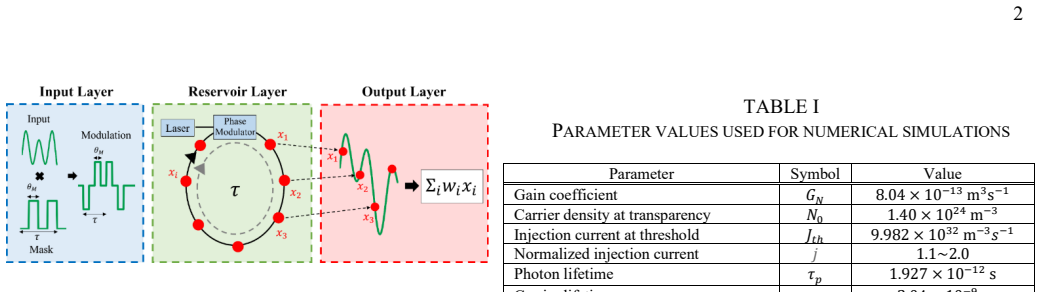
Summary. The paper proposes 'approximate reservoir computing' for a delay-coupled semiconductor laser reservoir. The authors quantize the node states and output weights to b bits, simulate the Santa Fe one-step-ahead prediction task, and use the Walden model plus datasheet values to estimate per-sample energy for the ADC, DAC, modulator, amplifier, photodiode, and laser. They report that 4-bit quantization of both node states and weights gives NMSE < 0.1, that output-weight quantization is more sensitive than node-state quantization, and that choosing fs = 2 GHz, j = 1.3, b = 5 reduces modeled per-sample energy from 237 pJ to 22 pJ relative to their reconstruction of reference [14]. The conclusion claims a 91% reduction in total energy consumption while maintaining NMSE < 0.1.
Significance. The underlying physics claims—that low-bit quantization is tolerable, that output weights are more sensitive than node states, and that there is a trade-off between prediction quality and energy—are potentially useful for practical photonic reservoir computers. A strength is that NMSE comes from direct simulation and the energy model is external (Walden model, component datasheets/literature). However, the quantitative headline depends on several unstated or inconsistent modeling choices, so the significance is conditional until those are resolved.
major comments (5)
- [Section III, Eqs. (9)–(11) and (16)] The quantizer defined by Eqs. (9)–(11) has scale s=(2^b−1)/αx and clips at ±(2^{b−1}−1), so its effective linear range is approximately ±αx/2 and its step is αx/(2^b−1). Equation (16), however, uses the step 2γxσx/(2^b−1). For αx=γxσx this is a factor-of-2 mismatch, i.e., a factor-of-4 in σq² and about 1 bit in ENOB. Since ADC power is P/fs = FOMw·2^ENOB and ADC is the dominant term at fs=20 GHz, the reported 237 pJ baseline and the 91% reduction are not robust to this inconsistency. Moreover, γx is never defined or assigned a value, so the calculation is not reproducible.
- [Section V-B, Table III] The baseline 237 pJ is not a measurement from reference [14]; it is the authors' reconstruction by applying their own energy model with fs=20 GHz, j=2.0, b=8. The paper should state explicitly that this is a model-based counterfactual and should provide a sensitivity analysis for the component power values. As written, the conclusion 'we succeed in reducing 91% of the total energy consumption' overstates what can be concluded from this comparison.
- [Section IV, Figs. 4–5, Eq. (5)] The reservoir simulation includes white Gaussian noise ξ(t), but the NMSE maps and the j≥1.3 success boundary are reported without error bars or the number of noise realizations. Since the operating point is selected using the threshold NMSE<0.1, the paper should report mean±standard deviation or, at minimum, show that the boundary is stable across realizations.
- [Table I, Fig. 9(b)] The cutoff frequency fc=9.9 GHz is quoted for fs=20 GHz. When the sampling frequency is reduced to fs=2 GHz for the optimized operating point, the manuscript does not state the cutoff frequency used. If fc is not adjusted to the new Nyquist frequency (approximately 1 GHz), the simulated node states at fs=2 GHz suffer aliasing, and the NMSE comparison against the fs=20 GHz cases is invalid. This needs to be specified and justified.
- [Sections II and III] Several parameters that the reported NMSE maps depend on are not given: the input scaling factor γ, the number of virtual nodes N (and the resulting mask interval θM), the four-valued mask pattern, the quantization range factor γx (or equivalently αx), and the noise intensity of ξ(t). Without these values, the central maps in Figs. 4–5 cannot be reproduced.
minor comments (5)
- [Section V, conclusion] The NMSE at the chosen operating point (fs=2 GHz, j=1.3, b=5) is not reported numerically. Please add the value and, ideally, a prediction plot.
- [Table III] The column 'Reference [14]' should be labeled 'estimated from [14] with this model' to avoid implying that the value was reported there.
- [Figure 10] Please list the sampling frequencies tested, or clarify that the minimum is over the discrete set shown.
- [Eq. (13)] The notation for quantized weights is introduced without a formal quantization formula; give the explicit equation for w_q, analogous to Eq. (11).
- [Section IV-B] The sentence about 'four- or higher-bit quantization... required' should be qualified, since the node-state-only curve in Fig. 4(a) shows bx≥2 suffices; clarify that the statement refers to the b=bx=bw case.
Circularity Check
No significant circularity: NMSE comes from direct simulation and the energy model is built from external references; the comparison with [14] is an explicitly stated estimate, not a fitted prediction.
full rationale
The paper's central physics claim is that quantizing node states and output weights to 4-5 bits still gives NMSE < 0.1 on the Santa Fe task. This is obtained by direct numerical simulation of the Lang-Kobayashi equations (Eqs. 5-6) with phase modulation (Eq. 7), least-squares output weights (Eq. 8), explicit scale quantization (Eqs. 9-13), and the standard NMSE definition (Eq. 14). No parameter is fitted to the NMSE target, and no prediction is claimed from a fitted quantity that is then renamed as a result. The energy evaluation is likewise not circular: ADC energy uses the Walden model (Eq. 15) with FOMw from the Murmann survey [18], and DAC/MOD/Amp/PD/LD energies are taken from external datasheets and literature (Table II, Refs. [20]-[23]). The 91% reduction claim compares the proposed parameters (fs = 2 GHz, j = 1.3, b = 5) with a baseline reconstructed from the authors' own prior paper [14] using the same energy model; the paper explicitly says 'We estimate the energy consumption of the previous result by using the parameter values in [14] for comparison.' This is a transparent, non-fitted comparison rather than a circular derivation. While the baseline is not an independent measurement and the quantitative reduction therefore depends on the model, that is a correctness/robustness concern, not a circularity of the derivation. There is no self-citation used to forbid alternatives, no uniqueness theorem imported from the authors, and no ansatz smuggled in via citation. Potential issues such as the quantizer step inconsistency between Eqs. (9)-(11) and Eq. (16) and the undefined gamma_x affect reproducibility and accuracy of ENOB, but they do not make the derivation circular. The manuscript is self-contained against an external benchmark (Santa Fe time series) and external hardware references, so no circularity step is identified.
Assumptions & free parameters
free parameters (4)
- Input scaling factor γ
- Number of virtual nodes N
- Quantization range factor γx
- Four-valued mask levels =
{±0.3, ±1.0}
assumptions (5)
- domain assumption The Lang-Kobayashi equations (Eqs. 5-6) with white Gaussian noise faithfully model the semiconductor laser with feedback.
- domain assumption The Santa Fe laser time-series task and NMSE < 0.1 threshold define 'successful prediction'.
- domain assumption The Walden model P/fs = FOMw·2^ENOB and the component power values from [18-23] estimate real hardware energy consumption.
- standard math Quantization of node states and output weights with integer arithmetic (Eq. 13) is a valid approximation of the analog reservoir output.
- ad hoc to paper The 'previous result' baseline in [14] can be reconstructed by applying the same energy model with parameters fs=20 GHz, j=2.0, b=8.
Cite this review
Pith. "Pith review of Approximate reservoir computing with a semiconductor laser for reducing energy consumption." pith.science (2026). https://pith.science/paper/IZRQNWFM
@misc{pith2026260723288,
  author       = {Pith},
  title        = {Pith review of: Approximate reservoir computing with a semiconductor laser for reducing energy consumption},
  year         = {2026},
  howpublished = {\url{https://pith.science/paper/IZRQNWFM}},
  note         = {Machine review of arXiv:2607.23288}
}
read the original abstract
Photonic reservoir computing is a promising physical machine-learning technique for predicting time-series data. The quantization of the response signal from the reservoir is required for the implementation of photonic reservoir computing, and the number of quantization bits and sampling frequency need to be optimized to achieve high performance and low energy consumption. However, few studies have been reported to investigate the effect of bit quantization and sampling frequency. In this study, we introduce a concept of approximate reservoir computing with a semiconductor laser by quantizing the amplitude of node states in the reservoir and output weights. We evaluate the performance of a chaotic time-series prediction task and energy consumption per sample. We achieve significant reduction of energy consumption by optimizing the number of quantization bits, the sampling frequency, and the injection current of the semiconductor laser, while maintaining the prediction performance.
Figures
Reference graph
Works this paper leans on
-
[14]
Reservoir computing based on an external-cavity semiconductor laser with optical feedback modulation,
K. Kanno, A. Haya and A. Uchida, “Reservoir computing based on an external-cavity semiconductor laser with optical feedback modulation,” Optics Express, vol. 30, no. 19, pp. 34218-34238 (2022)
2022
-
[1]
Novel frontier of photonics for data processing - Photonic accelerator,
K. Kitayama, M . Notomi, M . Naruse, K . Inoue, S . Kawakami, and A . Uchida, “Novel frontier of photonics for data processing - Photonic accelerator,” APL Photonics, vol. 4, pp. 090901 (2019)
2019
-
[2]
Deep learning with coherent nanophotonic circuits,
Y. Shen, N. C. Harris, S. Skirlo, M. Prabhu, T. Baehr-Jones, M. Hochberg, X. Sun, S . Zhao, H . Larochelle, D . Englund, and M . Soljacic, “Deep learning with coherent nanophotonic circuits,” Nature Photonics, vol. 11, pp. 441-446 (2017)
2017
-
[3]
Harnessing nonlinearity: Predicting chaotic systems and saving energy in wireless communication,
H. Jaeger and H . Haas, “Harnessing nonlinearity: Predicting chaotic systems and saving energy in wireless communication,” Science, vol. 304. no. 5667, pp. 78-80 (2004)
2004
-
[4]
Recent advances in physical reservoir computing: A review ,
G. Tanaka, T . Yamane, J . B. Héroux, R . Nakane, N . Kanazawa, S . Takeda, H . Numata, D . Nakano, and A . Hirose, “Recent advances in physical reservoir computing: A review ,” Neural Networks, vol. 115, pp. 100–123 (2019)
2019
-
[5]
Information processing using a single dynamical node as complex system ,
L. Appeltant, M. C. Soriano, G. Van der Sande, J. Danckaert, S. Massar, J. Dambre, B . Schrauwen, C . R. Mirasso, and I . Fischer, “Information processing using a single dynamical node as complex system ,” Nature Communications, vol. 2, Art. no. 468 (2011)
2011
-
[6]
Parallel photonic information processing at gigabyte per second data rates using transient states,
D. Brunner, M . C. Soriano, C . R. Mirasso, and I . Fischer, “Parallel photonic information processing at gigabyte per second data rates using transient states,” Nature Communications, vol. 4, Art. no. 1364 (2013)
2013
-
[7]
A survey of techniques for approximate computing,
S. Mittal, “A survey of techniques for approximate computing,” Association for Computing Machinery, vol. 48, no .4, pp.1-33 (2016)
2016
Show all 24 references
-
[8]
Energy - efficient ConvNets through approximate computing,
B. Moons, B. D. Brabandere , L. V. Gool and M. Verhelst, “Energy - efficient ConvNets through approximate computing,” 2016 IEEE Winter Conference on Applications of Computer Vision (WACV), pp.1-8 (2016)
2016
-
[9]
Optoelectronic reservoir computing: tackling noise - induced performance degradation,
M. C. Soriano, S. Ortin, D. Brunner, L. Larger, C. R. Mirasso, I. Fischer, and L. Pesquera, “Optoelectronic reservoir computing: tackling noise - induced performance degradation,” Optics Express, vol. 21, no. 1, pp. 12– 20 (2013)
2013
-
[10]
Scalable reservoir computing on coherent linear photonic processor ,
M. Nakajima, K . Tanaka, and T . Hashimoto, “Scalable reservoir computing on coherent linear photonic processor ,” Communications Physics, vol. 4, Art. no. 20 (2021)
2021
-
[11]
Photonic neural field on a silicon chip: large - scale, high-speed neuro-inspired computing and sensing,
S. Sunada and A. Uchida, “Photonic neural field on a silicon chip: large - scale, high-speed neuro-inspired computing and sensing, ” Optica, vol. 8, no. 11, pp. 1388-1396 (2021)
2021
-
[12]
External optical feedback effects on semiconductor injection laser properties,
R. Lang and K. Kobayashi, “External optical feedback effects on semiconductor injection laser properties,” IEEE Journal of Quantum Electronics, vol.16, no.3, pp.347-355 (1980)
1980
-
[13]
Uchida, Optical Communication with Chaotic Lasers, Applications of Nonlinear Dynamics and Synchronization
A. Uchida, Optical Communication with Chaotic Lasers, Applications of Nonlinear Dynamics and Synchronization . Wiley-VCH, Weinheim (2012). ISBN: 978-3-527-40869-6
2012
-
[15]
Integer quantization for deep learning inference: principles and empirical evaluation,
H. Wu, P. Judd, X. Zhang, M. Isaev and P. Micikevicius, “Integer quantization for deep learning inference: principles and empirical evaluation,” arXiv preprint arXiv:2004.09602 (2020)
2004 arXiv
-
[16]
Results of the time series prediction competition at the Santa Fe Institute,
A. S. Weigend and N. A. Gershenfeld, “Results of the time series prediction competition at the Santa Fe Institute,” IEEE International Conference on Neural Networks, vol. 3, pp. 1786-1793 (1993)
1993
-
[17]
Analog -to-digital converter survey and analysis,
R. H. Walden, “Analog -to-digital converter survey and analysis,” IEEE Journal on Selected Areas in Communications, vol. 17, no. 4, pp.539-550 (1999)
1999
-
[18]
ADC Performance Survey 1997 -2023,
B. Murmann, “ADC Performance Survey 1997 -2023,” [Online]. Available: https://github.com/bmurmann/ADC-survey
1997
-
[19]
Taking the mystery out of the infamous formula, “SNR= 6.02 n+ 1.76 dB,
W. Kester, “Taking the mystery out of the infamous formula, “SNR= 6.02 n+ 1.76 dB,” and why you should care,” Analog Devices, MT-001 (2005)
2005
-
[20]
8 -bit 5gs/s D/A converter for multi-gigabit wireless transceivers,
B. Sedighi, M. Khafaji, and J. C. Scheytt. “8 -bit 5gs/s D/A converter for multi-gigabit wireless transceivers,” 2011 6th European Microwave Integrated Circuit Conference, pp. 192–195. IEEE (2011)
2011
-
[21]
https://www.tek.com/ja/manual/awg70001a- awg70002a
Tektronix,Manual for Arbitrary Waveform Generators AWG70001A and AWG70002A,”(2015). https://www.tek.com/ja/manual/awg70001a- awg70002a
2015
-
[22]
Ultra-efficient 10 Gb/s hybrid integrated silicon photonic transmitter and receiver,
X. Zheng, D. Patil, J. Lexau, F. Liu, G. Li, H. Thacker, Y. Luo, I. Shubin, J, Li, J. Yao, P. Dong, D. Feng, M. Asghari, T. Pinguet, A. Mekis, P. Amberg, M. Dayringer, J. Gainsley, H. F. Moghadam, E. Alon, K. Raj, R. Ho, J. E. Cunningham, and A. V. Krishnamoorthy “Ultra-effici...
2011
-
[23]
DFB Laser Diode, NTT Electronics,KELD1C5GAAA, https://www.ntt- innovative-devices.com/en/products/photonics/pdf/NLK1E5GAAA.pdf Tatsuki Ito received the B.E. and M.E. degrees in Information and Computer Sciences from Saitama University, Saitama, Japan, in 2023 and 2025, respect...
2023
-
[2004]
He was an Associate Professor with the Department of Information and Computer Sciences, Saitama University, Saitama, Japan, from 2008 to 2015
He was a Lecturer with the Department of Electronics and Computer Systems, Takushoku University, Tokyo, Japan, from 2005 to 2008. He was an Associate Professor with the Department of Information and Computer Sciences, Saitama University, Saitama, Japan, from 2008 to 2015. Sinc...
2005
Reviewed July 31, 2026 · model on record in the stance chip above.
Discussion (0). Continue with ORCID to comment.